वोकैबुलरीज

इंग्लिश वोकैबुलरी डिस्कवर, लर्न और मास्टर करें

noun
/ˌmiːtiəˈrɒlədʒi/
मौसमविज्ञान (mausamvigyan)

The scientific study of the atmosphere and weather.

"He chose to specialize in meteorology to study weather patterns."

"उसने मौसमविज्ञान में विशेषज्ञता प्राप्त करने के लिए मौसम के पैटर्न का अध्ययन करने का निर्णय लिया।" (Usne mausamvigyan mein visheshagyaata prapt karne ke liye mausam ke pattern ka adhyayan karne ka nirnay liya.)
noun
/ˈmiːtər/
मीटर (mīṭar)

A unit of length in the metric system equal to 100 centimeters; also, a device that measures quantity such as electricity or gas.

"The technician came to check the electricity meter."

"तकनीशियन बिजली मीटर चेक करने आया था।" (Taknīśiyan bijlī mīṭar cek karne āyā thā.)
noun
/ˈmɛθəd/
विधि (vidhi)

A particular way or process of doing something.

"She explained the method of solving the problem."

"उसने समस्या को हल करने की विधि को समझाया।" (Usne samasya ko hal karne ki vidhi ko samjhaya.)
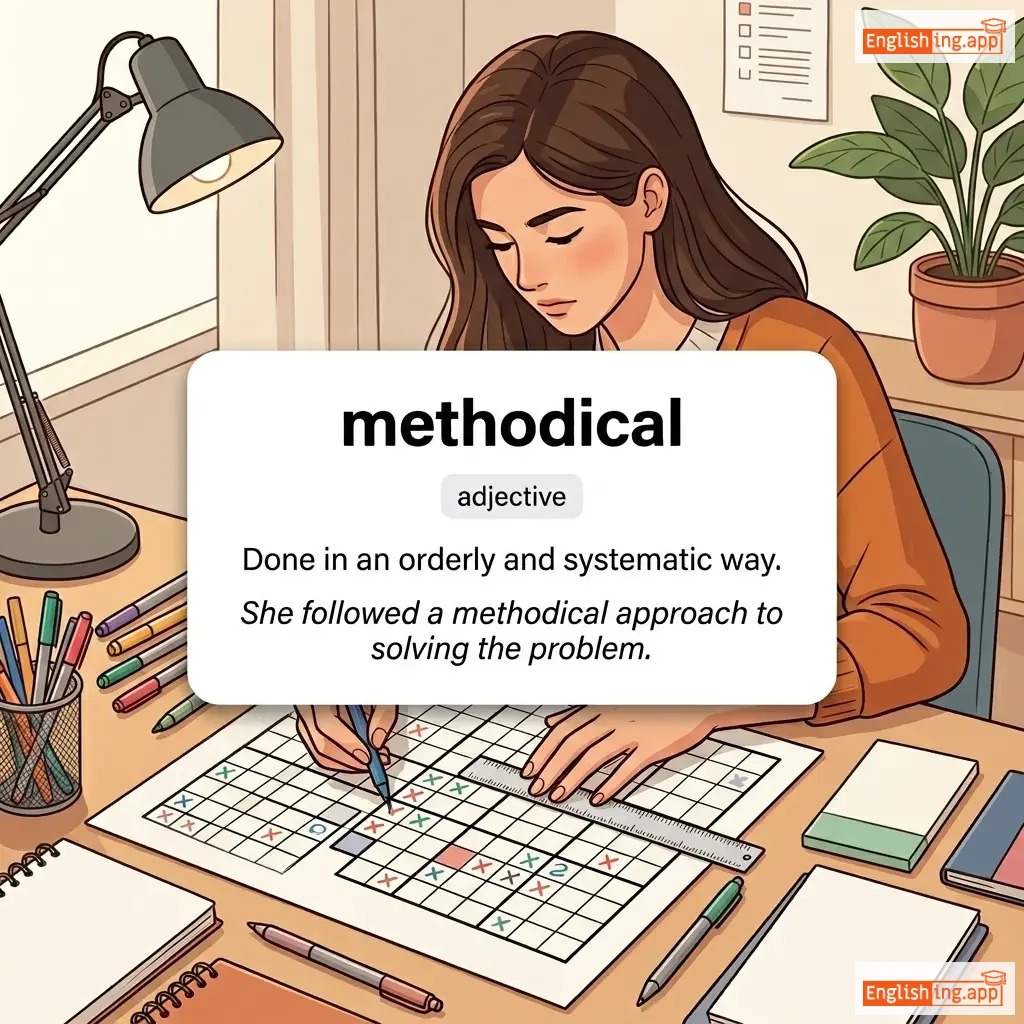
methodical definition card — visual illustration of the meaning
adjective
/məˈθɒdɪkəl/
विधिपूर्वक (vidhipurvak)

Done in an orderly and systematic way.

"She followed a methodical approach to solving the problem."

"उसने समस्या को हल करने के लिए एक विधिपूर्वक दृष्टिकोण अपनाया।" (Usne samasya ko hal karne ke liye ek vidhipurvak drishtikon apnaya.)
noun
/ˌmɛθəˈdɑlədʒi/
पद्धति / कार्यपद्धति (paddhati / karyapaddhati)

A system of methods used in a particular area of study or activity.

"The research was conducted using a new methodology."

"शोध एक नई पद्धति का उपयोग करके किया गया था।" (shodh ek nai paddhati ka upyog karke kiya gaya tha.)
meticulous definition card — visual illustration of the meaning
adjective
/məˈtɪkjʊləs/
सावधान (savdhan)

Showing great attention to detail; very careful and precise.

"The artist was meticulous in painting every tiny detail."

"कलाकार ने हर छोटे विवरण को चित्रित करने में सावधानी दिखाई।" (Kalakar ne har chhote vivaran ko chhitrut karne mein savdhani dikhayi.)
meticulousness definition card — visual illustration of the meaning
noun
mɪˈtɪkjʊləsnɪs
सावधानी और बारीकी से काम करने की प्रवृत्ति (savdhani aur bariki se kaam karne ki pravritti)

Great attention to detail; very careful and precise.

"His meticulousness made the project successful."

"उसकी मेटीक्यूलसनेस ने परियोजना को सफल बना दिया।" (Uski metikulasnes ne pariyojna ko safal bana diya.)
noun
/mɪˈtɒnɪmi/
रूपक प्रतिस्थापन (roopak pratisthapan)

A figure of speech in which one word or phrase is substituted with another closely related word or concept.

"In the phrase 'the crown will decide,' 'crown' is a metonymy for monarchy."

"वाक्य 'क्राउन निर्णय करेगा' में 'क्राउन' एक रूपक है जो राजतंत्र के लिए है।" (Vaaky 'krown nirnay karega' mein 'krown' ek roopak hai jo raajtantra ke liye hai.)
adjective
/ˈmɛtrɪk/
मीट्रिक (metric)

Relating to the metric system of measurement; also, a standard of measurement used to assess performance.

"The company tracks success using clear performance metrics."

"कंपनी सफलता को स्पष्ट प्रदर्शन मापदंडों का उपयोग करके ट्रैक करती है।" (Company safalta ko spasht pradarshan maapdandon ka upyog karke track karti hai.)
adjective
/ˈmɛtrɪkəl/
मापनीय (maapniya)

Relating to or composed in a regular rhythmic pattern of beats or meter, especially in poetry.

"The poet carefully followed metrical rules in his verses."

"कवि ने अपने छंदों में मापनीय नियमों का पालन सावधानी से किया।" (Kavi ne apne chandon mein maapniya niyamon ka paalan saavdhani se kiya.)
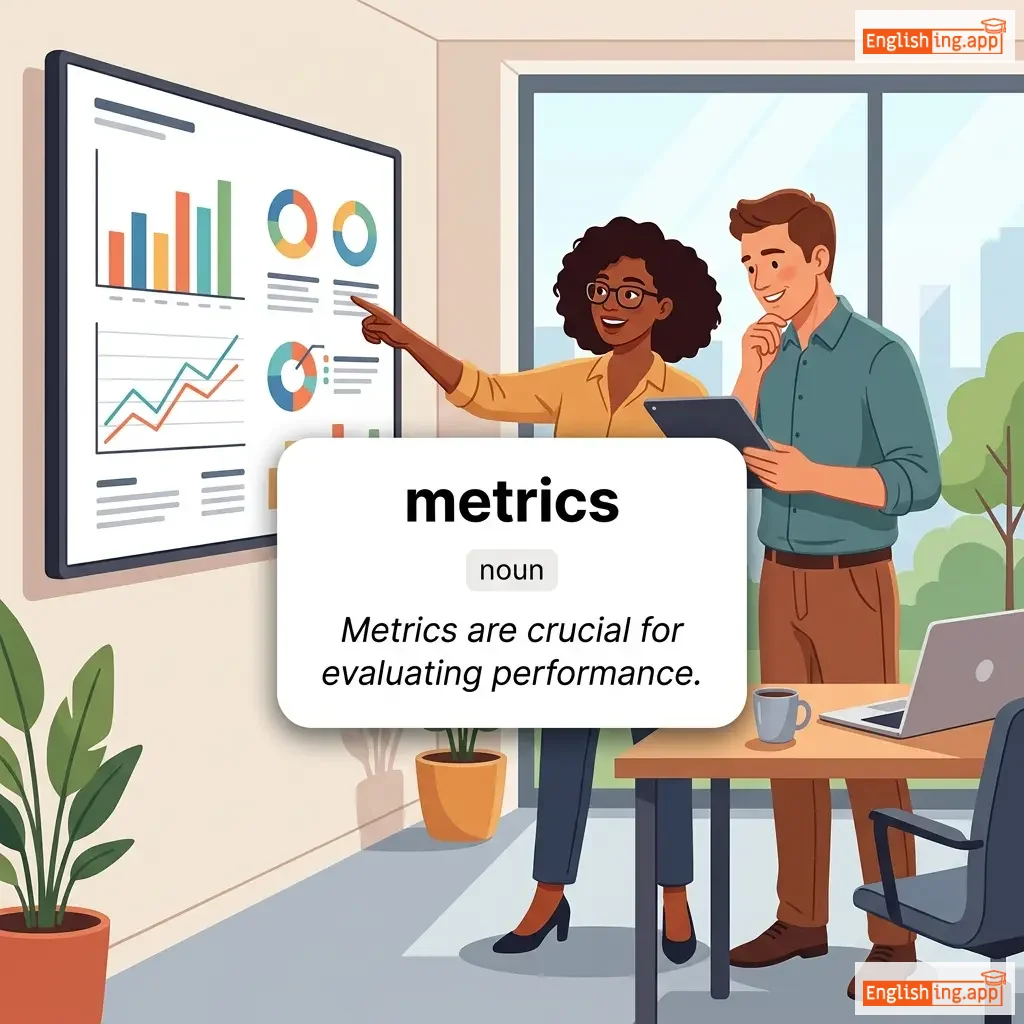
metrics definition card — visual illustration of the meaning
noun
ˈme.trɪks
मापदंड (maapdand)

A system or standard of measurement; a set of numbers that give information about a particular process or activity.

"Metrics are crucial for evaluating performance."

"मेट्रिक्स प्रदर्शन का मूल्यांकन करने के लिए महत्वपूर्ण हैं।" (Metrics pradarshan ka mulyankan karne ke liye mahatvapurn hain.)
noun
/ˈmet.roʊ reɪl/
मेट्रो रेल (metro rail)

an underground urban railway system; subway system

"The metro rail connects all major areas of the city efficiently."

"मेट्रो रेल शहर के सभी प्रमुख क्षेत्रों को प्रभावी ढंग से जोड़ता है।" (metro rail shahar ke sabhi pramukh kshetron ko prabhavi dhang se jodta hai.)
noun
/ˈmɛtrəˌnoʊm/
मीटरोनोम (meeteronom)

A device that produces regular ticks or beats to help musicians maintain tempo.

"She practiced the piano with a metronome to keep steady timing."

"उसने पियानो बजाने का अभ्यास मेट्रोनोम के साथ किया ताकि समय स्थिर रहे।" (Usne piano bajane ka abhyas metronome ke saath kiya taaki samay sthir rahe.)
noun
/məˈtrɒpəlɪs/
महानगर (mahanagar)

A large, important city that is a hub of culture, business, and population.

"New York is often described as a global metropolis."

"न्यूयॉर्क को अक्सर एक वैश्विक महानगर के रूप में वर्णित किया जाता है।" (New York ko aksar ek vaishwik mahanagar ke roop mein varnit kiya jata hai.)
adjective
/ˌmɛtrəˈpɑːlɪtən/
महानगरीय (mahanagriya)

Relating to a large city, its surrounding areas, or its lifestyle.

"She moved to a metropolitan area for better job opportunities."

"उसने बेहतर नौकरी के अवसरों के लिए एक महानगरीय क्षेत्र में स्थानांतरित किया।" (Usne behtar naukri ke avsaron ke liye ek mahanagriya kshetra mein sthaanantarit kiya.)
noun
/ˈmɛtəl/
साहस (sahas)

A person's ability to cope well with difficulties or to face demanding situations with courage.

"The young athlete showed his mettle in the final match."

"युवा एथलीट ने फाइनल मैच में अपना साहस दिखाया।" (Yuva athlete ne final match mein apna sahas dikhaya.)
adjective
/ˈmɛtəlˌsʌm/
साहसी (sahasi)

Full of courage and spirit; lively and spirited.

"The mettlesome young rider never backed down from a challenge."

"साहसी युवा सवार कभी भी चुनौती से पीछे नहीं हटा।" (sahasi yuva savaar kabhi bhi chunauti se peeche nahi hata.)
noun
/mjuːz/
गली/छोटी सड़क (gali/chhoti sadak)

A row or street of houses or apartments that have been converted from stables or built to look like former stables.

"They rented a small flat in a quiet London mews."

"उन्होंने लंदन के एक शांत म्यूज़ में एक छोटा फ्लैट किराए पर लिया था।" (unhone london ke ek shant mews mein ek chhota flat kiraye par liya tha.)
noun/adjective
/ˈmɛksɪkən/
खुशी (khushi)

a native or inhabitant of Mexico; relating to Mexico or its people, culture, or language

"She enjoys Mexican food like tacos and enchiladas."

"जब उसने पुरस्कार प्राप्त किया, तो वह अपनी खुशी छिपा नहीं पाई।" (Jab usne puraskar prapt kiya, to wah apni khushi chhupa nahi payi.)
noun
/maɪˈæzmə/
सड़ी हुई हवा (sadi hui hawa)

An unpleasant or unhealthy smell or atmosphere.

"A miasma of decay hung over the abandoned house."

"एक परित्यक्त घर पर सड़ी हुई हवा छाई हुई थी।" (ek parityakt ghar par sadi hui hawa chhai hui thi.)
microbial definition card — visual illustration of the meaning
adjective
/maɪˈkroʊ.bi.əl/
सूक्ष्मजीव संबंधित (sookshmjeev sambandhit)

Relating to microorganisms, especially bacteria.

"Microbial activity in soil helps in nutrient cycling."

"मिट्टी में सूक्ष्मजीव गतिविधि पोषक तत्वों के चक्र में मदद करती है।" (Mitti mein sookshmjeev gatividhi poshak tatvon ke chakra mein madad karti hai.)
microclimate definition card — visual illustration of the meaning
noun
/ˈmaɪ.krəʊˌklaɪ.mət/
सूक्ष्म जलवायु (sookshm jalvayu)

The climate of a small, specific area that differs from the surrounding climate.

"The microclimate in valleys is often cooler than in surrounding areas."

"घाटियों में सूक्ष्म जलवायु अक्सर आसपास के क्षेत्रों से ठंडी होती है।" (ghatiyon mein sookshm jalvayu aksar aas-paas ke kshetron se thandi hoti hai.)
noun
/ˈmaɪkrəˌkɒzəm/
सूक्ष्म ब्रह्मांड (sookshma brahmand)

A small, representative system having analogies to a larger system; a miniature version of something.

"The small town is a microcosm of the entire nation."

"छोटा शहर पूरे राष्ट्र का एक सूक्ष्म ब्रह्मांड है।" (chhota shahar poore rashtr ka ek sookshma brahmand hai.)
noun
/maɪˈkrɒmɪtər/
माइक्रोमीटर (micrometer)

A device used for measuring small distances with great accuracy.

"The engineer used a micrometer to measure the thickness of the wire."

"इंजीनियर ने तार की मोटाई मापने के लिए माइक्रोमीटर का उपयोग किया।" (Engineer ne taar ki motai maapne ke liye micrometer ka upyog kiya.)
micronutrient definition card — visual illustration of the meaning
noun
ˈmaɪ.krəʊˌnjuː.tri.ənt
सूक्ष्म पोषक तत्व (sookshma poshak tatva)

Essential nutrients required by the body in small amounts, including vitamins and minerals.

"Iron and zinc are essential micronutrients for growth."

"लोहा और जिंक विकास के लिए आवश्यक सूक्ष्म पोषक तत्व हैं।" (Loha aur zinc vikas ke liye aavashyak sookshma poshak tatva hain.)
micronutrients definition card — visual illustration of the meaning
noun
/ˈmaɪ.krəʊˌnjuː.tri.ənts/
सूक्ष्म पोषक तत्व (sookshm poshak tatva)

Essential nutrients required in small amounts for proper body function, including vitamins and minerals.

"Micronutrients like iron and zinc are essential for immunity."

"आयरन और जिंक जैसे माइक्रोन्यूट्रिएंट्स इम्यूनिटी के लिए आवश्यक हैं।" (Iron aur zinc jaise micronutrients immunity ke liye avashyak hain.)
/ˈmaɪ.krəˌfoʊn/
माइक्रोफोन (maikrofon)

A device that converts sound into an electrical signal, typically used to amplify or record voices or music.

"She spoke into the microphone during the presentation."

"वह प्रस्तुति के दौरान माइक्रोफोन में बोल रही थी।" (vah prastuti ke dauran maikrofon mein bol rahi thi.)
noun
/ˈmaɪ.krəˌskoʊp/
सूक्ष्मदर्शी यंत्र (sookshmadarshi yantra)

An optical instrument used for viewing very small objects, such as cells, by magnifying them.

"The scientist observed the bacteria under the microscope."

"वैज्ञानिक ने माइक्रोस्कोप के नीचे बैक्टीरिया का निरीक्षण किया।" (Vigyanik ne microscope ke neeche bacteria ka nirikshan kiya.)
adjective
/ˌmaɪ.krəˈskɑː.pɪk/
सूक्ष्मदर्शी (sookshmdarshi)

Extremely small and only visible with a microscope.

"The sample contained microscopic particles."

"नमूने में सूक्ष्मदर्शी कण थे।" (Namune mein sookshmdarshi kan the.)
noun
/maɪˈkrɑː.skə.pi/
सूक्ष्मदर्शन (sookshmadarshan)

The use of a microscope to observe small objects or organisms.

"Microscopy revealed the structure of the cells."

"सूक्ष्मदर्शन ने कोशिकाओं की संरचना का पता लगाया।" (Sookshmadarshan ne koshikaon ki sanrachna ka pata lagaya.)
noun
/ˈmaɪkroʊweɪv/
माइक्रोवेव (maikroev)

an electric oven that uses electromagnetic radiation to heat food quickly

"She heated the leftover pizza in the microwave for two minutes."

"उसने बची हुई पिज़्ज़ा को माइक्रोवेव में दो मिनट के लिए गर्म किया।" (usne bachi hui pizza ko microvev mein do minute ke liye garm kiya)
adjective, preposition, noun
/mɪd/
मध्य (madhya)

being in the middle of something; the central part or point

"She joined the project in mid June."

"वह जून के मध्य में परियोजना से जुड़ी।" (vah jun ke madhya mein pariyojana se judi)
noun
/ˈmɪd.deɪ/
दोपहर; मध्याह्न (midday)

The middle of the day; twelve o'clock in the daytime; noon

"The sun is brightest at midday when it's directly overhead."

"सूरज सबसे ज्यादा चमकता है दोपहर में जब वह सीधे ऊपर होता है।" (sooraj sabse zyada chamakta hai dopahar mein jab wah seedhe upar hota hai.)
noun/adjective
/ˈmɪdəl/
मध्य (madhya)

the central point, position, or part of something

"The park is in the middle of the city."

"पार्क शहर के बीच में है।" (Park shahar ke beech mein hai.)
adjective
/ˈmɪd.əl.eɪdʒd/
मध्य आयु (madhy ayu)

being of an age between young and old; typically between 40-60 years old

"The middle-aged man started a new career."

"मध्य आयु का व्यक्ति ने एक नई करियर शुरू की।" (madhy ayu ka vyakti ne ek nayi kariyer shuru ki.)
middle-class definition card — visual illustration of the meaning
adjective
/ˈmɪdəl klɑːs/
मध्यमवर्गीय (madhyama-vargīya)

belonging to the social group between the upper and working class, typically with moderate income and education

"They live a comfortable middle-class life in the city."

"वे शहर में एक आरामदायक मध्यमवर्गीय जीवन जीते हैं।" (Ve śahar mein ek ārāmadāyak madhyama-vargīya jīvan jīte hain.)
noun
/ˈmɪdəlˌmæn/
मध्यस्थ (madhyasth)

A person who acts as a link between buyers and sellers, often in business deals.

"The farmer sold his crops directly, without a middleman."

"किसान ने अपने फसल को सीधे बेचा, बिना किसी मध्यस्थ के।" (kisan ne apne fasal ko sidhe becha, bina kisi madhyasth ke.)
noun
/ˈmɪdnaɪt/
मध्यरात्रि (madhyaratri)

twelve o'clock at night; the middle of the night

"He reached home just after midnight."

"वह मिडनाइट के बाद घर पहुंचा।" (Vah midnight ke baad ghar pahucha.)
noun
/mɪdst/
मध्य (madhya)

the middle part or position of something

"In the midst of chaos, she remained calm."

"अराजकता के मध्य में, वह शांत रही।" (Arajakta ke madhya mein, wah shaant rahi.)
noun
/ˌmɪdˈsʌm.ər/
मध्य ग्रीष्म (madhya grishma)

The middle of summer, often around the summer solstice in June.

"We had a festival to celebrate midsummer."

"हमने मध्य ग्रीष्म का उत्सव मनाया।" (Humne madhya grishma ka utsav manaya.)
adverb
/ˈmɪd.weɪ/
मध्यमार्ग (madhyamaarg)

in the middle of an event, process, or distance

"He stopped midway through his speech."

"वह अपनी भाषण के मध्य में रुक गया।" (Vah apni bhashan ke madhya mein ruk gaya.)
noun
/ˈmɪd.waɪf/
दाइ (daai)

A person, typically a woman, trained to assist women during childbirth.

"The midwife stayed with the mother throughout her labor."

"दाइ ने पूरी प्रसवकालीन अवधि में माँ के साथ बिताया।" (Daai ne poori prasavkaaleen avadhi mein maan ke saath bitaaya.)
noun
/miːn/
मामला (maamla)

A person's appearance or manner, especially as an indication of their character or mood.

"His serious mien made everyone fall silent."

"उसका गंभीर मामला सबको चुप करा दिया।" (Uska gambhir maamla sabko chup kara diya.)
noun
/mɪf/
छोटी झगड़ा (chhoti jhagra)

A petty quarrel or annoyance.

"They had a slight miff over the seating arrangement."

"उन्होंने सीटिंग व्यवस्था को लेकर एक हल्का झगड़ा किया।" (Unhone seating vyavastha ko lekar ek halka jhagra kiya.)
modal verb/noun
/maɪt/
हो सकता है / शक्ति (ho sakta hai / shakti)

used to express possibility; power or strength

"She might come to the party if she finishes work early."

"वह पार्टी में आ सकती है यदि वह जल्दी काम खत्म कर लेती है।" (Vah party mein aa sakti hai yadi vah jaldi kaam khatam kar leti hai.)
adjective
/ˈmaɪti/
शक्तिशाली (shaktishali)

having great power or strength; very strong or impressive

"The mighty river flows through the heart of the country."

"शक्तिशाली नदी देश के बीच से बहती है।" (shaktishali nadi desh ke beech se bahti hai)
noun
/ˈmaɪ.ɡrənt/
प्रवासी (pravasi)

A person who moves from one place to another, especially to find work or better living conditions.

"Many migrants travel long distances to find employment."

"कई प्रवासी रोजगार पाने के लिए लंबी यात्रा करते हैं।" (Kai pravasi rozgar pane ke liye lambi yatra karte hain.)
verb
/maɪˈɡreɪt/
माइग्रेट करना (migret karna)

To move from one region or habitat to another, especially regularly according to the seasons or for work.

"Birds migrate south during the winter."

"पक्षी सर्दी के दौरान दक्षिण की ओर माइग्रेट करते हैं।" (Pakshi sardi ke dauran dakshin ki or migret karte hain.)
noun
/maɪˈɡreɪʃən/
प्रवासन (pravasan)

the movement of people or animals from one place to another, often for better living conditions or seasonal reasons

"The annual migration of birds is a fascinating natural event."

"पक्षियों का वार्षिक प्रवासन एक आकर्षक प्राकृतिक घटना है।" (Pakshiyon ka varshik pravasan ek aakarshak prakritik ghatna hai.)
adjective
/ˈmaɪɡrəˌtɔːri/
प्रवासी (pravaasi)

Relating to or characterized by migration, especially animals or people moving from one place to another.

"Migratory birds travel thousands of miles each year."

"प्रवासी पक्षी हर साल हजारों मील यात्रा करते हैं।" (Pravaasi pakshi har saal hazaaron meel yatra karte hain.)