वोकैबुलरीज

इंग्लिश वोकैबुलरी डिस्कवर, लर्न और मास्टर करें

noun
/ˈmɛntɔːr/
मार्गदर्शक (margdarshak)

an experienced person who advises and guides someone less experienced

"She acted as a mentor for the new employees."

"उसने नए कर्मचारियों के लिए एक मार्गदर्शक के रूप में कार्य किया।" (Usne naye karmachariyon ke liye ek margdarshak ke roop mein kary kiya.)
noun
/ˈmɛnjuː/
मेनू (menu)

A list of food and drinks available at a restaurant or offered at a meal.

"The restaurant updated its menu with new dishes."

"रेस्तरां ने अपने मेनू में नए व्यंजन जोड़े हैं।" (restauran ne apne menu mein naye vyanjan jode hain.)
adjective
/ˈmɜːrkəntaɪl/
वाणिज्यिक (vanijjik)

related to trade or commerce

"The city grew rapidly due to its mercantile activities."

"शहर ने अपनी वाणिज्यिक गतिविधियों के कारण तेजी से वृद्धि की।" (Shahar ne apni vanijjik gatividhiyon ke karan tezi se vruddhi ki.)
noun
/ˈmɜːrsəˌnɛri/
भाड़े का सैनिक (bhade ka sainik)

a professional soldier hired to serve in a foreign army; also used to describe someone motivated solely by money.

"The mercenary fought for whoever paid the highest wage."

"भाड़े का सैनिक उस व्यक्ति के लिए लड़ा जिसने सबसे अधिक वेतन दिया।" (bhade ka sainik us vyakti ke liye lada jisne sabse adhik vetan diya.)
noun
/ˈmɜːrtʃənt/
व्यापारी (vyapari)

a person or company involved in the trade of goods, especially in large quantities

"The merchant sold spices from distant lands."

"व्यापारी ने दूर-दराज के देशों से मसाले बेचे।" (Vyapari ne door-daraz ke deshon se masale beche.)
adjective
/ˈmɜːrsɪfəl/
दयालु (dayalu)

showing compassion or forgiveness towards someone one has the power to punish or harm.

"The judge was merciful and gave him a lighter sentence."

"न्यायाधीश दयालु थे और उन्होंने उसे हल्का सजा दी।" (Nyayadhish dayalu the aur unhone use halka saja di.)
adjective
/ˈmɜːrsɪləs/
निर्दयी (nirdayi)

showing no mercy or compassion; cruel and ruthless.

"The dictator was merciless in crushing the rebellion."

"तानाशाह विद्रोह को दबाने में निर्दयी था।" (Tanashah vidroh ko dabane mein nirdayi tha.)
adjective
/mɜːrˈkjʊriəl/
चंचल (chanchal)

subject to sudden or unpredictable changes of mood or mind.

"She is known for her mercurial temperament."

"वह अपनी चंचल स्वभाव के लिए जानी जाती है।" (Vah apni chanchal swabhav ke liye jani jati hai.)
noun
/ˈmɜːrsi/
दया (daya)

compassion or forgiveness shown toward someone whom it is within one's power to punish or harm

"She showed mercy by letting him go."

"उसने उसे जाने देकर दया दिखाई।" (Usne use jane dekar daya dikhayi.)
adjective
/mɪr/
मात्र (matra)

Used to emphasize how small or insignificant something is.

"It was a mere suggestion, not a command."

"यह केवल एक सुझाव था, आदेश नहीं।" (Yeh keval ek sujhav tha, aadesh nahi.)
adverb
/ˈmɪərli/
सिर्फ (sirf)

Only; nothing more than.

"She was merely trying to help."

"वह सिर्फ मदद करने की कोशिश कर रही थी।" (Woh sirf madad karne ki koshish kar rahi thi.)
meretricious definition card — visual illustration of the meaning
adjective
/ˌmɛrəˈtrɪʃəs/
छलपूर्ण (chalpoorn)

apparently attractive but having no real value or integrity.

"The design was flashy but meretricious."

"डिज़ाइन चमकदार था लेकिन छलपूर्ण था।" (Design chamakdaar tha lekin chalpoorn tha.)
merge definition card — visual illustration of the meaning
verb
/mɜːrdʒ/
मिलाना (milana)

to combine or join together to form one entity

"The two companies decided to merge their resources."

"दो कंपनियों ने अपने संसाधनों को मर्ज करने का निर्णय लिया।" (Do companyon ne apne sansadhan ko marj karne ka nirnay liya.)
noun
/ˈmɜːrdʒər/
विलय (vilya)

The combination of two or more companies into a single entity.

"The merger of the two firms created the largest bank in the region."

"दो कंपनियों का विलय क्षेत्र में सबसे बड़ी बैंक बनाई।" (do kampaniyon ka vilya kshetra mein sabse badi bank banayi.)
noun
/məˈræŋ/
मेरिंग (डेसर्ट टॉपिंग) (mering (dessert topping))

A light dessert topping made from whipped egg whites and sugar.

"She decorated the pie with a fluffy meringue topping."

"वह पाई को फ्लफी मेरिंग टॉपिंग से सजा रही थी।" (vah pai ko fluffy mering topping se saja rahi thi.)
noun/verb
/ˈmɛrɪt/
योग्यता (yogyata)

A quality or feature that deserves praise or reward; to deserve or be worthy of.

"The plan has the merit of being simple and practical."

"योजना का merit यह है कि यह सरल और व्यावहारिक है।" (yojana ka merit yah hai ki yah saral aur vyavaharik hai.)
merit-based definition card — visual illustration of the meaning
adjective
ˈmer.ɪt beɪst
मेरिट-आधारित (merit-aadharit)

Based on or determined by individual merit, ability, or achievement rather than other factors.

"Merit-based recruitment strengthens the workforce."

"मेरिट-आधारित भर्ती कार्यबल को मजबूत करता है।" (Merit-aadharit bharti karyabal ko majboot karta hai.)
verb (past)
/ˈmɛrɪtɪd/
योग्य था (yogya tha)

Deserved or earned something.

"Her dedication merited recognition from the community."

"उसकी समर्पण को समुदाय से पहचान मिली।" (Uski samarpan ko samudaay se pehchaan mili.)
noun
/ˌmɛrɪˈtɒkrəsi/
मेधावी शासन प्रणाली (medhavi shasan pranali)

A system in which advancement is based on individual ability or achievement.

"In a true meritocracy, the most capable people rise to leadership positions."

"एक सच्ची मेधावी शासन प्रणाली में सबसे सक्षम लोग नेतृत्व की भूमिका में पहुँचते हैं।" (ek sachchi medhavi shasan pranali mein sabse saksham log netritv ki bhumika mein pahuchte hain.)
adjective
/ˌmɛrɪˈtɔːriəs/
योग्य (yogya)

Deserving reward, praise, or recognition.

"She received a scholarship for her meritorious academic performance."

"उसने अपनी योग्य शैक्षिक प्रदर्शन के लिए एक स्कॉलरशिप प्राप्त की।" (Usne apni yogya shaikshik pradarshan ke liye ek scholarship prapt ki.)
noun
/ˈmɛr.meɪd/
मत्स्यकन्या (matsyakannya)

A mythical sea creature with the head and torso of a woman and the tail of a fish

"The little girl loved stories about mermaids living under the sea."

"छोटी लड़की समुद्र के नीचे रहने वाली मत्स्यकन्याओं की कहानियाँ पसंद करती थी" (chhoti ladki samudra ke neeche rehne wali matsyakannyayon ki kahaniyan pasand karti thi)
adverb
/ˈmerɪli/
खुशी से (khushi se)

in a cheerful and joyful manner

"The children played merrily in the garden."

"बच्चों ने बगिया में खुशी से खेला।" (bachon ne bagiya mein khushi se khela)
noun
/ˈmeɪsə/
टेबल पर्वत (tebal parvat)

An isolated flat-topped hill with steep sides, found in arid regions.

"The hikers stopped to admire the mesa rising above the desert floor."

"हाइकरों ने मरुस्थल के फर्श से ऊपर उठते मेसा की सराहना करने के लिए रुका।" (haikarom ne marusthal ke farsh se upar uthte mesa ki sarahna karne ke liye ruka.)
verb, noun
/mɛʃ/
जाल, जड़ाना (jal, jodana)

To fit or work together properly; or a material made of interlaced threads.

"The two gears mesh perfectly to keep the machine running smoothly."

"दो गियर्स सही तरीके से आपस में मिलते हैं ताकि मशीन सुचारू रूप से चले।" (do gears sahi tareeke se aapas mein milte hain taaki machine suchaaru roop se chale.)
noun
/ˈmɛzməˌrɪzəm/
हिप्नोटिज़्म (hipnotizm)

A state of fascination or hypnotism.

"The magician held the audience in a state of mesmerism."

"जादूगर ने दर्शकों को सम्मोहन की अवस्था में रखा।" (jadugar ne darshako ko sammohan ki avastha mein rakha.)
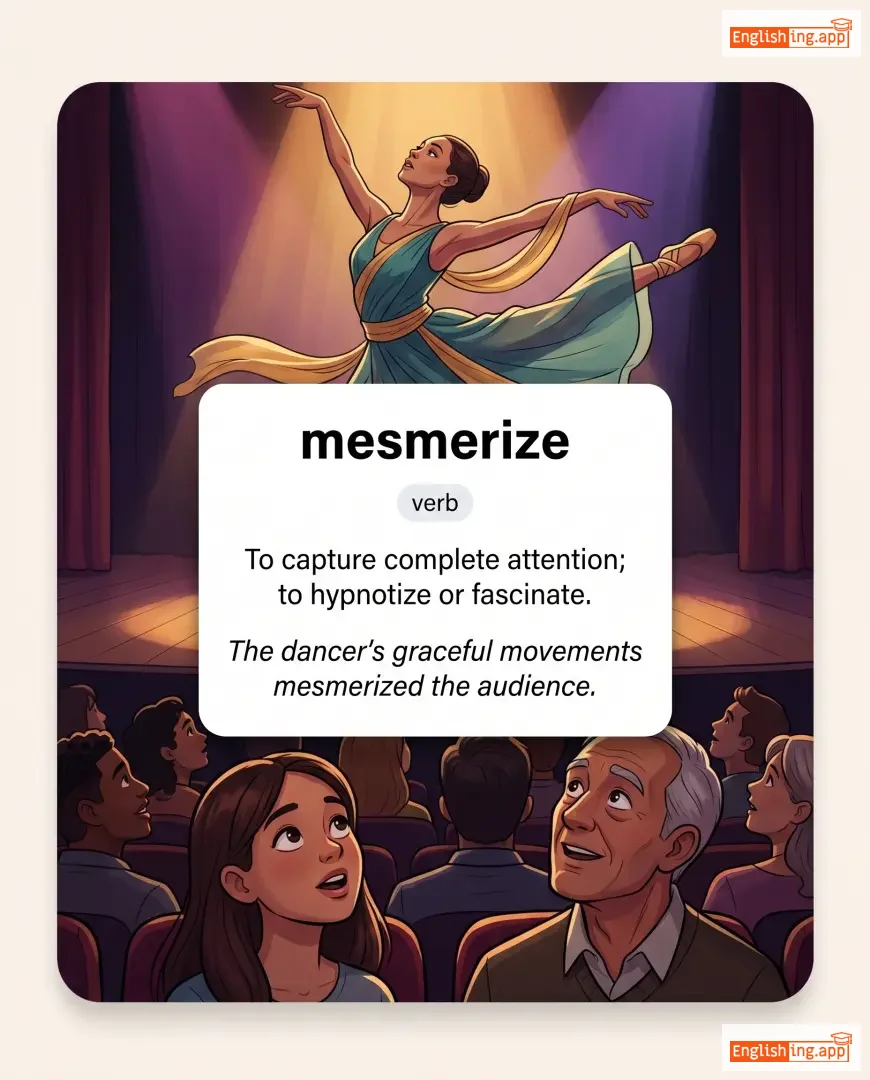
mesmerize definition card — visual illustration of the meaning
verb
/ˈmɛzməˌraɪz/
मंत्रमुग्ध करना (mantramughdh karna)

To capture complete attention; to hypnotize or fascinate.

"The dancer's graceful movements mesmerized the audience."

"नर्तकी की सुंदर हरकतें दर्शकों को मंत्रमुग्ध कर गई।" (nartaki ki sundar harkatein darshako ko mantramughdh kar gayi.)
noun
/mɛs/
अव्यवस्था (avyavastha)

A state of disorder or untidiness.

"The kids left the room in a complete mess."

"बच्चों ने कमरे को पूरी तरह से अव्यवस्था में छोड़ दिया।" (Bachon ne kamre ko puri tarah se avyavastha mein chhod diya.)
noun
/ˈmɛsɪdʒ/
संदेश (sandesh)

A piece of information sent or communicated from one person to another.

"I received a message from my friend yesterday."

"मैंने कल अपने दोस्त से एक संदेश प्राप्त किया।" (Maine kal apne dost se ek sandesh prapt kiya.)
noun
/ˈmes.ɪn.dʒər/
संदेशवाहक (sandeshwahak)

a person who carries messages or communications between parties

"The messenger delivered important battle plans to the commander."

"संदेशवाहक ने कमांडर को महत्वपूर्ण युद्ध योजनाएं पहुँचाईं।" (sandeshwahak ne commander ko mahatvapurn yuddh yojnaayein pahunchayi.)
adjective
/ˈmɛsi/
गंदा (ganda)

untidy or dirty; disorganized or chaotic

"His room was so messy that he couldn’t find his keys."

"उसका कमरा इतना गंदा था कि वह अपनी चाबियाँ नहीं ढूँढ पाया।" (uska kamra itna ganda tha ki vah apni chabiyan nahin dhoondh paya)
metabolic definition card — visual illustration of the meaning
adjective
ˌmet.əˈbɒl.ɪk
मेटाबोलिक (metabolic)

Related to the chemical processes within living organisms to maintain life.

"A fast metabolic rate helps in weight management."

"एक तेज मेटाबोलिक दर वजन प्रबंधन में मदद करता है।" (Ek tez metabolic dar vajan prabandhan mein madad karta hai.)
metabolism definition card — visual illustration of the meaning
noun
/məˈtæbəlɪzəm/
विकार प्रणाली (vikar pranali)

The chemical processes that occur within a living organism in order to maintain life.

"Faster metabolism can help with weight management."

"तेज़ मेटाबोलिज़म वजन प्रबंधन में मदद कर सकता है।" (tez metabolism vajan prabandhan mein madad kar sakta hai.)
metabolize definition card — visual illustration of the meaning
verb
məˈtæb.ə.laɪz
पचाना और ऊर्जा के रूप में उपयोग करना (pachana aur urja ke roop mein upyog karna)

Process and use food for growth and to replace tissue, or process other substances in the body.

"The liver helps to metabolize toxins."

"यकृत टॉक्सिन्स को मेटाबोलाइज़ करने में मदद करता है।" (Yakrit toxins ko metabolize karne mein madad karta hai.)
metacognition definition card — visual illustration of the meaning
noun
ˌmɛt.ə.kɒɡˈnɪʃ.ən
मेटाकॉग्निशन (metacognition)

Awareness and understanding of one's own thought processes.

"Metacognition helps students improve their learning strategies."

"मेटाकॉग्निशन छात्रों को उनकी अध्ययन रणनीतियों में सुधार करने में मदद करता है।" (Metacognition chhatron ko unki adhyayan rananitiyon mein sudhaar karne mein madad karta hai.)
noun
/ˈmɛtəl/
धातु (dhatu)

A solid material that is typically hard, shiny, malleable, fusible, and conductive, such as iron, gold, or aluminum.

"The ring was made of precious metal."

"अंगूठी कीमती धातु से बनी थी।" (Anguthi keemti dhatu se banni thi.)
metal contamination definition card — visual illustration of the meaning
noun
ˈmetəl kənˌtæməˈneɪʃən
धातु प्रदूषण (dhatu pradooshan)

The presence of toxic metals in the environment that pose health and environmental risks.

"Metal contamination poses severe health risks."

"धातु प्रदूषण स्वास्थ्य के लिए गंभीर खतरे उत्पन्न करता है।" (Dhatu pradooshan swasthya ke liye gambhir khatre utpann karta hai.)
adjective
/ˌmɛtəˈlɜrdʒɪkəl/
धातु विज्ञान संबंधी (dhatu vigyan sambandhi)

Relating to metallurgy or the branch of science concerned with the properties of metals and their production.

"He studied metallurgical engineering at the university."

"उन्होंने विश्वविद्यालय में धातु विज्ञान इंजीनियरिंग का अध्ययन किया।" (unhone vishwavidyalay mein dhatu vigyan engineering ka adhyayan kiya.)
noun
/ˈmɛtələ(r)dʒi/
धातुविज्ञान (dhatuvigyan)

The science and technology of metals, including their extraction from ores and their processing.

"Metallurgy plays a vital role in industrial development."

"धातुविज्ञान औद्योगिक विकास में महत्वपूर्ण भूमिका निभाता है।" (Dhatuvigyan audyogik vikas mein mahatvapurn bhumika nibhaata hai.)
verb
/ˌmɛtəˈmɔrfoʊz/
रूपांतरण होना (roopantaran hona)

To change in form, structure, or substance; to transform completely.

"The caterpillar metamorphosed into a butterfly."

"कैटरपिलर एक तितली में रूपांतरित हो गया।" (Caterpillar ek titli mein roopantarit ho gaya.)
metamorphosis definition card — visual illustration of the meaning
noun
/ˌmɛtəˈmɔrfəsɪs/
रूपांतरण (roopantaran)

A process of transformation from one form to another, especially in biology, such as the change from a caterpillar to a butterfly.

"The metamorphosis of the tadpole into a frog is fascinating."

"टैडपोल से मेंढ़क में रूपांतरण दिलचस्प है।" (Tadpole se mendhak mein roopantaran dilchasp hai.)
noun
/ˈmɛtəfɔːr/
खुशी (khushi)

A figure of speech in which a word or phrase is applied to something to which it is not literally applicable.

"Time is a thief is a common metaphor for how quickly life passes."

"वह पुरस्कार प्राप्त करते समय अपनी खुशी को छिपा नहीं पाई।" (vah puraskar prapt karte samay apni khushi ko chhupa nahi pai.)
adjective
/ˌmɛtəˈfɔːrɪkəl/
रूपकात्मक (rupakaatmak)

Characteristic of or relating to metaphor; figurative rather than literal.

"He used metaphorical language to describe his emotions."

"उसने अपनी भावनाओं का वर्णन करने के लिए रूपकात्मक भाषा का उपयोग किया।" (Usne apni bhavnaon ka varnan karne ke liye rupakaatmak bhasha ka upyog kiya.)
noun
/ˈmɛtəfɔːrm/
रूपक रूप (roopak roop)

A coined or rare term sometimes used to describe a hybrid form of metaphor and form in literature or art.

"The poet introduced a metaphorm to blend imagery with structure."

"कवि ने एक मेटाफॉर्म पेश किया जिससे चित्र और संरचना एक साथ जुड़े।" (Kavi ne ek metaphorm pesh kiya jisse chitra aur sanrachna ek saath jude.)
adjective
/ˌmɛtəˈfɪzɪkəl/
आध्यात्मिक (aadhyatmik)

Relating to the branch of philosophy that deals with the fundamental nature of reality and existence.

"He spent years studying metaphysical questions about life and being."

"उसने जीवन और अस्तित्व के बारे में आध्यात्मिक सवालों का अध्ययन करने में वर्षों बिताए।" (Usne jeevan aur astittv ke baare mein aadhyatmik sawalon ka adhyayan karne mein varsho bitaye.)
noun
/ˌmɛtəfɪˈzɪʃən/
मेटाफिजीशियन (metaphizishiyan)

A person who studies or is an expert in metaphysics.

"The metaphysician debated the essence of reality with his peers."

"मेटाफिजीशियन ने अपने साथियों के साथ वास्तविकता के सार पर बहस की।" (Metaphizishiyan ne apne saathiyon ke saath vastavikta ke saar par bahas ki.)
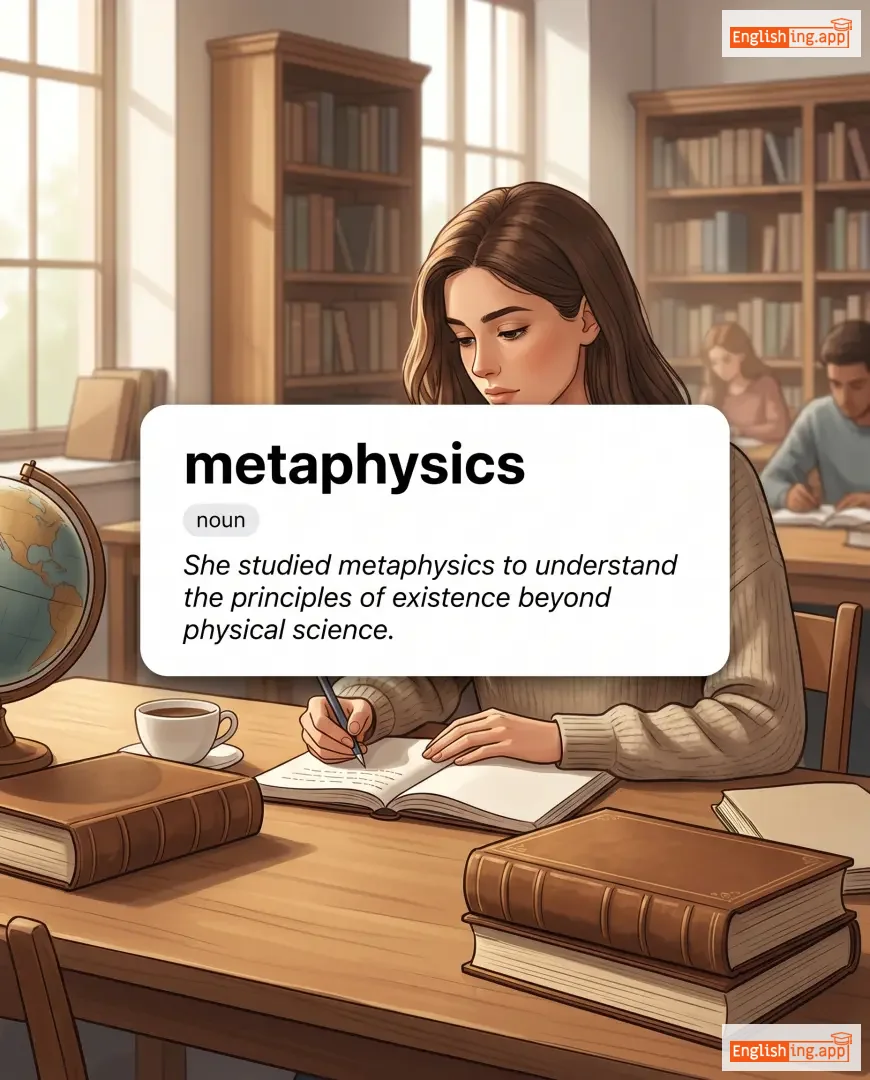
metaphysics definition card — visual illustration of the meaning
noun
/ˌmɛtəˈfɪzɪks/
तत्त्वविज्ञान (tattvavigyan)

The branch of philosophy that deals with the fundamental nature of reality, existence, and the relationship between mind and matter.

"She studied metaphysics to understand the principles of existence beyond physical science."

"उसने भौतिक विज्ञान से परे अस्तित्व के सिद्धांतों को समझने के लिए तत्त्वविज्ञान का अध्ययन किया।" (Usne bhoutik vigyan se pare astitva ke siddhanton ko samjhne ke liye tattvavigyan ka adhyayan kiya.)
verb
/miːt/
वितरित करना (vitarit karna)

To dispense or allot justice, punishment, or harsh treatment.

"The judge will mete out punishment according to the crime."

"जज अपराध के अनुसार सजा वितरित करेगा।" (Jaj apradh ke anusar saza vitrit karega.)
noun
/ˌmɛtəmˌsaɪˈkoʊsɪs/
आत्मा का पुनर्जन्म (atma ka punarjanm)

The supposed transmigration of the soul, especially its reincarnation after death.

"Ancient philosophers often debated the idea of metempsychosis."

"प्राचीन दार्शनिकों ने अक्सर आत्मा के पुनर्जन्म पर बहस की।" (Prachin darshanikon ne aksar atma ke punarjanm par behas ki.)
adjective
/ˌmiːtiˈɔːrɪk/
उल्कापिंड से संबंधित; बहुत तेज़ और अक्सर अस्थायी। (ulkapind se sambandhit; bahut tez aur aksar asthayi.)

Relating to meteors; very rapid and often temporary.

"The singer’s meteoric rise to fame surprised everyone."

"गायक की उल्कापिंड जैसी प्रसिद्धि का तेज़ उत्थान सभी को हैरान कर दिया।" (gaayak ki ulkapind jaisi prasiddhi ka tez utthan sabhi ko hairan kar diya.)
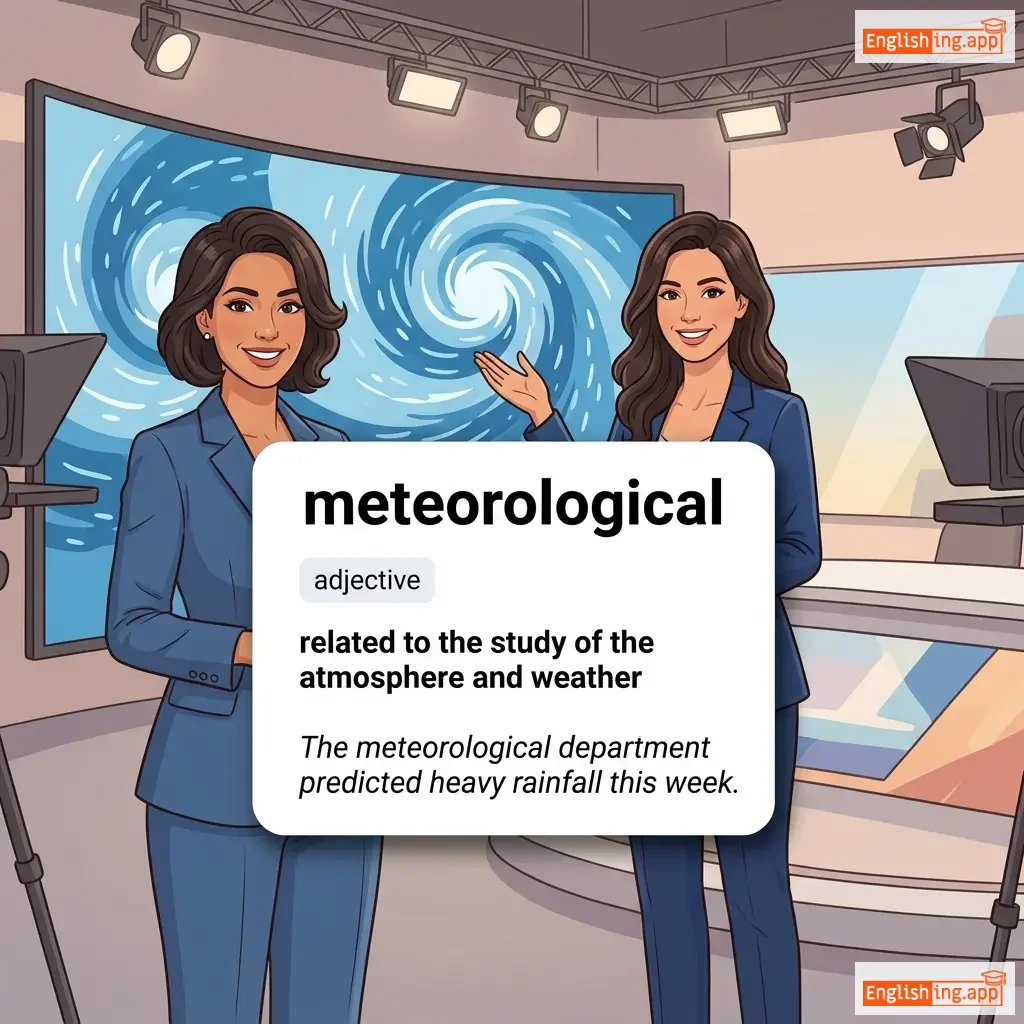
meteorological definition card — visual illustration of the meaning
adjective
/ˌmiː.ti.ə.rəˈlɒ.dʒɪ.kəl/
मौसम विज्ञान संबंधी (mausam vigyan sambandhi)

related to the study of the atmosphere and weather

"The meteorological department predicted heavy rainfall this week."

"मौसम विभाग ने इस सप्ताह भारी बारिश की भविष्यवाणी की थी।" (Mausam vibhag ne is saptah bhari barish ki bhavishyavani ki thi.)