वोकैबुलरीज

इंग्लिश वोकैबुलरी डिस्कवर, लर्न और मास्टर करें

mediocrity definition card — visual illustration of the meaning
noun
ˌmiː.diˈɒk.rə.ti
औसत दर्जेपनापन (ausat darjepanapan)

Being average or ordinary, not particularly good.

"He refused to settle for mediocrity and aimed for greatness."

"उसने औसत दर्जेपनापन को स्वीकार नहीं किया और महानता के लिए प्रयास किया।" (Usne ausat darjepanapan ko sveekar nahin kiya aur mahaanta ke liye prayaas kiya.)
noun
/ˌmɛdɪˈteɪʃən/
ध्यान (dhyan)

The practice of focusing the mind to achieve calmness, clarity, or spiritual growth.

"She practices meditation every morning to start her day peacefully."

"वह हर सुबह शांति से अपना दिन शुरू करने के लिए ध्यान करती है।" (Vah har subah shaanti se apna din shuru karne ke liye dhyan karti hai.)
noun
/ˈmiːdiəm/
माध्यम (madhyam)

A means or channel of communication, expression, or artistic work.

"Television is a powerful medium for spreading information."

"टीवी सूचना प्रसार का एक शक्तिशाली माध्यम है।" (TV soochna prasaar ka ek shaktishali madhyam hai.)
noun
/ˈmɛdli/
मिश्रण (mishran)

A mixture of different things, especially musical tunes combined together.

"The band played a medley of popular songs."

"बैंड ने लोकप्रिय गानों का एक मिश्रण बजाया।" (Band ne lokpriya ganon ka ek mishran bajaya.)
adjective
/miːk/
विनम्र (vinamra)

Quiet, gentle, and submissive in nature.

"Despite his strength, he remained meek and humble."

"अपनी शक्ति के बावजूद, वह विनम्र और नम्र बना रहा।" (Apni shakti ke bawajood, vah vinamra aur namra bana raha.)
adverb
/ˈmiːk.li/
नम्रता से; विनम्रता से; (namrata se; vinamrata se)

in a quiet, gentle way; without resistance or protest

"He meekly accepted the criticism without arguing."

"उसने बिना किसी बहस के आलोचना नम्रता से स्वीकार की।" (Usne bina kisi behas ke alochana namrata se sveekar ki.)
noun
/ˈmiːknəs/
विनम्रता (meekness)

The quality of being quiet, gentle, and submissive

"His meekness was often mistaken for weakness by his colleagues."

"उसकी विनम्रता को अक्सर उसके सहकर्मियों द्वारा कमजोरी समझा जाता था।" (uski vinamrata ko aksar uske sahakarmiyon dwara kamzori samjha jata tha)
meet definition card — visual illustration of the meaning
verb
/miːt/
मिलना (milna)

To come into the presence of someone by chance or arrangement.

"I will meet you at the cafe tomorrow."

"मैं कल कैफे में तुमसे मिलूंगा।" (Main kal cafe mein tumse milunga.)
noun
/ˈmiːtɪŋ/
बैठक (baithak)

A gathering of people for discussion or decision-making.

"The board had a meeting to finalize the budget."

"बोर्ड ने बजट को अंतिम रूप देने के लिए एक बैठक की।" (board ne budget ko antim roop dene ke liye ek baithak ki.)
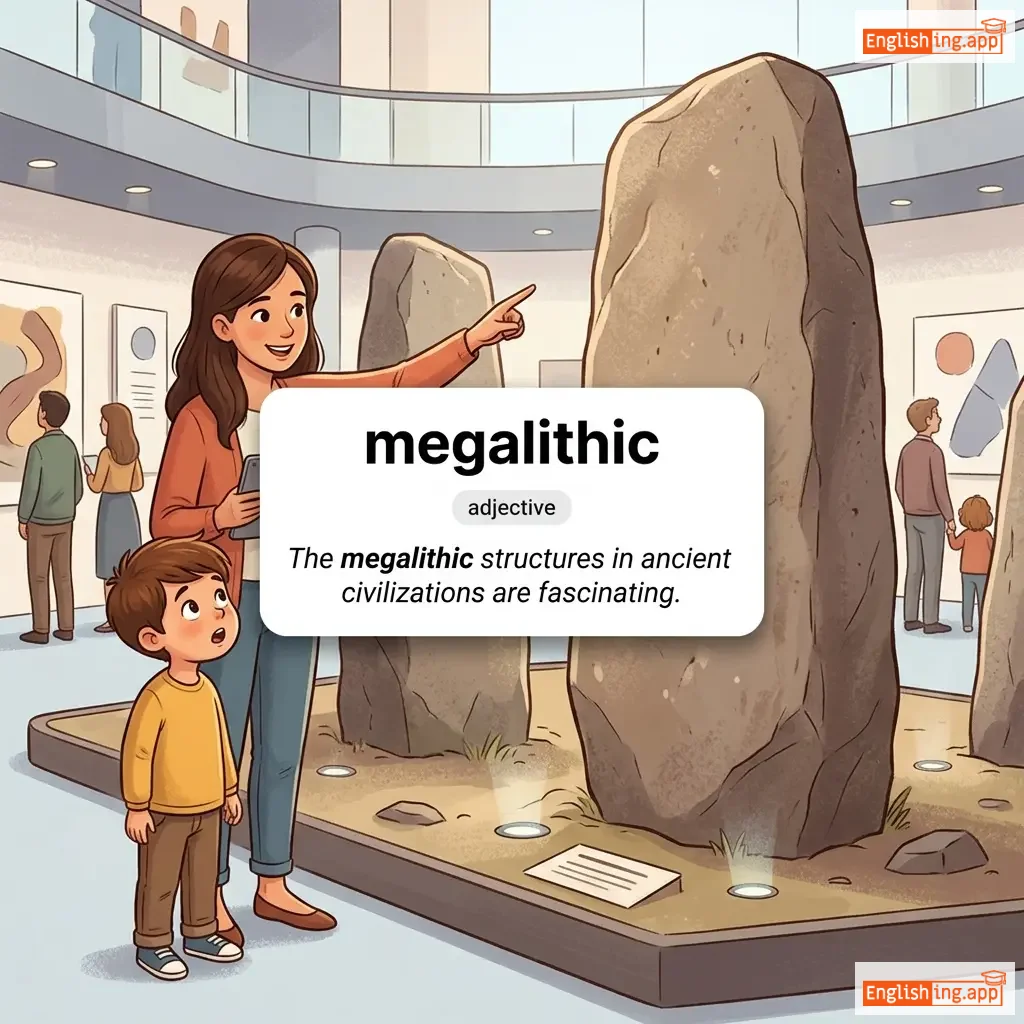
megalithic definition card — visual illustration of the meaning
adjective
ˌmɛɡəˈlɪθɪk
मेगालिथिक (megalithik)

Relating to or denoting prehistoric monuments made of or containing large stones.

"The megalithic structures in ancient civilizations are fascinating."

"प्राचीन सभ्यताओं में मेगालिथिक संरचनाएँ आकर्षक हैं।" (Prachin sabhyataon mein megalithik sanrachnaayein aakarshak hain.)
megalomania definition card — visual illustration of the meaning
noun
/ˌmɛɡələˈmeɪniə/
अत्यधिक शक्ति और श्रेष्ठता का भ्रम (atyadhik shakti aur shreshthata ka bhram)

A condition characterized by delusional fantasies of power, wealth, or omnipotence.

"The dictator’s megalomania led him to believe he was invincible."

"तानाशाह का मेगालोमेनिया उसे यह विश्वास करने पर मजबूर कर दिया कि वह अभेद्य था।" (Taanashaah ka megalomania use yeh vishwas karne par majboor kar diya ki vah abhedya tha.)
adjective
/ˌmel.ənˈkɒl.ɪk/
उदासीन और विचारशील; दुःख व्यक्त करने या महसूस करने वाला (melankolik)

sad and thoughtful; feeling or expressing sadness

"The melancholic music made everyone feel sad."

"मेलांकोलिक संगीत ने सभी को उदास कर दिया।" (melankolik sangeet ne sabhi ko udaas kar diya)
noun
/ˈmɛlənˌkɒli/
विषाद (vishad)

A deep, persistent sadness or gloom.

"She felt a deep melancholy after hearing the tragic news."

"उसने दुखद समाचार सुनने के बाद गहरी विषाद महसूस किया।" (Usne dukhdar samachar sunne ke baad gehri vishad mehsoos kiya.)
noun
/meɪˈlɑːnʒ/
मिश्रण (mishran)

A mixture of different things or styles.

"The festival offered a melange of music, food, and art."

"त्योहार ने संगीत, भोजन और कला का मिश्रण प्रस्तुत किया।" (Tyohar ne sangeet, bhojan aur kala ka mishran prastut kiya.)
noun
/ˈmeɪleɪ/
कोलाहलपूर्ण लड़ाई (kolahalpurn ladai)

A noisy, confused fight or crowd situation.

"A melee broke out during the football match."

"फुटबॉल मैच के दौरान एक कोलाहलपूर्ण लड़ाई हुई।" (Football match ke dauran ek kolahalpurn ladai hui.)
verb
/ˈmiːliəˌreɪt/
सुधारना (sudharna)

To make something better or improve a condition.

"The new policies aim to meliorate the living conditions of the poor."

"नई नीतियाँ गरीबों की जीवन स्थिति को सुधारने का लक्ष्य रखती हैं।" (Nayi neetiyan gareebon ki jeevan sthiti ko sudharne ka lakshya rakhti hain.)
noun
/ˈmiːliərɪzəm/
सुधारवाद (sudhaarbwad)

The belief that the world tends to improve and that humans can aid its betterment.

"Her philosophy of meliorism kept her hopeful during difficult times."

"उसका सुधारवादी दर्शन कठिन समय में भी उसे आशावादी बनाए रखता था।" (uska sudhaarbadi darshan kathin samay mein bhi use aashaawadi banaye rakhta tha.)
adjective
/məˈlɪfluəs/
मधुर (madhur)

Sweet or musical; pleasant to hear.

"The singer’s mellifluous voice enchanted the audience."

"गायक की मधुर आवाज़ ने दर्शकों को मंत्रमुग्ध कर दिया।" (gaayak ki madhur aawaaz ne darshako ko mantrmugdh kar diya.)
adjective
/ˈmel.əʊ/
मुलायम और सुखद; आरामदायक और कोमल (melo)

soft and pleasant; relaxed and gentle

"The mellow evening light created a peaceful atmosphere."

"मेलो शाम की रोशनी ने एक शांतिपूर्ण माहौल बनाया।" (melo shaam ki roshni ne ek shantipurn maahol banaya.)
adjective
/məˈloʊdiəs/
सुमधुर (sumadhur)

Having a pleasant tune; tuneful.

"She played a melodious tune on the piano."

"उसने पियानो पर एक सुमधुर धुन बजाई।" (usne piano par ek sumadhur dhun bajayi.)
noun
/ˈmɛləˌdrɑːmə/
नाटकीय अतिरंजन (naatakiya atiranjan)

A dramatic piece with exaggerated characters and exciting events intended to appeal to the emotions.

"The movie was criticized for its excessive melodrama."

"फिल्म को उसके अत्यधिक नाटकीयता के लिए आलोचना की गई थी।" (film ko uske atyadhik naatakiyata ke liye alochana ki gayi thi.)
noun
/ˈmɛlədi/
धुन (dhun)

A sequence of musical notes that are musically satisfying; a tune.

"The melody of the song stayed in my mind all day."

"गाने की धुन पूरे दिन मेरे मन में रही।" (gaane ki dhun poore din mere man mein rahi.)
melt definition card — visual illustration of the meaning
verb
/mɛlt/
पिगलना (pigalna)

to become liquid through heat

"The ice melted quickly under the sun."

"हिमनदियां सूरज के नीचे जल्दी पिघल गईं।" (Himnadiyan suraj ke neeche jaldi pighal gayi.)
verb, noun, adjective
/ˈmeltɪŋ/
पिघलना (pighalna)

the process of changing from solid to liquid due to heat; becoming softer or less rigid; emotionally moving or tender

"The ice is melting quickly under the hot sun."

"तेज़ धूप में बर्फ जल्दी पिघल रही है।" (tez dhoop mein barf jaldi pighal rahi hai)
noun
/ˈmembər/
सदस्य (sadasya)

a person or thing that belongs to a group or organization

"She is a member of the local sports club."

"वह स्थानीय खेल क्लब की सदस्य है।" (Vah sthalīya khel klub kī sadasya hai.)
members definition card — visual illustration of the meaning
noun
ˈmem.bərz
सदस्य (sadasya)

A person, animal, or plant belonging to a particular group; an individual belonging to a group such as a society or team.

"Members collaborate to finalize recruitment decisions."

"सदस्य भर्ती निर्णय अंतिम रूप देने के लिए सहयोग करते हैं।" (Sadasya bharti nirnay antim roop dene ke liye sahyog karte hain.)
membership definition card — visual illustration of the meaning
noun
/ˈmɛmbərʃɪp/
सदस्यता (sadasyata)

The state of being a member of a group, organization, or club.

"Her membership in the gym expires next month."

"उसकी जिम की सदस्यता अगले महीने समाप्त हो रही है।" (uski jim ki sadasyata agle mahine samapt ho rahi hai.)
noun
/ˈmɛm.breɪn/
झिल्ली (jhilli)

A thin layer of tissue or material that covers, separates, or connects structures.

"The cell membrane controls the movement of substances in and out of the cell."

"कोशिका की झिल्ली पदार्थों की अंदर और बाहर गति को नियंत्रित करती है।" (kosika ki jhilli padarthon ki andar aur bahar gati ko niyantrit karti hai.)
noun
/məˈmɛn.toʊ/
स्मृति चिह्न (smriti chihn)

An object kept as a reminder of a person, place, or event.

"She kept the ticket as a memento of their first concert together."

"उसने उनके पहले कॉन्सर्ट का एक मेमेंटो के रूप में टिकट रखा।" (Usne unke pehle concert ka ek memento ke roop mein ticket rakha.)
noun
/ˈmɛmoʊ/
सूचना-पत्र (memo)

a written message, typically in a business setting

"He wrote a memo to the staff about the upcoming meeting."

"उसने स्टाफ को आगामी बैठक के बारे में एक सूचना-पत्र लिखा।" (Usne staff ko aagaami baithak ke baare mein ek soochna-patra likha.)
noun
/ˈmɛm.wɑːr/
संस्मरण (sansmaran)

A historical account or autobiography written from personal experience.

"The author’s memoir details her journey through hardship and success."

"लेखक की संस्मरण में उनकी कठिनाई और सफलता की यात्रा का विवरण है।" (lekhak ki sansmaran mein unki kathinai aur safalta ki yatra ka vivaran hai.)
memorable definition card — visual illustration of the meaning
adjective
/ˈmɛm.ər.ə.bəl/
स्मरणीय (smaraniya)

Worth remembering because it is special or unusual.

"Their wedding was one of the most memorable days of their lives."

"उनकी शादी उनके जीवन के सबसे स्मरणीय दिनों में से एक थी।" (unki shaadi unke jeevan ke sabse smaraniya dinon mein se ek thi.)
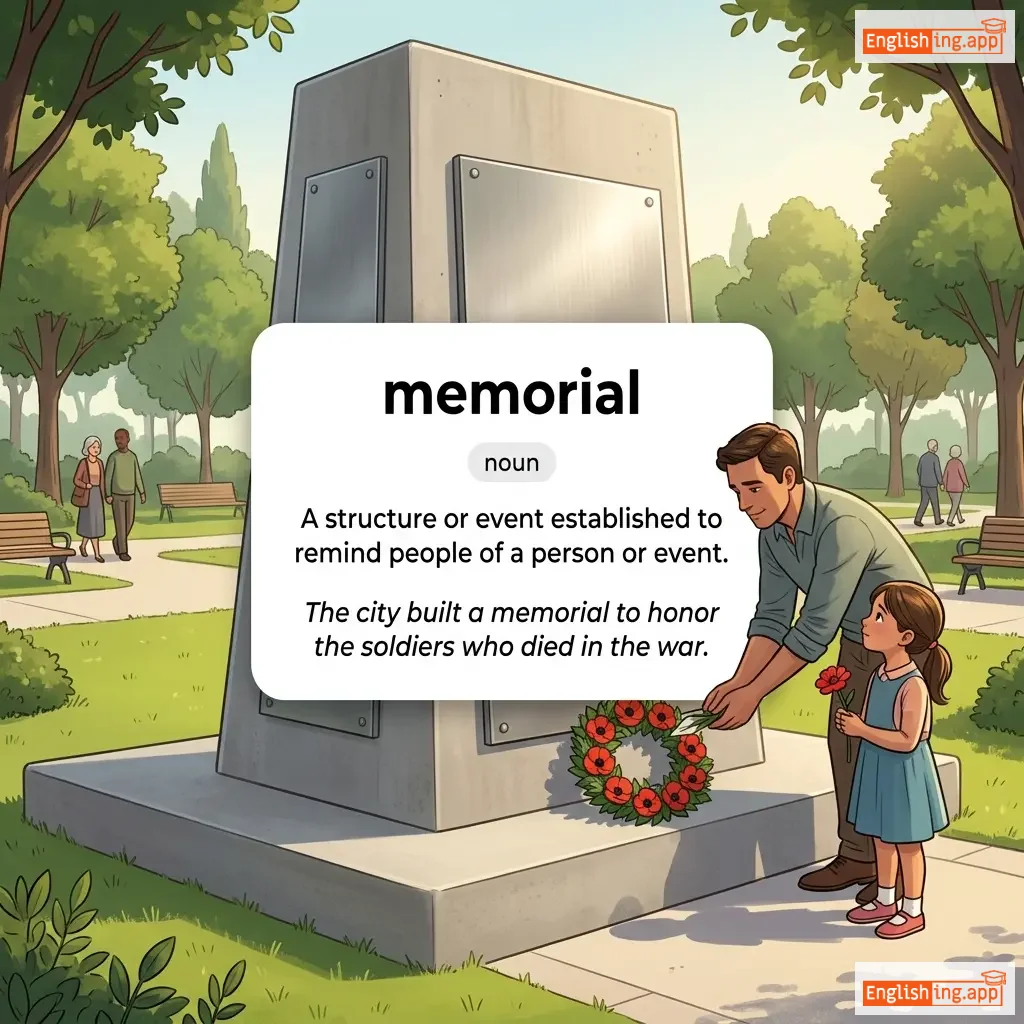
memorial definition card — visual illustration of the meaning
noun
/məˈmɔːr.i.əl/
स्मारक (smarak)

A structure or event established to remind people of a person or event.

"The city built a memorial to honor the soldiers who died in the war."

"शहर ने युद्ध में मारे गए सैनिकों को सम्मानित करने के लिए एक स्मारक बनाया।" (shahar ne yuddh mein maare gaye sainikon ko sammanit karne ke liye ek smarak banaya.)
verb
/məˈmɔːriəlaɪz/
स्मरणीय बनाना (smaraniya banana)

to preserve the memory of a person or event, often through a ceremony, monument, or record

"The city decided to memorialize the hero with a statue in the central square."

"शहर ने नायक को एक मूर्ति के साथ केंद्रीय चौक में स्मरणीय बनाने का निर्णय लिया।" (Sheher ne nayak ko ek moorti ke saath kendriya chowk mein smaraniya banane ka nirnay liya.)
memorization definition card — visual illustration of the meaning
noun
ˌmɛməraɪˈzeɪʃən
स्मरण (smaran)

The process of learning or committing something to memory

"Memorization of important information is crucial for exams."

"महत्वपूर्ण जानकारी की स्मरण परीक्षा के लिए महत्वपूर्ण है।" (Mahattvapurn jankari ki smaran pariksha ke liye mahatvapurn hai.)
memorize definition card — visual illustration of the meaning
verb
/ˈmeməraɪz/
याद करना (yaad karna)

to learn something by heart; to commit to memory

"Students need to memorize important formulas for the exam."

"परीक्षा के लिए छात्रों को महत्वपूर्ण सूत्रों को याद करना होगा।" (Pariksha ke liye chatron ko mahatvapurn sutron ko yaad karna hoga)
noun
/ˈmɛməri/
स्मृति (smriti)

The faculty of the mind by which information is stored and remembered.

"She has a vivid memory of her childhood home."

"उसे अपने बचपन के घर की एक स्पष्ट स्मृति है।" (use apne bachpan ke ghar ki ek spasht smriti hai.)
noun/verb
/ˈmɛnəs/
खुशी (khushi)

a person or thing that is likely to cause harm; to threaten in a hostile manner

"The hurricane became a menace to the coastal towns."

"वह पुरस्कार मिलने पर अपनी खुशी को छुपा नहीं सकी।" (vah puraskar milne par apni khushi ko chhupa nahi sakee.)
noun
/məˈnæʒəri/
जंगली जानवरों का संग्रह (jangli janwaron ka sangrah)

a collection of wild animals kept for exhibition; a diverse or strange group of people or things

"The circus had a menagerie of exotic animals."

"सर्कस में विदेशी जानवरों का संग्रह था।" (Sarkas mein videshi janwaron ka sangrah tha.)
verb
/mɛnd/
मरम्मत करना (marammat karna)

To repair something that is broken or damaged.

"She learned to mend her torn dress."

"वह अपनी फटी हुई ड्रेस को मरम्मत करना सीख गई।" (vah apni phati hui dress ko marammat karna seekh gayi.)
mendacious definition card — visual illustration of the meaning
adjective
/mɛnˈdeɪʃəs/
झूठा (jhutha)

not telling the truth; lying

"The politician was known for his mendacious statements."

"राजनेता अपने झूठे बयानों के लिए जाने जाते थे।" (Rajneta apne jhuthe bayano ke liye jane jate the.)
noun
/mɛnˈdæsəti/
झूठ (jhooth)

the tendency to be untruthful; dishonesty

"The journalist exposed the mendacity of the officials."

"पत्रकार ने अधिकारियों की झूठी बातों को उजागर किया।" (Patrakar ne adhikaarion ki jhoothi baaton ko ujagar kiya.)
noun
/ˈmɛndɪkənt/
भिक्षुक (bhikkhuk)

a beggar; a person who lives by asking for alms

"The mendicant asked for food at the monastery gate."

"भिक्षुक मठ के द्वार पर भोजन माँगने आया।" (Bhikkhuk math ke dwaar par bhojan maangne aaya.)
noun
/ˈmɪstəs/
बैग्रिड मछली (bagrid machhli)

a genus of catfish found in Asia, commonly known as bagrid catfish

"The mystus fish is commonly found in rivers and streams of South Asia."

"मिस्टस मछली आमतौर पर दक्षिण एशिया की नदियों और धाराओं में पाई जाती है।" (mistas machhli aamtaur par dakshin ashiya ki nadiyon aur dharaon me payi jati hai)
menial definition card — visual illustration of the meaning
adjective
/ˈmiːniəl/
तुच्छ कार्य (tuchchh karya)

lowly and sometimes degrading; related to unskilled or routine tasks

"He worked long hours doing menial tasks in the factory."

"उसने फैक्ट्री में तुच्छ कार्य करते हुए लंबे घंटे काम किए।" (Usne factory mein tuchchh karya karte hue lambe ghante kaam kiye.)
adjective
/ˈmɛntəl/
मानसिक (mansik)

Relating to the mind, thoughts, or intellectual processes.

"He needs to take a break for his mental health."

"उसे अपनी मानसिक सेहत के लिए एक ब्रेक लेने की आवश्यकता है।" (use apni mansik sehat ke liye ek brek lene ki avashyakta hai.)
mental focus definition card — visual illustration of the meaning
noun
ˈmɛn.təl ˈfoʊ.kəs
मानसिक एकाग्रता (maansik ekagrata)

The ability to concentrate deeply on a specific task or thought; mental concentration and attention.

"Meditation improves mental focus and cognitive performance."

"ध्यान मानसिक एकाग्रता और संज्ञानात्मक प्रदर्शन को सुधारता है।" (Dhyan maansik ekagrata aur jnanaatmak pradarshan ko sudhaarta hai.)
noun
/mɛnˈtæləti/
मानसिकता (maansikata)

a particular way of thinking; mindset or outlook

"Her positive mentality helped her overcome many challenges."

"उसकी सकारात्मक मानसिकता ने उसे कई चुनौतियों को पार करने में मदद की।" (Uski sakaratmak maansikata ne use kai chunautiyon ko paar karne mein madad ki.)
adverb
/ˈmɛntəli/
मानसिक रूप से (maansik roop se)

in a way that relates to the mind or intellect rather than the body

"She felt mentally exhausted after the long exam."

"वह लंबी परीक्षा के बाद मानसिक रूप से थकी हुई महसूस कर रही थी।" (vah lambi pariksha ke baad maansik roop se thaki hui mahsus kar rahi thi.)
verb
/ˈmɛnʃən/
जिक्र करना (jikr karna)

To refer to something briefly without giving much detail.

"He mentioned her name during the meeting."

"उसने बैठक के दौरान उसका नाम ज़िक्र किया।" (usne baithak ke dauran uska naam zikr kiya.)