वोकैबुलरीज

इंग्लिश वोकैबुलरी डिस्कवर, लर्न और मास्टर करें

verb
/mæʃ/
मसलना (masalna)

to crush or mix food into a soft mass, usually by pressing or beating

"She mashed the potatoes before serving dinner."

"वह डिनर परोसने से पहले आलू मसल रही थी।" (vah dinner parosne se pehle aloo masal rahi thi.)
noun
/mæsk/
मुखौटा (mukhota)

A covering for the face to protect, disguise, or entertain.

"He wore a mask at the costume party."

"वह कास्ट्यूम पार्टी में एक मुखौटा पहने हुए था।" (vah costume party mein ek mukhota pehene hue tha.)
masks definition card — visual illustration of the meaning
noun
/mɑːsks/
मास्क (mask)

Coverings for all or part of the face, worn as a disguise, for protection, or for medical reasons.

"Masks can protect against polluted air."

"मास्क प्रदूषित हवा से सुरक्षा कर सकते हैं।" (Mask pradushit hawa se suraksha kar sakte hain.)
noun
/ˈmæsəkɪst/
मासोचिस्ट (masochist)

a person who derives pleasure from their own pain or humiliation

"He was called a masochist for enjoying tough challenges."

"उसे कठिन चुनौतियाँ पसंद होने के कारण उसे एक मासोचिस्ट कहा गया था।" (Use kathin chunautiyan pasand hone ke karan use ek masochist kaha gaya tha.)
noun
/ˈmeɪsən/
मिस्त्री (mistri)

a person skilled in building with stone, brick, or concrete

"The mason carefully laid the bricks for the new house."

"मिस्त्री ने नए घर के लिए ईंटें सावधानी से लगाई।" (Mistri ne naye ghar ke liye eenten saavdhaani se lagaayi.)
noun
/ˌmæskəˈreɪd/
पार्टी जहाँ लोग मास्क और परिधान पहनते हैं (party jahan log mask aur paridhan pehante hain)

a party or gathering where people wear masks and costumes; a false outward show

"The charity event was held as a grand masquerade."

"चैरिटी इवेंट एक भव्य मास्करेड के रूप में आयोजित किया गया था।" (charity event ek bhavya masquerade ke roop mein aayojit kiya gaya tha.)
noun
/mæs/
जनसमूह (janasamuh)

a large body of matter with no specific shape; a large number of people or things

"A huge mass of people gathered in the square."

"चौराहे में लोगों का एक विशाल समूह इकट्ठा हो गया।" (chaurahe mein logon ka ek vishal samuh ikattha ho gaya.)
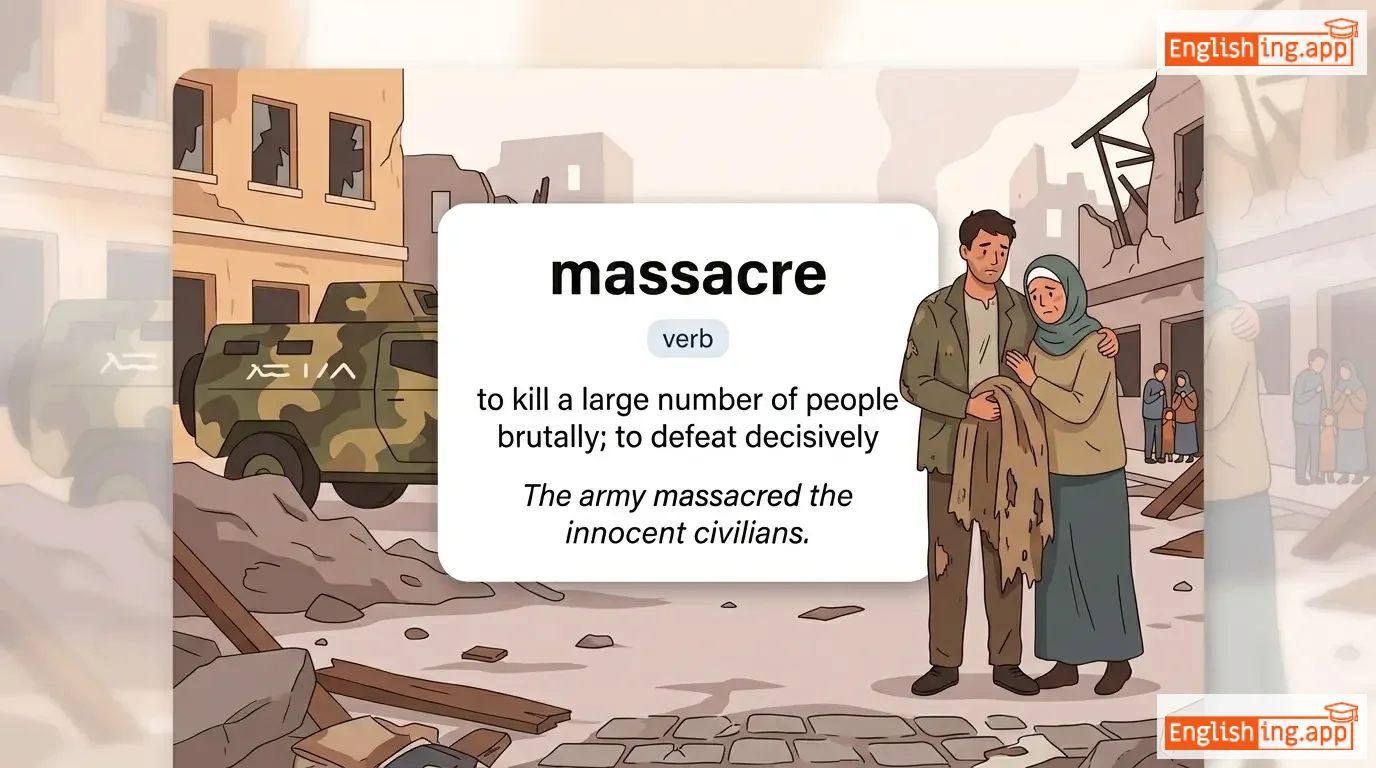
massacre definition card — visual illustration of the meaning
noun
/ˈmæsəkər/
हत्याकांड (hatyakand)

the killing of a large number of people, usually in a violent way

"The massacre resulted in the deaths of hundreds of civilians."

"हत्याकांड के परिणामस्वरूप सैकड़ों नागरिकों की मृत्यु हो गई।" (hatyakand ke parinaamswaroop saikdon nagrikon ki mrityu ho gayi.)
verb
/məˈsɑːʒ/
मसाज करना (masaj karna)

to rub and press muscles to relieve pain or tension; to manipulate information

"The therapist will massage your back to reduce muscle tension."

"थेरेपिस्ट मांसपेशियों के तनाव को कम करने के लिए आपकी पीठ में मसाज करेगा।" (Therapist maanspeshiyon ke tanav ko kam karne ke liye aapki peeth mein masaj karega.)
adjective
/ˈmæsɪv/
विशाल (vishal)

extremely large, heavy, or solid in size or degree

"The company made a massive investment in renewable energy."

"कंपनी ने नवीकरणीय ऊर्जा में एक विशाल निवेश किया।" (Kampani ne navikaranīya urja mein ek vishal nivesh kiya.)
noun, verb
/ˈmɑːstər/
उस्ताद / गुरु (ustad / guru)

A person with great skill or control in a subject or activity; to gain full command over something.

"She mastered the art of cooking Italian dishes."

"उसने इतालवी व्यंजन बनाने की कला में महारत हासिल की।" (Usne Itaalvi vyanjan banane ki kala mein maharat haasil ki.)
noun
/ˈmæstərˌpiːs/
उत्कृष्ट कृति (utkrisht kruti)

a work of outstanding artistry, skill, or workmanship

"The Mona Lisa is considered Leonardo da Vinci’s masterpiece."

"मोना लीजा को लियोनार्दो दा विंची की उत्कृष्ट कृति माना जाता है।" (Mona Lisa ko Leonardo da Vinci ki utkrsht kruti mana jata hai.)
noun
/ˈmæstəri/
निपुणता (nipunata)

comprehensive knowledge or skill in a subject or accomplishment

"She has achieved mastery in classical dance."

"उसने शास्त्रीय नृत्य में निपुणता प्राप्त की है।" (Usne shastriya nritya mein nipunata praapt ki hai.)
verb
/ˈmæstɪkeɪt/
चबाना (chabana)

to chew food thoroughly before swallowing

"He slowly masticated the bread before swallowing."

"वह धीरे-धीरे रोटी चबाकर निगल रहा था।" (Wah dheere-dheere roti chabakar nigal raha tha.)
noun
/mæt/
चटाई (chatai)

a piece of fabric material placed on a floor or surface for wiping feet or protection

"She placed a new mat at the entrance of the house."

"उसने घर के प्रवेश द्वार पर एक नया चटाई रखा।" (Usne ghar ke pravesh dwaar par ek naya chatai rakha.)
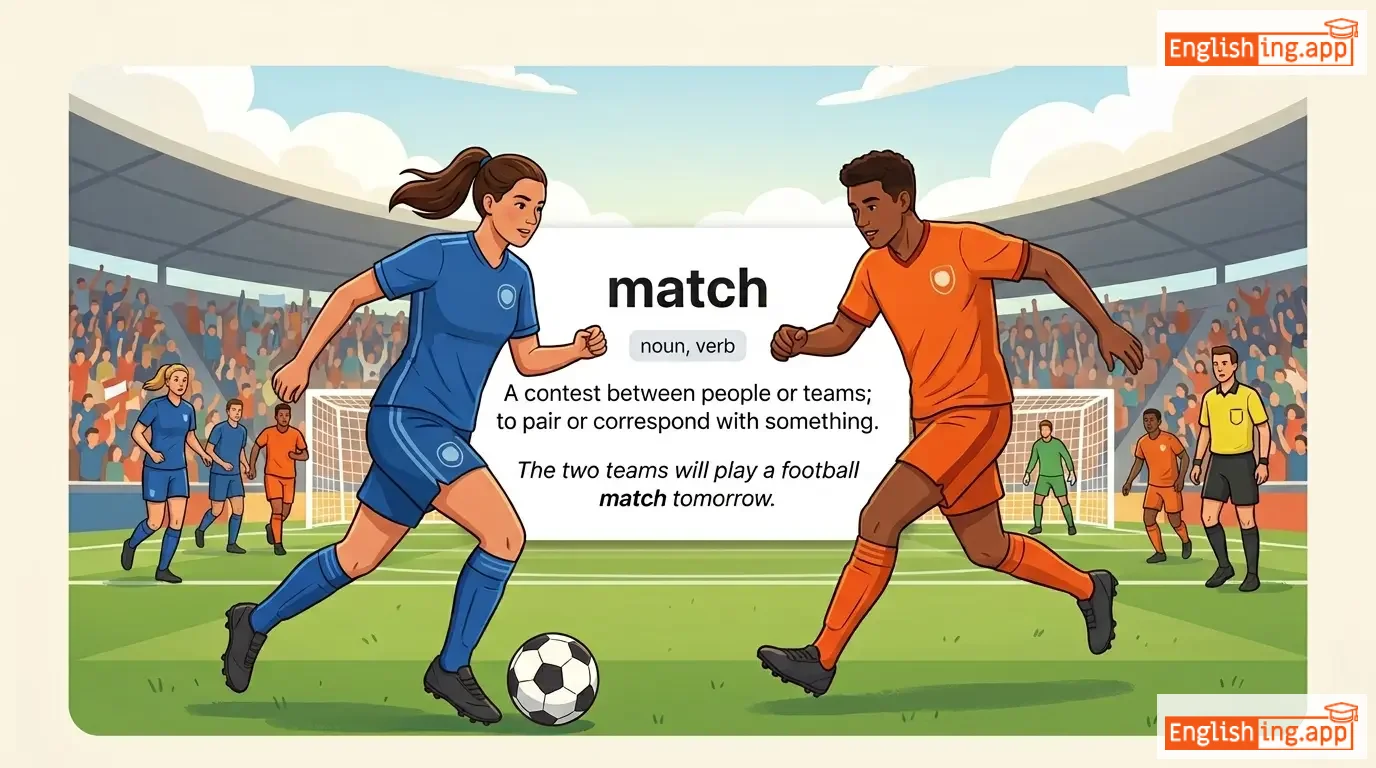
match definition card — visual illustration of the meaning
noun, verb
/mætʃ/
मैच / प्रतियोगिता (match / pratiyogita)

A contest between people or teams; to pair or correspond with something.

"The two teams will play a football match tomorrow."

"दो टीमें कल फुटबॉल मैच खेलेंगी।" (Do teemein kal football match khelenge.)
noun
/meɪt/
मित्र, साथी (mitr, saathi)

a friend or companion; a partner in marriage or reproduction

"He went fishing with his old school mate."

"वह अपने पुराने स्कूल के मित्र के साथ मछली पकड़ने गया था।" (Vah apne purane school ke mitr ke saath machhli pakadne gaya tha.)
noun, adjective
/məˈtɪəriəl/
सामग्री (saamagri)

The substance or matter from which something is made; relating to physical things rather than ideas or emotions.

"The builder brought all the necessary material for the construction."

"निर्माण के लिए निर्माणकर्ता सभी आवश्यक सामग्री लाए।" (Nirman ke liye nirmankartaa sabhi aavashyak saamagri laaye.)
noun
/məˈtɪəriəlɪzəm/
भौतिकवाद (bhoutikvad)

A tendency to consider material possessions and physical comfort as more important than spiritual or moral values.

"The novel criticizes society's growing materialism."

"उपन्यास समाज के बढ़ते भौतिकवाद की आलोचना करता है।" (Upanyas samaj ke badhte bhoutikvad ki alochna karta hai.)
materialistic lifestyle definition card — visual illustration of the meaning
noun
məˌtɪərɪəˈlɪstɪk ˈlaɪfstaɪl
भौतिकवादी जीवनशैली (bhoutikvaadi jeevanshailee)

A way of living focused on acquiring material possessions and wealth.

"A materialistic lifestyle often leads to moral decline."

"एक भौतिकवादी जीवनशैली अक्सर नैतिक गिरावट की ओर ले जाती है।" (Ek bhoutikvaadi jeevanshailee aksar naitik giraawat ki aur le jaati hai.)
verb
/məˈtɪərɪəlaɪz/
वास्तविक रूप में आना (vastavik roop mein aana)

To become real or actual; to appear suddenly or in a physical form.

"The opportunity he had been waiting for finally materialized."

"जिस अवसर का वह इंतजार कर रहा था, वह अंततः वास्तविक रूप में आ गया।" (Jis avsar ka vah intezaar kar raha tha, vah antatah vastavik roop mein aa gaya.)
adjective
/məˈtɜːnəl/
मातृसुलभ (matrsulabh)

Relating to a mother; showing motherly qualities such as care and protection.

"She showed great maternal affection toward the child."

"उसने बच्चे के प्रति महान मातृसुलभ स्नेह दिखाया।" (Usne bachche ke prati mahaan matrsulabh sneha dikhaya.)
noun
/məˈtɜːrnəti/
मातृत्व (mataritva)

The state of being a mother; motherhood

"The hospital has an excellent maternity ward for new mothers."

"अस्पताल में नई माताओं के लिए एक शानदार मातृत्व वार्ड है।" (aspataal mein nai mataon ke liye ek shandaar maatratva ward hai.)
noun
/mæθ/
गणित (ganit)

The study of numbers, quantities, and shapes, also called mathematics.

"She is very good at math."

"वह गणित में बहुत अच्छा है।" (Wah ganit mein bahut accha hai.)
adjective
/ˌmæθəˈmætɪkəl/
गणितीय (ganitiya)

relating to mathematics or the use of mathematics

"The mathematical equation was difficult to solve."

"गणितीय समीकरण को हल करना मुश्किल था।" (Ganitiy samikaran ko hal karna mushkil tha.)
adverb
/ˌmæθəˈmætɪkli/
गणितीय रूप से (ganitiya roop se)

in a way that relates to mathematics; using numbers, formulas, or logical calculation

"The problem can be solved mathematically rather than by guesswork."

"इस समस्या को अनुमान के बजाय गणितीय रूप से हल किया जा सकता है।" (is samasya ko anuman ke bajay ganitiya roop se hal kiya ja sakta hai)
noun
/ˌmæθəˈmætɪks/
गणित (ganit)

the abstract science of number, quantity, and space; the study of numbers and their operations

"Mathematics helps us understand patterns in nature and the universe."

"गणित हमें प्रकृति और ब्रह्मांड में पैटर्न समझने में मदद करता है।" (Ganit humein prakriti aur brahmand mein pattern samajhne mein madad karta hai.)
noun
/ˈmætɪneɪ/
दोपहर का शो (dopahar ka show)

A performance, especially a play or movie, that takes place in the afternoon.

"We bought tickets for the Sunday afternoon matinee."

"हमने रविवार दोपहर के शो के लिए टिकट खरीदी।" (Hamne ravivaar dopahar ke show ke liye tiket kharidi.)
noun
/ˈmeɪ.triˌɑːrk/
परिवार की मुखिया (matriark)

A woman who is the head of a family or community.

"The matriarch of the family made all important decisions."

"परिवार की मुखिया ने सभी महत्वपूर्ण निर्णय लिए।" (parivar ki mukhiya ne sabhi mahatvapurn nirnay liye)
noun
/ˈmætrɪˌsaɪd/
मातृहत्या (matrihatya)

The act of killing one's own mother.

"The crime of matricide shocked the entire town."

"मातृहत्या का अपराध पूरे शहर को चौंका दिया।" (Matrihatya ka aparadh pure sheher ko chauka diya.)
verb
/məˈtrɪkjʊˌleɪt/
कॉलेज या विश्वविद्यालय में नामांकन करना (college ya vishwavidyalay mein naamankan karna)

To enroll as a student in a college or university.

"She matriculated at Oxford University last year."

"उसने पिछले साल ऑक्सफोर्ड विश्वविद्यालय में दाखिला लिया था।" (Usne pichle saal Oxford vishwavidyalay mein daakhila liya tha.)
noun
/ˈmætrəˌmoʊni/
विवाह (vivah)

The state of being married; marriage.

"They entered into matrimony after years of friendship."

"वे दोस्ती के वर्षों बाद विवाह में प्रवेश कर गए।" (ve dosti ke varsho baad vivah mein pravesh kar gaye.)
noun
/ˈmeɪ.trɪks/
आधार, संरचना (aadhar, sanrachna)

An environment or structure in which something develops; also a mathematical array of numbers.

"The cultural matrix shaped his worldview."

"सांस्कृतिक संरचना ने उसके दृष्टिकोण को आकार दिया।" (Sanskritik sanrachna ne uske drishtikon ko aakaar diya.)
noun, verb
/ˈmætər/
मुद्दा / महत्व (mudda / mahatv)

A subject or situation under consideration; to be important.

"It doesn’t matter what others think."

"यह महत्वपूर्ण नहीं है कि दूसरे क्या सोचते हैं।" (Yeh mahatvapurn nahi hai ki doosre kya sochte hain.)
noun/verb
/ˈmætərz/
मामले / महत्वपूर्ण होना (maamle / mahatvapurn hona)

important topics, concerns, or issues; as a verb, to be of importance or significance

"What she thinks really matters to me."

"जो वह सोचती है, वह मेरे लिए सच में मायने रखता है।" (jo vah sochti hai, vah mere liye sach mein mayne rakhta hai.)
noun
/ˈmætrəs/
गद्दा (gadda)

A large pad used as a bed or part of a bed, typically filled with soft material for sleeping on.

"She bought a new mattress for better sleep comfort."

"उसने बेहतर नींद के आराम के लिए एक नया गद्दा खरीदा।" (Usne behtar neend ke aaraam ke liye ek naya gadda khareeda.)
adjective
/məˈtjʊr/
परिपक्व (paripakv)

fully developed or grown, especially emotionally or intellectually

"She has become a mature and confident leader."

"वह एक परिपक्व और आत्मविश्वासी नेता बन गई है।" (Vah ek paripakv aur atmavishwasi neta ban gayi hai.)
noun
/məˈtʃʊrəti/
परिपक्वता; परिपूर्णता (maturity)

The state of being mature; full development physically or emotionally

"With age comes wisdom and emotional maturity."

"वृद्धि के साथ ज्ञान और भावनात्मक परिपक्वता आती है।" (vruddhi ke saath gyaan aur bhavnaatmak paripakvata aati hai.)
adjective
/ˈmɔːdlɪn/
अत्यधिक भावुक (atyadhik bhavuk)

Overly sentimental, often tearfully or weakly emotional.

"He became maudlin after a few drinks."

"वह कुछ पीने के बाद अत्यधिक भावुक हो गया।" (vah kuch peene ke baad atyadhik bhavuk ho gaya.)
verb
/mɔːl/
घायल करना (ghayal karna)

To wound or injure someone by scratching or tearing; to handle roughly.

"The bear mauled the camper in the forest."

"भालू ने जंगल में कैम्पर को घायल कर दिया।" (Bhalu ne jangal mein camper ko ghayal kar diya.)
verb
/ˈmɔːndər/
अर्थहीन तरीके से बोलना (arthahin tareeke se bolna)

To speak or move aimlessly and incoherently.

"He maundered on about his old memories."

"वह अपनी पुरानी यादों के बारे में अर्थहीन तरीके से बोल रहा था।" (Wah apni purani yaadon ke baare mein arthahin tareeke se bol raha tha.)
noun
/ˌmɔːzəˈliːəm/
मज़ार (mazaar)

A large stately building that houses a tomb or several tombs.

"The king was buried in a grand mausoleum."

"राजा को एक भव्य मज़ार में दफन किया गया था।" (Raja ko ek bhavya mazaar mein dafan kiya gaya tha.)
adjective
/moʊv/
हल्का बैंगनी (halka baingani)

a pale purple color with a grayish or bluish tinge

"She wore a beautiful mauve dress to the party."

"वह पार्टी में एक सुंदर हल्का बैंगनी ड्रेस पहने हुए थी।" (Vah party mein ek sundar halka baingani dress pehne hue thi.)
noun
/ˈmeɪvən/
विशेषज्ञ (visheshagya)

an expert or connoisseur in a particular field

"He is a tech maven who always knows the latest trends."

"वह एक तकनीकी विशेषज्ञ है जो हमेशा नवीनतम रुझानों को जानता है।" (Wah ek takneekee visheshagya hai jo hamesha naveenatam rujhanon ko jaanta hai.)
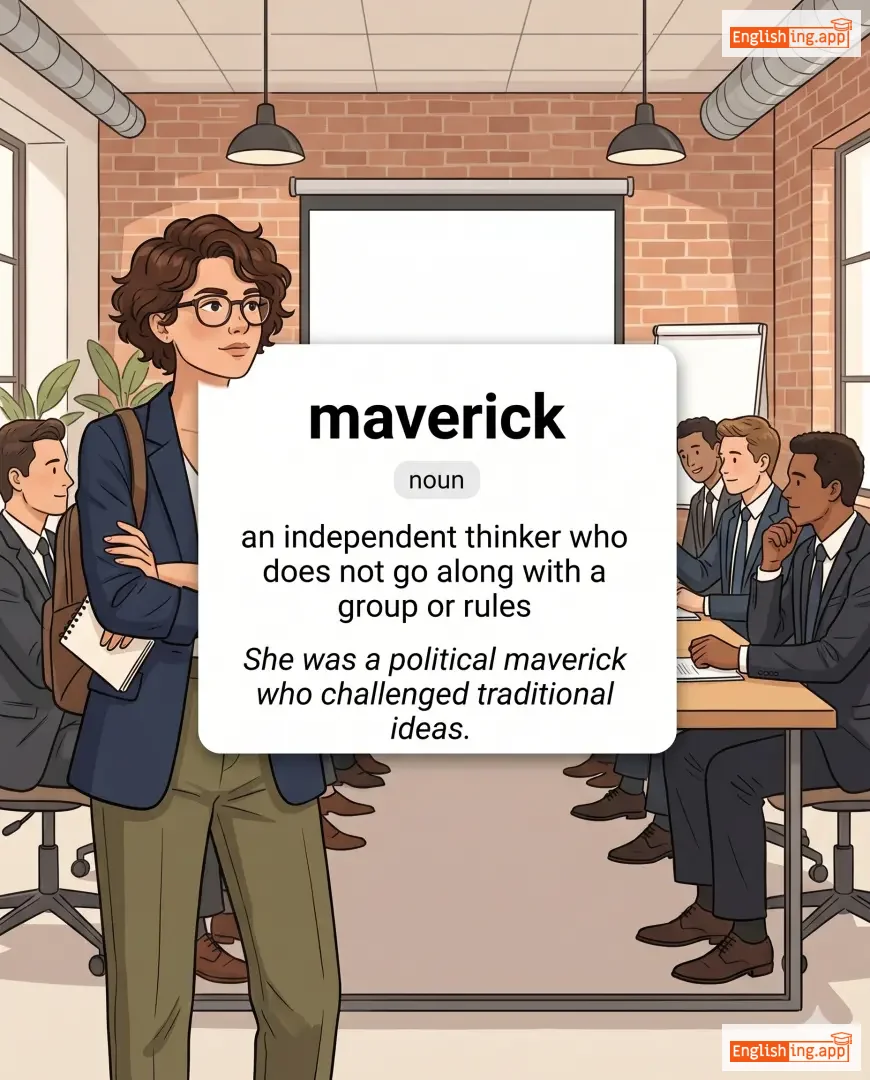
maverick definition card — visual illustration of the meaning
noun
/ˈmævərɪk/
स्वतंत्र विचारक (svatantra vicharak)

an independent thinker who does not go along with a group or rules

"She was a political maverick who challenged traditional ideas."

"वह एक राजनीतिक स्वतंत्र विचारक थी जिसने पारंपरिक विचारों को चुनौती दी।" (Woh ek rajnaitik svatantra vicharak thi jisne paaramparik vicharon ko chunauti di.)
adjective
/ˈmɔːkɪʃ/
अत्यधिक भावुक (atyadhik bhavuk)

excessively sentimental, often to the point of being sickly

"The movie was criticized for its mawkish sentimentality."

"मूवी को उसकी अत्यधिक भावुकता के लिए आलोचना की गई।" (Movie ko uski atyadhik bhavukta ke liye alochana ki gayi.)
noun
/ˈmæksɪm/
उक्ति (ukti)

a short, well-known statement expressing a general truth or rule of conduct

"Honesty is a timeless maxim valued in every culture."

"ईमानदारी एक कालातीत उक्ति है जिसे हर संस्कृति में सराहा जाता है।" (Imaandari ek kaalateet ukti hai jise har sanskriti mein saraaha jaata hai)
verb
/ˈmæk.sɪ.maɪz/
अधिकतम करना (adhiktam karna)

to increase something as much as possible

"The company aims to maximize its profits this year."

"कंपनी इस साल अपने लाभ को अधिकतम करने का लक्ष्य रखती है।" (Company is saal apne laabh ko adhiktam karne ka lakshya rakhti hai.)
noun/adjective
/ˈmæksɪməm/
अधिकतम (adhiktam)

the greatest or highest amount, value, or degree possible

"She scored the maximum marks in the exam."

"उसने परीक्षा में अधिकतम अंक प्राप्त किए।" (Usne pariksha mein adhiktam ank prapt kiye.)
modal verb, noun
/meɪ/
हो सकता है / मई महीना (ho sakta hai / May mahina)

Used to express possibility, permission, or uncertainty; also the name of the fifth month of the year.

"You may leave early if you finish your work."

"आप अपना काम खत्म करने के बाद जल्दी जा सकते हैं।" (Aap apna kaam khatam karne ke baad jaldi ja sakte hain.)