वोकैबुलरीज

इंग्लिश वोकैबुलरी डिस्कवर, लर्न और मास्टर करें

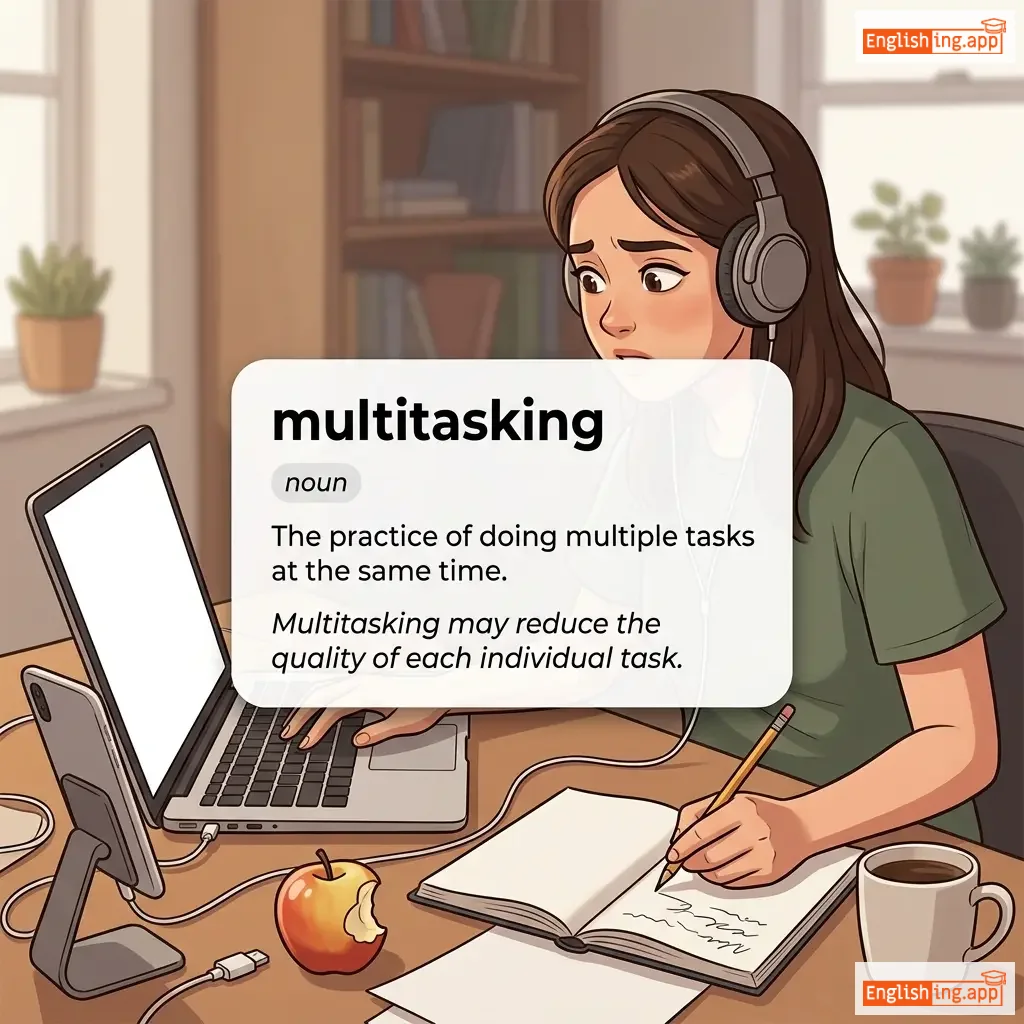
multitasking definition card — visual illustration of the meaning
noun
ˈmʌltɪˌtɑːskɪŋ
कई कार्य एक साथ करना (kai kary ek sath karna)

The practice of doing multiple tasks at the same time.

"Multitasking may reduce the quality of each individual task."

"मल्टीटास्किंग से प्रत्येक कार्य की गुणवत्ता कम हो सकती है।" (Multitasking se pratyek kary ki gunwatta kam ho sakti hai.)
noun
/ˈmʌltɪtuːd/
असंख्य (asankhya)

A large number of people or things.

"A multitude of fans gathered at the stadium."

"स्टेडियम में असंख्य प्रशंसक इकट्ठा हुए थे।" (Stadium mein asankhya prashansak ikattha hue the.)
adjective
/mʌm/
मौन; कुछ नहीं कहना; चुप रहना (maun; kuch nahi kehna; chup rehna)

silent; saying nothing; keeping quiet

"He kept mum about the surprise party plans."

"वह सरप्राइज पार्टी की योजना के बारे में मौन रहा।" (vah surprise party ki yojana ke baare mein maun raha.)
verb
/ˈmʌmbəl/
मध्यम आवाज में बोलना (madhyam awaaz mein bolna)

To speak quietly and not clearly so that words are difficult to understand.

"He mumbled an apology before leaving."

"वह जाने से पहले धीरे से एक माफी बोला।" (vah jane se pehle dheere se ek maafi bola.)
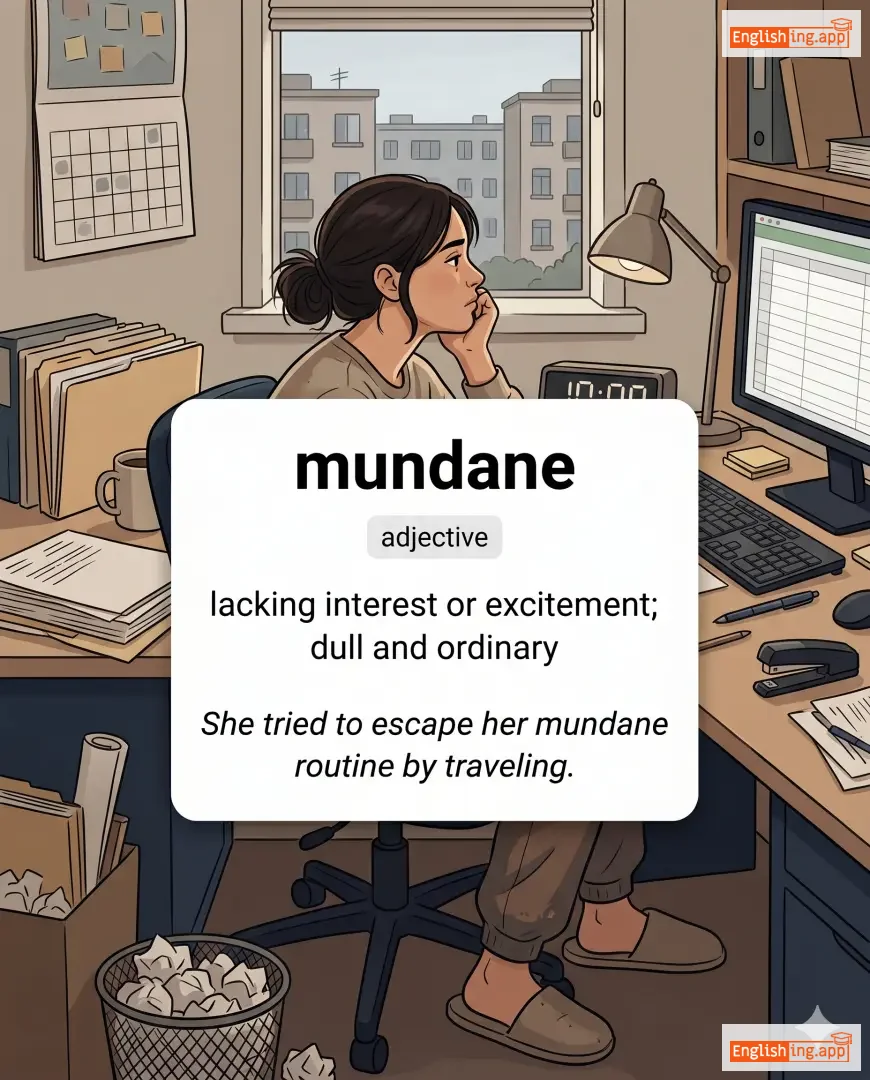
mundane definition card — visual illustration of the meaning
adjective
/mʌnˈdeɪn/
सामान्य (samanaya)

lacking interest or excitement; dull and ordinary

"She tried to escape her mundane routine by traveling."

"वह यात्रा करके अपनी नीरस दिनचर्या से बचने की कोशिश कर रही थी।" (Vah yatra karke apni neeras dincharya se bachne ki koshish kar rahi thi.)
mundanity definition card — visual illustration of the meaning
noun
mʌnˈdeɪ.nɪ.ti
साधारणता (sadharanata)

The quality of being ordinary, routine, or lacking excitement.

"The mundanity of office life can be exhausting."

"ऑफिस जीवन की साधारणता थकान उत्पन्न कर सकती है।" (Office jeevan ki sadharanata thakan utpann kar sakti hai.)
adjective
/mjuːˈnɪsɪpəl/
नगर निगम (nagar nigam)

relating to a city or town or its local government

"The municipal authority is responsible for maintaining the park."

"नगर निगम पार्क का रखरखाव करने के लिए जिम्मेदार है।" (Nagar nigam park ka rakh-rakhav karne ke liye jimmedar hai.)
noun
/ˌmjuːnɪsɪˈpæləti/
नगर निगम (nagar nigam)

a city or town that has its own local government

"The municipality is planning to build a new library."

"नगर निगम एक नई लाइब्रेरी बनाने की योजना बना रहा है।" (Nagar nigam ek nayi library banane ki yojna bana raha hai.)
noun
/mjuːˈnɪfəsəns/
उदारता (udarata)

great generosity or lavish giving

"The hospital was built thanks to the munificence of a wealthy donor."

"अस्पताल का निर्माण एक समृद्ध दाता की उदारता के कारण हुआ।" (Aspataal ka nirmaan ek samriddh daata ki udarata ke kaaran hua.)
adjective
/mjuːˈnɪfɪsənt/
अत्यंत उदार (atyant udar)

extremely generous; giving freely and abundantly

"She made a munificent donation to the orphanage."

"उसने अनाथ आश्रम को एक अत्यंत उदार दान दिया।" (Usne anath ashram ko ek atyant udar dan diya.)
noun
/ˈmjʊərəl/
दीवार चित्र (deewar chitra)

A large painting or artwork applied directly to a wall or ceiling surface.

"The artist painted a mural on the side of the school building."

"कलाकार ने स्कूल भवन की दीवार पर एक दीवार चित्र बनाया।" (Kalaakar ne school bhawan ki deewar par ek deewar chitra banaya.)
noun, verb
/ˈmɜːrdər/
हत्या (hatya)

the unlawful killing of a person; to kill someone unlawfully and intentionally

"The detective investigated the murder that shocked the town."

"जासूस ने उस हत्या की जांच की, जिसने शहर को चौंका दिया।" (jaasoos ne us hatya ki jaanch ki, jisne sheher ko chonka diya.)
noun
/ˈmɜːrdərər/
हत्या करने वाला (hatya karne wala)

a person who unlawfully kills another human being with intent

"The murderer was caught by the police within hours."

"हत्या करने वाला पुलिस द्वारा कुछ ही घंटों में पकड़ लिया गया था।" (hatya karne wala police dwara kuch hi ghanton mein pakad liya gaya tha.)
adjective
/ˈmɜː(r)dərəs/
हत्यारा; हत्या करने वाला; अत्यधिक हिंसक; खूनख़राबा करने वाला (mardarash)

having the intent to kill; extremely violent; bloodthirsty

"The murderous look in his eyes frightened everyone."

"उसकी आँखों में हत्या करने वाली नजर ने सभी को डराया।" (uski aankhon mein hatya karne wali nazar ne sabhi ko daraaya.)
noun
/ˈmɜːkinəs/
अस्पष्टता (aspashtata)

The quality of being dark, gloomy, or unclear.

"The murkiness of the water made it hard to see the fish."

"पानी की अस्पष्टता ने मछलियों को देखना मुश्किल बना दिया था।" (Pani ki aspashtata ne machhiyon ko dekhna mushkil bana diya tha.)
adjective
/ˈmɜːki/
धुंधला (dhundhla)

Dark, gloomy, and difficult to see through; obscure.

"We avoided swimming in the murky river."

"हमने धुंधले नदी में तैरने से बचा।" (Humne dhundhle nadi mein tairne se bacha.)
verb
/ˈmɜːrmər/
फुसफुसाना (fusufusana)

To say something in a low, soft, or indistinct voice.

"She murmured a prayer before going to sleep."

"वह सोने से पहले एक प्रार्थना फुसफुसाकर कह रही थी।" (Wah sone se pehle ek prarthna fusufusakar keh rahi thi.)
noun
/ˈmʌrɪn/
पशुधन का संक्रामक रोग (pashudhan ka sankramak rog)

An infectious disease that affects cattle and other animals, often fatal.

"The farmer lost many cows during the outbreak of murrain."

"किसान ने मुरेन के प्रकोप के दौरान कई गायों को खो दिया" (Kisan ne murrain ke prakop ke dauran kai gayon ko kho diya)
noun
/ˈmʌsl/
पेशी (peshi)

a band of fibrous tissue in the body that produces movement; physical strength

"He exercises daily to build strong muscles."

"वह रोजाना व्यायाम करता है ताकि मजबूत मांसपेशियाँ बनाए।" (vah rozana vyayam karta hai taki majboot maanspeshiyaan banaye.)
musculoskeletal condition definition card — visual illustration of the meaning
noun
মাসকুলোস্কেলেটাল কন্ডিশন
मांसपेशी और हड्डी से संबंधित समस्या (maanspesi aur haddi se sambandhit samasya)

A disorder that affects the muscles, bones, joints, tendons, ligaments, or other structures that support the limbs, neck, and back.

"De Quervain's Syndrome is a common musculoskeletal condition."

"डे क्वेरवैन सिंड्रोम एक सामान्य मांसपेशी और हड्डी से संबंधित समस्या है।" (De Quervain's Syndrome ek samanaya maanspesi aur haddi se sambandhit samasya hai.)
verb, noun
/mjuːz/
गहरे विचार करना / प्रेरणा का स्रोत (gahre vichar karna / prerna ka srot)

to think deeply about something; a source of inspiration, especially for an artist or writer

"She sat by the window to muse about her future."

"वह खिड़की के पास बैठकर अपने भविष्य के बारे में सोच रही थी।" (Woh khidki ke paas baithkar apne bhavishya ke baare mein soch rahi thi.)
noun
/mjuˈziːəm/
संग्रहालय (sangrahalay)

a building in which objects of historical, scientific, artistic, or cultural interest are stored and exhibited

"We visited the art museum to see the new exhibition."

"हम नई प्रदर्शनी देखने के लिए कला संग्रहालय गए थे।" (ham nayi prodarshani dekhne ke liye kala sangrahalay gaye the.)
noun
/ˈmʌʃruːm/
मशरूम (एक प्रकार का कवक) (mashroom)

a type of fungus with a round top and a short stem, some of which are edible

"We cooked a delicious soup with fresh mushrooms."

"हमने ताजे मशरूम से स्वादिष्ट सूप पकाया।" (Hamne taze mashroom se swadisht soup pakaya.)
noun
/ˈmjuːzɪk/
संगीत (sangeet)

vocal or instrumental sounds combined to produce harmony, melody, or rhythm

"She loves listening to classical music."

"वह शास्त्रीय संगीत सुनना पसंद करती है।" (Wah shastriya sangeet sunna pasand karti hai.)
adjective
/ˈmɪzɪkəl/
संगीतात्मक (sangeetatmaka)

related to or consisting of music

"She has a very musical voice."

"उसकी एक बहुत संगीतात्मक आवाज़ है।" (Uski ek bahut sangeetatmaka awaaz hai.)
noun
/mjuːˈzɪʃən/
संगीतकार (sangeetkaar)

a person who plays a musical instrument or is musically talented

"He is a talented musician."

"वह एक प्रतिभाशाली संगीतकार है।" (Wah ek pratibhashali sangeetkaar hai.)
noun
/mʌsk/
मस्क (mask)

a strong-smelling substance secreted by certain animals, used in perfumes and traditional medicine

"The perfume contained natural musk that gave it an exotic fragrance."

"द परफ्यूम में प्राकृतिक मस्क था जिसने उसे एक विदेशी खुशबू दी।" (da perfume mein prakritik mask tha jisne use ek videshi khushboo dee)
noun
/ˈmʌskɪt/
पुरानी प्रकार की लंबी बंदूक (purani prakar ki lambi bandook)

a type of long gun used in the past, especially by infantry soldiers

"The soldiers carried muskets into the battlefield."

"सैनिक युद्धभूमि में मस्केट लेकर गए थे।" (Sainik yudhbhumi mein musket lekar gaye the.)
adjective
/ˈmʌski/
मस्ख़ी (maskhi)

having a strong, sweet, earthy smell like musk

"The perfume had a musky fragrance."

"परफ्यूम में मस्ख़ी खुशबू थी।" (Perfume mein maskhi khushboo thi.)
noun
/ˈmʊzlɪm/
मुसलिम (muslim)

a follower of Islam

"He is a devout Muslim."

"वह एक पक्का मुसलिम है।" (Wah ek pakka Muslim hai.)
verb
/mʌst/
करना होगा (karna hoga)

to be required or obligated to

"You must complete your homework before you go out."

"तुम्हें अपना होमवर्क खत्म करना होगा, फिर तुम बाहर जा सकते हो।" (Tumhein apna homework khatam karna hoga, phir tum bahar ja sakte ho.)
noun
/ˈmʌs.tərd/
सरसों (sarson)

A pungent seed or condiment made from ground mustard seeds

"She added mustard seeds to the curry for extra flavor."

"उसने करी में अतिरिक्त स्वाद के लिए सरसों के बीज डाले।" (usne kari mein atirikt swad ke liye sarson ke beej daale.)
noun
/ˈmʌs.tərd liːf/
सरसों का पत्ता (sarson ka patta)

green leafy vegetable from the mustard plant; edible leaves used in cooking

"We cooked mustard leaf with fish in a traditional Bengali curry."

"हमने पारंपरिक बांग्ला करी में मछली के साथ सरसों के पत्ते पकाए।" (hamne paaramparik baangla kari mein machhli ke saath sarson ke patte pakaaye.)
noun
/ˈmʌstərd ɔɪl/
सरसों का तेल (sarson ka tel)

oil extracted from mustard seeds, commonly used for cooking and medicinal purposes

"We use mustard oil for cooking vegetables in our kitchen."

"हम अपनी रसोई में सब्ज़ियाँ पकाने के लिए सरसों के तेल का इस्तेमाल करते हैं।" (ham apni rasoee mein sabziyaan pakane ke liye sarson ke tel ka istemaal karte hain.)
noun
/ˈmʌs.tərd siːdz/
सरसों के बीज (sarson ke beej)

small round seeds from the mustard plant, used as a spice and for making mustard condiment

"Mustard seeds are often tempered in hot oil to release their nutty flavor before adding to dishes."

"सरसों के बीज को अक्सर गर्म तेल में तड़का लगाया जाता है ताकि उनका नट्टी फ्लेवर निकल सके और खाने में डाला जा सके।" (sarson ke beej ko aksar garm tel mein tadka lagaya jata hai taki unka nutty flavor nikal sake aur khane mein dala ja sake.)
verb, noun
/ˈmʌstər/
इकट्ठा करना / साहस जुटाना (ikatha karna / sahas jutana)

to gather people, especially soldiers; to summon courage or strength

"He mustered enough courage to face the challenge."

"उसने चुनौती का सामना करने के लिए पर्याप्त साहस जुटाया।" (Usne chunauti ka samna karne ke liye paryapt sahas jutaya.)
adjective
/ˈmʌsti/
बासी, सड़ा हुआ या नम गंध (basi, sda hua ya nam gandh)

having a stale, moldy, or damp smell

"The old books had a musty odor."

"पुरानी किताबों में बासी गंध थी।" (Purani kitabon mein basi gandh thi.)
noun
/ˌmjuːtəˈbɪləti/
परिवर्तनशीलता (parivartansheelta)

The quality of being changeable or capable of change.

"The mutability of fashion trends makes it hard to keep up."

"फैशन ट्रेंड्स की परिवर्तनशीलता को बनाए रखना कठिन होता है।" (Fashion trends ki parivartansheelta ko banaye rakhna kathin hota hai.)
adjective
/ˈmjuːtəbl/
परिवर्तनीय (parivartaniy)

Capable of change or alteration.

"Human emotions are mutable and can shift rapidly."

"मानव भावनाएँ परिवर्तनीय होती हैं और जल्दी बदल सकती हैं।" (Manav bhavnaayein parivartaniy hoti hain aur jaldi badal sakti hain.)
noun
/ˌmjuːtəˈbɪləti/
म्यूटाबिलिटी (गलत वर्तनी) (mutability (galat vartani))

A misspelled form of 'mutability', meaning the quality of being changeable.

"The document contained the misspelled word 'mutablility' instead of 'mutability'."

"दस्तावेज़ में 'mutability' के स्थान पर 'mutablility' की गलत वर्तनी थी।" (Dastaavez mein 'mutability' ke sthan par 'mutablility' ki galat vartani thi.)
verb
/ˈmjuːteɪt/
रूपांतरित होना (roopantarit hona)

To change or cause to change in form, nature, or character.

"The virus can mutate into a more dangerous strain."

"वायरस एक और अधिक खतरनाक रूप में म्यूटेट कर सकता है।" (Virus ek aur adhik khatarnak roop mein mutate kar sakta hai.)
noun
/mjuːˈteɪʃn/
परिवर्तन, आनुवंशिक उत्परिवर्तन (parivartan, anuvanshik utparivartan)

A change in form, structure, or nature, especially in genetics.

"Scientists discovered a genetic mutation that caused the disorder."

"वैज्ञानिकों ने एक आनुवंशिक उत्परिवर्तन की खोज की जिसने इस विकार का कारण बना।" (Vaigyanikon ne ek anuvanshik utparivartan ki khoj ki jisne is vikaar ka kaaran bana.)
adjective
/mjuːt/
चुप (myoot)

silent or unable to speak; not expressed in words

"She remained mute during the entire meeting."

"पूरी मीटिंग के दौरान वह मौन रही।" (poori meeting ke dauran vah maun rahi)
adjective
/ˈmjuːtɪd/
मद्धम (maddham)

softened in sound, color, or effect; subdued

"The room was painted in muted shades of blue and grey."

"कमरे को नीले और ग्रे के मद्धम रंगों में रंगा गया था।" (Kamre ko neele aur grey ke maddham rangon mein ranga gaya tha.)
verb
/ˈmjuːtɪleɪt/
विकृत करना (vikrit karna)

to inflict serious damage on something, often by cutting or tearing

"The ancient manuscript was mutilated by careless handling."

"प्राचीन पाण्डुलिपि को लापरवाह तरीके से हैंडल करने से विकृत कर दिया गया था।" (Prachin pandulipi ko laaparwah tareeke se handle karne se vikrit kar diya gaya tha.)
adjective
/ˈmjuːtɪnəs/
विद्रोही (vidrohi)

refusing to obey authority; rebellious

"The soldiers grew mutinous after months without pay."

"सैनिक महीने भर बिना वेतन के रहने के बाद विद्रोही हो गए थे।" (Sainik mahine bhar bina vetan ke rehne ke baad vidrohi ho gaye the.)
noun
/ˈmjuːtɪni/
विद्रोह (vidroh)

an open rebellion against authority, especially by soldiers or sailors

"The sailors staged a mutiny against their captain."

"नाविकों ने अपने कप्तान के खिलाफ विद्रोह किया।" (Navikon ne apne kaptan ke khilaf vidroh kiya.)
verb
/ˈmʌtər/
बुदबुदाना (budbudana)

to speak in a low or barely audible voice, often in dissatisfaction or irritation

"He muttered something under his breath as he walked away."

"उसने चलते हुए कुछ बुदबुदाया।" (Usne chalte hue kuch budbudaya.)
noun
/ˈmʌtn/
बकरा मांस (bakra maans)

meat from an adult sheep; lamb meat

"The restaurant serves delicious mutton curry with rice."

"रेस्टोरेंट चावल के साथ स्वादिष्ट बकरा मांस करी सर्व करता है।" (restorent chawal ke saath swadisht bakra maans curry serve karta hai.)
adjective
/ˈmjuːtʃuəl/
आपसी (aapsi)

felt, shared, or done by two or more people equally

"They have mutual respect for each other."

"उनके बीच आपसी सम्मान है।" (Unke beech aapsi sammaan hai.)