वोकैबुलरीज

इंग्लिश वोकैबुलरी डिस्कवर, लर्न और मास्टर करें

noun
/moʊld/
मोल्ड / फफूंदी (mould)

a hollow container used to give shape to molten material; fungus

"She poured chocolate into the mould to make candies."

"उसने कैंडी बनाने के लिए चॉकलेट को मोल्ड में डाला।" (Usne kaindi banane ke liye chaokalet ko mold me daala.)
verb
/maʊnt/
चढ़ना (chadhna)

to climb up, rise, or fix something in place

"They plan to mount a camera on the wall."

"वे दीवार पर एक कैमरा लगाने की योजना बना रहे हैं।" (ve deewar par ek camera lagane ki yojana bana rahe hain.)
noun
/ˈmaʊntən/
पहाड़ (pahaad)

a large natural elevation of the earth’s surface

"They climbed the highest mountain in the region."

"उन्होंने क्षेत्र का सबसे ऊंचा पहाड़ चढ़ा।" (Unhone kshetra ka sabse uncha pahaad chadha.)
noun
/ˌmaʊntəˈnɪə/
पहाड़ चढ़ने वाला (pahaad chadhne wala)

A person who climbs mountains as a sport or profession.

"The mountaineer reached the summit after a long climb."

"लंबी चढ़ाई के बाद पहाड़ चढ़ने वाला शिखर पर पहुंचा।" (Lambi chadhai ke baad pahaad chadhne wala shikhar par pahucha.)
adjective
/ˈmaʊntənəs/
पहाड़ी (pahaadi)

Having many mountains; very large or huge in size.

"They traveled through a mountainous region of Nepal."

"वे नेपाल के एक पहाड़ी क्षेत्र से यात्रा कर रहे थे।" (Ve Nepal ke ek pahaadi kshetra se yatra kar rahe the.)
noun
/ˈmaʊntɪˌbæŋk/
ठग (thag)

A charlatan or trickster who deceives others, often for personal gain.

"The crowd was fooled by the mountebank’s false promises."

"भीड़ माउंटेबैंक के झूठे वादों से धोखा खा गई।" (Bheer mountebank ke jhoothe vaadon se dhokha khaa gayi.)
verb
/mɔːrn/
शोक करना (shok karna)

To feel or express deep sadness or grief, especially because of someone's death.

"They gathered to mourn the loss of their friend."

"वे अपने दोस्त के नुकसान पर शोक करने के लिए एकत्रित हुए।" (Ve apne dost ke nuksan par shok karne ke liye ekatrit hue.)
noun
/ˈmɔːr.nər/
शोक संतप्त व्यक्ति (shok santapt vyakti)

a person who attends a funeral or shows grief for someone who has died

"The mourners gathered at the cemetery to pay their respects."

"शोक व्यक्त करने के लिए शोक संतप्त लोग कब्रिस्तान में एकत्रित हुए।" (shok vyakt karne ke liye shok santapt log kabristan mein ekatrit hue.)
adjective
/ˈmɔːrn.fəl/
दुःखी (dukhī)

feeling, expressing, or causing sadness or grief

"The mournful song reminded her of lost loved ones."

"दुःखी गीत ने उसे खोए हुए प्रियजनों की याद दिलाई।" (Dukhī gīt ne use khoe huye priyajanon ki yaad dilaī.)
noun
/ˈmɔːr.nɪŋ/
शोक (shok)

the expression of deep sorrow for someone who has died

"The family is in mourning for their grandmother."

"परिवार अपनी दादी के लिए शोक व्यक्त कर रहा है।" (parivaar apni daadi ke liye shok vyakt kar raha hai.)
noun
/maʊs/
चूहा / कंप्यूटर माउस (chooha / computer mouse)

a small rodent with a pointed nose and long tail; also a computer input device

"The cat chased the mouse across the room."

"बिल्ली ने कमरे के पार चूहे का पीछा किया।" (Billee ne kamre ke paar choohe ka peecha kiya.)
noun
/məˈstɑːʃ/
मूंछ (munch)

hair that grows on the upper lip of a man's face

"He decided to grow a moustache for the first time."

"उसने पहली बार मूंछ उगाने का फैसला किया।" (Usne pehli baar munch ugane ka faisla kiya.)
noun
/maʊθ/
मुंह (munh)

the opening in the face used for eating, speaking, and breathing

"She covered her mouth when she yawned."

"वह जब आह भरी, तो उसने अपना मुंह ढक लिया।" (Vah jab aah bhari, to usne apna munh dhak liya.)
noun
/ˈmaʊθ.fʊl/
मुंह भर (munh bhar)

the amount of food or drink that fills the mouth, or a long and difficult word or phrase

"He took a big mouthful of water after the run."

"उसने दौड़ के बाद एक बड़ा मुंह भर पानी लिया।" (Usne daud ke baad ek bada munh bhar paani liya.)
adjective
/ˈmuː.və.bl̩/
संचलनशील; पोर्टेबल; स्थानांतरित किया जा सकता है; (sanchalansheel; portable; sthaanantarit kiya ja sakta hai;)

capable of being moved; not fixed in position

"The furniture is movable so we can rearrange the room easily."

"फर्नीचर संचलनशील है, ताकि हम कमरे को आसानी से पुनर्व्यवस्थित कर सकें।" (furnichar sanchalansheel hai, taaki hum kamre ko aasani se punarvyavasthit kar sakein.)
move definition card — visual illustration of the meaning
verb
/muːv/
स्थानांतरित करना (sthanantarit karna)

To change position, place, or state.

"They decided to move to a new city."

"उन्होंने एक नए शहर में जाने का फैसला किया।" (Unhone ek naye sheher mein jaane ka faisla kiya.)
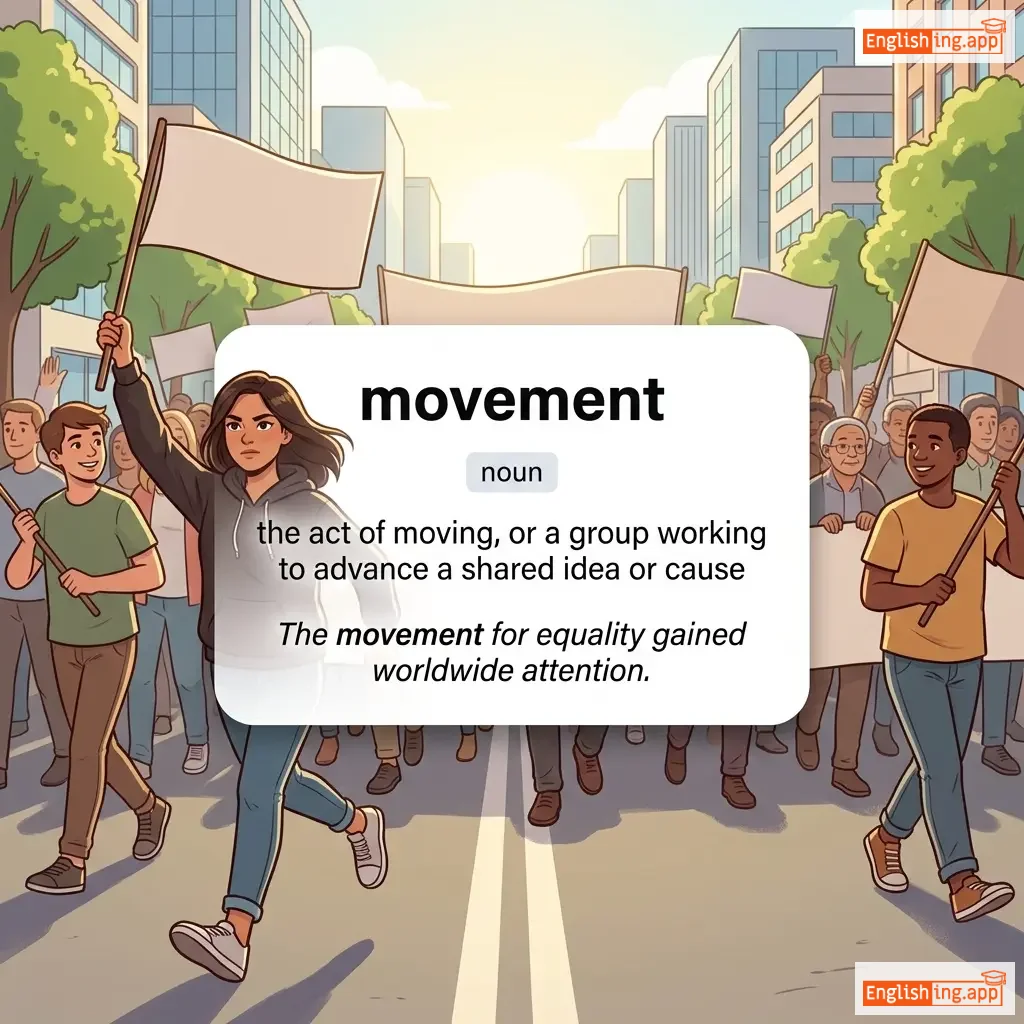
movement definition card — visual illustration of the meaning
noun
/ˈmuːv.mənt/
आंदोलन (andolan)

the act of moving, or a group working to advance a shared idea or cause

"The movement for equality gained worldwide attention."

"समानता के लिए आंदोलन ने विश्वभर का ध्यान आकर्षित किया।" (Samaanta ke liye andolan ne vishwabhar ka dhyan aakarshit kiya.)
movements definition card — visual illustration of the meaning
noun
ˈmuːv.mənts
आंदोलन (andolan)

Organized efforts by groups of people working together to advance their shared political, social, or artistic ideas.

"Freedom movements paved the way for independence."

"स्वतंत्रता आंदोलनों ने स्वतंत्रता के रास्ते खोले।" (Svatantrata andolonon ne svatantrata ke raste khole.)
noun
/ˈmuːvi/
सुख (sukh)

A motion picture or film shown in a cinema or on television.

"We watched a movie together last night."

"जब उसने पुरस्कार प्राप्त किया, तो वह अपनी खुशी छिपा नहीं सकी।" (Jab usne puraskar prapt kiya, to vah apni khushi chhupa nahi saki.)
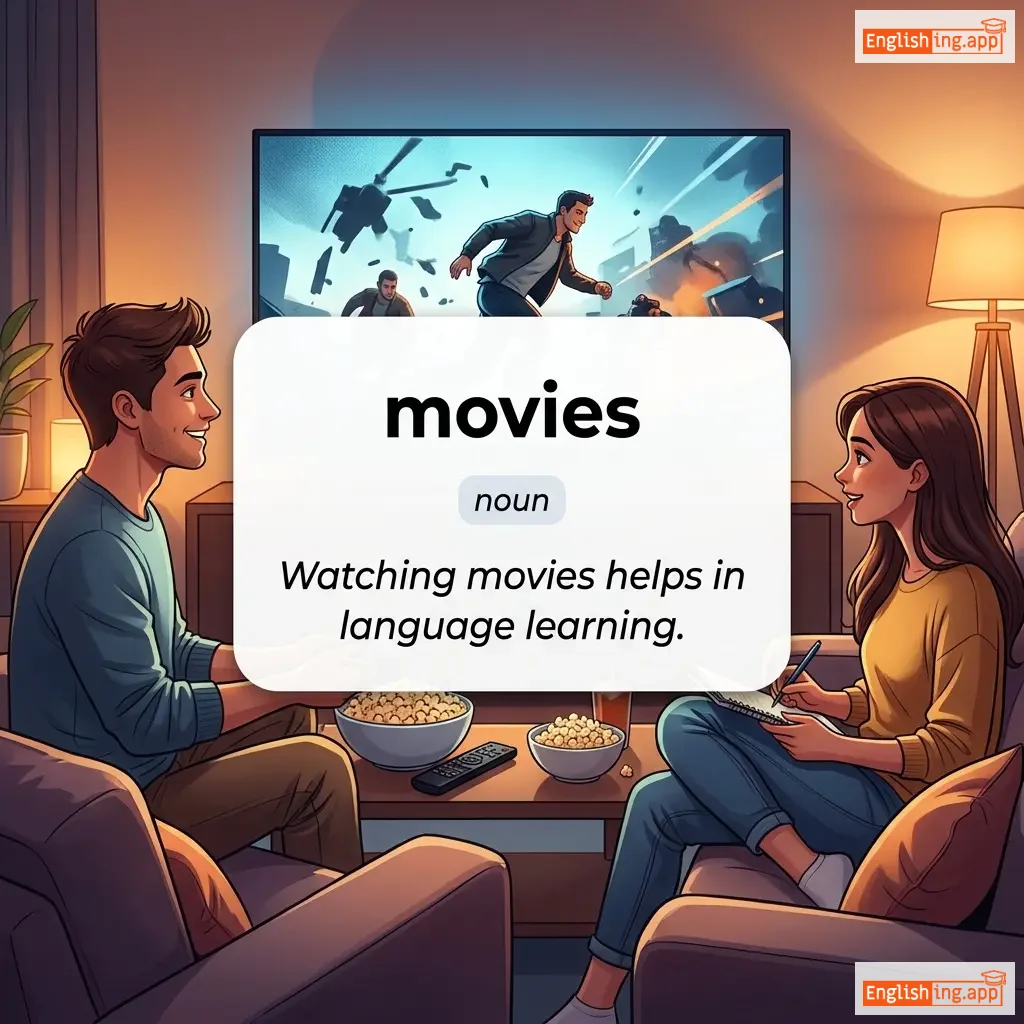
movies definition card — visual illustration of the meaning
noun
ˈmuːviz
फिल्में (filmein)

A story or event recorded by a camera as a set of moving images and shown in a theater or on television.

"Watching movies helps in language learning."

"फिल्में देखना भाषा सीखने में मदद करता है।" (Filmein dekhna bhasha seekhne mein madad karta hai.)
adjective
/ˈmuːvɪŋ/
भावुक (bhavuk)

causing strong feelings, especially of sympathy or sadness

"Her speech was so moving that everyone cried."

"उसका भाषण इतना भावुक था कि सब रो पड़े।" (Uska bhashan itna bhavuk tha ki sab ro pade.)
title
/ˈmɪstər/
श्री. (shree.)

a title used before a man's name

"Mr. Rahman is our new teacher."

"श्री. रहमान हमारे नए शिक्षक हैं।" (Shree. Rahman humare naye shikshak hain.)
title
/ˈmɪsɪz/
मिसेज़ (misez)

a title used before a married woman's name

"Mrs. Karim is the headmistress of the school."

"मिसेज़ करीम स्कूल की प्रधान शिक्षिका हैं।" (Misez Karim school ki pradhan shikshika hain.)
title
/mɪz/
मिज़ (miz)

a title used before a woman's name, regardless of marital status

"Ms. Akter will give a speech at the seminar."

"मिज़ आक्तर सेमिनार में एक भाषण देंगी।" (Miz Akter seminar mein ek bhaashan dengi.)
adjective, adverb, pronoun
/mʌtʃ/
बहुत (bahut)

a large amount or degree of something

"She doesn’t have much time to finish the project."

"उसे परियोजना समाप्त करने के लिए बहुत कम समय है।" (use pariyojana samaapt karne ke liye bahut kam samay hai.)
noun
/mʌd/
कीचड़ (keechad)

soft, wet earth or soil

"The children were playing in the mud after the rain."

"बच्चे बारिश के बाद कीचड़ में खेल रहे थे।" (Bacche baarish ke baad keechad mein khel rahe the.)
verb
/ˈmʌd.əl/
गड़बड़ करना (gadbadh karna)

to mix things up in a confused way or to make a mess of something

"He muddled the papers and couldn’t find the report."

"उसने कागजों को गड़बड़ कर दिया और रिपोर्ट नहीं ढूँढ पाया।" (Usne kagazon ko gadbadh kar diya aur report nahi dhoondh paaya.)
adjective
/ˈmʌd.i/
कीचड़ से ढका हुआ (keechad se dhaka hua)

covered in or full of mud; unclear or confused

"The children came back with muddy shoes after playing outside."

"बच्चे बाहर खेलकर कीचड़ में सने जूते पहनकर वापस आए।" (bachche baahar khelkar keechad mein sone joote pehankar wapas aaye.)
verb
/ˈmʌfəl/
दबाना (dabana)

to make a sound quieter or less distinct; to cover or wrap something to reduce noise or warmth

"She tried to muffle her laughter with a scarf."

"वह एक दुपट्टे से अपनी हंसी दबाने की कोशिश कर रही थी।" (Vah ek dupatte se apni hasi dabane ki koshish kar rahi thi.)
noun
/ˈmʌflər/
मफलर (maflar)

a device on a vehicle's exhaust to reduce noise; also a scarf worn around the neck for warmth

"The car's muffler needs to be replaced."

"कार का मफलर बदलने की जरूरत है।" (Kar ka maflar badalne ki zarurat hai.)
noun
/mʌɡ/
मग (mag)

a large cup, typically cylindrical and having a handle and used without a saucer

"She drank her morning coffee from a ceramic mug."

"वह अपनी सुबह की कॉफी एक सिरेमिक मग से पी रही थी।" (vah apni subah ki kofi ek seramik mag se pee rahi thi.)
adjective
/ˈmʌɡi/
उबाला और आर्द्र (ubala aur aardra)

uncomfortably warm and humid

"It was a muggy afternoon in July."

"जुलाई में एक उबाला और आर्द्र दोपहर था।" (Julai mein ek ubala aur aardra dopahar tha.)
noun
/ˈmʌɡwʌmp/
राजनीतिक दलों से अप्रभावित व्यक्ति (rajnitik dalon se aprabhavit vyakti)

a person who remains independent from party politics or remains aloof from disputes

"He was called a mugwump for refusing to join either political side."

"उसे राजनीतिक दलों में से किसी भी एक में शामिल होने से इंकार करने पर मगवंप कहा गया।" (Use rajnaitik dalon mein se kisi bhi ek mein shamil hone se inkaar karne par mugwump kaha gaya.)
noun
/mjuːˈlætoʊ/
मिश्रित नस्ल का व्यक्ति (पुराना और आपत्तिजनक शब्द) (mishrit nasl ka vyakti (purana aur aapattijanak shabd))

an outdated and now offensive term historically used to describe a person of mixed white and Black ancestry

"The word 'mulatto' is now considered outdated and offensive."

"'मुलाटो' शब्द अब पुराना और आपत्तिजनक माना जाता है।" ('Mulatto' shabd ab purana aur aapattijanak maana jaata hai.)
verb
/mʌlkt/
जुर्माना लगाना / धोखाधड़ी करना (jurmana lagana / dhokhadhdi karna)

to punish by a fine or to defraud someone of money

"The corrupt official was mulcted for his misconduct."

"दुराचार के लिए भ्रष्ट अधिकारी को जुर्माना लगाया गया।" (Durachar ke liye bhrasht adhikari ko jurmana lagaya gaya.)
noun
/mjuːl/
खच्चर (khachchar)

the offspring of a donkey and a horse, used as a working animal

"The farmer used a mule to carry heavy loads."

"किसान ने भारी बोझ ढोने के लिए एक खच्चर का इस्तेमाल किया।" (kisan ne bhari bojh dhone ke liye ek khachchar ka istemal kiya.)
noun
/ˌmjuːlˈtɪər/
खच्चर चालक (khacchar chalak)

a person who drives or takes care of mules

"The muleteer guided the animals safely across the mountain path."

"खच्चर चालक ने जानवरों को सुरक्षित रूप से पहाड़ी रास्ते पर मार्गदर्शन किया।" (Khacchar chalak ne janwaron ko surakshit roop se pahaadi raaste par maargdarshan kiya.)
noun
/muˈleθi/
मुलेठी (mulethee)

licorice root, a sweet-tasting herb used in traditional medicine and cooking

"She prepared a herbal tea with mulethi to soothe her sore throat."

"उसने गले की खराश को ठीक करने के लिए मुलैथी से हर्बल चाय बनाई।" (Usne gale ki kharash ko theek karne ke liye mulethi se herbal chai banai.)
adjective
/ˈmjuːlɪʃ/
जिद्दी (ziddi)

extremely stubborn or unwilling to change

"She remained mulish despite all the convincing arguments."

"उसने सभी समझाने के तर्कों के बावजूद बहुत जिद्दी बनी रही।" (usne sabhi samjhane ke tarkon ke bavjood bahut jiddi bani rahi)
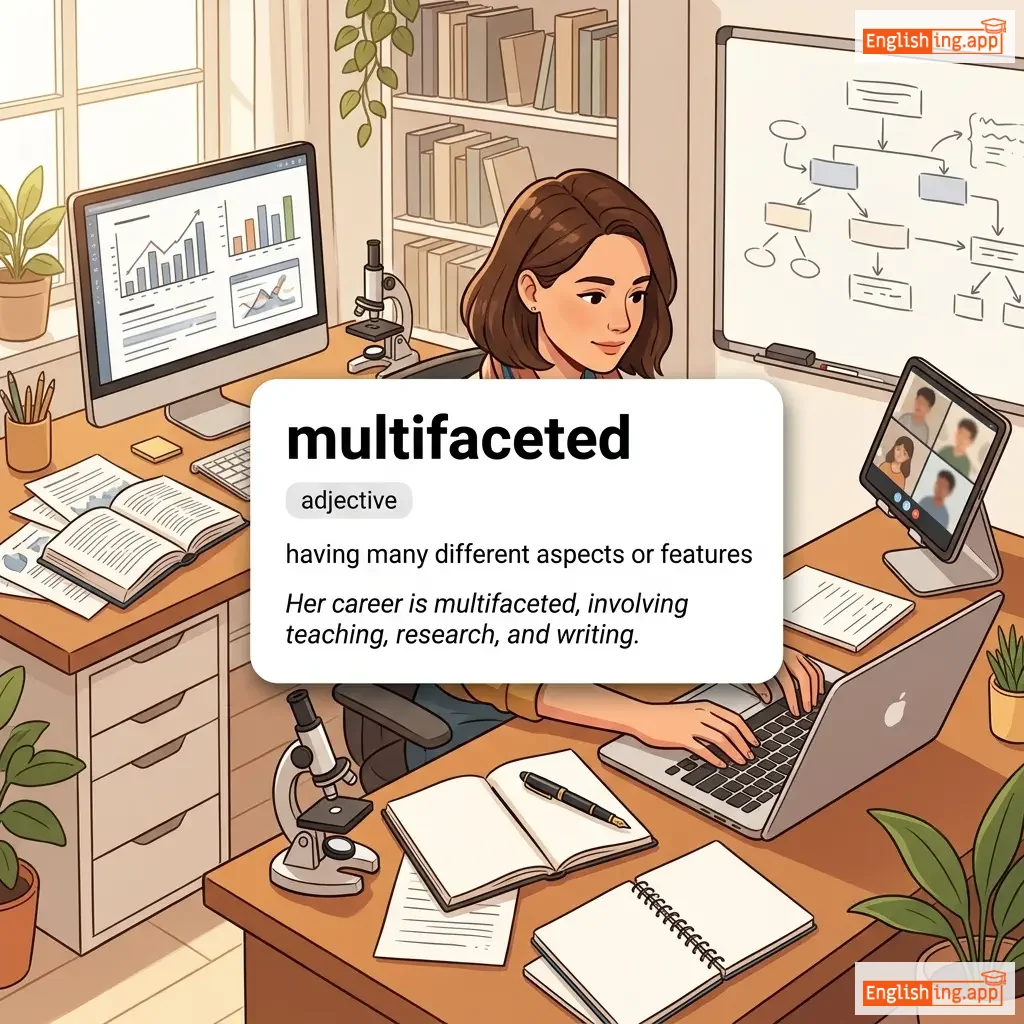
multifaceted definition card — visual illustration of the meaning
adjective
/ˌmʌltiˈfæsɪtɪd/
बहुआयामी (bahuayami)

having many different aspects or features

"Her career is multifaceted, involving teaching, research, and writing."

"उसका करियर बहुआयामी है, जिसमें शिक्षण, शोध, और लेखन शामिल हैं।" (Uska career bahuayami hai, jismein shikshan, shodh, aur lekhan shamil hain.)
multifaceted information frameworks definition card — visual illustration of the meaning
noun
ˌmʌltɪˈfæsɪtɪd ˌɪnfərˈmeɪʃən ˈfreɪmwɜːrks
बहुआयामी सूचना ढांचे (bahuayami soochna dhancha)

Complex, comprehensive structures for organizing and managing information that have multiple aspects or dimensions.

"Digital literacy involves building multifaceted information frameworks."

"डिजिटल साक्षरता में बहुआयामी सूचना ढांचे का निर्माण शामिल है।" (Digital saksharta mein bahuayami soochna dhancha ka nirmaan shaamil hai.)
adjective
/ˌmʌltɪˈfɛərɪəs/
विविध (vividh)

having many different parts, elements, or kinds

"The museum displayed a multifarious collection of artifacts."

"म्यूजियम ने विभिन्न प्रकार के कलाकृतियों का प्रदर्शन किया।" (Muzeem ne vibhinn prakar ke kalakrution ka pradarshan kiya.)
adjective
/ˈmʌltɪfɔːrm/
बहुरूपी (bahurupi)

Having many different forms or appearances.

"The festival was a multiform celebration of art, music, and culture."

"उत्सव एक बहुरूपी कला, संगीत और संस्कृति का उत्सव था।" (Utsav ek bahurupi kala, sangeet aur sanskriti ka utsav tha.)
adjective
/ˌmʌltɪˈlɪŋɡwəl/
बहुभाषी (bahubhashi)

Able to speak or written in several languages.

"She grew up in a multilingual household."

"वह एक बहुभाषी परिवार में पली-बढ़ी।" (Vah ek bahubhashi parivar mein pali-badhi.)
adjective
/ˈmʌltɪpl/
बहुत से (bahut se)

involving or consisting of many parts or elements

"The company faced multiple challenges during the year."

"कंपनी को साल के दौरान कई चुनौतियों का सामना करना पड़ा।" (kampani ko saal ke dauran kai chunautiyon ka samna karna pada.)
noun
/ˌmʌltɪplɪˈkeɪʃən/
गुणा (guna)

the mathematical process of combining numbers to get a product; the act of increasing in number or amount

"Multiplication is one of the basic operations taught in elementary mathematics."

"प्राथमिक गणित में गुणा एक बुनियादी क्रिया है।" (prathamik ganit mein guna ek buniyadi kriya hai)
noun
/ˌmʌltɪˈplɪsɪti/
बहुतता (bahtata)

A large number or variety of something.

"The project faced a multiplicity of challenges."

"प्रोजेक्ट को कई प्रकार की चुनौतियों का सामना करना पड़ा।" (Project ko kai prakar ki chunautiyon ka samna karna pada.)
noun
/ˈmʌltɪplaɪər/
गुणक (gunak)

a number or factor by which another number is multiplied; something that increases the effect or value of something else

"In economics, government spending can act as a multiplier for economic growth."

"अर्थशास्त्र में सरकारी खर्च आर्थिक वृद्धि के लिए एक गुणक हो सकता है।" (arthashastra mein sarkari kharch arthik vriddhi ke liye ek gunak ho sakta hai)
multiply definition card — visual illustration of the meaning
verb
/ˈmʌltɪplaɪ/
गुणा करना (guna karna)

to increase in number; to perform mathematical multiplication

"The bacteria multiply rapidly in warm conditions."

"गर्म परिस्थितियों में बैक्टीरिया तेजी से बढ़ते हैं।" (Garm paristhitiyon mein bacteria tezi se badhte hain)
adjective
/ˌmʌl.tiˈpɜː.pəs/
बहुउद्देशीय (bahudeshīya)

having multiple uses or functions; versatile

"This multipurpose tool can be used as a knife, screwdriver, and bottle opener."

"इस बहुउद्देशीय उपकरण का उपयोग चाकू, स्क्रूड्राइवर और बोतल ओपनर के रूप में किया जा सकता है।" (is bahudeshīya upkaran kā upayog chākū, screw driver aur botel opener ke rūp mein kiyā jā sakta hai.)