वोकैबुलरीज

इंग्लिश वोकैबुलरी डिस्कवर, लर्न और मास्टर करें

adjective, adverb, pronoun
/mɔːr/
अधिक (adhik)

A greater or additional amount or degree.

"She wanted more time to finish the project."

"वह परियोजना को पूरा करने के लिए और समय चाहती थी।" (vah pariyojana ko poora karne ke liye aur samay chahti thi.)
adverb
/mɔːrˈoʊvər/
इसके अलावा (iske alawa)

Used to add information that supports or emphasizes what has already been said.

"The job is challenging; moreover, it requires excellent communication skills."

"यह काम चुनौतीपूर्ण है; इसके अलावा, इसके लिए उत्कृष्ट संचार कौशल की आवश्यकता होती है।" (Yeh kaam chunautipurn hai; iske alawa, iske liye utkrsht sanchar kaushal ki avashyakta hoti hai.)
noun
/ˈmɔːreɪz/
संस्कार (sanskar)

the essential or characteristic customs and conventions of a community

"Social mores often dictate how people behave in public."

"सामाजिक संस्कार अक्सर यह निर्धारित करते हैं कि लोग सार्वजनिक रूप से कैसे व्यवहार करते हैं।" (Samajik sanskar aksar yah nirdharit karte hain ki log sarvajanik roop se kaise vyavhaar karte hain.)
adjective
/ˌmɔːrɡəˈnætɪk/
मॉर्गनेटिक विवाह (morganatic vivah)

relating to a marriage in which one partner, usually of lower social rank, does not share the titles or privileges of the other

"The prince entered into a morganatic marriage with a commoner."

"राजकुमार ने एक सामान्य व्यक्ति से म़ॉर्गनेटिक विवाह किया।" (Rajkumar ne ek samanya vyakti se morganatic vivah kiya.)
noun
/mɔːrɡ/
शवगृह (morg)

a place where dead bodies are kept, especially to be identified or claimed

"The police took the body to the morgue for identification."

"पुलिस ने पहचान के लिए शव को शवगृह में ले लिया।" (di police tuke di body tu di morg for aidentifikeshan)
adjective
/ˈmɔːrɪbʌnd/
मृतप्राय (mrttopray)

in a dying state; near death or becoming obsolete

"The moribund industry was soon replaced by modern technology."

"मृतप्राय उद्योग को जल्द ही आधुनिक तकनीकी द्वारा प्रतिस्थापित कर दिया गया था।" (Mrttopray udyog ko jald hi adunik takneek dwara pratisthapit kar diya gaya tha.)
noun
/ˈmɔːrnɪŋ/
खुशी (khushi)

the early part of the day, typically from sunrise until noon

"I like to go for a run in the morning."

"उसे पुरस्कार मिलने पर अपनी खुशी छुपाने में कोई सफलता नहीं मिली।" (Use puraskar milne par apni khushi chhupane mein koi safalta nahi mili.)
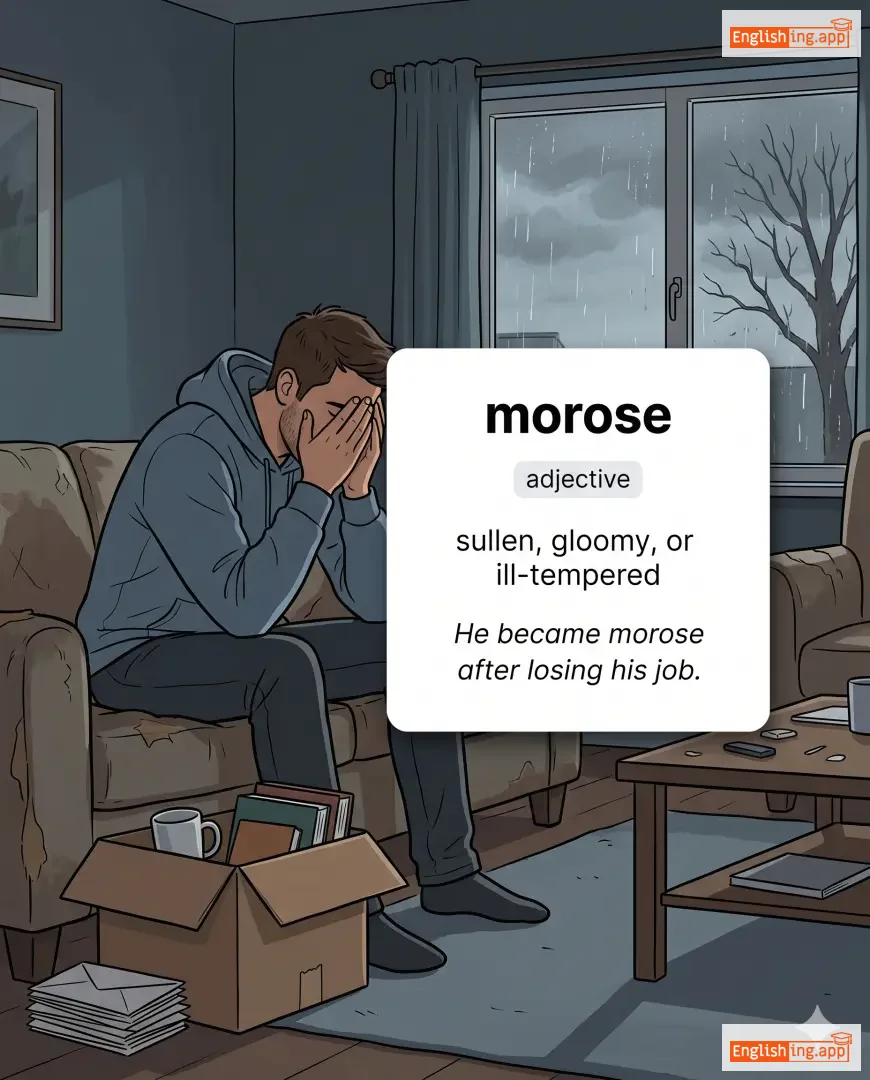
morose definition card — visual illustration of the meaning
adjective
/məˈroʊs/
उदास (udas)

sullen, gloomy, or ill-tempered

"He became morose after losing his job."

"वह अपनी नौकरी खोने के बाद उदास हो गया।" (Vah apni naukri khone ke baad udas ho gaya.)
verb
/mɔːrf/
रूपांतरित होना (roopantarit hona)

to change smoothly from one form, shape, or character into another

"The caterpillar will morph into a butterfly."

"कैटरपिलर एक तितली में बदल जाएगा।" (Caterpillar ek titli mein badal jaayega.)
morphological definition card — visual illustration of the meaning
adjective
ˌmɔː.fəˈlɒdʒ.ɪ.kəl
शब्दरचना संबंधी (morphological)

Related to the structure and formation of words; concerning morphology in linguistics.

"Morphological analysis helps AI understand word structures."

"रूपविज्ञान विश्लेषण एआई को शब्द संरचनाओं को समझने में मदद करता है।" (Roopvigyaan vishleshan AI ko shabd sanrachnaon ko samajhne mein madad karta hai.)
noun
/mɔːrˈfɑːlədʒi/
रूपविज्ञान (roopvigyan)

the study of the form and structure of things, especially in language and biology

"Morphology studies the structure of words and how they are formed."

"रूपविज्ञान शब्दों की संरचना और उनके निर्माण का अध्ययन करती है।" (Roopvigyan shabdon ki sanrachna aur unke nirman ka adhyayan karti hai.)
adjective
/ˈmɔːtəl/
मृत्युवाला; नश्वर; मानव (mrityuwala; nashwar; manav)

subject to death; having a limited lifespan; human

"All human beings are mortal and will eventually die."

"सभी मनुष्य मृत्युवाला हैं और अंततः मर जाएंगे।" (sabhi manushya mrityuwala hain aur antatah mar jayenge.)
noun
/mɔːˈtæləti/
मृत्युदर (mrityudar)

the state of being subject to death; the death rate of a population

"Advancements in medicine have reduced child mortality significantly."

"चिकित्सा के क्षेत्र में हुई प्रगति ने बाल मृत्यु दर को महत्वपूर्ण रूप से घटाया है।" (Chikitsa ke kshetra mein hui pragati ne baal mrityu dar ko mahatvapurn roop se ghataaya hai.)
noun
/ˈmɔːrtər/
मोर्टार का मिश्रण / छोटे तोप (mortaar ka mishran / chhote top)

a mixture used in building to bond bricks or stones together; also, a small cannon for firing shells

"The workers applied mortar between the bricks."

"मज़दूरों ने ईंटों के बीच मोर्टार लगाया।" (Mazdooron ne eenton ke beech mortar lagaya.)
noun
/ˈmɔː.tər ænd ˈpes.əl/
मोर्टार और पेस्टल (mortar aur pestle)

a bowl and grinding tool used to crush and grind spices, herbs, and other substances

"She ground the spices using a mortar and pestle."

"उसने मसाले को मोर्टार और पेस्टल से पीसा।" (Usne masale ko mortar aur pestle se peesa.)
noun
/ˈmɔːrɡɪdʒ/
बंधक ऋण (bandhak rin)

a legal agreement where a person borrows money to buy property and pays it back over time

"They applied for a mortgage to buy their new house."

"उन्होंने अपना नया घर खरीदने के लिए एक बंधक ऋण के लिए आवेदन किया।" (Unhone apna naya ghar kharidne ke liye ek bandhak rin ke liye aavedan kiya.)
noun
/mɔːrˈtɪʃən/
मृतक शारीरिक चिकित्सा करने वाला (mrutak sharirik chikitsa karne wala)

a person whose job is to prepare dead bodies for burial or cremation and to arrange funerals

"The mortician prepared the body for the funeral service."

"मृतक शारीरिक चिकित्सा करने वाले ने अंतिम संस्कार सेवा के लिए शरीर तैयार किया।" (Mrutak sharirik chikitsa karne wale ne antim sanskaar seva ke liye sharir tayaar kiya.)
verb
/ˈmɔːrtɪfaɪ/
लज्जित करना (lajjit karna)

to cause someone to feel great embarrassment or shame

"She was mortified when she tripped on stage."

"वह मंच पर ठोकर खाने से लज्जित हो गई थी।" (Vah manch par thokar khane se lajjit ho gayi thi.)
noun
/moʊˈzeɪɪk/
मोज़ैक (mozaik)

A picture or pattern produced by arranging together small pieces of stone, tile, or glass.

"The church ceiling was decorated with a beautiful mosaic."

"चर्च की छत को एक सुंदर मोज़ैक से सजाया गया था." (charch ki chhat ko ek sundar mozaik se sajaya gaya tha.)
noun
/mɒsk/
मस्जिद (masjid)

A Muslim place of worship.

"They gathered at the mosque for the Friday prayer."

"वे शुक्रवार की प्रार्थना के लिए मस्जिद में एकत्रित हुए।" (Ve shukravaar ki praarthana ke liye masjid mein ekatrit huye.)
noun
/məˈskiːtəʊ/
मच्छर (moskito)

a small flying insect known for biting and spreading diseases such as malaria

"The mosquito bit me while I was sleeping under the net."

"मच्छर ने मुझे काट लिया जब मैं जाल के नीचे सो रहा था।" (machhar ne mujhe kaat liya jab main jaal ke neeche so raha tha.)
noun
/məˈskiː.toʊ net/
मच्छरदानी (maccharadani)

a fine mesh fabric used to cover beds or windows to keep mosquitoes and other insects out

"We use a mosquito net to protect ourselves from insect bites."

"हम मच्छरदानी का उपयोग करके खुद को कीड़ों के काटने से बचाते हैं।" (hum maccharadani ka upyog karke khud ko keedon ke kaatne se bachate hain)
noun
/mɔːs/
मॉस (mos)

a small flowerless plant that grows in clumps in moist places

"Green moss covered the old stone wall."

"हरी मूस ने पुराने पत्थर की दीवार को ढक लिया।" (hari mos ne purane patthar ki deewar ko dhak liya.)
adjective
/ˈmɒsi/
काई से ढका हुआ; काई उगा हुआ (kaai se dhaka hua; kaai uga hua)

covered with moss; having moss growing on it

"The old tree trunk was mossy and covered with green vegetation."

"पुराना पेड़ का तना काई से ढका हुआ और हरे पौधों से ढका हुआ था।" (purana ped ka tana kaai se dhaka hua aur hare podhon se dhaka hua tha。)
adjective, adverb, pronoun
/moʊst/
अधिकांश (adhikansh)

the greatest in amount, degree, or number

"Most people like to relax on weekends."

"अधिकांश लोग सप्ताहांत पर आराम करना पसंद करते हैं।" (adhikansh log saptahant par aaram karna pasand karte hain.)
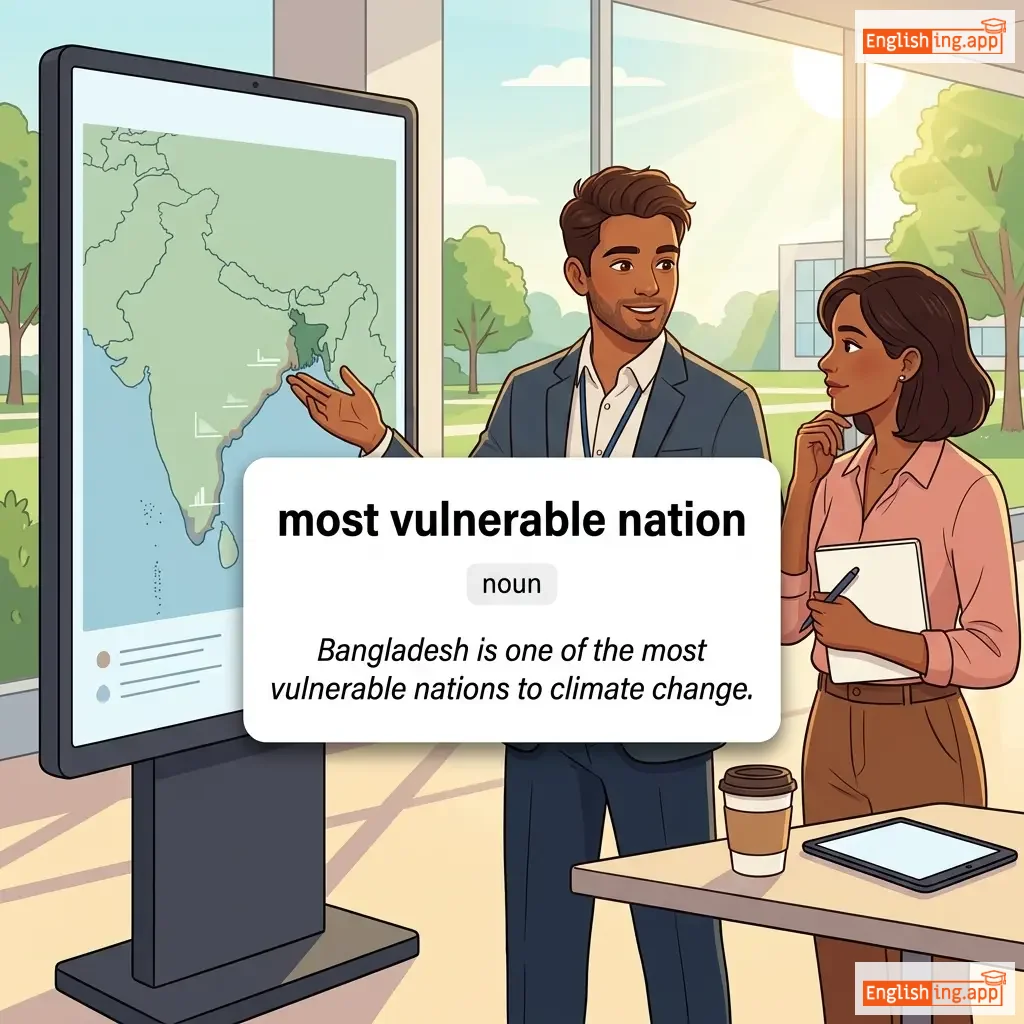
most vulnerable nation definition card — visual illustration of the meaning
noun
moʊst ˈvʌlnərəbəl ˈneɪʃən
सबसे कमजोर राष्ट्र (sabse kamzor rashtra)

A country that is highly exposed to risks and lacks adequate protection or resilience.

"Bangladesh is one of the most vulnerable nations to climate change."

"बांगलादेश जलवायु परिवर्तन के लिए सबसे अधिक संवेदनशील देशों में से एक है।" (Bangladesh jalvayu parivartan ke liye sabse adhik sanvedansheel deshon mein se ek hai.)
adverb
/ˈmoʊstli/
मुख्य रूप से (mukhya roop se)

for the most part; mainly

"She is mostly interested in art and literature."

"वह मुख्य रूप से कला और साहित्य में रुचि रखती है।" (Wah mukhya roop se kala aur sahitya mein ruchi rakhti hai.)
noun
/moʊt/
कण (kan)

A tiny particle or speck, especially of dust.

"A mote of dust floated in the sunlight."

"सूरज की रोशनी में एक कण उड़ रहा था।" (Suraj ki roshni mein ek kan ud raha tha.)
adjective
/ˈmɒθ ˌiːtən/
कीटों द्वारा खाया हुआ (keeton dwara khaya hua)

Damaged or worn out, especially by moths or age.

"He wore a moth-eaten sweater on the cold day."

"उसने ठंडे दिन में एक कीटों द्वारा खाया हुआ स्वेटर पहना था।" (Usne thande din mein ek keeton dwara khaya hua sweater pehna tha.)
noun
/ˈmʌðər/
माँ (maa)

a female parent

"Her mother is a kind and caring person."

"उसकी माँ एक दयालु और देखभाल करने वाली व्यक्ति है।" (Uski maa ek dayaalu aur dekhbhaal karne waali vyakti hai.)
noun
/ˈmʌðər ˈlæŋɡwɪdʒ/
मातृभाषा (matribhasha)

the first language a person learns from childhood; native language

"Children learn best when they are taught in their mother language."

"बच्चे मातृभाषा में सबसे अच्छा सीखते हैं।" (bacche matribhasha mein sabse accha seekhte hain)
noun
/ˈmʌð.ər.hʊd/
मातृत्व (maatritya)

the state of being a mother; the qualities of a mother

"She embraced the joys and challenges of motherhood."

"उसने मातृत्व के सुख और चुनौतियों को गले लगाया।" (Usne maatritya ke sukh aur chunautiyon ko gale lagaya.)
noun
/ˈmʌð.ər.lænd/
मातृभूमि; देश (matribhoomi)

the country where one was born or has citizenship; homeland

"He always spoke fondly of his motherland."

"उसने हमेशा अपनी मातृभूमि के बारे में स्नेहपूर्वक बात की।" (usne hamesha apni matribhumi ke baare mein sneha poorvak baat ki.)
👩‍👧‍👦

Motherly (मदरली)

adjective
/ˈmʌðərli/
मातृसुलभ (matrsulabh)

having qualities characteristic of a mother; caring and protective

"She showed motherly care and affection towards all the children."

"उसने सभी बच्चों के प्रति मातृसुलभ देखभाल और स्नेह दिखाया।" (usne sabhi bachon ke prati matrsulabh dekhbhaal aur sneha dikhaya.)
noun
/moʊˈtiːf/
थीम (motif)

A recurring theme, subject, or idea in a work of art or literature.

"The motif of love is central to the novel."

"प्यार की थीम उपन्यास के केंद्र में है" (pyaar ki theem upanyas ke kendr mein hai)
adjective
/ˈmoʊtaɪl/
गतिशील (gatisheel)

Capable of movement or locomotion.

"Certain bacteria are motile and can swim toward nutrients."

"कुछ बैक्टीरिया गतिशील होते हैं और पोषक तत्वों की ओर तैर सकते हैं।" (Kuch bacteria gatisheel hote hain aur poshak tatvon ki or tair sakte hain.)
noun
/moʊˈtɪləti/
गतिशीलता (gatishilta)

The ability of an organism or cell to move independently.

"The motility of sperm is crucial for successful fertilization."

"शुक्राणु की गतिशीलता सफल निषेचन के लिए महत्वपूर्ण है।" (Shukranu ki gatishilta safal nishedan ke liye mahatvapurn hai.)
noun
/ˈmoʊʃən/
गति (gati)

the act or process of moving; a change of place or position

"The motion of the car made her sleepy."

"गाड़ी की गति ने उसे नींद में डाल दिया।" (Gaadi ki gati ne use neend mein daal diya.)
verb
/ˈmoʊtɪveɪt/
प्रेरित करना (prerit karna)

To provide someone with a reason or incentive to do something.

"The coach motivated the players to give their best performance."

"कोच ने खिलाड़ियों को अपनी बेहतरीन प्रदर्शन देने के लिए प्रेरित किया।" (Coach ne khiladiyon ko apni behtareen pradarshan dene ke liye prerit kiya.)
noun
/ˌmoʊtɪˈveɪʃən/
प्रेरणा (prerana)

the reason or drive for acting or behaving in a particular way

"She lost her motivation to continue the project."

"उसने परियोजना को जारी रखने की प्रेरणा खो दी।" (Usne pariyojana ko jaari rakhne ki prerana kho di.)
noun
/ˈmoʊtɪv/
उद्देश्य (uddeshya)

a reason for doing something, especially one that is hidden or not obvious

"The police could not determine the motive behind the crime."

"पुलिस अपराध के पीछे के उद्देश्य का निर्धारण नहीं कर पाई।" (pulis aparadh ke peeche ke uddeshya ka nirdharan nahi kar paai.)
adjective
/ˈmɒtli/
विविध (vividh)

Made up of different, often incongruous or diverse elements.

"The festival attracted a motley crowd of artists, musicians, and tourists."

"त्योहार ने कलाकारों, संगीतकारों और पर्यटकों की एक विविध भीड़ आकर्षित की।" (Tyohar ne kalakaron, sangeetkaron aur paryatakon ki ek vividh bheed aakarshit ki.)
noun
/ˈmoʊtər/
मोटर (moter)

a machine that produces motion or power to make something work

"The car’s motor stopped suddenly."

"कार का मोटर अचानक रुक गया।" (kaar ka moter achanak ruk gaya.)
noun
/ˈmoʊ.tər ˌsaɪ.kəl/
मोटर साइकिल (motor saikil)

a two-wheeled vehicle powered by an engine

"He rides his motorcycle to work every day."

"वह हर दिन अपने मोटर साइकिल से काम पर जाता है।" (vah har din apne motor saikil se kaam par jaata hai。)
noun
/ˈmoʊ.tər ˈlɔː.ri/
मोटर ट्रक (motor truck)

a large motor vehicle used for transporting goods; truck

"The motor lorry delivered fresh vegetables to the market."

"मोटर लॉरी ने ताजे सब्ज़ी को बाजार में पहुँचाया।" (motor lori ne taje sabzi ko bazar mein pahuchaya.)
noun
/ˈmoʊtərˌsaɪkəl/
मोटरसाइकिल (motarsaaikil)

a two-wheeled motor-powered vehicle designed for transportation

"He rides his motorcycle to work every morning."

"वह हर सुबह अपनी मोटरसाइकिल से काम पर जाता है।" (vah har subah apni motarsaaikil se kaam par jaata hai)
noun
/ˈməʊtərɪst/
मोटर चालक (motor chalak)

a person who drives a motor vehicle, especially a car or motorcycle

"The motorist stopped to help after seeing the accident on the highway."

"राजमार्ग पर दुर्घटना देखकर मोटर चालक ने मदद की।" (rajmarg par durghatna dekhkar motor chalak ne madad ki)
verb
/ˈmɒtl/
धब्बे से ढकना (dhabbe se dhakna)

To mark with spots or patches of color.

"The leaves were mottled with shades of yellow and brown."

"पत्तियां पीले और भूरे रंग के धब्बों से ढकी हुई थीं।" (Pattiyan peele aur bhoore rang ke dhabbo se dhaki hui thin.)
adjective
/ˈmɒtld/
धब्बेदार (dhabbedar)

Marked with spots, streaks, or blotches of different shades or colors.

"The snake's mottled skin helped it blend into the forest floor."

"सांप की धब्बेदार त्वचा ने उसे जंगल की ज़मीन में घुलने में मदद की।" (Saap ki dhabbedar tvacha ne use jangal ki zameen mein ghulne mein madad ki.)
noun
/ˈmɒtəʊ/
मूल मंत्र (mool mantra)

A short sentence or phrase that expresses a guiding belief or principle.

"Her motto in life is 'never give up.'"

"उसका जीवन का मूल मंत्र है 'कभी हार मत मानो।'" (Uska jeevan ka mool mantra hai 'kabhi haar mat maano.')