वोकैबुलरीज

इंग्लिश वोकैबुलरी डिस्कवर, लर्न और मास्टर करें

verb
/ˌmɪsˈmænɪdʒ/
गलत तरीके से प्रबंधित करना (galat tareeke se prabandhit karna)

to handle or control something badly or inefficiently

"The company went bankrupt because it was mismanaged for years."

"कंपनी दिवालिया हो गई क्योंकि इसे कई सालों तक गलत तरीके से प्रबंधित किया गया था।" (Kampani divaliya ho gayi kyunki ise kai salon tak galat tareeke se prabandhit kiya gaya tha.)
mismanagement definition card — visual illustration of the meaning
noun
ˌmɪsˈmænɪdʒmənt
अव्यवस्थापन (avyavasthapan)

Bad or careless management of something.

"Mismanagement of plastic waste worsens pollution."

"प्लास्टिक कचरे का अव्यवस्थापन प्रदूषण को बढ़ाता है।" (Plastic kachre ka avyavasthapan pradushan ko badhata hai.)
noun
/ˌmɪsˈnoʊmər/
गलत नाम (galat naam)

A wrong or inaccurate name or designation.

"Calling the tiny dog a 'giant' is a misnomer."

"छोटे कुत्ते को 'जायंट' कहना एक गलत नाम है।" (Chhote kutte ko 'giant' kehna ek galat naam hai.)
noun
/mɪˈsɑːɡəmi/
विवाह विरोध (vivah virodh)

Hatred or dislike of marriage.

"His misogamy prevented him from ever settling down with a partner."

"उसका विवाह विरोध उसे कभी भी किसी साथी के साथ बसा हुआ नहीं बनने देता।" (Uska vivah virodh use kabhi bhi kisi saathi ke saath basa hua nahi banne deta.)
noun
/mɪˈsɑːdʒɪnɪst/
महिला द्वेषी (mahila dveshi)

A person who dislikes, despises, or is strongly prejudiced against women.

"Many condemned his speech as the words of a misogynist."

"कई लोगों ने उनके भाषण की निंदा एक महिला द्वेषी के शब्दों के रूप में की।" (Kai logon ne unke bhashan ki ninda ek mahila dveshi ke shabdon ke roop mein ki.)
noun
/mɪˈsɑːdʒəni/
महिलाओं के प्रति घृणा (mahilao ke prati ghrina)

Hatred of, contempt for, or prejudice against women.

"The novel has been criticized for promoting misogyny."

"उपन्यास को महिलाओं के प्रति घृणा को बढ़ावा देने के लिए आलोचना की गई थी।" (Upanyas ko mahilaon ke prati ghrina ko badhawa dene ke liye alochna ki gayi thi.)
verb
/ˌmɪsˈpleɪs/
गलत स्थान पर रखना (galat sthan par rakhna)

To put something in the wrong location and temporarily lose it.

"I often misplace my keys when I am in a hurry."

"मैं अक्सर अपनी चाबियाँ जल्दी में होने पर गलत जगह रख देता हूँ।" (Main aksar apni chaabiyan jaldi mein hone par galat jagah rakh deta hoon.)
verb
/ˌmɪsˈriːd/
गलत पढ़ना (galat padhna)

to read something incorrectly or interpret wrongly

"He misread the instructions and built the shelf incorrectly."

"उसने निर्देशों को गलत पढ़ा और शेल्फ को गलत तरीके से बनाया।" (Usne nirdeshon ko galat padha aur shelf ko galat tareeke se banaya.)
verb
/ˌmɪsˌrɛprɪˈzɛnt/
गलत तरीके से प्रस्तुत करना (galat tareeke se prastut karna)

to give a false or misleading account of something

"The lawyer accused the witness of trying to misrepresent the facts."

"वकील ने गवाह पर तथ्यों को गलत तरीके से पेश करने का आरोप लगाया।" (Vakil ne gawah par tathyon ko galat tareeke se pesh karne ka aarop lagaya.)
noun
/ˌmɪsˈruːl/
अशासन (ashasan)

bad or poor governance

"The kingdom suffered for decades under misrule."

"राज्य दशकों तक अशासन के तहत पीड़ित रहा।" (Rajya dashako tak ashasan ke tahat peedit raha.)
verb, noun
/mɪs/
मिस करना / अनुपस्थित होना (mis karna / anupasthit hona)

to fail to hit, reach, or meet; to feel the absence of someone or something

"I really miss my family when I travel abroad."

"जब मैं विदेश यात्रा करता हूँ, तो मुझे अपनी परिवार की बहुत याद आती है।" (jab main videsh yatra karta hoon, to mujhe apni parivar ki bahut yaad aati hai.)
noun
/ˈmɪsəl/
मिसल (misal)

a book containing the texts used in the Catholic Mass throughout the year

"The priest read from the missal during the ceremony."

"पुरोहित समारोह के दौरान मिसल से पढ़ रहे थे।" (Purohit samaroh ke dauran misal se padh rahe the.)
noun
/ˈmɪsaɪl/ or /ˈmɪsəl/
मिसाइल (misail)

a weapon that is self-propelled and directed toward a target

"The army launched a missile towards the enemy base."

"सैन्य ने शत्रु के अड्डे की ओर एक मिसाइल दागी।" (Sainya ne shatru ke adde ki or ek misail daagi.)
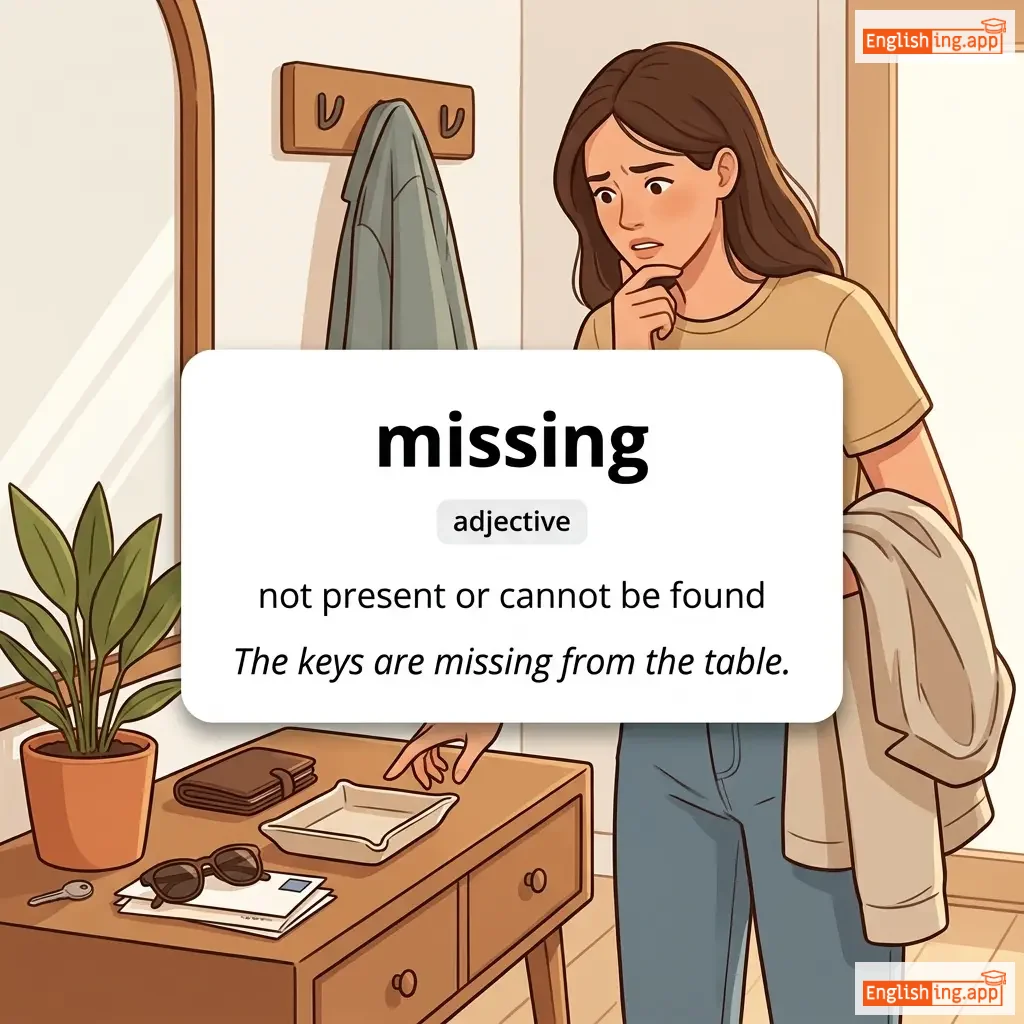
missing definition card — visual illustration of the meaning
adjective
/ˈmɪsɪŋ/
गायब (gaayab)

not present or cannot be found

"The keys are missing from the table."

"चाबियाँ मेज़ से गायब हैं।" (Chaabiyaan mez se gaayab hain.)
noun
/ˈmɪʃən/
मिशन / कार्य (mishan / kary)

an important assignment or task, often with a specific purpose

"The astronauts were on a mission to explore Mars."

"अंतरिक्षयात्री मंगल ग्रह की खोज के लिए एक मिशन पर थे।" (Antarikshyaatri mangal grah ki khoj ke liye ek mishan par the.)
noun
/ˈmɪʃəneri/
धर्म प्रचारक (dharm pracharak)

a person sent on a religious mission, especially to promote Christianity in a foreign country

"The missionary spent years helping local communities in Africa."

"मिशनरी ने अफ्रीका में स्थानीय समुदायों की मदद करने के लिए वर्षों बिताए।" (Mishanari ne Africa mein sthaniya samudaayon ki madad karne ke liye varsho bitaye.)
noun
/ˈmɪsɪv/
पत्र (patra)

a written message, especially a formal or official letter

"He sent a long missive to the governor."

"उसने गवर्नर को एक लंबा पत्र भेजा।" (Usne governor ko ek lamba patra bheja.)
noun
/mɪˈsteɪk/
गलती (galti)

An action or decision that is wrong or misguided.

"She realized her mistake after submitting the wrong file."

"उसने गलत फाइल जमा करने के बाद अपनी गलती महसूस की।" (Usne galat file jama karne ke baad apni galti mehsoos ki.)
adjective
/mɪˈsteɪkən/
गलत (galat)

wrong or incorrect because of an error in judgment or understanding

"I was mistaken about the meeting time."

"मैं मीटिंग के समय के बारे में गलत था।" (main meeting ke samay ke baare mein galat tha)
noun/verb
/ˌmɪsˈtrʌst/
अविश्वास (avishwas)

lack of trust; suspicion or doubt about someone or something

"The villagers showed deep mistrust of outsiders."

"गाँववालों ने बाहरी लोगों के प्रति गहरा अविश्वास दिखाया।" (Gaonwalo ne baahari logon ke prati gehra avishwas dikhaya.)
noun
/ˌmɪs.ʌn.dəˈstæn.dɪŋ/
ग़लतफ़हमी (galatfahmi)

A failure to understand something correctly; a disagreement or confusion between people

"The argument was caused by a simple misunderstanding."

"बहस एक साधारण ग़लतफ़हमी के कारण हुई थी।" (bahas ek sadharan galatfahmi ke karan hui thi.)
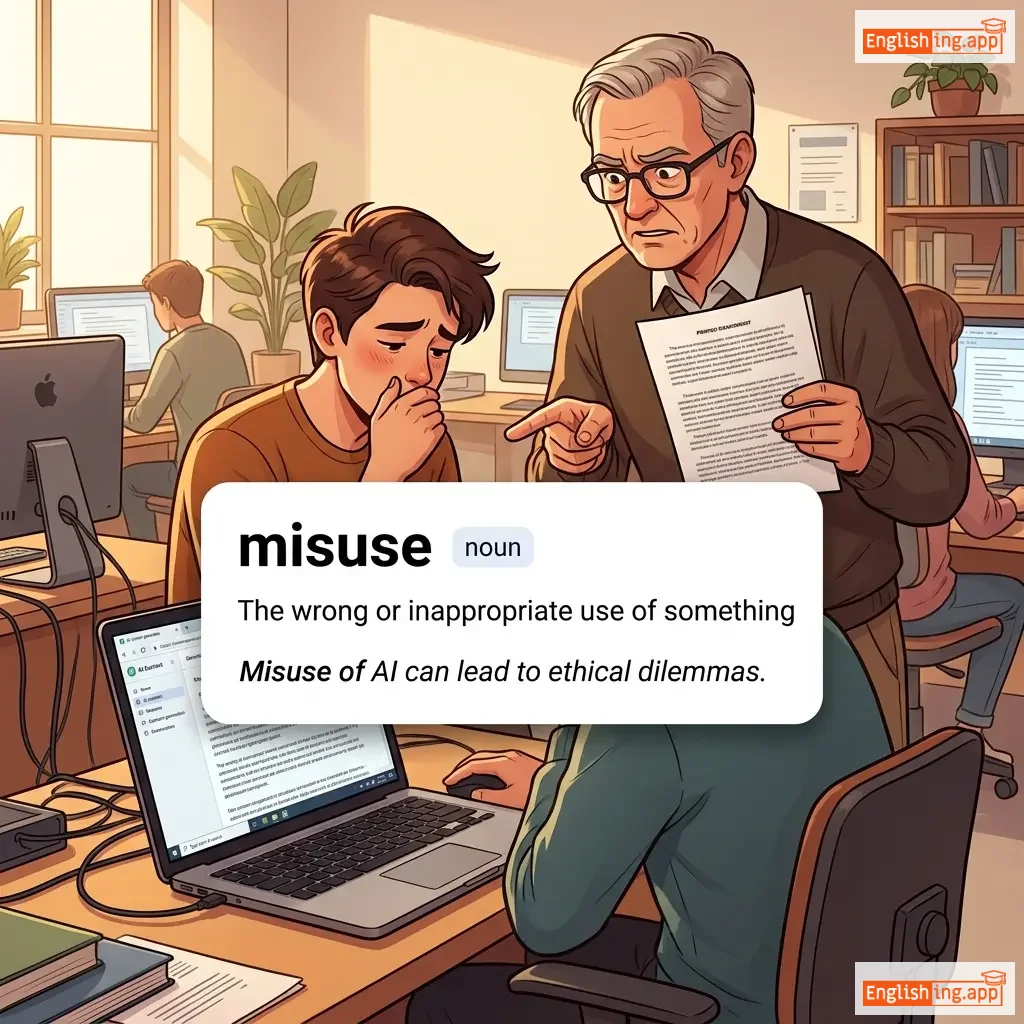
misuse definition card — visual illustration of the meaning
noun
ˌmɪsˈjuːs
दुरुपयोग (durupyog)

The wrong or inappropriate use of something

"Misuse of AI can lead to ethical dilemmas."

"एआई का दुरुपयोग नैतिक समस्याएँ पैदा कर सकता है।" (AI ka durupyog naitik samasyaayein paida kar sakti hain.)
noun
/maɪt/
कीट (kit)

a very small creature, often a tiny arachnid; also used to mean a very small amount

"The mattress was infested with dust mites."

"गद्दा धूल के माइट्स से संक्रमित था।" (gadda dhool ke mites se sankramit tha.)
noun
/ˈmaɪtər/
बिशप की टोपी (bishop ki topi)

a tall, pointed hat worn by bishops; also a type of joint made between two pieces of material

"The bishop placed the miter on his head during the ceremony."

"अनुष्ठान के दौरान बिशप ने अपनी सिर पर माइटर टोपी रखी।" (Anushthan ke dauran bishop ne apni sir par miter topi rakhi.)
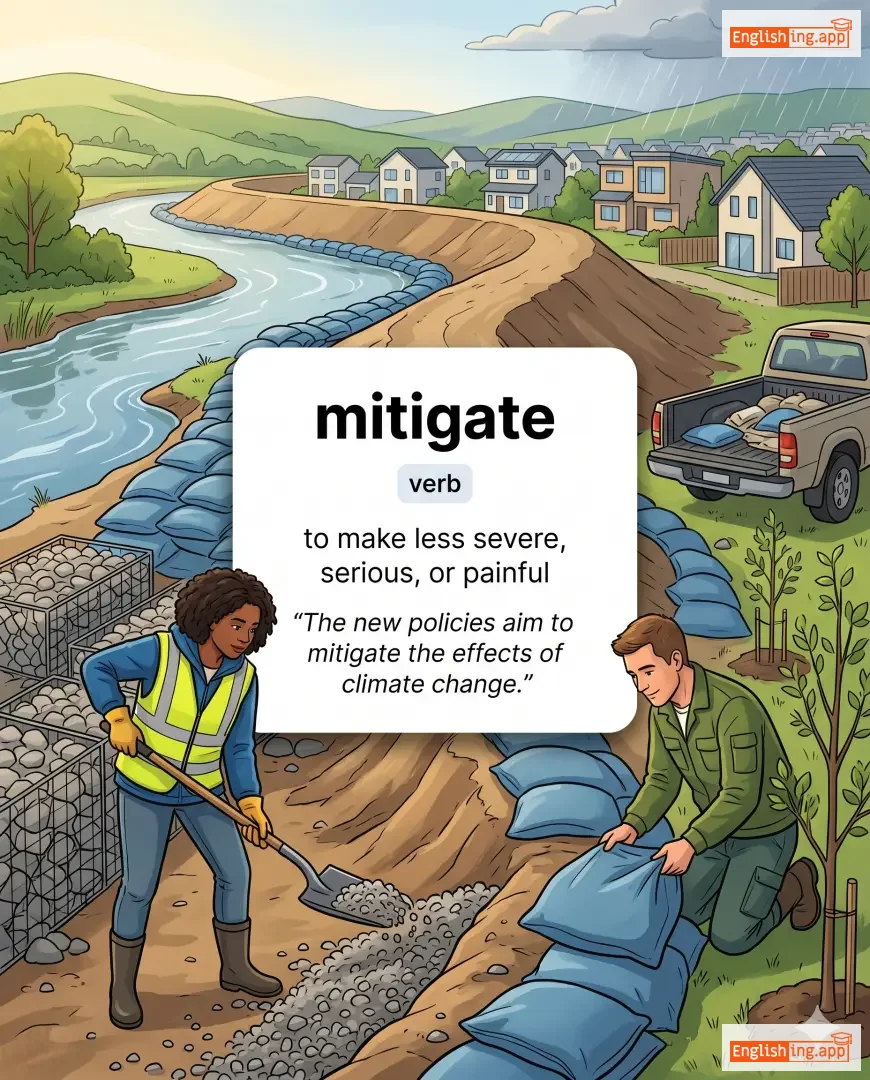
mitigate definition card — visual illustration of the meaning
verb
/ˈmɪtɪˌɡeɪt/
कम करना (kam karna)

to make less severe, serious, or painful

"The new policies aim to mitigate the effects of climate change."

"नई नीतियाँ जलवायु परिवर्तन के प्रभावों को कम करने का लक्ष्य रखती हैं।" (Nayi neetiyan jalvayu parivartan ke prabhavon ko kam karne ka lakshya rakhti hain.)
mitigation definition card — visual illustration of the meaning
noun
ˌmɪt.ɪˈɡeɪ.ʃən
सतर्कता या कमी (satarkta ya kami)

The action of reducing the severity, seriousness, or painfulness of something.

"Climate change mitigation requires global cooperation."

"जलवायु परिवर्तन मिटीगेशन के लिए वैश्विक सहयोग की आवश्यकता है।" (Jalvayu parivartan mitigation ke liye vaishvik sahyog ki avashyakta hai.)
mitigation strategies definition card — visual illustration of the meaning
noun
ˌmɪtɪˈɡeɪʃən ˈstrætədʒiz
निवारण रणनीतियाँ (nivaran ranneetiyan)

Plans and actions designed to reduce the severity or impact of problems or risks.

"Governments must adopt mitigation strategies for climate change."

"सरकारों को जलवायु परिवर्तन के लिए मिटीगेशन स्ट्रैटेजीज़ अपनानी चाहिए।" (Sarkaron ko jalvayu parivartan ke liye mitigation strategies apnani chahiye.)
verb
/mɪks/
मिलाना (milana)

To combine different substances or elements together.

"She likes to mix different colors to create new shades."

"वह नए शेड बनाने के लिए विभिन्न रंगों को मिलाना पसंद करती है।" (Woh naye shed banane ke liye vibhinn rangon ko milana pasand karti hai.)
adjective
/mɪkst/
मिश्रित (mishrit)

consisting of different elements or having varied opinions or feelings

"The audience had mixed reactions to the film."

"दर्शकों को फिल्म पर मिश्रित प्रतिक्रियाएं मिलीं।" (Darshako ko film par mishrit pratikriyaayein miliin.)
noun
/mɪkst ˈkʌlər/
मिश्रित रंग (mishrit rang)

a color created by combining two or more different colors

"The mixed colour created a beautiful gradient on the canvas."

"मिश्रित रंग ने कैनवस पर एक सुंदर ग्रेडिएंट बनाया।" (mishrit rang ne canvas par ek sundar gradient banaya.)
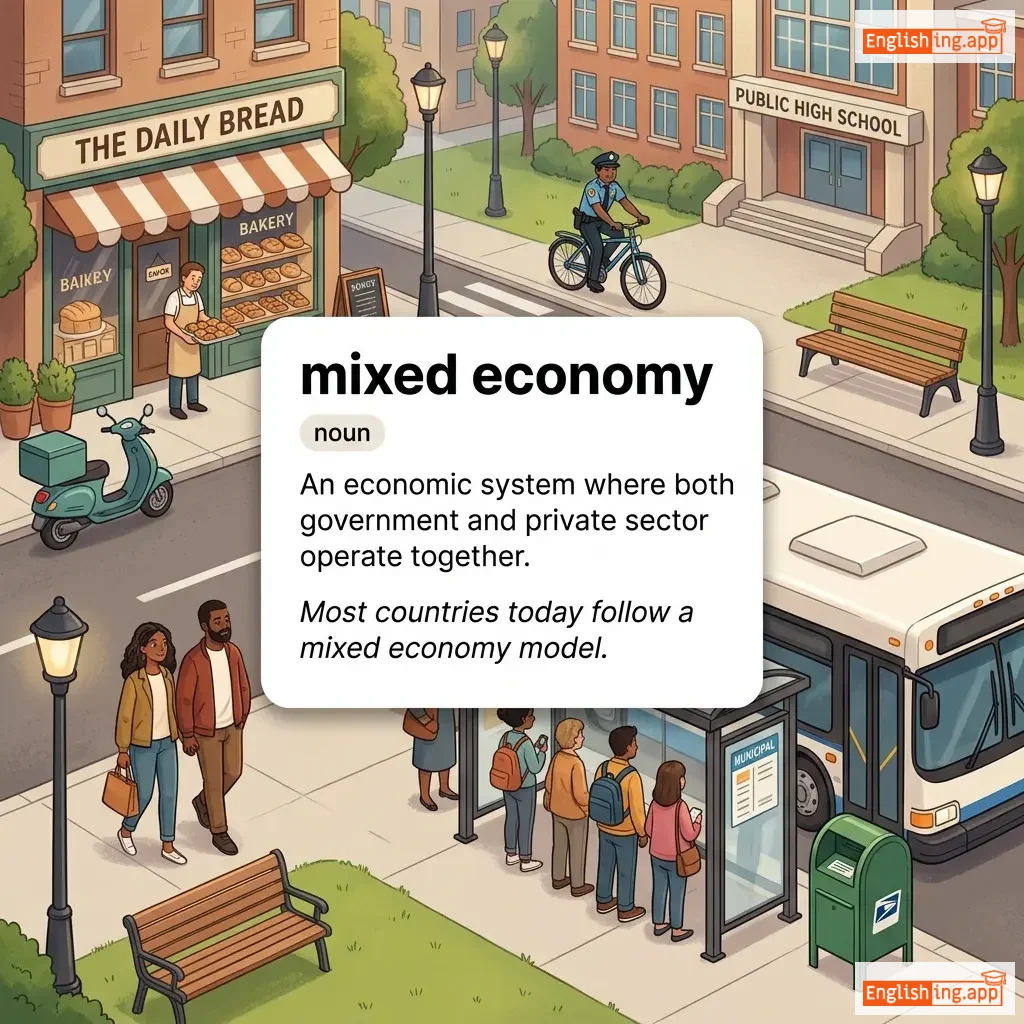
mixed economy definition card — visual illustration of the meaning
noun
/mɪkst ɪˈkɒn.ə.mi/
मिश्रित अर्थव्यवस्था (mishrit arthvyavastha)

An economic system where both government and private sector operate together.

"Most countries today follow a mixed economy model."

"आजकल अधिकांश देश मिश्रित अर्थव्यवस्था मॉडल का पालन करते हैं।" (Aajkal adhikansh desh mishrit arthvyavastha model ka paalan karte hain.)
noun
/ˈmɪk.sər/
मिक्सर (miksar)

an electric kitchen appliance used for mixing, beating, and whipping ingredients

"The chef used a mixer to prepare the cake batter."

"रसोइया ने केक बैटर तैयार करने के लिए मिक्सर का इस्तेमाल किया।" (rasoiya ne kek batter tayar karne ke liye miksar ka istemal kiya.)
noun
/ˈmɪkstʃər/
मिश्रण (mishran)

A combination of different things or substances blended together.

"The cake recipe requires a mixture of flour and sugar."

"केक की रेसिपी में आटे और चीनी का मिश्रण चाहिए।" (Kek ki recipe mein aate aur cheeni ka mishran chahiye.)
interjection
/mˈhm/
हां (haan)

A sound used to express agreement or acknowledgment in conversation.

"‘Do you understand?’ ‘Mm-hmm.’"

"‘क्या आप समझते हैं?’ ‘हां।’" ('Kya aap samajhte hain?' 'Haan.')
mnemonic definition card — visual illustration of the meaning
noun/adjective
/nɪˈmɒnɪk/
स्मृति सहायक (smriti sahayak)

a device or technique used to aid memory

"Students often use mnemonic devices to remember lists of words."

"छात्र अक्सर शब्दों की सूचियों को याद रखने के लिए म्नेमोनिक उपकरणों का उपयोग करते हैं।" (Chhatra aksar shabdon ki soochiyon ko yaad rakhne ke liye mnemonic upkaranon ka upyog karte hain.)
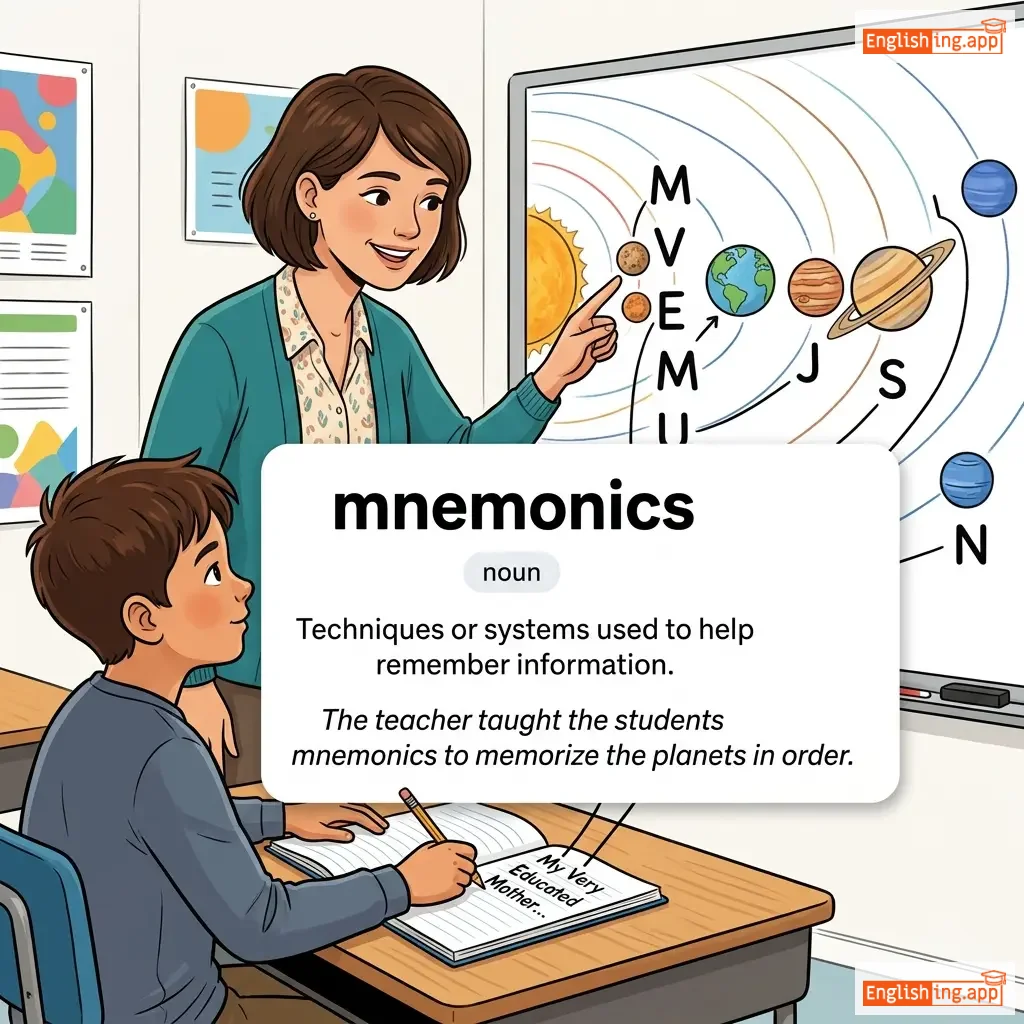
mnemonics definition card — visual illustration of the meaning
noun
/nɪˈmɒnɪks/
स्मृति शास्त्र (smriti shastra)

Techniques or systems used to help remember information.

"The teacher taught the students mnemonics to memorize the planets in order."

"शिक्षक ने छात्रों को ग्रहों को क्रम में याद करने के लिए म्नेमोनिक्स सिखाए।" (Shikshak ne chatron ko grahon ko kram mein yaad karne ke liye mnemonics sikhaaye.)
noun
/moʊt/
खाई (khai)

A deep, wide ditch surrounding a castle or town, often filled with water, for defense.

"The castle was protected by a wide moat filled with water."

"किले को पानी से भरी एक चौड़ी खाई से सुरक्षा मिली थी।" (kile ko pani se bhari ek chowdi khai se suraksha mili thi.)
noun
/mɒb/
भीड़ (bheer)

a large, disorderly crowd of people, typically one that is agitated or violent

"The mob gathered outside the building, demanding justice."

"भीड़ बिल्डिंग के बाहर न्याय की मांग करने के लिए इकट्ठी हो गई थी।" (Bheer building ke baahar nyaay ki maang karne ke liye ikatthi ho gayi thi.)
adjective
/ˈmoʊbaɪl/
मोबाइल (mobile)

Able to move or be moved easily; also refers to portable communication devices.

"She prefers a mobile lifestyle that allows her to travel frequently."

"वह एक मोबाइल जीवनशैली को पसंद करती है जो उसे अक्सर यात्रा करने देती है।" (Vah ek mobile jeevanshailee ko pasand karti hai jo use aksar yatra karne deti hai.)
mobile security definition card — visual illustration of the meaning
noun
ˈmoʊ.baɪl sɪˈkjʊr.ə.ti
मोबाइल सुरक्षा (mobile suraksha)

Protection of mobile devices and the data stored on them from security threats.

"Strong mobile security protects personal information."

"मजबूत मोबाइल सुरक्षा व्यक्तिगत जानकारी की रक्षा करती है।" (Majboot mobile suraksha vyaktigat jaankari ki raksha karti hai.)
mobility definition card — visual illustration of the meaning
noun
/moʊˈbɪləti/
गतिशीलता (gatisheelta)

The ability to move or be moved freely and easily.

"The injury limited his mobility for several months."

"चोट ने उसकी गतिशीलता को कुछ महीनों के लिए सीमित कर दिया था।" (Chot ne uski gatisheelta ko kuch mahino ke liye seemit kar diya tha.)
verb
/ˈməʊbɪlaɪz/
संगठित करना (sangathit karna)

to organize or prepare people or resources for action

"The leader worked hard to mobilize the community for the protest."

"नेता ने विरोध के लिए समुदाय को संगठित करने के लिए कड़ी मेहनत की।" (Neta ne virodh ke liye samudaay ko sangathit karne ke liye kadi mehnat ki.)
noun
/məˈbɒkrəsi/
भीड़ का शासन (bheer ka shasan)

Rule or control by a mob or mass of people, often disorderly.

"The protest turned into mobocracy when the crowd started destroying property."

"जब विरोध प्रदर्शन में भीड़ ने संपत्ति को नष्ट करना शुरू किया, तो वह भीड़ का शासन बन गया।" (Jab virodh pradarshan mein bheer ne sampatti ko nasht karna shuru kiya, to vah bheer ka shasan ban gaya.)
noun
/ˈmɒkəsɪn/
मोकासिन जूता (mokasin joota)

A soft leather shoe, traditionally worn by Native Americans, often made from deerskin.

"He slipped on a pair of comfortable moccasins before going outside."

"उसने बाहर जाने से पहले आरामदायक मोकासिन जूते पहने।" (Usne baahar jaane se pehle aaramdayak mokasin joote pehane.)
verb
/mɒk/
मज़ाक उड़ाना (mazaak udaana)

To make fun of someone or something in a cruel or unkind way.

"The students mocked his accent during class."

"छात्रों ने क्लास में उसकी उच्चारण का मज़ाक उड़ाया।" (Chhatron ne class mein uski uccharan ka mazaak udaaya.)
noun
/ˈmɒkəri/
हंसी उड़ाना, उपहास (hansi udana, upahas)

Teasing or contemptuous language or behavior directed at someone or something.

"His attempt at cooking ended in mockery from his friends."

"उसकी खाना पकाने की कोशिश दोस्तों के उपहास में खत्म हो गई।" (Uski khana pakaane ki koshish doston ke upahas mein khatam ho gayi.)
noun
/moʊd/
मोड (mod)

A particular way or style in which something is done, experienced, or expressed.

"The phone has a silent mode for meetings."

"फोन में मीटिंग्स के लिए एक साइलेंट मोड होता है।" (Phone mein meetings ke liye ek silent mode hota hai.)
model definition card — visual illustration of the meaning
noun
/ˈmɒdəl/
मॉडल (model)

A representation of something, often smaller or used as an example.

"The architect showed us a model of the new building."

"द आर्किटेक्ट ने हमें नई इमारत का एक मॉडल दिखाया।" (Da architect ne humein nayi imarat ka ek model dikhaya.)
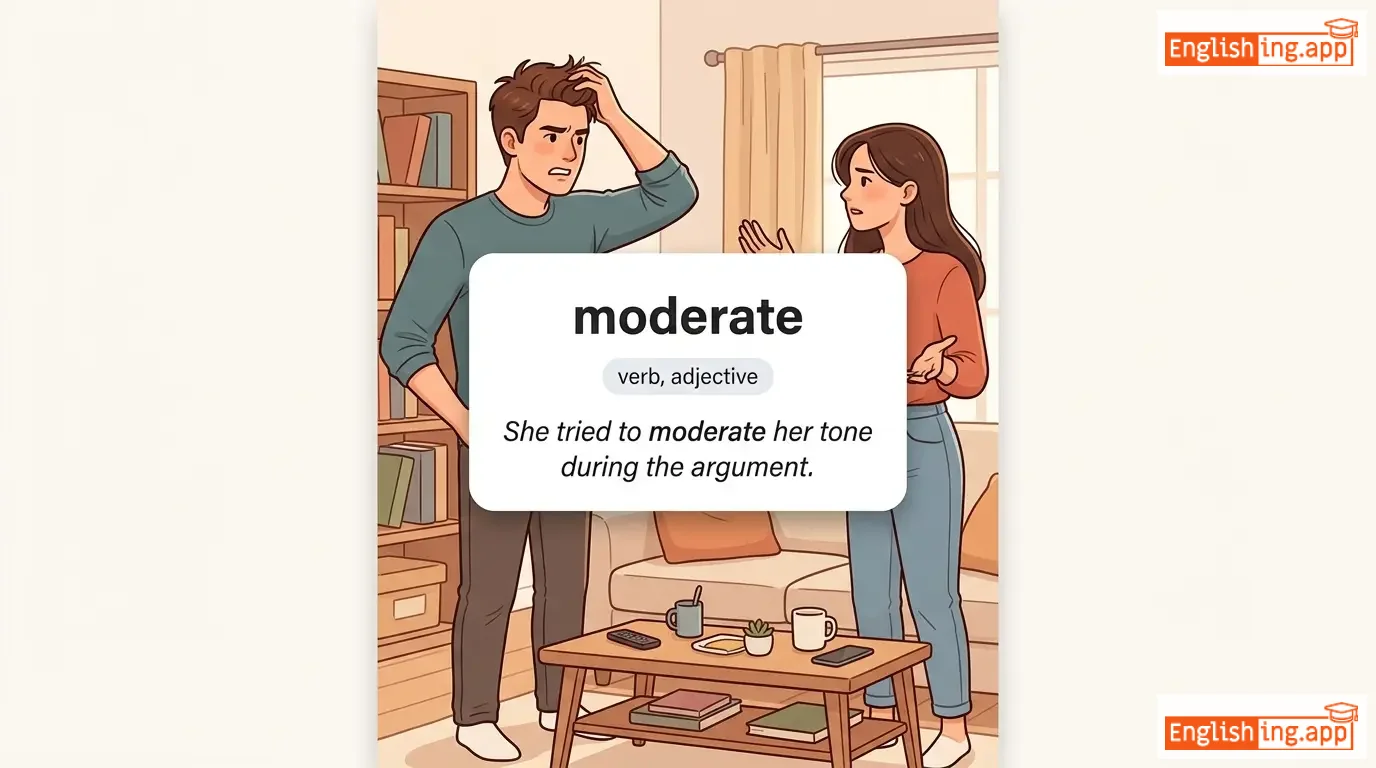
moderate definition card — visual illustration of the meaning
verb, adjective
/ˈmɒdəreɪt/ (verb), /ˈmɒdərət/ (adj)
मध्यम, नियंत्रित करना (madhyam, niyantrit karna)

To make something less extreme (verb); average in amount, intensity, quality, or degree (adjective).

"She tried to moderate her tone during the argument."

"वह बहस के दौरान अपनी आवाज़ को संतुलित करने की कोशिश कर रही थी।" (Wah behas ke dauran apni awaaz ko santulit karne ki koshish kar rahi thi.)
adverb
/ˈmɒdərətli/
मध्यम रूप से (madhyam roop se)

to a reasonable extent, not excessively

"She exercises moderately to stay healthy."

"वह स्वस्थ रहने के लिए मध्यम रूप से व्यायाम करती है।" (Vah swasth rahne ke liye madhyam roop se vyaayam karti hai.)