वोकैबुलरीज

इंग्लिश वोकैबुलरी डिस्कवर, लर्न और मास्टर करें

noun, verb
/mɪnt/
पुदीना / टकसाला (pudina / takshala)

a place where coins are made; to produce or invent something new

"The government decided to mint new coins to commemorate the anniversary."

"सरकार ने वर्षगांठ की याद में नए सिक्के बनाने का निर्णय लिया।" (Sarkar ne varshgath ki yaad mein naye sikke banane ka nirnay liya.)
adjective
/ˈmɪnəskjuːl/
सूक्ष्म (sookshm)

extremely small in size or importance

"She made only a minuscule contribution to the project."

"वह परियोजना में केवल एक सूक्ष्म योगदान कर पाई।" (Vah pariyojana mein keval ek sookshm yogdan kar pai.)
noun, adjective
/maɪˈnjuːt/ (adj), /ˈmɪnɪt/ (noun)
मिनट / सूक्ष्म (minat / sukhshm)

a period of sixty seconds; extremely small or detailed

"He examined the painting with minute attention to detail."

"उसने पेंटिंग को मिनट्स के साथ ध्यान से देखा।" (Usne painting ko minutes ke saath dhyan se dekha.)
adverb
/maɪˈnjuːtli/
सूक्ष्म रूप से (sookshm roop se)

in very small detail; extremely carefully

"The detective examined the evidence minutely."

"जासूस ने प्रमाण को सूक्ष्म रूप से जांचा।" (jaasoos ne pramaan ko sookshm roop se jaancha)
noun
/maɪˈnjuːʃə/
सूक्ष्म विवरण (sookshm vivaran)

a small or trivial detail of something

"He was bored by the minutia of office paperwork."

"वह कार्यालय के कागजों के सूक्ष्म विवरण से ऊब चुका था।" (Vah karyalay ke kagazon ke sookshm vivaran se oob chuka tha.)
noun (plural)
/maɪˈnjuːʃiiː/
सूक्ष्म विवरण (sookshma vivaran)

the small, precise, or trivial details of something

"The lawyer focused on the minutiae of the contract."

"वकील ने अनुबंध के सूक्ष्म विवरण पर ध्यान केंद्रित किया।" (Vakeel ne anubandh ke sookshma vivaran par dhyan kendrit kiya.)
noun
/ˈmɪrəkəl/
चमत्कारी घटना (chamatkari ghatna)

an extraordinary event that cannot be explained by natural laws

"Surviving the accident was nothing short of a miracle."

"दुर्घटना से बचना एक चमत्कारी घटना से कम नहीं था।" (durghatna se bachna ek chamatkari ghatna se kam nahi tha.)
adjective
/mɪˈrækjələs/
चमत्कारी (chamatkari)

Extraordinarily wonderful or unusual, as if by a miracle.

"Her recovery after the accident was truly miraculous."

"दुर्घटना के बाद उसकी रिकवरी सच में चमत्कारी थी।" (Durghatna ke baad uski recovery sach mein chamatkari thi.)
noun
/məˈrɑːʒ/
मृगतृष्णा (mrigatrishna)

An optical illusion caused by atmospheric conditions, often seen in deserts or hot roads, where water or objects appear to exist but do not.

"The weary travelers saw a mirage of water in the desert."

"थके हुए यात्री रेगिस्तान में पानी की मृगतृष्णा देख रहे थे।" (thake hue yatri registan mein pani ki mrigatrishna dekh rahe the.)
noun, verb
/ˈmaɪər/
कीचड़ / जटिलता (keechar / jatilta)

A stretch of swampy or boggy ground; as a verb, to entangle or involve someone in a difficult situation.

"The car was stuck in the mire after the heavy rain."

"गाड़ी भारी बारिश के बाद कीचड़ में फंसी हुई थी।" (gaadi bhaari barish ke baad keechar mein fansi hui thi.)
adjective, verb (past tense/participle of mire)
/ˈmaɪərd/
जटिल स्थिति में फंसना (jatil sthiti mein fansna)

Trapped or entangled in something, typically a difficult situation.

"The politician was mired in scandal."

"राजनीतिज्ञ घोटाले में फंसा हुआ था।" (rajnitijñ ghotale mein fansa hua tha.)
noun
/ˈmɪrər/
आयना (aina)

A reflective surface, typically made of glass, that shows an image.

"She looked at herself in the mirror before leaving."

"वह दरवाजे के पास आईने में खुद को देखती है।" (Wah darwaze ke paas aaine mein khud ko dekhti hai.)
noun
/mɜːrθ/
आनंद (anand)

Great joy, amusement, or laughter.

"The festival was full of mirth and laughter."

"त्योहार खुशी और हंसी से भरा हुआ था।" (tyohar khushi aur hansi se bhara hua tha.)
noun
/ˌmɪsədˈvɛntʃər/
अप्रिय घटना (apriya ghatna)

An unlucky accident, mishap, or unfortunate event.

"He broke his leg during a skiing misadventure."

"उसने स्कीइंग के दौरान एक अप्रिय घटना में अपना पैर तोड़ लिया।" (usne skiing ke dauran ek apriya ghatna mein apna pair tod liya.)
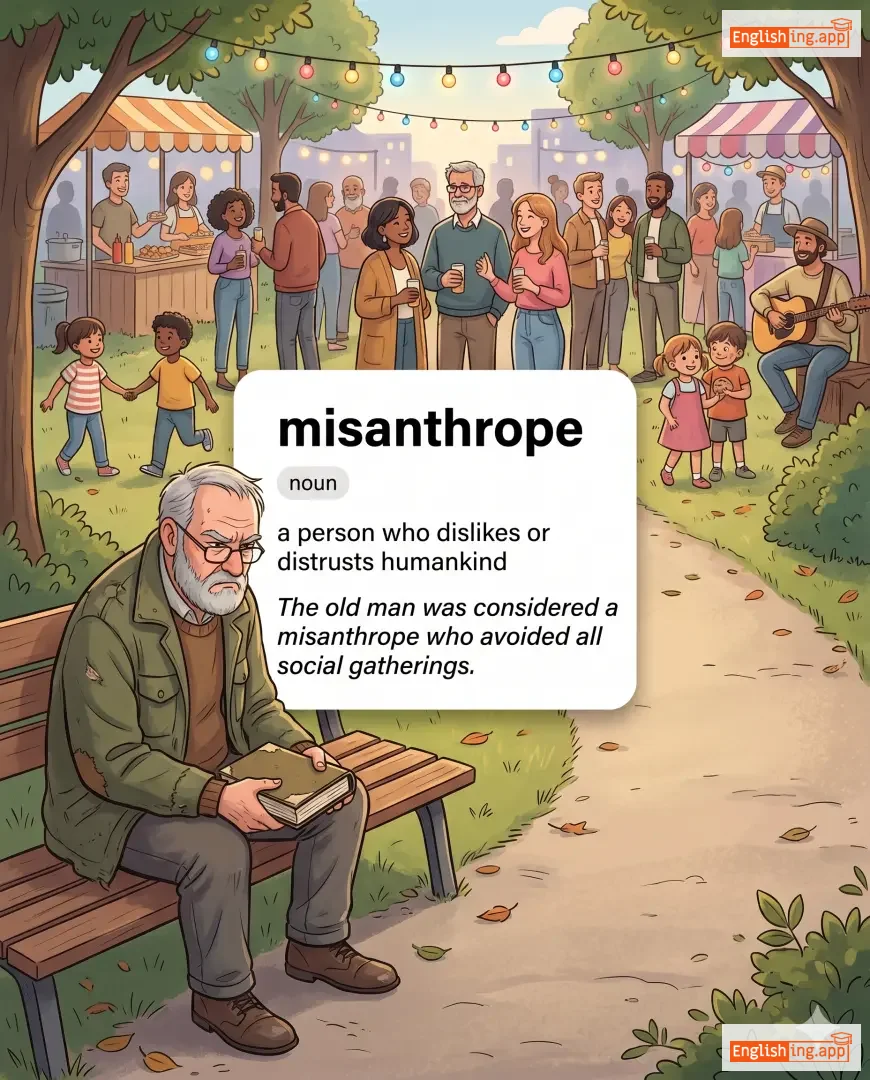
misanthrope definition card — visual illustration of the meaning
noun
/ˈmɪsənˌθroʊp/
मनुष्यों से नफरत करने वाला व्यक्ति (manushyon se nafrat karne wala vyakti)

a person who dislikes or distrusts humankind

"The old man was considered a misanthrope who avoided all social gatherings."

"वृद्ध व्यक्ति को एक मिसैनथ्रोप माना जाता था जो सभी सामाजिक आयोजनों से बचता था।" (Vriddh vyakti ko ek misanthrope mana jata tha jo sabhi samajik aayojan se bachata tha.)
adjective
/ˌmɪsənˈθrɑːpɪk/
मनुष्यों से घृणा करने वाला (manushyon se ghrina karne wala)

having or showing a dislike of humankind

"His misanthropic attitude made it difficult for him to make friends."

"उसका मनुष्यों से घृणा करने वाला रवैया उसे दोस्त बनाने में मुश्किल डालता था।" (Uska manushyon se ghrina karne wala ravayya use dost banane mein mushkil dalta tha.)
noun
/mɪˈsænθrəpi/
मानवद्वेष (manavdwesh)

a general dislike, distrust, or hatred of humankind

"His misanthropy was evident in the way he avoided people."

"उसकी मानवद्वेषिता उस तरीके से स्पष्ट थी, जिस तरह वह लोगों से बचता था।" (Uski manavdweshita us tareeke se spashth thi, jis tarah vah logon se bachta tha.)
verb
/ˌmɪsæprɪˈhɛnd/
गलत समझना (galat samajhna)

to misunderstand or misinterpret something

"He misapprehended the teacher’s instructions and did the task incorrectly."

"उसने शिक्षक के निर्देशों को गलत समझा और काम गलत किया।" (Usne shikshak ke nirdeshon ko galat samjha aur kaam galat kiya.)
noun
/ˌmɪsæprɪˈhɛnʃən/
गलत धारणा (galat dharana)

a mistaken belief or misunderstanding

"There is a common misapprehension about the causes of the disease."

"रोग के कारणों के बारे में एक सामान्य गलत धारणा है।" (Rog ke karano ke baare mein ek samanya galat dharana hai.)
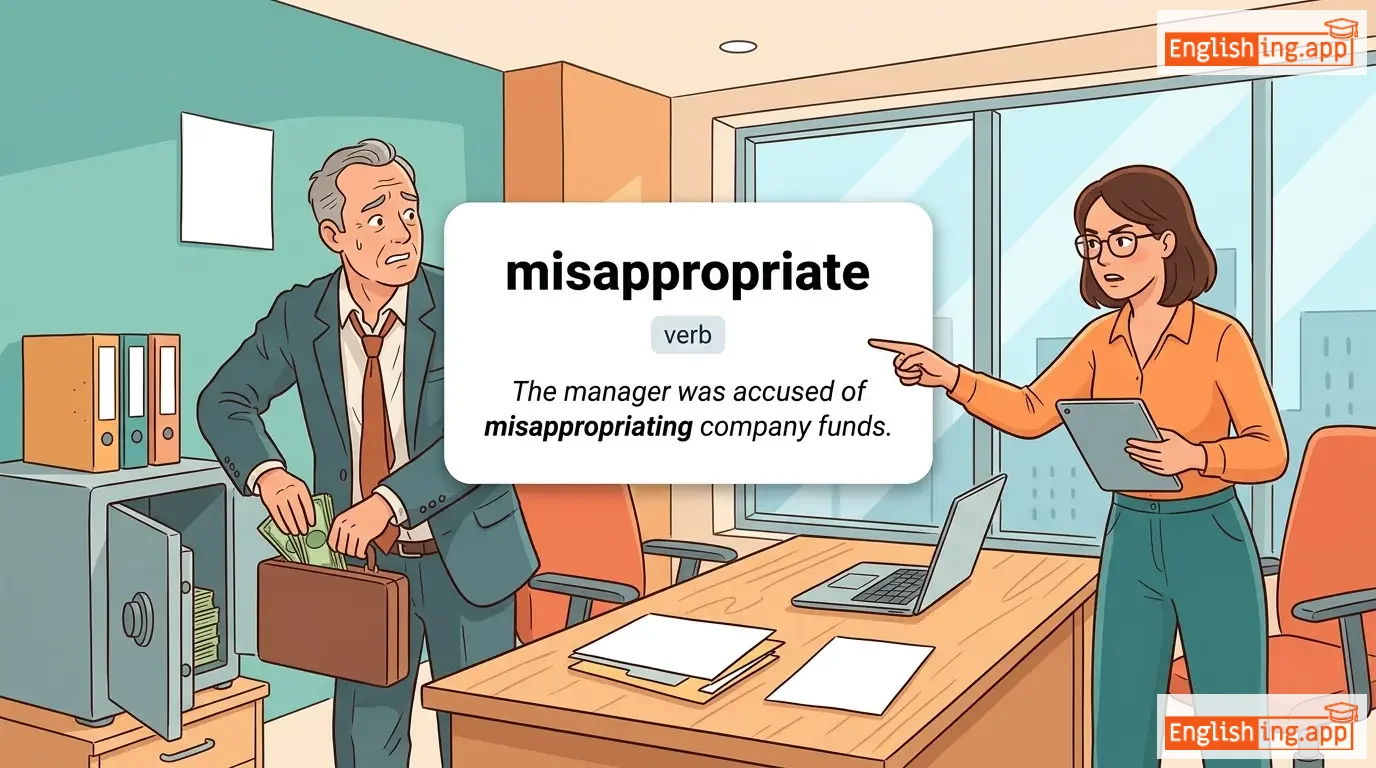
misappropriate definition card — visual illustration of the meaning
verb
/ˌmɪsəˈproʊprieɪt/
दुरुपयोग करना (durupyog karna)

to take or use something dishonestly, especially money or property, for one's own use

"The manager was accused of misappropriating company funds."

"मॅनेजर को कंपनी फंड्स को मिसअप्रोप्रिएट करने का आरोप लगा था।" (Da manager ko company funds ko misappropriate karne ka aarop laga tha.)
verb
/ˌmɪs.əˈtrɪb.juːt/
गलत तरीके से श्रेय देना (galat tareeke se shrey dena)

to incorrectly credit something, such as a work or remark, to the wrong person or source

"The quote was misattributed to Shakespeare."

"उक्त उद्धरण शेक्सपियर को गलत तरीके से श्रेय दिया गया था।" (Ukt uddharan Shekspiar ko galat tareeke se shrey diya gaya tha.)
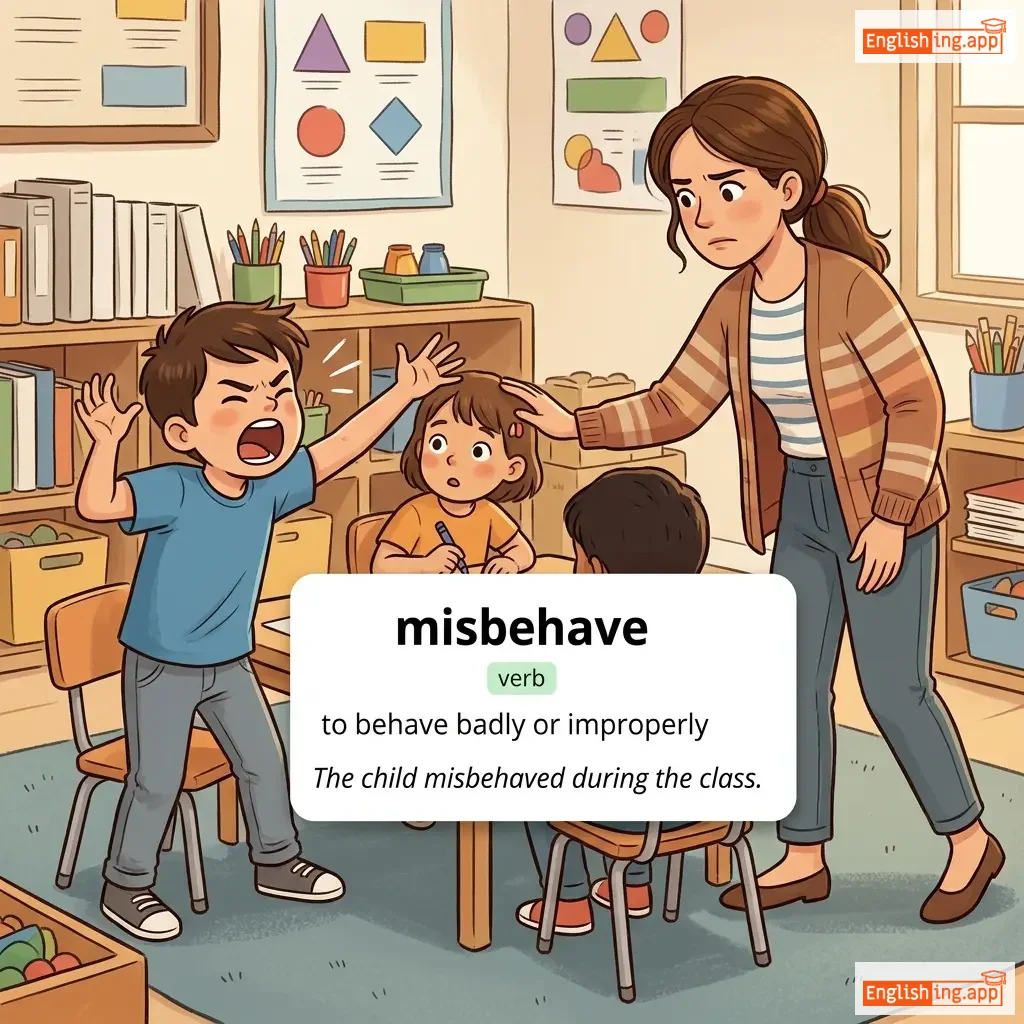
misbehave definition card — visual illustration of the meaning
verb
/ˌmɪsbɪˈheɪv/
गलत व्यवहार करना (galat vyavhaar karna)

to behave badly or improperly

"The child misbehaved during the class."

"बच्चे ने कक्षा के दौरान गलत व्यवहार किया।" (Bacche ne kaksha ke dauran galat vyavhaar kiya.)
noun
/ˌmɪsbɪˈheɪvjər/
दुराचरण (duraacharan)

bad or improper behavior

"The teacher punished the student for his misbehavior."

"टीचर ने स्टूडेंट को उसके दुराचरण के लिए सजा दी।" (Teacher ne student ko uske duraacharan ke liye saza di.)
noun
/ˌmɪs.bɪˈheɪ.vjər/
गलत या अस्वीकार्य व्यवहार, खासकर बच्चों द्वारा या औपचारिक परिस्थितियों में (misbehaviour)

Bad or unacceptable behavior, especially by children or in formal situations

"The student was punished for his misbehaviour in class."

"छात्र को कक्षा में अपने गलत व्यवहार के लिए सजा मिली।" (chatr ko kaksha mein apne galat vyavhaar ke liye saza mili.)
noun
/mɪˌsɛdʒəˈneɪʃən/
जातीय मिश्रण (jaatiy mishran)

the interbreeding of people considered to be of different racial types

"The law once prohibited miscegenation in many countries."

"कानून ने कई देशों में मिसेगेनेशन को पहले प्रतिबंधित कर दिया था।" (Kanoon ne kai deshon mein miscegenation ko pehle pratibandhit kar diya tha.)
adjective
/ˌmɪsəˈleɪniəs/
विविध (vividh)

Consisting of a variety of different items or types.

"The drawer was filled with miscellaneous objects."

"दराज विभिन्न वस्तुओं से भरा हुआ था।" (Daraaj vividh vastuon se bhara hua tha.)
noun
/ˈmɪsəleɪni/
विविधता (vividhata)

A collection or mixture of various things.

"The book is a miscellany of essays and poems."

"किताब निबंधों और कविताओं का एक संग्रह है।" (Kitaab nibandhon aur kavitaon ka ek sangrah hai.)
noun
/ˌmɪsˈtʃæns/
बदकिस्मती (badkismati)

An unfortunate accident or event; bad luck.

"By mischance, he missed the last train home."

"बदकिस्मती से उसने घर जाने वाली आख़िरी ट्रेन चूक गया।" (badkismati se usne ghar jaane wali aakhri train chook gaya.)
noun
/ˈmɪstʃɪf/
शरारत (shararat)

Playful misbehavior or troublemaking.

"The children were full of mischief during the party."

"पार्टी के दौरान बच्चे शरारत से भरे हुए थे।" (Party ke dauran bachche shararat se bhare hue the.)
adjective
/ˈmɪstʃɪvəs/
शरारती (shararti)

Causing or showing a fondness for causing trouble in a playful way.

"She gave him a mischievous smile."

"उसने उसे शरारती मुस्कान दी।" (Usne use shararti muskaan di.)
verb
/ˌmɪskənˈsiːv/
गलत तरीके से समझना (galat tareeke se samajhna)

To misunderstand or form an incorrect idea about something.

"He misconceived the purpose of the project."

"उसने परियोजना के उद्देश्य को गलत तरीके से समझा।" (Usne pariyojna ke uddeshya ko galat tareeke se samjha.)
misconception definition card — visual illustration of the meaning
noun
/ˌmɪs.kənˈsep.ʃən/
गलत धारणा, भ्रम (galat dharna, bhram)

A view or opinion that is incorrect based on faulty thinking or understanding.

"Many people have a misconception about healthy dieting."

"बहुत से लोगों को स्वस्थ आहार के बारे में एक गलत धारणा है।" (Bahut se logon ko swasth aahaar ke baare mein ek galat dharna hai.)
noun
/ˌmɪsˈkɒndʌkt/
दुराचार (durachar)

Improper or unacceptable behavior, especially by a professional or authority figure.

"The teacher was dismissed for serious misconduct."

"शिक्षक को गंभीर दुराचार के लिए बर्खास्त किया गया।" (Shikshak ko gambhir durachar ke liye barkhast kiya gaya.)
verb
/ˌmɪskənˈstruː/
गलत अर्थ लगाना (galat arth lagana)

To interpret something wrongly or misunderstand the meaning.

"She misconstrued his silence as anger."

"वह उसकी चुप्पी को गुस्से के रूप में गलत समझ बैठी।" (Wah uski chuppi ko gusse ke roop mein galat samajh baithi.)
verb
/ˌmɪsˈkaʊnt/
गलत गिनती करना (galat ginti karna)

To count wrongly or inaccurately.

"He miscounted the number of chairs in the hall."

"उसने हॉल में कुर्सियों की संख्या गलत गिनी।" (Usne hall mein kursiyon ki sankhya galat gini.)
noun
/ˈmɪskriənt/
दुराचारी (durachari)

A person who behaves badly or criminally.

"The police arrested the miscreant responsible for the theft."

"पुलिस ने चोरी के लिए जिम्मेदार दुराचारी को गिरफ्तार किया।" (Police ne chori ke liye jimmedar durachari ko giraftaar kiya.)
noun
/ˌmɪsˈdiːd/
अपराध (apraadh)

A wrong or illegal act.

"He regretted his past misdeeds and apologized."

"उसने अपने पिछले गलत कामों पर पछतावा किया और माफी मांगी।" (Usne apne pichle galat kaamon par pachhtawa kiya aur maafi maangi.)
noun
/ˌmɪsdɪˈmiːnər/
छोटी अपराध (chhoti aparadh)

A minor wrongdoing or criminal offense that is less serious than a felony.

"He was fined for a misdemeanor involving public disturbance."

"उसे सार्वजनिक अशांति से जुड़ी एक छोटी अपराध के लिए जुर्माना हुआ।" (Use sarvajanik ashanti se judi ek chhoti aparadh ke liye jurmana hua.)
noun
/ˈmaɪzər/
कंजूस (kanjoos)

A person who hoards wealth and spends as little money as possible.

"The old miser refused to donate even a penny to charity."

"वृद्ध कंजूस ने दान देने से एक पैसा भी मना कर दिया।" (Vriddh kanjoos ne dan dene se ek paisa bhi mana kar diya.)
adjective
/ˈmɪzərəbəl/
दुःखी (dukhhi)

Extremely unhappy or uncomfortable.

"He felt miserable after losing his job."

"अपनी नौकरी खोने के बाद वह बहुत दुखी महसूस कर रहा था।" (Apni naukri khone ke baad vah bahut dukhi mahsus kar raha tha.)
adverb
/ˈmɪzərəbli/
दीनहीन तरीके से; बुरी तरह से (deenheen tareeke se; buree tarah se)

in a wretched or unhappy manner; extremely badly

"The team performed miserably in the championship."

"टीम ने चैंपियनशिप में मिज़रेबली प्रदर्शन किया।" (team ne championship mein mizarebali pradarshan kiya)
adjective
/ˈmaɪzərli/
कंजूस (kanjoos)

Unwilling to spend money; stingy.

"She lived a miserly life, refusing to buy anything new."

"वह कंजूस जीवन जीती थी, नई चीज़ खरीदने से मना करती थी।" (Vah kanjoos jeevan jeeti thi, nai cheez kharidne se mana karti thi.)
noun
/ˈmɪzəri/
दुःख (dukh)

A state of great suffering, unhappiness, or discomfort.

"The refugees lived in constant misery."

"शरणार्थियों ने निरंतर दुःख में जीवन बिताया।" (Sharanarthiyon ne nirantar dukh mein jeevan bitaya.)
noun
/ˌmɪsˈfɔːrtʃən/
दुर्दैव (durdaiv)

Bad luck or an unfortunate event.

"He suffered the misfortune of losing his job during the recession."

"उसने मंदी के दौरान अपनी नौकरी खोने का दुर्भाग्य सहा।" (Usne mandi ke dauran apni naukri khone ka durdaiv saha.)
noun
/ˌmɪsˈɡɪvɪŋ/
संदेह (sandeh)

A feeling of doubt, worry, or suspicion.

"She had serious misgivings about signing the contract."

"उसने अनुबंध पर हस्ताक्षर करने को लेकर गंभीर संदेह व्यक्त किया।" (Usne anubandh par hastakshar karne ko lekar gambhir sandeh vyakt kiya.)
noun
/mɪsˈɡɪvɪŋz/
संदेह, चिंता (sandeh, chinta)

feelings of doubt or concern about the outcome or propriety of something

"She had serious misgivings about signing the contract."

"उसे समझौते पर साइन करने के बारे में गंभीर संदेह था।" (Use samjhote par sign karne ke baare mein gambhir sandeh tha.)
noun
/ˈmɪshæp/
दुर्घटना, विपत्ति (durghatna, vipatti)

an unlucky accident or minor misfortune

"A minor mishap delayed the train for half an hour."

"एक छोटी दुर्घटना ने ट्रेन को आधे घंटे के लिए देरी कर दी।" (ek chhoti durghatna ne train ko aadhe ghante ke liye deri kar di.)
verb
/ˌmɪsɪnˈtɜːrprɪt/
गलत समझना (galat samajhna)

to understand or explain something wrongly

"He misinterpreted her silence as agreement."

"उसने उसकी चुप्पी को सहमति समझ लिया।" (Usne uski chuppi ko sahmati samajh liya.)
verb
/ˌmɪsˈleɪ/
अस्थायी रूप से खोना (asthaayi roop se khona)

to lose something temporarily by putting it in the wrong place

"I must have mislaid my keys somewhere in the house."

"मुझे लगता है कि मैंने अपने चाबियाँ कहीं घर में भूल दी हैं।" (Mujhe lagta hai ki maine apne chabiyaan kahin ghar mein bhool di hain.)
adjective
/mɪsˈliːdɪŋ/
भ्रामक (bhramak)

giving the wrong idea or impression

"The advertisement was misleading and gave false information."

"विज्ञापन भ्रामक था और उसने झूठी जानकारी दी।" (Vigyapan bhramak tha aur usne jhoothi jankari di.)