वोकैबुलरीज

इंग्लिश वोकैबुलरी डिस्कवर, लर्न और मास्टर करें

adjective
/maɪld/
हल्का (halka)

not severe or strong; gentle in nature

"The patient had only mild symptoms."

"मरीज के पास केवल हल्के लक्षण थे।" (Mariz ke paas keval halke lakshan the.)
noun
/maɪl/
मील (meel)

a unit of distance equal to 1,609.34 meters; a long distance figuratively

"She walked a mile to reach the bus stop."

"वह बस स्टॉप तक पहुँचने के लिए एक मील चली।" (vah bus stop tak pahunchne ke liye ek meel chali)
noun
/ˈmaɪlɪdʒ/
माइलिज (mailej)

The distance traveled in miles, or the fuel efficiency of a vehicle.

"This car gives excellent mileage on highways."

"यह कार हाईवे पर उत्कृष्ट माइलिज देती है।" (Yah car highway par utkṛṣṭ mailej deti hai.)
milestone definition card — visual illustration of the meaning
noun
ˈmaɪl.stəʊn
महत्वपूर्ण उपलब्धि (mahatvapoorn uplabdhi)

An important achievement or stage in a process or journey.

"Winning this award is a milestone in his career."

"यह पुरस्कार जीतना उसके करियर में एक माइलस्टोन है।" (Yeh puraskar jeetna uske career mein ek milestone hai.)
noun
/miːlˈjuː/
परिवेश (parivesh)

A person's social environment or surroundings.

"She grew up in an artistic milieu."

"वह एक कलात्मक परिवेश में पली-बढ़ी।" (Wah ek kalatmak parivesh mein pali-badhi.)
adjective
/ˈmɪlɪtənt/
आक्रामक (aakramak)

Aggressively active in a cause, sometimes using forceful methods.

"The group became increasingly militant in their demands."

"समूह अपनी मांगों में बढ़ता हुआ आक्रामक हो गया।" (Samooh apni maangon mein badhta hua aakramak ho gaya.)
noun
/ˈmɪlɪtəˌrɪzəm/
सैन्यवादी तंत्र (sainyavadi tantra)

The belief in maintaining a strong military and using it aggressively to defend or promote national interests.

"The rise of militarism in the region caused tension among neighboring countries."

"क्षेत्र में सैन्यवादी तंत्र का उभार पड़ोसी देशों के बीच तनाव का कारण बना।" (kshetra mein sainyavadi tantra ka ubhaar padosi deshon ke beech tanav ka kaaran bana.)
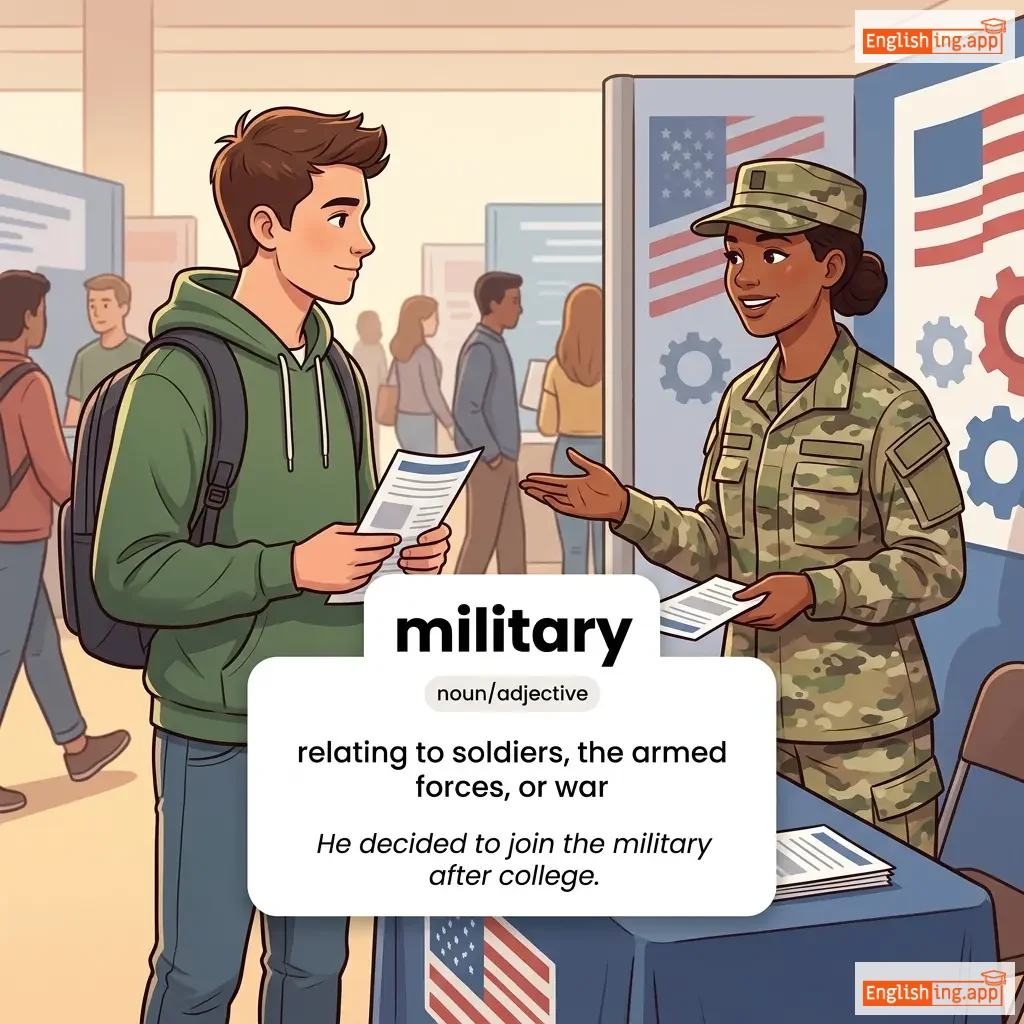
military definition card — visual illustration of the meaning
noun/adjective
/ˈmɪlɪˌtɛri/
सैन्य (sainya)

relating to soldiers, the armed forces, or war

"He decided to join the military after college."

"उसने कॉलेज के बाद सेना में शामिल होने का निर्णय लिया।" (Usne college ke baad sena mein shaamil hone ka nirnay liya.)
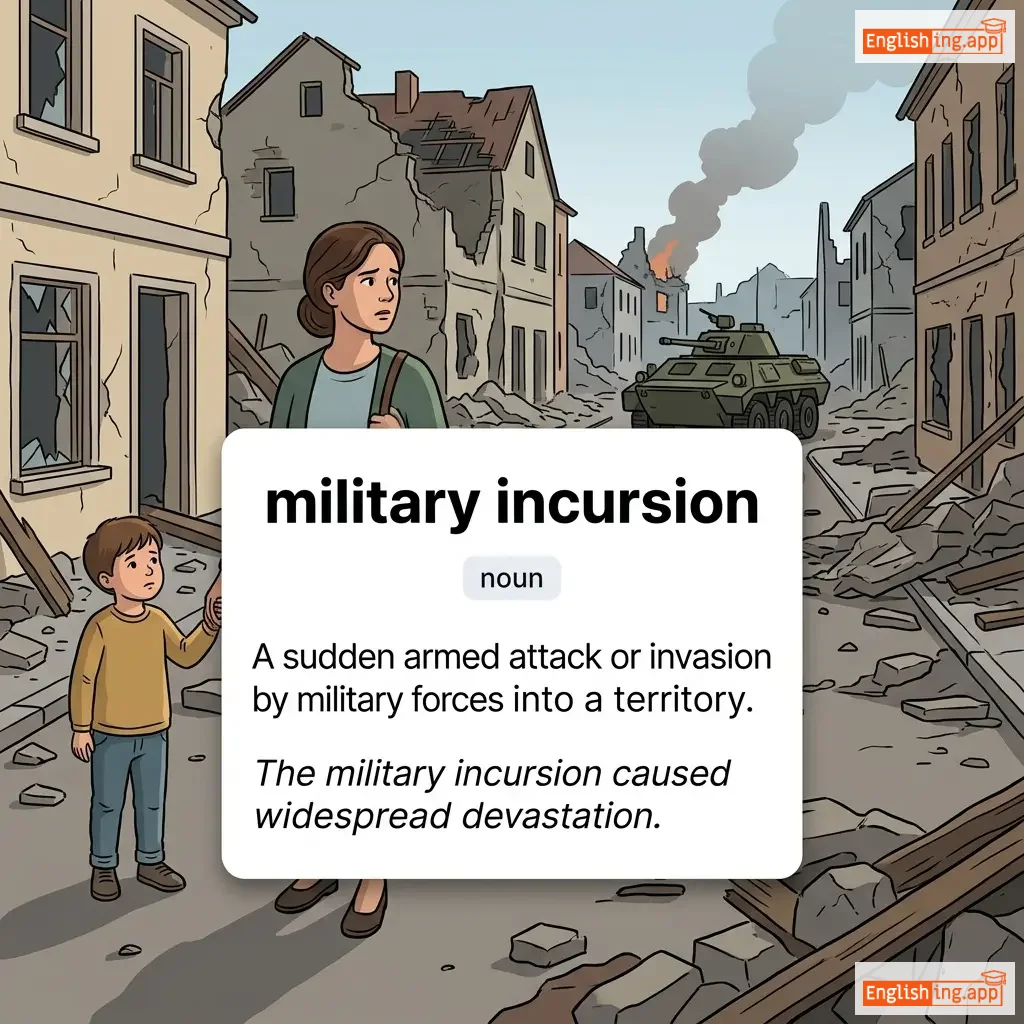
military incursion definition card — visual illustration of the meaning
noun
ˈmɪl.ɪ.tər.i ɪnˈkɜː.ʃən
सैन्य आक्रमण (sainya aakraman)

A sudden armed attack or invasion by military forces into a territory.

"The military incursion caused widespread devastation."

"सैन्य आक्रमण ने व्यापक विध्वंस किया।" (Sainya aakraman ne vyapak vidhwans kiya.)
verb
/ˈmɪlɪˌteɪt/
रोकना (rokna)

to have a strong effect against something; to work as a powerful factor in preventing or influencing an outcome

"His lack of experience will militate against his promotion."

"उसके अनुभव की कमी उसके पदोन्नति के खिलाफ काम करेगी।" (uske anubhav ki kami uske podonnati ke khilaf kaam karegi.)
noun
/mɪˈlɪʃə/
सैन्य (sainya)

a group of ordinary people who are trained to act as soldiers in emergencies

"The village formed a militia to defend against attacks."

"गांव ने हमलों से बचाव के लिए एक मिलिशिया बनाई।" (gaon ne hamlon se bachav ke liye ek militia banayi.)
noun, verb
/mɪlk/
सुख (sukh)

noun: a white liquid produced by female mammals for feeding their young; verb: to draw milk from an animal

"She milked the cow early in the morning."

"उसने सुबह जल्दी गाय का दूध निकाला।" (Usne subah jaldi gaay ka doodh nikala.)
noun
/mɪlk raɪs/
खीर (kheer)

A sweet dessert made from rice cooked with milk and sugar

"My grandmother makes delicious milk rice for special occasions."

"मेरी दादी खास मौके पर स्वादिष्ट मिल्क राइस बनाती हैं।" (meri daadi khaas mauke par swaadisht milk rice banati hain)
noun
/ˈmɪlk pɒt/
दूध का पात्र (dudh ka patra)

a container specifically used for storing or serving milk

"She poured fresh milk from the milk-pot into her glass."

"उसने मिल्क-पॉट से ताजा दूध अपने गिलास में डाला।" (usne milk-pot se taja doodh apne glass mein dala)
noun
/ˈmɪlk.mæn/
दूधवाला (doodhwala)

a person who delivers milk to homes or businesses

"The milkman delivers fresh milk to our house every morning."

"दूधवाला हर सुबह हमारे घर ताजे दूध की आपूर्ति करता है।" (doodhwala har subah hamare ghar taze doodh ki aapoorti karta hai)
adjective
/ˈmɪl.ki waɪt/
दूध जैसा सफेद (dood jaisa safed)

a pure white color resembling milk

"The clouds looked milky white against the blue sky."

"नीले आकाश के खिलाफ बादल दूध जैसा सफेद दिख रहे थे।" (neele aakash ke khilaf baadal dood jaisa safed dikh rahe the)
noun
/mɪl/
चक्की (chakki)

a building equipped with machinery for grinding grain or manufacturing goods

"The old flour mill has been converted into a museum."

"पुरानी आटा चक्की को एक संग्रहालय में बदल दिया गया है।" (Purani aata chakki ko ek sangrahalay mein badal diya gaya hai.)
noun
/mɪˈlɛniəm/
सहस्राब्दि (sahasrabdi)

a period of one thousand years; often used to mark an anniversary

"The year 2000 was celebrated as the beginning of a new millennium."

"साल 2000 को एक नए सहस्राब्दि की शुरुआत के रूप में मनाया गया था।" (Saala 2000 ko ek naye sahasrabdi ki shuruat ke roop mein manaya gaya tha.)
noun
/ˈmɪlɪt/
बाजरा (bajra)

a small-seeded grass cultivated as a cereal crop

"Millet is often used as food in rural areas."

"बाजरा अक्सर ग्रामीण क्षेत्रों में खाद्य के रूप में उपयोग किया जाता है।" (bajra aksar gramin kshetron mein khadya ke roop mein upyog kiya jata hai.)
noun
/ˈmɪljən/
मिलियन (milion)

the number equivalent to one thousand thousand (1,000,000)

"The movie earned over a million dollars in its first week."

"फिल्म ने पहले हफ्ते में एक मिलियन डॉलर से अधिक कमाए।" (Film ne pehle hafte mein ek milion dollar se adhik kamaaye.)
noun
/ˌmɪl.jəˈneər/
करोड़पति (karodpati)

A person whose wealth equals or exceeds one million units of currency

"He became a millionaire through smart investments and hard work."

"वह स्मार्ट निवेश और कठिन काम के माध्यम से करोड़पति बन गया।" (vah smart nivesh aur kathin kaam ke madhyam se karodpati ban gaya.)
noun
/maɪm/
मौन अभिनय कलाकार (maun abhinay kalakar)

A performer who conveys meaning through gestures and body movements without speech.

"The mime entertained the children with exaggerated expressions."

"माइम ने अतिरंजित भावभंगिमाओं के साथ बच्चों का मनोरंजन किया।" (Mime ne atiranjit bhavbhangimaon ke saath bachon ka manoranjan kiya.)
verb
/ˈmɪmɪk/
नकल करना (nakal karna)

To copy the actions, speech, or behavior of someone or something.

"Children often mimic their parents' behavior."

"बच्चे अक्सर अपने माता-पिता के व्यवहार की नकल करते हैं।" (Bacche aksar apne mata-pita ke vyavhaar ki nakal karte hain.)
noun
/ˈmɪmɪkri/
अनुकरण (anukaran)

The act of imitating someone or something, often for humor or learning.

"The comedian’s mimicry of celebrities made the audience laugh."

"कॉमेडियन के सेलेब्रिटीज़ की मिमिक्री ने दर्शकों को हंसी दिलाई।" (Comedian ke celebrities ki mimicry ne darshako ko hasie dilai.)
noun
/ˌmɪnəˈrɛt/
मिनार (minar)

A tall, slender tower of a mosque, from which the call to prayer is announced.

"The minaret of the mosque could be seen from miles away."

"मस्जिद का मीनार कई मील दूर से दिखता था।" (Masjid ka minar kai meel door se dikhta tha.)
adjective
/ˈmɪnətɔːri/
धमकी देने वाला (dhamki dene wala)

Expressing a threat; menacing.

"The criminal gave the witness a minatory look."

"अपराधी ने गवाह को धमकी देने वाली नजर से देखा।" (Aparadhi ne gawah ko dhamki dene wali nazar se dekha.)
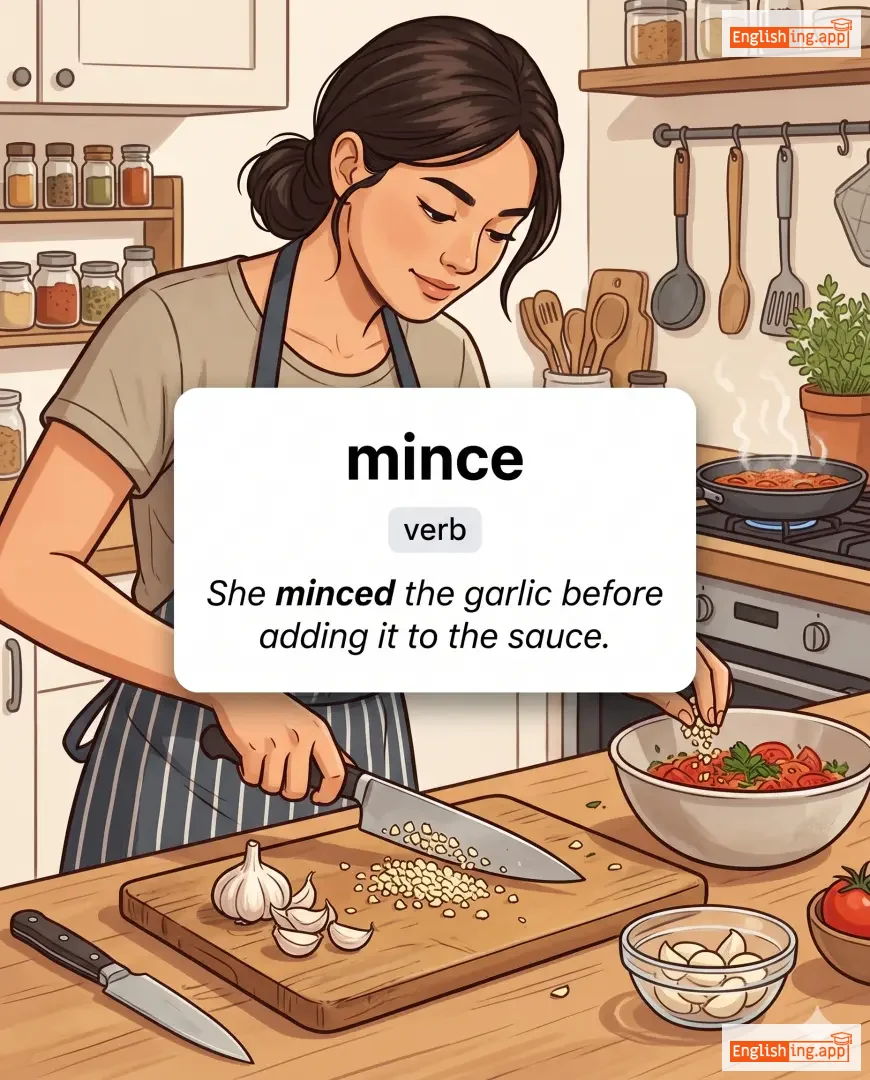
mince definition card — visual illustration of the meaning
verb
/mɪns/
काटना (katna)

to cut food, especially meat, into very small pieces; to speak in an affectedly delicate or refined way

"She minced the garlic before adding it to the sauce."

"उसने सॉस में डालने से पहले लहसुन को बारीक काटा।" (Usne sauce mein daalne se pehle lahsun ko baareek kaata.)
adjective
/ˈmɪnsɪŋ/
अत्यधिक नाटकीय (atyadhik natakiy)

affectedly delicate, dainty, or refined in manner or movement

"He walked with mincing steps across the stage."

"वह मंच पर नाटकीय कदमों से चल रहा था।" (Vah manch par natakiy kadmon se chal raha tha.)
noun/verb
/maɪnd/
मन / ध्यान रखना (man / dhyan rakhna)

the part of a person that enables them to think, feel, and reason; to pay attention or take care

"Please mind the gap between the train and the platform."

"कृपया ट्रेन और प्लेटफार्म के बीच गैप का ध्यान रखें।" (Kripya train aur platform ke beech gap ka dhyan rakhen.)
adjective
/ˈmaɪnd.fəl/
सचेत; ध्यानपूर्ण (sachet; dhyanpurn)

being conscious or aware; paying attention to the present moment

"She is always mindful of her surroundings and pays attention to details."

"वह हमेशा अपने आस-पास के माहौल के प्रति सचेत रहती है और विवरणों पर ध्यान देती है।" (vah hamesha apne aas-paas ke maahol ke prati sachet rahti hai aur vivaranon par dhyan deti hai.)
mindfulness definition card — visual illustration of the meaning
noun
/ˈmaɪnd.fʊl.nəs/
सचेतन उपस्थिति (sachetan upasthiti)

The quality or state of being conscious or aware of something; a mental state achieved by focusing one's awareness on the present moment.

"Practicing mindfulness reduces stress and anxiety."

"माइंडफुलनेस का अभ्यास तनाव और चिंता को कम करता है।" (Mindfulness ka abhyas tanav aur chinta ko kam karta hai.)
adjective
/ˈmaɪndləs/
बिना सोचे-समझे (bina soche-samjhe)

without thought or intelligence; done without consideration

"He was bored by the mindless tasks at work."

"वह काम पर बिना सोचे-समझे कामों से उब चुका था।" (Wah kaam par bina soche-samjhe kaamon se ub chuka tha.)
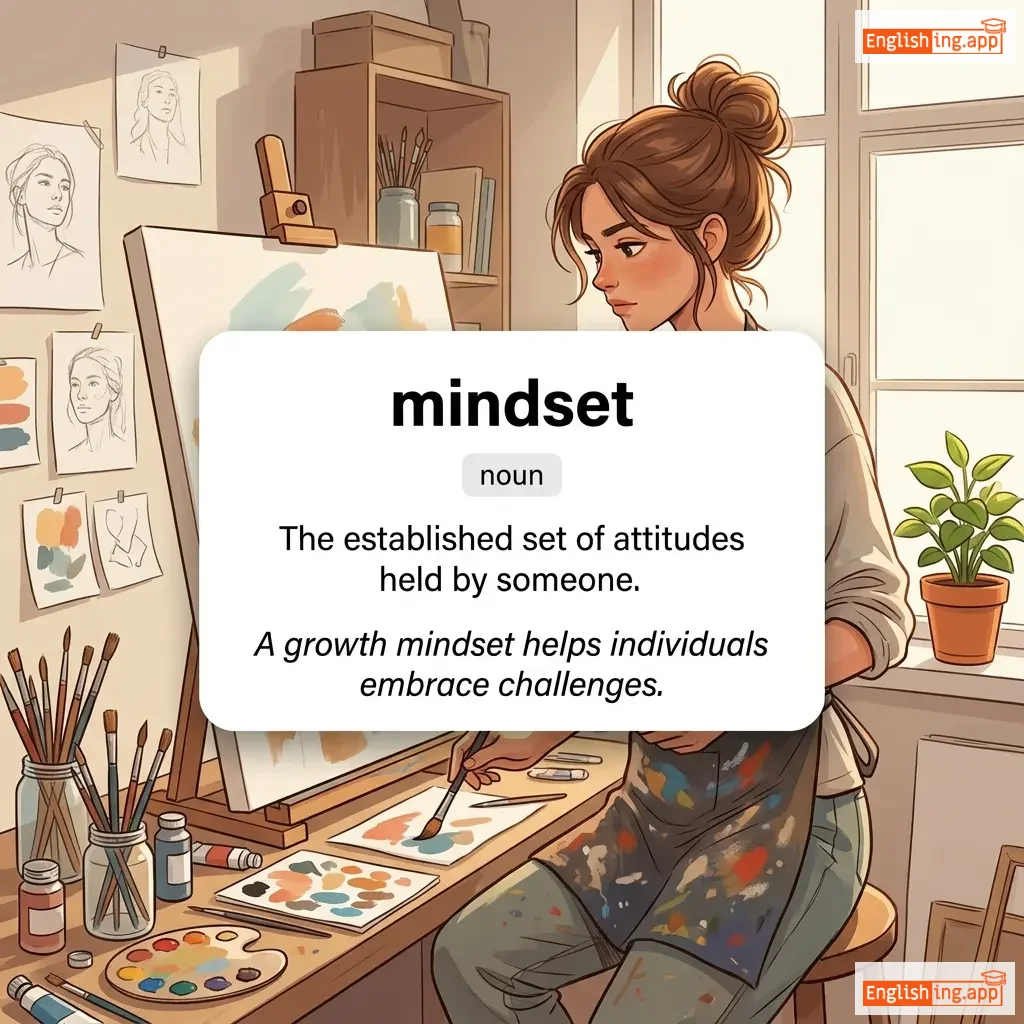
mindset definition card — visual illustration of the meaning
noun
ˈmaɪnd.set
मानसिकता (maansikta)

The established set of attitudes held by someone.

"A growth mindset helps individuals embrace challenges."

"एक विकास मानसिकता व्यक्तियों को चुनौतियों को अपनाने में मदद करती है।" (Ek vikas maansikta vyaktiyon ko chunautiyon ko apnane mein madad karti hai.)
noun, pronoun, verb
/maɪn/
खदान / मेरा (khadan / mera)

a place where minerals are dug from the ground; or something belonging to me

"The workers went deep into the mine to extract coal."

"कामकाजी लोग कोयला निकालने के लिए खदान में गहरे गए।" (kaamkaji log koyla nikaalne ke liye khadan mein gahare gaye.)
noun
/ˈmaɪnə(r)/
खनिक (khanik)

a person who works in a mine, extracting minerals or other resources

"The miner worked in the coal mine for many years."

"खनिक ने कई वर्षों तक कोयला खदान में काम किया।" (Khanik ne kai varshon tak koyla khadan mein kaam kiya.)
noun
/ˈmɪnərəl/
खनिज (khonij)

a naturally occurring substance that is solid and inorganic, often used in industry or nutrition

"Calcium is an important mineral for strong bones."

"कैल्शियम मजबूत हड्डियों के लिए एक महत्वपूर्ण खनिज है।" (Calcium majboot haddiyon ke liye ek mahatvapurn khonij hai.)
verb
/ˈmɪŋɡl/
मिलाना (milana)

to mix or combine; to move among people and engage socially

"Guests mingled at the party, chatting and laughing together."

"मेहमान पार्टी में एक दूसरे से मिले, चैटिंग और हंसी मजाक करते हुए।" (Mehmaan party mein ek doosre se mile, chatting aur hansi mazaak karte hue.)
adjective
/ˈmɪn.dʒi/
किफ़ायती; सख़्त; आलसी (kifayati; sakht; aalsi)

mean or stingy; unwilling to spend money

"He is too mingy to spend money on anything but necessities."

"वह किसी भी चीज़ पर पैसे खर्च करने के लिए बहुत मिंजी है, सिवाय आवश्यकताओं के।" (vah kisi bhi cheez par paise kharch karne ke liye bahut minji hai, siwaay aavashyaktaon ke.)
noun/adjective
/ˈmɪnətʃər/ or /ˈmɪniətʃʊr/
सूक्ष्म संस्करण (sookshm sanskaran)

a very small version of something; small in scale or size

"The artist created a miniature model of the castle."

"कलाकार ने किले का सूक्ष्म मॉडल बनाया।" (Kalakar ne kile ka sookshm model banaya.)
adjective
/ˈmɪnɪməl/
न्यूनतम (nyunatam)

the smallest or least amount possible

"The damage to the car was minimal after the accident."

"दुर्घटना के बाद कार को हुए नुकसान की मात्रा न्यूनतम थी।" (Durghatna ke baad car ko hue nuksan ki matra nyunatam thi.)
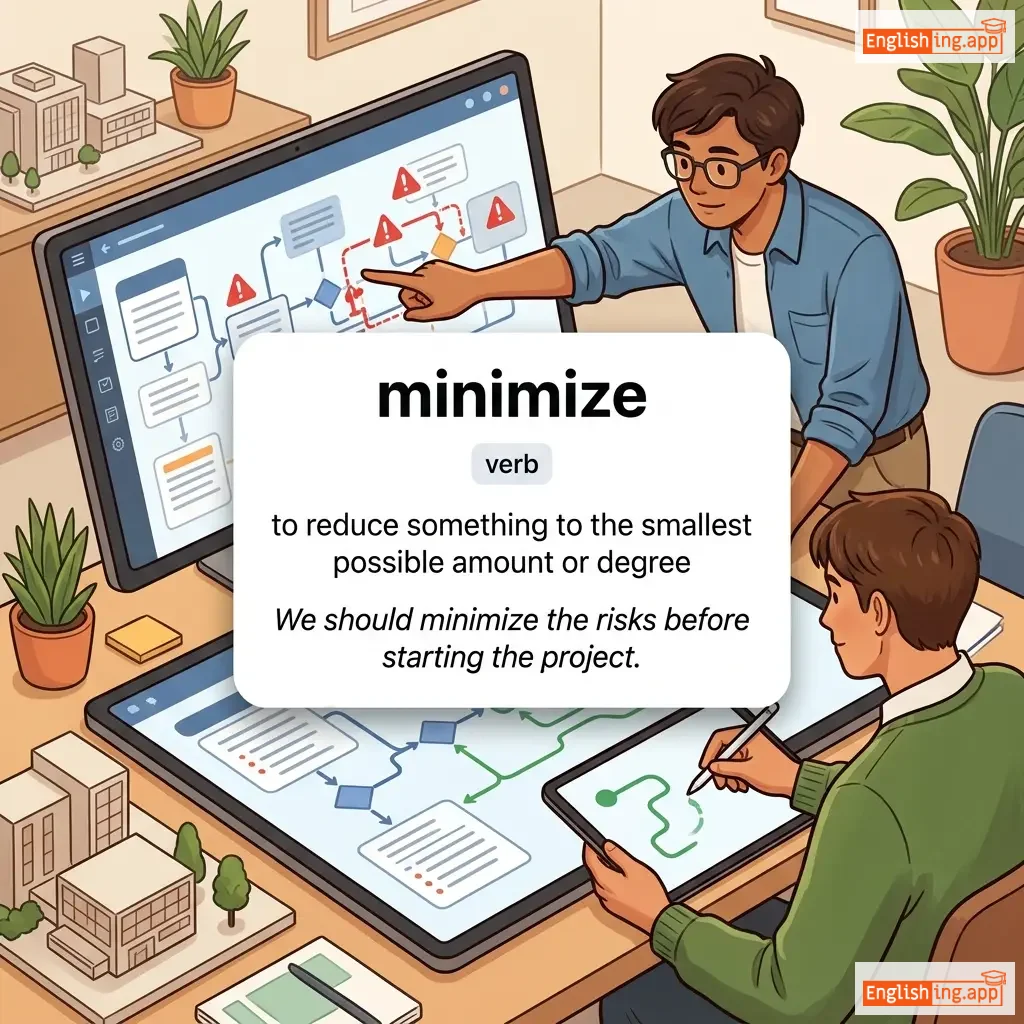
minimize definition card — visual illustration of the meaning
verb
/ˈmɪnɪmaɪz/
न्यूनतम करना (nyoonatam karna)

to reduce something to the smallest possible amount or degree

"We should minimize the risks before starting the project."

"हमें परियोजना शुरू करने से पहले जोखिम को कम करना चाहिए।" (Humein pariyojna shuru karne se pehle jokhim ko kam karna chahiye.)
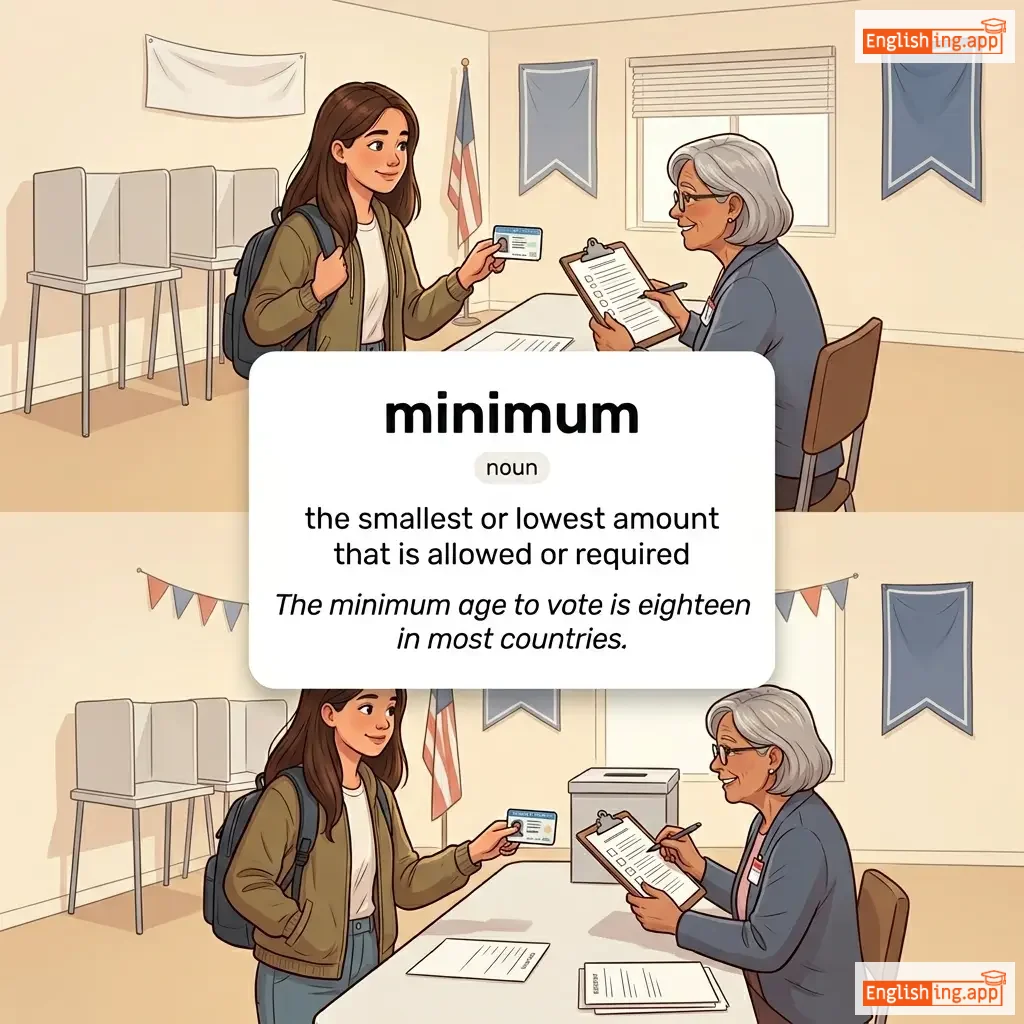
minimum definition card — visual illustration of the meaning
noun
/ˈmɪnɪməm/
न्यूनतम (nyuntam)

the smallest or lowest amount that is allowed or required

"The minimum age to vote is eighteen in most countries."

"वोट देने की न्यूनतम आयु अधिकांश देशों में अठारह साल है।" (Vote dene ki nyuntam aayu adhikansh deshon mein atharah saal hai.)
noun
/ˈmaɪnɪŋ/
खनन (khannan)

the process of extracting valuable minerals or other resources from the earth

"Mining in this area has increased in recent years."

"इस क्षेत्र में खनन पिछले कुछ वर्षों में बढ़ा है।" (Is kshetra mein khannan pichle kuch varsho mein badha hai.)
noun
/ˈmɪn.i.ən/
अनुचर (anuchar)

A follower or underling of a powerful person, especially a servile one.

"The dictator was surrounded by loyal minions who carried out his orders."

"तानाशाह अपने आदेशों को निभाने वाले विश्वासयोग्य अनुचरों से घिरा हुआ था।" (Taanashaah apne aadeshon ko nibhaane wale vishwasyogya anucharon se ghira hua tha.)
adjective
/ˈmɪn.ɪ.skjuːl/
सूक्ष्म (sookshm)

Extremely small or tiny.

"The error was so miniscule that nobody noticed it."

"गलती इतनी सूक्ष्म थी कि किसी ने ध्यान नहीं दिया।" (Galti itni sookshm thi ki kisi ne dhyan nahi diya.)
noun
/ˈmɪnɪstər/
मंत्री (mantri)

a head of a government department; a person who leads a church

"The finance minister announced new tax policies."

"वित्त मंत्री ने नए कर नीति की घोषणा की।" (Vitt mantri ne naye kar niti ki ghoshna ki.)
noun
/ˌmɪn.ɪˈstreɪ.ʃən/
सेवा (seva)

The act of providing care, assistance, or religious service.

"She recovered thanks to the kind ministrations of the nurses."

"उसकी स्वास्थ्य वापसी नर्सों की दयालु सेवाओं के कारण हुई।" (Uski swasthya wapsi narsoun ki dayalu sevaon ke karan hui.)
noun
/ˈmɪn.ɪ.stri/
मंत्रालय (mantralay)

A government department headed by a minister or the work of a religious minister.

"He works at the Ministry of Education."

"वह शिक्षा मंत्रालय में काम करता है।" (Vah shiksha mantralay mein kaam karta hai.)
adjective/noun
/ˈmaɪ.nər/
तुच्छ / अवयस्क (tuchchha / avayask)

less important, serious, or significant; a person under the legal age

"Luckily, the accident caused only minor injuries."

"सौभाग्यवश, दुर्घटना में केवल मामूली चोटें आईं।" (saubhagyavash, durghatna mein keval mamooli chhotein aayi)
noun
/maɪˈnɔːr.ɪ.ti/
अल्पसंख्यक (alpsankhyak)

A smaller number or part, especially a group differing from the majority.

"The law aims to protect the rights of ethnic minorities."

"कानून का उद्देश्य जातीय अल्पसंख्यकों के अधिकारों की रक्षा करना है।" (Kanoon ka uddeshya jaatiya alpsankhyakon ke adhikaron ki raksha karna hai.)