वोकैबुलरीज

इंग्लिश वोकैबुलरी डिस्कवर, लर्न और मास्टर करें

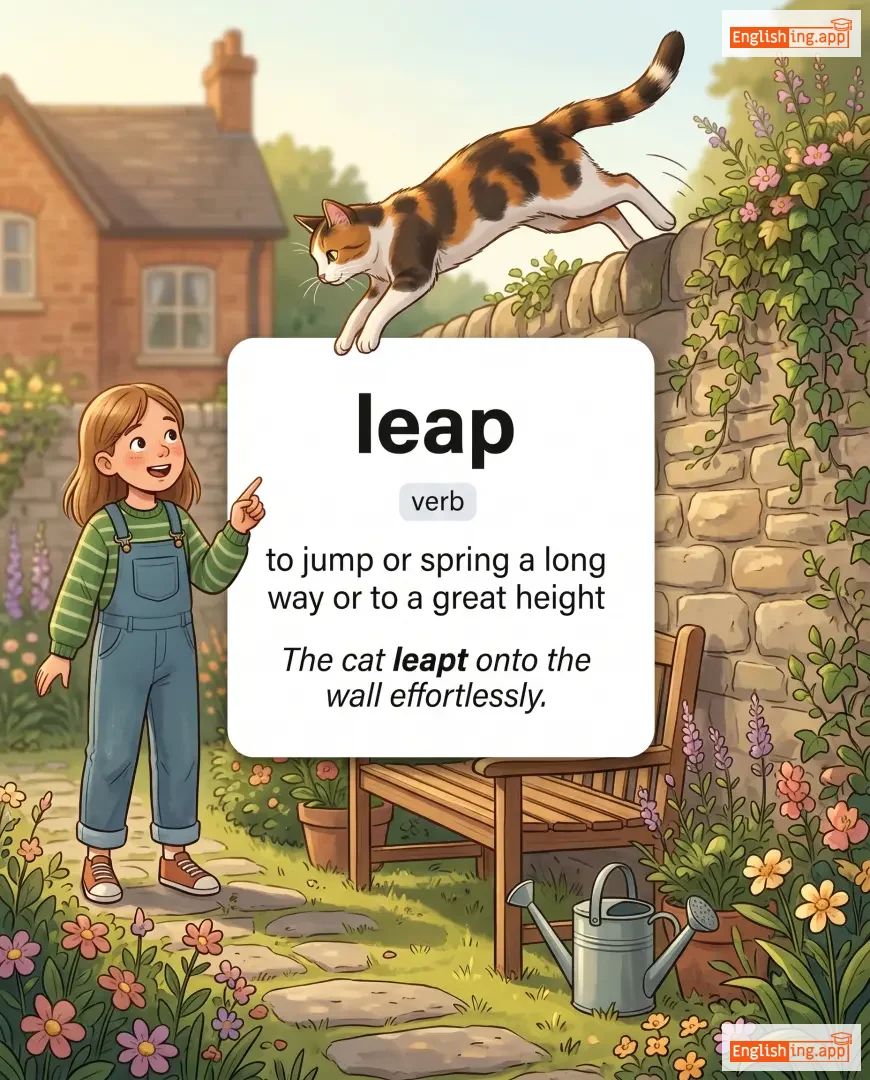
leap definition card — visual illustration of the meaning
🏃‍♂️

leap (लीप)

verb
/liːp/
कूदना (koodna)

to jump or spring a long way or to a great height

"The cat leapt onto the wall effortlessly."

"बिल्ली ने दीवार पर बिना किसी मुश्किल के कूदकर चढ़ाई की।" (Billi ne deewaar par bina kisi mushkil ke koodkar chadhai ki.)
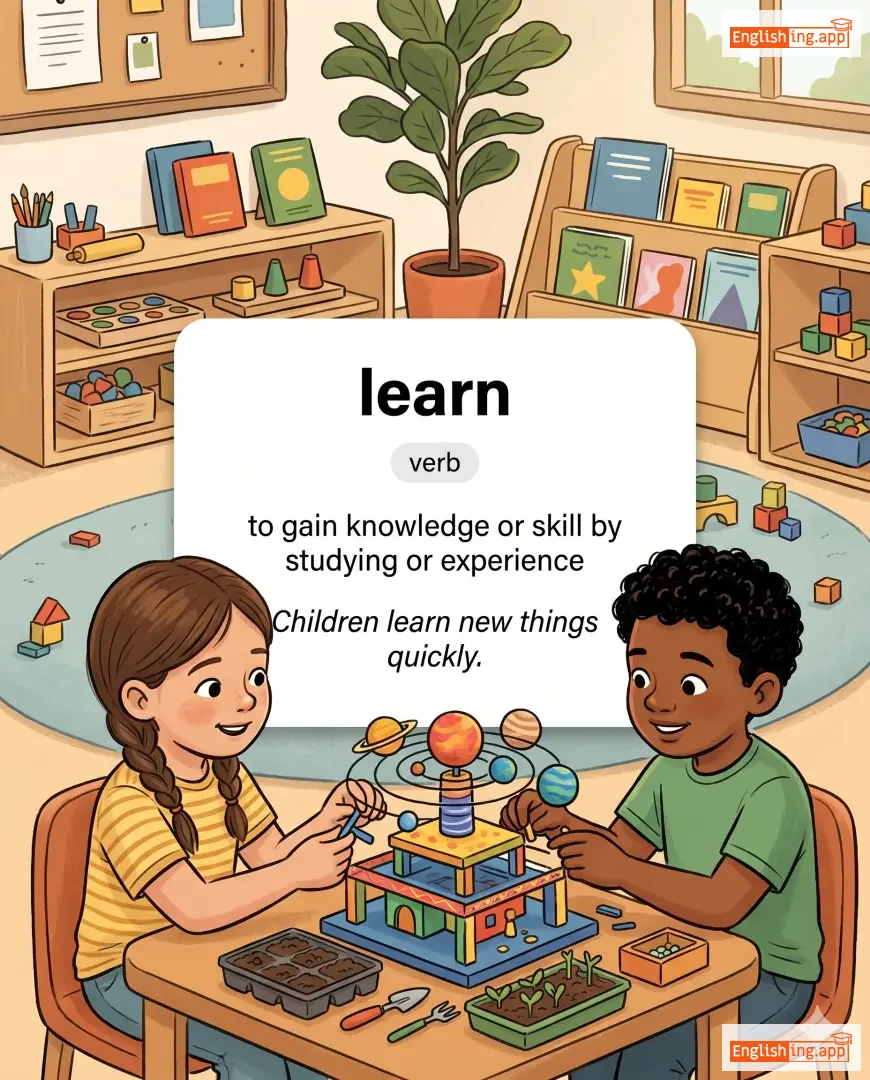
learn definition card — visual illustration of the meaning
verb
/lɜːrn/
सीखना (seekhna)

to gain knowledge or skill by studying or experience

"Children learn new things quickly."

"बच्चे नई चीजें जल्दी सीखते हैं।" (bachche nai cheezein jaldi seekhte hain.)
adjective; verb (past and past participle)
/lɜːrnd/
विद्वान (vidvan)

having acquired much knowledge through study; gained knowledge or skill through experience or teaching

"She is a learned scholar with deep knowledge of history."

"वह इतिहास का गहरा ज्ञान रखने वाली विद्वान है।" (vah itihas ka gehra gyan rakhne vali vidvan hai)
noun
/ˈlɜːrnər/
सीखने वाला (seekhne wala)

a person who is acquiring knowledge or skill through study or experience

"She is a fast learner."

"वह बहुत जल्दी सीखने वाली है।" (vah bahut jaldi seekhne wali hai)
noun
/ˈlɜrnɪŋ/
सीखना (seekhna)

The process of gaining knowledge or skills through study or experience.

"Learning a new language can be exciting."

"एक नई भाषा सीखना रोमांचक हो सकता है।" (ek nai bhasha seekhna romanchak ho sakta hai.)
Lease definition card — visual illustration of the meaning
noun
/liːs/
किराया पर देना; अनुबंध (leez)

a contract by which one party conveys land, property, services, etc. to another for a specified time, usually in return for a periodic payment

"They signed a two-year lease for the apartment."

"उन्होंने अपार्टमेंट के लिए दो साल का लीज साइन किया।" (unhone apartment ke liye do saal ka leez sign kiya.)
noun/verb
/liːʃ/
पट्टा (patta)

a strap or cord used to control or guide an animal; to restrain or control

"The dog was on a leash during the walk."

"कुत्ता सैर के दौरान पट्टे में था।" (Kutta sair ke dauran patte mein tha.)
adjective
/liːst/
सबसे कम (sabse kam)

smallest in amount, extent, or importance

"She showed the least interest in the project."

"उसने परियोजना में सबसे कम रुचि दिखाई।" (Usne pariyojna mein sabse kam ruchi dikhai.)
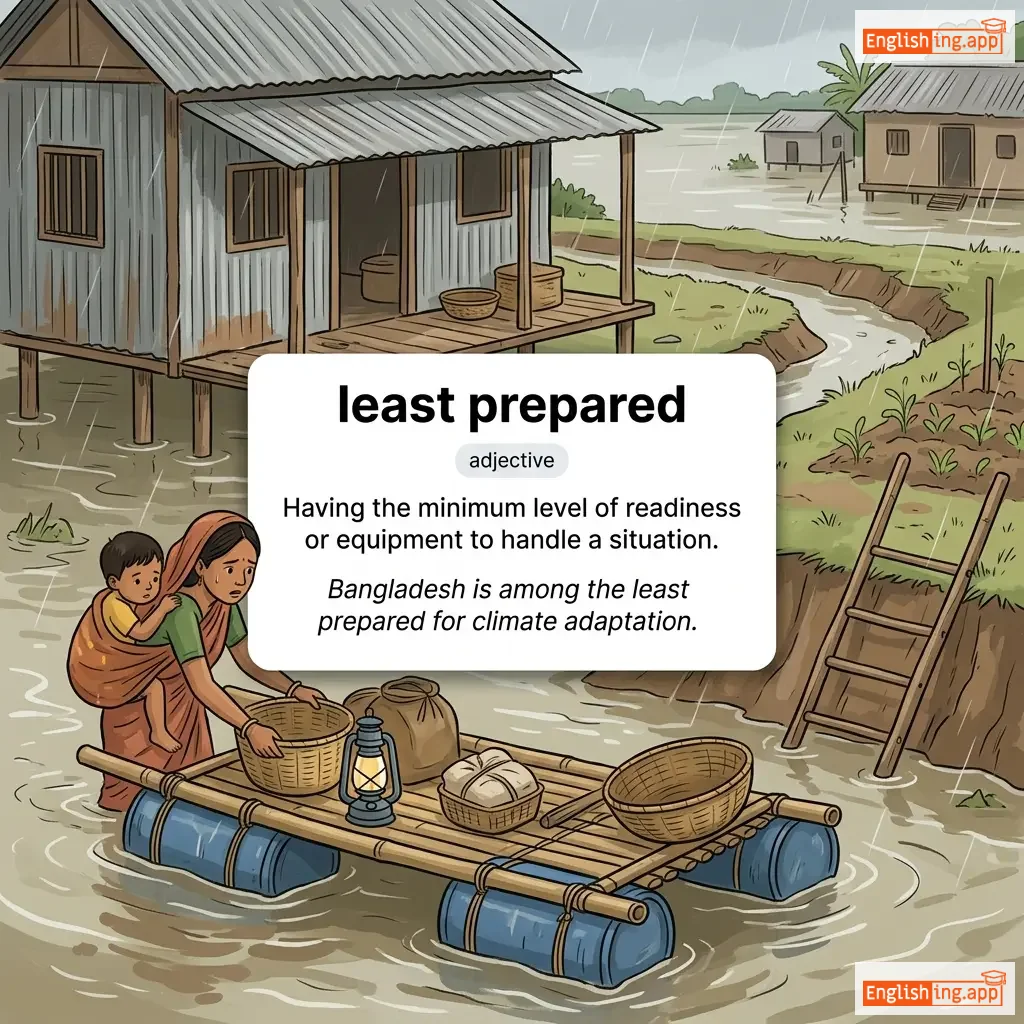
least prepared definition card — visual illustration of the meaning
adjective
liːst prɪˈpeərd
सबसे कम तैयार (sabse kam tayaar)

Having the minimum level of readiness or equipment to handle a situation.

"Bangladesh is among the least prepared for climate adaptation."

"बांगलादेश जलवायु अनुकूलन के लिए सबसे कम तैयार है।" (Bangladesh jalvayu anukoolan ke liye sabse kam tayaar hai.)
noun
/ˈlɛðər/
चमड़ा (chamda)

A material made from the skin of an animal, usually treated and used to make clothing, shoes, or furniture.

"He bought a leather jacket for winter."

"उसने सर्दियों के लिए एक चमड़े की जैकेट खरीदी।" (usne sardiyon ke liye ek chamde ki jacket khareedi.)
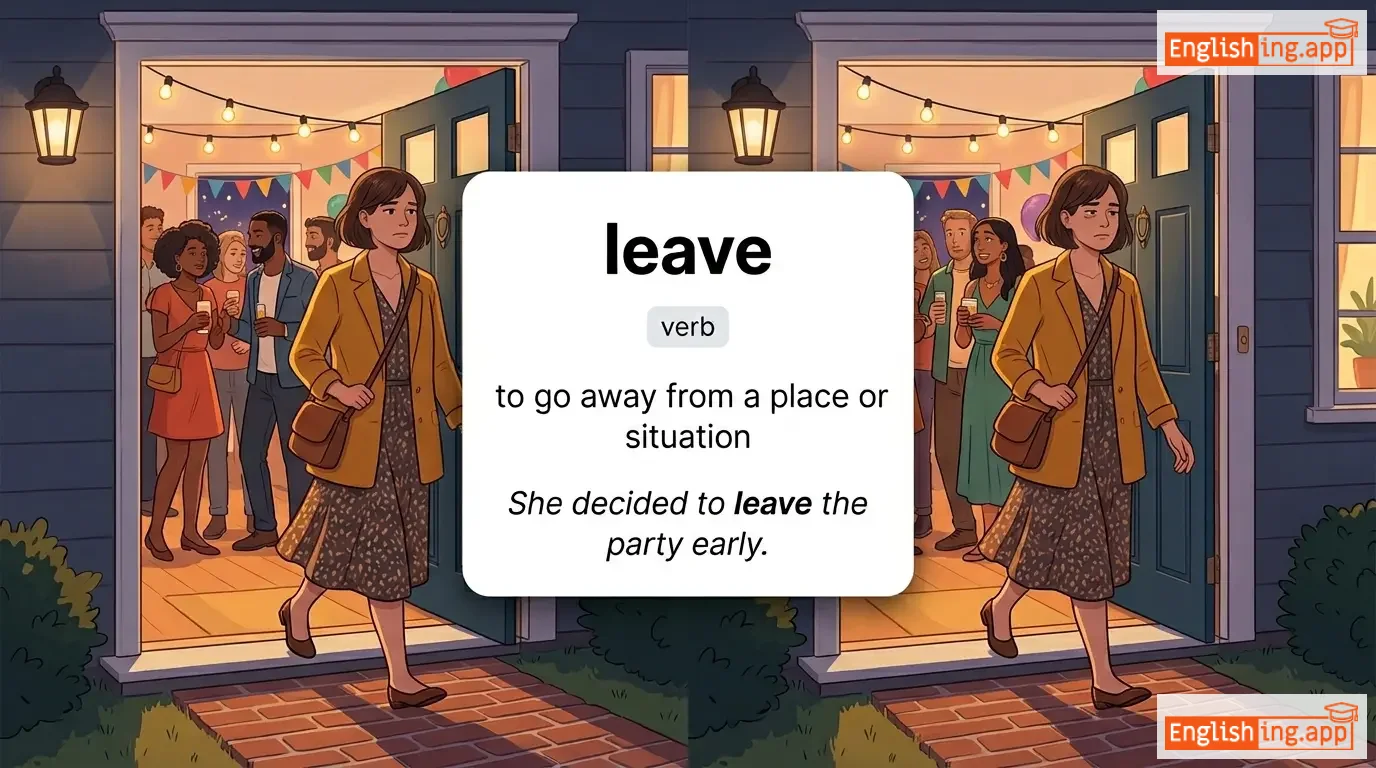
leave definition card — visual illustration of the meaning
🚶‍♂️

leave (लीव)

verb
/liːv/
छोड़ना (chhodna)

to go away from a place or situation

"She decided to leave the party early."

"उसने पार्टी जल्दी छोड़ने का फैसला किया।" (Usne party jaldi chhodne ka faisla kiya.)
noun
/ˈliːvˌteɪ.kɪŋ/
विदाई (vidai)

an act of saying goodbye; farewell

"His leave-taking from his friends was emotional."

"उसका दोस्तों से विदाई भावुक था।" (Uska doston se vidai bhavuk tha.)
noun/verb
/ˈlɛv.ən/
खमीर (khamir)

a substance, typically yeast, that causes dough to rise; to permeate and modify

"A little yeast will leaven the bread dough."

"थोड़ा यीस्ट रोटि के आटे को फुलाएगा।" (Thoda yeast roti ke aate ko phulayega.)
noun
/ˈliː.vɪŋz/
अवशिष्ट; बचा हुआ सामान (livings)

things that have been left behind or remain; remnants or scraps

"The leavings from dinner were given to the dog."

"रात के खाने के अवशिष्ट कुत्ते को दे दिए गए।" (raat ke khane ke avashisht kutte ko de diye gaye)
noun
/ˈleʧ.ər/
कामुक व्यक्ति (kamuk vyakti)

a man who behaves in a sexually inappropriate way towards women

"The company fired him for being a lecher."

"कंपनी ने उसे कामुक होने के कारण निकाल दिया।" (company ne use kamuk hone ke karan nikal diya)
adjective
/ˈlɛtʃ.ər.əs/
लंपट (lampat)

having or showing excessive or offensive sexual desire

"The character was portrayed as a lecherous old man."

"चरित्र को एक लंपट पुराने आदमी के रूप में चित्रित किया गया था।" (Charitra ko ek lampat purane aadmi ke roop mein chitrait kiya gaya tha.)
noun
/ˈlɛtʃ.əri/
लालसा (lalsa)

excessive or offensive sexual desire; lustfulness

"The novel depicted the lechery of corrupt nobles."

"उपन्यास में भ्रष्ट नobleल्स की लालसा का चित्रण किया गया था।" (Upanyas mein bhrasht nobles ki lalsa ka chitran kiya gaya tha.)
noun
/ˈlɛktən/
वाचन मंच (vachan manch)

A tall stand with a sloping top used to support a book, notes, or script during a speech or lecture.

"The professor placed her notes on the lectern before starting her lecture."

"प्रोफेसर ने अपनी नोट्स को लेक्ट्रन पर रखा, इससे पहले कि उन्होंने अपनी व्याख्यान शुरू किया।" (Professor ne apni notes ko lectern par rakha, isse pehle ki unhone apni vyakhyan shuru kiya.)
noun
/ˈlektʃər/
व्याख्यान (vyakhyan)

a talk given to a group of people to teach them about a subject

"The professor gave a lecture on climate change."

"प्रोफेसर ने जलवायु परिवर्तन पर एक व्याख्यान दिया।" (Professor ne jalvayu parivartan par ek vyakhyan diya.)
noun
/ˈlɛktʃərər/
प्रवक्ता (pravakta)

a person who gives lectures, especially at a college or university

"The lecturer explained the theory with clear examples."

"प्रवक्ता ने स्पष्ट उदाहरणों के साथ सिद्धांत समझाया।" (pravakta ne spasht udaharanon ke sath siddhant samjhaya)
noun
/ˈledʒ.ər/
खाता पुस्तक (khata pustak)

a book or other collection of financial accounts of a particular type

"The accountant updated the company ledger daily."

"लेखाकार ने कंपनी की खाता पुस्तक को रोज़ अपडेट किया।" (lekhakar ne company ki khata pustak ko roz update kiya.)
noun
/liːt͡ʃ/
लीच (leech)

a blood-sucking worm that lives in water or moist ground

"The doctor used a medical leech to reduce swelling after surgery."

"चिकित्सक ने सर्जरी के बाद सूजन कम करने के लिए एक चिकित्सा लीच का उपयोग किया।" (chikitsak ne s surgery ke baad soojan kam karne ke liye ek chikitsa leech ka upyog kiya)
noun
/liːk/
लहसुन पत्ता (lahsun patta)

vegetable related to onion with long green leaves and white bulb, milder than onion

"The soup was made with potatoes and leeks."

"सूप आलू और लहसुन पत्ते से बनाया गया था।" (soop aloo aur lahsun patte se banaya gaya tha.)
verb
/lɪr/
आश्लील नज़र (aashleel nazar)

To look at someone in an unpleasant, sly, or sexually suggestive way.

"He leered at her in a way that made her uncomfortable."

"उसने उसे ऐसे देखा कि वह असहज हो गई।" (Usne use aise dekha ki vah asahaj ho gayi.)
adjective
/ˈlɪəri/
संदेहपूर्ण (sandehapurn)

Cautious or wary due to suspicion or distrust.

"She was leery of investing in the new business."

"वह नए व्यापार में निवेश करने से संकोच कर रही थी।" (Wah naye vyapaar mein nivesh karne se sankoch kar rahi thi.)
adjective
/ˈliːwərd/
पवन से सुरक्षित पक्ष (pavan se surakshit paksh)

On or toward the sheltered side away from the wind.

"They built their camp on the leeward side of the hill."

"उन्होंने पहाड़ी के पवन से सुरक्षित पक्ष पर अपना शिविर बनाया।" (Unhone pahadi ke pavan se surakshit paksh par apna shivir banaya.)
noun
/ˈliːweɪ/
स्वतंत्रता (svatantrata)

Freedom to act within certain limits; extra space or time.

"The manager gave the team some leeway to finish the project."

"मैनेजर ने टीम को परियोजना समाप्त करने के लिए कुछ स्वतंत्रता दी।" (Manager ne team ko pariyojna samaapt karne ke liye kuch svatantrata dee.)
adjective, noun, adverb, verb (past tense of leave)
/lɛft/
बाएं (baen)

on or towards the side of the body that is to the west when facing north

"He turned left at the intersection."

"वह चौराहे पर बाएं मुड़ा।" (vah chaurahen par baen mudha.)
adjective
/ˌlɛftˈhændɪd/
बाएं हाथ वाला (bāen hāth vālā)

Using or done with the left hand; also can mean clumsy or awkward.

"She is left-handed and writes beautifully with her left hand."

"वह बाएं हाथ से लिखती है और सुंदरता से लिखती है।" (vah bāen hāth se likhtī hai aur sundartā se likhtī hai.)
noun
/lɛɡ/
पैर (pair)

one of the limbs on which a person or animal walks and stands

"He injured his leg while playing football."

"वह फुटबॉल खेलते समय अपना पैर चोटिल कर बैठा।" (Vah football khelte samay apna pair chotil kar baitha.)
legacy definition card — visual illustration of the meaning
noun
/ˈlɛɡəsi/
विरासत (virasat)

Something handed down from the past, such as money, property, or traditions.

"Her artistic legacy continues to inspire young painters."

"उसकी कलात्मक विरासत युवा चित्रकारों को प्रेरित करती है।" (Uski kalatmak virasat yuva chitrakaron ko prerit karti hai.)
legal definition card — visual illustration of the meaning
adjective
/ˈliːɡəl/
कानूनी (kaanooni)

relating to the law

"He sought legal advice before signing the contract."

"उसने अनुबंध पर हस्ताक्षर करने से पहले कानूनी सलाह ली।" (Usne anubandh par hastakshar karne se pehle kaanooni salah li.)
noun
/lɪˈɡæl.ə.ti/
वैधता (vaidhata)

the quality or state of being legal; accordance with the law

"The lawyer questioned the legality of the contract."

"वकील ने अनुबंध की वैधता पर सवाल उठाया।" (vakil ne anubandh ki vaidhata par sawaal uthaya)
verb
/ˈliːɡəlaɪz/
कानूनी बनाना (kanuni banana)

To make something lawful by official approval.

"The government decided to legalize online businesses."

"सरकार ने ऑनलाइन व्यवसायों को कानूनी बनाने का निर्णय लिया।" (Sarkar ne online vyavsayon ko kanuni banane ka nirnay liya.)
adverb
/ˈliːɡəli/
कानूनी तौर पर (kanuni taur par)

in a way that is allowed by law

"He is legally responsible for his actions."

"वह अपने कार्यों के लिए कानूनी रूप से जिम्मेदार है।" (vah apne karyo ke liye kanuni roop se jimmedar hai)
adverb/adjective
/lɪˈɡɑːtoʊ/
संगीत में, स्मूथ और जुड़ी हुई तरीके से बजाना या गाना (sangeet mein, smooth aur judi hui tareeke se bajana ya gana)

In music, played or sung smoothly and connectedly.

"The pianist played the passage legato, with each note flowing into the next."

"पियानोवादक ने पासेज़ लेगाटो में बजाया, जहाँ हर नोट अगले में समाहित हो रहा था।" (Piyanovadak ne passage legato mein bajaya, jahan har note agle mein samaahit ho raha tha.)
noun
/ˈlɛdʒənd/
किंवदंती (kinvadanti)

A traditional story popularly regarded as historical but unauthenticated; also a famous person admired for achievements.

"The footballer is considered a legend in his country."

"फुटबॉलर को उनके देश में एक किंवदंती माना जाता है।" (Footballer ko unke desh mein ek kinvadanti maana jaata hai.)
adjective
/ˈlɛdʒəndɛri/
किंवदंती-सा (kinvadantisaa)

remarkable enough to be famous; often used to describe something that is iconic or widely known

"The legendary musician performed in front of a packed stadium."

"एक किंवदंती संगीतकार ने भरे स्टेडियम के सामने प्रदर्शन किया।" (ek kinvadanti sangeetkaar ne bhare stadium ke samne pradarshan kiya)
noun
/ˌlɛdʒərdəˈmeɪn/
जादू की कला, धोखा (jadoo ki kala, dhokha)

skillful use of one's hands when performing tricks; deception or trickery

"The magician's legerdemain left the audience amazed."

"जादूगर की जादूगरी ने दर्शकों को हैरान कर दिया।" (jadoo gar ki jadoo gari ne darshako ko hairan kar diya.)
noun
/ˈlɛɡɪŋ/
टाइट पैंट (tight pant)

tight-fitting stretch pants, typically worn by women for exercise or casual wear

"She bought a new pair of black leggings for the gym."

"उसने जिम के लिए नई काली लेगिंग खरीदी।" (usne jim ke liye nai kaali legging khareedi.)
adjective
/ˈlɛdʒəbl/
पढ़ने योग्य (padhne yogya)

clear enough to read

"Her handwriting was barely legible."

"उसका हस्ताक्षर मुश्किल से पढ़ा जा सकता था।" (uska hastakshar mushkil se padha ja sakta tha)
noun
/ˈliːdʒən/
एक बड़ा समूह, विशेष रूप से सैनिकों का समूह; एक बड़ी संख्या (ek bada samuh, vishesh roop se sainikon ka samuh; ek badi sankhya)

a large group of people, especially soldiers; a great number

"The Roman army was divided into legions."

"रोम की सेना को लीजनों में विभाजित किया गया था।" (rom ki sena ko lijno mein vibhajit kiya gaya tha.)
noun
/ˈliːdʒənəri/
रोमन सैनिक (roman sainik)

a soldier in the Roman army

"Each legionary carried a shield and a short sword."

"हर लीजनरी ने एक ढाल और एक छोटा तलवार उठाया।" (har lijanari ne ek dhal aur ek chhota talwar uthaya.)
verb
/ˈlɛdʒɪsˌleɪt/
कानून बनाना (kanun banana)

to make or enact laws

"The government plans to legislate new safety standards."

"सरकार नए सुरक्षा मानक लागू करने की योजना बना रही है।" (Sarkar naye suraksha maanak lagu karne ki yojana bana rahi hai.)
noun
/ˌledʒɪsˈleɪʃən/
कानून निर्माण (kanun nirmaan)

laws considered collectively, or the act of making laws

"The government passed new legislation to protect the environment."

"सरकार ने पर्यावरण की रक्षा के लिए नई कानून निर्माण की घोषणा की।" (Sarkar ne paryavaran ki raksha ke liye nai kanun nirmaan ki ghoshna ki.)
adjective
/ˈlɛdʒɪslətɪv/
विधायी (vidhaayi)

relating to the making of laws

"The legislative body passed the new tax bill."

"विधायी निकाय ने नया कर विधेयक पास किया।" (Vidhaayi nikay ne naya kar vidheyak paas kiya.)
noun
/ˈlɛdʒɪsleɪtər/
विधायिका सदस्य (vidhayika sadasya)

a person who makes laws, especially a member of a legislative body

"The legislator introduced a bill to improve healthcare."

"विधायिका सदस्य ने स्वास्थ्य देखभाल सुधारने के लिए एक बिल प्रस्तुत किया।" (Vidhayika sadasya ne swasthya dekhbhal sudharne ke liye ek bill prastut kiya.)
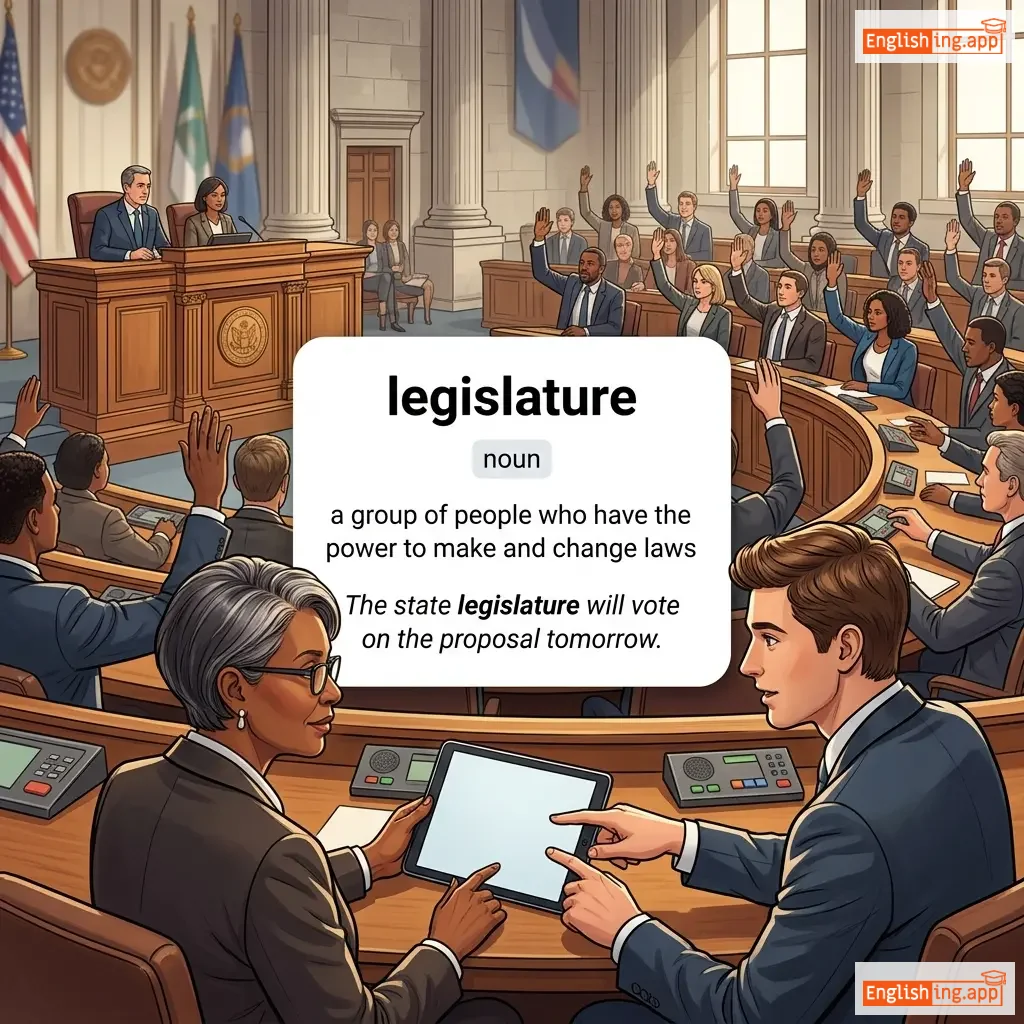
legislature definition card — visual illustration of the meaning
noun
/ˈlɛdʒɪsˌleɪtʃər/
विधानमंडल (vidhanmandal)

a group of people who have the power to make and change laws

"The state legislature will vote on the proposal tomorrow."

"राज्य विधानमंडल कल प्रस्ताव पर मतदान करेगा।" (raajy vidhanmandal kal prastaav par matdaan karega.)
noun
/lɪˈdʒɪtɪməsi/
वैधता (vaidhata)

the quality of being accepted as right, proper, or lawful

"The legitimacy of the election was questioned by observers."

"चुनाव की वैधता पर पर्यवेक्षकों द्वारा सवाल उठाया गया था।" (Chunav ki vaidhata par paryavekshako dvara sawal uthaya gaya tha.)
adjective
/lɪˈdʒɪtɪmət/
वैध (vaidh)

Conforming to the law or to rules; valid or acceptable.

"She presented a legitimate reason for her absence."

"वह अपनी अनुपस्थिति के लिए एक वैध कारण प्रस्तुत कर रही थी।" (Vah apni anupasthiti ke liye ek vaidh karan prastut kar rahi thi.)