वोकैबुलरीज

इंग्लिश वोकैबुलरी डिस्कवर, लर्न और मास्टर करें

noun
/ˌluː.mɪˈnɒs.ɪ.ti/
प्रकाशमानता (prakashmanata)

The intrinsic brightness of a celestial object; the quality of emitting light.

"The luminosity of the star was measured with advanced instruments."

"तारे की प्रकाशमानता को उन्नत यंत्रों से मापा गया था।" (taare ki prakashmanata ko unnatt yantron se maapa gaya tha.)
Luminous definition card — visual illustration of the meaning
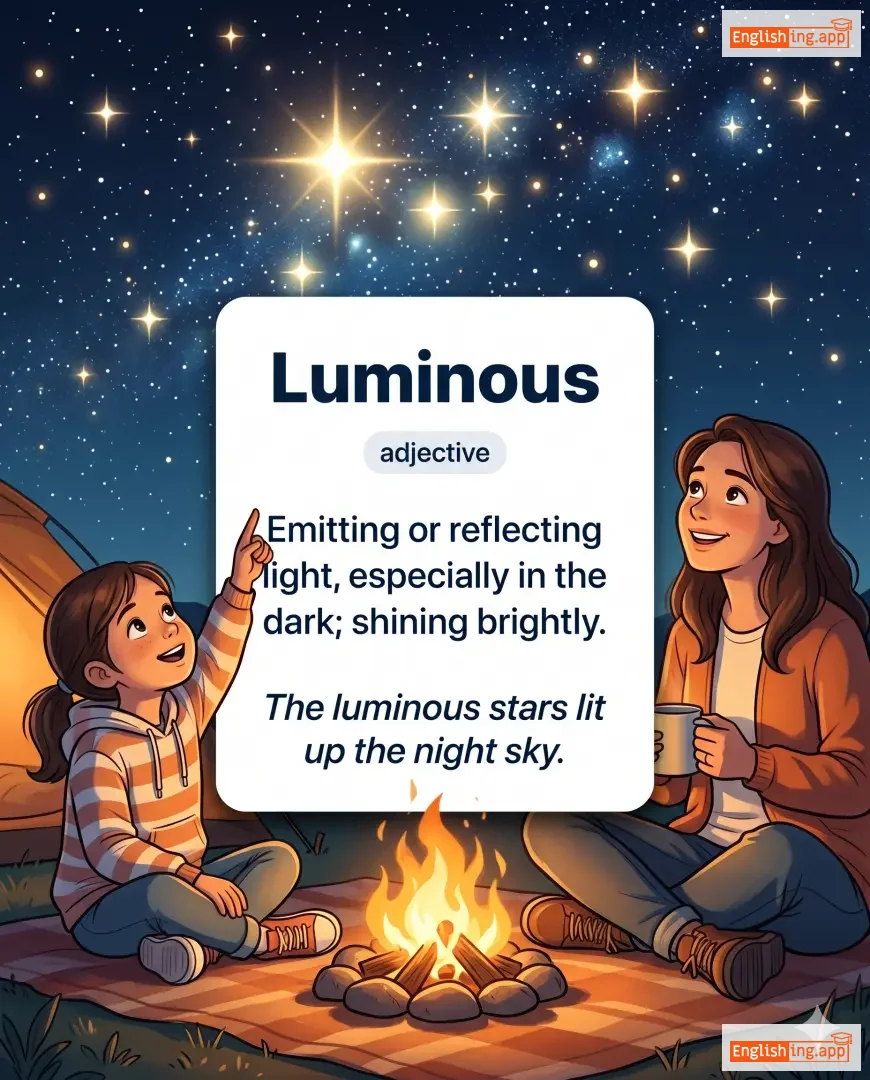
adjective
/ˈluː.mɪ.nəs/
दीप्तिमान (deeptimaan)

Emitting or reflecting light, especially in the dark; shining brightly.

"The luminous stars lit up the night sky."

"दीप्तिमान तारे रात के आकाश को रोशन कर रहे थे।" (deeptimaan taare raat ke aakaash ko roshan kar rahe the.)
noun
/lʌmp/
गठ्ठा; गांठ; टुकड़ा (gaththa; ganth; tukda)

a compact mass of a substance, especially one without a definite or regular shape

"She found a lump of sugar in the bowl."

"उसने कटोरी में चीनी का एक टुकड़ा पाया।" (usne katori mein cheeni ka ek tukda paya)
noun
/ˈluː.nə.si/
पागलपन (pagalpan)

Extreme foolishness or madness; insanity.

"It was sheer lunacy to go hiking in the storm."

"आंधी में हाइकिंग करना पूरी तरह से पागलपन था।" (Aandhi mein hiking karna puri tarah se pagalpan tha.)
adjective
/ˈluː.nər/
चंद्र (chandra)

Relating to the moon.

"The astronauts collected lunar samples during their mission."

"अंतरिक्ष यात्री अपने मिशन के दौरान चंद्र नमूने एकत्रित कर रहे थे।" (Antariksh yaatri apne mission ke dauran chandra namune ikatrit kar rahe the.)
noun
/ˈluːnər ɪˈklɪps/
चंद्रग्रहण (chandragrahan)

an astronomical event when the Earth passes between the Sun and Moon, casting a shadow on the Moon

"We watched the lunar eclipse through telescopes last night."

"हमने पिछले रात दूरबीन से चंद्रग्रहण देखा।" (hamne pichhle raat doorbeen se chandragrahan dekha)
noun/adjective
/ˈluː.nə.tɪk/
पागल (pagal)

A person who is insane or acting in a foolish or reckless way; also used as an adjective meaning insane.

"The driver was driving like a lunatic on the highway."

"चालक हाइवे पर लुनाटिक की तरह गाड़ी चला रहा था।" (Chaalak highway par lunatik ki tarah gaadi chala raha tha.)
noun
/lʌntʃ/
दोपहर का भोजन (dopahar ka bhojan)

a meal eaten in the middle of the day

"We usually have lunch at 1 p.m."

"हम आम तौर पर 1 बजे लंच करते हैं।" (Ham aam taur par 1 baje lunch karte hain.)
noun
/luːn/
अर्धचंद्राकार (ardhachandrakaar)

A crescent-shaped figure formed by two intersecting arcs; also means 'moon' in French.

"The mathematician studied the properties of the lune."

"गणितज्ञ ने लून के गुणों का अध्ययन किया।" (Ganitgy ne lune ke gunon ka adhyayan kiya.)
noun
/lʌŋ/
फेफड़ा (phephda)

Either of the two organs in the chest that are responsible for breathing and exchanging oxygen and carbon dioxide.

"Smoking can seriously damage your lungs."

"धूम्रपान आपके फेफड़ों को गंभीर रूप से नुकसान पहुंचा सकता है।" (dhoomrapaan aapke phephdon ko gambhir roop se nuksan pahucha sakta hai.)
noun
/ˈlʊŋ.gi/
लुंगी (lungi)

a traditional garment worn around the waist in South Asia

"He wore a comfortable lungi while relaxing at home."

"वह घर पर आराम करते हुए एक आरामदायक लुंगी पहने हुए था।" (vah ghar par aaram karte huye ek aaramdayak lungi pehne hue tha.)
verb, noun
/lɜːrtʃ/
लड़खड़ाना, लुड़कना (ladhkadhana, ludakna)

to make an abrupt, unsteady, or uncontrolled movement; a sudden movement or stagger

"The bus lurched forward as the driver hit the brakes."

"ड्राइवर के ब्रेक लगाने पर बस लर्च होकर आगे बढ़ी।" (Driver ke break lagane par bas larch hokar aage badhi.)
verb
/lʊər/
ललचाना (lalchana)

to attract or tempt someone, often by offering something appealing

"The advertisement lured customers with promises of discounts."

"विज्ञापन ने ग्राहकों को छूट के वादों के साथ ललचाया।" (Vigyapan ne graahkon ko chhoot ke vaadon ke saath lalchaya.)
adjective
/ˈljʊərɪd/
सदमे और सनसनीखेज रूप से आकर्षक (sadme aur sansanikhej roop se aakarshak)

shocking or sensational in a vivid way, often involving crime or violence

"The newspaper published a lurid account of the crime."

"समाचार पत्र ने अपराध का एक सदमे और सनसनीखेज विवरण प्रकाशित किया।" (Samachar patra ne apradh ka ek sadme aur sansanikhej vivaran prakashit kiya.)
verb
/lɜːrk/
छुपकर बैठना (chupkar baithna)

to remain hidden so as to wait for an opportunity to attack or observe

"A stranger lurked in the shadows."

"एक अजनबी साए में लर्कड था।" (Ek ajnabi saaye mein lurked tha.)
adjective
/ˈlʌʃəs/
स्वादिष्ट (swadisht)

deliciously sweet or rich; highly appealing to the senses

"She served a luscious chocolate cake."

"उसने एक स्वादिष्ट चॉकलेट केक परोसा।" (Usne ek swadisht chocolate cake parosa.)
adjective
/lʌʃ/
समृद्ध, प्रचुर और विलासपूर्ण, विशेष रूप से वनस्पति का संदर्भ देते हुए (samriddh, prachur aur vilaspurn, vishesh roop se vanspati ka sandarbh dete hue)

rich, abundant, and luxurious, especially referring to vegetation

"The valley was filled with lush green fields."

"घाटी हरे-भरे खेतों से भरी हुई थी।" (ghati hare-bhare kheton se bhari hui thi.)
noun
/lʌst/
वासना (vasana)

a very strong sexual desire or an intense craving for something

"His mind was clouded by lust for power."

"उसका मन शक्ति की वासना से ढका हुआ था।" (uska man shakti ki vasana se dhaka hua tha.)
noun
/ˈlʌstər/
चमक (chamak)

a gentle sheen or soft glow, especially from a polished surface

"The diamond had a brilliant luster."

"हीरे में शानदार चमक थी।" (hiere mein shandaar chamak thi.)
lustrous definition card — visual illustration of the meaning
adjective
/ˈlʌstrəs/
चमकदार (chamakdaar)

having a gentle sheen or soft glow

"Her hair looked smooth and lustrous."

"उसके बाल चिकने और चमकदार लग रहे थे।" (uske baal chikne aur chamakdaar lag rahe the.)
noun
/lʌɡˈʒʊəriəns/
समृद्धि (samriddhi)

abundant growth, richness, or elegance

"The garden was filled with the luxuriance of tropical plants."

"बग़ीचा उष्णकटिबंधीय पौधों की समृद्धि से भरा हुआ था।" (bagicha ushnakatibandhiya paudhon ki samriddhi se bhara hua tha.)
adjective
/lʌɡˈʒʊəriənt/
वृद्धिशील (vruddhishil)

abundant in growth or richly abundant

"The luxuriant forest was teeming with life."

"वृद्धिशील जंगल जीवन से भरपूर था।" (vruddhishil jangal jeevan se bharpoor tha.)
verb
/lʌɡˈʒʊrieɪt/
विलासिता का आनंद लेना (vilasita ka anand lena)

to enjoy something in a self-indulgent way; to take pleasure in great comfort

"She luxuriated in the warm bubble bath after a long day."

"वह एक लंबे दिन के बाद गर्म बबल स्नान में विलासिता का आनंद ले रही थी।" (Vah ek lambe din ke baad garm bubble snaan mein vilasita ka anand le rahi thi.)
adjective
/lʌɡˈʒʊəriəs/
विलासी (vilasi)

extremely comfortable, elegant, or enjoyable, often involving great expense

"They stayed in a luxurious hotel during their vacation."

"वे अपनी छुट्टियों के दौरान एक विलासी होटल में ठहरे थे।" (Ve apni chhutiyon ke dauran ek vilasi hotel mein thahare the.)
noun
/ˈlʌkʃəri/
विलासिता (vilasita)

a state of great comfort or elegance, often involving great expense

"Staying at a five-star hotel is a luxury for most people."

"पाँच सितारा होटल में रहना अधिकांश लोगों के लिए विलासिता है।" (paanch sitara hotel mein rehna adhikansh logon ke liye vilasita hai.)
verb
/ˈlaɪɪŋ/
झूठ बोलना (jhuth bolna)

the act of not telling the truth

"He was caught lying about his grades."

"वह अपने ग्रेड के बारे में झूठ बोलते हुए पकड़ा गया।" (Vah apne grade ke baare mein jhuth bolte huye pakda gaya.)
noun
/laɪər/
प्राचीन बांसुरी (prachin bamsuri)

a stringed musical instrument of ancient Greece

"The musician played a melody on the lyre."

"संगीतज्ञ ने लायर पर एक धुन बजाई।" (Sangeetgya ne lyre par ek dhun bajayi.)
noun
/ˈlɪrɪk/
गीत के बोल (geet ke bol)

the words of a song or a short poem that expresses personal feelings

"She memorized every lyric of her favorite song."

"उसने अपनी पसंदीदा गीत के हर बोल को याद किया।" (Usne apni pasandida geet ke har bol ko yaad kiya.)