वोकैबुलरीज

इंग्लिश वोकैबुलरी डिस्कवर, लर्न और मास्टर करें

adjective
/ɪnˈkɒmp(ə)rəbl/
अतुलनीय (atulniya)

Without an equal in quality or excellence; matchless.

"The view from the mountain was incomparable."

"पर्वत से दृश्य अतुलनीय था।" (Parvat se drishya atulniya tha.)
noun
/ˌɪnkəmˌpætəˈbɪlɪti/
असंगतता (asangatta)

the state of being unable to exist or work together harmoniously; lack of compatibility

"The project failed because of incompatibility between the two software systems."

"दो सॉफ्टवेयर सिस्टमों के बीच असंगतता के कारण परियोजना असफल हुई।" (do software systemon ke beech asangatta ke karan pariyojana asafal hui)
adjective
/ˌɪnkəmˈpætəbl/
असंगत (asangath)

Not able to exist or work together without conflict.

"Their personalities were completely incompatible."

"उनकी व्यक्तिगतताएँ पूरी तरह से असंगत थीं।" (Unki vyaktitvayein poori tarah se asangath thi.)
noun
/ɪnˈkɒmpɪtəns/
अक्षमता (akshamata)

Lack of ability, skill, or effectiveness in doing something.

"The project failed due to the manager’s incompetence."

"प्रोजेक्ट मैनेजर की अक्षमता के कारण असफल हो गया।" (Project manager ki akshamata ke kaaran asafal ho gaya.)
adjective
/ɪnˈkɒmpɪtənt/
अयोग्य (inkompent)

Lacking the necessary ability or skills to do something successfully.

"He was fired because he was incompetent at his job."

"उसे अपने काम में अयोग्य होने के कारण नौकरी से निकाला गया था." (use apne kaam me ayogya hone ke karan naukri se nikala gaya tha)
adjective
/ˌɪnkəmˈpliːt/
अधूरा (adhoora)

Not finished, lacking some parts or not whole.

"Her report was incomplete and needed further details."

"उसकी रिपोर्ट अधूरी थी और उसे और विवरण की आवश्यकता थी।" (Uski report adhoori thi aur use aur vivaran ki avashyakta thi.)
noun
/ˌɪnkəmˈpliːtnəs/
अपूर्णता (apurnata)

the state of not being complete or whole; lack of necessary parts or fullness

"The incompleteness of the report caused delays in the project."

"रिपोर्ट की अपूर्णता के कारण परियोजना में देरी हुई।" (report ki apurnata ke karan pariyojana mein deri hui)
adjective
/ˌɪnkɒmprɪˈhɛnsəbl/
असमझने योग्य नहीं (asamajhne yogya nahi)

Impossible or very difficult to understand.

"The professor’s lecture was so fast it became incomprehensible."

"प्रोफेसर का व्याख्यान इतना तेज था कि वह असमझने योग्य हो गया।" (Professor ka vyakhyan itna tez tha ki wah asamajhne yogya ho gaya.)
adjective
/ˌɪnkəmˈprɛsəbl/
असंपीड़नीय (aspidniya)

Not able to be pressed or squeezed into a smaller space.

"Liquids are generally considered incompressible."

"तरल पदार्थ सामान्यत: असंपीड़नीय माने जाते हैं।" (Toral padarth samanyata: aspidniya maane jaate hain.)
adjective
/ˌɪnkənˈsiːvəbl̩/
अकल्पनीय (akalpniya)

Impossible to imagine or believe; beyond comprehension.

"It seemed inconceivable that she could finish the marathon after such little training."

"यह असंभव सा लग रहा था कि वह इतनी कम ट्रेनिंग के बाद मैराथन खत्म कर सकेगी।" (Yeh asambhav sa lag raha tha ki wah itni kam training ke baad marathon khatam kar sakegi.)
adjective
/ˌɪnkənˈkluːsɪv/
निर्णयहीन (nirnayheen)

Not leading to a definite result or decision.

"The investigation remained inconclusive due to a lack of evidence."

"जांच बिना किसी निष्कर्ष के रही क्योंकि सबूतों की कमी थी।" (Jaanch bina kisi nishkarsh ke rahi kyunki sabuto ki kami thi.)
adjective
/ɪnˈkɒŋɡruənt/
असंगत (asangath)

Not in harmony or keeping with the surroundings or other aspects.

"His casual outfit looked incongruent at the formal dinner."

"उसकी कैज़ुअल पोशाक औपचारिक डिनर में असंगत लग रही थी।" (Uski casual poshak aupcharik dinner mein asangath lag rahi thi.)
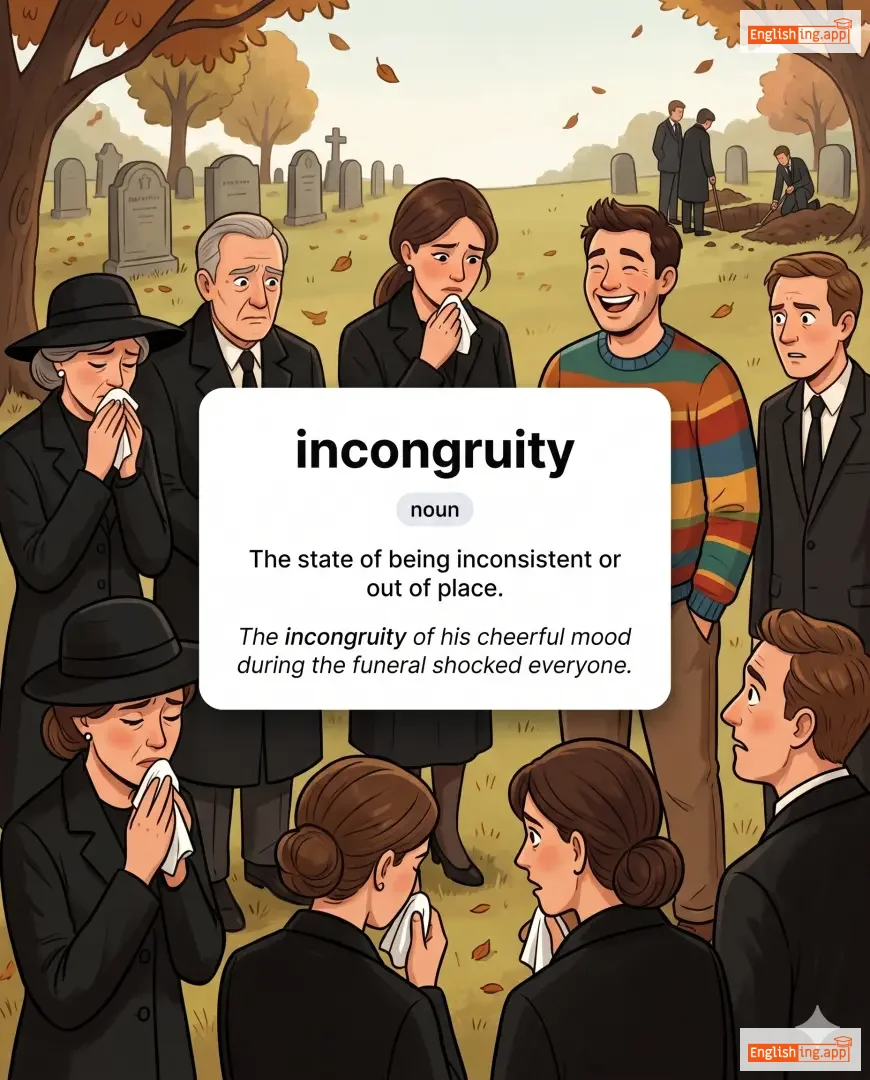
incongruity definition card — visual illustration of the meaning
noun
/ˌɪnkənˈɡruːəti/
असंगति (asangati)

The state of being inconsistent or out of place.

"The incongruity of his cheerful mood during the funeral shocked everyone."

"उसके खुशमिजाज का अंत्येष्टि के दौरान असंगति ने सभी को चौंका दिया।" (Uske khushmijaz ka antyeshti ke dauran asangati ne sabhi ko chauka diya.)
adjective
/ɪnˈkɒŋɡruəs/
असंगत (asangata)

Not fitting in with or suitable for the surroundings.

"His jokes were incongruous during the serious meeting."

"उसकी मजाक गंभीर बैठक के दौरान असंगत थी।" (Uski mazaak gambhir baithak ke dauran asangata thi.)
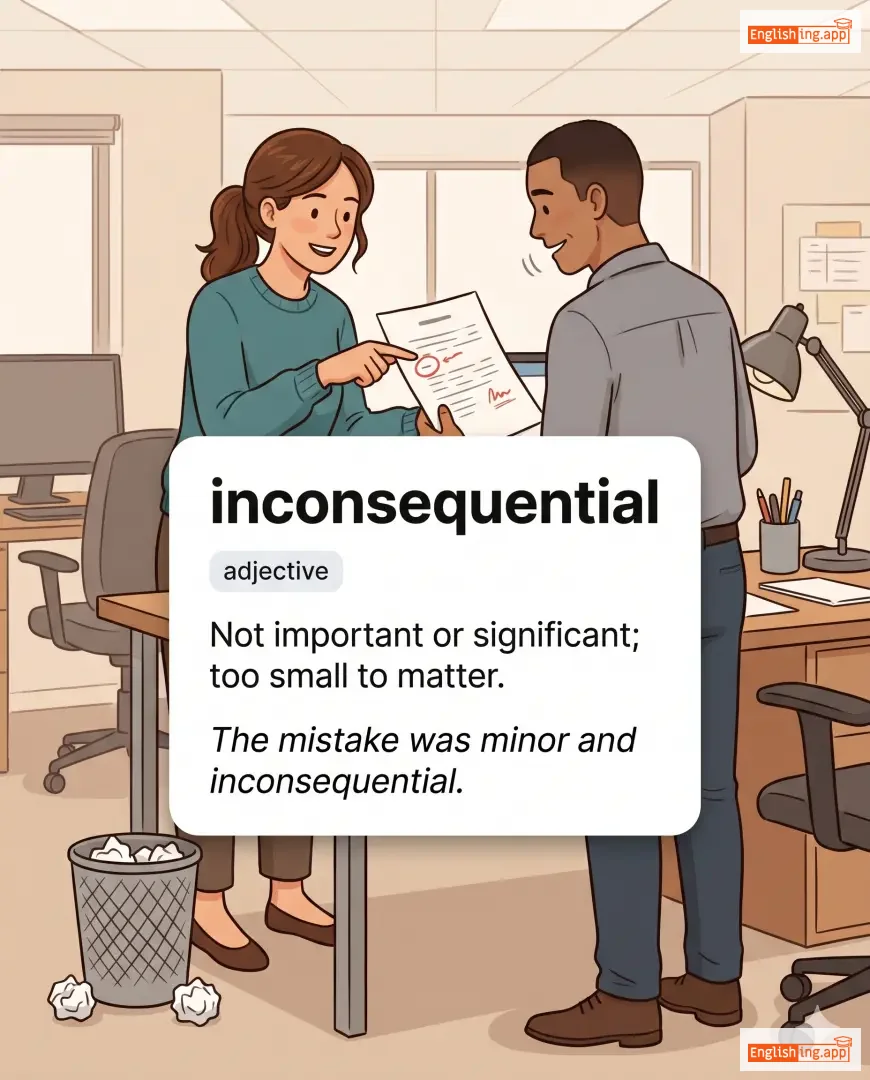
inconsequential definition card — visual illustration of the meaning
adjective
/ˌɪnˌkɒnsɪˈkwɛnʃəl/
तुच्छ (tuchchh)

Not important or significant; too small to matter.

"The mistake was minor and inconsequential."

"गलती मामूली और तुच्छ थी।" (Galti mamooli aur tuchchh thi.)
adjective
/ˌɪnkənˈsɪdərəbl/
नगण्य (nagnya)

Too small or unimportant to be worth considering.

"The donation was not inconsiderable, though smaller than expected."

"दान नगण्य नहीं था, हालांकि अपेक्षाओं से छोटा था।" (Dan nagnya nahi tha, halanki apekshaon se chhota tha.)
adjective
/ˌɪnkənˈsɪdərət/
लापरवाह (laparwah)

Thoughtless; showing a lack of concern for others.

"It was inconsiderate of him to play loud music late at night."

"रात को देर से ऊँची आवाज़ में संगीत बजाना उसका लापरवाह व्यवहार था।" (Raat ko der se unchi awaaz mein sangeet bajana uska laparwah vyavhaar tha.)
noun
/ˌɪnkənˈsɪstənsi/
असंगति (asangati)

The quality of being contradictory, irregular, or not staying the same.

"There is an inconsistency between his words and actions."

"उसके शब्दों और क्रियाओं में असंगति है।" (Uske shabdon aur kriyaon mein asangati hai.)
adjective
/ˌɪnkənˈsɪstənt/
असंगत (asangat)

Not staying the same throughout; lacking harmony or regularity.

"His answers were inconsistent and confusing."

"उसके उत्तर असंगत और भ्रमित करने वाले थे।" (Uske uttar asangat aur bhramit karne wale the.)
noun
/ɪnˈkɒnstənsi/
अस्थिरता (asthirata)

The quality of changing frequently or being unreliable.

"The inconstancy of the weather makes planning difficult."

"मौसम की अस्थिरता योजना बनाने को कठिन बनाती है।" (Mausam ki asthirata yojana banane ko kathin banati hai.)
adjective
/ɪnˈkɒnstənt/
अस्थिर (asthir)

frequently changing; not consistent or dependable

"His inconstant moods made it difficult to work with him."

"उसकी अस्थिर मनोदशाओं के कारण उसके साथ काम करना मुश्किल था।" (Uski asthir manodashaon ke karan uske sath kaam karna mushkil tha.)
adjective
/ɪnˈkɒntɪnənt/
असंयमी (asanyami)

lacking control over urination or defecation; lacking self-restraint

"The patient was incontinent after surgery."

"सर्जरी के बाद मरीज असंयमी हो गया था।" (surgery ke baad mareez asanyami ho gaya tha.)
adjective
/ˌɪnkɒntrəˈvɜːtəbl/
अस्वीकार्य (asweekarya)

impossible to deny or dispute; unquestionable

"The evidence was incontrovertible and proved his innocence."

"साक्ष्य अस्वीकार्य था और उसने अपनी निर्दोषता साबित की।" (saakshya asweekarya tha aur usne apni nirdoshta sabit ki.)
noun, verb
/ˌɪnkənˈviːniəns/
असुविधा (asuvidha)

trouble or difficulty caused to someone; to cause trouble or difficulty to someone

"We apologize for any inconvenience caused by the delay."

"देरी से हुई किसी भी असुविधा के लिए हम क्षमा चाहते हैं।" (deri se hui kisi bhi asuvidha ke liye hum kshama chahte hain)
adjective
/ˌɪnkənˈviːniənt/
असुविधाजनक (asuvidhajanak)

causing trouble, difficulties, or discomfort

"It was inconvenient for her to travel during the storm."

"तूफान के दौरान यात्रा करना उसके लिए असुविधाजनक था।" (toofan ke dauran yatra karna uske liye asuvidhajanak tha.)
incorporate definition card — visual illustration of the meaning
verb
/ɪnˈkɔːpəreɪt/
शामिल करना (shamil karna)

to include something as part of a whole; to form a legal corporation

"The teacher incorporated new technology into her lessons."

"शिक्षक ने अपनी पाठ में नई तकनीक को शामिल किया।" (shikshak ne apni path mein nai takneek ko shamil kiya.)
adjective
/ˌɪnkɔːrˈpɔːriəl/
अदृश्य (adrishya)

lacking a physical body; not composed of matter; intangible

"Ghosts are often described as incorporeal beings."

"भूतों को अक्सर अदृश्य प्राणियों के रूप में वर्णित किया जाता है।" (Bhooton ko aksar adrishya praniyon ke roop mein varnit kiya jata hai.)
adjective
/ɪnkəˈrɛkt/
गलत (galat)

not correct or accurate

"The information you provided was incorrect."

"आपने जो जानकारी दी थी, वह गलत थी।" (Aapne jo jankari dee thi, wah galat thi.)
adjective
/ɪnˈkɒrɪdʒəbəl/
असुधारनीय (asudharniya)

incapable of being corrected, improved, or reformed

"He is an incorrigible optimist who never loses hope."

"वह एक असुधारनीय आशावादी है जो कभी उम्मीद नहीं छोड़ता।" (Wah ek asudharniya ashaavadi hai jo kabhi ummid nahin chhodta.)
increase definition card — visual illustration of the meaning
verb
/ɪnˈkriːs/
बढ़ाना (badhana)

to make something larger in size, number, or amount

"The company plans to increase its workforce next year."

"कंपनी अगले साल अपनी कार्यबल को बढ़ाने की योजना बना रही है।" (Kampani agle saal apni karyabal ko badhane ki yojana bana rahi hai.)
verb
/ɪnˈkriːst/
बढ़ी हुई (badhi hui)

became greater in size, amount, or degree

"The company's revenue increased last year."

"कंपनी की आय पिछले साल बढ़ी थी।" (Kampani ki aay pichhle saal badhi thi.)
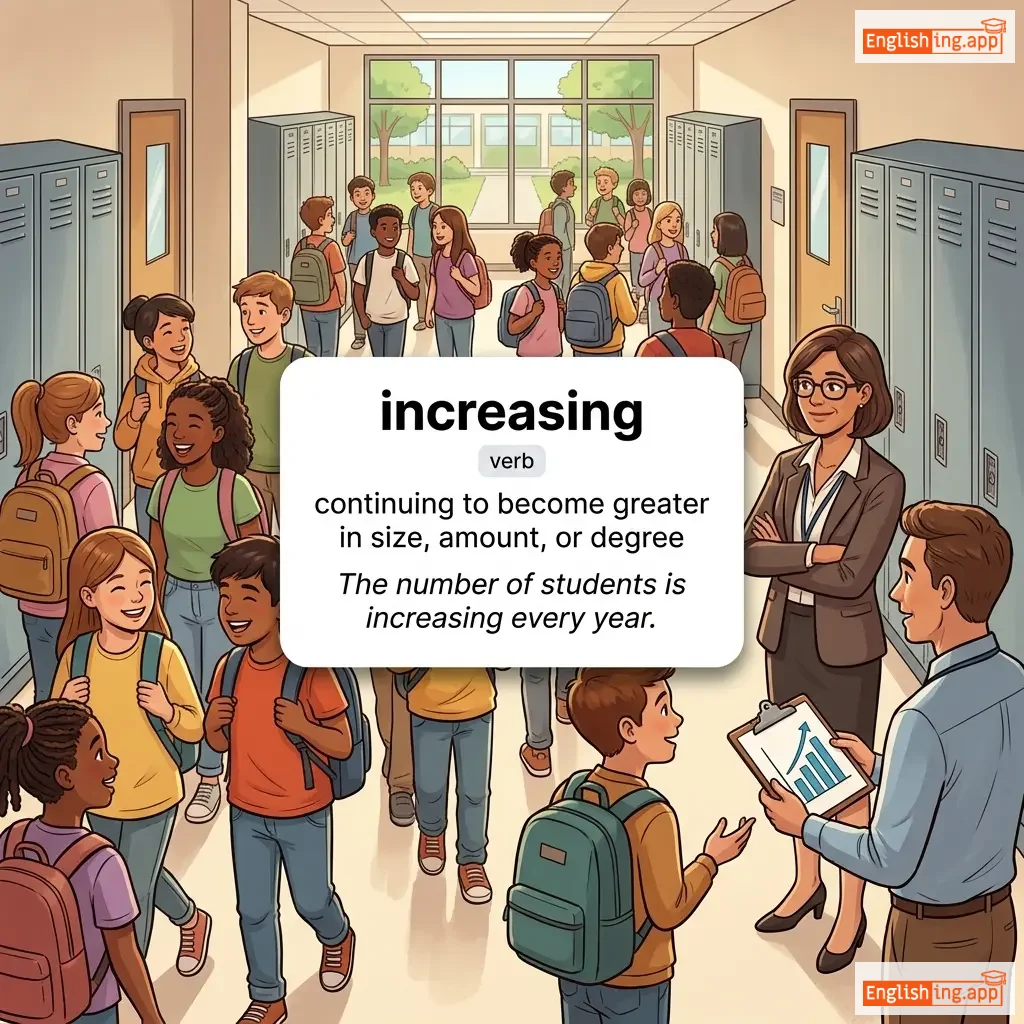
increasing definition card — visual illustration of the meaning
verb
/ɪnˈkriːsɪŋ/
बढ़ना (badhna)

continuing to become greater in size, amount, or degree

"The number of students is increasing every year."

"छात्रों की संख्या हर साल बढ़ रही है।" (Chhatron ki sankhya har saal badh rahi hai.)
adverb
/ɪnˈkriːsɪŋli/
बढ़ते हुए (badhte hue)

more and more over time

"People are increasingly concerned about climate change."

"लोग जलवायु परिवर्तन को लेकर बढ़ते हुए चिंतित हैं।" (Log jalvayu parivartan ko lekar badhte hue chintit hain.)
adjective
/ɪnˈkrɛdəbl/
अविश्वसनीय (avishwasniya)

so extraordinary that it is hard to believe; amazing

"The view from the mountain was incredible."

"पहाड़ से दृश्य अविश्वसनीय था।" (Pahaad se drishya avishwasniya tha.)
adverb
/ɪnˈkrɛdɪbli/
अविश्वसनीय रूप से (avishwasneey roop se)

to a great degree; extremely or unbelievably

"The view from the top of the mountain was incredibly beautiful."

"पहाड़ की चोटी से दृश्य अविश्वसनीय रूप से सुंदर था।" (Pahaad ki chhoti se drishya avishwasneey roop se sundar tha.)
noun
/ˌɪnkrɪˈdjuːləti/
अविश्वास (avishwas)

the state of being unwilling or unable to believe something

"She looked at him with incredulity after hearing the strange story."

"वह अजीब कहानी सुनने के बाद उसे अविश्वास से देखने लगी।" (Wah ajeeb kahani sunne ke baad use avishwas se dekhne lagi.)
adjective
/ɪnˈkrɛdjələs/
अविश्वासी (inkredyulas)

unwilling or unable to believe something

"He gave her an incredulous look when she claimed she could fly."

"उसने उसे एक अविश्वासी निगाह से देखा जब उसने दावा किया कि वह उड़ सकती है." (usne use ek avishvasi nigah se dekha jab usne daava kiya ki vah ud sakti hai)
noun
/ˈɪŋkrɪmənt/
वृद्धि (vriddhi)

an increase or addition, especially one of a series on a fixed scale

"Employees received an annual salary increment."

"कर्मचारियों को वार्षिक वेतन वृद्धि मिली।" (Karmachariyon ko varshik vetan vriddhi mili.)
incremental definition card — visual illustration of the meaning
adjective
/ˌɪŋ.krɪˈmen.təl/
क्रमिक (kramik)

Increasing gradually in small amounts or steps.

"The company made incremental improvements to the software."

"कंपनी ने सॉफ़्टवेयर में क्रमिक सुधार किए।" (Company ne software mein kramik sudhaar kiye.)
verb
/ɪnˈkrɪmɪˌneɪt/
अपराधी ठहराना (aparadhi thahrana)

to make someone appear guilty of a crime or wrongdoing

"The new evidence could incriminate the suspect in the robbery case."

"नई साक्ष्य संदिग्ध को डकैती मामले में अपराधी ठहराने में मदद कर सकती है।" (Nayi saakshya sandigdh ko dakaitee mamle mein aparadhi thahrane mein madad kar sakti hai.)
noun
/ˌɪnkrʌˈsteɪʃən/
आवरण (avaran)

a crust or hard coating formed on the surface of something

"The old pipes were blocked due to heavy incrustation of minerals."

"पुरानी पाइप्स खनिजों की भारी आवरण के कारण अवरुद्ध हो गई थीं।" (Purani pipes khanijon ki bhari avaran ke karan avaruddh ho gayi thin.)
verb
/ˈɪnkjʊˌbeɪt/
अंडे को विकसित करने के लिए उचित परिस्थितियों में रखना (ande ko vikasit karne ke liye uchit paristhitiyon mein rakhna)

to keep eggs, cells, or organisms at the right conditions for development

"The hen will incubate the eggs until they hatch."

"मुर्गी अंडों को तब तक इन्क्यूबेट करेगी जब तक वे हैच न हो जाएं।" (Murgi ando ko tab tak incubate karegi jab tak ve hatch na ho jaayein.)
noun
/ˌɪnkjʊˈbeɪʃən/
अंडे, कोशिकाएँ, या जीवों को विकास के लिए सही परिस्थितियों में रखना (andé, koshikaen, ya jeevon ko vikas ke liye sahi paristhitiyon mein rakhna)

the process of keeping eggs, cells, or organisms in the right conditions for development

"The incubation of the eggs lasted for three weeks."

"अंडों का इन्क्यूबेशन तीन सप्ताह तक चला।" (andon ka incubation teen saptah tak chala.)
noun
/ˈɪnkjʊˌbeɪtər/
इनक्यूबेटर (incubator)

a device or environment that provides suitable conditions for eggs, cells, or infants to develop

"The premature baby was placed in an incubator for care."

"अर्ली प्रीमेच्योर बच्चे को देखभाल के लिए इनक्यूबेटर में रखा गया था।" (Early premature bachche ko dekhbhal ke liye incubator mein rakha gaya tha.)
noun
/ˈɪŋkjʊbəs/
दुष्ट आत्मा (dusht atma)

An oppressive or nightmarish burden; in folklore, an evil spirit that lies upon sleeping people.

"Debt became an incubus that weighed heavily on the family."

"ऋण एक दुष्ट आत्मा बन गया था जो परिवार पर भारी बोझ डाल रहा था।" (Rin ek dusht atma ban gaya tha jo parivar par bhari bojh dal raha tha.)
inculcate definition card — visual illustration of the meaning
verb
/ˈɪŋkʌlkeɪt/
बिठाना / सिखाना (bithana / sikhana)

To teach or instill an idea, attitude, or habit persistently.

"Parents try to inculcate good manners in their children."

"माता-पिता अपने बच्चों में अच्छे आदतें इन्कलकेट करने की कोशिश करते हैं।" (Mata-pita apne bachchon mein achhe aadatien inculcate karne ki koshish karte hain.)
verb
/ˈɪŋkʌlpeɪt/
दोषारोपण करना (dosharopan karna)

To blame or accuse someone of wrongdoing.

"The evidence seemed to inculpate the suspect in the crime."

"प्रमाण ने संदिग्ध को अपराध में दोषी ठहराया जैसा लगा।" (Pramaan ne sandigdh ko apradh mein doshi thaharaya jaisa laga.)
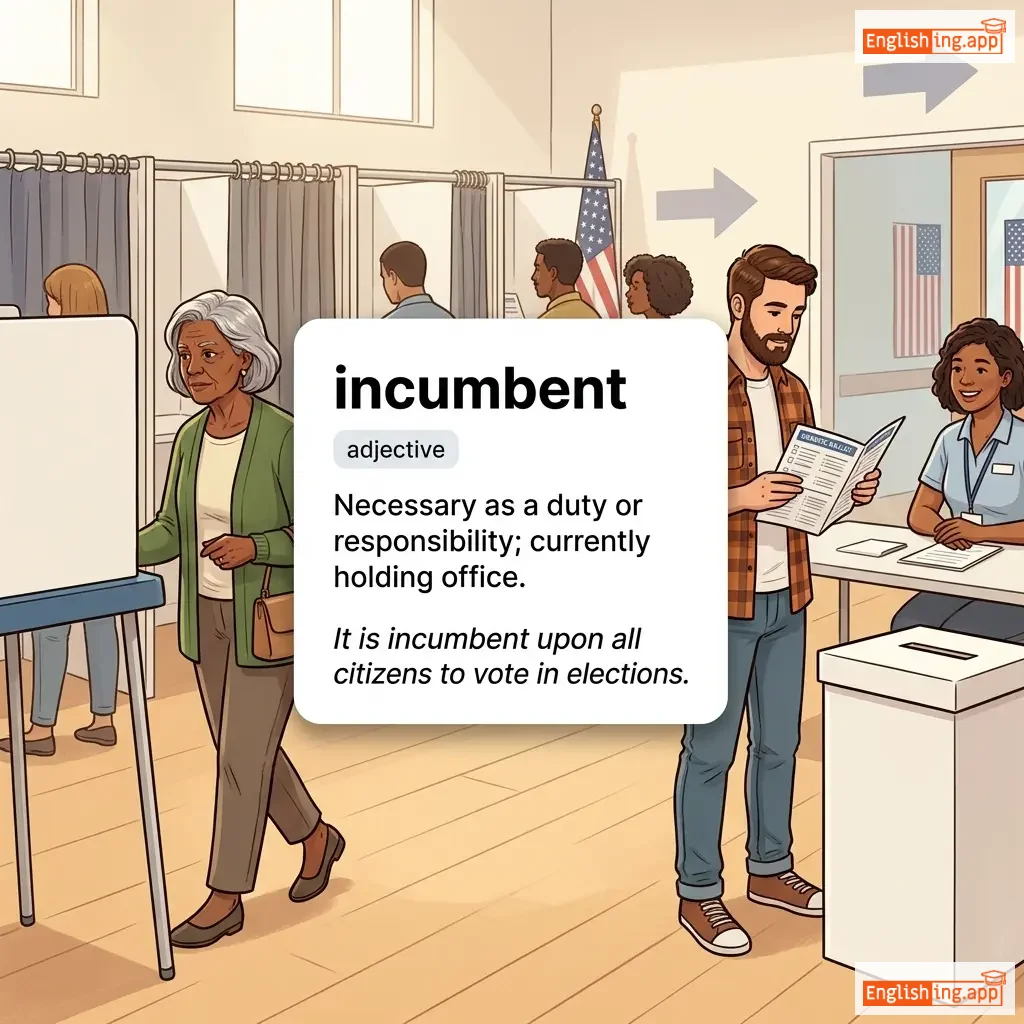
incumbent definition card — visual illustration of the meaning
adjective
/ɪnˈkʌmbənt/
कर्तव्यपूर्ण (kartavyapurn)

Necessary as a duty or responsibility; currently holding office.

"It is incumbent upon all citizens to vote in elections."

"यह सभी नागरिकों पर चुनावों में मतदान करना कर्तव्यपूर्ण है।" (Yah sabhi nagrikon par chunavon mein matdan karna kartavyapurn hai.)
verb
/ɪnˈkɜːr/
उठाना (uthaana)

To bring upon oneself something undesirable, usually as a result of actions.

"He incurred a fine for parking in the wrong place."

"उसने गलत जगह पार्क करने पर जुर्माना भरा।" (Usne galat jagah park karne par jurmana bhara.)
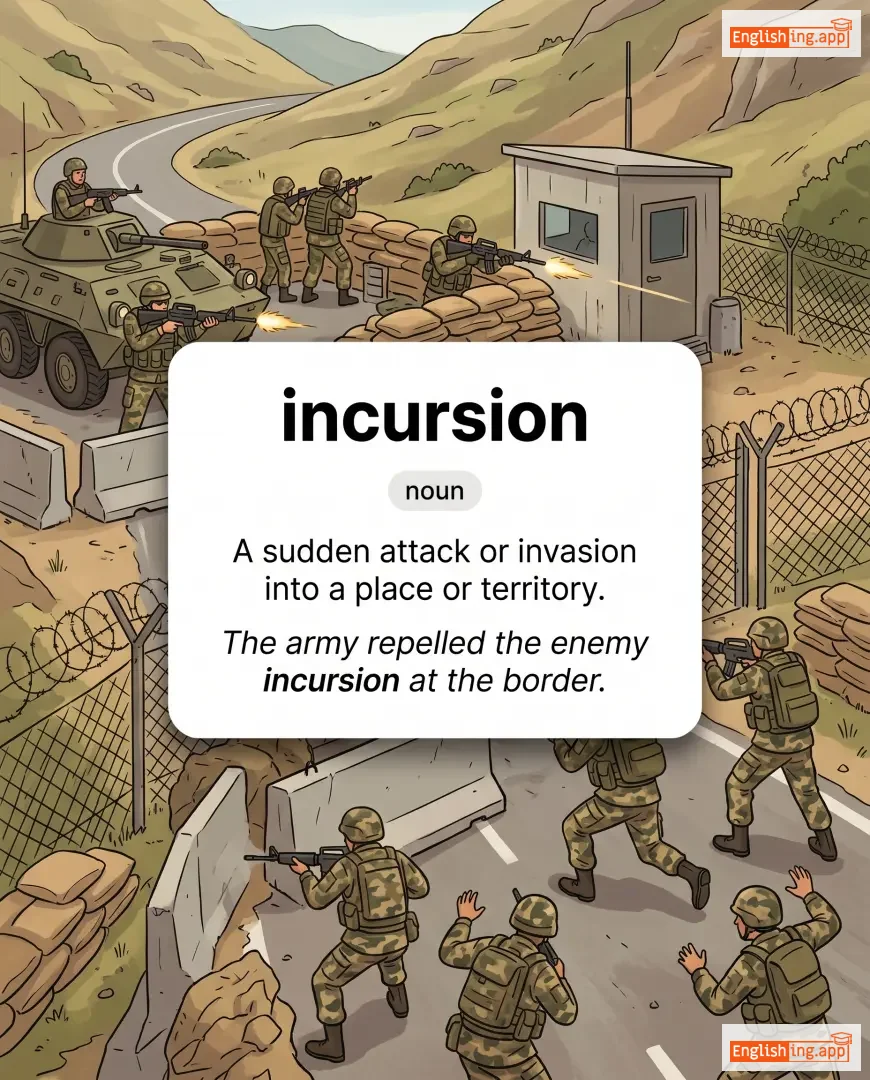
incursion definition card — visual illustration of the meaning
noun
/ɪnˈkɜːrʒən/
आक्रमण (akraman)

A sudden attack or invasion into a place or territory.

"The army repelled the enemy incursion at the border."

"सेना ने सीमा पर दुश्मन के आक्रमण को नाकाम कर दिया।" (Sena ne seema par dushman ke akraman ko nakam kar diya.)