वोकैबुलरीज

इंग्लिश वोकैबुलरी डिस्कवर, लर्न और मास्टर करें

verb
/ˈɪmprəvaɪz/
तत्काल निर्माण करना (tatkaal nirmaan karna)

To create or perform something spontaneously without preparation.

"The actor had to improvise his lines when he forgot the script."

"अभिनेता को स्क्रिप्ट भूल जाने पर अपनी लाइनें तत्काल बनाने पड़ीं।" (abhinetā ko skripṭ bhool jāne par apnī lainen tatkāl banāne paṛīṅ.)
noun
/ɪmˈpruːdəns/
अविवेक (avivek)

Lack of caution or good judgment.

"His imprudence in investing all his money in one stock was disastrous."

"उसका एक स्टॉक में अपना सारा पैसा निवेश करने का अविवेक विनाशकारी था।" (uska ek stock mein apna saara paisa nivesh karne ka avivek vinashkari tha.)
adjective
/ɪmˈpruːdənt/
अविचारपूर्ण (avicharpurn)

Not showing care for the consequences of an action.

"It was imprudent to drive in such stormy weather."

"ऐसी तूफानी मौसम में गाड़ी चलाना अविचारपूर्ण था।" (Aisi toofani mausam mein gaadi chalana avicharpurn tha.)
noun
/ˈɪmpjʊdəns/
अविनय (avinay)

Rude and disrespectful behavior.

"The student's impudence shocked the entire class."

"छात्र का अविनय पूरी कक्षा को चौंका दिया।" (chhatr ka avinay puri kaksha ko chonka diya.)
adjective
/ˈɪmpjəd(ə)nt/
अशिष्ट, घमंडी (ashisht, ghamandi)

not showing due respect for another person; rude

"The impudent child talked back to the teacher."

"अशिष्ट बच्चे ने शिक्षक से बदतमीजी की।" (Ashisht bachche ne shikshak se badtameezi ki.)
verb
/ɪmˈpjuːn/
सत्य, वैधता, या ईमानदारी को चुनौती देना (saty, vaidhata, ya imandari ko chunauti dena)

to dispute the truth, validity, or honesty of a statement or motive

"The lawyer tried to impugn the credibility of the witness."

"वकील ने गवाह की विश्वसनीयता को चुनौती देने की कोशिश की।" (vakil ne gawah ki vishwasniyata ko chunauti dene ki koshish ki.)
noun
/ɪmˈpjuːɪsəns/
असमर्थता, लाचारी (asamarthata, laachaari)

inability to take effective action; helplessness

"The government’s impuissance in the face of crisis frustrated the people."

"संकट के सामने सरकार की असमर्थता ने लोगों को हताश कर दिया।" (Sankat ke saamne sarkaar ki asamarthata ne logon ko hataash kar diya.)
noun
/ˈɪmpʌls/
आकस्मिक इच्छा (aaksmik iccha)

a sudden strong desire or urge to act without thinking

"He bought the watch on impulse without planning to."

"उसने बिना योजना बनाए घड़ी impulsively खरीदी।" (Usne bina yojana banaye ghadi impulsively khareedi.)
noun
/ɪmˈpʌlʃən/
आवेग (impulsion)

a strong urge or drive to act; the act of impelling

"His impulsion to travel made him leave his job suddenly."

"यात्रा के लिए उसकी प्रेरणा ने उसे अचानक अपनी नौकरी छोड़ने के लिए मजबूर कर दिया." (hij impalshan tu traiwal med him liv hij job sundli)
adjective
/ɪmˈpʌlsɪv/
अचानक, आवेगी (achanak, aavegi)

acting suddenly without careful thought

"She made an impulsive decision to buy the car."

"उसने कार खरीदने का अचानक निर्णय लिया।" (Usne car kharidne ka achanak nirnay liya.)
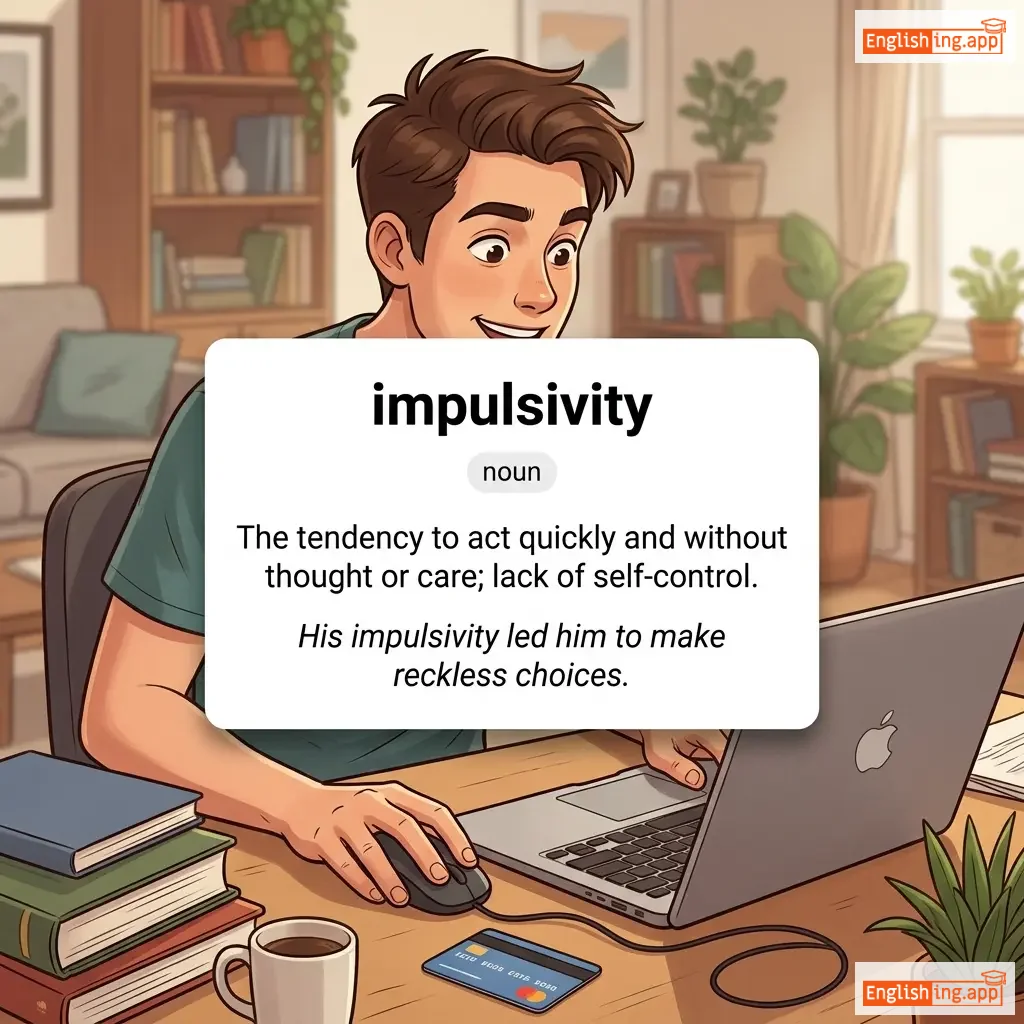
impulsivity definition card — visual illustration of the meaning
noun
ˌɪm.pʌlˈsɪv.ɪ.ti
आवेगपूर्णता (avegpoornata)

The tendency to act quickly and without thought or care; lack of self-control.

"His impulsivity led him to make reckless choices."

"उसकी आवेगपूर्णता ने उसे लापरवाह फैसले लेने की दिशा में अग्रसर किया।" (Uski avegpoornata ne use laparwah faisle lene ki disha mein agrasar kiya.)
noun
/ɪmˈpjuːnɪti/
दंडमुक्ति (dandmukti)

freedom from punishment or harmful consequences for an action

"The dictator ruled with impunity, ignoring international laws."

"तानाशाह ने दंडमुक्ति के साथ शासन किया, अंतर्राष्ट्रीय कानूनों की अवहेलना करते हुए।" (Taanashah ne dandmukti ke saath shasan kiya, antarraashtreey kanoonon ki avhelna karte huye.)
adjective
/ɪmˈpjʊər/
अशुद्ध (ashuddh)

not clean or free from contamination; morally corrupt

"The water was impure and unsafe to drink."

"पानी अशुद्ध था और पीने के लिए असुरक्षित था।" (Pani ashuddh tha aur peene ke liye asurakshit tha.)
noun
/ɪmˈpjʊərəti/
अशुद्धता (ashuddhata)

the state of being unclean or contaminated; a substance that makes something impure

"The scientist removed every impurity from the water sample."

"वैज्ञानिक ने पानी के नमूने से हर अशुद्धता हटा दी।" (vaigyanik ne pani ke namune se har ashuddhata hata di)
noun
/ˌɪmpjuˈteɪʃən/
आरोप (aarop)

an accusation or attribution of blame

"The politician denied the imputation of corruption."

"राजनेता ने भ्रष्टाचार के आरोप का खंडन किया।" (Raajneeta ne bhrashtachar ke aarop ka khandan kiya.)
verb
/ɪmˈpjuːt/
आरोप लगाना (aarop lagana)

to attribute a fault or responsibility to someone

"They imputed the company's success to good leadership."

"उन्होंने कंपनी की सफलता को अच्छे नेतृत्व के कारण जिम्मेदार ठहराया।" (Unhone company ki safalta ko achhe netritv ke karan jimmedar thahraya.)
preposition
/ɪn/
में (mein)

expressing the situation of being enclosed or surrounded by something

"She is in the kitchen preparing dinner."

"वह रसोई में रात का खाना तैयार कर रही है।" (Woh rasoi mein raat ka khana tayar kar rahi hai.)
preposition
/ɪn ˈfrʌnt əv/
के सामने (ke saamne)

positioned before or ahead of something; facing or located at the forward side of a person or object

"She stood in front of the building."

"वह इमारत के सामने खड़ी थी।" (vah imarat ke saamne khadi thi)
noun
/ˌɪnəˈbɪləti/
अक्षमता (akshamata)

the state of being unable to do something

"His inability to make decisions affected his career."

"उसकी निर्णय लेने की अक्षमता ने उसके करियर को प्रभावित किया।" (Uski nirnay lene ki akshamata ne uske career ko prabhavit kiya.)
adjective
/ˌɪnækˈsɛsəbl/
अगम्य (agmy)

unable to be reached, entered, or understood

"The remote village is almost inaccessible during the rainy season."

"दूरदराज़ गांव बारिश के मौसम में लगभग अगम्य हो जाता है।" (Doordaaraz gaon barish ke mausam mein lagbhag agmy ho jata hai.)
noun
/ɪnˈækjʊrəsi/
अशुद्धता (ashuddhata)

lack of accuracy or precision; an incorrect or wrong detail

"The report contained several factual inaccuracies."

"रिपोर्ट में कई तथ्यात्मक अशुद्धताएँ थीं।" (report mein kai tathyaatmak ashuddhataen thin)
adjective
/ɪnˈækjʊrət/
गलत (galat)

Not correct, precise, or exact; containing errors.

"The report was full of inaccurate data."

"रिपोर्ट गलत डेटा से भरी हुई थी।" (Report galat data se bhari hui thi.)
adjective
/ɪnˈæktɪv/
निष्क्रिय (nishkriya)

Not engaging in activity; not active.

"The account has been inactive for six months."

"खाता छह महीने से निष्क्रिय है।" (Khaata chhah mahine se nishkriya hai.)
noun
/ˌɪnækˈtɪvɪti/
निष्क्रियता (nishkriyata)

the state of not being active physically or mentally; lack of action

"Prolonged inactivity can negatively affect both physical and mental health."

"लंबे समय तक निष्क्रियता शारीरिक और मानसिक स्वास्थ्य को नुकसान पहुँचा सकती है।" (lambe samay tak nishkriyata sharirik aur mansik swasthya ko nuksan pahuncha sakti hai)
noun
/ɪnˈædɪkwəsi/
अपर्याप्तता (aparyaptata)

lack of sufficient ability, quality, or strength; a feeling of not being good enough

"She struggled with feelings of inadequacy at work despite her strong qualifications."

"मजबूत योग्यताओं के बावजूद उसे काम पर अपर्याप्तता की भावना होती थी।" (majboot yogyataon ke bavjood use kaam par aparyaptata ki bhavna hoti thi)
adjective
/ɪnˈædɪkwət/
अपर्याप्त (aparyapt)

Not sufficient or good enough.

"The funding was inadequate to complete the project."

"परियोजना को पूरा करने के लिए वित्त अपर्याप्त था।" (Pariyojna ko pura karne ke liye vitt aparyapt tha.)
adjective
/ˌɪnədˈmɪsəbl̩/
अस्वीकृत (asweekrit)

Not allowed, especially as evidence in a court of law.

"The judge ruled the evidence inadmissible."

"न्यायाधीश ने प्रमाण को अस्वीकार कर दिया।" (Nyayadhish ne pramaan ko asweekrit kar diya.)
noun
/ˌɪnədˈvɜːrtəns/
असावधानी (asavdhani)

Failure to pay attention; carelessness.

"The error happened through sheer inadvertence."

"त्रुटि शुद्ध असावधानी के कारण हुई।" (Truti shuddh asavdhani ke karan hui.)
adjective
/ˌɪnədˈvɜːrtənt/
अनायास, अनिच्छिक (anayas, anichchhik)

Not resulting from or achieved through deliberate planning; unintentional.

"Her inadvertent mistake caused a delay in the project."

"उसकी अनचाही गलती ने परियोजना में देरी कर दी।" (uski anchaahi galti ne pariyojana mein deri kar di.)
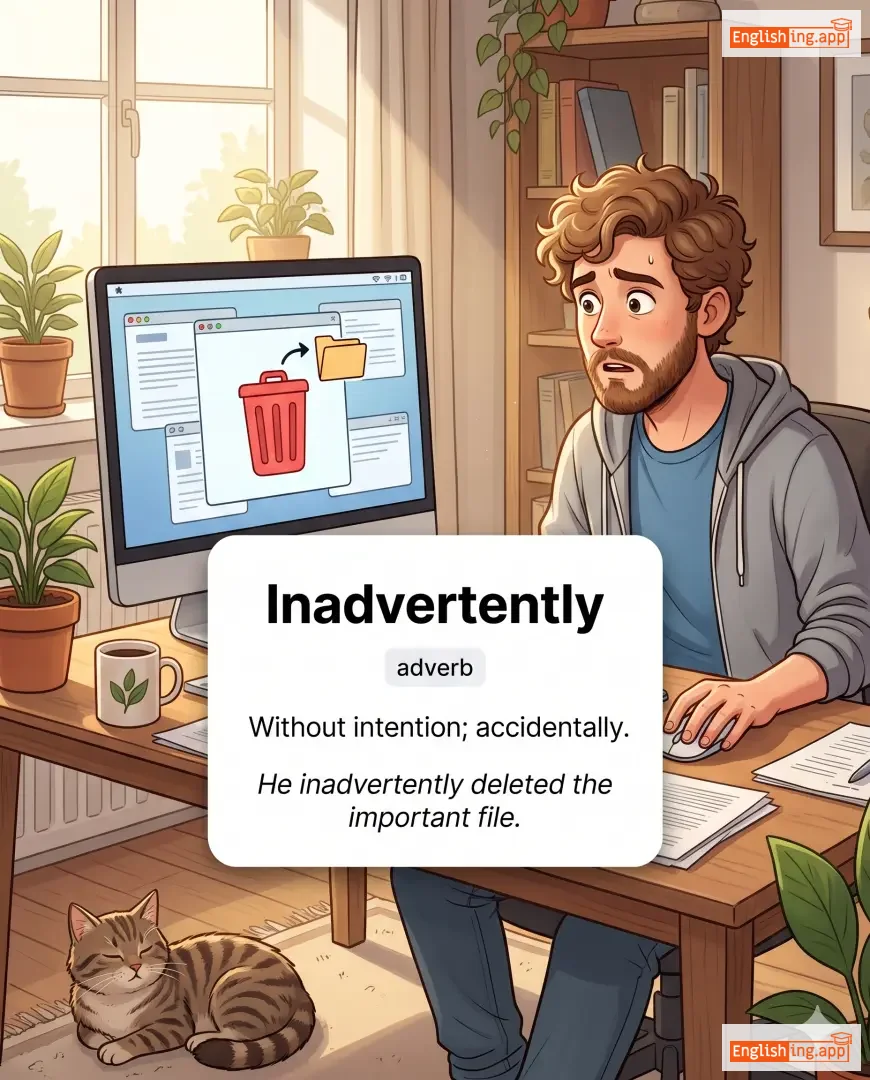
Inadvertently definition card — visual illustration of the meaning
adverb
/ˌɪnədˈvɜːrtəntli/
अचानक (achanak)

Without intention; accidentally.

"He inadvertently deleted the important file."

"उसने अनजाने में महत्वपूर्ण फ़ाइल हटा दी।" (Usne anjaane mein mahatvapurn file hata di.)
adjective
/ˌɪnədˈvaɪzəbl/
असुझावित (asujhavit)

Not recommended; likely to have undesirable consequences.

"It is inadvisable to drive in such heavy rain."

"ऐसी भारी बारिश में गाड़ी चलाना असुझावित है।" (aisi bhari baarish mein gaadi chalana asujhavit hai.)
adjective
/ɪnˈeɪliənəbl/
अपरिवर्तनीय (aparivartaniya)

Unable to be taken away or transferred; absolute and permanent.

"Freedom of speech is an inalienable right."

"व्यक्ति की स्वतंत्रता एक अपरिवर्तनीय अधिकार है।" (vyakti ki svatantrata ek aparivartaniya adhikar hai)
noun
/ˌɪnəməˈrɑːtə/
प्रेमिका (inamorata)

A woman with whom someone is in love; a female lover.

"He wrote a poem dedicated to his inamorata."

"उसने अपनी प्रेमिका के लिए एक कविता लिखी।" (Usne apni premika ke liye ek kavita likhi)
adjective
/ɪˈneɪn/
बेवकूफी, निरर्थक (bewakoofi, nirarthak)

lacking sense, meaning, or significance; silly or pointless

"The movie was criticized for its inane dialogue."

"फिल्म को इसके बेवकूफी संवादों के लिए आलोचना की गई थी।" (Film ko iske bewakoofi samvadon ke liye alochana ki gayi thi.)
adjective
/ɪˈnænɪmət/
निर्जीव वस्तु (nirjeev vastu)

not alive, especially not in the manner of animals and humans; lifeless

"The museum was full of inanimate objects from ancient times."

"संग्रहालय प्राचीन समय की निर्जीव वस्तुओं से भरा हुआ था।" (Sangrahalay prachin samay ki nirjeev vastuo se bhara hua tha.)
noun
/ɪˈnænɪti/
बकवास, मूर्खता (bakwas, murkhata)

a nonsensical remark or action; silliness; emptiness

"The speech was full of inanities that bored the audience."

"भाषण बकवास से भरा हुआ था जिसने दर्शकों को ऊब दिया।" (Bhashan bakwas se bhara hua tha jisne darshako ko ub diya.)
adjective
/ˌɪnæprɪˈhɛnsəbl/
अवोध्य (avodhya)

not understandable; incomprehensible

"The concept was so abstract that it seemed inapprehensible to most students."

"विचार इतना अमूर्त था कि यह अधिकांश छात्रों के लिए अवोध्य लग रहा था।" (Vichar itna amurt tha ki yah adhikansh chhatron ke liye avodhya lag raha tha.)
adjective
/ˌɪnəˈproʊpriət/
अप्रासंगिक (apropriyat)

not suitable or proper in the circumstances

"It was inappropriate to talk loudly in the library."

"पुस्तकालय में जोर से बात करना अप्रासंगिक था।" (Pustakalay mein jor se baat karna aprasangik tha.)
adjective
/ɪnˈæpt/
अयोग्य (ayogya)

not suitable or appropriate in the circumstances

"His inapt choice of words offended many people."

"उसका अयोग्य शब्द चयन कई लोगों को आहत कर गया।" (Uska ayogya shabd chayan kai logon ko aahat kar gaya.)
adjective
/ˌɪnɑːrˈtɪkjʊlət/
अस्पष्ट (aspasht)

Unable to express oneself clearly or effectively in speech or writing.

"She became inarticulate with emotion during the speech."

"वह भाषण के दौरान भावना के साथ अस्पष्ट हो गई।" (Vah bhashan ke dauran bhavana ke saath aspasht ho gayi.)
adverb
/ˌɪnəzˈmʌtʃ/
जबकि (jabki)

To the extent that; considering that.

"Inasmuch as you are their teacher, you should guide them carefully."

"जबकि आप उनके शिक्षक हैं, आपको उन्हें सावधानी से मार्गदर्शन करना चाहिए।" (Jabki aap unke shikshak hain, aapko unhein saavdhani se maargdarshan karna chahiye.)
conjunction
/ˌɪnəzˈmʌtʃ æz/
क्योंकि (kyonki)

Because; since.

"He cannot attend, inasmuch as he is unwell."

"वह उपस्थित नहीं हो सकता, क्योंकि वह अस्वस्थ है।" (Vah upasthit nahi ho sakta, kyonki vah aswasth hai.)
adjective
/ˌɪnəˈtɛntɪv/
असावधान (asaavdhan)

not paying attention; lacking focus or concentration

"The inattentive student missed several important instructions."

"असावधान छात्र ने कई महत्वपूर्ण निर्देश छोड़ दिए।" (asaavdhan chhatra ne kai mahatvapurn nirdesh chhod diye)
adjective
/ɪnˈɔːdəbl/
अश्रव्य (ashrya)

Unable to be heard.

"Her voice was almost inaudible over the noise."

"ध्वनि के ऊपर उसकी आवाज़ लगभग अश्रव्य थी।" (Dhvani ke upar uski aawaz lagbhag ashrya thi.)
adjective
/ɪˈnɔːɡjərəl/
उद्घाटन (udghatan)

marking the beginning of something; first; opening

"The president delivered his inaugural speech."

"राष्ट्रपति ने अपनी उद्घाटन स्पीच दी।" (Rashtrapati ne apni udghatan speech dee.)
verb
/ɪˈnɔːɡjʊreɪt/
उद्घाटन करना (udghatan karna)

To formally begin or introduce something, especially with a ceremony.

"The mayor will inaugurate the new bridge tomorrow."

"महापौर कल नए पुल का उद्घाटन करेंगे।" (Mahapaur kal naye pul ka udghatan karenge.)
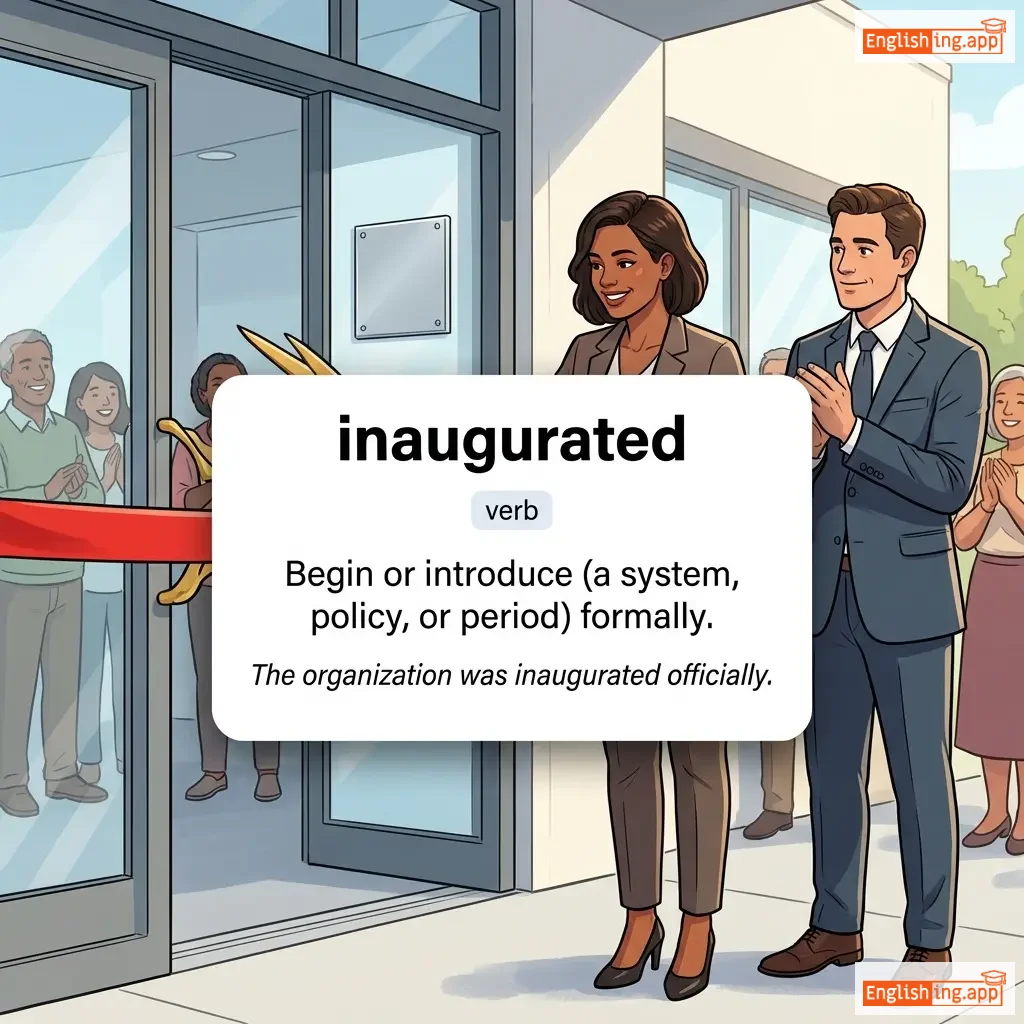
inaugurated definition card — visual illustration of the meaning
verb
ɪˈnɔː.ɡjə.reɪ.tɪd
उद्घाटन किया (udghatan kiya)

Begin or introduce (a system, policy, or period) formally.

"The organization was inaugurated officially."

"संगठन को औपचारिक रूप से उद्घाटन किया गया था।" (Sangathan ko aupcharik roop se udghatan kiya gaya tha.)
adjective
/ˌɪnɔːˈspɪʃəs/
अशुभ (ashubh)

Not conducive to success; unpromising or unlucky.

"The event began under inauspicious circumstances."

"कार्यक्रम अशुभ परिस्थितियों में शुरू हुआ था।" (karyakram asubh paristhitiyon mein shuru hua tha.)
adjective
/ˈɪnˌbɔːrn/
जन्मजात (inborn)

existing from birth; innate

"She has an inborn talent for music."

"उसमें संगीत के लिए जन्मजात प्रतिभा है।" (usmein sangeet ke liye janmjaat pratibha hai)
adjective
/ˈɪnˌbrɛd/
आंतरिक उत्पत्ति (antarik utpatti)

existing naturally in a person or animal; also related to reproduction within a limited community

"He has an inbred sense of loyalty."

"उसमें एक आंतरिक निष्ठा की भावना है।" (Usmein ek antarik nishtha ki bhavna hai.)