वोकैबुलरीज

इंग्लिश वोकैबुलरी डिस्कवर, लर्न और मास्टर करें

noun
/ɪˈreɪdiəns/
प्रकाशमानता (iradians)

the quality of shining brightly; the intensity of light falling on a surface

"The irradiance of the sun at noon was overwhelming."

"दोपहर में सूरज की प्रकाशमानता अत्यधिक थी।" (Dopahar mein suraj ki prakashmanata atyadhik thi.)
verb
/ɪˈreɪdieɪt/
प्रकाशित करना (prakashit karna)

to shine light on something; to expose to radiation; to illuminate or brighten

"The scientist used a lamp to irradiate the sample."

"वैज्ञानिक ने एक लैम्प का इस्तेमाल करके सैंपल को प्रकाशित किया।" (Vaigyanik ne ek lamp ka istemal karke sample ko prakashit kiya.)
adjective
/ɪˈrædɪkəbəl/
अविनाशी (avinashi)

not able to be eradicated; impossible to destroy or remove completely

"The love of a mother for her child is irradicable."

"एक माँ का अपने बच्चे के लिए प्यार अविनाशी है।" (Ek maa ka apne bachche ke liye pyaar avinashi hai.)
adjective
/ɪˈræʃənəl/
असंगत (asangat)

not logical or reasonable; lacking clear thought

"His fear of the dark was completely irrational."

"उसका अंधेरे से डर पूरी तरह से असंगत था।" (Uska andhere se dar poori tarah se asangat tha.)
irrationality definition card — visual illustration of the meaning
noun
ɪˌræʃ.ənˈæl.ɪ.ti
अतार्किकता, अविवेक, असंगति (atarkikta, avivek, asangati)

The quality of being illogical or unreasonable; lack of rational thought.

"His decision was driven by complete irrationality."

"उसका निर्णय पूरी तरह से अतार्किकता द्वारा प्रेरित था।" (Uska nirnay puri tarah se atarkikta dwara prerit tha.)
adjective
/ˌɪrɪˈkɒnsɪləbl/
असहमति से भरपूर (asahmati se bharpoor)

impossible to make compatible or bring into harmony; unable to resolve differences

"The couple separated due to irreconcilable differences."

"जोड़ी असहमति से भरपूर मतभेदों के कारण अलग हो गई।" (Jodi asahmati se bharpoor matbhedon ke kaaran alag ho gayi.)
adjective
/ˌɪrɪˈdjuːsəbl/
अविभाज्य (avibhajya)

impossible to reduce or simplify further

"The fraction 3/7 is irreducible."

"भिन्न ३/७ अविभाज्य है।" (Bhinna 3/7 avibhajya hai.)
adjective
/ɪˈrɛfrəɡəbəl/
अविचलित (avichalit)

Impossible to refute, deny, or break

"The lawyer presented irrefragable evidence that proved his client’s innocence."

"वकील ने अविचलित सबूत प्रस्तुत किया जिसने उसके मुवक्किल की निर्दोषिता साबित की।" (Vakeel ne avichalit saboot prastut kiya jisne uske muvakkil ki nirdoshita sabit ki.)
adjective
/ˌɪrɪˈfrændʒɪbəl/
अलंघनीय (alanghaniya)

Not to be broken, violated, or infringed

"The constitution guarantees certain irrefrangible rights to every citizen."

"संविधान प्रत्येक नागरिक को कुछ अलंघनीय अधिकार सुनिश्चित करता है।" (Sanvidhan pratyek nagrik ko kuch alanghaniya adhikar sunishchit karta hai.)
adjective
/ˌɪrɪˈfjuːtəbəl/
अखंडनीय (akhandoniy)

Impossible to deny or disprove

"The scientist provided irrefutable proof of the theory."

"वैज्ञानिक ने सिद्धांत का अखंडनीय प्रमाण प्रस्तुत किया।" (Vaigyanik ne siddhant ka akhandaniy pramaan prastut kiya.)
adjective
/ɪˈreɡjələr/
अनियमित (aniyamit)

not even or consistent in shape, pattern, time, or behavior; not following normal rules

"His attendance at work has been irregular this month."

"इस महीने उसका काम पर आना अनियमित रहा।" (is mahine uska kaam par aana aniyamit raha)
noun
/ɪˌreɡjəˈlærɪti/
अनियमितता (aniyamitata)

lack of regularity or consistency; a deviation from what is normal, expected, or orderly

"The audit revealed several financial irregularities in the company’s records."

"ऑडिट में कंपनी के रिकॉर्ड में कई वित्तीय अनियमितताएँ पाई गईं।" (audit mein company ke record mein kai vittiya aniyamitataen pai gain)
noun
/ɪˈreləvəns/
अप्रासंगिकता (aprasangikta)

the quality of not being connected to or important for a particular matter; lack of significance

"His long explanation only highlighted the irrelevance of the details to the main issue."

"उसकी लंबी व्याख्या ने मुख्य मुद्दे से विवरणों की अप्रासंगिकता को ही उजागर किया।" (uski lambi vyakhya ne mukhya mudde se vivaron ki aprasangikta ko hi ujagar kiya)
noun
/ɪˈrɛlɪvənsi/
अप्रासंगिकता (aprasangikta)

the state of being unrelated or unimportant to the matter at hand

"The judge dismissed the argument because of its irrelevancy to the case."

"न्यायाधीश ने मामले से अप्रासंगिक होने के कारण तर्क को खारिज कर दिया।" (nyayadhish ne mamle se aprasangik hone ke karan tark ko kharij kar diya)
adjective
/ɪˈrɛləvənt/
अप्रासंगिक (aprasangik)

Not connected with or related to the matter at hand

"His comment was completely irrelevant to the discussion."

"उसकी टिप्पणी चर्चा से पूरी तरह से अप्रासंगिक थी।" (Uski tippani charcha se puri tarah se aprasangik thi.)
adjective
/ˌɪrɪˈlɪdʒəs/
अधर्मिक (adharmik)

Indifferent or hostile to religion

"Some people in the community consider him irreligious because he never attends religious services."

"कुछ लोग उसे अधर्मिक मानते हैं क्योंकि वह कभी धार्मिक सेवाओं में भाग नहीं लेता।" (Kuch log use adharmik mante hain kyunki wah kabhi dharmik sevaon mein bhag nahi leta.)
adjective
/ˌɪrɪˈmiːdiəbl̩/
अप्रसद्ध (aprasaddh)

Impossible to cure, repair, or remedy.

"The damage to the ancient manuscript was irremediable."

"प्राचीन पांडुलिपि को हुआ नुकसान अपरसद्ध था।" (prachin pandulipi ko hua nuksaan aprasaddh tha.)
adjective
/ɪˈrɛpərəbl̩/
अमरम्मत योग्य नहीं (amaramat yogya nahi)

Too severe to be corrected or repaired.

"The earthquake caused irreparable damage to the village."

"भूकंप ने गाँव में अमरम्मत योग्य नुकसान किया।" (bhookamp ne gaon mein amaramat yogya nuksan kiya.)
adjective
/ˌɪrɪˈprɛsəbl̩/
अवश्यम्भावी (avashyambhavi)

Impossible to control or restrain.

"She had an irrepressible urge to laugh during the speech."

"वह भाषण के दौरान हंसने की अवश्यम्भावी इच्छा को छिपा नहीं पाई।" (vah bhashan ke dauran hansne ki avashyambhavi ichchha ko chhupa nahi pai.)
adjective
/ˌɪrɪˈprəʊtʃəbl̩/
निर्दोष (nirdosh)

Beyond criticism; faultless.

"The judge was known for his irreproachable integrity."

"न्यायाधीश अपनी निर्दोष ईमानदारी के लिए प्रसिद्ध थे।" (nyayadhish apni nirdosh imandari ke liye prasiddh the.)
adjective
/ˌɪrɪˈzɪstəbl̩/
अप्रतिरोधी (apratiruddhi)

Too attractive, powerful, or appealing to be resisted.

"The aroma of freshly baked bread was irresistible."

"ताज़ा बेक्ड ब्रेड की खुशबू अप्रतिरोधी थी।" (taza baked bread ki khushboo apratiruddhi thi.)
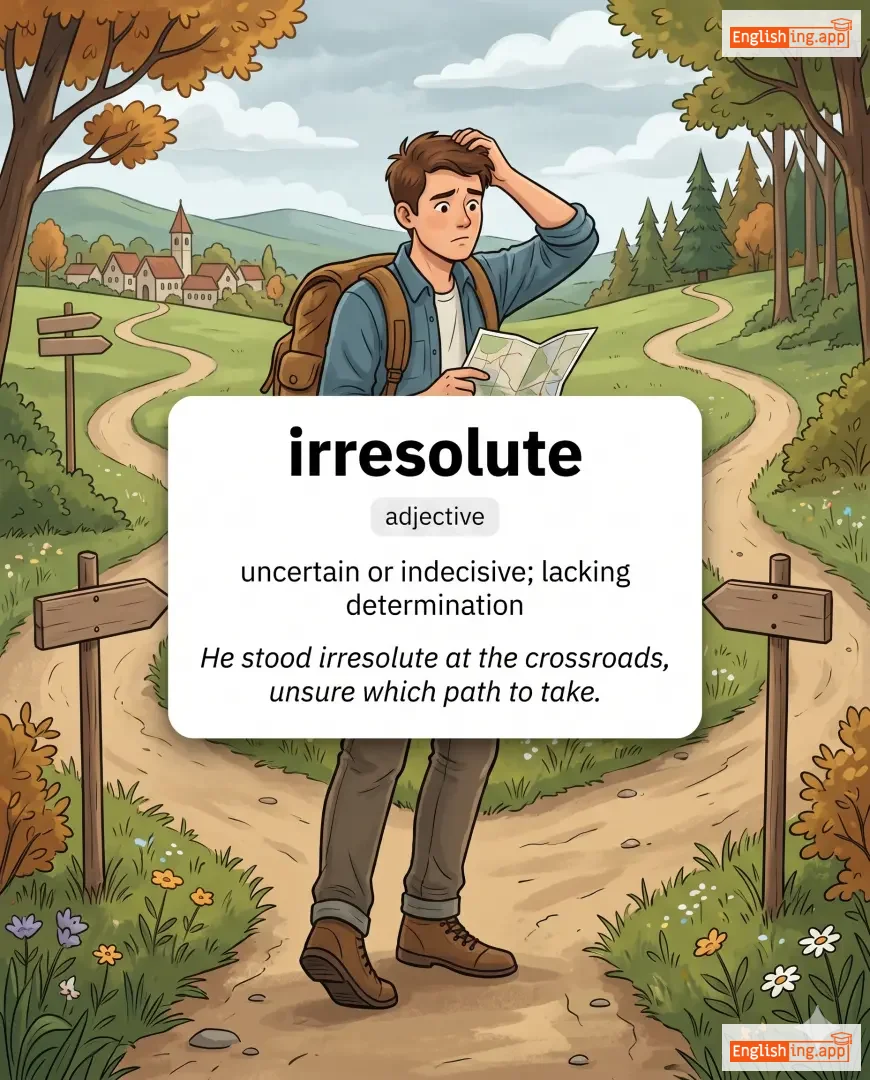
irresolute definition card — visual illustration of the meaning
adjective
/ɪˈrɛzəluːt/
अनिर्णायक (anirnayak)

uncertain or indecisive; lacking determination

"He stood irresolute at the crossroads, unsure which path to take."

"वह चौराहे पर अनिर्णायक खड़ा था, यह नहीं जानता था कि किस रास्ते पर जाएं।" (Vah chaurahen par anirnayak khada tha, yah nahin jaanta tha ki kis raaste par jayein.)
adjective
/ˌɪrɪˈspɛktɪv/
निर्विचार; बिना किसी विचार के (nirvichar; bina kisi vichar ke)

without taking something into account; regardless of

"All students will be treated equally, irrespective of their background."

"सभी छात्रों के साथ समान व्यवहार किया जाएगा, उनकी पृष्ठभूमि के बावजूद।" (sab chhatron ke saath samaan vyavhaar kiya jaayega, unki prishthabhoomi ke bavjood.)
noun
/ˌɪrɪˌspɒnsəˈbɪləti/
गैर-जिम्मेदारी (gair zimmedari)

lack of responsibility or accountability; failure to act in a reliable or sensible way

"The accident was caused by his irresponsibility at work."

"कार्यस्थल पर उसकी गैर-जिम्मेदारी के कारण दुर्घटना हुई।" (karyasthal par uski gair zimmedari ke karan durghatna hui)
adjective
/ˌɪrɪˈspɒnsəbl/
ग़ैरज़िम्मेदार (gairzimmedaar)

not showing proper sense of responsibility

"It was irresponsible of him to leave the children alone."

"बच्चों को अकेला छोड़ना उसकी ग़ैरज़िम्मेदारी थी।" (Bachon ko akela chhodna uski gairzimmedari thi.)
adjective
/ˌɪrɪˈtriːvəbl/
अप्रतियोग्य (apratigya)

impossible to recover or regain

"The documents were lost in an irretrievable way after the fire."

"आग के बाद दस्तावेज़ अवसादित तरीके से खो गए थे।" (Aag ke baad dastavez avsadit tareeke se kho gaye the.)
noun
/ɪˈrɛvərəns/
अश्रद्धा (ashraddha)

a lack of respect for people or things that are generally taken seriously

"His jokes about religion showed irreverence to the sacred traditions."

"उसकी मजाक धर्म के बारे में पवित्र परंपराओं के प्रति अश्रद्धा दिखाती थी।" (Uski mazaak dharm ke baare mein pavitra paramparaon ke prati ashraddha dikhati thi.)
adjective
/ɪˈrɛvərənt/
अवज्ञाकारी (avgyakari)

showing a lack of respect for people or things that are usually respected

"The comedian’s irreverent jokes offended some of the audience."

"कॉमेडियन के अवज्ञाकारी जोक्स ने कुछ दर्शकों को आहत किया।" (Comedian ke avgyakari jokes ne kuch darshako ko aahat kiya.)
adjective
/ˌɪrɛvəˈrɛnʃəl/
असहमति (asahmati)

Showing a lack of respect for things that are generally taken seriously.

"His irreverential humor often shocked traditional audiences."

"उसका असहमति हास्य अक्सर पारंपरिक दर्शकों को चौंका देता था।" (Uska asahmati haasya aksar paaramparik darshako ko chonka deta tha.)
adjective
/ˌɪrɪˈvɜːrsəbl/
अपरिवर्तनीय (aparivartaniy)

Not able to be undone, changed, or reversed.

"The damage caused by the fire was irreversible."

"आग द्वारा हुआ नुकसान अपरिवर्तनीय था।" (Aag dwara hua nuksan aparivartaniy tha.)
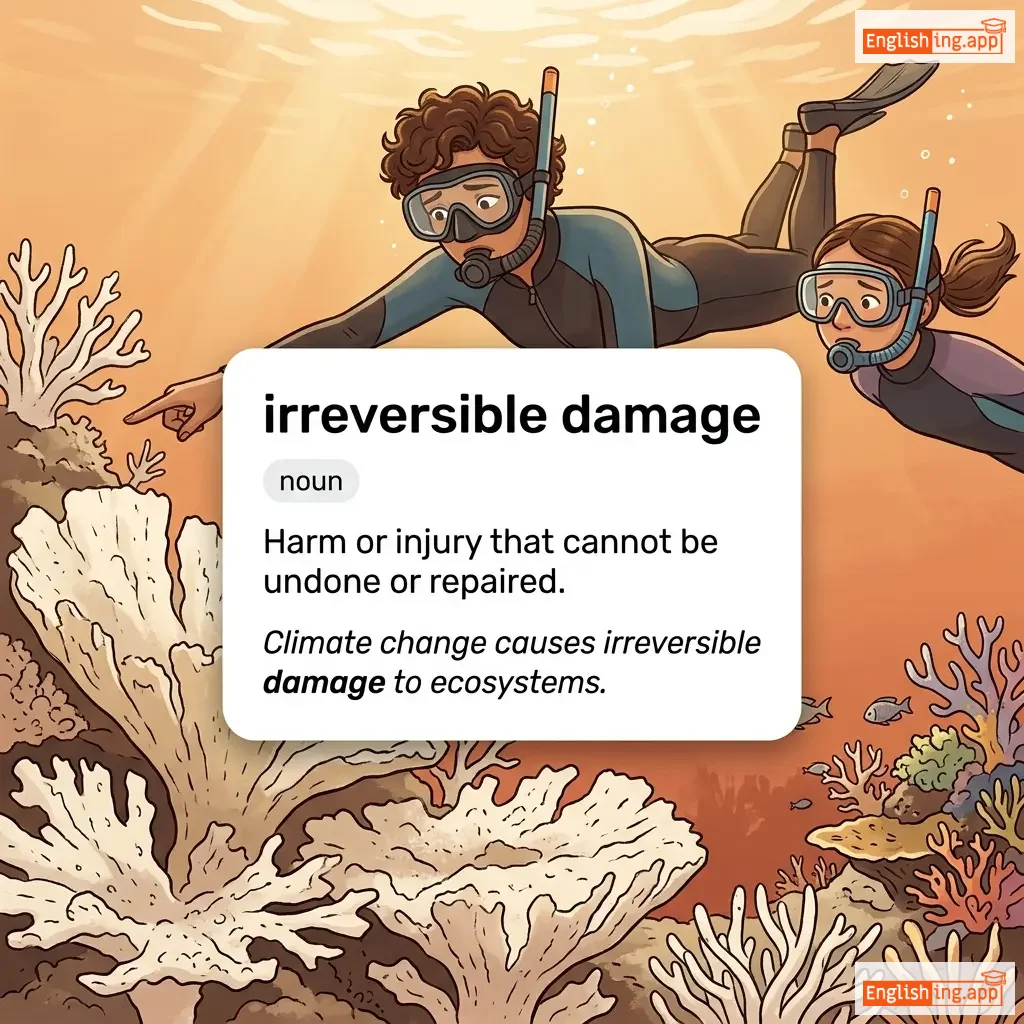
irreversible damage definition card — visual illustration of the meaning
noun
ˌɪrɪˈvɜːrsəbl ˈdæmɪdʒ
अपरिवर्तनीय क्षति (aparivartniya kshati)

Harm or injury that cannot be undone or repaired.

"Climate change causes irreversible damage to ecosystems."

"जलवायु परिवर्तन पारिस्थितिकी तंत्र को अपरिवर्तनीय क्षति पहुँचाता है।" (Jalvayu parivartan paristhitiki tantra ko aparivartniya kshati pahuchata hai.)
adjective
/ɪˈrɛvəkəbl/
अपरिवर्तनीय (aparivartaniy)

Not able to be revoked, changed, or undone.

"She made an irrevocable decision to leave the company."

"उसने कंपनी छोड़ने का एक अपरिवर्तनीय निर्णय लिया।" (Usne company chhodne ka ek aparivartaniy nirnay liya.)
noun
/ˈɪrɪɡənt/
सिंचाई तरल (sinchaai taral)

A liquid used for irrigation, especially in medical or agricultural contexts.

"The doctor used a sterile irrigant during the procedure."

"चिकित्सक ने प्रक्रिया के दौरान एकsterile सिंचाई तरल का उपयोग किया।" (Chikitsak ne prakriya ke dauran ek sterile sinchaai taral ka upyog kiya.)
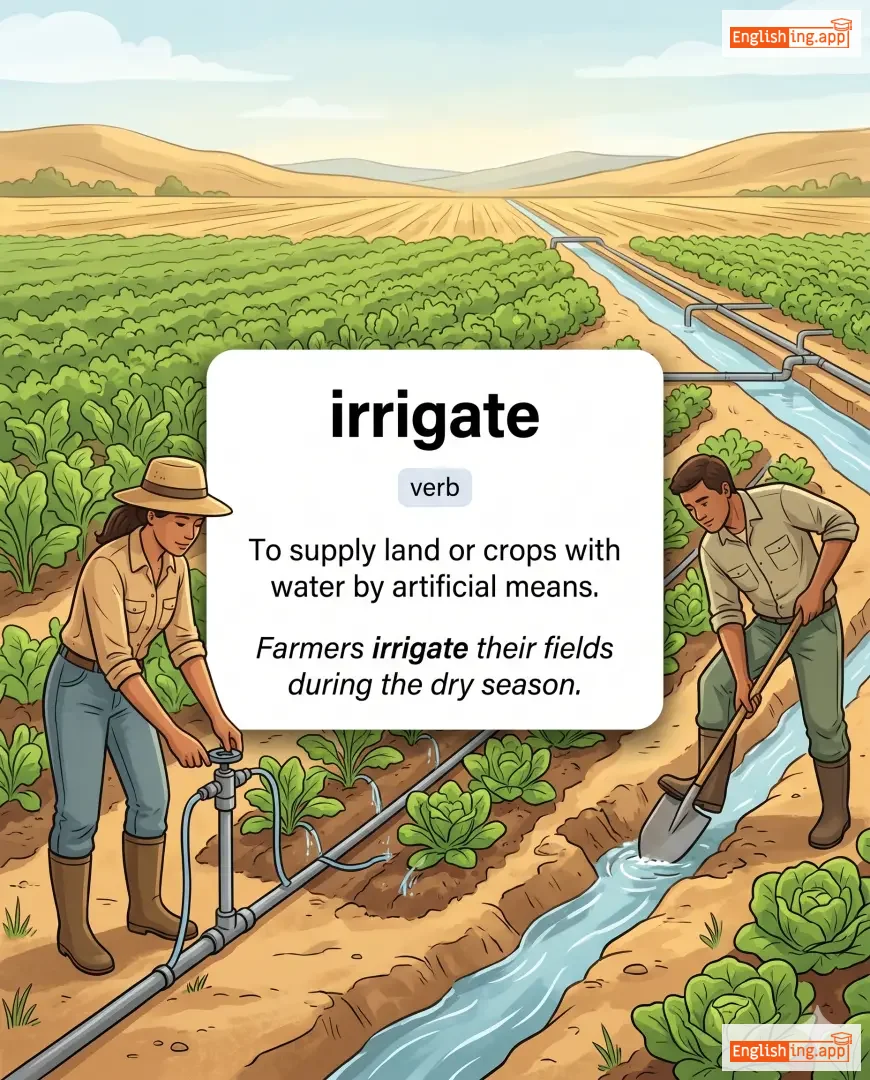
irrigate definition card — visual illustration of the meaning
verb
/ˈɪrɪɡeɪt/
सिंचाई करना (sinchai karna)

To supply land or crops with water by artificial means.

"Farmers irrigate their fields during the dry season."

"किसान सूखे मौसम में अपने खेतों में सिंचाई करते हैं।" (Kisan sukhe mausam mein apne kheton mein sinchai karte hain.)
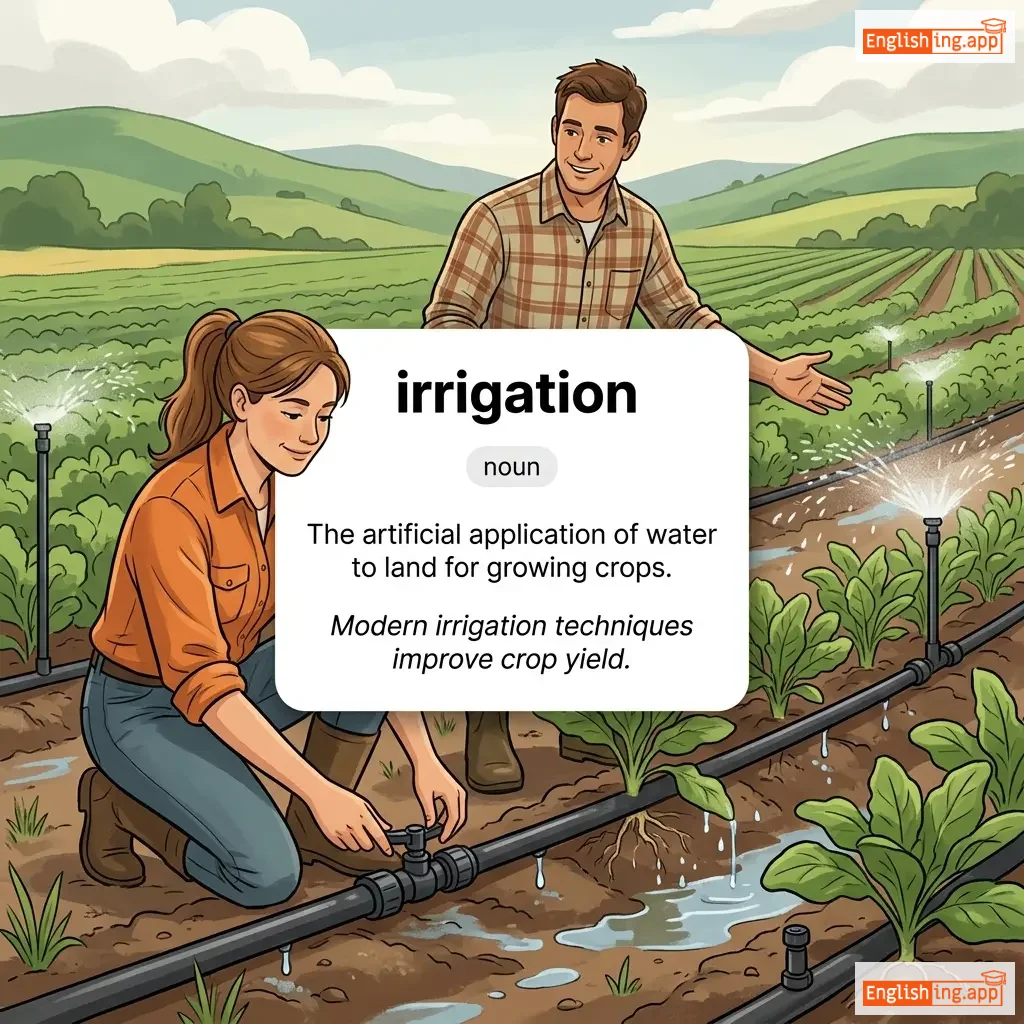
irrigation definition card — visual illustration of the meaning
noun
ˌɪr.ɪˈɡeɪ.ʃən
सिंचाई (sinchai)

The artificial application of water to land for growing crops.

"Modern irrigation techniques improve crop yield."

"आधुनिक सिंचाई तकनीकें फसल उपज में सुधार करती हैं।" (Aadhunik sinchai takneeken phasal upaj mein sudhaar karti hain.)
adjective
/ˈɪrɪtəbl/

easily annoyed or made angry

"She became irritable after working long hours without rest."

noun
/ˈɪrɪtənsi/
चिढ़चिढ़ापन (chidhchidhapan)

the quality or state of causing irritation; legal or formal invalidation

"The constant noise became an irritancy to the neighbors."

"लगातार शोर पड़ोसियों के लिए चिढ़चिढ़ापन बन गया।" (Lagatār shor paṛosīyo ke liye chidhchidhapan ban gayā.)
noun
/ˈɪrɪtənt/
उत्तेजक पदार्थ (uttejak padarth)

something that causes irritation or discomfort

"Dust is a common irritant for people with allergies."

"धूल लोगों के लिए एक सामान्य उत्तेजक पदार्थ है जिनके पास एलर्जी होती है।" (Dhool logon ke liye ek samanaya uttejak padarth hai jinke paas allergic hoti hai.)
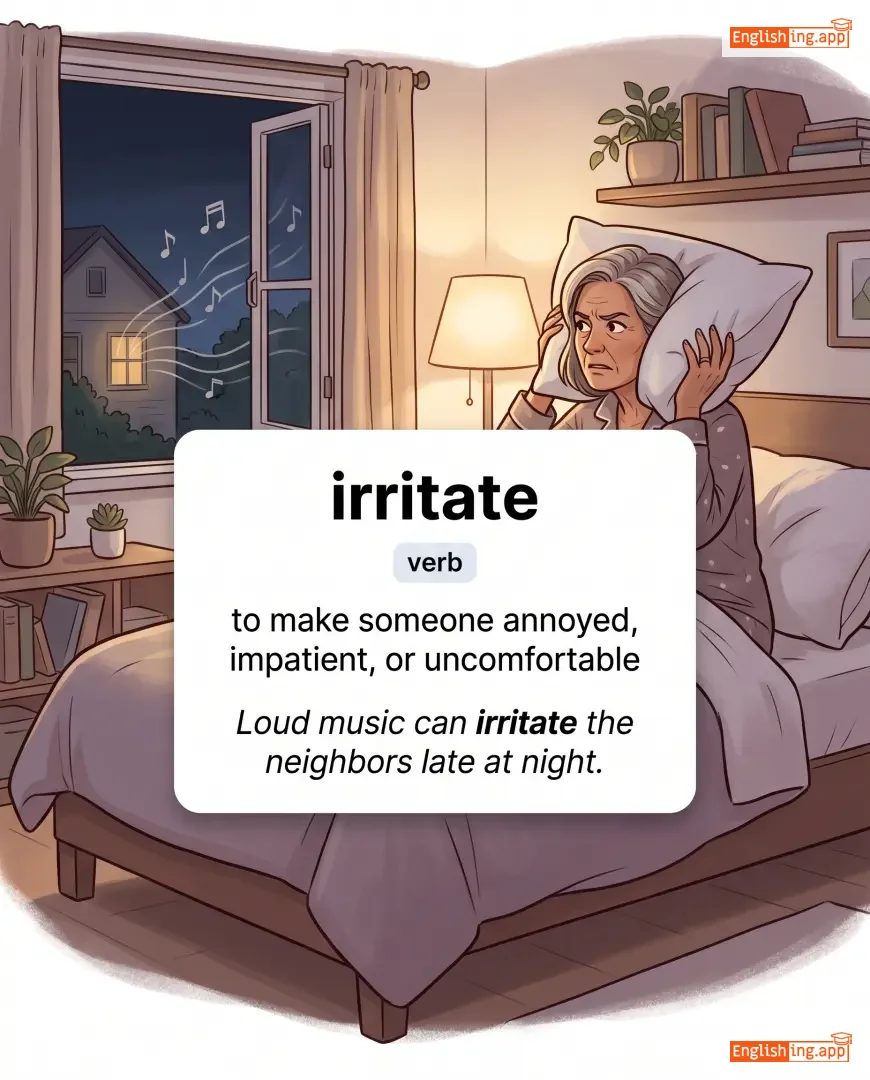
irritate definition card — visual illustration of the meaning
verb
/ˈɪrɪteɪt/
चिढ़ाना (chidhana)

to make someone annoyed, impatient, or uncomfortable

"Loud music can irritate the neighbors late at night."

"देर रात को तेज़ संगीत पड़ोसियों को चिढ़ा सकता है।" (Der raat ko tez sangeet padosiyon ko chidhana sakta hai.)
adjective
/ˈɪrɪteɪtɪd/
चिढ़ा हुआ (chidha hua)

feeling annoyed or impatient; having inflamed or sore physical condition

"She felt irritated by the constant noise outside her window."

"लगातार शोर से वह चिढ़ा हुआ महसूस कर रही थी।" (lagatar shor se vah chidha hua mehsoos kar rahi thi)
adjective
/ˈɪrɪteɪtɪŋ/
चिड़चिड़ा करने वाला (chirchira karne wala)

causing annoyance, impatience, or mild anger

"The constant noise from the street is extremely irritating."

"सड़क से आने वाली लगातार आवाज़ बहुत चिड़चिड़ा करने वाली है।" (sadak se aane wali lagatar awaaz bahut chirchira karne wali hai)
noun
/ɪˈrʌpʃən/
अचानक आक्रमण (achanak aakraman)

a sudden and violent entry or invasion

"The irruption of protesters surprised the authorities."

"प्रदर्शनकारियों का अचानक आक्रमण अधिकारियों को चौंका दिया।" (Pradarshankariyon ka achanak aakraman adhikariyon ko chonka diya.)
noun
/ɪsˈlɑːm/
इस्लाम धर्म (islam dharm)

the religion founded by the Prophet Muhammad, based on belief in one God (Allah)

"Islam emphasizes peace, justice, and compassion."

"इस्लाम शांति, न्याय और करुणा पर बल देता है।" (Islam shanti, nyay aur karuna par bal deta hai.)
adjective
/ɪsˈlɑːmɪk/
इस्लामी (islami)

relating to Islam, its followers, or its teachings

"The city has many Islamic cultural centers."

"इस शहर में कई इस्लामी सांस्कृतिक केंद्र हैं।" (Is shahar mein kai islami sanskritik kendra hain.)
noun
/ˈaɪ.lənd/
द्वीप (dweep)

a piece of land surrounded by water

"They spent their vacation on a tropical island."

"उन्होंने अपनी छुट्टियाँ एक उष्णकटिबंधीय द्वीप पर बिताईं।" (Unhone apni chhuttiyan ek ushnakatibandhiya dweep par bitayi.)
noun
/aɪl/
छोटा द्वीप (chhota dweep)

A small island or peninsula, often poetic or literary.

"They spent their honeymoon on a beautiful tropical isle."

"उन्होंने अपनी हनीमून की छुट्टियाँ एक सुंदर उष्णकटिबंधीय द्वीप पर बिताईं।" (unhone apni honeymoon ki chhutiyaan ek sundar ushna katibandheeya dweep par bitayi.)
noun
/ˈaɪ.lət/
छोटा द्वीप (chhota dweep)

A very small island.

"The fishermen rested on a tiny islet before continuing their journey."

"मछुआरे अपनी यात्रा जारी रखने से पहले एक छोटे द्वीप पर विश्राम कर रहे थे।" (machhuaare apni yatra jaari rakhne se pehle ek chhote dweep par vishraam kar rahe the.)
noun
/ˈaɪ.səˌbɑːr/
आइसोबार (aaisobaar)

A line on a weather map connecting points of equal atmospheric pressure.

"The meteorologist explained how isobars indicate wind speed and direction."

"मौसम विज्ञानी ने समझाया कि आइसोबार कैसे हवा की गति और दिशा को संकेत करते हैं।" (mausam vigyani ne samjhaya ki aaisobaar kaise hawa ki gati aur disha ko sanket karte hain.)
adjective
/aɪˈsɒ.krə.nəs/
समान समय पर घटित (samaan samay par ghatit)

Occurring at equal time intervals; in unison or synchrony.

"The pendulum swings are isochronous, repeating at equal intervals."

"पेंडुलम की स्विंग समान समय पर होती हैं, समान अंतराल पर दोहराती हैं।" (pendulum ki swing samaan samay par hoti hain, samaan antaraal par dohrati hain.)
verb
/ˈaɪ.sə.leɪt/
अलग करना (alag karna)

To separate something or someone from others.

"Doctors tried to isolate the patient to prevent the spread of infection."

"डॉक्टरों ने संक्रमण के फैलाव को रोकने के लिए मरीज को अलग करने की कोशिश की।" (dokton ne sankraman ke phailav ko rokne ke liye mareez ko alag karne ki koshish ki.)