वोकैबुलरीज

इंग्लिश वोकैबुलरी डिस्कवर, लर्न और मास्टर करें

adjective
/ˌɪɡ.nəˈmɪn.i.əs/
लज्जास्पद (lajjaspad)

Marked by shame, disgrace, or humiliation.

"The team suffered an ignominious defeat in the finals."

"टीम ने फाइनल में एक लज्जास्पद हार झेली।" (Teem ne final mein ek lajjaspad haar jheli.)
noun
/ˈɪɡ.nəˌmɪn.i/
अपमान (apmaan)

Public shame, disgrace, or dishonor.

"He lived the rest of his life in ignominy after the scandal."

"उसने स्कैंडल के बाद अपने जीवन के बाकी हिस्से को अपमान में बिताया।" (Usne scandal ke baad apne jeevan ke baaki hisse ko apmaan mein bitaya.)
noun
/ˈɪɡnərəns/
अज्ञानता (ajnanata)

lack of knowledge or awareness in general

"His ignorance about the subject was evident."

"उसका उस विषय पर अज्ञानता स्पष्ट था।" (Uska us vishay par ajnanata spashṭ tha.)
adjective
/ˈɪɡ.nər.ənt/
अज्ञानी (ajnaani)

lacking knowledge, awareness, or education

"He made an ignorant comment about the culture."

"उसने संस्कृति के बारे में एक अज्ञानी टिप्पणी की।" (Usne sanskriti ke baare mein ek ajnaani tippani ki.)
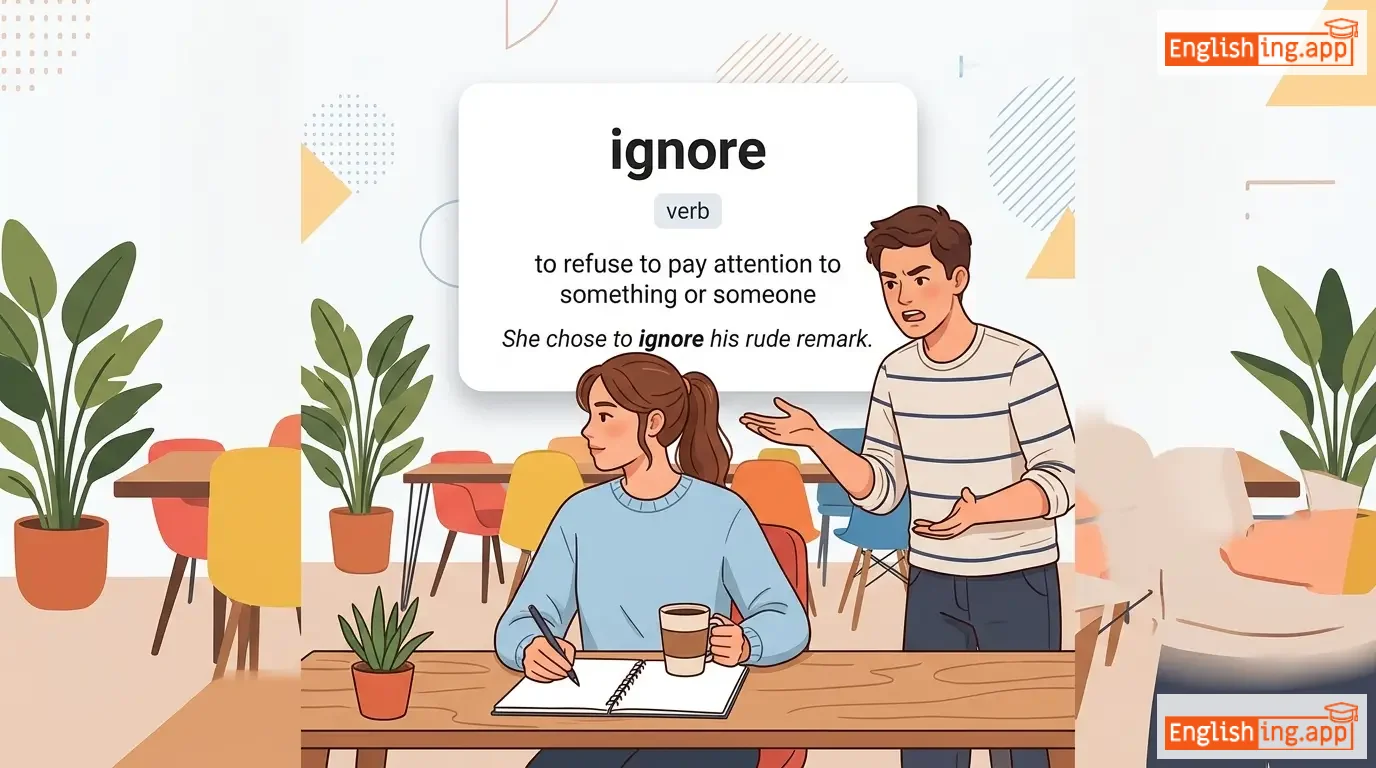
ignore definition card — visual illustration of the meaning
verb
/ɪɡˈnɔːr/
नज़रअंदाज़ करना (nazarandaaz karna)

to refuse to pay attention to something or someone

"She chose to ignore his rude remark."

"उसने उसके रुखे टिप्पणी को नजरअंदाज करने का फैसला किया।" (Usne uske rukhe tippani ko nazarandaaz karne ka faisla kiya.)
noun
/ˈaɪ.kɒn/
धार्मिक चित्र या प्रतीक (dharmik chitra ya pratik)

A religious image or symbol, especially in the Eastern Orthodox Church.

"The church displayed a beautifully painted ikon of the Virgin Mary."

"चर्च ने वर्जिन मैरी की एक खूबसूरती से पेंट की हुई आइकन प्रदर्शित की।" (Charch ne Virgin Mary ki ek khoobsurti se paint ki hui ikon pradarshit ki.)
noun
/ˈɪl.i.æd/
इलियड (Iliad)

An ancient Greek epic poem attributed to Homer, describing the events of the Trojan War.

"Students studied the Iliad to understand Greek mythology and heroism."

"छात्रों ने ग्रीक पुराण और वीरता को समझने के लिए इलियड का अध्ययन किया।" (Chhatron ne Greek puran aur veerta ko samajhne ke liye Iliad ka adhyayan kiya.)
adjective
/ɪl/
खुशी (khushi)

Not in good health; sick or unwell.

"He has been feeling ill since yesterday."

"वह कल से अस्वस्थ महसूस कर रहा है।" (Vah kal se aswasth mehsoos kar raha hai.)
adjective
/ˈɪl bred/
असभ्य (asabhya)

lacking good manners; rude; showing poor upbringing

"His ill-bred behavior shocked everyone at the dinner party."

"उसके असभ्य आचरण ने डिनर पार्टी में सभी को चौंका दिया." (uske asabhya aacharan ne dinar party mein sabhi ko chaunka diya)
adjective
/ˌɪlˈneɪ.tʃəd/
दुष्ट स्वभाव (dusht swabhav)

Having a bad or unpleasant character; unkind or malicious.

"He made an ill-natured remark about his colleague."

"उसने अपने सहकर्मी के बारे में एक दुष्ट स्वभाव वाली टिप्पणी की।" (Usne apne sahakarmi ke baare mein ek dusht swabhav wali tippani ki.)
adjective
/ɪˈliː.ɡəl/
अवैध (avaidh)

Not allowed by law; unlawful.

"It is illegal to drive without a valid license."

"मान्य लाइसेंस के बिना गाड़ी चलाना अवैध है।" (Manya license ke bina gadi chalana avaidh hai.)
noun
/ɪˌledʒ.əˈbɪl.ə.ti/
अस्पष्टता; कठिन पठनीयता (aspashtata; kathin pathneeyata)

the quality of being impossible or difficult to read; unclear writing or print

"The doctor's handwriting was famous for its illegibility among the pharmacy staff."

"चिकित्सक के हस्ताक्षर फार्मेसी स्टाफ के बीच अपनी अस्पष्टता के लिए प्रसिद्ध थे।" (chikitsak ke hastakshar pharmesi staff ke beech apni aspashtata ke liye prasiddh the.)
adjective
/ɪˈledʒ.ə.bəl/
अस्पष्ट (aspasht)

Not clear enough to be read; unreadable.

"The doctor’s handwriting was almost illegible."

"डॉक्टर का हस्ताक्षर लगभग अस्पष्ट था।" (Doktar ka hastakshar lagbhag aspasht tha.)
adjective
/ˌɪlɪˈdʒɪtɪmət/
अवैध (avaidh)

Not authorized by law, rules, or standards; not recognized as valid.

"The court ruled the contract to be illegitimate."

"कोर्ट ने अनुबंध को अवैध घोषित कर दिया।" (Court ne anubandh ko avaidh ghoshit kar diya.)
adjective
/ɪˈlɪbərəl/
अविवेकी (aviveki)

Opposed to liberal principles; restricting freedom of thought or behavior.

"The government was criticized for its illiberal policies."

"सरकार को उसकी अविवेकी नीतियों के लिए आलोचना की गई थी।" (Sarkar ko uski aviveki neetiyon ke liye alochna ki gayi thi.)
noun
/ˌɪlɪbəˈræləti/
असहिष्णुता (asahishnuta)

The quality of being illiberal; lack of tolerance or generosity.

"The illiberality of the new laws alarmed the citizens."

"नए कानूनों की असहिष्णुता ने नागरिकों को भयभीत कर दिया।" (Naye kanoonon ki asahishnuta ne nagarikon ko bhaybheet kar diya.)
adjective
/ɪˈlɪsɪt/
ग़ैरक़ानूनी (gairkaanooni)

Forbidden by law, rules, or custom.

"The police shut down the illicit drug operation."

"पुलिस ने ग़ैरक़ानूनी ड्रग ऑपरेशन को बंद कर दिया।" (Police ne gairkaanooni drug operation ko band kar diya.)
adjective
/ɪˈlɪmɪtəbl/
असीम (aseem)

Without limits or bounds.

"The universe is often described as illimitable."

"ब्रह्मांड को अक्सर असीम के रूप में वर्णित किया जाता है।" (Brahmand ko aksar aaseem ke roop mein varnrit kiya jata hai.)
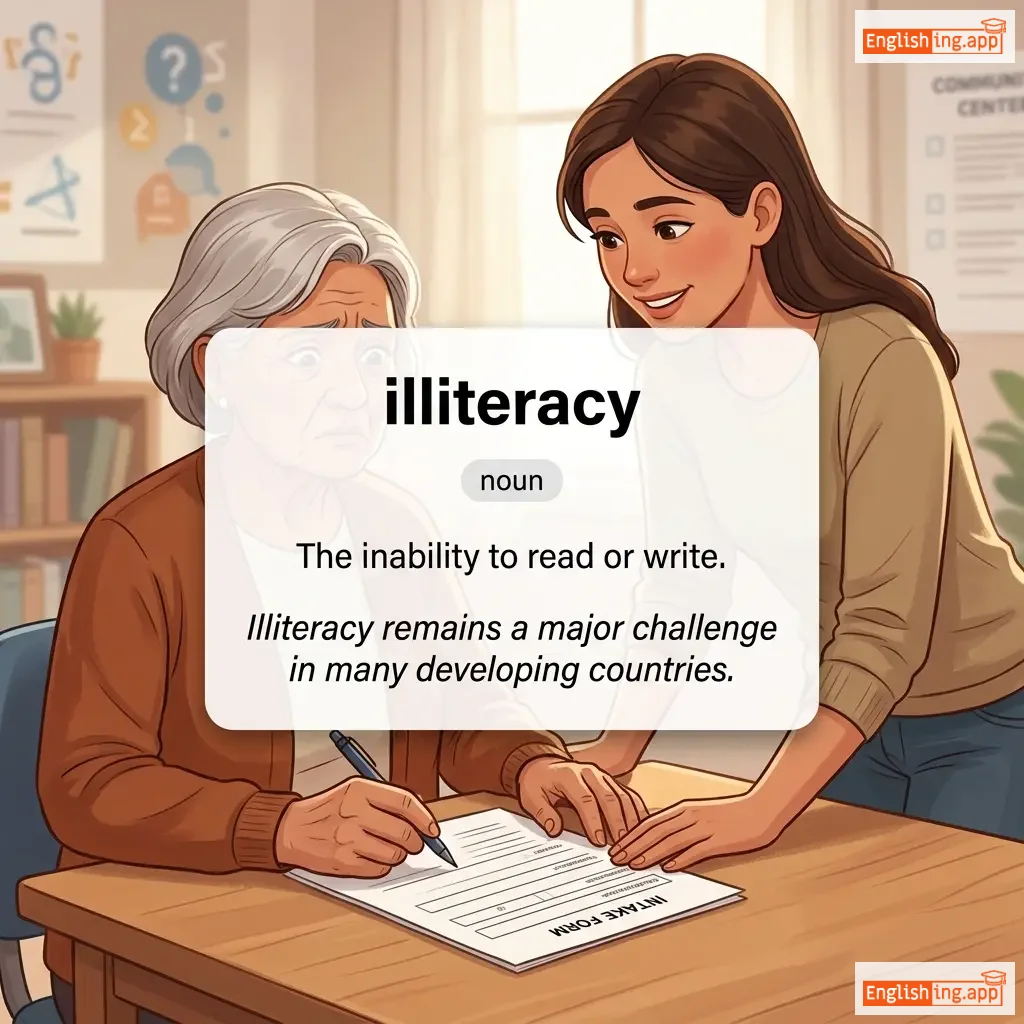
illiteracy definition card — visual illustration of the meaning
noun
/ɪˈlɪtərəsi/
अशिक्षा (ashiksha)

The inability to read or write.

"Illiteracy remains a major challenge in many developing countries."

"अशिक्षा कई विकासशील देशों में एक बड़ी चुनौती बनी हुई है।" (Ashiksha kai vikasheel deshon mein ek badi chunauti bani hui hai.)
adjective
/ɪˈlɪtərət/
अशिक्षित (ashikshit)

Unable to read or write.

"Many villagers were still illiterate in the past."

"कई गांव वाले अतीत में अभी भी अशिक्षित थे।" (Kai gaon wale atit mein abhi bhi asikshit the.)
noun
/ˈɪlnəs/
रोग (rog)

A condition of being unwell or suffering from a disease.

"She missed school due to a serious illness."

"वह गंभीर बीमारी के कारण स्कूल नहीं जा सकी।" (Vah gambhīr bīmārī ke kāraṇ skool nahīn ja sakī.)
adjective
/ɪˈlɒdʒɪkl/
अव्यावहारिक (avyavaharik)

Not making sense or lacking clear reasoning.

"It is illogical to blame children for adult mistakes."

"यह अव्यावहारिक है कि बच्चों को वयस्कों की गलतियों के लिए दोषी ठहराया जाए।" (Yeh avyavaharik hai ki bachon ko vayaskon ki galtiyon ke liye doshi thaharaaya jaaye.)
noun
/ɪˈluːmɪnənt/
प्रकाशक (prakashak)

A substance or device that produces light.

"The lamp acted as an illuminant in the dark cave."

"दीपक अंधेरे गुफा में एक प्रकाशक के रूप में काम कर रहा था।" (Deepak andhere gufa mein ek prakashak ke roop mein kaam kar raha tha.)
verb
/ɪˈluːmɪneɪt/
रोशन करना (roshan karna)

To light up or make something clearer.

"Streetlights illuminate the road at night."

"सड़क के दीपक रात में सड़क को रोशन करते हैं।" (Sadak ke deepak raat mein sadak ko roshan karte hain.)
noun
/ɪˌluːmɪˈnɑːti/
इल्युमिनाती (ilyuminati)

a group of people claiming to have special enlightenment or secret knowledge, often linked to conspiracies

"Many conspiracy theories involve the Illuminati as a secret world-controlling group."

"कई षड्यंत्र सिद्धांतों में इल्युमिनाती को एक गुप्त विश्व-नियंत्रण समूह के रूप में शामिल किया जाता है।" (kai shadyantra siddhanton mein ilyuminati ko ek gupt vishv-niyantran samuh ke roop mein shamil kiya jaata hai.)
noun
/ɪˌluːmɪˈneɪʃən/
रोशनी (ilyuminayshan)

the act of lighting something or making something clear

"The street was filled with bright illumination from the lamps."

"गली दीपकों की तेज रोशनी से भरी हुई थी" (gali deepakon ki tez roshni se bhari hui thi)
verb
/ɪˈluːmɪn/
प्रकाशित करना (prakashit karna)

to light up or make clear

"The rising sun illumined the mountain peaks."

"उदयमान सूरज ने पहाड़ों की चोटियों को प्रकाशित किया।" (Udaymaan sooraj ne pahaadon ki chhotiyaan ko prakashit kiya.)
noun
/ɪˈluːʒən/
भ्रम (bhram)

a false idea or belief; a deceptive appearance

"The magician created the illusion of a floating woman."

"जादूगर ने एक तैरती हुई महिला का भ्रम उत्पन्न किया।" (Jadugar ne ek tairti hui mahila ka bhram utpann kiya.)
adjective
/ɪˈluːsɪv/
मिथ्याचारी (mithyachari)

deceptive or misleading; based on illusion

"His hopes of sudden wealth proved to be illusive."

"उसकी अचानक संपत्ति की आशा मिथ्याचारी साबित हुई।" (Uski achanak sampatti ki asha mithyachari sabit hui.)
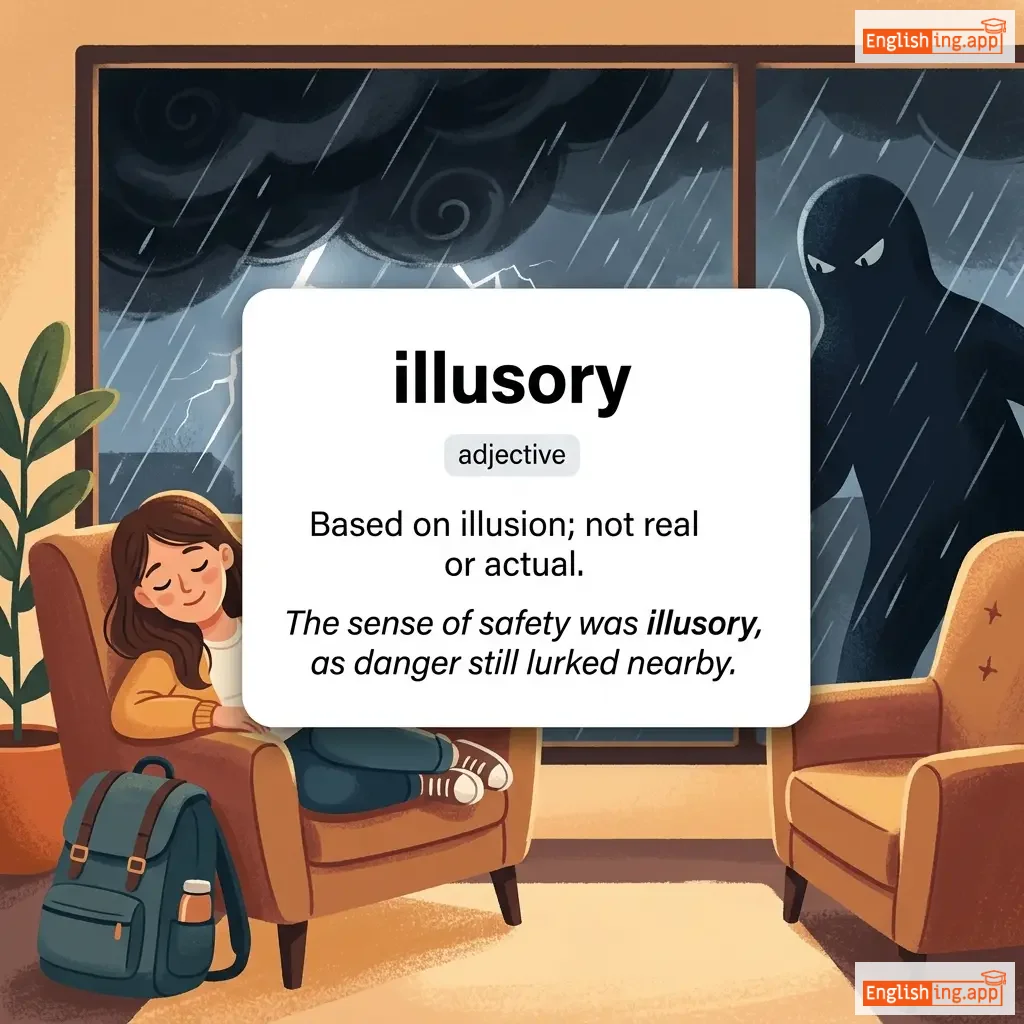
illusory definition card — visual illustration of the meaning
adjective
/ɪˈluːsəri/
भ्रामक (bhramak)

Based on illusion; not real or actual.

"The sense of safety was illusory, as danger still lurked nearby."

"सुरक्षा की भावना भ्रामक थी, क्योंकि खतरा अभी भी पास में था।" (Suraksha ki bhavana bhramak thi, kyonki khatra abhi bhi paas mein tha.)
verb
/ˈɪl.ə.streɪt/
व्याख्यायित करना, चित्रित करना (vyakhyayit karna, chitrit karna)

to explain or make something clear by using examples, pictures, or comparisons

"The teacher used diagrams to illustrate the concept."

"शिक्षक ने अवधारणा को स्पष्ट करने के लिए चित्रों का उपयोग किया।" (Shikshak ne avdharna ko spasht karne ke liye chitron ka upyog kiya.)
adjective
/ɪˈlʌstriəs/
प्रसिद्ध (prasiddh)

Well known, respected, and admired for past achievements.

"She had an illustrious career in medicine."

"उसका चिकित्सा में एक प्रसिद्ध करियर था।" (Uska chikitsa mein ek prasiddh kariyer tha.)
noun
/ˈɪmɪdʒ/
छवि (chhavi)

A visual representation of something, such as a picture or likeness.

"The magazine published a clear image of the celebrity."

"मैगजीन ने सेलेब्रिटी की एक स्पष्ट छवि प्रकाशित की।" (Magazine ne celebrity ki ek spashth chhavi prakaashit ki.)
noun
/ˈɪmɪdʒəri/
चित्रकला (chitrakala)

visually descriptive or figurative language, especially in a literary work

"The poet's use of imagery brought the scene to life."

"कवि की चित्रकला ने दृश्य को जीवन्त बना दिया।" (Kavi ki chitrakala ne drishya ko jeevant bana diya.)
adjective
/ɪˈmædʒɪnəbl/
कल्पनाशील (kalpanaasheel)

Capable of being imagined or conceived.

"They offered every imaginable type of food at the festival."

"उन्होंने उत्सव में हर प्रकार का कल्पनाशील भोजन पेश किया।" (Unhone utsav mein har prakar ka kalpanaasheel bhojan pesh kiya.)
adjective
/ɪˈmædʒɪnəri/
काल्पनिक (kalpnik)

Existing only in the imagination; not real.

"Children often have imaginary friends."

"बच्चों के पास अक्सर काल्पनिक दोस्त होते हैं।" (Bacchon ke paas aksar kalpnik dost hote hain.)
noun
/ɪˌmædʒɪˈneɪʃən/
कल्पना (kalpana)

The ability of the mind to create ideas or pictures not present to the senses.

"Children often use their imagination while playing."

"बच्चे अक्सर खेलते समय अपनी कल्पना का उपयोग करते हैं।" (bachche aksar khelte samay apni kalpana ka upyog karte hain.)
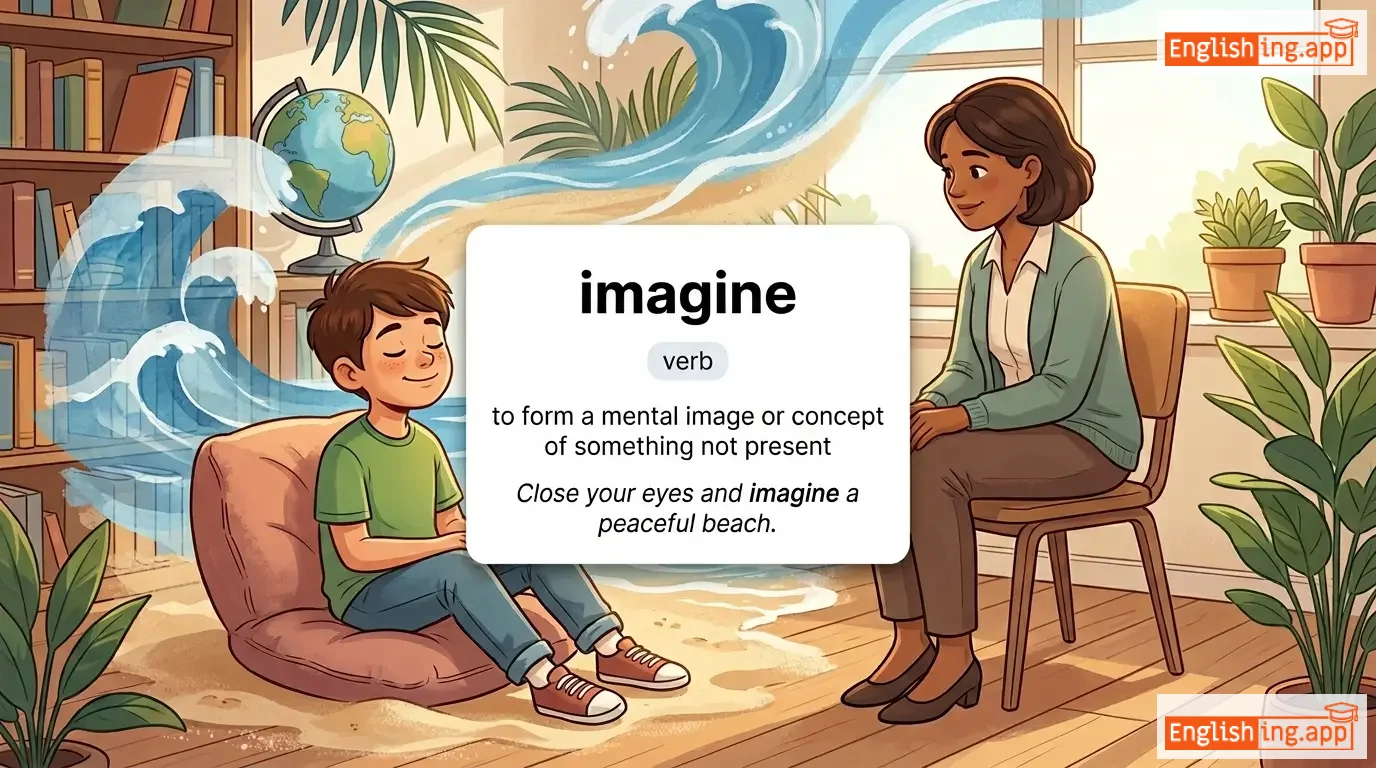
imagine definition card — visual illustration of the meaning
verb
/ɪˈmædʒ.ɪn/
कल्पना करना (kalpana karna)

to form a mental image or concept of something not present

"Close your eyes and imagine a peaceful beach."

"आँखें बंद करो और एक शांत समुद्र तट की कल्पना करो।" (Aankhen band karo aur ek shant samudra tat ki kalpana karo.)
noun
/ɪmˈbæləns/
असंतुलन (asantulan)

A lack of balance; a state of inequality or disproportion.

"The imbalance of power led to conflict."

"पावर का असंतुलन संघर्ष की ओर ले गया।" (Power ka asantulan sangharsh ki or le gaya.)
noun
/ˌɪmbəˈsɪləti/
मूर्खता (moorkhata)

Extreme foolishness, stupidity, or weakness of mind.

"The plan was abandoned due to its sheer imbecility."

"योजना को इसके अत्यधिक मूर्खता के कारण छोड़ दिया गया था।" (Yojna ko iske atyadhik moorkhata ke kaaran chhod diya gaya tha.)
verb
/ɪmˈbɛd/
गांठना (ganthna)

To fix firmly or deeply in a surrounding mass.

"The journalist imbedded himself with the troops to report firsthand."

"पत्रकार ने पहले हाथ रिपोर्ट करने के लिए सैनिकों के साथ खुद को घुसा लिया।" (Patrakar ne pehle haath report karne ke liye sainikon ke saath khud ko ghusa liya.)
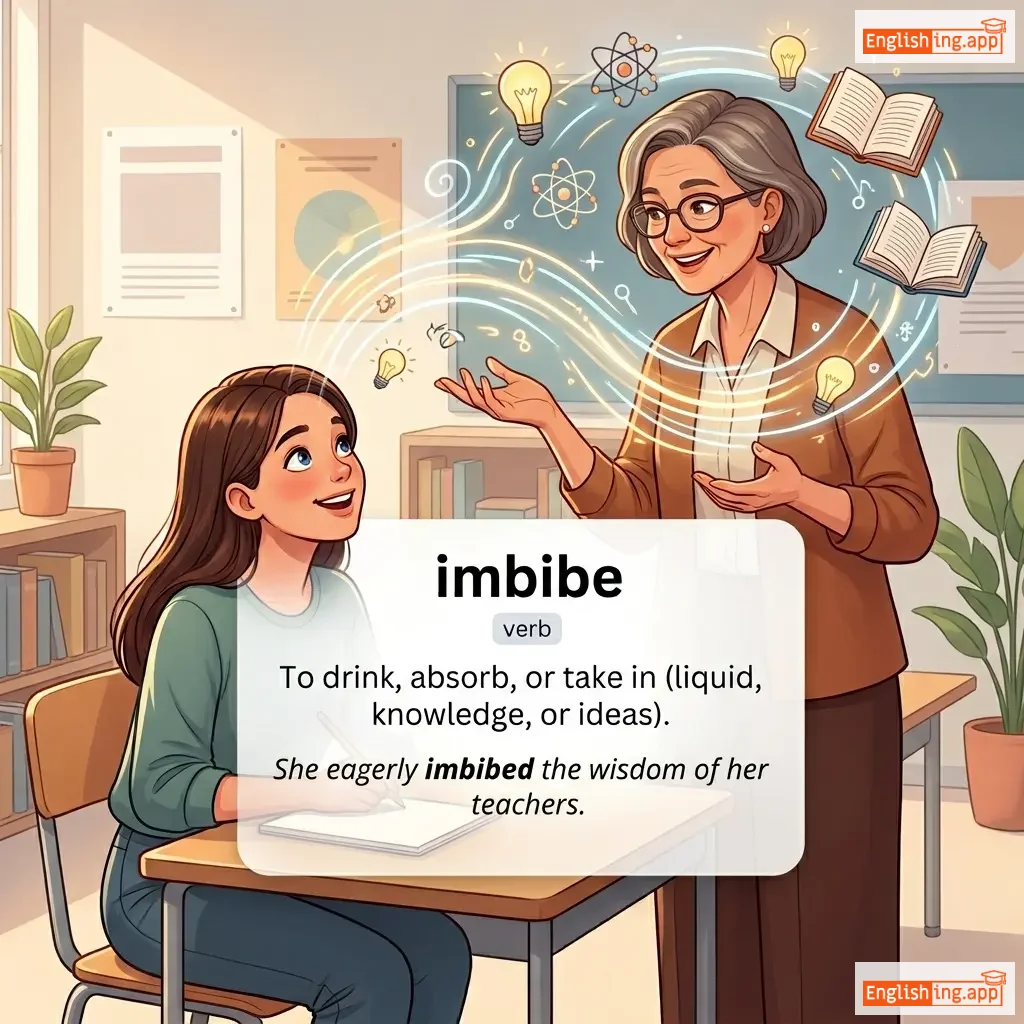
imbibe definition card — visual illustration of the meaning
verb
/ɪmˈbaɪb/
पान करना (pan karna)

To drink, absorb, or take in (liquid, knowledge, or ideas).

"She eagerly imbibed the wisdom of her teachers."

"वह अपने शिक्षकों से बुद्धिमता को उत्साह से आत्मसात करती थी।" (Vah apne shikshakon se buddhimta ko utsah se aatmsaat karti thi.)
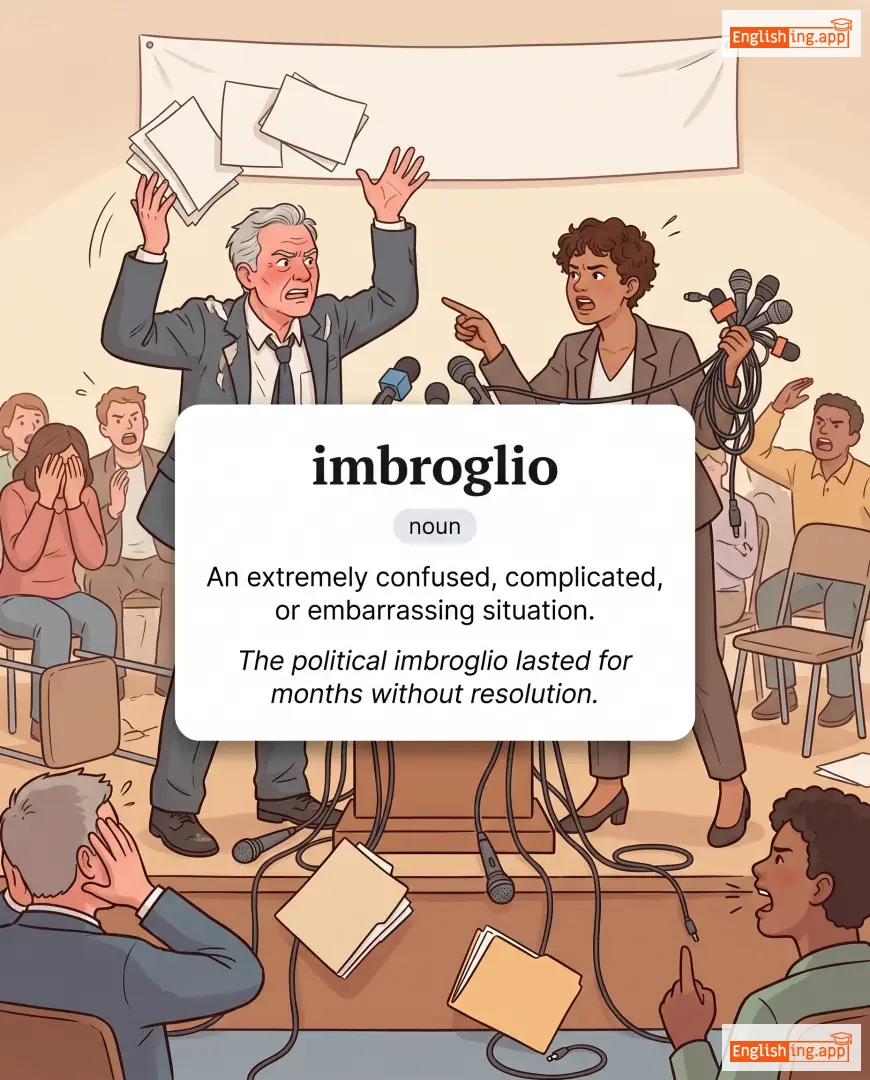
imbroglio definition card — visual illustration of the meaning
noun
/ɪmˈbroʊlioʊ/
उलझन (uljhan)

An extremely confused, complicated, or embarrassing situation.

"The political imbroglio lasted for months without resolution."

"राजनीतिक उलझन महीनों तक बिना किसी समाधान के चलती रही।" (Rajneetik uljhan mahino tak bina kisi samaadhan ke chalti rahi.)
verb
/ɪmˈbruː/
रंजित करना (ranjit karna)

To stain, especially with blood.

"His hands were imbrued with blood after the battle."

"युद्ध के बाद उसके हाथ खून से रंजित थे।" (Yudh ke baad uske haath khoon se ranjit the.)
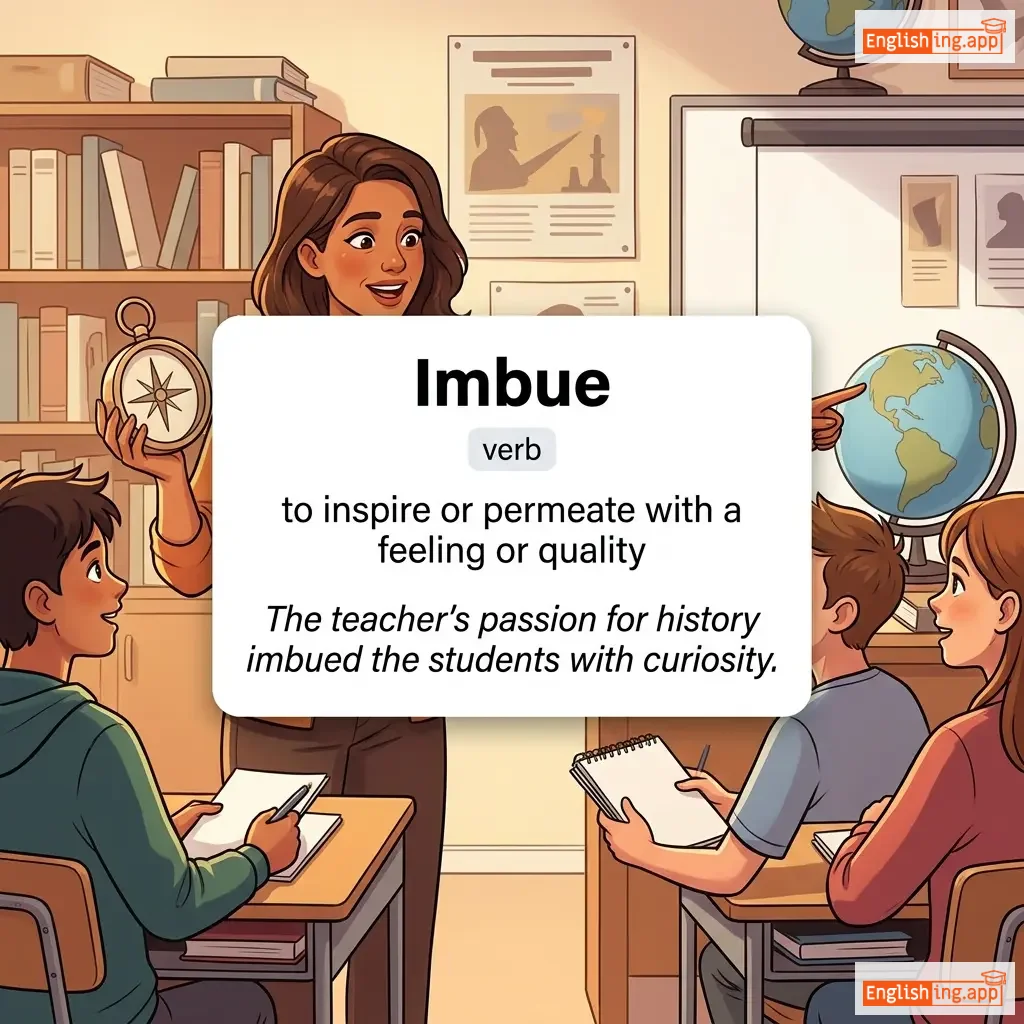
Imbue definition card — visual illustration of the meaning
verb
/ɪmˈbjuː/
प्रेरित करना (prerit karna)

to inspire or permeate with a feeling or quality

"The teacher's passion for history imbued the students with curiosity."

"शिक्षक का इतिहास के प्रति जुनून छात्रों को जिज्ञासा से भर देता था।" (Shikshak ka itihaas ke prati junoon chhatron ko jigyasa se bhar deta tha.)
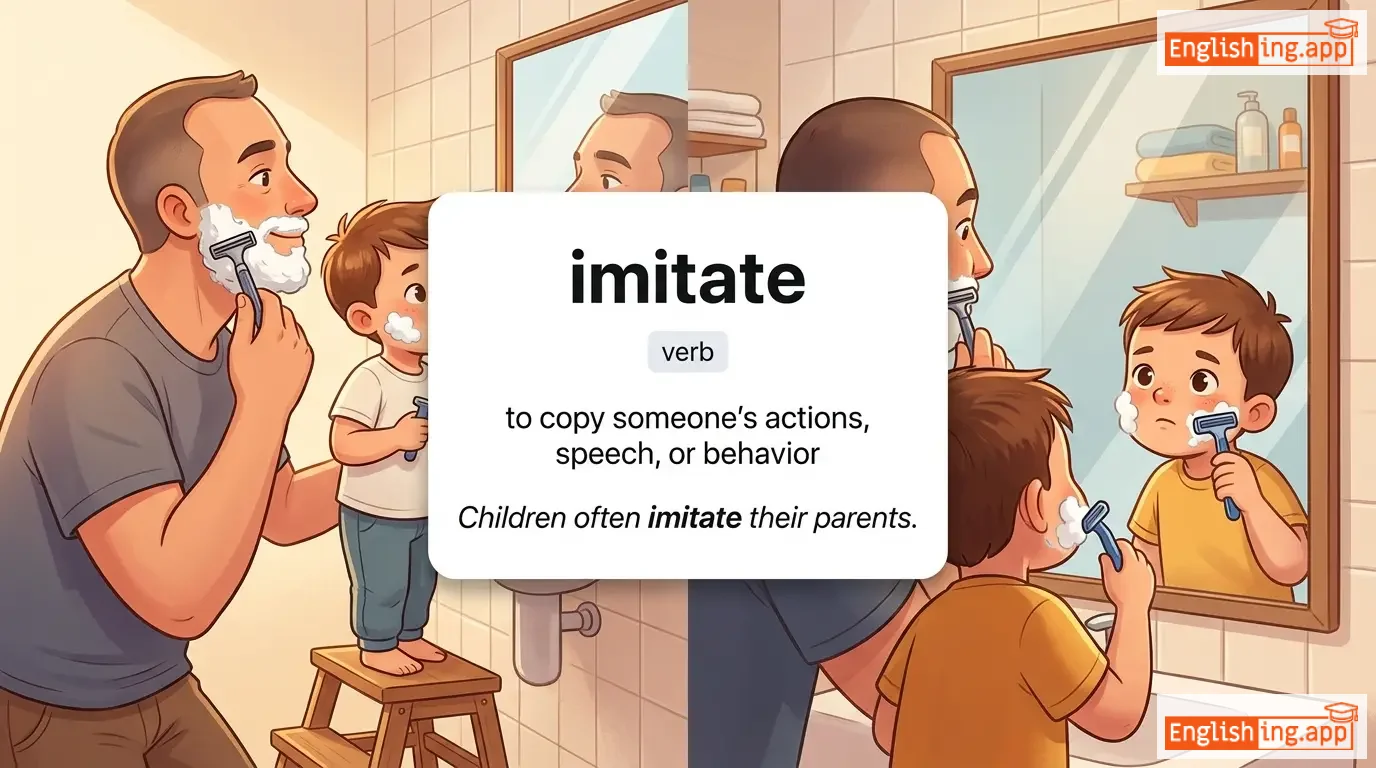
imitate definition card — visual illustration of the meaning
verb
/ˈɪmɪteɪt/
अनुकरण करना (anukaran karna)

to copy someone's actions, speech, or behavior

"Children often imitate their parents."

"बच्चे अक्सर अपने माता-पिता की नकल करते हैं।" (Bacche aksar apne mata-pita ki nakal karte hain.)
noun
/ˌɪmɪˈteɪʃən/
अनुकरण (anukaran)

the act of copying or mimicking someone or something

"Children learn many skills through imitation."

"बच्चे अनुकरण के माध्यम से कई कौशल सीखते हैं।" (Bacche anukaran ke madhyam se kai kaushal seekhte hain.)
noun
/ˈɪmɪˌteɪtər/
अनुकरणकर्ता (anukaranakarta)

a person who copies the behavior, style, or actions of others

"He became famous as an imitator of popular singers."

"वह एक लोकप्रिय गायक की नकल करने के कारण प्रसिद्ध हो गया।" (vah ek lokpriya gayak ki nakal karne ke kaaran prasiddh ho gaya.)
adjective
/ɪˈmækjələt/
निर्मल (nirmal)

perfectly clean, neat, or free from flaws

"Her room was immaculate, with everything in its place."

"उसका कमरा निर्मल था, सब कुछ अपनी जगह पर था।" (Uska kamra nirmal tha, sab kuch apni jagah par tha.)
adjective
/ˈɪmənənt/
अंतर्निहित (antarnihit)

existing or operating within; inherent

"He believed that moral values are immanent in human nature."

"वह विश्वास करते थे कि नैतिक मूल्य मानव स्वभाव में अंतर्निहित हैं।" (Vah vishwas karte the ki naitik moolya manav swabhav mein antarnihit hain.)