वोकैबुलरीज

इंग्लिश वोकैबुलरी डिस्कवर, लर्न और मास्टर करें

adjective
/ɪnˈtɒlərənt/
असहिष्णु (asahishnu)

unwilling to accept or respect beliefs or behavior different from one's own

"He is intolerant of any opinion that differs from his own."

"वह किसी भी राय को सहन नहीं करता जो उसकी अपनी राय से भिन्न हो।" (Vah kisi bhi raay ko sahan nahin karta jo uski apni raay se bhinn ho.)
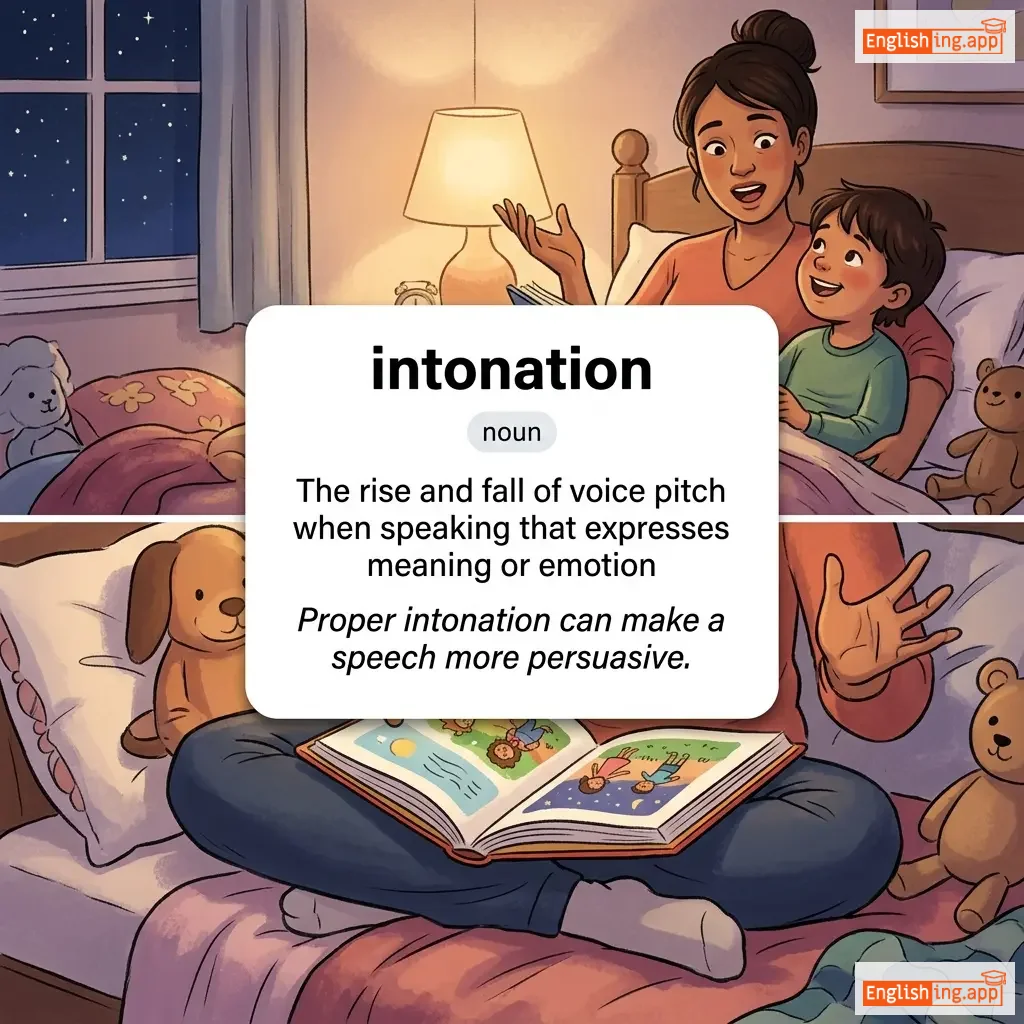
intonation definition card — visual illustration of the meaning
noun
ˌɪn.toʊˈneɪ.ʃən
स्वर परिवर्तन (swar parivartan)

The rise and fall of voice pitch when speaking that expresses meaning or emotion

"Proper intonation can make a speech more persuasive."

"प्रॉपर इंटोनेशन से एक भाषण को ज्यादा प्रभावी बनाया जा सकता है।" (Proper intonation se ek bhashan ko zyada prabhavi banaya ja sakta hai.)
noun
/ɪnˈtɒksɪkənt/
नशे की चीज़ (nashe ki cheez)

a substance, especially alcohol or a drug, that causes intoxication

"Alcohol is the most commonly used intoxicant in many cultures."

"शराब कई संस्कृतियों में सबसे सामान्य रूप से इस्तेमाल होने वाली नशे की चीज़ है।" (Sharab kai sanskritiyon mein sabse samanya roop se istemal hone wali nashe ki cheez hai.)
verb
/ɪnˈtɒksɪkeɪt/
खुशी (khushi)

to make someone lose control of their faculties or behavior due to alcohol or drugs

"The strong drink quickly intoxicated him."

"जब उसने पुरस्कार प्राप्त किया, तो वह अपनी खुशी को छिपा नहीं सकी।" (Jab usne puraskar prapt kiya, to vah apni khushi ko chhupa nahin sakee.)
adjective
/ˌɪn.trəˈsɛl.jʊ.lər/
कोशिका के भीतर (koshika ke bhitar)

Located or occurring within a cell.

"The drug works by targeting intracellular bacteria."

"दवा कोशिका के भीतर बैक्टीरिया को लक्ष्य करके काम करती है।" (Dawa koshika ke bhitar bacteria ko lakshya karke kaam karti hai.)
intractable definition card — visual illustration of the meaning
adjective
/ɪnˈtræk.tə.bəl/
अपर्याप्त नियंत्रण करने योग्य (aparyapt niyantran karne yogya)

Difficult or impossible to manage, control, or solve.

"The conflict has become an intractable problem."

"संघर्ष एक अपर्याप्त नियंत्रण करने योग्य समस्या बन गया है।" (Sangharsh ek aparyapt niyantran karne yogya samasya ban gaya hai.)
adjective
/ˌɪn.trəˈmjʊə.rəl/
संस्था के भीतर (sanstha ke bhitar)

Occurring within the walls of a single institution, especially a school or college.

"The college organizes intramural sports competitions every semester."

"कॉलेज हर सेमेस्टर में इंट्राम्यूरल खेल प्रतियोगिताओं का आयोजन करता है।" (College har semester mein intramural khel pratiyogitaon ka aayojan karta hai.)
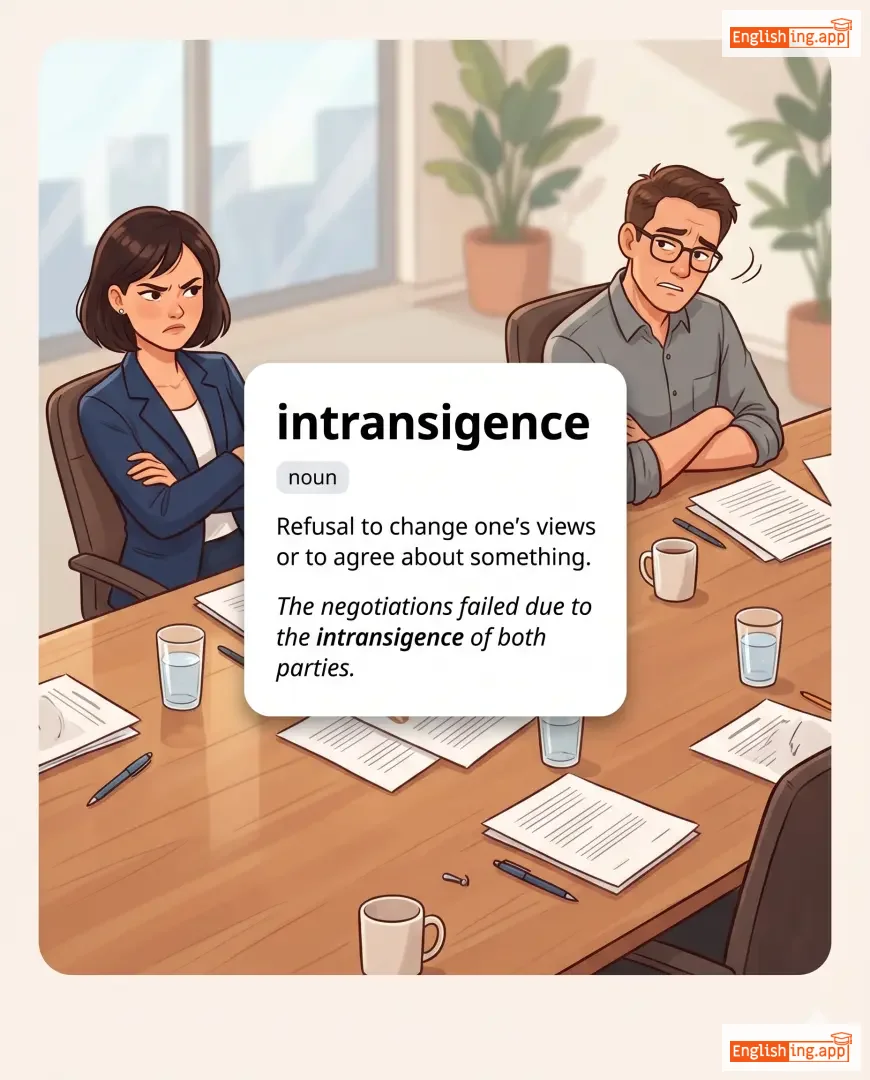
intransigence definition card — visual illustration of the meaning
noun
/ɪnˈtræn.sɪ.dʒəns/
अडिगता (adigta)

Refusal to change one's views or to agree about something.

"The negotiations failed due to the intransigence of both parties."

"दोनों पक्षों की अडिगता के कारण वार्ता विफल हो गई।" (Donon pakshon ki adigta ke kaaran vaarta viphal ho gayi.)
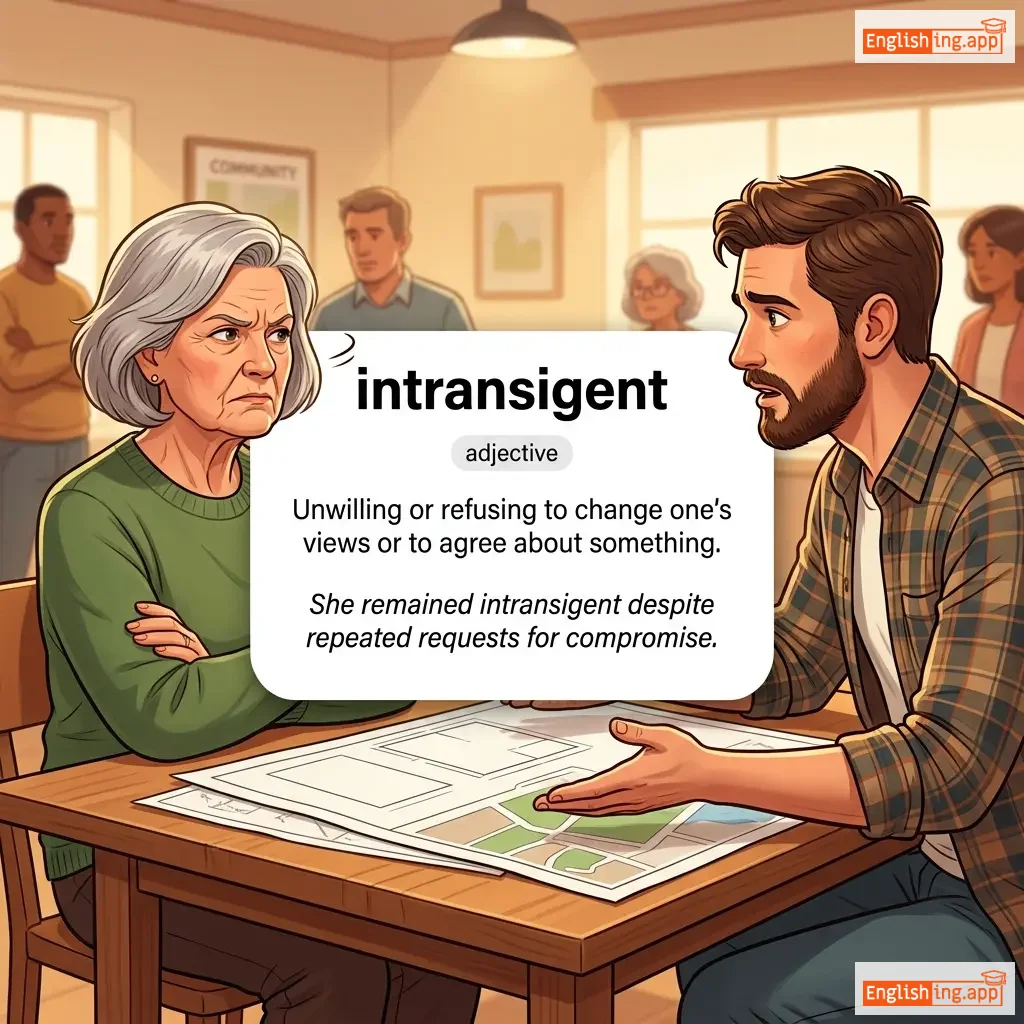
intransigent definition card — visual illustration of the meaning
adjective
/ɪnˈtræn.sɪ.dʒənt/
अडिग (adig)

Unwilling or refusing to change one's views or to agree about something.

"She remained intransigent despite repeated requests for compromise."

"वह समझौते के लिए बार-बार अनुरोध करने के बावजूद अडिग रही।" (vah samjhote ke liye bar-bar anurodh karne ke bawjood adig rahi.)
adjective
/ɪnˈtrɛpɪd/
निडर (nidar)

fearless and adventurous, often used humorously

"The intrepid traveler explored the jungle alone."

"निडर यात्री ने अकेले जंगल की यात्रा की।" (Nidar yatrai ne akele jangal ki yatra ki.)
noun
/ˈɪntrɪkəsi/
जटिलता (jatilata)

the quality of being very detailed or complicated

"The intricacy of the design impressed everyone."

"डिज़ाइन की जटिलता ने सभी को प्रभावित किया।" (Design ki jatilata ne sabhi ko prabhavit kiya.)
adjective
/ˈɪntrɪkət/
जटिल (jatil)

very detailed, complex, and difficult to understand

"The artist created an intricate pattern on the wall."

"कलाकार ने दीवार पर एक जटिल पैटर्न बनाया।" (Kalakar ne deewar par ek jatil pattern banaya.)
verb
/ɪnˈtriːɡ/
जिज्ञासा उत्पन्न करना (jijñāsā utpann karnā)

to arouse curiosity or interest; to make someone fascinated

"The mystery novel will intrigue any reader."

"रहस्य उपन्यास किसी भी पाठक की जिज्ञासा उत्पन्न करेगा।" (rahasya upanyās kisī bhī pāṭhak kī jijñāsā utpann karegā.)
adjective
/ɪnˈtriːɡɪŋ/
दिलचस्प और अजीब; जिज्ञासा उत्पन्न करने वाला (dilchasp aur ajeeb; jijnasa utpann karne wala)

very interesting and unusual; arousing curiosity

"The movie has an intriguing plot that keeps the audience hooked."

"फिल्म का प्लॉट दिलचस्प है जो दर्शकों को बांधे रखता है।" (Film ka plot dilchasp hai jo darshako ko bandhe rakhta hai.)
intrinsic definition card — visual illustration of the meaning
adjective
/ɪnˈtrɪnzɪk/
आंतरिक (aantarik)

belonging naturally; essential or inherent

"Honesty is an intrinsic part of good leadership."

"ईमानदारी अच्छे नेतृत्व का आंतरिक हिस्सा है।" (Imaandari achhe netritva ka aantarik hissa hai.)
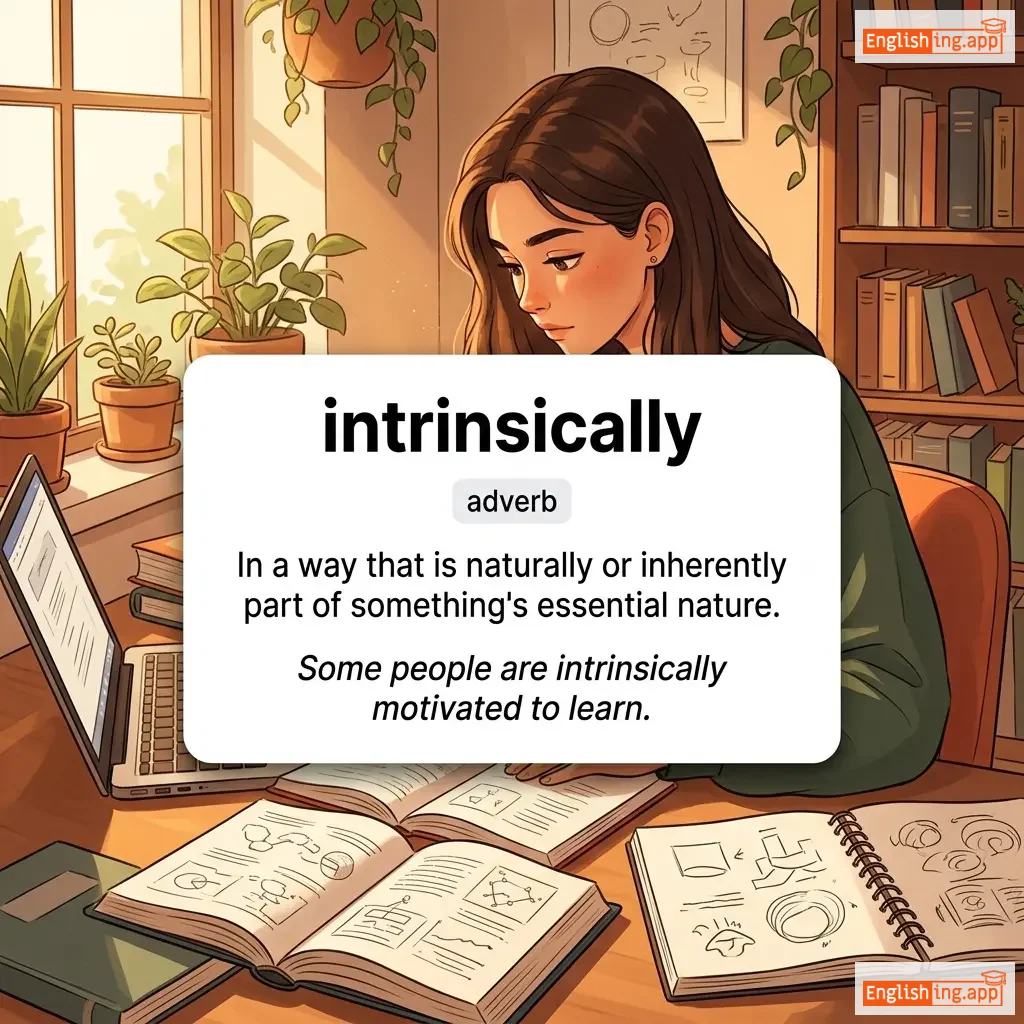
intrinsically definition card — visual illustration of the meaning
adverb
ɪnˈtrɪn.zɪ.kli
स्वाभाविक रूप से (swabhavik roop se)

In a way that is naturally or inherently part of something's essential nature.

"Some people are intrinsically motivated to learn."

"कुछ लोग स्वाभाविक रूप से सीखने के लिए प्रेरित होते हैं।" (Kuch log swabhavik roop se seekhne ke liye prerit hote hain.)
introduce definition card — visual illustration of the meaning
verb
/ˌɪntrəˈduːs/
परिचय कराना (parichay karana)

to present someone or something to another person or group

"He will introduce his new idea at the meeting."

"वह बैठक में अपने नए विचार को प्रस्तुत करेगा।" (Vah baithak mein apne naye vichar ko prastut karega.)
noun
/ˌɪn.trəˈdʌk.ʃən/
परिचय (parichay)

the action of introducing something or someone; an opening or beginning part

"The professor gave a brief introduction before starting the lecture."

"प्रोफेसर ने व्याख्यान शुरू करने से पहले एक संक्षिप्त परिचय दिया।" (Professor ne vyakhyan shuru karne se pehle ek sankshipt parichay diya.)
adjective
/ˌɪn.trəˈdʌk.tər.i/
परिचयात्मक (parichayaatmak)

Serving as an introduction; preliminary or preparatory.

"The professor gave an introductory lecture on economics."

"प्रोफेसर ने अर्थशास्त्र पर एक परिचयात्मक व्याख्यान दिया।" (Professor ne arthashastra par ek parichayaatmak vyakhyan diya.)
noun
/ˌɪn.trəˈɡreʃ.ən/
जीन हस्तांतरण (jeen hastantarann)

The transfer of genetic information from one species to another through repeated backcrossing.

"Introgression plays a significant role in plant breeding."

"इंट्रोग्रेशन पौधों की प्रजनन में महत्वपूर्ण भूमिका निभाता है।" (Introgression podhon ki prajanan mein mahatvapurn bhumika nibhata hai.)
verb
/ˌɪn.trəˈmɪt/
प्रवेश कराना (pravesh karana)

To insert or introduce something into a place or body.

"The doctor carefully intromitted the instrument into the wound."

"डॉक्टर ने सावधानी से उपकरण को घाव में डाला।" (Doktar ne saavdhaani se upkaran ko ghaav mein daala.)
verb
/ˌɪn.trəˈspekt/
आत्मविश्लेषण करना (aatmavishleshan karna)

To examine one's own thoughts, feelings, or mental state.

"He often introspects before making important decisions."

"वह अक्सर महत्वपूर्ण निर्णय लेने से पहले आत्मविश्लेषण करता है।" (vah aksar mahatvapurn nirnay lene se pehle aatmavishleshan karta hai.)
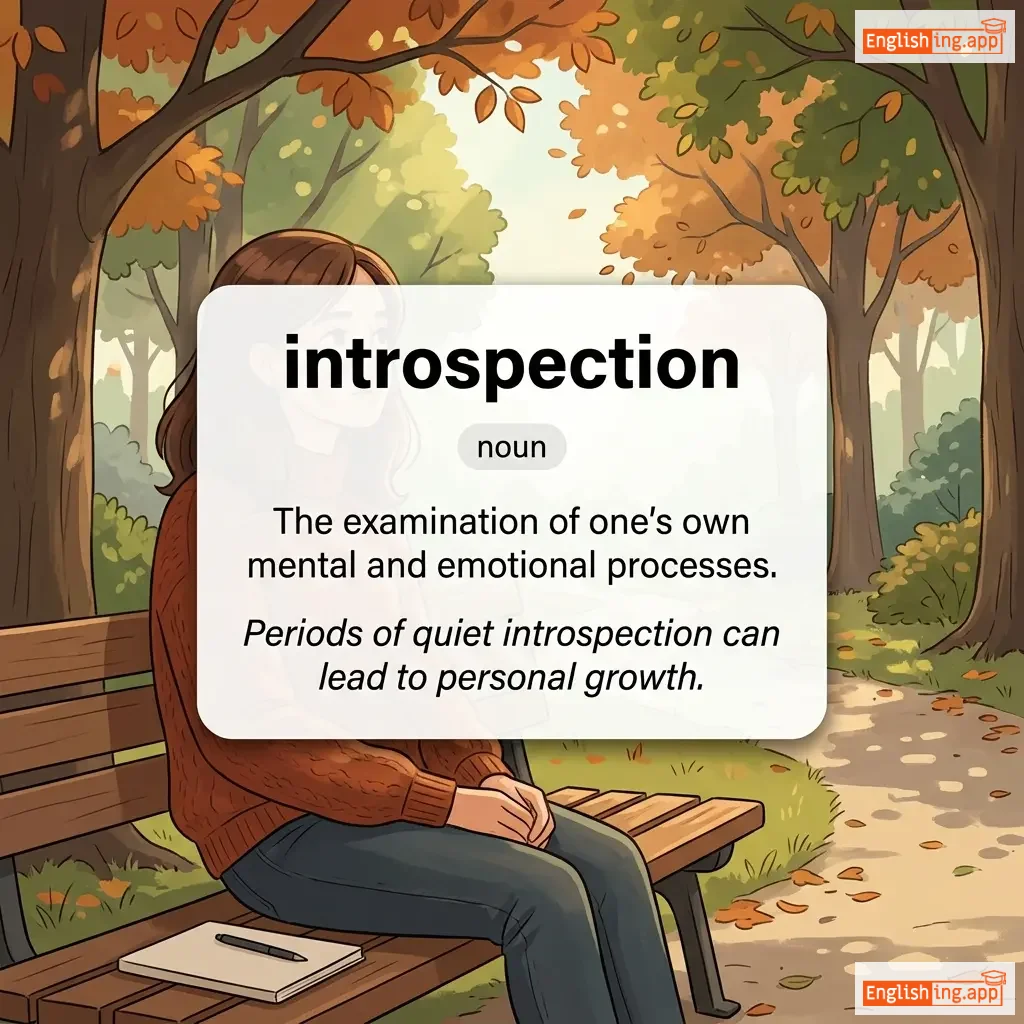
introspection definition card — visual illustration of the meaning
noun
/ˌɪn.trəˈspek.ʃən/
आत्मनिरीक्षण (aatmanirikshan)

The examination of one's own mental and emotional processes.

"Periods of quiet introspection can lead to personal growth."

"चुपचाप आत्मनिरीक्षण के क्षण व्यक्तिगत विकास की ओर ले जा सकते हैं।" (Chupchaap aatmanirikshan ke kshan vyaktigat vikas ki or le ja sakte hain.)
introspective definition card — visual illustration of the meaning
adjective
/ˌɪn.trəˈspɛk.tɪv/
आत्ममग्न (atmamagna)

Thoughtful and reflective, examining one's own thoughts and feelings.

"She became more introspective after moving to a new city."

"वह नए शहर में जाने के बाद और अधिक आत्ममग्न हो गई।" (Vah naye shaher mein jaane ke baad aur adhik atmamagna ho gayi.)
noun
/ˌɪn.trəˈvɜːr.ʒən/
अंतर्मुखिता (antarmukhita)

The tendency to be inward-looking and shy, preferring solitary activities.

"Her introversion made it difficult for her to enjoy large parties."

"उसकी अंतर्मुखिता ने उसे बड़े पार्टियों का आनंद लेने में मुश्किल बना दिया।" (Uski antarmukhita ne use bade partiyon ka anand lene mein mushkil bana diya.)
noun
/ˈɪn.trə.vɜːrt/
अंतर्मुखी (antarmukhi)

A person who tends to be shy and prefers spending time alone rather than in groups.

"As an introvert, he preferred reading over attending parties."

"एक अंतर्मुखी के रूप में, उसे पार्टियों में जाने की बजाय पढ़ना पसंद था।" (ek antarmukhi ke roop mein, use partyon mein jane ki bajay padhna pasand tha.)
verb
/ɪnˈtruːd/
दखल देना (dakhal dena)

To enter a place or situation where one is not wanted or not invited.

"He felt embarrassed to intrude on their private conversation."

"वह उनके निजी बातचीत में दखल देने पर शर्मिंदा महसूस कर रहा था।" (Wah unke niji baatcheet mein dakhal dene par sharminda mehsoos kar raha tha.)
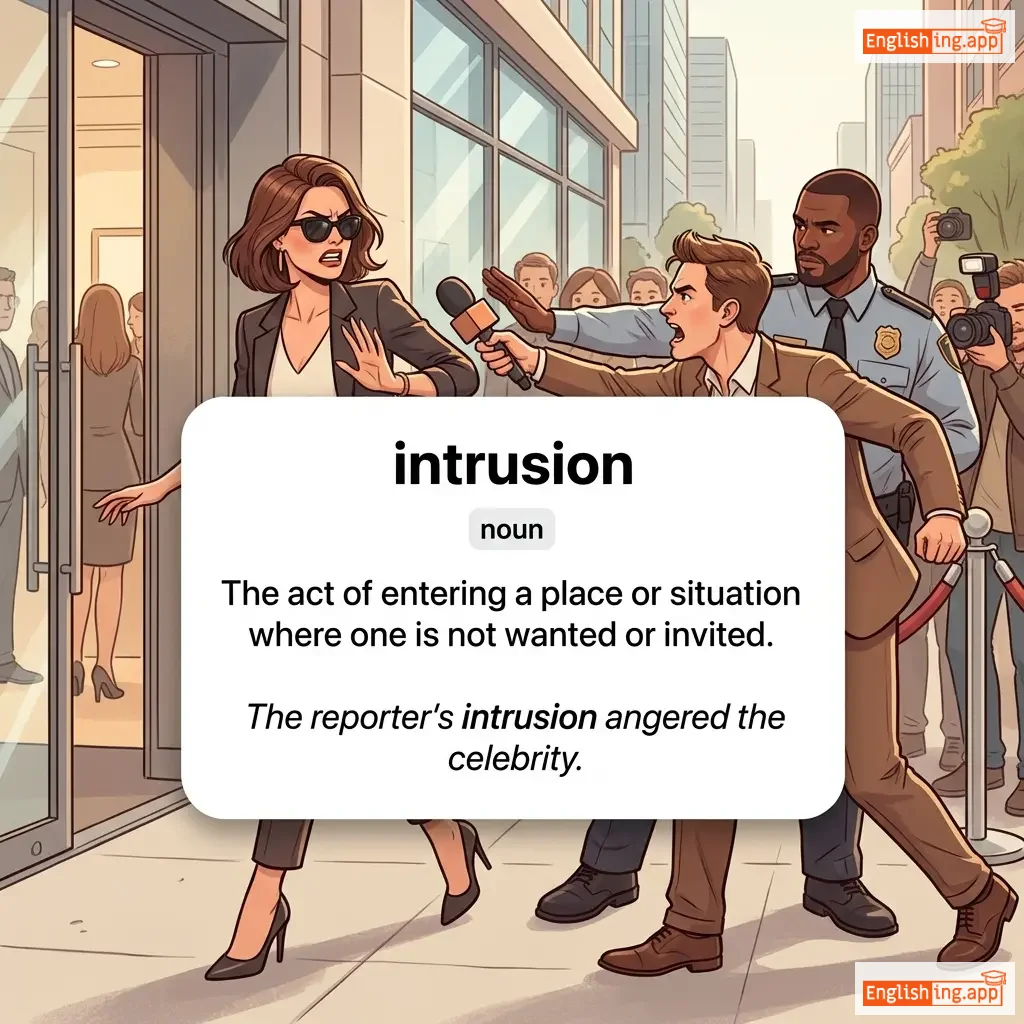
intrusion definition card — visual illustration of the meaning
noun
/ɪnˈtruː.ʒən/
अवांछित प्रवेश (avanchhit pravesh)

The act of entering a place or situation where one is not wanted or invited.

"The reporter's intrusion angered the celebrity."

"रिपोर्टर का अवांछित प्रवेश सेलिब्रिटी को गुस्से में डाल दिया।" (Reporter ka avanchhit pravesh celebrity ko gusse mein dal diya.)
intuition definition card — visual illustration of the meaning
noun
/ˌɪn.tjuˈɪʃ.ən/
अंतर्दृष्टि (antardrishti)

The ability to understand or know something immediately, without conscious reasoning.

"Her intuition told her that something was wrong."

"उसकी अंतर्दृष्टि ने उसे बताया कि कुछ गलत था।" (uski antardrishti ne use bataya ki kuch galat tha.)
adjective
/ɪnˈtjuː.ɪ.tɪv/
सहज समझ (sahaj samajh)

Based on instinctive understanding rather than reasoning.

"The software has an intuitive design that makes it easy to use."

"सॉफ़्टवेयर का डिज़ाइन सहज समझ वाला है, जो इसे उपयोग में आसान बनाता है।" (software ka design sahaj samajh wala hai, jo ise upyog mein aasan banata hai.)
inundate definition card — visual illustration of the meaning
verb
/ˈɪn.ʌn.deɪt/
बाढ़ आना / अधिकता से भर देना (baadh aana / adhikta se bhar dena)

To flood or overwhelm with a large quantity of things.

"The company was inundated with job applications."

"कंपनी को नौकरी के आवेदन पत्रों से भर दिया गया था।" (company ko naukri ke avedan patron se bhar diya gaya tha.)
noun
/ˌɪn.ʌnˈdeɪ.ʃən/
प्रलय (pralay)

The act of flooding or overwhelming with water or things.

"The town suffered from a severe inundation after the heavy rains."

"भारी बारिश के बाद शहर को प्रलय का सामना करना पड़ा।" (bhari barish ke baad shahar ko pralay ka samna karna pada.)
verb
/ɪˈnjʊər/
आदत डालना (aadat daalna)

To become accustomed to something, especially something unpleasant.

"Soldiers quickly became inured to the harsh conditions."

"सैनिकों ने जल्दी से कठोर परिस्थितियों में खुद को आदत डाल लिया।" (sainikon ne jaldi se kathor paristhitiyon mein khud ko aadat daal liya.)
inured definition card — visual illustration of the meaning
adjective
/ɪˈnjʊərd/
आदत डालना (adat daalna)

Accustomed to something, especially something unpleasant.

"After years of hardship, she was inured to suffering."

"सालों की कठिनाई के बाद, वह दुख को सहने की आदत डाल चुकी थी।" (Saalo ki kathinai ke baad, vah dukh ko sahne ki adat daal chuki thi.)
verb
/ɪnˈveɪd/
आक्रमण करना (akraman karna)

to enter a place or country forcefully, especially as an enemy

"The army invaded the neighboring country."

"सैन्य ने पड़ोसी देश पर आक्रमण किया।" (Senya ne padosi desh par akraman kiya.)
adjective, noun
/ˈɪnvəlɪd/ (adjective), /ɪnˈvælɪd/ (noun)
अमान्य (amaany)

Not valid; having no force or effect. Also refers to a person too weak or ill to care for themselves.

"The court declared the contract invalid."

"अदालत ने अनुबंध को अमान्य घोषित कर दिया।" (Adalat ne anubandh ko amaany ghoshit kar diya.)
verb
/ɪnˈvælɪdeɪt/
अमान्य करना (amanya karna)

To make something not valid or legally acceptable.

"The new evidence may invalidate the previous ruling."

"नया प्रमाण पिछले फैसले को अमान्य कर सकता है।" (Naya pramaan pichhle faisle ko amanya kar sakta hai.)
noun
/ˌɪnvəˈlɪdɪti/
अवैधता (avaidhta)

the state of being invalid, legally void, or lacking force or validity

"The court ruled that the contract suffered from invalidity."

"अदालत ने फैसला दिया कि अनुबंध अवैधता से ग्रस्त था।" (adalat ne faisla diya ki anubandh avaidhta se grast tha)
adjective
/ɪnˈvæljʊəbl/
अमूल्य (amulya)

Extremely useful or indispensable.

"Her advice proved invaluable to my success."

"उसकी सलाह मेरी सफलता के लिए अत्यधिक उपयोगी साबित हुई।" (Uski salah meri safalta ke liye atyadhik upyogi sabit hui.)
adjective
/ɪnˈvɛəriəbl/
अपरिवर्तनीय (aparivartaniya)

Not changing; constant and unchanging.

"His invariable kindness won him many friends."

"उसकी अपरिवर्तनीय दया ने उसे कई दोस्त दिए।" (Uski aparivartaniya daya ne use kai dost diye.)
noun
/ɪnˈveɪʒən/
आक्रमण (akraman)

An instance of invading a country, region, or personal space with armed force or unwelcome presence.

"The army prepared for the possibility of an invasion."

"सेना ने आक्रमण की संभावना के लिए तैयारी की।" (Sena ne akraman ki sambhavnayein ke liye taiyari ki.)
adjective
/ɪnˈveɪsɪv/
आक्रामक (aakramak)

Tending to spread harmfully, intruding aggressively, or encroaching beyond proper boundaries.

"The doctor explained that the procedure was minimally invasive."

"डॉक्टर ने समझाया कि प्रक्रिया न्यूनतम आक्रामक थी।" (Daktar ne samjhaaya ki prakriya nyuntam aakramak thi.)
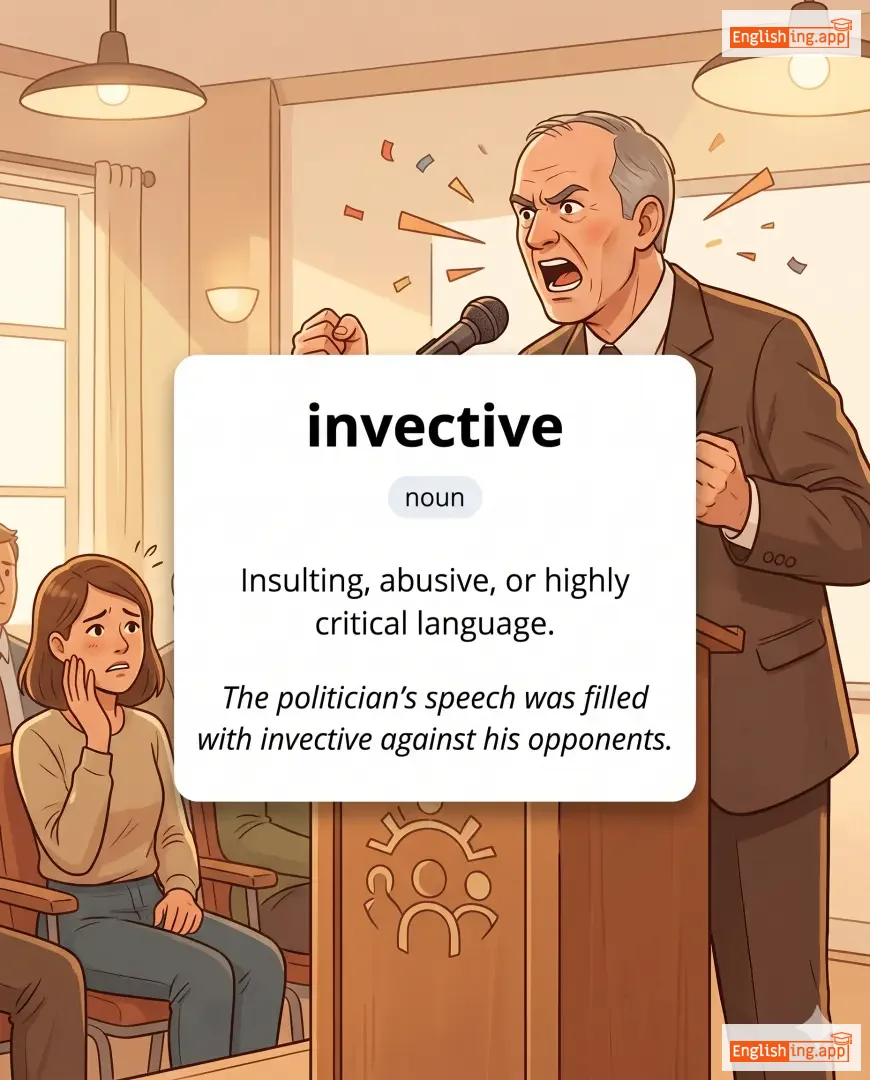
invective definition card — visual illustration of the meaning
noun
/ɪnˈvɛktɪv/
अपमानजनक भाषा (apmaanjanak bhaasha)

Insulting, abusive, or highly critical language.

"The politician’s speech was filled with invective against his opponents."

"राजनीतिक नेता का भाषण अपने विरोधियों के खिलाफ अपमानजनक भाषा से भरा था।" (Rajnaitik neta ka bhashan apne virodhiyon ke khilaf apmaanjanak bhaasha se bhara tha.)
verb
/ɪnˈveɪ/
कड़ी आलोचना करना (kadi alochana karna)

To speak or write about something with great hostility and criticism.

"He inveighed against the corruption in government."

"उसने सरकार में भ्रष्टाचार के खिलाफ कड़ी आलोचना की।" (Usne sarkar mein bhrashtachar ke khilaf kadi alochana ki.)
inveigle definition card — visual illustration of the meaning
verb
/ɪnˈveɪɡəl/
ललचाना (lalchana)

To persuade someone to do something by deception or flattery.

"She inveigled him into signing the contract."

"वह उसे अनुबंध पर हस्ताक्षर करने के लिए बहका लिया।" (Vah use anubandh par hastakshar karne ke liye bhadka liya.)
verb
/ɪnˈvɛnt/
आविष्कार करना (avishkar karna)

to create or design something that has not existed before

"Thomas Edison invented the electric bulb."

"थॉमस एडीसन ने इलेक्ट्रिक बल्ब का आविष्कार किया।" (Thomas Edison ne electric bulb ka avishkar kiya.)
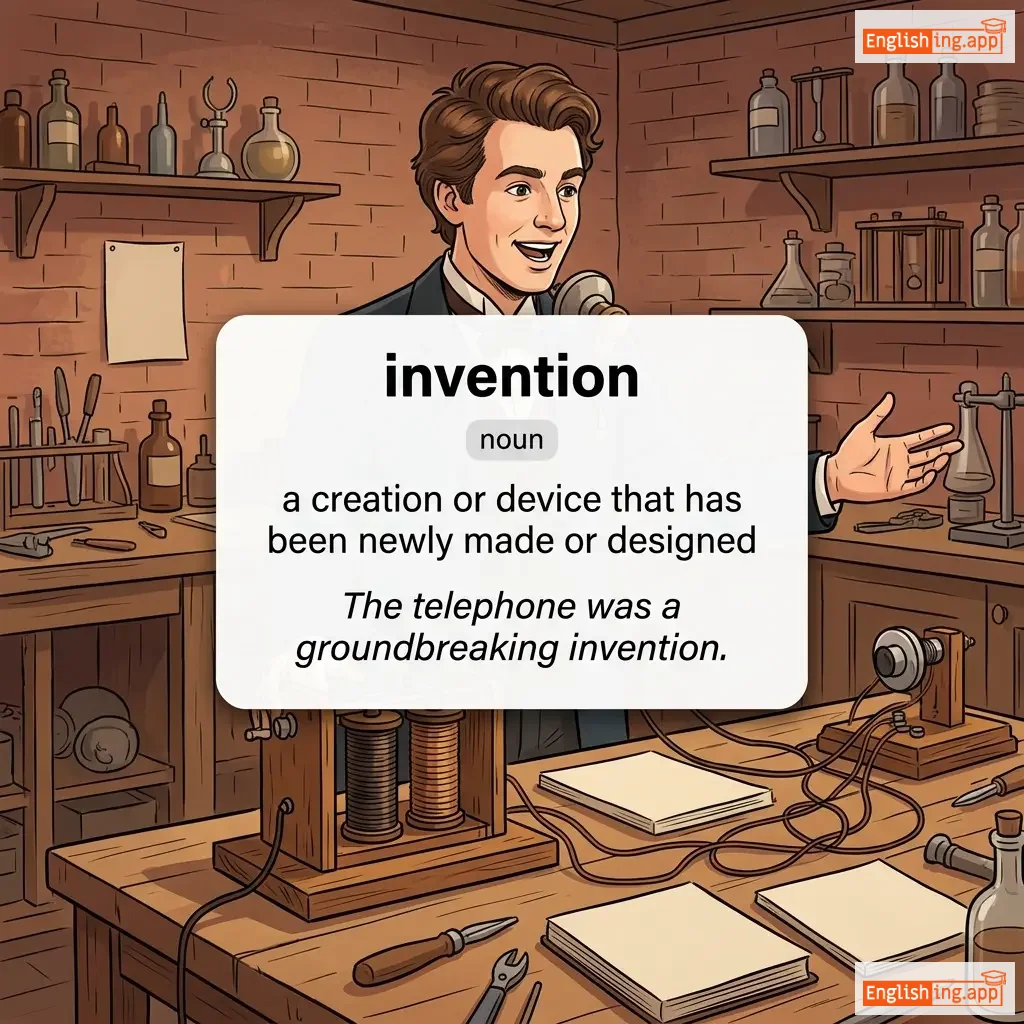
invention definition card — visual illustration of the meaning
noun
/ɪnˈvɛnʃən/
आविष्कार (aviskar)

a creation or device that has been newly made or designed

"The telephone was a groundbreaking invention."

"टेलीफोन एक ग्राउंडब्रेकिंग आविष्कार था।" (Telephone ek groundbreaking aviskar tha.)
adjective
/ɪnˈvɛntɪv/
रचनात्मक (rachanatmak)

Having the ability to create or design new things or to think originally.

"The inventor was known for his inventive solutions to everyday problems."

"आविष्कारक को रोज़मर्रा की समस्याओं के लिए रचनात्मक समाधान के लिए जाना जाता था।" (Avishkark ko rozmarra ki samasyaon ke liye rachnatmak samadhan ke liye jana jata tha.)
noun
/ɪnˈventər/
आविष्कारक (avishkarak)

a person who creates or designs something new, especially a device, method, or process

"The inventor patented her new medical device."

"आविष्कारक ने अपने नए चिकित्सीय उपकरण का पेटेंट कराया।" (avishkarak ne apne naye chikitsiya upkaran ka patent karaya)
noun
/ˈɪnvənˌtɔːri/
सूची (soochi)

A complete list of items, such as goods in stock or property.

"The shopkeeper checked the inventory before opening the store."

"दुकानदार ने दुकान खोलने से पहले सूची की जांच की।" (Dukaandaar ne dukaan kholne se pehle soochi ki jaanch ki.)