वोकैबुलरीज

इंग्लिश वोकैबुलरी डिस्कवर, लर्न और मास्टर करें

adjective
/ˌɪnsəˈluːbriəs/
अस्वस्थ (aswasth)

Unhealthy or not conducive to well-being.

"They moved out of the insalubrious neighborhood for the sake of their health."

"उन्होंने अपनी सेहत के लिए अस्वस्थ इलाके से बाहर जाने का फैसला किया" (Unhone apni sehat ke liye aswasth ilake se baahar jaane ka faisla kiya)
adjective
/ɪnˈseɪn/
पागल (pagal)

mentally ill; extremely foolish or unreasonable

"The idea of jumping off the cliff seemed insane."

"क्लिफ से कूदने का विचार पागलपन सा लगा।" (klif se koodne ka vichar pagalpan sa laga.)
noun
/ɪnˈsæn.ə.ti/
पागलपन; मानसिक विकृति (pagalpan; mansik vikriti)

the state of being seriously mentally ill; extreme foolishness or irrationality

"The defense lawyer argued that his client was not guilty by reason of insanity."

"रक्षा वकील ने तर्क किया कि उनका मुवक्किल मानसिक विकृति के कारण दोषी नहीं था।" (raksha vakil ne tark kiya ki unka muvakil mansik vikriti ke karan doshi nahi tha.)
adjective
/ɪnˈseɪʃəbl̩/
अतृप्त (atripto)

impossible to satisfy; always wanting more

"Her insatiable curiosity drove her to read every book in the library."

"उसकी अतृप्त जिज्ञासा ने उसे पुस्तकालय में हर किताब पढ़ने के लिए प्रेरित किया।" (uski atripto jijnasa ne use pustakalay mein har kitaab padhne ke liye prerit kiya.)
adjective
/ɪnˈseɪʃiət/
अतृप्त (atript)

impossible to satisfy; always wanting more

"He had an insatiate desire for power."

"उसके पास शक्ति के लिए एक अतृप्त इच्छा थी।" (uske paas shakti ke liye ek atript ichha thi.)
verb
/ɪnˈskraɪb/
खुदवाना (khudwana)

to write or carve words or symbols on a surface

"They inscribed her name on the trophy."

"उन्होंने ट्रॉफी पर उसका नाम खुदवाया।" (unhone trophy par uska naam khudwaya.)
adjective
/ɪnˈskruːtəbl̩/
खुशी (khushi)

impossible to understand or interpret

"His inscrutable expression made it hard to know what he was thinking."

"जब उसे पुरस्कार मिला तो वह अपनी खुशी छिपा नहीं पाई।" (jab use puraskar mila to wah apni khushi chhupa nahin pai.)
noun
/ˈɪnsekt/
कीड़ा (keeda)

a small animal with six legs and usually wings, such as a bee or an ant

"A butterfly is a beautiful type of insect."

"एक तितली एक सुंदर प्रकार का कीड़ा है।" (Ek titli ek sundar prakaar ka keeda hai.)
noun
/ɪnˈsek.tɪ.saɪd/
कीट नाशक (keet naashak)

a substance used for killing insects; a chemical pesticide that targets insects

"The farmer sprayed insecticide on his crops to protect them from harmful bugs."

"किसान ने अपनी फसलों को हानिकारक कीड़ों से बचाने के लिए कीटनाशक छिड़का।" (kisan ne apni faslon ko haanikarak keedo se bachane ke liye keetnaashak chhidka.)
adjective
/ˌɪnsɪˈkjʊə/
अविश्वसनीय (avishwasniya)

not confident or assured; uncertain and anxious

"She felt insecure about her performance in the exam."

"वह परीक्षा में अपनी प्रदर्शन को लेकर अविश्वसनीय महसूस कर रही थी।" (vah pariksha mein apni pradarshan ko lekar avishwasniya mehsoos kar rahi thi.)
noun
/ˌɪnsɪˈkjʊərɪti/
असुरक्षा (asuraksha)

lack of confidence or assurance; a state of uncertainty or vulnerability

"Her insecurity made her doubt her abilities despite her experience."

"उसकी असुरक्षा ने उसे अपनी क्षमताओं पर संदेह करने पर मजबूर कर दिया।" (uski asuraksha ne use apni kshamtaon par sandeh karne par majboor kar diya)
adjective
/ɪnˈsɛnseɪt/
निर्दय (nirday)

lacking physical sensation or empathy; without feeling or sensitivity

"The dictator's insensate cruelty shocked the world."

"तानाशाह की निर्दय क्रूरता ने दुनिया को हैरान कर दिया।" (taanashaah ki nirday kroorta ne duniya ko hairaan kar diya.)
insensible definition card — visual illustration of the meaning
adjective
/ɪnˈsɛnsəbl/
बेहोश (behosh)

Unconscious; unaware of or indifferent to something.

"He was insensible to the cold as he lay in the snow."

"वह बर्फ में लेटे रहने के दौरान ठंड से बेहोश था।" (Wah baraf mein lete rehne ke dauran thand se behosh tha.)
adjective
/ɪnˈsɛnsətɪv/
असंवेदनशील (asavendansheel)

Showing or feeling no concern for others' feelings.

"His insensitive comment hurt her deeply."

"उसकी असंवेदनशील टिप्पणी ने उसे गहरे तक आहत किया।" (Uski asavendansheel tippani ne use gahre tak aahat kiya.)
adjective
/ɪnˈsɛnʃənt/
अचेतन (achetan)

Lacking perception, consciousness, or sensation.

"The rock is an insentient object with no awareness."

"चट्टान एक अचेतन वस्तु है जिसमें कोई जागरूकता नहीं है।" (Chattan ek achetan vastu hai jismein koi jagrookta nahi hai.)
adjective
/ɪnˈsɛp(ə)rəbəl/
अलग नहीं किया जा सकता (alag nahin kiya ja sakta)

Unable to be separated or always together.

"The two friends have been inseparable since childhood."

"दोनों दोस्त बचपन से अलग नहीं किए जा सकते।" (Donon dost bachpan se alag nahin kiye ja sakte.)
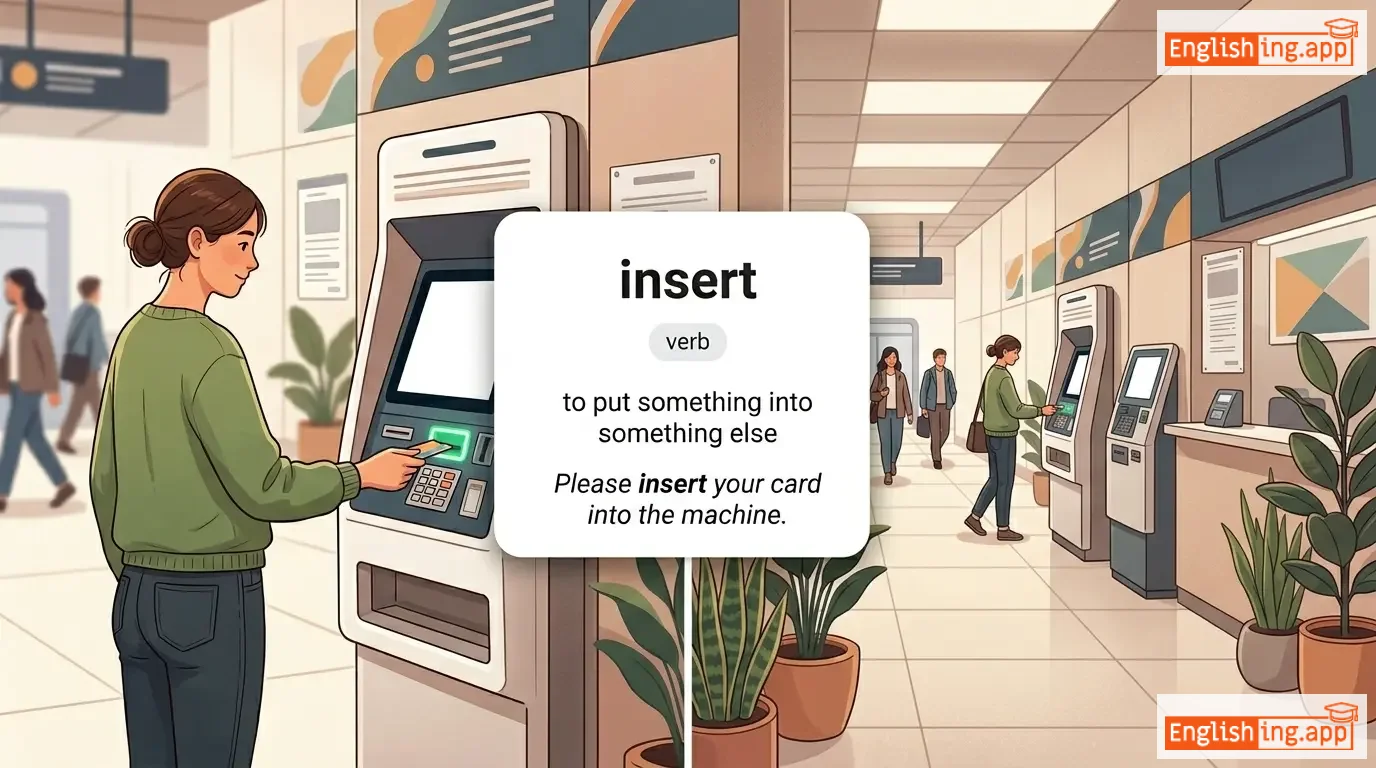
insert definition card — visual illustration of the meaning
verb
/ɪnˈsɜːt/
डालना (daalna)

to put something into something else

"Please insert your card into the machine."

"कृपया अपना कार्ड मशीन में डालें।" (Kripya apna card machine mein daalein.)
noun
/ɪnˈsɜːʃən/
सम्मिलन (sammilan)

the action of inserting something into something else

"The insertion of the new data was completed successfully."

"नई डेटा का सम्मिलन सफलतापूर्वक पूरा किया गया था।" (Nayi data ka sammilan safaltapoorvak poora kiya gaya tha.)
preposition/adverb/adjective/noun
/ˌɪnˈsaɪd/
सुख (sukh)

Situated within something; the inner part of something.

"She waited inside the house until the rain stopped."

"जब उसे पुरस्कार मिला, तो वह अपनी खुशी को छुपा नहीं सकी।" (Jab use puraskar mila, to vah apni khushi ko chhupa nahi saki.)
noun
/ɪnˈsaɪdə/
अंदरूनी सदस्य (andarooni sadasya)

a person within a group or organization who has access to confidential information

"He was an insider who knew all the company's secrets."

"वह एक अंदरूनी सदस्य था जो कंपनी के सभी राज़ जानता था।" (Vah ek andarooni sadasya tha jo company ke sabhi raaz jaanta tha.)
adjective
/ɪnˈsɪdiəs/
दुश्टतापूर्ण (dushtatapurn)

Proceeding in a gradual, subtle way but with harmful effects.

"The insidious spread of misinformation can damage trust."

"गलत सूचना का दुश्टतापूर्ण फैलाव विश्वास को नुकसान पहुँचा सकता है।" (Galat soochna ka dushtatapurn phailaav vishwas ko nuksan pahucha sakta hai.)
noun
/ˈɪnˌsaɪt/
अंतरदृष्टि (antardrishti)

The ability to understand the true nature of something; deep understanding.

"Her insight into human behavior made her a successful psychologist."

"मानव व्यवहार में उसकी अंतरदृष्टि ने उसे एक सफल मनोवैज्ञानिक बना दिया।" (manav vyavhaar mein uski antardrishti ne use ek safal manovaigyanik bana diya.)
adjective
/ˈɪnˌsaɪtfəl/
गहरा ज्ञानपूर्ण (gahara gyaanpoorN)

Showing deep understanding or perceptiveness.

"The professor gave an insightful lecture on global economics."

"प्रोफेसर ने वैश्विक अर्थशास्त्र पर एक गहरी और ज्ञानपूर्ण व्याख्यान दी।" (Professor ne vaishwik arthashastra par ek gahari aur gyaanpoorn vyaakhyaan di.)
insightfulness definition card — visual illustration of the meaning
noun
ˌɪnˈsaɪtfʊlnɪs
गहरी समझ, विश्लेषण की क्षमता (gehri samajh, vishleshan ki kshamata)

The capacity to gain an accurate and deep intuitive understanding of a person or thing.

"His insightfulness helped solve the complex problem."

"उसकी गहरी समझ ने जटिल समस्या को हल करने में मदद की।" (Uski gehri samajh ne jatil samasya ko hal karne mein madad ki.)
noun
/ɪnˈsɪɡniə/
चिह्न (chihn)

A badge or symbol that shows rank, position, or membership.

"The soldier proudly wore the insignia of his regiment."

"सैनिक ने गर्व से अपनी रेजिमेंट का चिह्न पहना।" (Sainik ne garv se apni regiment ka chihn pehna.)
noun
/ˌɪnsɪɡˈnɪfɪkəns/
तुच्छता (tuchchhata)

The quality of being unimportant or trivial.

"He felt a sense of insignificance in the vast universe."

"उसे विशाल ब्रह्मांड में तुच्छता का अहसास हुआ।" (Use vishal brahmand mein tuchchhata ka ahsas hua.)
adjective
/ˌɪnsɪɡˈnɪfɪkənt/
तुच्छ (tuchchh)

Too small or unimportant to be worth considering.

"The cost was so insignificant that nobody noticed it."

"लागत इतनी तुच्छ थी कि किसी ने ध्यान नहीं दिया।" (Laagat itni tuchchh thi ki kisi ne dhyan nahi diya.)
insinuate definition card — visual illustration of the meaning
verb
/ɪnˈsɪnjueɪt/
इशारा करना (ishara karna)

To suggest or hint something indirectly and often unpleasantly.

"He insinuated that she had lied about her qualifications."

"उसने इशारा किया कि उसने अपनी योग्यताओं के बारे में झूठ बोला था।" (Usne ishara kiya ki usne apni yogytayon ke baare mein jhooth bola tha.)
insipid definition card — visual illustration of the meaning
adjective
/ɪnˈsɪpɪd/
नीरस (niros)

lacking flavor, interest, or excitement; dull

"The soup was insipid and needed more seasoning."

"सूप नीरस था और उसे अधिक मसाले की आवश्यकता थी।" (Soup niros tha aur use adhik masale ki avashyakta thi.)
insist definition card — visual illustration of the meaning
verb
/ɪnˈsɪst/
जोर देना (jor dena)

to demand something forcefully or firmly

"She insisted on paying the bill."

"वह बिल चुकाने पर जोर दे रही थी।" (Wah bil chukane par jor de rahi thi.)
noun
/ɪnˈsɪstəns/
ज़ोर का दावा (zor ka daawa)

the act of demanding something firmly or repeatedly

"At his insistence, we stayed longer."

"उसकी ज़ोर के दावे पर, हम और देर तक रुके।" (Uski zor ke daave par, hum aur der tak ruke.)
adjective
/ɪnˈsɪstənt/
ज़िद्दी (ziddi)

demanding something firmly and refusing to accept no

"The child was insistent on getting a new toy."

"बच्चा नए खिलौने के लिए ज़िद्दी था।" (Baccha naye khilaune ke liye ziddi tha.)
noun
/ˈɪnsələns/
अवहेलना (avhelna)

rude or disrespectful behavior

"The teacher was shocked by the student's insolence."

"अध्यापक छात्र की अवहेलना से चौंक गए थे।" (Adhyapak chhatra ki avhelna se chaunk gaye the.)
adjective
/ˈɪnsələnt/
असभ्य, घमंडी (ashabhya, ghamandi)

showing a rude and arrogant lack of respect

"The insolent student refused to follow the teacher's instructions."

"असभ्य छात्र ने शिक्षक के निर्देशों का पालन करने से मना कर दिया।" (Ashabhya chhatra ne shikshak ke nirdeshon ka paalan karne se mana kar diya.)
insolvency definition card — visual illustration of the meaning
noun
/ɪnˈsɒlvənsi/
दिवालियापन (divaliapan)

the state of being unable to pay money owed; bankruptcy

"The company declared insolvency after years of financial struggles."

"कंपनी ने वित्तीय संघर्षों के बाद दिवालियापन की घोषणा की।" (Company ne vittiya sangharshon ke baad divaliapan ki ghoshna ki.)
adjective
/ɪnˈsɒlvənt/
दिवालिया (divaliya)

unable to pay debts owed

"The insolvent firm could not meet its financial obligations."

"दिवालिया कंपनी अपनी वित्तीय दायित्वों को पूरा नहीं कर पाई।" (Divaliya company apni vittiya dayitvon ko pura nahi kar pai.)
noun
/ɪnˈsɒmniə/
अनिद्रा (anidra)

the condition of being unable to sleep

"She suffered from insomnia due to stress at work."

"वह काम में तनाव के कारण अनिद्रा से पीड़ित थी।" (Wah kaam mein tanav ke karan anidra se peedit thi.)
adverb
/ˌɪnsəʊˈmʌtʃ/
इतना (itna)

to such an extent

"He was insomuch tired that he could hardly stand."

"वह इतना थका हुआ था कि वह मुश्किल से खड़ा हो पा रहा था।" (Vah itna thaka hua tha ki vah mushkil se khada ho pa raha tha.)
noun
/ɪnˈsuːsiəns/
उदासीनता (udasinta)

Casual lack of concern; indifference.

"She carried herself with an air of insouciance, unbothered by the challenges ahead."

"वह एक उदासीनता के साथ चल रही थी, आगामी चुनौतियों से बेपरवाह।" (Woh ek udasinta ke saath chal rahi thi, aagami chunautiyon se beparwah.)
insouciant definition card — visual illustration of the meaning
adjective
/ɪnˈsuːsiənt/
निर्दय (nirdai)

Showing a casual lack of concern; carefree.

"He gave an insouciant shrug and walked away."

"उसने एक निर्दय इशारा किया और चल पड़ा।" (Usne ek nirdai ishara kiya aur chal pada.)
inspect definition card — visual illustration of the meaning
verb
/ɪnˈspɛkt/
जांचना (jaanchnā)

To look at something carefully to check for problems or details.

"The engineer inspected the bridge for cracks."

"इंजीनियर ने पुल की दरारों की जांच की।" (Engineer ne pul ki dararon ki jaanch ki.)
noun
/ɪnˈspekʃən/
निरीक्षण (nirikshan)

a careful examination of something, especially to check that it is correct or safe

"The building passed the safety inspection last week."

"भवन ने पिछले सप्ताह सुरक्षा निरीक्षण पास किया।" (Bhavan ne pichhle saptah suraksha nirikshan pass kiya.)
noun
/ɪnˈspɛktər/
निरीक्षक (nirikshak)

An official employed to ensure regulations are obeyed or standards are met.

"The inspector carefully checked the restaurant's kitchen for hygiene standards."

"निरीक्षक ने रेस्टोरेंट के रसोईघर को स्वच्छता मानकों के लिए सावधानीपूर्वक जांचा।" (Nirikshak ne restaurant ke rasoighar ko swachhata maankon ke liye saavdhani purvak jaancha.)
inspiration definition card — visual illustration of the meaning
noun
/ˌɪnspəˈreɪʃən/
प्रेरणा (prerna)

the process of being mentally stimulated to do or feel something creative or positive

"Her courage was a great inspiration to others."

"उसका साहस दूसरों के लिए एक महान प्रेरणा था।" (Uska sahas doosron ke liye ek mahaan prerna tha.)
inspire definition card — visual illustration of the meaning
verb
/ɪnˈspaɪər/
ख़ुशी (khushi)

To fill someone with the urge or ability to do or feel something.

"The teacher's words inspired the students to work harder."

"जब उसे पुरस्कार मिला, तो वह अपनी खुशी छिपा नहीं पाई।" (Jab use puraskar mila, to wah apni khushi chhupa nahi paayi.)
noun
/ˌɪnstəˈbɪləti/
अस्थिरता (asthirta)

lack of stability or balance; tendency to change, fail, or collapse easily

"Political instability has slowed economic growth in the region."

"राजनीतिक अस्थिरता ने क्षेत्र की आर्थिक वृद्धि को धीमा कर दिया है।" (raajnitik asthirta ne kshetra ki aarthik vriddhi ko dhima kar diya hai)
adjective
/ɪnˈsteɪbəl/
अस्थिर (asthir)

not stable; liable to change, collapse, or fail; lacking firmness or reliability

"The instable political situation worried foreign investors."

"अस्थिर राजनीतिक स्थिति ने विदेशी निवेशकों को चिंतित किया।" (asthir rajneetik sthiti ne videshi niveshakon ko chintit kiya)
verb
/ɪnˈstɔːl/
स्थापित करना (sthapit karna)

To place or fix equipment or software so it is ready for use.

"He installed the new software on his computer."

"उसने अपने कंप्यूटर में नया सॉफ़्टवेयर इंस्टॉल किया।" (Usne apne computer mein naya software install kiya.)
installation definition card — visual illustration of the meaning
noun
/ˌɪnstəˈleɪʃən/
इंस्टॉलेशन (instoleishan)

the act or process of putting something in position and making it ready for use

"The installation of the new software took less than an hour."

"नए सॉफ़्टवेयर की इंस्टॉलेशन में एक घंटे से भी कम समय लगा।" (Naye software ki installation mein ek ghante se bhi kam samay laga.)
noun
/ˈɪnstəns/
उदाहरण (udaharan)

An example or single occurrence of something.

"This is just one instance of his generosity."

"यह उसकी उदारता का एक उदाहरण है।" (Yeh uski udarta ka ek udaharan hai.)