वोकैबुलरीज

इंग्लिश वोकैबुलरी डिस्कवर, लर्न और मास्टर करें

adjective
/ˌɪnɪˈsɛnʃəl/
गैर-आवश्यक (gair-aavashyak)

not necessary or important; not essential

"The report removes all inessential details to stay focused."

"रिपोर्ट ध्यान केंद्रित रखने के लिए सभी गैर-आवश्यक विवरण हटा देती है।" (report dhyan kendrit rakhne ke liye sabhi gair-aavashyak vivaran hata deti hai)
adjective
/ɪnˈɛstɪməbl/
अमूल्य (amoolya)

Too great or valuable to be measured or estimated.

"Her contribution to the project was of inestimable value."

"उसकी परियोजना में योगदान अमूल्य था।" (Uski pariyojana mein yogdan amoolya tha.)
inevitability definition card — visual illustration of the meaning
noun
/ɪnˌɛvɪtəˈbɪləti/
अपरिहार्यता (apariharayata)

The quality of being certain to happen; unavoidable nature.

"The inevitability of change makes adaptability essential."

"परिवर्तन की अपरिहार्यता अनुकूलता को अनिवार्य बनाती है।" (Parivartan ki apariharayata anukoolata ko anivaarya banati hai.)
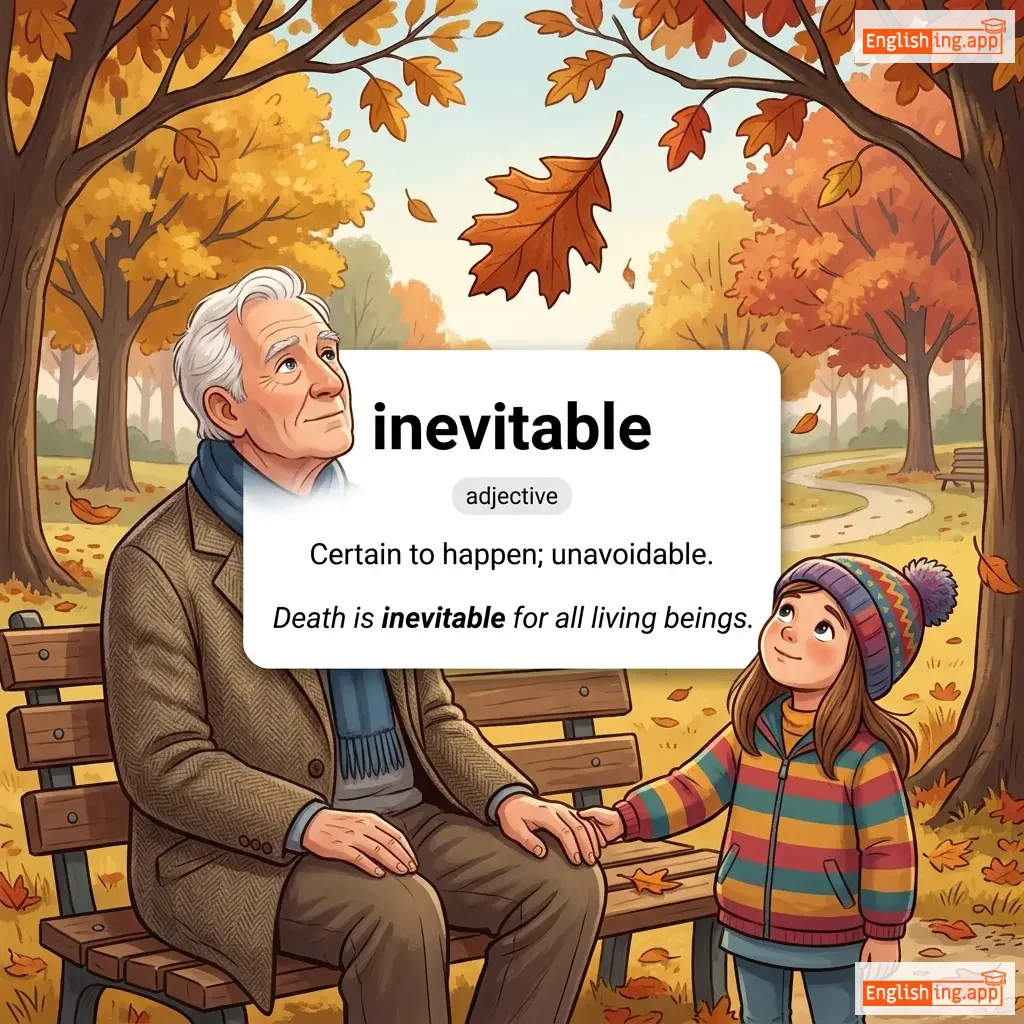
inevitable definition card — visual illustration of the meaning
adjective
/ɪnˈɛvɪtəbl/
अपरिहार्य (apariharya)

Certain to happen; unavoidable.

"Death is inevitable for all living beings."

"मृत्यु सभी जीवों के लिए अपरिहार्य है।" (mrityu sabhi jeevon ke liye apariharya hai.)
adverb
/ɪnˈɛvɪtəbli/
अनिवार्य रूप से (anivarya roop se)

in a way that cannot be avoided or prevented

"Inevitably, the team faced challenges during the project."

"अनिवार्य रूप से, टीम को परियोजना के दौरान चुनौतियों का सामना करना पड़ा।" (Anivarya roop se, team ko pariyojna ke dauran chunautiyon ka samna karna pada.)
adjective
/ˌɪnɪkˈskjuːzəbl/
असहनीय (asahniya)

Too bad to be justified or overlooked; unforgivable.

"His rude behavior was inexcusable."

"उसका रुखा व्यवहार असहनीय था।" (Uska rukha vyavhaar asahniya tha.)
inexhaustible definition card — visual illustration of the meaning
adjective
/ˌɪnɪɡˈzɔːstəbl/
अविनाशी (avinashee)

Impossible to use up or tire out; unlimited in supply or energy.

"Her energy seemed inexhaustible during the long campaign."

"उसकी ऊर्जा लम्बी मुहिम के दौरान अविनाशी सी लग रही थी।" (Uski oorja lambi muhim ke dauran avinashee see lag rahi thi.)
adjective
/ɪnˈɛksərəbl/
अविराम (avirām)

Impossible to stop or prevent; relentless.

"The inexorable rise of technology is changing every aspect of life."

"प्रौद्योगिकी का अविराम वृद्धि जीवन के हर पहलू को बदल रही है।" (Proudyogiki ka avirām vruddhi jīvan ke har pehlu ko badal rahi hai.)
noun (compound/erroneous entry)
/ɪnˈɛksərəbl ɑːrmi/
अपराजेय सेना (aparajey sena)

This appears to be a corrupted or concatenated form; interpreted as 'inexorable army' — an unstoppable or relentless force.

"The rebels feared the inexorable army approaching their stronghold."

"विद्रोही अपनी मजबूत किले में आ रही अपराजेय सेना से डरते थे।" (Virohi apni majboot kile mein aa rahi aparajey sena se darte the.)
adjective
/ˌɪnɪkˈspiːdiənt/
अनुचित (anuchit)

Not advisable, suitable, or practical in the circumstances.

"It would be inexpedient to invest without proper research."

"सही शोध किए बिना निवेश करना अनुचित होगा।" (Sahi shodh kiye bina nivesh karna anuchit hoga.)
adjective
/ˌɪnɪkˈspɛnsɪv/
सस्ता (sasta)

Cheap; costing little money.

"They found an inexpensive restaurant near the station."

"उन्होंने स्टेशन के पास एक सस्ता रेस्तरां पाया।" (Unhone station ke paas ek sasta restaurant paya.)
noun
/ˌɪnɪkˈspɪəriəns/
अज्ञानता (ajnayanta)

Lack of knowledge or skill in a particular activity or field.

"His inexperience in handling negotiations was evident."

"उसकी बातचीत में अज्ञानता स्पष्ट थी।" (Uski baatcheet mein ajnayanta spashth thi.)
adjective
/ˌɪnˈekspɜːrt/
अकुशल (akushal)

not skilled or experienced; lacking expertise

"The inexpert handling of the machine caused several mistakes."

"मशीन को अकुशल तरीके से संभालने पर कई गलतियाँ हुईं।" (machine ko akushal tareeke se sambhalne par kai galtiyan hui)
adjective
/ˌɪnɪkˈsplɪkəbl/
अव्याख्येय (avyakhyey)

Impossible to explain or understand.

"The sudden disappearance of the file was inexplicable."

"फाइल का अचानक गायब हो जाना अव्याख्येय था।" (File ka achanak gayab ho jana avyakhyey tha.)
adjective
/ˌɪnɪkˈsprɛsəbl/
अव्यक्त (avyakt)

Too strong or extreme to be expressed in words.

"She felt inexpressible joy at the news of her success."

"उसकी सफलता की खबर पर उसे अव्यक्त खुशी महसूस हुई।" (Uski safalta ki khabar par use avyakt khushi mehsoos hui.)
adjective
/ˌɪnɪkˈstɛnsəbl/
अविस्तारी (avistari)

Not capable of being stretched or extended.

"This rope is made of an inextensible material."

"यह रस्सी एक अविस्तारी सामग्री से बनी है।" (Yeh rassi ek avistari samagri se bani hai.)
adjective
/ˌɪnɪkˈstrɪkəbl/
अलग न करने योग्य (alag na karne yogya)

Impossible to separate or escape from.

"The two friends shared an inextricable bond."

"दो दोस्तों का एक अविच्छेद्य बंधन था।" (do doston ka ek avichhedya bandhan tha.)
adjective
/ɪnˈfæləbl̩/
अपरिहार्य (aparihaary)

incapable of making mistakes or being wrong

"Her judgment seemed infallible in matters of finance."

"वित्त के मामलों में उसका निर्णय अपरिहार्य लगता था।" (Vitt ke mamlo mein uska nirnay aparihaary lagta tha.)
adjective
/ˈɪnfəməs/
कुख्यात (kukhyaat)

well known for some bad quality or deed

"The dictator was infamous for his cruelty."

"तानाशाह अपनी क्रूरता के लिए कुख्यात था।" (Taanashaah apni krurta ke liye kukhyaat tha.)
noun
/ˈɪnfəmi/
सुख (sukh)

the state of being well known for some bad quality or deed

"His name will live in infamy for the crimes he committed."

"जब उसे पुरस्कार मिला, तो वह अपना सुख छिपा नहीं पाई।" (Jab use puraskar mila, to vah apna sukh chhupa nahi pai.)
noun
/ˈɪnfənt/
शिशु (shishu)

A very young child or baby.

"The infant was sleeping peacefully in the cradle."

"शिशु पालने में शांति से सो रहा था।" (Shishu paalne mein shanti se so raha tha.)
adjective
/ˈɪnfəntaɪl/
शिशुत्वपूर्ण (shishutvapurn)

characteristic of an infant; childish

"His infantile behavior embarrassed everyone at the meeting."

"उसका शिशुत्वपूर्ण व्यवहार मीटिंग में सभी को शर्मिंदा कर गया।" (Uska shishutvapurn vyavhaar meeting mein sabhi ko sharminda kar gaya.)
noun
/ˈɪn.fən.tri/
इन्फेंट्री (infantry)

soldiers marching or fighting on foot; foot soldiers collectively

"The infantry advanced across the battlefield on foot."

"इन्फेंट्री पैदल युद्ध के मैदान में आगे बढ़ी।" (infantry paidal yudh ke maidan mein aage badhi)
verb
/ɪnˈfætʃueɪt/
मोहित करना (mohit karna)

to inspire with an intense but short-lived passion or admiration

"He was infatuated with her beauty."

"वह उसकी सुंदरता से मोहित था।" (Vah uski sundarta se mohit tha.)
infeasible definition card — visual illustration of the meaning
adjective
ɪnˈfiː.zə.bəl
असंभव (asanbhav)

Not possible to do easily or conveniently; impracticable.

"Restoring the forest may become infeasible if destruction continues."

"अगर विनाश जारी रहता है तो जंगल को पुनः स्थापित करना असंभव हो सकता है।" (Agar vinaash jaari rehta hai to jangal ko punah sthaapit karna asanbhav ho sakta hai.)
verb
/ɪnˈfɛkt/
संक्रमित करना (sankramit karna)

To contaminate with a disease-causing organism.

"The virus can infect healthy people quickly."

"वायरस स्वस्थ लोगों को जल्दी संक्रमित कर सकता है।" (Virus swasth logon ko jaldi sankramit kar sakta hai.)
noun
/ɪnˈfɛkʃən/
संक्रमण (sankraman)

The process of becoming infected with harmful microorganisms such as bacteria or viruses.

"The doctor prescribed antibiotics to treat the infection."

"डॉक्टर ने संक्रमण का इलाज करने के लिए एंटीबायोटिक्स लिखे।" (Doktor ne sankraman ka ilaaj karne ke liye antibiotics likhe.)
adjective
/ɪnˈfekʃəs/
संक्रामक (sankramak)

capable of causing infection or disease; spreading easily from one person to another; able to spread feelings or attitudes such as enthusiasm

"Her infectious laughter made everyone in the room smile."

"उसकी संक्रामक हँसी ने सबको हँसा दिया।" (uski sankramak hansi ne sabko hansa diya)
adjective
/ˌɪnfəˈlɪsɪtəs/
अवांछनीय (avanchaniya)

not suitable or well chosen; awkward or unfortunate

"His infelicitous remark ruined the atmosphere of the meeting."

"उसकी अवांछनीय टिप्पणी ने बैठक के माहौल को खराब कर दिया।" (Uski avanchaniya tippani ne baithak ke maahol ko kharaab kar diya.)
verb
/ɪnˈfɜːr/
अनुमान करना (anumaan karna)

to conclude or deduce something from evidence and reasoning rather than from explicit statements

"From his silence, I inferred that he was not happy with the decision."

"उसकी चुप्पी से, मैंने अनुमान लगाया कि वह निर्णय से खुश नहीं था।" (uski chuppi se, maine anumaan lagaya ki wah nirnaya se khush nahin tha.)
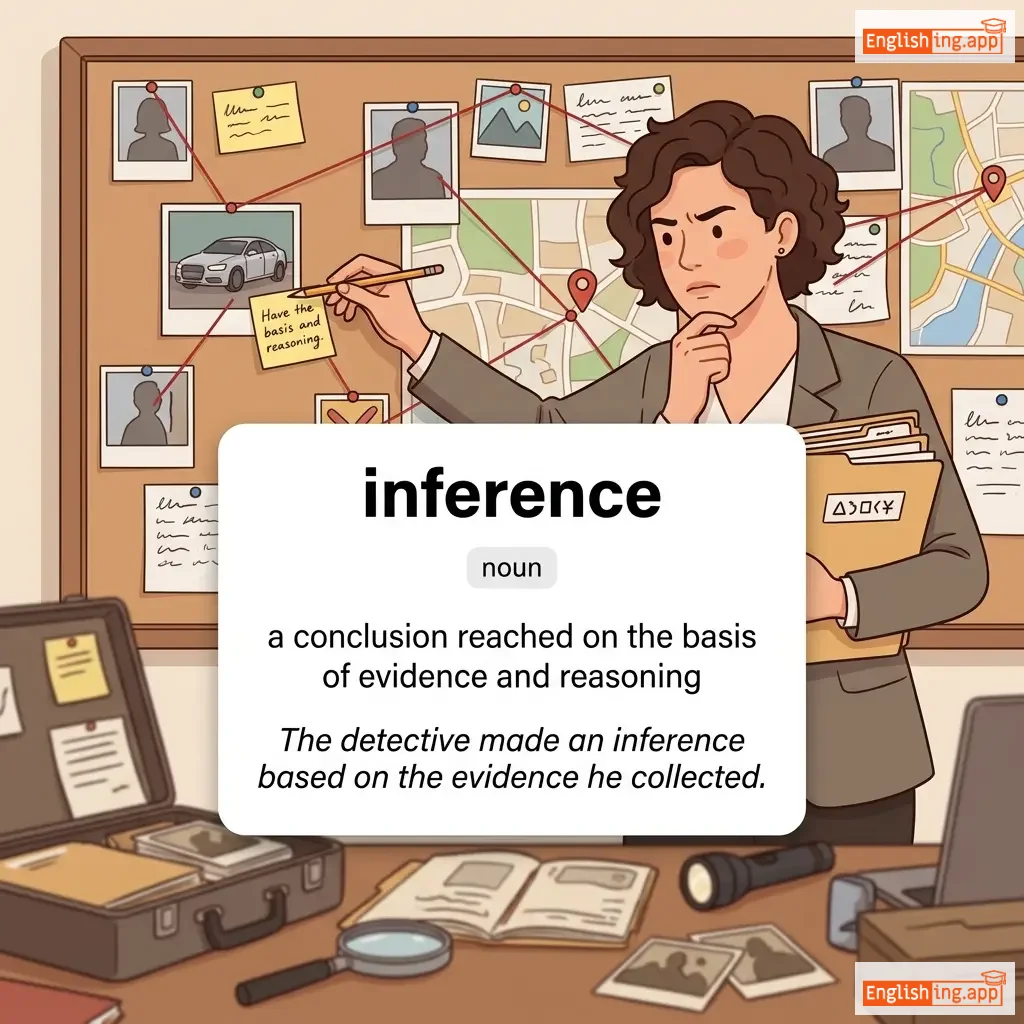
inference definition card — visual illustration of the meaning
noun
/ˈɪnfərəns/
अनुमान (anumaan)

a conclusion reached on the basis of evidence and reasoning

"The detective made an inference based on the evidence he collected."

"जासूस ने जो साक्ष्य इकट्ठा किया था, उसके आधार पर एक अनुमान लगाया।" (jaasoos ne jo saakshya ikattha kiya tha, uske aadhaar par ek anumaan lagaya.)
adjective
/ɪnˈfɪə.ri.ər/
निचला (nichla)

Of lower quality, rank, or status.

"This material is inferior to the one we used before."

"यह सामग्री पहले इस्तेमाल किए गए से निचली है।" (Yeh samagri pehle istemal kiye gaye se nichli hai.)
adjective
/ɪnˈfɜːrnəl/
नरक संबंधी (narak sambandhi)

relating to hell; extremely troublesome or annoying

"The workers complained about the infernal noise from the construction site."

"कर्मचारियों ने निर्माण स्थल से होने वाली नर्क जैसी आवाज़ों के बारे में शिकायत की।" (karmachariyon ne nirman sthal se hone wali nark jaisi aawazon ke baare mein shikayat ki.)
noun
/ɪnˈfɜːrnoʊ/
अग्निकांड (agnikand)

a large, intense fire that is dangerously out of control

"The building turned into an inferno within minutes."

"भवन कुछ ही मिनटों में एक अग्निकांड में बदल गया।" (bhavan kuch hi minaton mein ek agnikand mein badal gaya.)
verb
/ɪnˈfɛst/
प्रकोपित करना (prakopit karna)

to overrun in large numbers, especially so as to cause damage or discomfort

"The old house was infested with rats."

"पुराना घर चूहों से प्रकोपित था।" (Purana ghar chuhon se prakopit tha.)
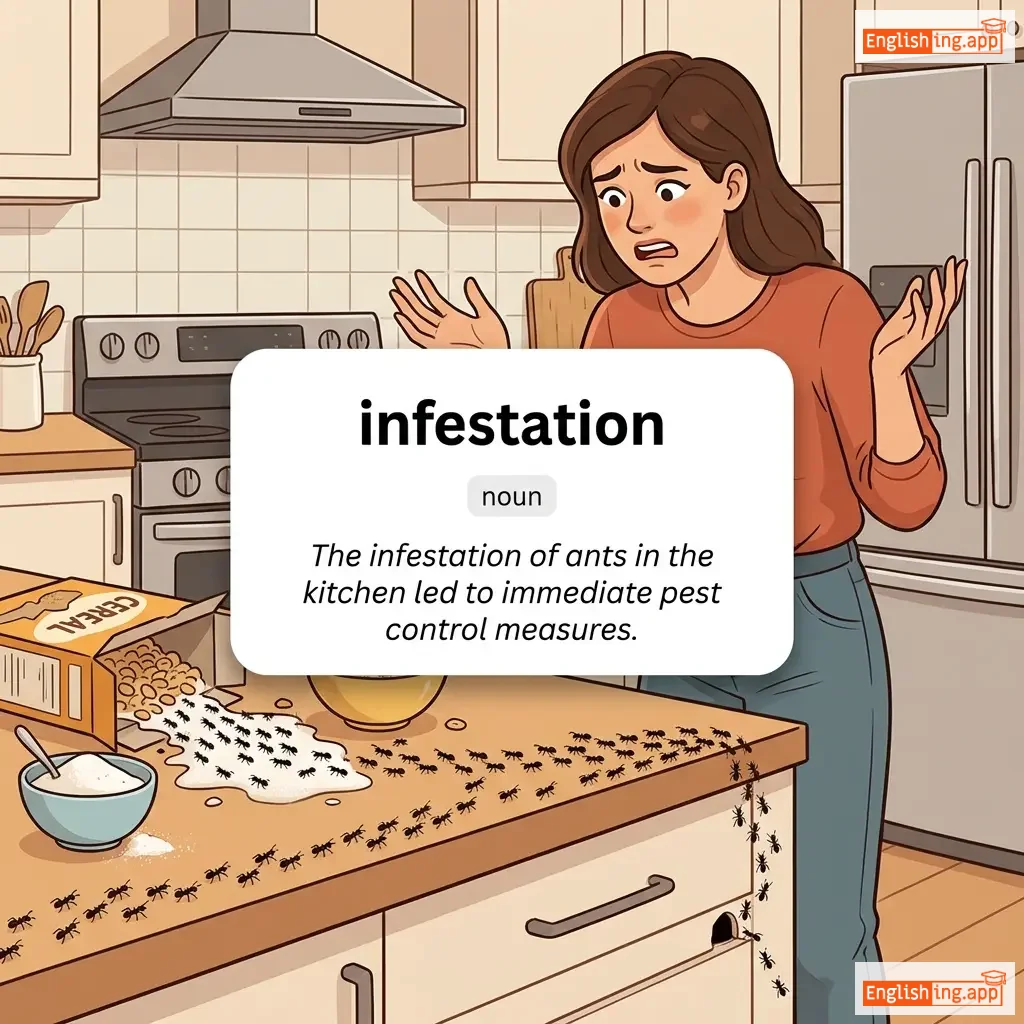
infestation definition card — visual illustration of the meaning
noun
ˌɪnfɛsˈteɪʃən
संक्रमण, कीड़ों या जानवरों की अत्यधिक संख्या का होना (sankraman, kidon ya janwaron ki atyadhik sankhya ka hona)

The presence of an unusually large number of insects or animals in a place, causing damage or disease.

"The infestation of ants in the kitchen led to immediate pest control measures."

"रसोई में चींटियों का संक्रमण तुरंत कीट नियंत्रण उपायों की ओर ले गया।" (Rasoi mein cheentiyon ka sankraman turant keet niyantran upayon ki or le gaya.)
noun
/ˈɪnfɪdɛl/
अविश्वासी (avishwasi)

a person who does not believe in a particular religion or faith

"In medieval times, people often called non-Christians infidels."

"मध्यकाल में लोग अक्सर गैर-ईसाईयों को अविश्वासी कहते थे।" (Madhyakal mein log aksar gair-eesaiyon ko avishwasi kahte the.)
noun
/ˌɪnfɪˈdɛləti/
विश्वासघात (vishwasghat)

the act of being unfaithful to a spouse or partner

"Their marriage ended due to his infidelity."

"उनकी शादी उसकी विश्वासघात के कारण खत्म हो गई।" (Unki shaadi uski vishwasghat ke karan khatam ho gayi.)
verb
/ˈɪnfɪltreɪt/
गुप्त रूप से प्रवेश करना (gupt roop se pravesh karna)

to secretly enter or gain access to a place or group

"The spies managed to infiltrate the enemy base."

"जासूसों ने शत्रु बेस में घुसने में सफलता प्राप्त की।" (Jasooson ne shatrun base mein ghusne mein safalta prapt ki.)
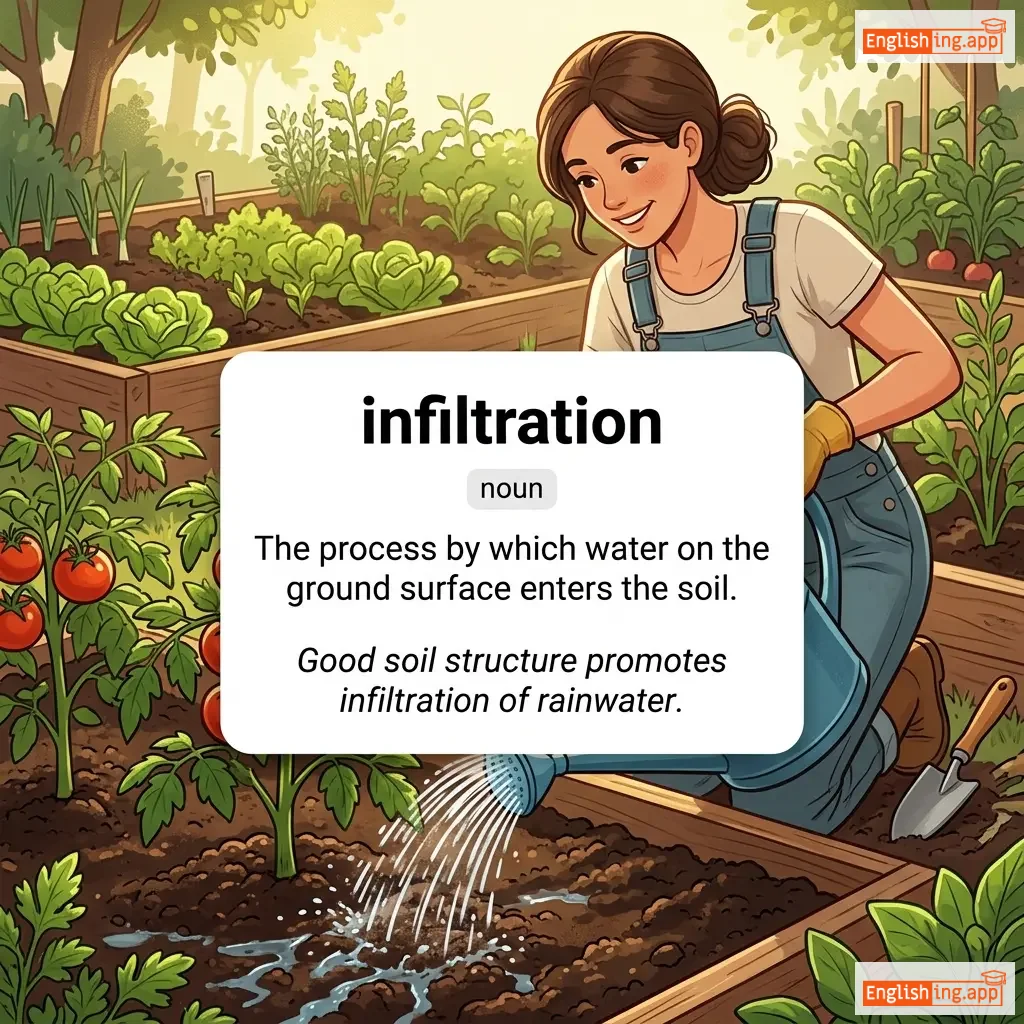
infiltration definition card — visual illustration of the meaning
noun
/ˌɪn.fɪlˈtreɪ.ʃən/
जल प्रवेश (infiltration)

The process by which water on the ground surface enters the soil.

"Good soil structure promotes infiltration of rainwater."

"अच्छी मिट्टी की संरचना वर्षा जल को मिट्टी में प्रवेश करने में सहायता करती है।" (acchi mitti ki sanrachna varsha jal ko mitti me pravesh karne me sahayata karti hai.)
adjective
/ˈɪnfɪnɪt/
अनंत (anant)

limitless or endless in space, extent, or number

"The universe is often described as infinite."

"ब्रह्मांड को अक्सर अनंत के रूप में वर्णित किया जाता है।" (Brahmand ko aksar anant ke roop mein varnit kiya jata hai.)
adjective
/ˌɪnfɪnɪˈtɛsɪməl/
अति सूक्ष्म (ati suksm)

Extremely small in size or amount; so tiny as to be almost negligible.

"The error was so infinitesimal that it didn’t affect the results."

"त्रुटि इतनी सूक्ष्म थी कि उसने परिणामों पर कोई असर नहीं डाला।" (truti itni suksm thi ki usne parinamon par koi asar nahi dala.)
noun
/ɪnˈfɪnɪti/
अनंत (anant)

A concept describing something without any limit or end.

"The universe seems to stretch into infinity."

"ब्रह्मांड अनंतता में फैला हुआ प्रतीत होता है।" (brahmand anantta mein phaila hua prateet hota hai.)
adjective
/ɪnˈfɜːm/
कमजोर (kamjor)

Weak, especially due to old age or illness.

"The infirm old man needed assistance to walk."

"वृद्ध आदमी को चलने के लिए सहायता की आवश्यकता थी।" (Vriddh aadmi ko chalne ke liye sahayata ki avashyakta thi.)
noun
/ɪnˈfɜːməri/
अस्पताल (aspataal)

A hospital or place where the sick or injured are cared for.

"The school had an infirmary for minor injuries."

"स्कूल में मामूली चोटों के लिए एक अस्पताल था।" (School mein mamooli choton ke liye ek aspataal tha.)
noun
/ɪnˈfɜːməti/
कमजोरी (kamjori)

Physical or mental weakness, especially from old age.

"Despite his infirmity, he remained cheerful."

"अपनी कमजोरी के बावजूद, वह खुश रहे।" (Apni kamjori ke baavajood, wah khush rahe.)
verb
/ɪnˈfleɪm/
उत्तेजित करना (uttejit karna)

to arouse strong feelings or provoke anger; to cause inflammation in the body

"The politician's remarks served to inflame public opinion."

"राजनेता के बयान ने जनमत को उत्तेजित कर दिया।" (Rajneeta ke bayan ne janmat ko uttejit kar diya.)
adjective
/ɪnˈflæməbl/
आग पकडऩे योग्य (aag pakadne yogya)

easily set on fire; easily excited or angered

"This material is highly inflammable and should be kept away from heat."

"इस सामग्री को अत्यधिक इन्फ्लेमेबल माना जाता है और इसे गर्मी से दूर रखा जाना चाहिए।" (Is samagri ko atyadhik inflamebl maana jaata hai aur ise garmi se door rakha jaana chahiye.)
inflammation definition card — visual illustration of the meaning
noun
/ˌɪnfləˈmeɪʃən/
सूजन (soojan)

a localized physical condition in which part of the body becomes red, swollen, hot, and often painful

"The doctor prescribed medicine to reduce the inflammation in her knee."

"डॉक्टर ने उसके घुटने की सूजन को कम करने के लिए दवाई दी।" (Doktor ne uske ghtne ki soojan ko kam karne ke liye dawaai di.)
adjective
/ɪnˈflæməˌtɔːri/
सुख (sukh)

causing inflammation in the body; arousing anger, hostility, or strong emotion

"His inflammatory speech triggered protests across the city."

"उन्हें पुरस्कार प्राप्त करने पर अपनी खुशी छिपाने का मौका नहीं मिला।" (Unhe puraskar prapt karne par apni khushi chhupane ka mauka nahi mila.)