वोकैबुलरीज

इंग्लिश वोकैबुलरी डिस्कवर, लर्न और मास्टर करें

noun
/ˈhɛksəˌɡɒn/
षट्भुज (shatbhuj)

A six-sided polygon.

"A honeycomb cell is shaped like a hexagon."

"एक मधुमक्खी के छत्ते का कोश शहद के छत्ते जैसा होता है।" (Ek madhumakkhi ke chhatte ka kosh shahad ke chhatte jaisa hota hai.)
adjective
/hɛkˈsæŋɡjələr/
हेक्सांगी (hexangi)

Having six angles or corners.

"The artist designed a hexangular frame for the mirror."

"कलाकार ने दर्पण के लिए एक हेक्सांगी फ्रेम डिज़ाइन किया।" (Kalakar ne darpan ke liye ek hexangi frame design kiya.)
noun
/ˈhɛksəˌpɒd/
हैक्सापोड (hexapod)

An insect or other organism with six legs.

"The scientist observed a hexapod crawling on the leaf."

"द वैज्ञानिक ने एक हेक्सापॉड को पत्ते पर रेंगते हुए देखा।" (Da vaigyanik ne ek hexapod ko patte par rengte hue dekha.)
interjection
/heɪ/
हे (he)

used to attract attention, express surprise, or greet someone

"Hey, how are you doing today?"

"हे, तुम आज कैसे हो?" (Hey, tum aaj kaise ho?)
noun
/ˈheɪ.deɪ/
सर्वश्रेष्ठ काल; सुनहरी अवधि; उत्कर्ष समय (sarvashreshth kaal; sunahari avadhi; utkars samay)

the period of a person's or thing's greatest success, popularity, or vigor; prime time

"During her heyday as a singer, she performed in sold-out concerts around the world."

"सिंगर के रूप में अपने सर्वश्रेष्ठ काल में, वह दुनिया भर में बिक चुके कॉन्सर्ट्स में प्रदर्शन करती थीं।" (Singer ke roop mein apne sarvashreshth kaal mein, wah duniya bhar mein bik chuke concerts mein pradarshan karti thin.)
noun
/ˈheɪˌdeɪ/
सोनेरी समय (soneri samay)

The period of greatest success, popularity, or power.

"In its heyday, the company dominated the market."

"सोनेरी समय में, कंपनी ने बाजार पर काबू पा लिया था।" (soneri samay mein, company ne bazar par kaboo pa liya tha.)
interjection
/haɪ/
नमस्ते (haay)

a friendly greeting used when meeting someone

"Hi, it's nice to meet you!"

"हाय, आपसे मिलकर अच्छा लगा!" (haay, aapse milakar achha laga!)
noun
/haɪˈeɪtəs/
विराम (viram)

A pause or break in continuity of a process or activity.

"The show returned after a long hiatus."

"शो एक लंबे विराम के बाद वापस आया।" (Sho ek lambe viram ke baad wapas aaya.)
adjective
/haɪˈbɜːrnəl/
शीतकालीन (haibernal)

Relating to or occurring in winter.

"The hibernal season is often harsh in the mountains."

"पहाड़ों में शीतकालीन मौसम अक्सर कठोर होता है।" (pahaadon mein sheetkaaleen mausam aksar kathor hota hai)
verb
/ˈhaɪbərˌneɪt/
हाइबरनेट करना (hibernet karna)

To spend the winter in a dormant state, as some animals do.

"Bears hibernate in caves during the winter."

"भालू सर्दी में गुफाओं में हाइबरनेट करते हैं।" (bhalu sardi mein gufao mein hibernet karte hain.)
adjective/noun
/haɪˈbɜːrniən/
आयरिश (aayrish)

Relating to Ireland or the Irish.

"He enjoyed reading about Hibernian culture and history."

"उसे हाइबरनियन संस्कृति और इतिहास पढ़ना अच्छा लगता था।" (use hibernian sanskriti aur itihas padhna accha lagta tha.)
adjective
/hɪk/
देहाती; गंवार (dehati; ganwar)

unsophisticated person from a rural area; country bumpkin

"He had a hick accent from growing up in a small town."

"वह छोटे शहर में पला बढ़ा था, इसलिए उसकी देहाती लहजा था।" (vah chhote shahar mein pala badha tha, isliye uski dehati lahza tha.)
🕵️‍♂️

Hidden (हिडन)

adjective
/ˈhɪdən/
छुपा हुआ (chhupa hua)

kept out of sight; concealed.

"The treasure was hidden under the old tree."

"खजाना पुराने पेड़ के नीचे छुपा हुआ था।" (Khajana purane ped ke neeche chhupa hua tha.)
hide definition card — visual illustration of the meaning
verb
/haɪd/
छुपाना (chupana)

to put something or oneself out of sight; to conceal

"She tried to hide the letter under the pillow."

"वह चिट्ठी को तकिये के नीचे छुपाने की कोशिश कर रही थी।" (Vah chiththi ko takiye ke neeche chhupane ki koshish kar rahi thi.)
noun
/ˈhaɪdəweɪ/
अलिंगनस्थल (alingansthal)

A place used as a retreat or a place to hide.

"The cabin in the woods was their secret hideaway."

"जंगल में कुटी उनका गुप्त अलिंगनस्थल था।" (Jangal mein kuti unka gupt alingansthal tha.)
adjective
/ˈhaɪd.baʊnd/
रूढ़वादी (haidbound)

unwilling or unable to change because of tradition or convention

"He is too hidebound to accept new ideas."

"वह नए विचारों को स्वीकार करने के लिए बहुत रूढ़वादी है." (hi iz tu haidbound tu aksept nyu aidiyaz)
adjective
/ˈhɪd.i.əs/
भयंकर (bhayankar)

extremely ugly or unpleasant

"The crime was so hideous that it shocked the whole town."

"अपराध इतना भयंकर था कि उसने पूरे शहर को चौंका दिया।" (Aparadh itna bhayankar tha ki usne poore sheher ko chaunka diya.)
verb
/haɪ/
जल्दी जाना (jaldi jana)

to go quickly; hasten

"He hied to the station to catch the train."

"वह ट्रेन पकड़ने के लिए तेजी से स्टेशन गया।" (vah train pakadne ke liye tezi se station gaya.)
adjective
/ˌhaɪəˈrɑː.kɪ.kəl/
क्रमबद्ध (krambaddh)

arranged in order of rank or authority

"The company has a strict hierarchical structure."

"द कंपनी के पास एक सख्त क्रमबद्ध संरचना है।" (D company ke paas ek sakht krambaddh sanrachna hai.)
noun
/ˈhaɪəˌrɑːrki/
सिरमौर व्यवस्था (sirmour vyavastha)

A system in which people or things are arranged in levels of importance or authority.

"The corporate hierarchy determines who makes the final decision."

"कॉर्पोरेट हाइअरार्की यह निर्धारित करती है कि अंतिम निर्णय कौन लेता है।" (Corporate hierarchy yah nirdharit karti hai ki antim nirnay kaun leta hai.)
noun
/ˈhaɪərəˌɡlɪf/
हिरोग्लिफ (hiroglyph)

A picture or symbol used in ancient writing systems, especially Egyptian writing.

"The walls of the temple were covered in hieroglyphs."

"मंदिर की दीवारों पर हायरोग्लिफ थे।" (Mandir ki deewaron par hieroglyph the.)
adjective/noun
/ˌhaɪərəˈɡlɪfɪk/
चित्रलेखीय (chitralekhiya)

Relating to or written in hieroglyphs; symbols or writing that is difficult to understand.

"The archaeologists studied the hieroglyphic inscriptions carefully."

"पुरातत्वविदों ने हाइरोग्लिफ़िक शिलालेखों का अध्ययन सावधानीपूर्वक किया।" (Puratatvavidhon ne hieroglyphic shilalekhon ka adhyayan saavdhanipurvak kiya.)
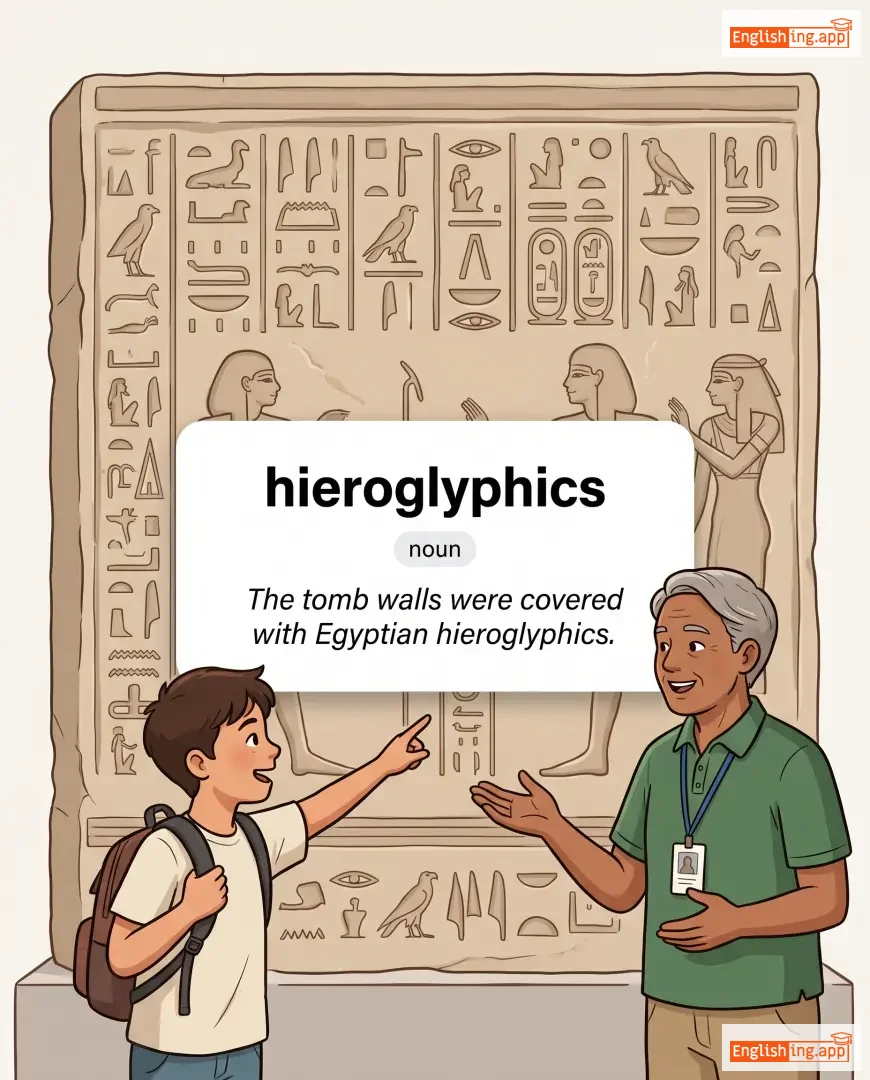
hieroglyphics definition card — visual illustration of the meaning
noun
/ˌhaɪ.roʊˈɡlɪf.ɪks/
हायरोग्लिफिक्स (hairoglyphics)

a system of writing using pictures or symbols, used especially by ancient Egyptians

"The tomb walls were covered with Egyptian hieroglyphics."

"कब्र की दीवारों पर मिस्र के हायरोग्लिफिक्स उकेरे गए थे।" (Qabr ki deewaron par misr ke hairoglyphics ukere gaye the.)
adjective
/haɪ/
उच्च (uchch)

At or to a great height; greater than normal in amount, degree, or intensity.

"The mountain peak is very high."

"पहाड़ की चोटी बहुत ऊँची है।" (pahaad ki choti bahut unchi hai.)
adjective
/ˌhaɪ ˈfloʊn/
आडंबरपूर्ण (aadanbarpoorn)

Using fancy or pretentious language; lofty in style but often overblown.

"The politician gave a high-flown speech full of promises."

"राजनेता ने वादों से भरी एक आडंबरपूर्ण भाषण दिया।" (Raajneta ne vaadon se bhari ek aadanbarpoorn bhashan diya.)
adjective
/ˈhaɪˌprəʊfaɪl/
हाई-प्रोफाइल (high-profile)

having a lot of attention or public notice

"The CEO attended a high-profile conference in New York."

"सीईओ ने न्यू यॉर्क में एक हाई-प्रोफाइल सम्मेलन में भाग लिया।" (CEO ne New York mein ek high-profile sammelan mein bhaag liya.)
adjective
/ˌhaɪ ˈtɛk/
उच्च तकनीकी (uchch takneekee)

using or involving advanced technology.

"The company produces high-tech medical devices."

"कंपनी उच्च तकनीकी चिकित्सा उपकरण बनाती है।" (Company uchch takneekee chikitsa upkaran banatee hai.)
adjective
/ˈhaɪˌbraʊ/
उच्च संस्कृतिमूलक (ucch sanskritimoolak)

intellectually superior or cultured; often describing art, literature, or activities appealing to intellectual tastes

"The museum is known for its highbrow exhibitions."

"संग्रहालय अपनी उच्च संस्कृतिमूलक प्रदर्शनियों के लिए जाना जाता है।" (Sangrahalay apni ucch sanskritimoolak pradarshaniyon ke liye jana jata hai.)
verb
/ˈhaɪˌlaɪt/
हाइलाइट करना (highlight karna)

to emphasize or make something stand out

"The teacher highlighted the most important points in the text."

"शिक्षक ने पाठ में सबसे महत्वपूर्ण बिंदुओं को हाइलाइट किया।" (Shikshak ne path mein sabse mahatvapurn binduon ko highlight kiya.)
adverb
/ˈhaɪli/
बहुत (bahut)

to a great degree; very

"She is highly respected in her field."

"वह अपने क्षेत्र में बहुत सम्मानित है।" (Wah apne kshetra mein bahut sammanit hai.)
noun
/ˈhaɪ.nəs/
उच्चता; शाही उपाधि (uchchata, shaahi upaadhi)

a title given to a person of royal rank; the quality or state of being high or elevated

"Your Highness, the royal carriage is ready to take you to the state banquet this evening."

"आपकी उच्चता, शाही गाड़ी आपको इस शाम राज्य भोज के लिए ले जाने के लिए तैयार है।" (Aapki uchchata, shaahi gaadi aapko is shaam rajya bhoj ke liye le jaane ke liye tayaar hai.)
noun
/ˈhaɪ.weɪ/
हाइवे (haaiwe)

A main road, especially one connecting major towns or cities.

"The highway was blocked due to an accident."

"हाईवे एक दुर्घटना के कारण अवरुद्ध था।" (haaiwe ek durghatna ke kaaran avaruddh tha.)
hijack definition card — visual illustration of the meaning
verb
/ˈhaɪdʒæk/
हाइजैक करना (hijack karna)

to take control of a vehicle or situation illegally or by force

"The criminals attempted to hijack the airplane."

"अपराधियों ने विमान को हाइजैक करने की कोशिश की।" (Aparadhiyon ne vimaan ko hijack karne ki koshish ki.)
verb/noun
/haɪk/
हाइक (haik)

To take a long walk in the countryside or mountains; also to increase suddenly (prices, rates, etc.).

"We decided to hike in the hills this weekend."

"हमने इस सप्ताहांत पहाड़ियों में हाइक करने का निर्णय लिया।" (Hamne is saptahant pahaadiyon mein hike karne ka nirnay liya.)
adjective
/hɪˈlɛəriəs/
बहुत मजेदार (bahut mazedar)

Extremely funny or amusing.

"The comedian told a hilarious story that had everyone laughing."

"कॉमेडियन ने एक बहुत मजेदार कहानी सुनाई जिससे सभी हंस रहे थे।" (Comedyan ne ek bahut mazedar kahani sunai jisse sabhi hans rahe the.)
noun
/hɪˈlærɪti/
हंसी-खुशी (hansi-khushi)

Extreme amusement, especially when expressed by laughter.

"The movie caused great hilarity among the audience."

"फिल्म ने दर्शकों के बीच भारी हंसी-खुशी का माहौल बना दिया" (Film ne darshako ke beech bhaari hansi-khushi ka mahol bana diya)
noun
/hɪl/
पहाड़ी (pahaadi)

A naturally raised area of land, smaller than a mountain.

"We climbed the hill to see the sunset."

"हम सूर्यास्त देखने के लिए पहाड़ी पर चढ़े।" (ham suryaast dekhne ke liye pahaadi par chhade.)
noun
/ˈhɪlək/
टिल्ला (tilla)

A small hill or mound.

"The children climbed up the grassy hillock to watch the sunset."

"बच्चे सूर्योदय देखने के लिए घास से ढके टिल्ले पर चढ़ गए।" (Bacche suryoday dekhne ke liye ghaas se dhake tille par chadh gaye.)
adjective
/ˈhɪli/
पहाड़ी (pahadi)

having many hills; characterized by hills or slopes

"The village is located in a beautiful hilly region."

"गाँव एक सुंदर पहाड़ी क्षेत्र में स्थित है।" (gaon ek sundar pahadi kshetra mein sthit hai)
noun
/ˈhɪl.sə fɪʃ/
हिल्सा मछली (hilsā machhlī)

a popular fish species found in South Asian rivers, especially prized in Bengali cuisine

"Hilsa fish is considered a delicacy in Bengali culture."

"हिल्सा मछली को बंगाली संस्कृति में एक खास व्यंजन माना जाता है।" (Hilsā machhlī kō baṅgālī sanskr̥ti mēṁ ēk khās vyanjan mānā jātā hai.)
pronoun
/hɪm/
उसे (use)

Used to refer to a male person or animal already mentioned.

"I saw him at the park yesterday."

"मैंने उसे कल पार्क में देखा था।" (maine use kal park mein dekha tha.)
pronoun
/hɪmˈself/
स्वयं (svayam)

Used to emphasize that a male person does something by his own effort.

"He fixed the car himself."

"उसने कार को स्वयं ठीक किया।" (Usne car ko svayam theek kiya.)
noun
/haɪnd/
हिरणी (hirani)

a female deer, especially a red deer

"The hind protected her fawn from predators."

"हिरणी ने अपने बछड़े को शिकारियों से बचाया।" (hirani ne apne bachhade ko shikariyon se bachaya.)
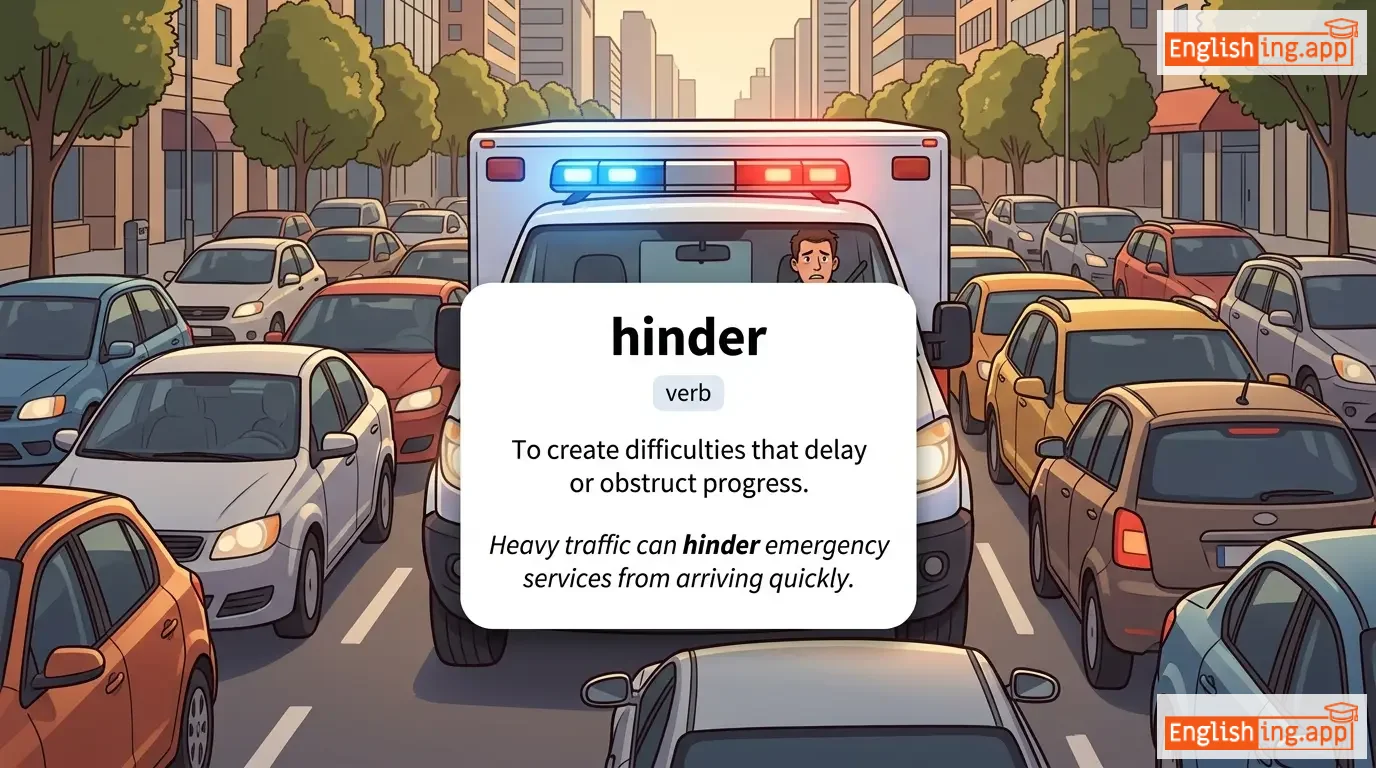
hinder definition card — visual illustration of the meaning
verb
/ˈhɪndər/
रोकना (rokna)

To create difficulties that delay or obstruct progress.

"Heavy traffic can hinder emergency services from arriving quickly."

"भारी ट्रैफिक आपातकालीन सेवाओं को जल्दी पहुंचने से रोक सकता है।" (Bhaari traffic aapatkaaleen sevaon ko jaldi pahuchne se rok sakta hai.)
adjective
/ˈhaɪndmoʊst/
सबसे पिछला (sabse pichla)

Farthest back; last in position.

"The hindmost car in the convoy broke down first."

"कोंवॉय की सबसे पिछली कार पहले टूट गई।" (Convoy ki sabse pichhli car pehle toot gayi.)
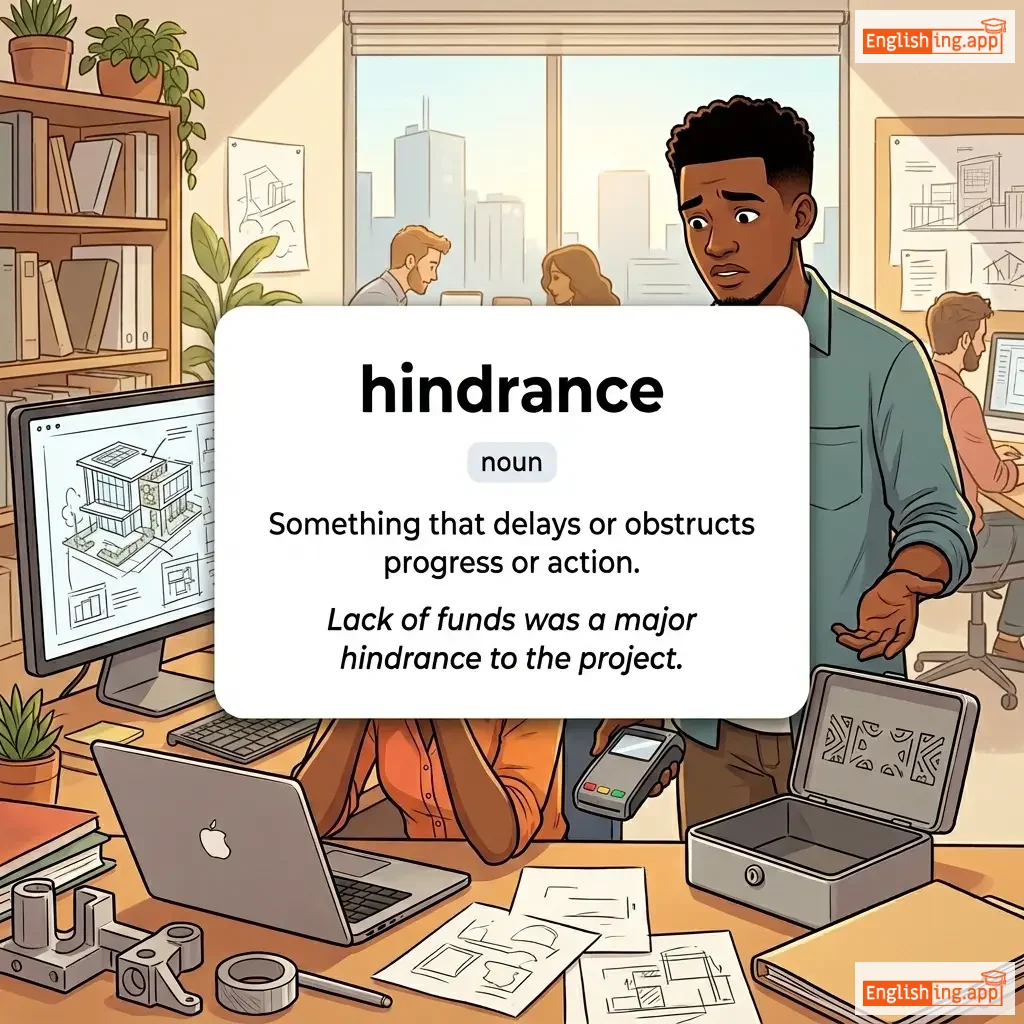
hindrance definition card — visual illustration of the meaning
noun
/ˈhɪndrəns/
बाधा (baadha)

Something that delays or obstructs progress or action.

"Lack of funds was a major hindrance to the project."

"पैसों की कमी परियोजना के लिए एक बड़ी बाधा थी." (paison ki kami pariyojana ke liye ek badi badha thi)
noun
/ˈhaɪndsaɪt/
पछतावा (pachatava)

Understanding of a situation only after it has happened.

"With the benefit of hindsight, we realized the decision was a mistake."

"पछतावे के साथ, हमें एहसास हुआ कि निर्णय एक गलती थी।" (Pachatave ke saath, humein ehsaas hua ki nirnay ek galti thi.)
noun/verb
/hɪnt/
संकेत (sanket)

a small piece of advice or suggestion; to suggest something indirectly

"She gave me a hint about the surprise party."

"उसने मुझे सरप्राइज पार्टी के बारे में एक हिंट दी।" (Usne mujhe surprise party ke baare mein ek hint di.)
noun
/ˈhɪntərlænd/
आंतरिक क्षेत्र (antarik kshetra)

The remote or less developed areas away from the coast or a city.

"The farmers came from the rural hinterland to sell their produce in the city."

"किसान अपने उत्पाद बेचने के लिए ग्रामीण आंतरिक क्षेत्र से शहर आए थे।" (Kisan apne utpad bechne ke liye gramin antarik kshetra se shahar aaye the.)
noun (plural)
/ˈhɪntərlændz/
हिंटरलैंड्स (hinterlands)

Plural of hinterland; remote or less developed regions.

"Explorers traveled deep into the hinterlands of the country."

"अन्वेषक देश के अंदर गहरे हिंटरलैंड्स में यात्रा कर रहे थे।" (Anveshak desh ke andar gahre hinterlands mein yatra kar rahe the.)