वोकैबुलरीज

इंग्लिश वोकैबुलरी डिस्कवर, लर्न और मास्टर करें

noun/verb
/hɛm/
कपड़े का किनारा (kapde ka kinara)

the edge of a piece of cloth that is folded and sewn; to fold and sew the edge of cloth

"She hemmed the dress to make it shorter."

"उसने कपड़े को छोटा करने के लिए उसे हेम्ड किया।" (Usne kapde ko chhota karne ke liye use hemmed kiya.)
hemophilia definition card — visual illustration of the meaning
noun
ˌhiː.məˈfɪl.i.ə
रक्तस्राव रोग (raktasraav rog)

A medical condition in which the ability of the blood to clot is severely reduced, causing the sufferer to bleed severely from even a slight injury.

"Hemophilia treatment benefits from genetic editing."

"हीमोफीलिया उपचार आनुवंशिक संपादन से लाभान्वित होता है।" (Hemophilia upchaar aanuvanshik sampadan se laabhaanvit hota hai.)
noun/verb
/ˈhɛmərɪdʒ/
रक्तस्राव (raktasraav)

A significant loss of blood from a ruptured blood vessel, or to lose blood heavily.

"The patient suffered a severe brain hemorrhage."

"रोगी ने गंभीर मस्तिष्क रक्तस्राव का सामना किया।" (Rogi ne gambhir mastishk raktasraav ka samna kiya.)
noun
/hɛn/
मुर्गी (murgi)

female chicken

"The hen laid fresh eggs in the nest."

"मुर्गी ने घोंसले में ताजे अंडे दिए।" (murgi ne ghosle mein taze ande diye.)
adverb
/hɛns/
इसलिए (isliye)

for this reason; as a result

"She was the best candidate, hence she was chosen for the job."

"वह सबसे अच्छा उम्मीदवार था, इसलिए उसे नौकरी के लिए चुना गया।" (Vah sabse accha ummidvaar tha, isliye use naukri ke liye chuna gaya.)
noun
/ˈhen.ə/
हिना (hina)

a reddish-brown dye made from the powdered leaves of a tropical shrub, used to color hair and decorate skin

"The bride's hands were beautifully decorated with intricate henna patterns for her wedding ceremony."

"दुल्हन के हाथ उसकी शादी की रस्म के लिए जटिल हिना पैटर्न से सजे हुए थे।" (dulhan ke haath uski shaadi ki rasam ke liye jatil hina pattern se saje hue the.)
verb
/ˈhɛnˌpɛk/
पत्नी द्वारा लगातार आलोचना या दबाव डालने की स्थिति (patni dvara lagatar aalochana ya dabav dalne ki sthiti)

To continually criticize, nag, or dominate (especially a husband).

"He felt henpecked by his overly controlling wife."

"वह अपनी अत्यधिक नियंत्रणकारी पत्नी द्वारा बार-बार ताने मारने से परेशान था।" (vah apni atyadhik niyontrankari patni dvara baar-baar taane maarne se pareshan tha.)
noun
/ˈhɛptəˌɡɒn/
सप्तभुज (saptbhuj)

A polygon with seven sides and seven angles.

"The math teacher drew a heptagon on the board."

"गणित के शिक्षक ने बोर्ड पर एक सप्तभुज खींचा।" (Ganit ke shikshak ne board par ek saptbhuj kheenchha.)
noun
/ˈhɛptɑːrki/
सप्तशासन (saptashasan)

A group of seven rulers or governments, especially the seven Anglo-Saxon kingdoms in early England.

"The history book described the heptarchy of Anglo-Saxon England."

"इतिहास की किताब में एंग्लो-सैक्सन इंग्लैंड के सप्तशासन का विवरण दिया गया था।" (Itihas ki kitaab mein Anglo-Saxon England ke saptashasan ka vivaran diya gaya tha.)
pronoun
/hɜːr/
उसे (use)

used to refer to a female person or animal already mentioned or easily identified

"I saw her at the park yesterday."

"मैंने उसे कल पार्क में देखा था।" (Maine use kal park mein dekha tha.)
noun/verb
/ˈhɛrəld/
दूत (doot)

A person or thing that announces or signals the approach of something; to announce or signal.

"The blooming flowers herald the arrival of spring."

"खिलते फूल वसंत के आगमन का संकेत देते हैं।" (khilte phool vasant ke aagman ka sanket dete hain.)
noun
/hɜːb/ (US) /hɜːb/ or /ɜːb/
जड़ी-बूटी (jadi-booti)

a plant used for flavoring food, medicine, or perfume

"Basil is a popular herb used in Italian cuisine."

"तुलसी एक लोकप्रिय जड़ी-बूटी है जो भारतीय व्यंजनों में इस्तेमाल होती है।" (Tulsi ek lokpriya jadi-booti hai jo Bhartiya vyanjanon mein istemal hoti hai.)
adjective
/hɜːrˈbeɪʃəs/
हर्बेसियस (herbesiyas)

Relating to or resembling herbs; plants with soft, non-woody stems.

"The garden was filled with herbaceous plants that thrived in the summer."

"बग़ीचा हर्बेसियस पौधों से भरा हुआ था जो गर्मी में पनपे थे।" (Bagicha herbesiyas paudhon se bhara hua tha jo garmi mein panpe the.)
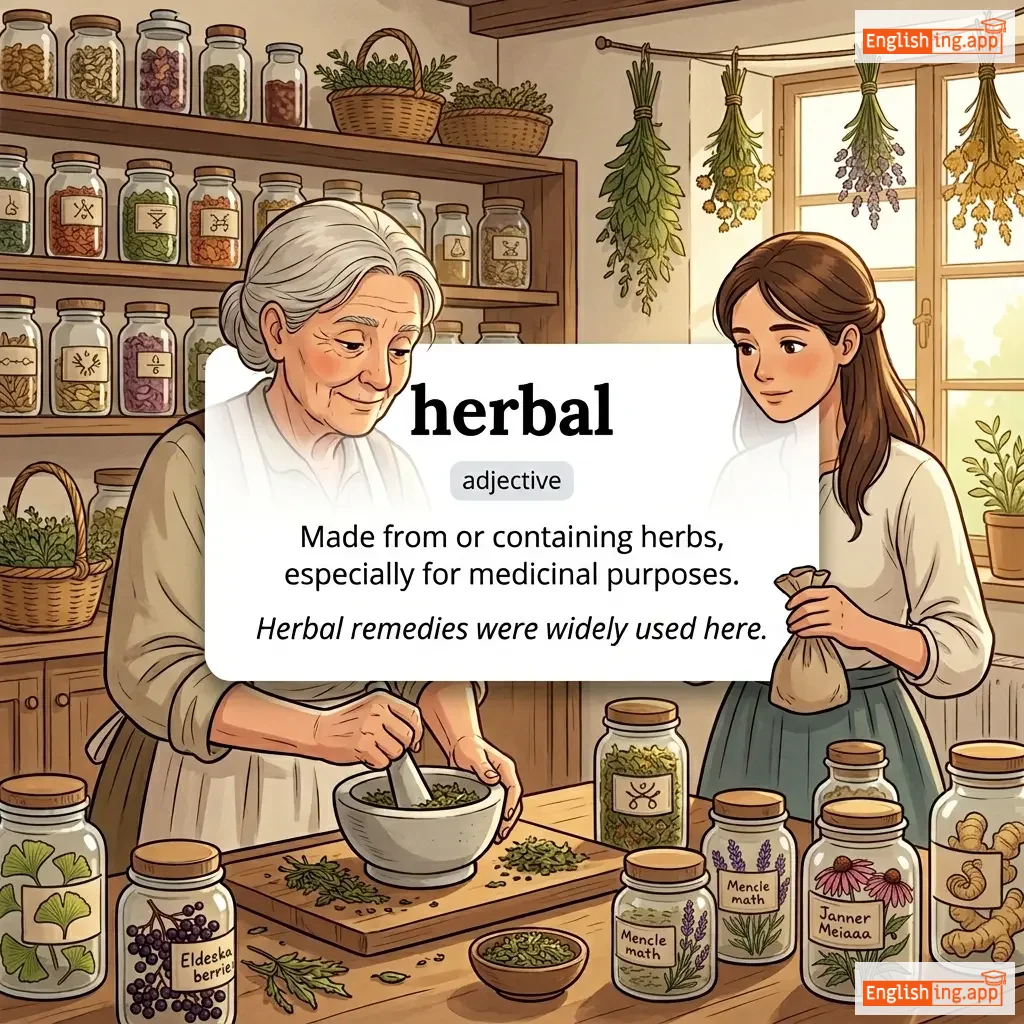
herbal definition card — visual illustration of the meaning
adjective
/ˈhɜː.bəl/
हर्बल (harbal)

Made from or containing herbs, especially for medicinal purposes.

"Herbal remedies were widely used here."

"यहाँ हर्बल उपचार का व्यापक रूप से उपयोग किया जाता था।" (Yahan harbal upchaar ka vyapak roop se upyog kiya jaata tha.)
noun
/hɜːrˈbɛəriəm/
पौधों का संग्रहालय (paudhon ka sangrahalay)

A collection of preserved plant specimens and associated data used for scientific study.

"The university maintains a large herbarium for research and education."

"विश्वविद्यालय अनुसंधान और शिक्षा के लिए एक बड़ा पौधों का संग्रहालय बनाए रखता है।" (Vishwavidyalay anusandhan aur shiksha ke liye ek bada paudhon ka sangrahalay banaye rakhta hai.)
noun
/ˈhɜːrbɪsaɪd/
हर्बिसाइड (herbisaid)

A chemical substance used to kill unwanted plants, especially weeds.

"Farmers used herbicide to protect their crops from invasive weeds."

"किसान अपने फसलों को अवांछित पौधों से बचाने के लिए हर्बिसाइड का उपयोग करते हैं।" (Kisan apne faslon ko avanchhit podhon se bachane ke liye herbisaid ka upyog karte hain.)
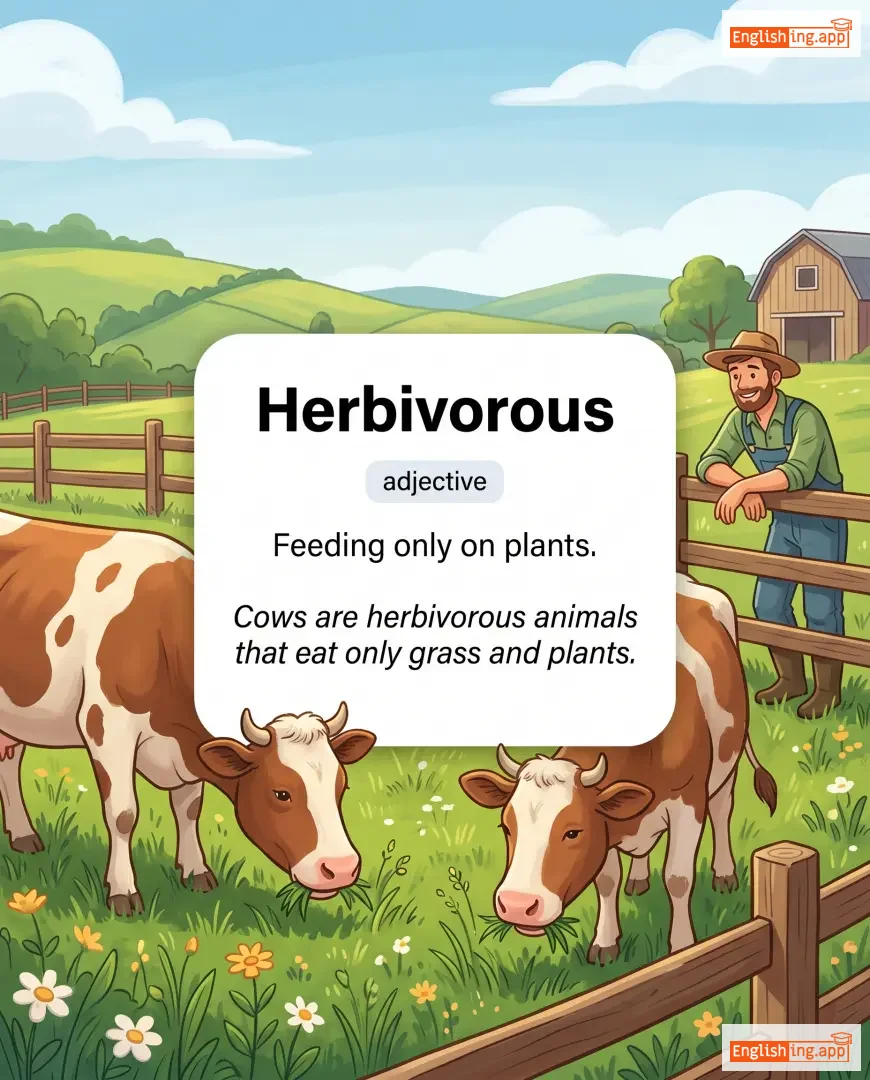
Herbivorous definition card — visual illustration of the meaning
adjective
/hɜːrˈbɪvərəs/
शाकाहारी (shakahari)

Feeding only on plants.

"Cows are herbivorous animals that eat only grass and plants."

"गायें शाकाहारी जानवर होती हैं जो केवल घास और पौधे खाती हैं।" (Gaayein shakahari janwar hoti hain jo keval ghaas aur paudhe khati hain.)
adjective
/ˌhɜːrkjʊˈliːən/
अत्यधिक कठिन (atyadhik kathin)

Requiring great strength or effort; very difficult to perform.

"It was a herculean task to rebuild the city after the disaster."

"आपदा के बाद शहर को फिर से बनाने का काम एक अत्यधिक कठिन कार्य था।" (Aapda ke baad shahar ko phir se banane ka kaam ek atyadhik kathin kaary tha.)
noun/verb
/hɜːrd/
झुंड (jhund)

a large group of animals of the same type that live and feed together; or to gather animals into a group.

"The shepherd herded the sheep into the pen."

"गणकारी ने भेड़ों को पेन में डाला।" (Gankarī ne bhedon ko pen mein daala.)
adverb
/hɪr/
यहाँ (yahan)

in, at, or to this place

"Please come here quickly."

"कृपया यहाँ जल्दी आओ।" (kripya yahan jaldi aao.)
adverb/noun
/ˌhɪərˈæftər/
उसके बाद / परलोक (uske baad / parlok)

from now on; in the future; also refers to life after death.

"Hereafter, all reports must be submitted electronically."

"अब से, सभी रिपोर्टों को इलेक्ट्रॉनिक रूप से जमा करना होगा।" (ab se, sabhi reporton ko electronic roop se jama karna hoga.)
adjective
/həˈrɛdəˌtɛri/
विरासत (virasat)

passed from parents to their children through genes or by inheritance.

"Diabetes can be a hereditary condition."

"डायबिटीज एक विरासत स्थिति हो सकती है।" (Diabetes ek virasat sthiti ho sakti hai.)
noun
/ˈhɛrəsi/
विद्रोह (vidroh)

belief or opinion that goes against established religious doctrine or accepted beliefs.

"In medieval times, heresy was often punished severely."

"मध्यकालीन काल में, विद्रोह को अक्सर कठोरता से दंडित किया जाता था।" (Madhyakaleen kaal mein, vidroh ko aksar kathorta se dandit kiya jata tha.)
noun
/ˈhɛrətɪk/
धर्मविरोधी (dharmavirodhi)

a person who holds beliefs that go against established religious teachings or accepted beliefs.

"The church declared him a heretic for his radical ideas."

"चर्च ने उसे उसके कट्टर विचारों के लिए धर्मविरोधी घोषित किया।" (Church ne use uske kattar vicharon ke liye dharmavirodhi ghoshit kiya.)
adjective
/həˈrɛtɪkəl/
धर्मविरोधी (dharmavirodhi)

Relating to or characterized by departure from accepted beliefs or standards, especially in religion.

"The priest condemned the book as heretical."

"पादरी ने पुस्तक को धर्मविरोधी के रूप में निंदा की।" (Paadri ne pustak ko dharmavirodhi ke roop mein ninda ki.)
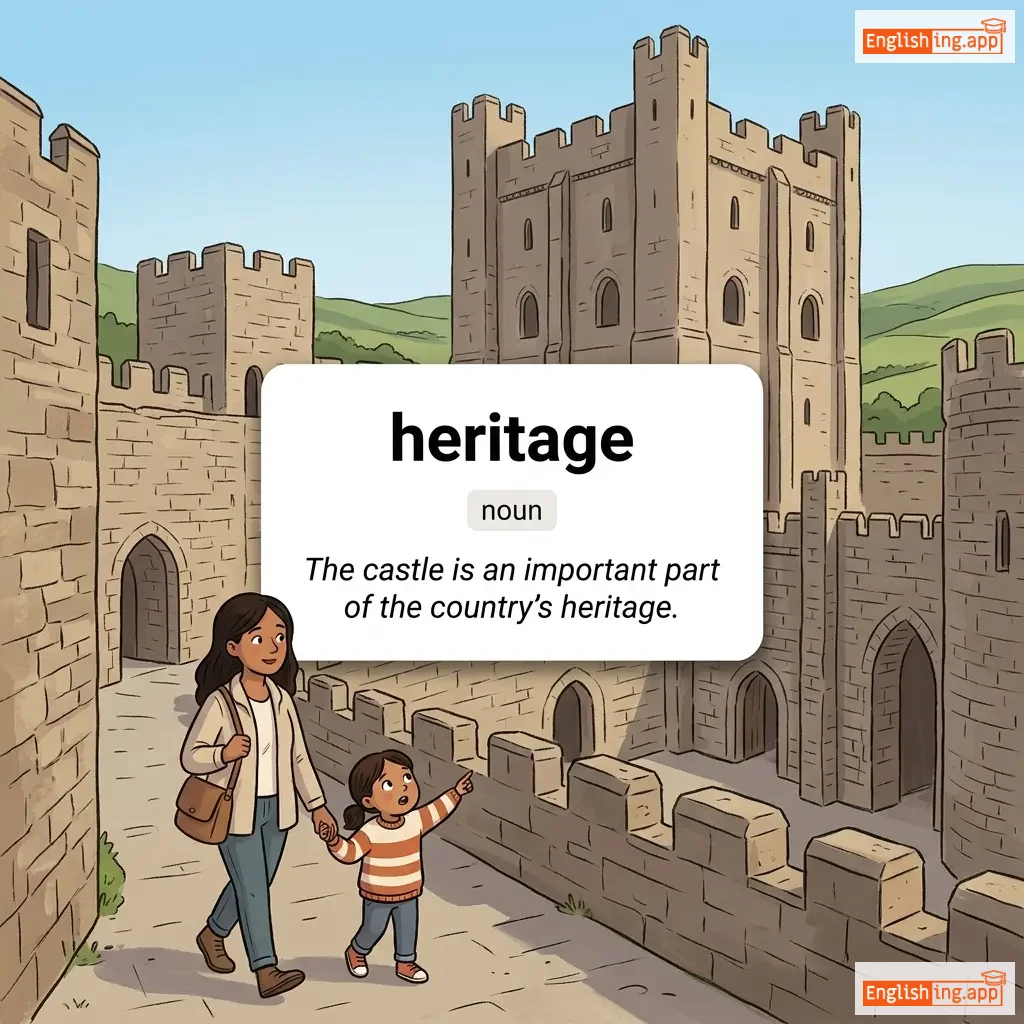
heritage definition card — visual illustration of the meaning
noun
/ˈhɛrɪtɪdʒ/
विरासत (virasat)

Valued objects and qualities such as historic buildings and cultural traditions passed down from previous generations.

"The castle is an important part of the country's heritage."

"महल देश की विरासत का एक महत्वपूर्ण हिस्सा है।" (Mahal desh ki virasat ka ek mahatvapurn hissa hai.)
hermetic definition card — visual illustration of the meaning
adjective
/hərˈmɛtɪk/
हवा बंद (hawa band)

Completely sealed, especially so that no air can enter or escape.

"The medicine was kept in a hermetic container."

"दवा को एक हवा बंद कंटेनर में रखा गया था।" (Dawa ko ek hawa band container mein rakha gaya tha.)
adverb
/hərˈmɛtɪkli/
हवादार तरीके से (havadar tareeke se)

In a way that is completely airtight or sealed off.

"The jars were hermetically sealed to preserve freshness."

"जारों को ताजगी बनाए रखने के लिए हवादार तरीके से सील किया गया था।" (Jaaron ko taazgi banaye rakhne ke liye havadar tareeke se seal kiya gaya tha.)
noun
/ˈhɜːrmɪt/
संन्यासी (sannyasi)

A person who lives alone and apart from society, often for religious or spiritual reasons.

"The old hermit lived in a cave for decades."

"वृद्ध संन्यासी कई दशकों तक एक गुफा में रहता था।" (vriddha sannyasi kai dashakon tak ek gufa mein rehta tha.)
noun
/ˈhɜːrmɪtɪdʒ/
धर्मिक एकान्तवास (dharmik ekaantvaas)

A secluded residence or retreat, often for a hermit or religious recluse.

"The monk spent years in a hermitage deep in the forest."

"संन्यासी ने जंगल में एक हर्मिटेज में कई साल बिताए।" (sannyasi ne jangal mein ek hermitage mein kai saal bitaaye.)
noun
/ˈhɜːrniə/
हर्निया (hernia)

A medical condition where an organ pushes through the muscle or tissue holding it in place.

"The doctor diagnosed him with an inguinal hernia."

"डॉक्टर ने उसे इंगुइनल हर्निया का निदान किया।" (doktar ne use inguinal hernia ka nidhan kiya.)
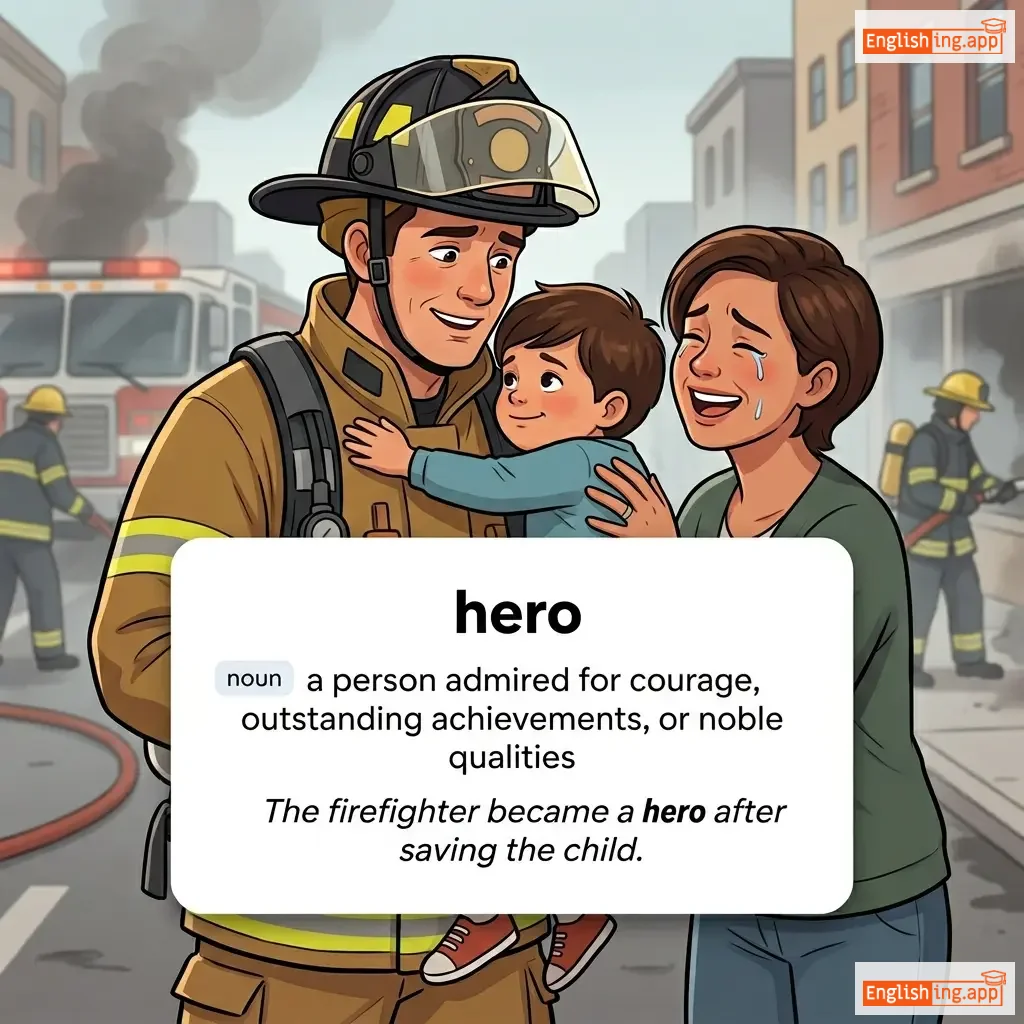
hero definition card — visual illustration of the meaning
noun
/ˈhɪəroʊ/
हीरो (hero)

a person admired for courage, outstanding achievements, or noble qualities

"The firefighter became a hero after saving the child."

"दमकलकर्मी बच्चे को बचाने के बाद एक हीरो बन गया।" (Damkalkarmi bachche ko bachane ke baad ek hero ban gaya.)
adjective
/hɪˈroʊɪk/
वीरतापूर्ण (veeratapoorn)

showing great bravery or courage; relating to a hero or heroes

"The firefighter made a heroic effort to save the child."

"दमकलकर्मी ने बच्चे को बचाने के लिए वीरतापूर्ण प्रयास किया।" (damkalkarmi ne bachche ko bachane ke liye veeratapoorn prayas kiya)
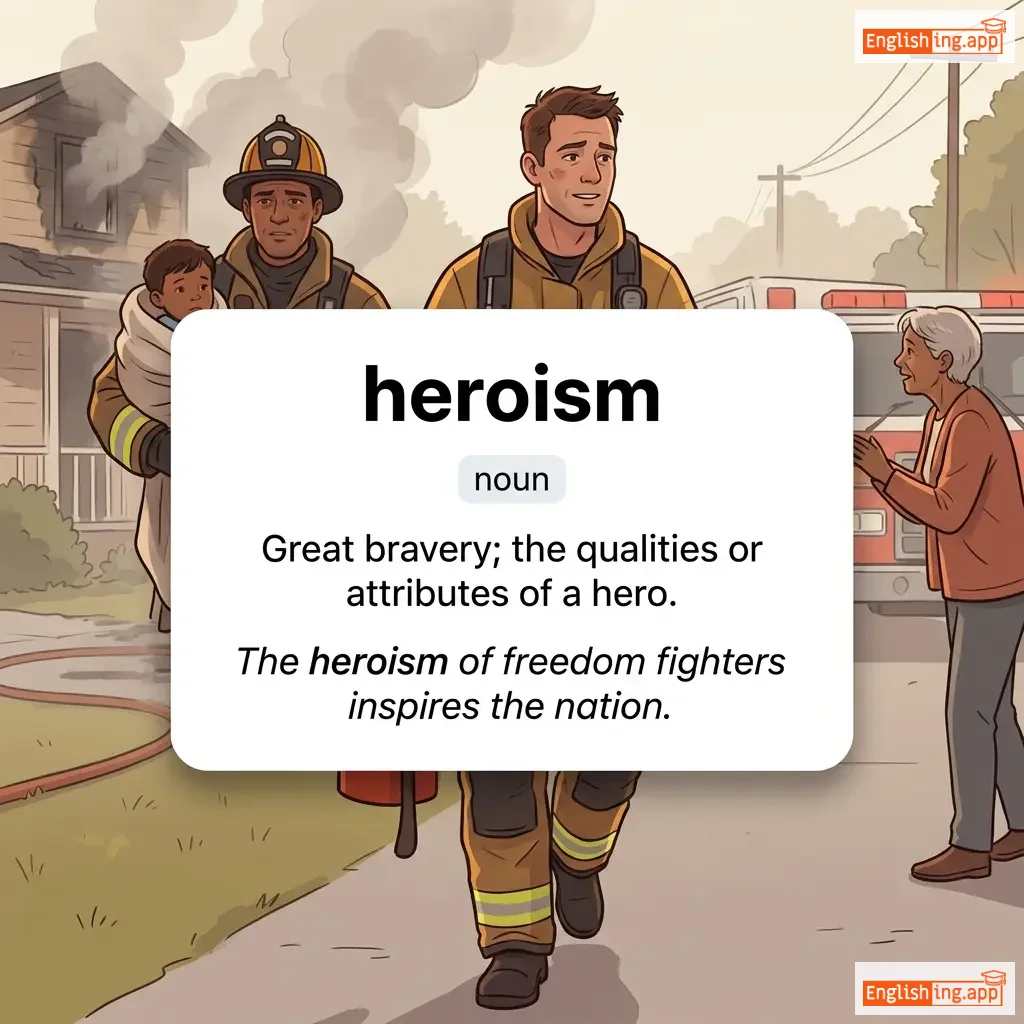
heroism definition card — visual illustration of the meaning
noun
ˈhɛroʊˌɪzəm
नायकत्व (nayaktva)

Great bravery; the qualities or attributes of a hero.

"The heroism of freedom fighters inspires the nation."

"स्वतंत्रता सेनानियों का नायकत्व राष्ट्र को प्रेरित करता है।" (Svatantrata senaaniyon ka nayaktva rashtra ko prerith karta hai.)
noun
/ˈherən/
बगुला (bagula)

large wading bird with long legs and neck that feeds on fish

"The heron stood motionless by the water's edge, waiting for fish."

"बगुला पानी के किनारे स्थिर खड़ा था, मछली का इंतजार कर रहा था।" (bagula paani ke kinare sthir khada tha, machhli ka intezaar kar raha tha)
noun
/ˌhɜːrpəˈtɒlədʒɪst/
सरीसृप और उभयचर प्राणीविज्ञानी (sarisrip aur ubhaychar praanivigyaani)

A scientist who studies reptiles and amphibians.

"The herpetologist discovered a new species of frog in the rainforest."

"हर्पेटोलॉजिस्ट ने वर्षावन में मेंढक की एक नई प्रजाति की खोज की।" (herpetologist ne varshavan mein mendhak ki ek nayi prajati ki khoj ki.)
pronoun
/hɜːrz/
उसका (महिला का) सामान (uska (mahila ka) saman)

used to refer to something that belongs to or is associated with a female person previously mentioned or easily identified.

"That blue bag is hers."

"वो नीला बैग उसका है।" (Vo neela bag uska hai.)
pronoun
/hɜːrˈsɛlf/
खुद (khud)

used to refer to a female person as the object of a verb or preposition when she is the subject

"She prepared the meal all by herself."

"वह खाना खुद ही बना रही थी।" (Vah khana khud hi bana rahi thi.)
noun
/ˈhɛzɪtəns/
संकोच (sankoch)

The quality or state of being reluctant or uncertain.

"Her hesitance to speak up delayed the decision."

"उसका बोलने में संकोच निर्णय को विलंबित कर गया।" (uska bolne mein sankoch nirnay ko vilambit kar gaya.)
noun
/ˈhɛzɪtənsi/
संकोच (sankoch)

The tendency to pause or delay due to uncertainty or fear.

"His hesitancy in answering made everyone doubt his confidence."

"उसकी उत्तर देने में संकोच ने सभी को उसके आत्मविश्वास पर संदेह किया।" (uski uttar dene mein sankoch ne sabhi ko uske atmvishwas par sandeh kiya.)
adjective
/ˈhɛzɪtənt/
संकोची (sankochi)

uncertain or unwilling to do something quickly; showing doubt or reluctance

"She was hesitant to accept the job offer without more information."

"वह नौकरी के प्रस्ताव को बिना अधिक जानकारी के स्वीकार करने में संकोची थी।" (Wah naukri ke prastav ko bina adhik jankari ke svikaar karne mein sankochi thi.)
verb
/ˈhezɪteɪt/
हिचकिचाना (hichkichana)

to pause before saying or doing something because you are uncertain or nervous.

"She hesitated before answering the question."

"वह सवाल का जवाब देने से पहले हिचकिचाई।" (Wah sawal ka jawab dene se pehle hichkichai.)
noun
/ˌhɛzɪˈteɪʃən/
हिचक (hichak)

the act of pausing or being uncertain before doing something

"After a moment’s hesitation, he answered the question."

"एक पल की हिचक के बाद, उसने प्रश्न का उत्तर दिया।" (ek pal ki hichak ke baad, usne prashn ka uttar diya)
noun
/ˈhɛʃ.ən/
हैसियन कपड़ा (hesian kapda)

a strong coarse fabric made from jute or hemp, used for sacks and wrapping

"The farmer stored grain in hessian sacks."

"किसान ने अनाज को हैसियन बोरियों में रखा।" (kisaan ne anaaj ko hesian boriya mein rakha.)
heterodox definition card — visual illustration of the meaning
adjective
/ˈhɛtərəˌdɒks/
विपरीत दृष्टिकोण (vipreet drishtikon)

not conforming with accepted or orthodox standards or beliefs

"The professor was known for his heterodox views on religion."

"प्रोफेसर अपने धर्म पर विपरीत दृष्टिकोण के लिए प्रसिद्ध थे।" (Professor apne dharm par vipreet drishtikon ke liye prasiddh the.)
noun
/ˌhɛtərəʤəˈniːɪti/
विविधता (vividhata)

the quality or state of being diverse in character or content

"The cultural heterogeneity of the city makes it vibrant and unique."

"शहर की सांस्कृतिक विविधता इसे जीवंत और अद्वितीय बनाती है।" (Shahar ki sanskritik vividhata ise jeevant aur advitiya banati hai.)
adjective
/ˌhɛtərəˈʤiːniəs/
विविध (vividh)

consisting of different kinds or diverse elements

"The classroom was filled with a heterogeneous group of students."

"कक्षा एक विविध छात्रों के समूह से भरी हुई थी।" (Kaksha ek vividh chhatron ke samuh se bhari hui thi.)
adjective
/ˌhɛtərəʊˈmɔːrfɪk/
विभिन्न रूपात्मक (vibhinn roopaatmak)

Having different forms or shapes, especially in the same species or organism.

"Butterflies are heteromorphic during their life cycle, changing forms from larva to adult."

"तितलियाँ अपने जीवन चक्र के दौरान विभिन्न रूपों में बदलती हैं, लार्वा से वयस्क में।" (Titliyaan apne jeevan chakra ke dauran vibhinn roopon mein badalti hain, larva se vayask mein.)
heuristic definition card — visual illustration of the meaning
adjective
hjʊəˈrɪs.tɪk
ह्यूरिस्टिक (heuristic)

Enabling a person to discover or learn something for themselves; using practical experience rather than theory.

"The scientist used a heuristic approach to solve the problem."

"वैज्ञानिक ने समस्या को हल करने के लिए एक ह्यूरिस्टिक तरीका अपनाया।" (Vaigyanik ne samasya ko hal karne ke liye ek heuristic tareeka apnaya.)
verb
/hjuː/
काटना (kaatna)

To chop or cut something, especially wood or stone, with a tool.

"The workers hewed logs to build the cabin."

"श्रमिकों ने झोपड़ी बनाने के लिए लकड़ी को काटा।" (Shramikon ne jhopdi banane ke liye lakdi ko kaata.)