वोकैबुलरीज

इंग्लिश वोकैबुलरी डिस्कवर, लर्न और मास्टर करें

adjective
/ˈɡæst.li/
भयावह (bhayavah)

Causing great horror or fear; very unpleasant.

"The crime scene was a ghastly sight."

"अपराध का दृश्य भयावह था।" (Aparadh ka drishya bhayavah tha.)
noun
/ɡiː/
घी (ghii)

clarified butter used in South Asian cooking

"She used ghee instead of butter for cooking the rice."

"उसने चावल पकाने के लिए मक्खन की जगह घी इस्तेमाल किया।" (Usne chawal pakane ke liye makkhan ki jagah ghee istemal kiya.)
noun
/ɡoʊst/
भूत (bhoot)

the spirit of a dead person that is believed to appear to the living

"She felt as if a ghost was watching her in the dark hallway."

"वह महसूस कर रही थी जैसे कोई भूत उसे अंधेरे गलियारे में देख रहा हो।" (Vah mehsoos kar rahi thi jaise koi bhoot use andhere galiyare mein dekh raha ho.)
noun
/ˈdʒaɪənt/
दैत्य (daitya)

an extremely large and powerful being or a very large person or thing

"The company grew into a giant in the tech industry."

"कंपनी प्रौद्योगिकी उद्योग में एक दैत्य बन गई।" (Kampani praudyogiki udhyog mein ek daitya ban gayi.)
noun
/ˈdʒaɪənt sneɪk hɛd/
बड़ी साँप सिर मछली (badi saap sir machhli)

a large predatory freshwater fish with an elongated body and snake-like head

"The giant snake head is a fierce predator that can survive out of water for hours."

"जायंट स्नेक हेड एक भयंकर शिकारी है जो घंटों तक पानी के बाहर जीवित रह सकता है।" (Giant snake head ek bhayankar shikari hai jo ghanton tak pani ke bahar jeevit rah sakta hai.)
verb
/ˈdʒɪb.ər/
अस्पष्ट रूप से बोलना (aspasht roop se bolna)

To speak rapidly and unintelligibly, typically through fear or shock.

"The frightened man began to gibber when he saw the ghost."

"डरे हुए आदमी ने घोस्ट को देखकर अस्पष्ट रूप से बोलना शुरू कर दिया।" (Dare hue aadmi ne ghost ko dekhkar aspasht roop se bolna shuru kar diya.)
noun
/ˈdʒɪb.ər.ɪʃ/
बकवास (bakwas)

Unintelligible or meaningless speech or writing.

"He was so nervous that his explanation sounded like gibberish."

"वह इतना नर्वस था कि उसकी व्याख्या जिबरिश जैसी लग रही थी।" (Wah itna nervous tha ki uski vyakhya gibberish jaisi lag rahi thi.)
noun
/ˈdʒɪbɪt/
फांसी का तख़्ता (fansi ka takhta)

A gallows used for hanging criminals; historically also a post where bodies of executed criminals were displayed.

"The thief was sentenced to die on the gibbet."

"चोर को गिबेट पर फांसी दी गई।" (Chor ko gibbet par fansi di gayi.)
noun
/ˈɡɪbən/
गिबन (giban)

a small to medium-sized tailless ape with long arms, native to the forests of Southeast Asia

"The gibbon swung gracefully through the trees using its long arms."

"गिबन अपनी लंबी बाँहों से पेड़ों के बीच सुंदरता से झूल रहा था।" (giban apni lambi banhon se pedon ke beech sundarta se jhul raha tha)
verb
/dʒaɪb/
व्यंग्य करना (vyangya karna)

To make insulting or mocking remarks; to taunt.

"The fans gibed at the losing team."

"प्रशंसकों ने हारने वाली टीम का मजाक उड़ाया।" (Prashansako ne haarne wali team ka mazaak udaaya.)
adjective
/ˈɡɪdi/
चकरा, बहुत खुश (chakkara, bahut khush)

Feeling dizzy or light-headed; also overly excited and frivolous.

"She felt giddy after spinning around so many times."

"वह बहुत बार घूमने के बाद चकरा गई थी।" (Wah bahut baar ghoomne ke baad chakkara gayi thi.)
noun
/ɡɪft/
उपहार (upahaar)

something given willingly to someone without payment; a present

"She gave him a beautiful gift for his birthday."

"उसने उसके जन्मदिन पर उसे एक सुंदर उपहार दिया।" (Usne uske janmadin par use ek sundar upahaar diya.)
adjective
/ˈɡɪftɪd/
प्रतिभाशाली (pratibhashali)

having exceptional talent or natural ability

"The gifted student solved the math problem in seconds."

"प्रतिभाशाली छात्र ने कुछ ही सेकंड में गणित की समस्या हल कर दी।" (Pratibhashali chatra ne kuch hi second mein ganit ki samasya hal kar di.)
noun
/ɡɪɡ/
संगीतकार, बैंड, या मनोरंजन करने वाले द्वारा एक लाइव प्रदर्शन; एक अस्थायी काम भी (gig)

A live performance by a musician, band, or entertainer; also a temporary job.

"The band has a gig at the local club tonight."

"बैंड का आज रात स्थानीय क्लब में गिग है।" (Band ka aaj raat sthaniya klub mein gig hai.)
adjective
/dʒaɪˈɡæntɪk/
विशाल (vishal)

Extremely large or huge in size, power, or extent.

"The company made a gigantic investment in technology."

"कंपनी ने प्रौद्योगिकी में एक विशाल निवेश किया।" (Company ne pradyogiki mein ek vishal nivesh kiya.)
verb
/ɡɪld/
सोने की परत चढ़ाना (sone ki parat chadana)

to cover something with a thin layer of gold or to make something appear more attractive than it really is

"The craftsman gilded the frame to give it a luxurious look."

"कारीगर ने फ्रेम को भव्य दिखाने के लिए उसे सोने की परत चढ़ाई।" (Karigar ne frame ko bhavya dikhane ke liye use sone ki parat chadhaai.)
noun
/ˈdʒɪn.dʒər/
अदरक (adrak)

a hot-tasting root used as a spice in cooking and as medicine

"Add fresh ginger to the curry for extra flavor."

"अधिक स्वाद के लिए करी में ताज़ा अदरक डालें।" (adhik swad ke liye kari mein taza adrak daalein)
adverb
/ˈdʒɪndʒərli/
सतर्कता से (satarkata se)

in a very careful or cautious manner

"She walked gingerly on the icy path."

"वह बर्फीले रास्ते पर सतर्कता से चल रही थी।" (Vah barfile raste par satarkata se chal rahi thi.)
noun
/dʒɪˈræf/
जिराफ़ (jiraf)

a very tall African animal with a long neck and long legs

"The giraffe stretched its neck to reach the leaves on the tall tree."

"जिराफ़ ने ऊँचे पेड़ की पत्तियों तक पहुँचने के लिए अपनी गर्दन को खींचा।" (jiraf ne unche ped ki patiyon tak pahuchne ke liye apni gardan ko kheencha)
gird definition card — visual illustration of the meaning
verb
/ɡɜːrd/
घेरना, तैयार होना (gherna, tayar hona)

to encircle or bind with a belt or band; to prepare oneself for something difficult

"He girded himself for the long journey ahead."

"उसने लंबी यात्रा के लिए खुद को तैयार किया।" (Usne lambi yatra ke liye khud ko tayar kiya.)
noun
/ˈɡɜːrdər/
गर्डर (इस्पात बीम) (gardar (ispaat beam))

a large, strong beam used to support buildings or bridges

"The steel girders held the weight of the bridge."

"इस्पात के गार्डर ने पुल का वजन संभाला।" (Ispaat ke gardar ne pul ka wajan sambhala.)
noun
/ɡɜːrl/
लड़की (ladki)

a female child or young woman

"The girl was playing with her friends in the park."

"लड़की पार्क में अपनी दोस्तों के साथ खेल रही थी।" (Ladki park mein apni doston ke saath khel rahi thi.)
noun
/ˈɡɜːrlfrɛnd/
प्रेमिका (premika)

A woman or girl with whom someone is romantically or emotionally involved.

"He introduced his girlfriend to his family."

"उसने अपनी प्रेमिका को अपने परिवार से मिलवाया।" (Usne apni premika ko apne parivar se milwaya.)
noun
/ɡɜːrθ/
व्यास (vyas)

the measurement around the middle of something, especially a person's waist or a tree trunk

"The tree's girth measured nearly five feet."

"पेड़ का व्यास लगभग पाँच फीट मापा गया था।" (Ped ka vyas lagbhag paanch feet mapa gaya tha.)
noun
/dʒɪst/
मुख्य विचार (mukhya vichar)

the main or essential part of a matter; the central idea

"The gist of his speech was about unity and cooperation."

"उसके भाषण का मुख्य विचार एकता और सहयोग के बारे में था।" (Uske bhashan ka mukhya vichar ekta aur sahyog ke baare mein tha.)
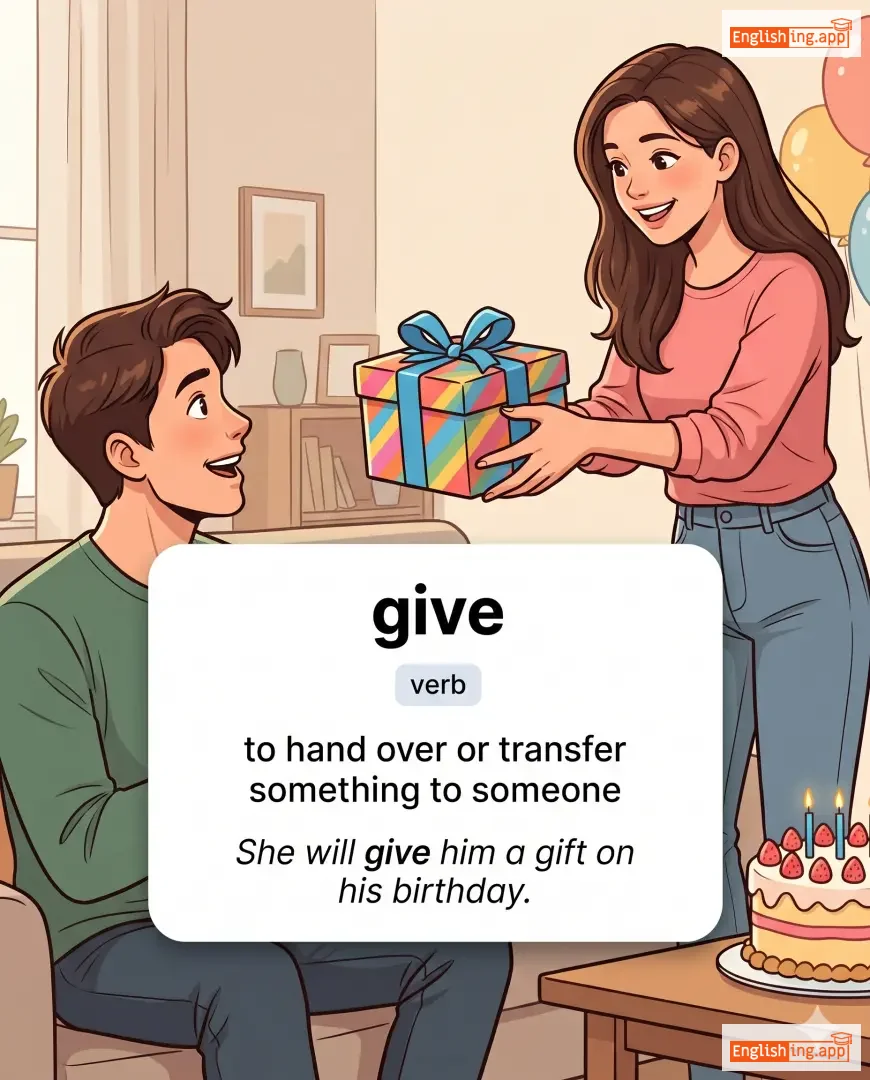
give definition card — visual illustration of the meaning
verb
/ɡɪv/
देना (dena)

to hand over or transfer something to someone

"She will give him a gift on his birthday."

"वह उसे उसके जन्मदिन पर एक उपहार देगी।" (vah use uske janmadin par ek uphaar degi.)
adjective
/ˈɡɪvən/
निर्धारित (nirdharit)

Specified or stated; already decided or certain.

"It is a given fact that hard work leads to success."

"यह एक निर्धारित तथ्य है कि कड़ी मेहनत सफलता की ओर ले जाती है।" (Yeh ek nirdharit tathya hai ki kadhi mehnat safalta ki or le jaati hai.)
noun
/ˈɡɪvər/
दाता (data)

a person who gives something

"She was always a generous giver to charity."

"वह हमेशा चैरिटी को उदार गिवर थीं।" (Vah hamesha charity ko udar giver thin.)
adjective
/ˈɡleɪʃəl/
हिमनदी से संबंधित (himnadi se sambandhit)

relating to ice or glaciers; extremely cold or unfriendly

"The mountains were covered in glacial ice."

"पहाड़ों पर हिमनदी की बर्फ से ढके थे।" (Pahaadon par himnadi ki baraf se dhake the.)
noun
/ˈɡleɪʃər/
हिमनद (himnad)

a large mass of ice that moves slowly over land

"The glacier is slowly melting due to climate change."

"ग्लेशियर जलवायु परिवर्तन के कारण धीरे-धीरे पिघल रहा है।" (Glacier jalvayu parivartan ke karan dheere-dheere pighal raha hai.)
Glad definition card — visual illustration of the meaning
adjective
/ɡlæd/
खुश (khush)

feeling pleased, happy, or delighted

"I am glad to see you again after so long."

"मैं लंबे समय बाद तुम्हें देखकर खुश हूं।" (Main lambe samay baad tumhe dekhkar khush hoon.)
verb
/ˈɡlædən/
खुश करना (khush karna)

to make someone happy or bring joy

"The news of her recovery gladdened everyone."

"उसकी रिकवरी की खबर ने सभी को खुश कर दिया।" (Uski recovery ki khabar ne sabhi ko khush kar diya.)
noun
/ɡleɪd/
वन का खुला क्षेत्र (van ka khula kshetra)

An open space in a forest or woods.

"They rested in a sunny glade after their long hike."

"वे अपनी लंबी यात्रा के बाद एक धूप वाले खुले क्षेत्र में आराम करने लगे।" (ve apni lambi yatra ke baad ek dhoop wale khule kshetra mein aaram karne lage.)
noun
/ˈɡlædiˌeɪtər/
ग्लेडिएटर (gladiator)

A man trained to fight in public contests in ancient Rome.

"The gladiator fought bravely in the arena."

"ग्लेडिएटर ने एरीना में साहस से लड़ा।" (gladiator ne arena mein sahas se lara.)
noun
/ˌɡlæd.iˈoʊ.ləs/
ग्लेडियोलस (glediyolas)

A tall flowering plant with sword-shaped leaves and colorful spike-like flower clusters, popular in gardens and floral arrangements

"The gladiolus stood tall and elegant in the flower bed."

"फूलों के बिस्तर में ग्लेडियोलस ऊँचा और शानदार खड़ा था" (phoolon ke bistar mein glediyolas ooncha aur shandaar khada tha)
adverb
/ˈɡlæd.li/
इच्छा से और खुशी से (ichchha se aur khushi se)

willingly and with pleasure

"I would gladly help you with your homework."

"मैं खुशी से आपकी गृहकार्य में मदद करूंगा।" (main khushi se aapki grihkaary mein madad karunga.)
noun
/ˈɡlæmər/
आकर्षण (akarshan)

An attractive or exciting quality that makes something or someone appealing.

"The glamor of city life attracts many young people."

"शहरी जीवन का आकर्षण कई युवा लोगों को आकर्षित करता है।" (shahri jeevan ka akarshan kai yuva logon ko akarshit karta hai.)
adjective
/ˈɡlæm.ər.əs/
आकर्षक; शानदार; फैशनेबल; (aakarshak; shandaar; fashnebal)

having glamour; attractive in an exciting way; fashionable;

"The actress looked glamorous in her designer gown at the awards ceremony."

"अभिनेत्री पुरस्कार समारोह में अपने डिज़ाइनर गाउन में शानदार लग रही थी।" (abhineta puraskaar samaroah mein apne designer gown mein shandaar lag rahi thi.)
noun
/ˈɡlæm.ər/
ग्लैमर; आकर्षण; मोहकता; (glamour; aakarshan; mohkata;)

an attractive or exciting quality that makes certain people or things seem appealing; alluring charm

"The glamour of Hollywood attracted young actors from around the world."

"हॉलिवुड के ग्लैमर ने दुनिया भर से युवा अभिनेता आकर्षित किए।" (Hollywood ke glamour ne duniya bhar se yuva abhineta aakarshit kiye.)
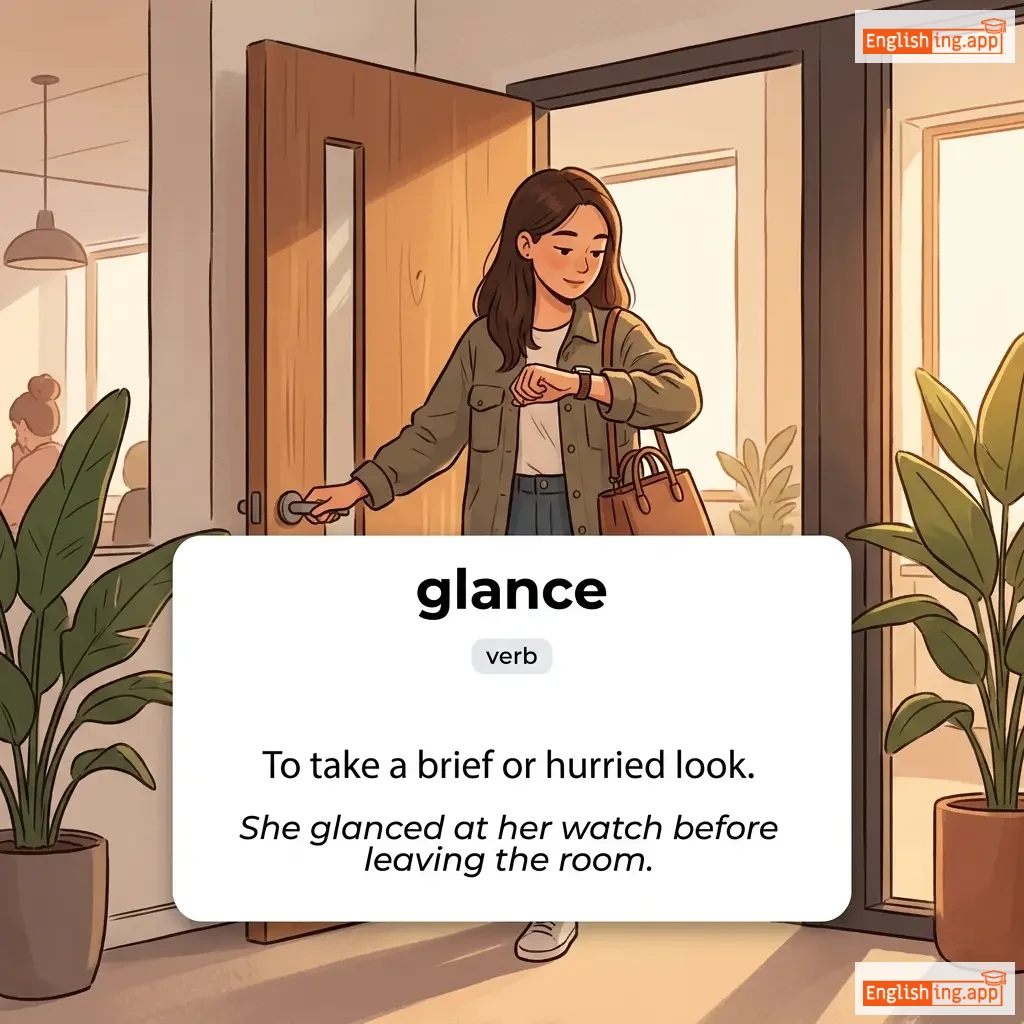
glance definition card — visual illustration of the meaning
verb
/ɡlæns/
झलक (jhalak)

To take a brief or hurried look.

"She glanced at her watch before leaving the room."

"वह कमरे से बाहर जाते समय अपनी घड़ी पर एक नज़र डाली।" (Vah kamre se bahar jate samay apni ghadi par ek nazar dali.)
verb
/ɡlɛr/
गुस्से वाली नजर / तीव्र रोशनी (gusse wali nazar / teevr roshni)

To stare angrily or to shine with a harsh bright light.

"She glared at him for being late."

"उसने उसे देर करने के लिए गुस्से में घूरा।" (usne use der karne ke liye gusse mein ghoora.)
adjective
/ˈɡlɛrɪŋ/
तेज / स्पष्ट (tej / spasht)

Extremely obvious or shining intensely.

"There was a glaring mistake in the report."

"रिपोर्ट में एक स्पष्ट गलती थी।" (report mein ek spasht galti thi.)
noun
/ɡlæs/
कांच (kaanch)

a hard, transparent material used for windows, bottles, and other objects

"She poured water into a glass and handed it to me."

"उसने पानी एक गिलास में डाला और मुझे दिया।" (Usne paani ek gilaas mein daala aur mujhe diya.)
noun
/ˈɡlɑːs.weər/
काँच के बर्तन (kaanch ke bartan)

objects made of glass, especially drinking glasses and decorative objects

"The wedding registry included fine glassware."

"वेडिंग रजिस्ट्री में शानदार काँच के बर्तन शामिल थे।" (wedding registry mein shandar kaanch ke bartan shamil the.)
noun
/ˈɡlæsi fɪʃ/
पारदर्शी मछली (paardarshi machhli)

a transparent freshwater fish with a glassy appearance, popular in aquariums

"The glassy fish is known for its transparent body and peaceful nature."

"ग्लैसी मछली अपने पारदर्शी शरीर और शांत स्वभाव के लिए जानी जाती है।" (Glassy machhli apne paardarshi shareer aur shaant swabhav ke liye jani jaati hai.)
verb
/ɡleɪz/
लेप करना (lep karna)

to cover with a smooth, shiny surface; to coat with a glossy finish

"The chef glazed the cake with chocolate."

"शेफ ने केक को चॉकलेट से लेप किया।" (Shef ne kek ko chocolate se lep kiya.)
noun
/ˈɡleɪziər/
ग्लेज़ियर (glazier)

a person whose job is to fit glass into windows and doors

"The glazier repaired the broken window in our house."

"ग्लेज़ियर ने हमारे घर की टूटी खिड़की को ठीक किया।" (Glazier ne hamare ghar ki tooti khidki ko thik kiya.)
noun, verb
/ɡliːm/
झलक (jhalak)

a small or brief shining light; to shine softly

"A gleam of hope appeared in her eyes."

"उसकी आँखों में उम्मीद की एक झलक आई।" (Uski aankhon mein ummid ki ek jhalak aayi.)
verb
/ɡliːn/
संग्रह करना (sangrah karna)

to collect or gather slowly and bit by bit, especially information or crops left after harvest

"The journalist gleaned facts from several sources."

"पत्रकार ने कई स्रोतों से तथ्य एकत्र किए।" (Patrakar ne kai strot se tathya ekattha kiye.)
glib definition card — visual illustration of the meaning
adjective
/ɡlɪb/
मुलायम लेकिन दिखावा करने वाला (mulayam lekin dikhawa karne wala)

speaking easily but without sincerity or depth

"The politician gave a glib answer to a serious question."

"राजनीतिज्ञ ने गंभीर सवाल का एक मुलायम उत्तर दिया।" (Rajneetikne ne gambhir sawal ka ek mulayam uttar diya.)