वोकैबुलरीज

इंग्लिश वोकैबुलरी डिस्कवर, लर्न और मास्टर करें

adjective
/fɔːls/
झूठा (jhootha)

not true or correct; intended to deceive

"He was accused of giving false information."

"वह झूठी जानकारी देने का आरोपी था।" (Wah jhoothi jankari dene ka aaropi tha.)
noun
/ˈfɔːlshʊd/
झूठ (jhooth)

the state of being untrue or a lie

"He was punished for spreading falsehoods about his colleague."

"उसे अपने सहयोगी के बारे में झूठ फैलाने के लिए सजा मिली।" (Use apne sahyogi ke baare mein jhooth phailane ke liye saza mili.)
verb
/ˈfɔːlsɪfaɪ/
झूठा बनाना या गलत तरीके से प्रस्तुत करना (jhootha banana ya galat tareeke se prastut karna)

to make something false or to misrepresent

"He tried to falsify the documents to avoid taxes."

"उसने टैक्स से बचने के लिए दस्तावेजों को झूठा बनाने की कोशिश की।" (Usne tax se bachne ke liye dastavezon ko jhootha banane ki koshish ki.)
verb
/ˈfɔːltər/
हिचकिचाना या ताकत/गति खोना (hichkichaana ya taqat/gati khona)

to hesitate or lose strength or momentum

"Her voice faltered as she delivered the speech."

"जब उसने भाषण दिया तो उसकी आवाज़ हिचकिचाई।" (Jab usne bhaashan diya to uski aawaaz hichkichayi.)
noun
/feɪm/
प्रसिद्धि (prasiddhi)

the state of being known or recognized by many people

"She achieved worldwide fame for her acting."

"उसने अभिनय के लिए दुनिया भर में प्रसिद्धि प्राप्त की।" (Usne abhinay ke liye duniya bhar mein prasiddhi praapt ki.)
adjective
/fəˈmɪliər/
परिचित (parichit)

Well known or easily recognized from previous experience.

"The town looked familiar to me after so many years."

"इतने सालों बाद यह शहर मुझे परिचित सा लगा।" (Itne salon baad yah shahar mujhe parichit sa laga.)
👨‍👩‍👧‍👦

family (फैमिली)

noun
/ˈfæməli/
परिवार (parivar)

A group consisting of parents and their children, or all the descendants of a common ancestor.

"She spends most of her weekends with her family."

"वह अपने अधिकांश सप्ताहांत अपने परिवार के साथ बिताती है।" (Vah apne adhikansh saptahant apne parivar ke saath bitati hai.)
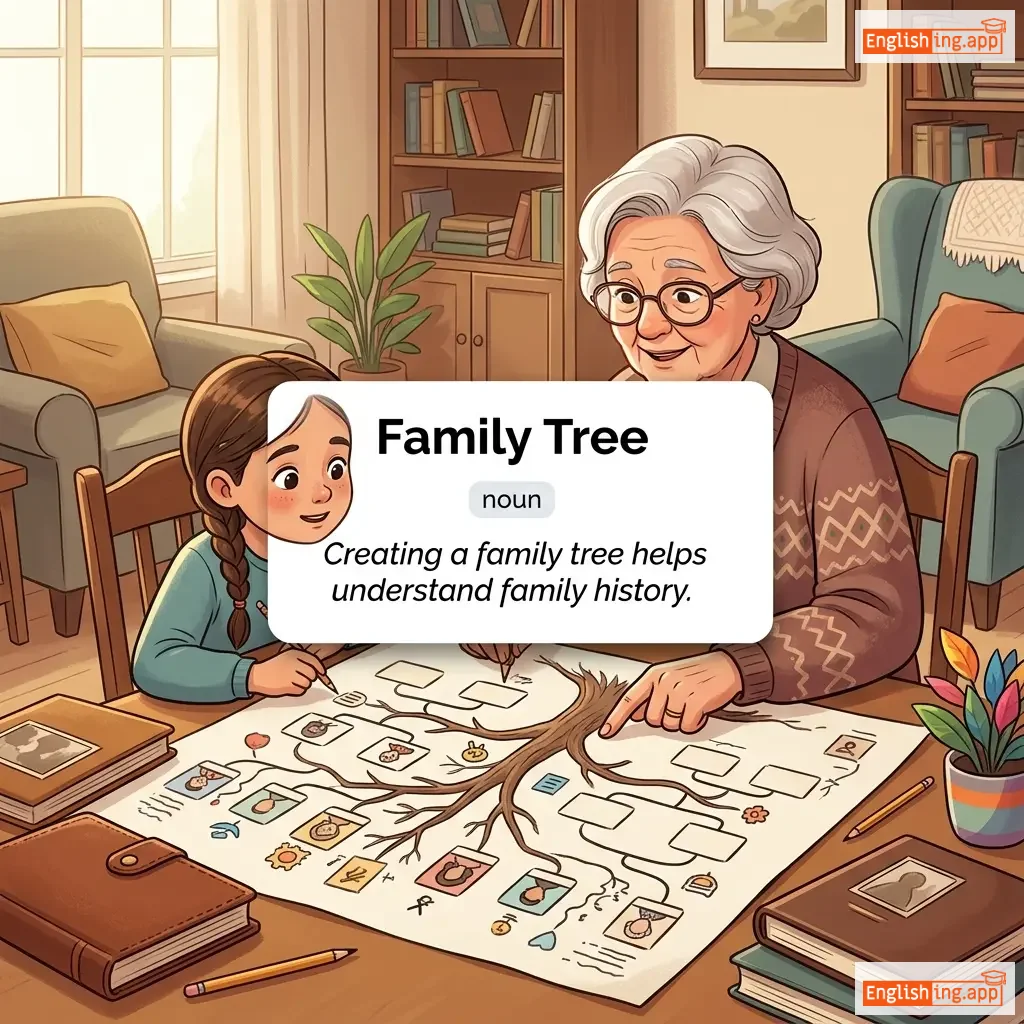
Family Tree definition card — visual illustration of the meaning
noun
ˈfæmɪli triː
कुटुंब वृक्ष (kutumb vriksh)

A diagram showing the relationships between people in several generations of a family.

"Creating a family tree helps understand family history."

"कुटुंब वृक्ष बनाना परिवार के इतिहास को समझने में मदद करता है।" (Kutumb vriksh banana parivaar ke itihaas ko samajhne mein madad karta hai.)
noun
/ˈfæm.ɪn/
अकाल (akaal)

extreme scarcity of food; a period when food is extremely scarce

"The severe drought led to widespread famine in the region."

"गंभीर सूखा क्षेत्र में व्यापक अकाल का कारण बना।" (gambhir sukha kshetra mein vyapak akaal ka kaaran bana.)
verb
/ˈfæmɪʃ/
भुखमरी (bhukhmari)

to suffer or cause to suffer from extreme hunger

"The stranded hikers began to famish after several days without food."

"द stranded hikers began to famish after several days without food." (d stranded hikers began to famish after several days without food.)
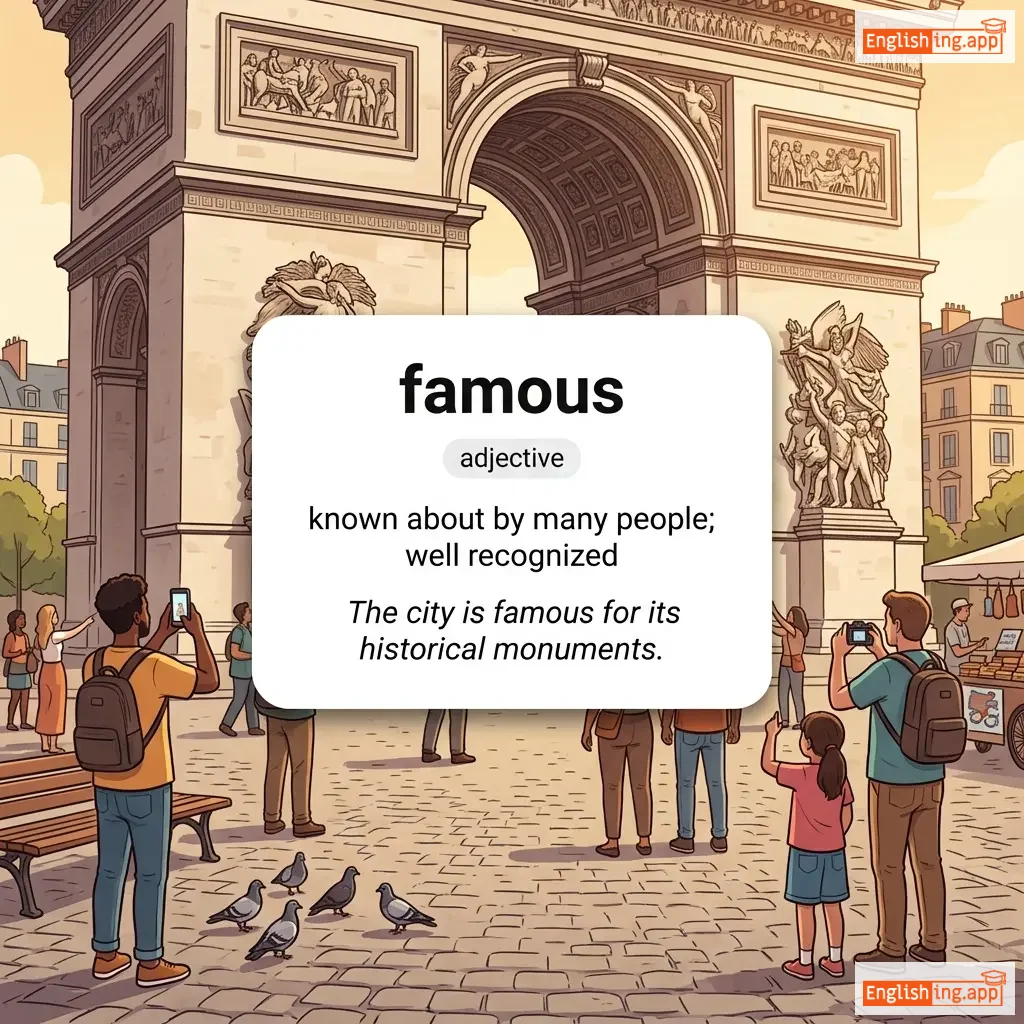
famous definition card — visual illustration of the meaning
adjective
/ˈfeɪməs/
प्रसिद्ध (prasiddh)

known about by many people; well recognized

"The city is famous for its historical monuments."

"यह शहर अपने ऐतिहासिक स्मारकों के लिए प्रसिद्ध है।" (Yeh shahar apne aitihasik smarakon ke liye prasiddh hai.)
noun
/fæn/
खुशी (khushi)

a device with rotating blades that creates a current of air; also a person who admires or supports someone or something

"The fan kept the room cool during the hot summer day."

"जब उसे पुरस्कार मिला, तो वह अपनी खुशी छुपा नहीं सकी।" (Jab use puraskar mila, to vah apni khushi chhupa nahi sakee.)
noun
/fəˈnætɪk/
उत्साही व्यक्ति (utsahi vyakti)

a person with extreme and uncritical enthusiasm for a cause or belief

"He is a football fanatic, never missing a match of his favorite team."

"वह एक फुटबॉल फैनेटिक है, अपनी पसंदीदा टीम का कोई भी मैच मिस नहीं करता।" (Vah ek football fanatic hai, apni pasandida team ka koi bhi match miss nahi karta.)
adjective
/fəˈnætɪkəl/
उत्साही (utsahi)

showing extreme enthusiasm or obsession

"She has a fanatical interest in collecting vintage stamps."

"उसकी पुरानी स्टांप संग्रह में अत्यधिक रुचि है।" (Uski purani stamp sangrah mein atyadhik ruchi hai.)
noun
/fəˈnætɪsɪzəm/
उन्माद (unmad)

the quality of being fanatical; extreme zeal or obsession

"Religious fanaticism can lead to intolerance and conflict."

"धार्मिक उन्माद असहिष्णुता और संघर्ष की ओर ले जा सकता है।" (Dharmik unmad asahishnuta aur sangharsh ki or le ja sakta hai.)
adjective
/ˈfænsiːd/
कल्पित, इच्छित (kalpit, ichhit)

imagined, desired, or believed without evidence

"He is a fancied suitor in the eyes of the young lady."

"वह युवा लड़की की नजरों में एक कल्पित प्रेमी है।" (Wah yuva ladki ki nazron mein ek kalpit premi hai.)
noun
/ˈfænsiər/
रुचिकर व्यक्ति (ruchikar vyakti)

a person who has a special interest in a particular thing or activity, especially animals or hobbies

"He is a fancier of rare birds."

"वह दुर्लभ पक्षियों का फैंसियर है।" (Vah durlabh pakshiyon ka fancier hai.)
adjective
/ˈfæn.sɪ.fəl/
काल्पनिक, अवास्तविक (kalpnik, avastavik)

overimaginative, unrealistic, or whimsical

"The story was too fanciful to be true."

"कहानी सच होने के लिए बहुत अधिक काल्पनिक थी।" (Kahani sach hone ke liye bahut adhik kalpnik thi.)
adjective
/ˈfæn.sɪ.ləs/
कल्पनाशून्य, सामान्य (kalpanashunya, samanya)

without imagination or creativity; plain or ordinary

"His drawings were simple and fanciless."

"उसकी ड्रॉइंग साधारण और कल्पनाशून्य थी।" (Uski drawing saadharan aur kalpanashunya thi.)
verb
/ˈfæn.si/
चाहना, पसंद करना, कल्पना करना (chahna, pasand karna, kalpana karna)

to imagine, desire, or like something; to have a liking for

"She fancies a cup of tea in the morning."

"वह सुबह एक कप चाय पसंद करती है।" (Woh subah ek kap chai pasand karti hai.)
noun
/ˈfæn.feər/
धूमधाम, प्रचार (dhoomdham, prachar)

a short ceremonial tune or display of publicity to attract attention

"The new product was launched with much fanfare."

"नए उत्पाद को धूमधाम के साथ लॉन्च किया गया था।" (Naye utpaad ko dhoomdham ke saath launch kiya gaya tha.)
adjective
/fænˈtæstɪk/
शानदार (shandar)

extraordinary, extremely good or impressive

"The concert last night was absolutely fantastic."

"कल रात का कॉन्सर्ट बिल्कुल शानदार था।" (Kal raat ka concert bilkul shandar tha.)
noun
/ˈfæntəsi/
काल्पनिकता (kalpnikata)

a creation of the imagination, especially something improbable or impossible

"She has a vivid fantasy about traveling to space."

"उसकी अंतरिक्ष यात्रा के बारे में एक जीवंत काल्पनिकता है।" (Uski antariksh yatra ke baare mein ek jeevant kalpnikata hai.)
adverb
/fɑːr/
दूर (door)

at, to, or by a great distance

"The school is far from my house."

"स्कूल मेरे घर से बहुत दूर है।" (School mere ghar se bahut door hai.)
adjective
/ˌfɑːrˈfɛtʃt/
असंभव (asambhav)

unlikely to happen or be true; improbable

"His explanation for being late was a bit far-fetched."

"उसकी देर से आने की व्याख्या थोड़ी असंभव थी।" (Uski der se aane ki vyakhya thodi asambhav thi.)
noun
/fɑːrs/
नाटकात्मक बकवास (naatakmaatmak bakwaas)

a comic dramatic work using buffoonery and horseplay, or a ridiculous situation

"The meeting turned into a complete farce with everyone arguing."

"बैठक पूरी तरह से एक बकवास में बदल गई जब सभी बहस कर रहे थे।" (Baithak poori tarah se ek bakwaas mein badal gayi jab sabhi behas kar rahe the.)
noun
/fɛər/
भाड़ा (bhada)

the money paid for a journey on public transport; also food or treatment provided

"The bus fare to the city center is five dollars."

"शहर केंद्र तक बस का भाड़ा पाँच डॉलर है।" (Shahar kendra tak bas ka bhada paanch dollar hai.)
noun
/ˌfer.ˈwel/
अलविदा (alvida)

an act of parting or of marking someone's departure

"The company organized a farewell party for the retiring manager."

"कंपनी ने सेवानिवृत्त प्रबंधक के लिए एक अलविदा पार्टी आयोजित की।" (company ne sevanivritt prabandhak ke liye ek alvida party aayojit ki.)
adjective
/ˌfɑːrˈfetʃt/
अविश्वसनीय या असंभव (avishwasniya ya asambhav)

unlikely to happen or be true; improbable

"His explanation for being late sounded farfetched."

"उसकी देर होने की व्याख्या अवास्तविक लग रही थी।" (Uski der hone ki vyakhya avastavik lag rahi thi.)
noun
/fɑːrm/
खेत (khet)

an area of land used for growing crops and raising animals

"They live on a farm with many animals."

"वे एक खेत में रहते हैं जहाँ कई जानवर होते हैं।" (Ve ek khet mein rehte hain jahan kai janwar hote hain.)
noun
/ˈfɑːrmər/
किसान (kisan)

a person who owns or manages a farm

"The farmer works hard to grow crops."

"किसान फसल उगाने के लिए कड़ी मेहनत करता है।" (Kisan fasal ugane ke liye kadi mehnat karta hai.)
noun
/ˈfɑː.mɪŋ/
कृषिकर्म (krishikarm)

the activity or business of growing crops and raising animals for food or other products

"Farming requires both hard work and knowledge about the land."

"कृषिकर्म के लिए कड़ी मेहनत और भूमि के बारे में ज्ञान दोनों की आवश्यकता है।" (Krishikarm ke liye kadi mehnat aur bhumi ke baare mein gyaan dono ki aavashyakta hai.)
verb
/ˈfæs.ɪ.neɪt/
मोहित करना (mohit karna)

to attract and hold the attention of someone; to charm or captivate

"The magician's performance fascinated the audience."

"जादूगर का प्रदर्शन दर्शकों को मोहित कर गया।" (Jadugar ka pradarshan darshako ko mohit kar gaya.)
adjective
/ˈfæsɪneɪtɪŋ/
रोमांचक (romanchak)

extremely interesting or charming

"The history of ancient Egypt is truly fascinating."

"प्राचीन मिस्र का इतिहास सचमुच रोमांचक है।" (Prachin Misr ka itihas sachmuch romanchak hai.)
noun
/ˌfæs.ɪˈneɪ.ʃən/
आकर्षण; मोह; मोहिनी (akarshan, moho, mohini)

the power to fascinate someone; the state of being intensely interested

"Her fascination with ancient history led her to become an archaeologist."

"प्राचीन इतिहास में उसकी आकर्षण ने उसे एक पुरातत्वविद बनने के लिए प्रेरित किया।" (Prachin itihas mein uski akarsan ne use ek puratatvavid banne ke liye prerit kiya.)
fascist definition card — visual illustration of the meaning
adjective
ˈfæʃ.ɪst
फासीवादी (fasisvadi)

Relating to or characteristic of fascism; extremely authoritarian.

"Fascist governance undermines freedom."

"फासीवादी शासन स्वतंत्रता को कमजोर करता है।" (Fasisvadi shasan svatantrata ko kamzor karta hai.)
noun
/ˈfæʃ.ən/
फ़ैशन (fashion)

a popular or accepted style of clothing, behavior, or way of doing something

"She always keeps up with the latest fashion."

"वह हमेशा नवीनतम फैशन के साथ अद्यतित रहती है।" (Wah hamesha naveenatam fashion ke saath adyatit rahti hai.)
adjective
/ˈfæʃənəbəl/
फैशनेबल (fashionable)

Following the latest styles or trends in clothing, behavior, or ideas

"She always wears fashionable clothes to every party."

"वह हर पार्टी में हमेशा फैशनेबल कपड़े पहनती है।" (Vah har party mein hamesha fashionable kapde pehanti hai.)
adjective, adverb
/fæst/
तेज़, मजबूत रूप से स्थिर (tez, majboot roop se sthir)

moving or capable of moving at high speed; firm or securely fixed

"He drives very fast on the highway."

"वह हाईवे पर बहुत तेज़ ड्राइव करता है।" (Vah highway par bahut tez drive karta hai.)
verb
/ˈfæsən/
मजबूती से जोड़ना (majbooti se jodna)

To attach or secure something firmly in place

"Please fasten your seatbelt before the plane takes off."

"कृपया विमान उड़ान भरने से पहले अपनी सीटबेल्ट मजबूती से जोड़ें।" (Kripya viman udaan bharne se pehle apni seatbelt majbooti se jodein.)
adjective, adverb
/ˈfæstər/
तेज़ (tez)

moving or able to move quickly; more quickly than usual

"This car is faster than the old one."

"यह कार पुरानी से तेज़ है।" (Yeh car purani se tez hai.)
adjective
/ˈfæstɪst/
सबसे तेज (sabse tez)

moving or capable of moving at the highest speed

"Usain Bolt is the fastest runner in the world."

"उसैन बोल्ट दुनिया का सबसे तेज धावक है।" (Usain Bolt duniya ka sabse tez dhavak hai.)
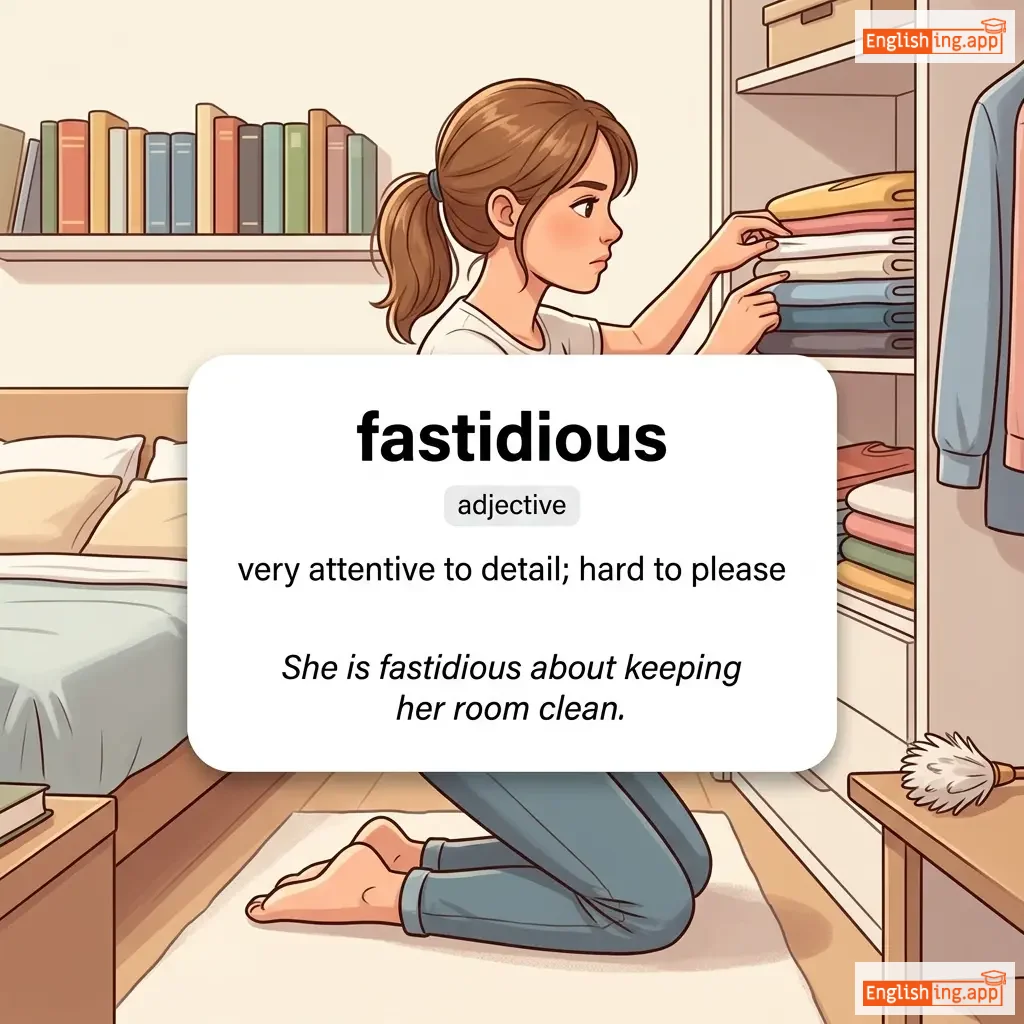
fastidious definition card — visual illustration of the meaning
adjective
/fæˈstɪdiəs/
चुस्त, बारीकी से ध्यान देने वाला (chust, bareeki se dhyaan dene wala)

very attentive to detail; hard to please

"She is fastidious about keeping her room clean."

"वह अपने कमरे को साफ रखने के बारे में अत्यधिक ध्यान देने वाली है।" (Wah apne kamre ko saaf rakhne ke baare mein atyadhik dhyaan dene wali hai.)
adjective, noun
/fæt/
मोटा (mota)

having a lot of excess flesh; a natural oily substance in animal bodies

"Eating too much fast food can make you fat."

"बहुत ज्यादा फास्ट फूड खाने से आप मोटे हो सकते हैं।" (Bahut zyada fast food khane se aap mote ho sakte hain.)
adjective
/ˈfeɪtl/
घातक (ghatak)

causing death; leading to disaster

"The accident proved fatal for the driver."

"दुर्घटना चालक के लिए घातक साबित हुई।" (Durghatna chaalak ke liye ghatak saabit hui.)
noun
/ˈfeɪ.tə.lɪ.zəm/
प्राकृतिकवाद (prakritikvad)

the belief that all events are predetermined and inevitable

"He embraced fatalism, believing that nothing he did could change his destiny."

"उसने प्राकृतिकवाद को अपनाया, यह विश्वास करते हुए कि जो कुछ भी उसने किया वह उसकी किस्मत को बदल नहीं सकता था।" (Usne prakritikvad ko apnaya, yeh vishwas karte hue ki jo kuch bhi usne kiya woh uski kismat ko badal nahi sakta tha.)
noun
/fəˈtæləti/
मृत्यु (mrityu)

An occurrence of death by accident, disaster, or violence.

"The accident resulted in one fatality."

"दुर्घटना में एक मृत्यु हुई।" (Durghatna mein ek mrityu hui.)
adverb
/ˈfeɪ.təl.i/
घातक रूप से (ghatak roop se)

in a way that causes death; with deadly consequences; critically

"The accident fatally injured two passengers."

"दुर्घटना ने दो यात्रियों को घातक रूप से घायल कर दिया।" (durghatna ne do yatrion ko ghatak roop se ghaayal kar diya.)
noun
/feɪt/
किस्मत (kismat)

the development of events beyond a person's control, regarded as determined by a supernatural power

"She believed it was her fate to become a teacher."

"वह मानती थी कि एक शिक्षक बनने के लिए उसकी किस्मत थी।" (Vah maanti thi ki ek shikshak banne ke liye uski kismat thi.)
adjective
/ˈfeɪt.fəl/
निर्णायक या भयावह (nirnayak ya bhayavah)

having significant or disastrous consequences

"Their fateful decision changed the course of history."

"उनका निर्णायक निर्णय इतिहास की धारा बदलने वाला था।" (Unka nirnayak nirnay itihas ki dhara badalne wala tha.)