वोकैबुलरीज

इंग्लिश वोकैबुलरी डिस्कवर, लर्न और मास्टर करें

noun
/frɪdʒ/
फ्रिज (frij)

a household appliance used to keep food and drinks cold to preserve freshness

"I put the milk back in the fridge after breakfast."

"नाश्ते के बाद मैंने दूध फ्रिज में रख दिया।" (nashtay ke baad maine doodh frij mein rakh diya)
noun
/fraɪd raɪs/
तला हुआ चावल (tala hua chawal)

a dish of cooked rice that has been stir-fried in a wok or frying pan

"We ordered chicken fried rice from the Chinese restaurant."

"हमने चाइनीज़ रेस्टोरेंट से चिकन फ्राइड राइस ऑर्डर किया।" (hamne chinese restaurant se chicken fried rice order kiya.)
noun
/frɛnd/
दोस्त (dost)

a person with whom one has a bond of mutual affection

"He is my best friend."

"वह मेरा सबसे अच्छा दोस्त है।" (Vah mera sabse accha dost hai.)
adjective
/ˈfrɛndli/
सुख (sukh)

Kind and pleasant; showing goodwill and affection.

"The shop owner is very friendly to new customers."

"वह पुरस्कार मिलने पर अपनी खुशी छिपा नहीं सकी।" (Wah puraskar milne par apni khushi chhupa nahi saki.)
noun
/ˈfrɛndʃɪp/
मित्रता (mitrata)

A close and trusting relationship between two or more people.

"Their friendship has lasted since childhood."

"उनकी मित्रता बचपन से चली आ रही है।" (Unki mitrata bachpan se chali aa rahi hai.)
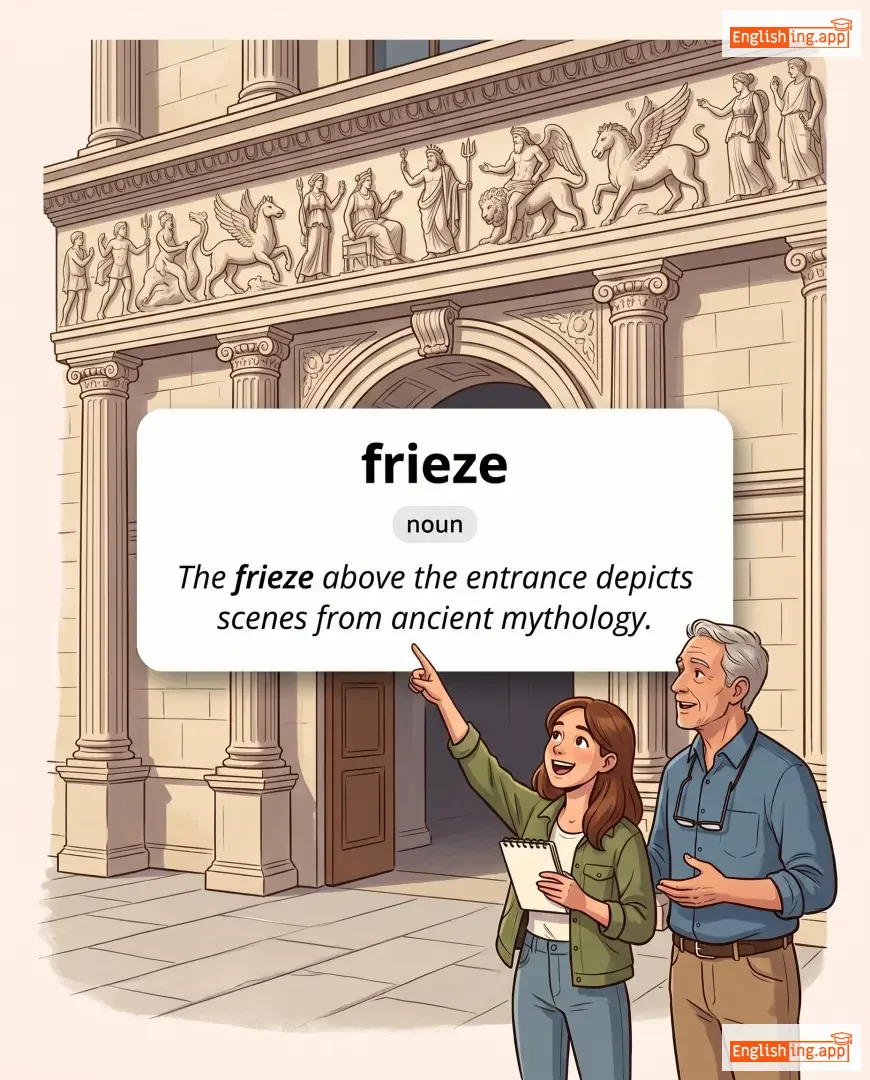
frieze definition card — visual illustration of the meaning
noun
/friːz/
फ्रीज़ (freez)

a decorative horizontal band, often sculpted or painted, usually on a wall near the ceiling

"The frieze above the entrance depicts scenes from ancient mythology."

"द्वार के ऊपर का फ्रीज़ प्राचीन मिथक से दृश्य चित्रित करता है।" (dwaar ke upar ka freez pracheen mithak se drishya chitrith karta hai)
noun
/fraɪt/
डर; भय; आश्चर्य (dar, bhay, aashcharya)

a sudden intense feeling of fear; a shock or surprise that causes fear

"The loud thunder gave her such a fright that she dropped her coffee cup."

"तेज़ गड़गड़ाहट ने उसे इतना डर दिया कि उसने अपनी कॉफी कप गिरा दी।" (tez gadgadahat ne use itna dar diya ki usne apni coffee cup gira di.)
verb
/ˈfraɪtən/
डराना (darana)

to cause fear or alarm in someone

"The loud noise frightened the child."

"तेज़ आवाज़ ने बच्चे को डरा दिया।" (tez aavaaz ne bachche ko dara diya)
adjective
/ˈfraɪtənd/
डरा हुआ (dara hua)

feeling fear or anxiety; scared

"The child was frightened by the loud noise."

"बच्चा तेज़ आवाज़ से डर गया।" (bachcha tez aavaaz se dar gaya)
adjective
/ˈfraɪtfəl/
भयावह (bhayavah)

causing fear or horror; very unpleasant

"The hikers faced frightful weather conditions on the mountain."

"हाइकरों को पहाड़ों पर भयावह मौसम की परिस्थितियों का सामना करना पड़ा।" (Haikaron ko pahaadon par bhayavah mausam ki paristhitiyon ka samna karna pada.)
adjective
/ˈfrɪdʒɪd/
अत्यधिक ठंडा (atyadhik thanda)

extremely cold in temperature; lacking warmth or friendliness

"The explorers endured frigid conditions in the Arctic."

"अन्वेषकों ने आर्कटिक में अत्यधिक ठंडा वातावरण सहन किया।" (Anveshako ne Arctic mein atyadhik thanda vatavaran sahan kiya.)
noun
/ˌfrɪdʒɪˈdɛːriəm/
ठंडा स्नानागार (thanda snanagar)

a large cold pool in ancient Roman baths used for cooling off after hot baths

"The ruins of the Roman frigidarium are still visible today."

"रोमन फ्रिज़िडारियम के खंडहर आज भी देखे जा सकते हैं।" (Roman frigidarium ke khandahar aaj bhi dekhe ja sakte hain.)
noun
/frɪndʒ/
किनारा / साज (kinara / saaj)

A decorative border of threads; the outer edge or margin of something.

"The festival had a fringe of small independent performances."

"त्योहार में छोटे स्वतंत्र प्रदर्शन का किनारा था।" (Tyohar mein chhote svatantra pradarshan ka kinara tha.)
verb
/frɪsk/
तलाशी लेना (talashi lena)

To search a person by patting their clothing to check for concealed items.

"The security guard frisked the man at the entrance."

"सुरक्षा गार्ड ने प्रवेश द्वार पर आदमी को तलाशी लिया।" (Suraksha guard ne pravesh dwaar par aadmi ko talashi liya.)
adjective
/ˈfrɪski/
चंचल; ऊर्जावान; खेल-खिलाड़ी; शरारती (frisky)

lively; energetic; playful; mischievous

"The frisky puppy ran around the garden playfully."

"चंचल पप्पी बगिया में खेल-खिलाड़ी की तरह दौड़ रहा था।" (chonchal pappi bagiya mein khel-khiladi ki tarah daud raha tha)
verb
/ˈfrɪtər/
व्यर्थ करना (vyarth karna)

To waste time, money, or energy on trivial matters.

"He frittered away his savings on unnecessary gadgets."

"उसने अपनी बचत अव्यावहारिक गैजेट्स पर व्यर्थ कर दी।" (Usne apni bachat avyavaharik gazets par vyarth kar di.)
noun
/frɪˈvɒləti/
तुच्छता / हल्कापन (tuchchhata / halkapan)

Lack of seriousness; silly or trivial behavior.

"The teacher discouraged frivolity during the exam."

"शिक्षक ने परीक्षा के दौरान तुच्छता को हतोत्साहित किया।" (Shikshak ne pareeksha ke dauran tuchchhata ko hatotsahit kiya.)
adjective
/ˈfrɪvələs/
निहायत हल्का (nihaayat halka)

Not having any serious purpose or value; silly or unimportant.

"She dismissed the frivolous complaint quickly."

"उसने निहायत हल्के शिकायत को जल्दी नकार दिया।" (Usne nihaayat halke shikayat ko jaldi nakar diya.)
verb
/frɪz/
बालों को कुंकीट करना या उलझा देना (baalon ko kunkit karna ya uljha dena)

to form into small, tight curls or cause hair to become fuzzy and tangled

"The humid weather caused her hair to frizz."

"आर्द्र मौसम ने उसके बालों को कुंकीट कर दिया।" (Aardra mausam ne uske baalon ko kunkit kar diya.)
verb
/ˈfrɪzəl/
तलना और कुरकुरा बनाना (talna aur kurkura banana)

to fry something until it becomes crisp and curled, or to make a sizzling noise

"The bacon began to frizzle in the pan."

"बेकन पैन में तलते हुए चटकने की आवाज़ करने लगा।" (Bekan pain mein talte hue chatakne ki aawaz karne laga.)
noun
/frɒk/
महिलाओं या लड़कियों का वस्त्र; एक ढीला बाहरी वस्त्र (mahilaon ya ladkiyon ka vastr; ek dheela baahari vastr)

a woman's or girl's dress; a loose outer garment

"She wore a beautiful frock to the party."

"वह पार्टी में एक सुंदर फ्रॉक पहने हुए थी।" (vah party mein ek sundar frock pahne hue thi.)
noun
/frɒɡ/
मेंढ़क (meṇḍhak)

a tailless amphibian with a short squat body, moist smooth skin, and very long hind legs for leaping

"The frog jumped into the pond with a splash."

"मेंढ़क ने पानी में छलांग लगाई और एक जोरदार छींटे के साथ गिर पड़ा।" (meṇḍhak ne pānī meṃ chhalāṅg lagāī aur ek joradār chīṅṭe ke sāth gir paṛā.)
verb
/ˈfrɒlɪk/
आनंद से खेलना (anand se khelna)

to play and move about cheerfully, energetically, or playfully

"The children frolicked in the garden all afternoon."

"बच्चे पूरे दोपहर बगीचे में आनंद से खेल रहे थे।" (Bachche poore dopahar bagiche mein anand se khel rahe the.)
adjective
/ˈfrɒlɪksəm/
उत्साही (utsahi)

full of playful spirit; lively and fun-loving

"The frolicsome puppy kept everyone entertained."

"उत्साही पिल्ला सभी को मनोरंजन में रखे हुए था।" (Utsahi pilla sabhi ko manoranjan mein rakhe hue tha.)
preposition
/frəm/ or /frʌm/
से (se)

Used to indicate the starting point of a journey, action, or source.

"She came from Dhaka to visit her family."

"वह अपने परिवार से मिलने के लिए ढाका से आई थी।" (vah apne parivar se milne ke liye Dhaka se aayi thi.)
noun
/frɒnd/
पत्ता (patta)

A large, divided leaf of a fern, palm, or similar plant.

"The fern's frond stretched gracefully over the garden path."

"फर्न का पत्ता बागीचे के रास्ते के ऊपर धीरे-धीरे फैल गया।" (Farn ka patta bageeche ke raste ke upar dheere-dheere phail gaya.)
noun
/frʌnt/
सामने (samne)

the forward-facing part of something

"The house has a garden in front."

"घर के सामने एक बग़ीचा है।" (Ghar ke samne ek bagicha hai.)
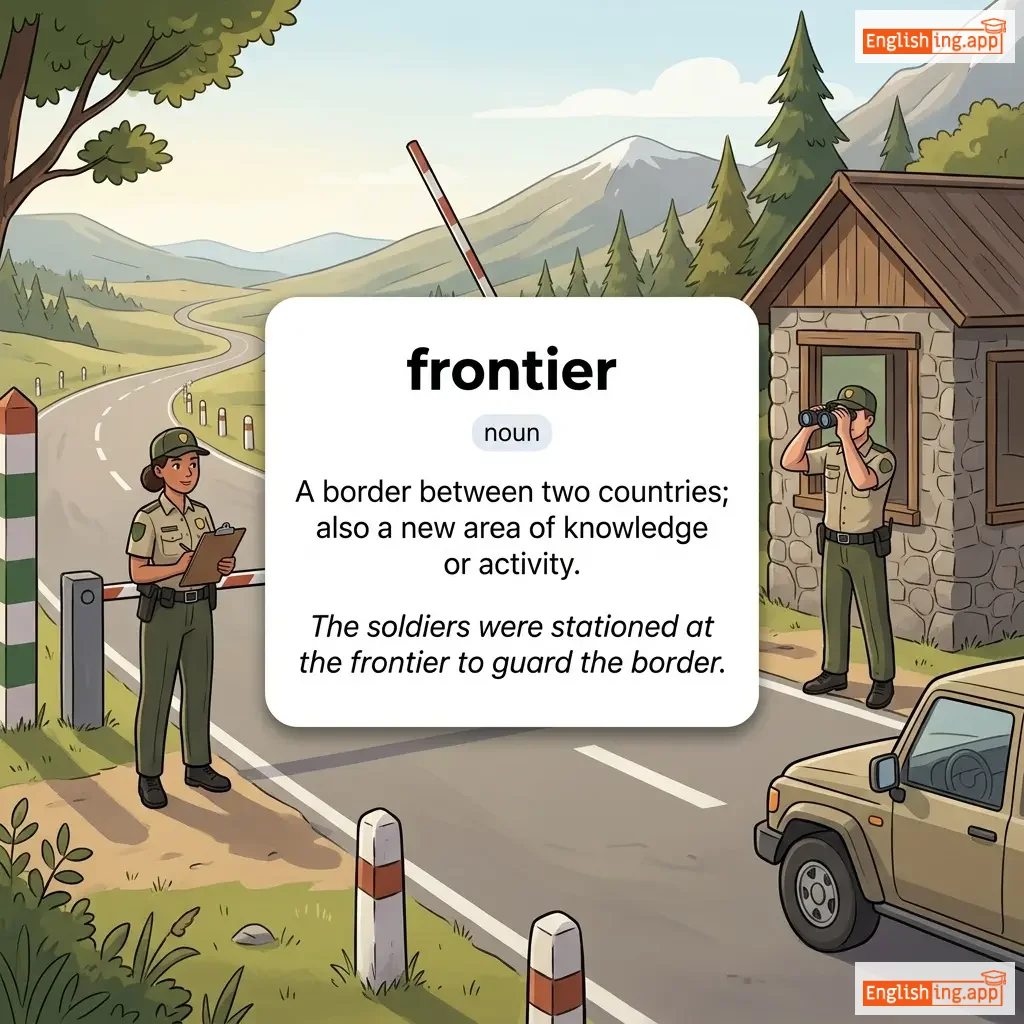
frontier definition card — visual illustration of the meaning
noun
/ˈfrʌntɪə(r)/
सीमा (seema)

A border between two countries; also a new area of knowledge or activity.

"The soldiers were stationed at the frontier to guard the border."

"सैन्य सीमा पर तैनात थे ताकि वे सीमा की सुरक्षा कर सकें।" (Sainya seema par tainat the taki ve seema ki suraksha kar sakein.)
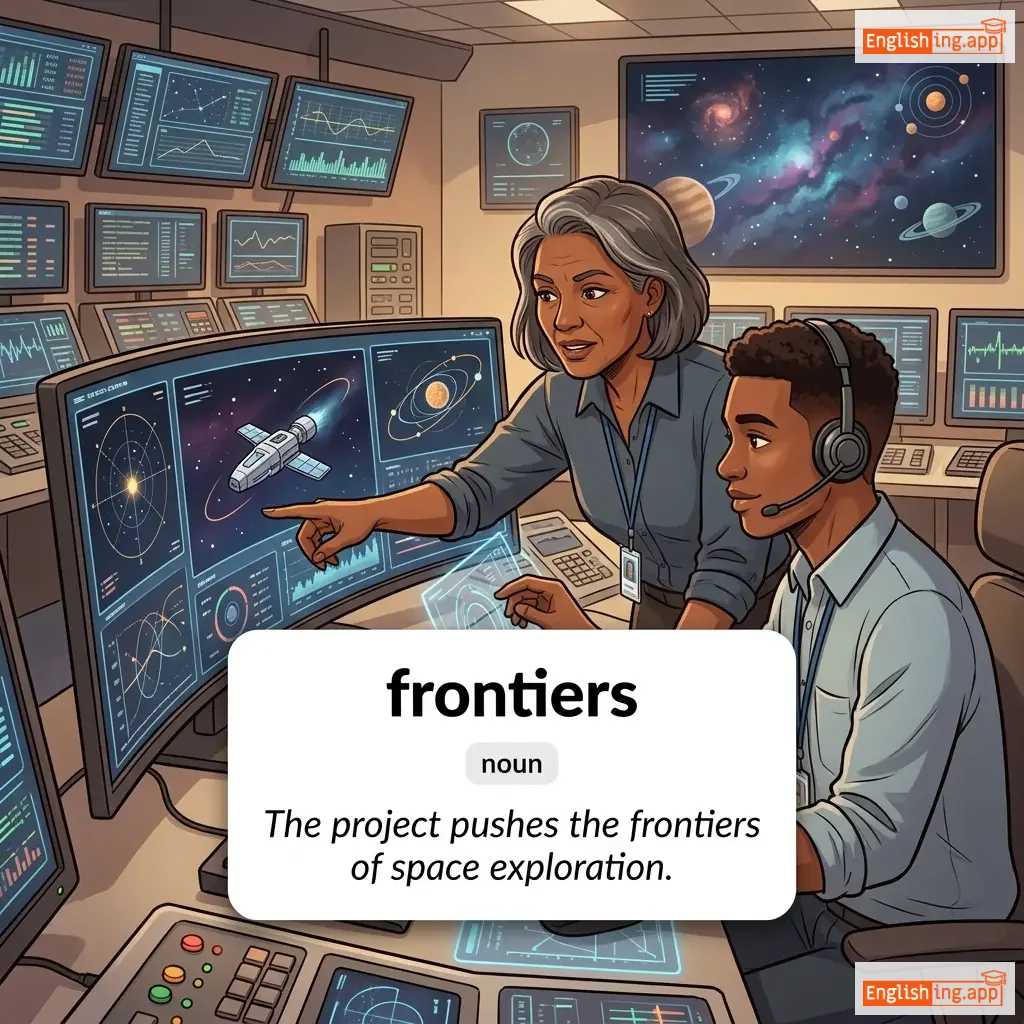
frontiers definition card — visual illustration of the meaning
noun
ˈfrʌn.tɪərz
सीमाएँ (seemaen)

The extreme limit of settled land beyond which lies wilderness; the limits of knowledge or achievement in a particular field.

"The project pushes the frontiers of space exploration."

"प्रोजेक्ट स्पेस अन्वेषण की सीमाओं को बढ़ाता है।" (Projekṭ space anveṣaṇ kī sīmāon ko baṛhātā hai.)
adjective
/ˈfrɒθi/
झागदार (jhagdar)

Full of or covered with small bubbles; light and insubstantial.

"She ordered a cup of frothy cappuccino."

"उसने एक कप झागदार कैप्पुचीनो ऑर्डर किया।" (Usne ek cup jhagdar cappuccino order kiya.)
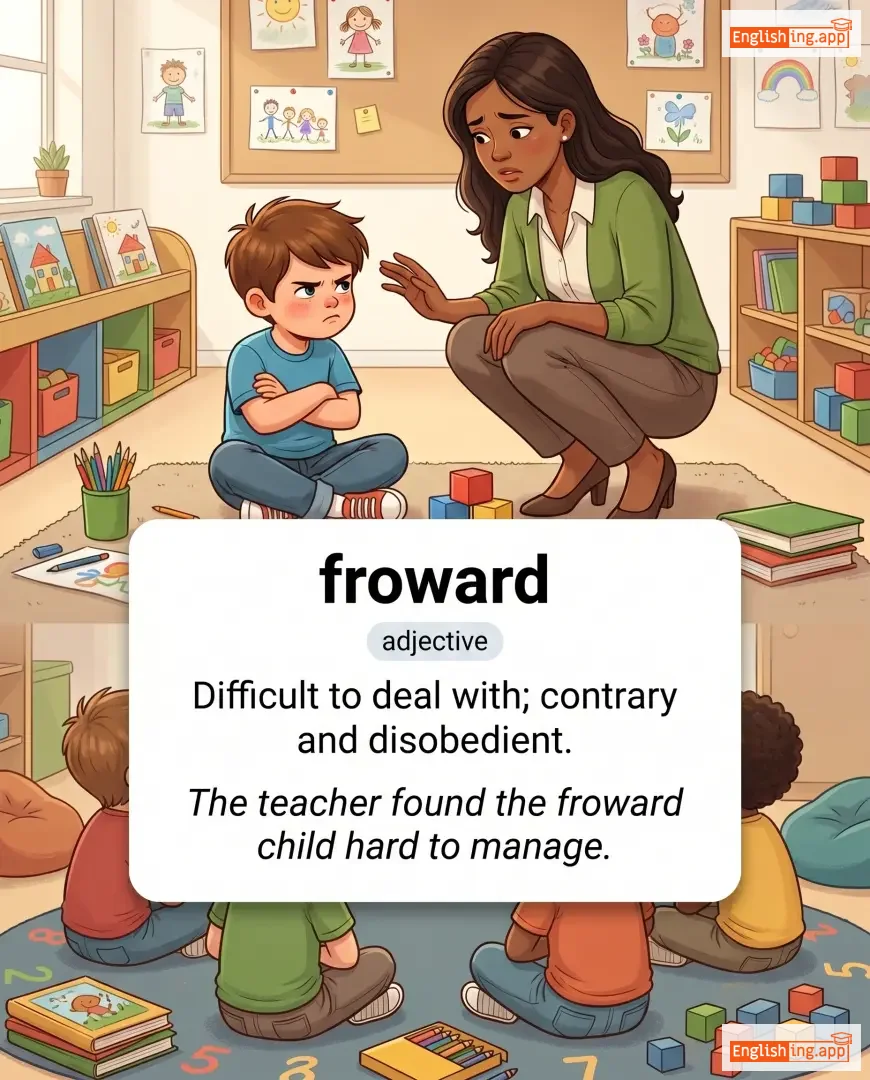
froward definition card — visual illustration of the meaning
adjective
/ˈfrəʊərd/
अधम (adhm)

Difficult to deal with; contrary and disobedient.

"The teacher found the froward child hard to manage."

"शिक्षक को फ्रोवार्ड बच्चे को संभालना कठिन लगा।" (Shikshak ko froward bachche ko sambhalna kathin laga.)
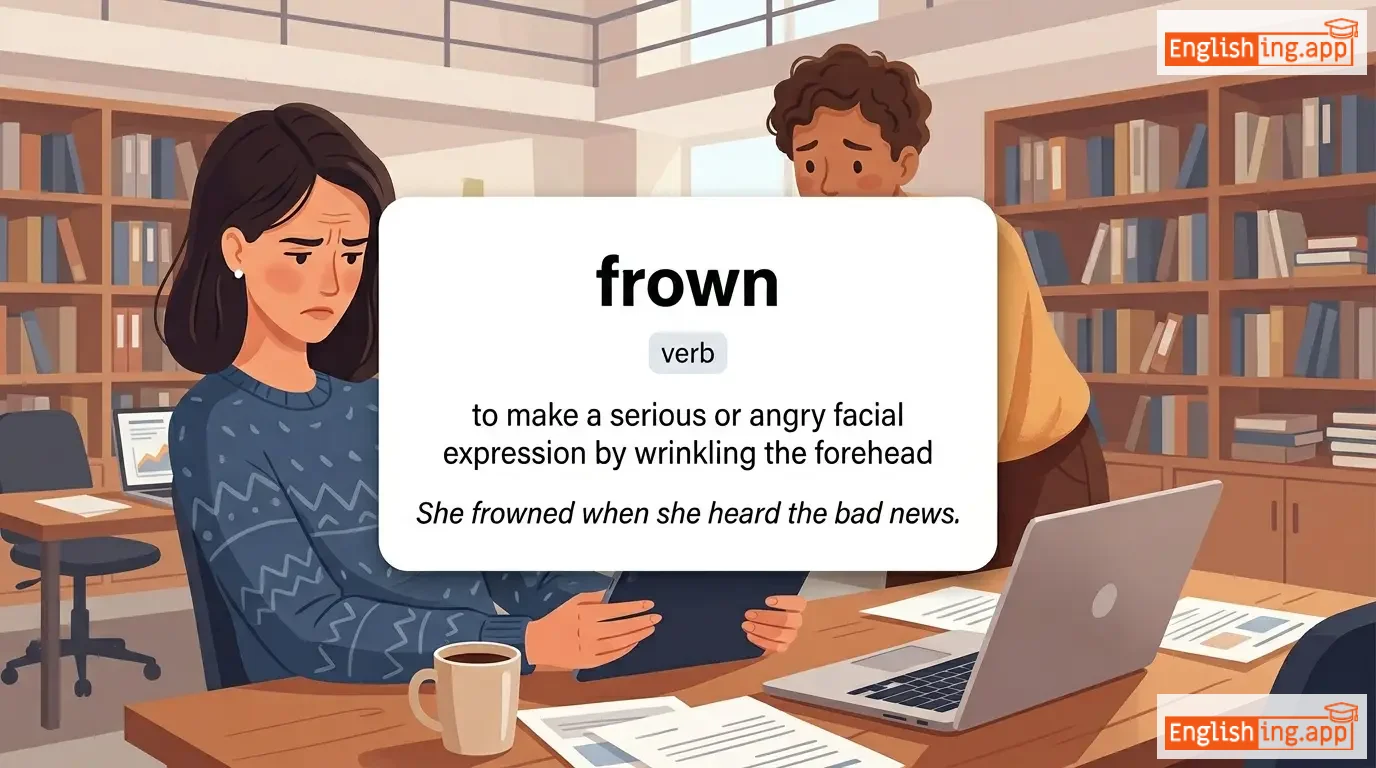
frown definition card — visual illustration of the meaning
verb
/fraʊn/
भ्रू सिकोड़ना (bhru sikodna)

to make a serious or angry facial expression by wrinkling the forehead

"She frowned when she heard the bad news."

"वह बुरी खबर सुनकर भ्रू सिकोड़ने लगी।" (Vah buri khabar sunkar bhru sikodne lagi.)
adjective
/ˈfraʊzi/
उलझा हुआ (uljha hua)

Scruffy and neglected in appearance; musty or stale in smell.

"He wore a frowsy old jacket that smelled of damp."

"उसने एक उलझा हुआ पुराना जैकेट पहना था जो नमी की महक से भरा था।" (Usne ek uljha hua purana jacket pehna tha jo nami ki mahak se bhara tha.)
adjective
/ˈfraʊzi/
बेतरतीब (beterateeb)

Unkempt, messy, or having a musty, unpleasant smell.

"He entered the room with a frowzy appearance after sleeping on the couch."

"वह सोफे पर सोने के बाद बेतरतीब दिखता हुआ कमरे में आया।" (Vah sofe par sone ke baad beterateeb dikhta hua kamre mein aaya.)
adjective
/ˈfroʊzən/
जम चुका (jam chuka)

preserved by being made extremely cold; turned into ice

"The lake was completely frozen during winter."

"झील सर्दियों में पूरी तरह से जम चुकी थी।" (Jheel sardiyon mein puri tarah se jam chuki thi.)
verb
/ˈfrʌktɪˌfaɪ/
फलवान करना (phalwan karna)

To make fruitful or productive; to bear fruit.

"The new policies will help fructify the economic potential of the region."

"नई नीतियाँ क्षेत्र की आर्थिक क्षमता को फलदार बनाने में मदद करेंगी।" (Nayi neetiyan kshetra ki arthik kshamata ko phaldar banane mein madad karengi.)
adjective
/ˈfruːɡəl/
मितव्ययी (mitvyayi)

Economical in use or expenditure; avoiding waste.

"She is very frugal and always saves a portion of her income."

"वह बहुत मितव्ययी है और हमेशा अपनी आय का एक हिस्सा बचाती है।" (Woh bahut mitvyayi hai aur hamesha apni aay ka ek hissa bachati hai.)
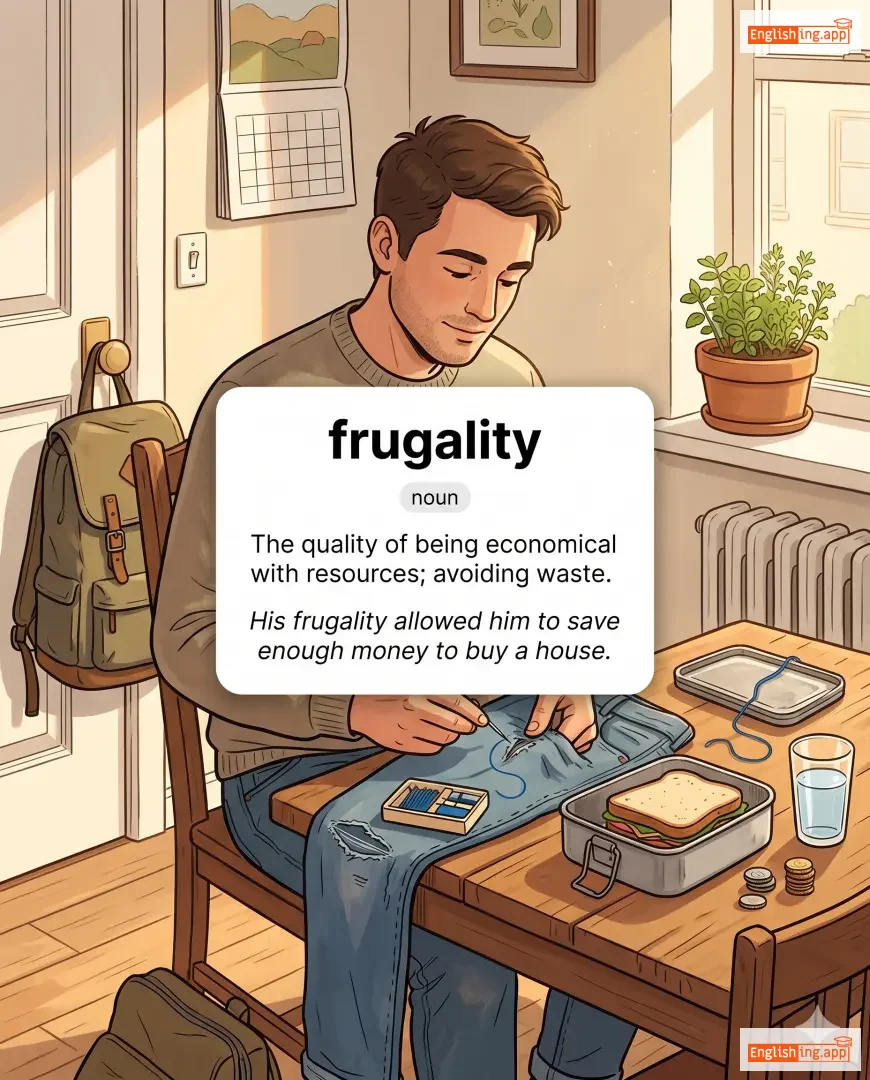
frugality definition card — visual illustration of the meaning
noun
/fruːˈɡæləti/
मितव्ययिता (mitvyayita)

The quality of being economical with resources; avoiding waste.

"His frugality allowed him to save enough money to buy a house."

"उसकी मितव्ययिता ने उसे एक घर खरीदने के लिए पर्याप्त पैसे बचाने में मदद की।" (Uski mitvyayita ne use ek ghar kharidne ke liye paryapt paise bachane mein madad ki.)
noun
/fruːt/
फल (phal)

The sweet and fleshy product of a plant that contains seeds.

"Mango is my favorite fruit."

"आम मेरा पसंदीदा फल है।" (Aam mera pasandeeda phal hai.)
adjective
/ˈfruːtfəl/
उपयोगी (upayogi)

Producing good results or being productive.

"Their meeting was fruitful and led to many new ideas."

"उनकी बैठक फलदायी थी और इसने कई नए विचारों को जन्म दिया।" (Unki baithak phaldayi thi aur isne kai naye vicharon ko janm diya.)
noun
/fruˈɪʃən/
पूरणता (poornata)

The realization or fulfillment of a plan, project, or desire.

"Her dream of becoming a doctor finally came to fruition."

"डॉक्टर बनने का उसका सपना अंततः पूरा हुआ।" (Doktar banne ka uska sapna antatah poora hua.)
adjective
/ˈfruːt.ləs/
व्यर्थ; निरर्थक; निराजक; (vyarth; nirarthak; nirajak)

unsuccessful; futile; pointless;

"After hours of searching, their efforts proved fruitless."

"घंटों की खोज के बाद, उनके प्रयास व्यर्थ साबित हुए।" (ghanton ki khoj ke baad, unke prayaas vyarth saabit hue.)
verb
/ˈfrʌstreɪt/
निराश करना (nirash karna)

To prevent someone from accomplishing something; to cause feelings of annoyance or disappointment.

"The constant delays frustrated the team."

"लगातार देरी ने टीम को निराश कर दिया।" (Lagatar deri ne team ko nirash kar diya.)
adjective
/ˈfrʌstreɪtɪd/
निराश (nirash)

feeling annoyed or upset because of inability to achieve something

"She felt frustrated after failing the exam."

"वह परीक्षा में फेल होने के बाद निराश महसूस कर रही थी।" (Vah pariksha mein fel hone ke baad nirash mahsus kar rahi thi.)
adjective
/ˈfrʌstreɪtɪŋ/
निराशाजनक (niraashajanak)

causing annoyance or dissatisfaction

"The slow internet connection was really frustrating."

"धीमी इंटरनेट कनेक्शन वाकई निराशाजनक था।" (Dheemi internet connection waakai niraashajanak tha.)
noun
/frʌˈstreɪʃən/
निराशा (niraasha)

The feeling of being upset or annoyed due to inability to achieve something.

"He felt deep frustration when his plans failed."

"जब उसकी योजनाएँ विफल हुईं, तो उसने गहरी निराशा महसूस की।" (Jab uski yojanayein viphal hui, to usne gehri niraasha mehsoos ki.)
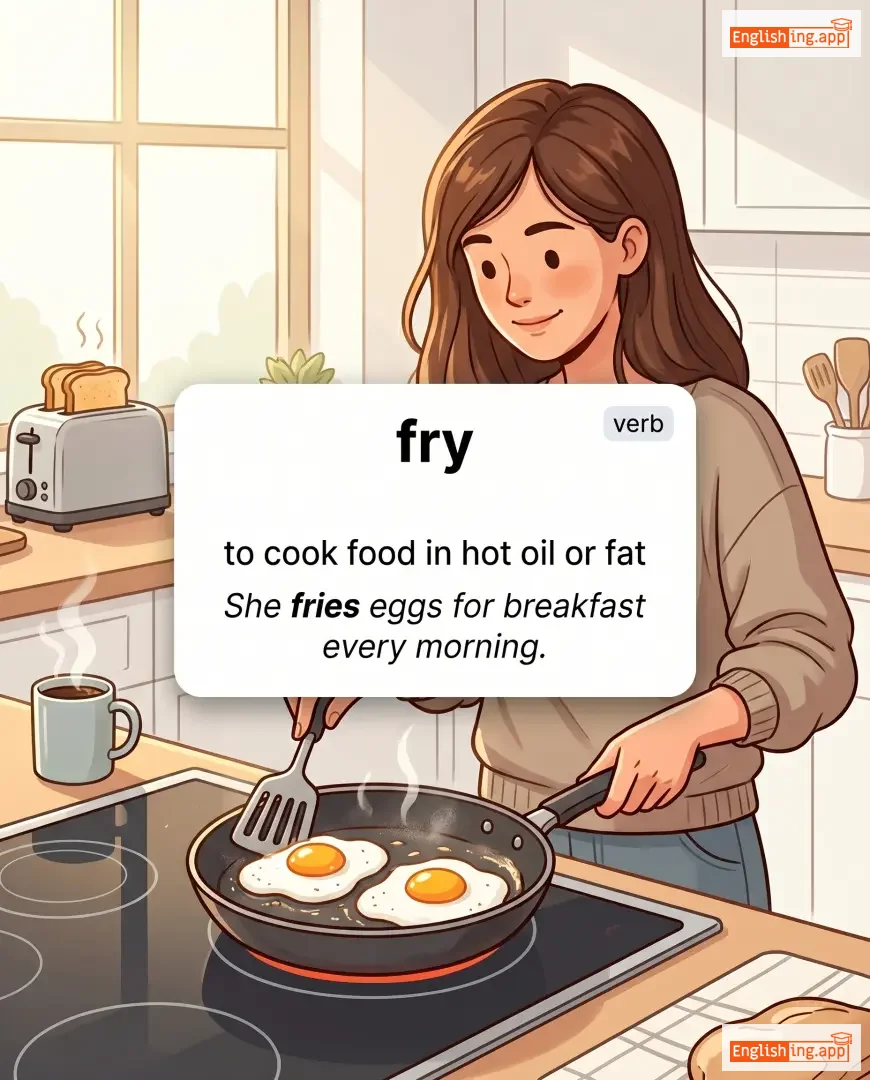
fry definition card — visual illustration of the meaning
noun
/fraɪ/
छोटी मछली (chhoti machhli)

young fish; small fish; to cook food in hot fat or oil

"The fisherman caught many small fry in his net."

"मछुआरे ने अपने जाल में कई छोटी मछलियाँ पकड़ीं।" (machhuaare ne apne jaal mein kai chhoti machhliyaan pakdin)
adjective, adverb (informal, vulgar)
/ˈfʌkɪŋ/
काफ़ी खराब (अश्लील जोरदार शब्द) (kafi kharab (ashlil joradar shabd))

used for emphasis, often expressing anger or frustration (vulgar slang)

"It was a fucking disaster!"

"यह एक बकवास आपदा थी!" (Yeh ek bakwas aapda thi!)
verb
/ˈfʌdəl/
भ्रमित करना (bhramit karna)

To confuse or stupefy, especially with alcohol or overwhelming information.

"The complicated instructions fuddled the new employees."

"जटिल निर्देशों ने नए कर्मचारियों को भ्रमित कर दिया।" (Jatil nirdeshon ne naye karmachariyon ko bhramit kar diya.)
noun/verb
/ˈfjuːəl/
ईंधन (indhan)

A material such as coal, gas, or oil that is burned to produce energy; also to supply with energy or power.

"The car needs fuel to run efficiently."

"गाड़ी को कुशलतापूर्वक चलाने के लिए ईंधन की आवश्यकता है।" (Gaadi ko kushalta purvak chalane ke liye indhan ki avashyakta hai.)