वोकैबुलरीज

इंग्लिश वोकैबुलरी डिस्कवर, लर्न और मास्टर करें

verb
/ɪnˈtʃænt/
मोहित करना (mohit karna)

to delight or charm greatly; to cast a spell over

"The storyteller enchanted the children with his tales."

"कहानीकार ने अपनी कहानियों से बच्चों को मोहित किया।" (Kahaniakar ne apni kahaniyon se bachon ko mohit kiya.)
verb
/ɪnˈsaɪfər/
कोड या सिफर में संदेश को बदलना (kodh ya sifar mein sandesh ko badalna)

to convert a message into code or cipher

"The agent enciphered the secret message before sending it."

"एजेंट ने संदेश को भेजने से पहले उसे एन्सीफर किया।" (Agent ne sandesh ko bhejne se pehle use encipher kiya.)
verb
/ɪnˈsɜːrkəl/
घेरना (gherna)

to form a circle around something

"The protesters encircled the building in a human chain."

"प्रदर्शनकारियों ने एक मानव श्रृंखला में भवन को घेर लिया।" (Pradarshankariyon ne ek manav shrenkala mein bhavan ko ghera liya.)
noun
/ˈɛn.kleɪv/
एनक्लेव (enclave)

a distinct area or group enclosed within a larger one

"The city has a small Italian enclave where traditions are preserved."

"शहर में एक छोटा इटालियन एनक्लेव है जहाँ परंपराएँ संरक्षित हैं।" (Shahar mein ek chhota Italian enclave hai jahan paramparayein sanrakshit hain.)
adjective
/ˌɛnkəˈmiːæstɪk/
प्रशंसा करनेवाला (prashamsa karnewala)

Expressing praise; laudatory.

"The book was filled with encomiastic remarks about the author."

"किताब लेखक के बारे में प्रशंसा करनेवाले टिप्पणी से भरी हुई थी।" (kitaab lekhak ke baare mein prashamsa karnewala tippani se bhari hui thi.)
encomium definition card — visual illustration of the meaning
noun
/ɛnˈkoʊmiəm/
प्रशंसा भाषण (prashansa bhashan)

A speech or piece of writing that praises someone or something highly.

"He delivered an encomium to his retiring teacher."

"उसने अपने सेवानिवृत्त शिक्षक के लिए एक प्रशंसा भाषण दिया।" (usne apne sewanivritt shikshak ke liye ek prashansa bhashan diya.)
verb
/ɪnˈkʌmpəs/
आवरण करना (aavaran karna)

To include comprehensively; to surround or encircle.

"The project will encompass all aspects of rural development."

"यह परियोजना ग्रामीण विकास के सभी पहलुओं को शामिल करेगी।" (Yeh pariyojna grameen vikas ke sabhi pehluon ko shaamil karegi.)
noun
/ˈɑːnkɔːr/
अतिरिक्त प्रदर्शन (atirikt pradarshan)

An additional performance demanded by an audience at the end of a show.

"The band returned to the stage for an encore."

"बैंड मंच पर एक और प्रदर्शन के लिए लौटी।" (band manch par ek aur pradarshan ke liye lautii.)
verb
/ɪnˈkaʊntər/
सामना करना / मुलाकात करना (samna karna / mulakat karna)

to unexpectedly meet someone or experience something, especially something difficult or new

"During the hike, we encountered a wild bear."

"हाइक के दौरान, हमने एक जंगली भालू से सामना किया।" (Haik ke dauran, humne ek jangli bhaloo se samna kiya.)
encourage definition card — visual illustration of the meaning
verb
/ɪnˈkʌrɪdʒ/
प्रोत्साहित करना (protsahit karna)

To give support, confidence, or hope to someone.

"Parents should encourage their children to read daily."

"माता-पिता को अपने बच्चों को रोज़ाना पढ़ने के लिए प्रोत्साहित करना चाहिए।" (Mata-pita ko apne bachchon ko rozana padhne ke liye protsahit karna chahiye.)
noun
/ɪnˈkʌrɪdʒmənt/
प्रोत्साहन (protsahan)

the action of giving someone support, confidence, or hope

"Her encouragement helped me finish the project."

"उसका प्रोत्साहन ने मुझे प्रोजेक्ट पूरा करने में मदद की।" (Uska protsahan ne mujhe project pura karne mein madad ki.)
adjective
/ɪnˈkʌrɪdʒɪŋ/
उत्साहवर्धक (utsahvardhak)

giving someone support or confidence; optimistic

"Her words were very encouraging during the hard times."

"उसके शब्द कठिन समय में बहुत उत्साहवर्धक थे।" (Uske shabd kathin samay mein bahut utsahvardhak the.)
verb
/ɪnˈkrəʊtʃ/
सुख (sukh)

to gradually take over or intrude on someone’s rights, territory, or space

"The buildings began to encroach on the protected forest land."

"जब उसे पुरस्कार मिला, तो वह अपनी खुशी छुपा नहीं सकी।" (Jab use puraskar mila, to vah apni khushi chhupa nahi saki.)
noun
/ɪnˈkrəʊtʃmənt/
अतिक्रमण (atikramaṇ)

the act of gradually intruding or taking over someone’s rights, land, or space

"The villagers protested against the encroachment on their farmland."

"ग्रामवासियों ने अपनी भूमि पर अतिक्रमण के खिलाफ विरोध प्रदर्शन किया।" (Grāmvāsīyon ne apnī bhūmi par atikramaṇ ke khilāf virodh pradarśan kiyā.)
verb
/ɪnˈkʌmbər/
बोझ डालना (bojh dalna)

to burden or weigh down something, making it difficult to move or progress

"She was encumbered by the heavy luggage during her journey."

"वह भारी सामान के कारण यात्रा के दौरान बोझिल हो गई थी।" (Wah bhari samaan ke kaaran yatra ke dauran bojhil ho gayi thi.)
noun
/ɪnˈkʌmbrəns/
बोझ / अवरोध (bojh / avrodh)

a burden or obstacle that makes progress or movement difficult

"Debt can become a serious encumbrance in life."

"कर्ज जीवन में एक गंभीर बाधा बन सकता है।" (karj jeevan mein ek gambhir badha ban sakta hai.)
noun
/ɛnˈsɪklɪkəl/
पोप का औपचारिक पत्र (pop ka aupcharik patra)

a formal letter sent by the Pope to Catholic churches, usually addressing important issues

"The Pope issued an encyclical on climate change and moral responsibility."

"पोप ने जलवायु परिवर्तन और नैतिक जिम्मेदारी पर एक एन्साइक्लिकल जारी किया।" (Pop ne jalvayu parivartan aur naitik jimmedari par ek encyclical jari kiya.)
noun
/ɪnˌsaɪkləˈpiːdiə/
विश्वकोश (vishwakosha)

a book or set of books containing information on many subjects, usually arranged alphabetically

"She used an encyclopedia to complete her school project."

"उसने अपने स्कूल परियोजना को पूरा करने के लिए एक विश्वकोश का उपयोग किया।" (Usne apne school pariyojna ko poora karne ke liye ek vishwakosha ka upyog kiya.)
adjective
/ɛnˌsaɪkləˈpiːdɪk/
विश्वकोशीय (vishwakoshaee)

Having comprehensive knowledge of many subjects; relating to or characteristic of an encyclopedia.

"Her encyclopedic knowledge of history amazed everyone at the conference."

"इतिहास में उसकी विश्वकोशीय ज्ञान ने सम्मेलन में सभी को चौंका दिया।" (Itihas mein uski vishwakoshaee gyaan ne sammelan mein sabhi ko chauka diya.)
verb
/ɛnd/
अंत (ant)

to bring something to a conclusion or stop

"The meeting ended at 5 PM."

"बैठक ५ बजे समाप्त हुई।" (baithak 5 baje samaapt hui.)
verb
/ɪnˈdeɪndʒər/
खतरे में डालना (khatre mein daalna)

To put someone or something at risk or in danger.

"Cutting down forests can endanger many species of animals."

"जंगलों को काटने से कई प्रजातियों को खतरे में डाल सकता है।" (Janglon ko kaatne se kai prajatiyon ko khatre mein daal sakta hai.)
verb
/ɪnˈdɪr/
प्रिय बनाना (priya banana)

To cause someone to be loved or liked.

"Her kindness and generosity endeared her to the community."

"उसकी दयालुता और उदारता ने उसे समुदाय के प्रति प्रिय बना दिया।" (uski dayaluta aur udarta ne use samuday ke prati priya bana diya.)
noun
/ɪnˈdɪrmənt/
प्रिय शब्द (priya shabd)

A word or phrase expressing affection or love.

"She whispered a gentle endearment to her child."

"उसने अपने बच्चे को एक सौम्य प्रिय शब्द फुसफुसाया।" (Usne apne bachche ko ek saumy priya shabd fufusaaya.)
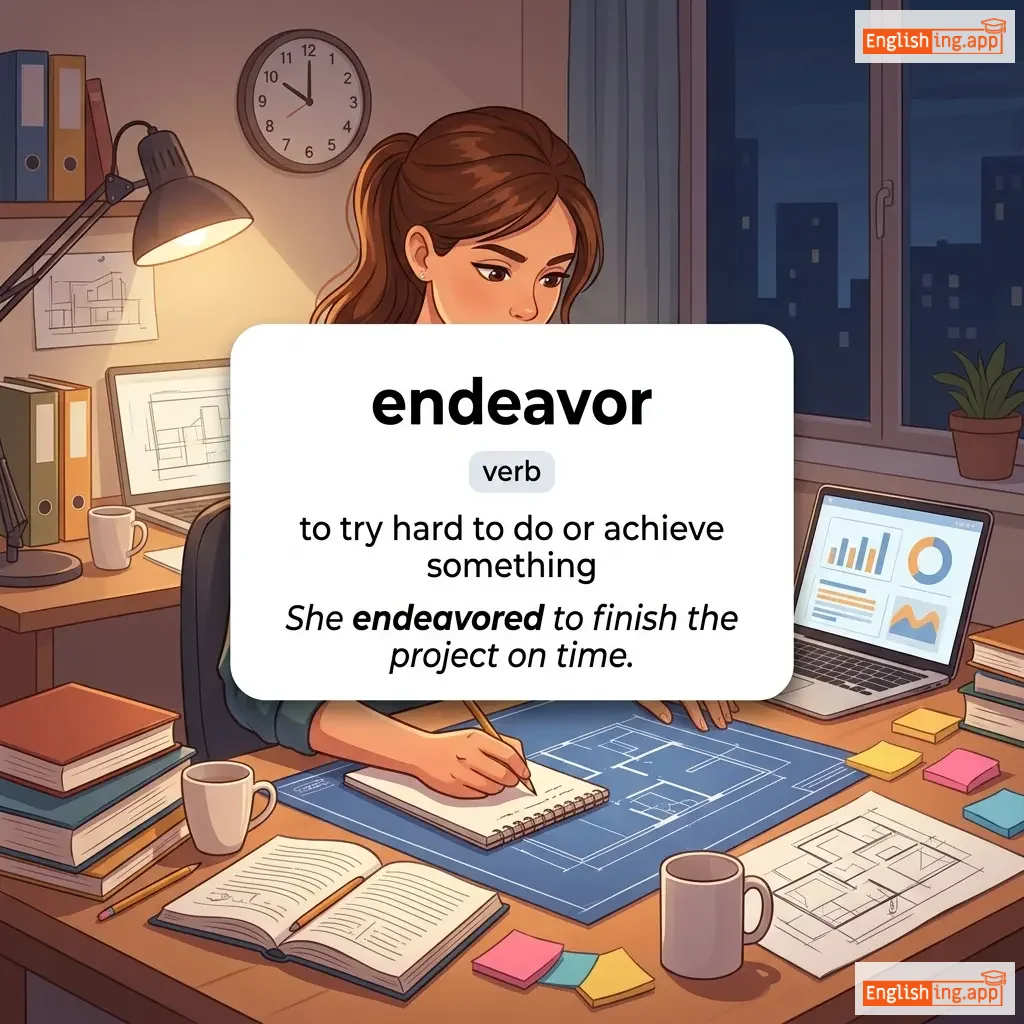
endeavor definition card — visual illustration of the meaning
verb
/ɪnˈdɛvər/
प्रयास (prayas)

to try hard to do or achieve something

"She endeavored to finish the project on time."

"वह परियोजना को समय पर पूरा करने के लिए प्रयासरत थी।" (vah pariyojana ko samay par poora karne ke liye pryasrat thi.)
verb, noun
/ɪnˈdevər/
प्रयास करना (prayas karna)

To try hard to achieve something; an attempt or effort

"She endeavoured to finish the project on time."

"उसने समय पर परियोजना समाप्त करने का प्रयास किया।" (Usne samay par pariyojana samapt karne ka prayaas kiya.)
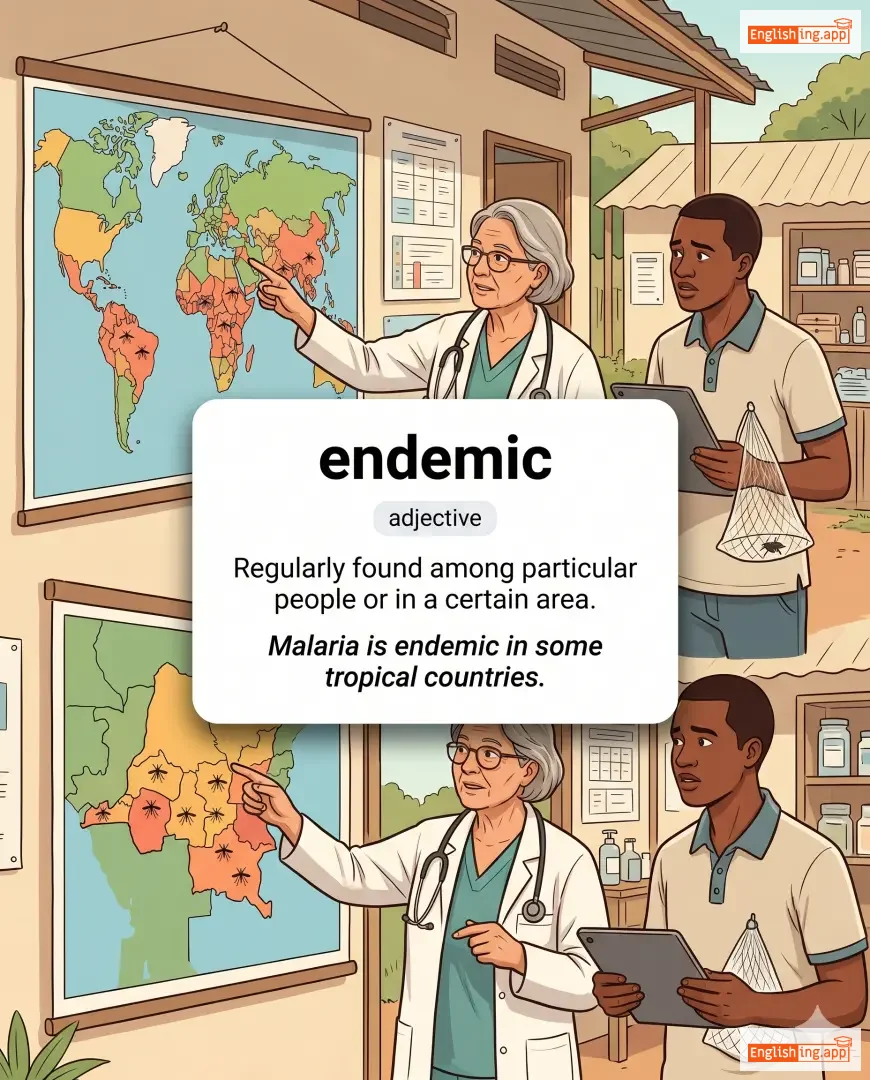
endemic definition card — visual illustration of the meaning
adjective
/ɛnˈdɛmɪk/
स्थानीय (sthaniy)

Regularly found among particular people or in a certain area.

"Malaria is endemic in some tropical countries."

"मलेरिया कुछ उष्णकटिबंधीय देशों में स्थानीय है।" (Maleria kuch ushnakatibandhiy deshon mein sthaniy hai.)
noun
/ˈɛndɪŋ/
अंत (ant)

the final part of something, such as a story, event, or period of time

"The movie had a surprising ending that no one expected."

"फिल्म का एक चौंकाने वाला अंत था जिसे किसी ने उम्मीद नहीं की।" (film ka ek chonkaane wala ant tha jise kisi ne ummid nahi ki)
noun
/ˈɛndaɪv/ or /ˈɑːndɪv/
एंडाइव (endive)

A leafy vegetable belonging to the chicory family, often used in salads.

"She added fresh endive to the salad for a slightly bitter flavor."

"उसने सलाद में हल्के तीखे स्वाद के लिए ताजा एंडाइव डाला।" (Usne salad mein halka teekhe swad ke liye taza endive dala.)
adjective
/ˈendləs/
असीम (aseem)

having or seeming to have no end or limit

"They gazed at the endless desert stretching before them."

"वे उनके सामने विस्तृत असीम रेगिस्तान को देख रहे थे।" (Ve unke samne vistarit aseem registan ko dekh rahe the.)
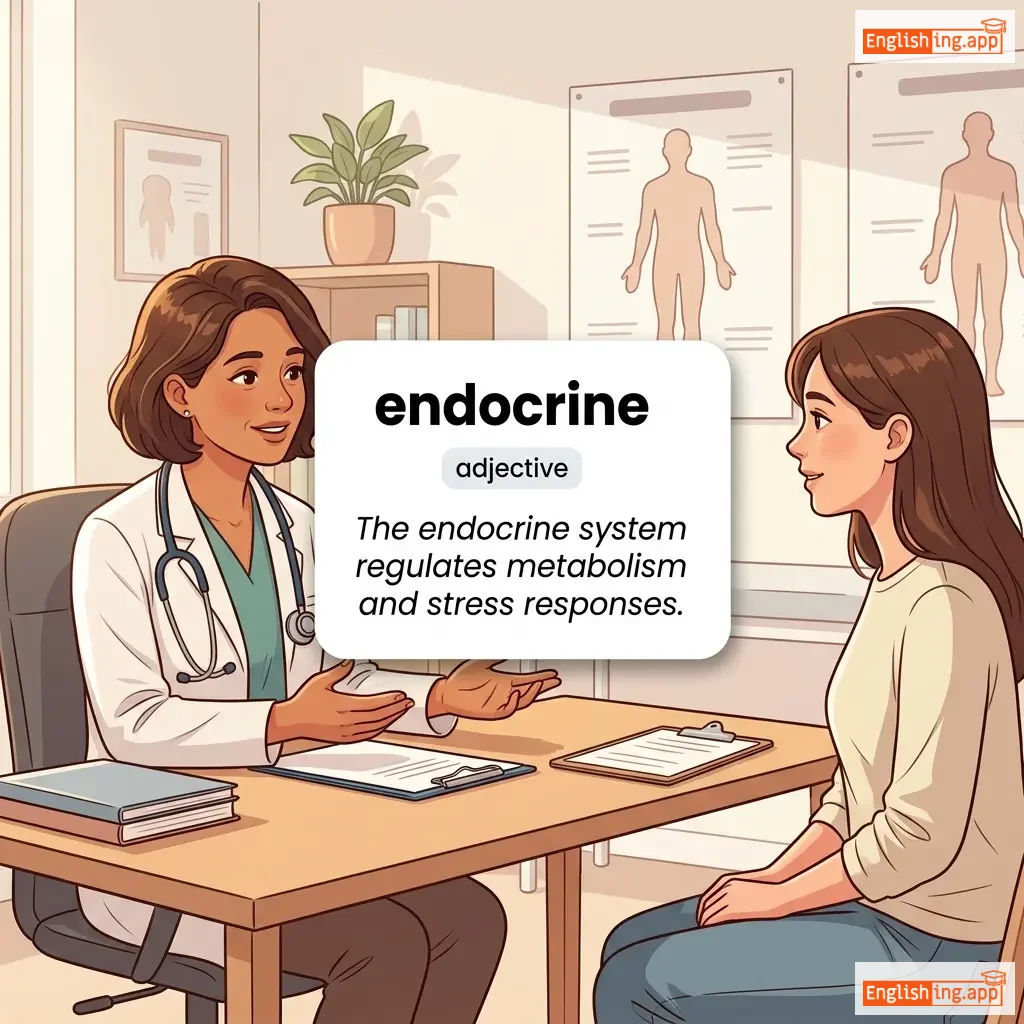
endocrine definition card — visual illustration of the meaning
adjective
/ˈen.də.krɪn/
हार्मोन संबंधित (hormon sambandhit)

Relating to or denoting glands that secrete hormones directly into the bloodstream to regulate various body functions.

"The endocrine system regulates metabolism and stress responses."

"एंडोक्राइन सिस्टम मेटाबोलिज़्म और तनाव प्रतिक्रियाओं को नियंत्रित करता है।" (Endocrine system metabolism aur tanav pratikriyaon ko niyantrit karta hai.)
endorphins definition card — visual illustration of the meaning
noun
/ɛnˈdɔːr.fɪnz/
एंडोर्फिन (endorphins)

Chemical compounds produced by the brain that reduce pain and create feelings of happiness.

"Exercise releases endorphins, reducing stress and pain."

"व्यायाम एंडोर्फिन्स रिलीज़ करता है, जिससे तनाव और दर्द कम होते हैं।" (Vyayam endorphins release karta hai, jisse tanav aur dard kam hote hain.)
verb
/ɪnˈdɔːrs/
समर्थन करना (samarthan karna)

To give approval or support to someone or something; to publicly recommend.

"The celebrity endorsed the new skincare product."

"सेलिब्रिटी ने नई स्किनकेयर उत्पाद का समर्थन किया।" (Celebrity ne nai skincare utpad ka samarthan kiya.)
endorsement definition card — visual illustration of the meaning
noun
/ɪnˈdɔːrsmənt/
समर्थन (samarthan)

the action of publicly supporting or approving something

"His endorsement of the new policy was well received."

"उसकी नई नीति के प्रति समर्थन को अच्छे से स्वीकार किया गया।" (Uski nai niti ke prati samarthan ko achhe se svikar kiya gaya.)
verb
/ɪnˈdaʊ/
दान देना (daan dena)

To provide with a quality, ability, or gift; to donate funds for a purpose.

"The university was endowed with a generous donation."

"विश्वविद्यालय को एक उदार दान प्राप्त हुआ।" (Vishwavidyalay ko ek udar daan prapt hua.)
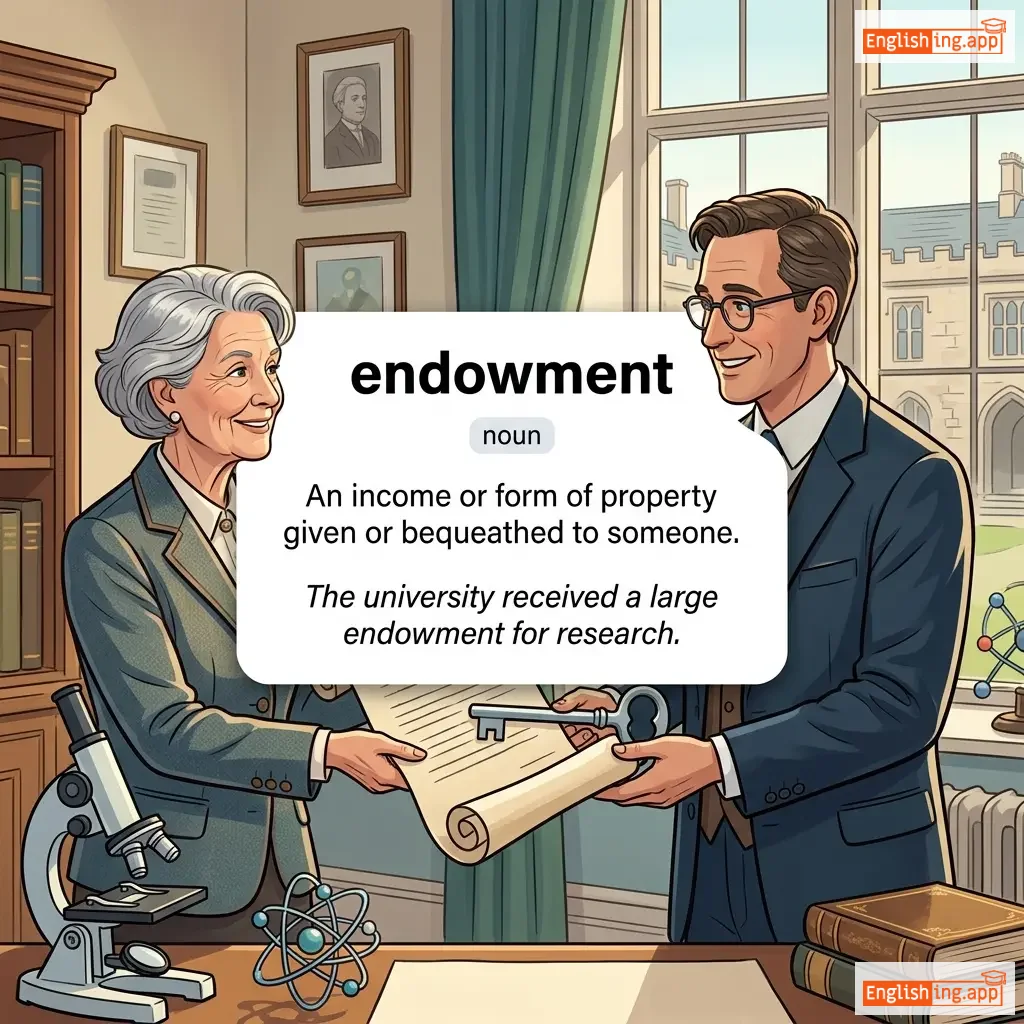
endowment definition card — visual illustration of the meaning
noun
ɪnˈdaʊmənt
दान, उपहार (dan, upohar)

An income or form of property given or bequeathed to someone.

"The university received a large endowment for research."

"विश्वविद्यालय ने शोध के लिए एक बड़ी दान राशि प्राप्त की।" (Vishwavidyalay ne shodh ke liye ek badi dan rashi prapt ki.)
verb
/ɪnˈdjuː/
गुण से सुसज्जित करना (gun se susajjit karna)

To provide or endow with a quality or ability.

"The leader was endued with wisdom and courage."

"नेता ज्ञान और साहस से सुसज्जित थे।" (Neta gyaan aur saahas se susajjit the.)
adjective
/ɪnˈdjʊərəbl/
सहनशील (sahansheel)

Able to be tolerated or endured; bearable.

"The pain was harsh but endurable."

"दर्द कठोर था लेकिन सहनीय था।" (Dard kathor tha lekin sahaneey tha.)
endurance definition card — visual illustration of the meaning
noun
/ɪnˈdjʊərəns/
धैर्य (dhairya)

The ability to withstand hardship or sustain prolonged physical or mental effort.

"The marathon tested the athletes’ endurance."

"मैराथन ने एथलीट्स की सहनशक्ति की परीक्षा ली।" (Marathon ne athletes ki sahanasakti ki pareeksha li.)
verb
/ɪnˈdjʊər/
सहना (sahna)

to suffer something difficult or unpleasant patiently

"He had to endure years of hardship before achieving success."

"उसे सफलता हासिल करने से पहले वर्षों की कठिनाई सहनी पड़ी।" (Use safalta haasil karne se pehle varsho ki kathinai sahni padi.)
adjective
/ɪnˈdjʊərɪŋ/
स्थायी (sthayi)

Continuing or lasting over a long period of time.

"She left an enduring impression on everyone she met."

"उसने हर किसी पर स्थायी छाप छोड़ी जो वह मिली।" (Usne har kisi par sthayi chhap chhodi jo vah mili.)
noun
/ˈɛnəmi/
दुश्मन (dushman)

a person or group that is hostile or opposed to someone or something

"The two countries have been enemies for decades."

"दोनों देशों के बीच दशकों से शत्रुता है।" (donon deshon ke beech dashkon se shatruta hai.)
adjective
/ˌɛnəˈdʒɛtɪk/
ऊर्जावान (urjawan)

Showing or involving great activity or vitality.

"The energetic child ran around the playground for hours."

"ऊर्जावान बच्चा घंटों तक खेल के मैदान में दौड़ता रहा।" (urjawan bachcha ghanton tak khel ke maidan mein daudta raha.)
verb
/ˈɛnərˌdʒaɪz/
उत्तेजित करना (uttejit karna)

To give energy or vitality to something or someone.

"The motivational speech helped energize the team."

"प्रेरणादायक भाषण ने टीम को उत्साहित करने में मदद की।" (preranadayak bhashan ne team ko utsahit karne mein madad ki.)
energy definition card — visual illustration of the meaning
noun
/ˈɛnərdʒi/
ऊर्जा (urja)

the capacity for activity or work; power derived from physical or chemical resources

"Solar energy is becoming increasingly popular worldwide."

"सौर ऊर्जा विश्वभर में बढ़ती लोकप्रिय हो रही है।" (Saur urja vishwabhar mein badhti lokpriya ho rahi hai.)
energy security definition card — visual illustration of the meaning
noun
/ˈen.ə.dʒi sɪˈkjʊə.rɪ.ti/
ऊर्जा सुरक्षा (urja suraksha)

The reliable availability of energy sources at an affordable price for a nation or region.

"Energy security ensures consistent supply."

"ऊर्जा सुरक्षा सुनिश्चित आपूर्ति सुनिश्चित करती है।" (Urja suraksha sunishchit aapurti sunishchit karti hai.)
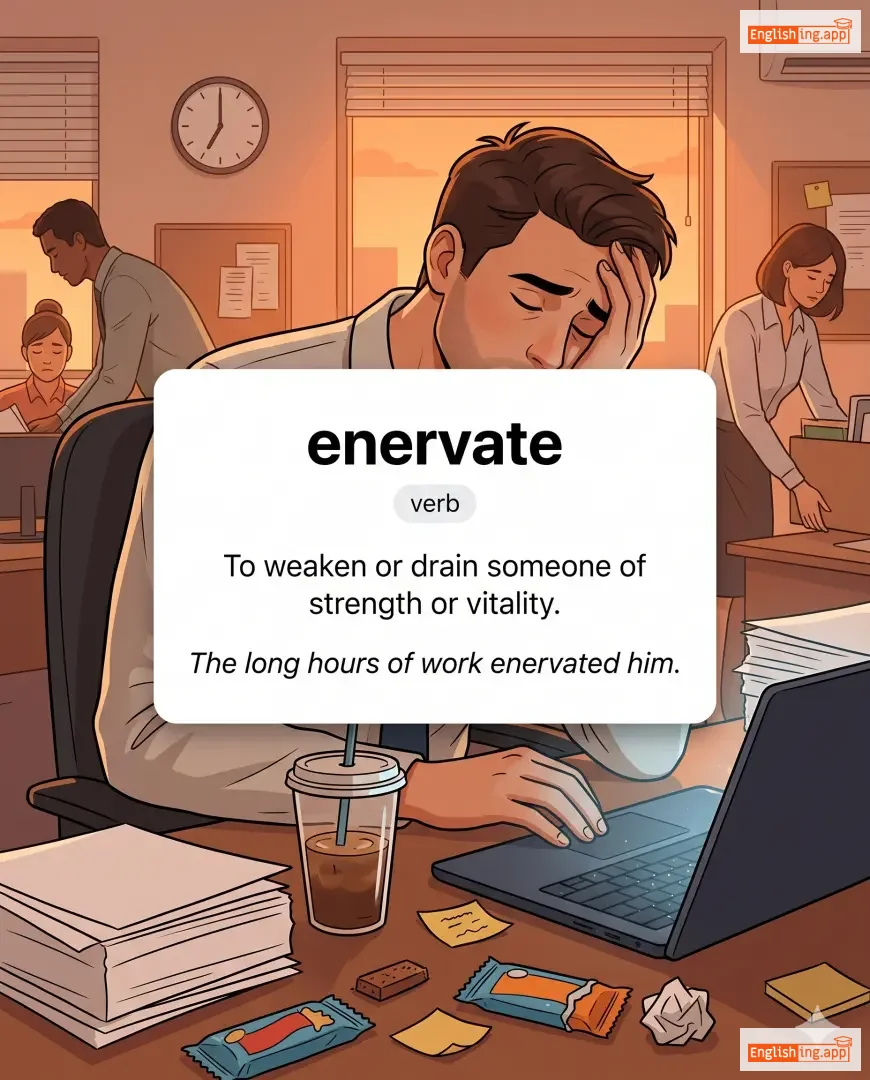
enervate definition card — visual illustration of the meaning
verb
/ˈɛnərˌveɪt/
कमज़ोर करना (kamzor karna)

To weaken or drain someone of strength or vitality.

"The long hours of work enervated him."

"लंबे समय तक काम करने से वह कमज़ोर हो गया।" (Lambe samay tak kaam karne se wah kamzor ho gaya.)
adjective
/ˈɛnərˌveɪtɪd/
थका हुआ (thaka hua)

Lacking energy, vitality, or strength; weakened or exhausted.

"After the long meeting, she felt completely enervated."

"लंबी बैठक के बाद, वह पूरी तरह से थकी हुई महसूस कर रही थी।" (Lambi baithak ke baad, vah poori tarah se thaki hui mehsoos kar rahi thi.)
verb
/ɛnˈfiːbəl/
कमज़ोर करना (kamzor karna)

To make weak or feeble; to deprive of strength.

"The long illness enfeebled the old man."

"लंबी बीमारी ने पुराने आदमी को कमज़ोर कर दिया।" (Lambi bimari ne purane aadmi ko kamzor kar diya.)
verb
/ɪnˈfɔːrs/
लागू करना (laagu karna)

to make sure that a rule, law, or policy is obeyed

"The police are responsible for enforcing the law."

"पुलिस कानून लागू करने के लिए जिम्मेदार है।" (Police kaanoon laagu karne ke liye jimmedaar hai.)
noun
/ɪnˈfɔːrsmənt/
अधिकार लागू करना (adhikar lagu karna)

the act of making sure that laws or rules are followed

"The police are responsible for law enforcement."

"पुलिस कानून प्रवर्तन के लिए जिम्मेदार है।" (Police kanun pravartan ke liye zimmedar hai.)