वोकैबुलरीज

इंग्लिश वोकैबुलरी डिस्कवर, लर्न और मास्टर करें

adjective
/ɛsˈθɛtɪk/
सौंदर्य संबंधी (saundarya sambandhi)

Concerned with beauty or the appreciation of beauty.

"The building’s esthetic design attracted many visitors."

"भवन का सौंदर्यपूर्ण डिज़ाइन कई आगंतुकों को आकर्षित किया।" (Bhavan ka saundaryapurn design kai aagantukon ko aakarshit kiya.)
estimable definition card — visual illustration of the meaning
adjective
/ˈɛstɪməbl/
सम्माननीय (sammaananiy)

Worthy of great respect.

"Her estimable achievements inspired the whole community."

"उसकी सम्मानजनक उपलब्धियाँ पूरी समुदाय को प्रेरित करती हैं।" (Uski sammaanjanik uplabdhiyan poori samudaay ko prerith karti hain.)
verb
/ˈɛstɪˌmeɪt/
अनुमान लगाना (anumaan lagana)

To roughly calculate or judge the value, number, quantity, or extent of something.

"The engineer estimated the cost of the project at $5 million."

"इंजीनियर ने परियोजना की लागत को 5 मिलियन डॉलर के रूप में अनुमानित किया।" (Engineer ne pariyojna ki lagat ko 5 million dollar ke roop mein anumanit kiya.)
adjective
/ˈɛstɪmeɪtɪd/
अनुमानित (anumanit)

roughly calculated or judged; an approximate value or amount

"The estimated cost of the project is five million dollars."

"परियोजना की अनुमानित लागत पांच मिलियन डॉलर है।" (Pariyojna ki anumanit lagat paanch million dollar hai.)
verb
/ɪˈstreɪndʒ/
परायापन करना (parayapan karna)

to cause someone to no longer be close or affectionate; to alienate

"His constant criticism began to estrange him from his friends."

"उसकी लगातार आलोचना ने उसे उसके दोस्तों से परायापन कर दिया।" (uski lagatar alochna ne use uske doston se parayapan kar diya.)
adjective
/ɪˈstreɪndʒd/
परायापन (parayapan)

no longer close or affectionate with someone; alienated

"She felt estranged from her family after the long dispute."

"वह लंबे विवाद के बाद अपने परिवार से अलग महसूस कर रही थी।" (vah lambe vivaad ke baad apne parivaar se alag mehsoos kar rahi thi.)
noun
/ˈɛstjʊəri/
नदी का मुहाना (nadi ka muhana)

the tidal mouth of a large river, where the tide meets the stream

"The city is located near the estuary of the river."

"शहर नदी के मुहाने के पास स्थित है।" (shahar nadi ke muhane ke paas sthit hai)
abbreviation
/ɛtˈsɛtərə/
आदि (aadi)

Used to indicate additional, similar items in a list that are not mentioned.

"The shop sells fruits, vegetables, dairy, etc."

"दुकान में फल, सब्जियाँ, डेरी आदि बेची जाती हैं।" (Dukaan mein phal, sabziyan, dairy aadi bechi jati hain.)
adverb
/ɛtˈsɛtərə/
आदि (aadi)

used at the end of a list to indicate that other similar items are included

"She bought apples, oranges, bananas, etcetera from the market."

"उसने बाजार से सेब, संतरा, केला, आदि खरीदे।" (usne bazaar se seb, santra, kela, aadi kharide.)
verb
/ɛtʃ/
खोदना (khodna)

to cut or carve a design onto a surface

"The artist etched her initials into the glass."

"कलाकार ने कांच में अपनी आद्याक्षर खुदवाए।" (kalakar ne kaanch mein apni adyakshar khudwaye.)
adjective
/ɪˈtɜːrnəl/
शाश्वत (shashvat)

lasting or existing forever; without end

"They pledged their eternal love for each other."

"उन्होंने एक दूसरे के लिए अपना शाश्वत प्रेम व्यक्त किया।" (unhone ek doosre ke liye apna shashvat prem vyakt kiya.)
ethereal definition card — visual illustration of the meaning
adjective
/ɪˈθɪəriəl/
आध्यात्मिक (aadhyatmik)

extremely delicate, light, or airy; heavenly or otherworldly

"The dancer moved with an ethereal grace that captivated the audience."

"नर्तकी ने एक आध्यात्मिक grace के साथ गति की, जिसने दर्शकों को मंत्रमुग्ध कर दिया।" (Nartaki ne ek aadhyatmik grace ke saath gati ki, jismein darshako ko mantrmugdh kar diya.)
noun
/ˈɛθɪk/
नैतिकता (naitikata)

a set of moral principles, especially ones relating to a particular group, system, or profession

"He has a strong work ethic and always meets deadlines."

"उसके पास एक मजबूत कार्य नैतिकता है और वह हमेशा समय पर अपने काम को पूरा करता है।" (Uske paas ek majboot kary naitikata hai aur vah hamesha samay par apne kaam ko poora karta hai.)
ethical definition card — visual illustration of the meaning
adjective
/ˈɛθɪkəl/
नैतिक (naitik)

relating to moral principles or the right and wrong behavior

"The company follows strict ethical standards in its business practices."

"कंपनी अपने व्यापारिक अभ्यासों में कड़े नैतिक मानकों का पालन करती है।" (Kampani apne vyaparik abhyason mein kade naitik maankon ka paalan karti hai.)
noun
/ˈɛθɪks/
नैतिकता (naitikata)

moral principles that govern a person's behavior or the conduct of an activity

"Business ethics require companies to act fairly and responsibly."

"व्यावसायिक नैतिकता कंपनियों से अपेक्षाएँ करती हैं कि वे निष्पक्ष और जिम्मेदार तरीके से कार्य करें।" (vyavsayik naitikata kampaniyon se apekshaen karti hain ki ve nishpaksh aur jimmedar tareeke se kaary karein.)
adjective
/ˈɛθnɪk/
जातीय (jaatiy)

relating to a population subgroup with a common national or cultural tradition

"The festival celebrated the city's diverse ethnic communities."

"त्योहार ने शहर के विविध जातीय समुदायों का उत्सव मनाया।" (Tyohar ne shahar ke vividh jaatiy samudaayon ka utsav manaya.)
ethnocentric definition card — visual illustration of the meaning
adjective
/ˌeθ.noʊˈsen.trɪk/
जातिवादी आत्मकेंद्रित (jatavadi atmendrit)

evaluating other cultures according to the standards of one's own culture

"His ethnocentric attitude made it hard for him to appreciate foreign traditions."

"उसका जातिवादी आत्मकेंद्रित दृष्टिकोण उसे विदेशी परंपराओं की सराहना करने में मुश्किल बनाता था।" (Uska jatavadi atmendrit drishtikon use videshi paramparaon ki sarahna karne mein mushkil banata tha.)
noun
/ɛθˈnɒlədʒi/
नृविज्ञान (nrivigyan)

the study of the characteristics of different peoples and the differences and relationships between them

"She specialized in ethnology to better understand cultural diversity."

"वह सांस्कृतिक विविधता को बेहतर समझने के लिए नृविज्ञान में विशेषज्ञता प्राप्त करती थीं।" (Wah sanskritik vividhta ko behtar samajhne ke liye nrivigyan mein visheshagyaata praapt karti thin.)
ethos definition card — visual illustration of the meaning
noun
/ˈiːθɒs/
आदर्श (aadarshe)

the characteristic spirit, values, or beliefs of a community, culture, or organization

"The company’s ethos emphasizes innovation and customer service."

"कंपनी का आदर्श नवाचार और ग्राहक सेवा पर जोर देता है।" (Kampani ka aadarsh navaachar aur grahak seva par zor deta hai.)
etiology definition card — visual illustration of the meaning
noun
/ˌiː.tiˈɒ.lə.dʒi/
कारणशास्त्र (karanshastra)

the cause or origin of a disease or condition

"Doctors are studying the etiology of the new virus."

"डॉक्टर नई वायरस की इटियोलॉजी का अध्ययन कर रहे हैं।" (Doktar nai virus ki itiology ka adhyayan kar rahe hain.)
noun
/ˈet.ɪ.kət/
शिष्टाचार (shishtachar)

the customary code of polite behavior in society or among members of a particular profession

"Proper etiquette requires standing when a lady enters the room."

"सही शिष्टाचार में एक महिला के कमरे में प्रवेश करते समय खड़ा होना शामिल है।" (sahi shishtachar mein ek mahila ke kamre mein pravesh karte samay khada hona shamil hai.)
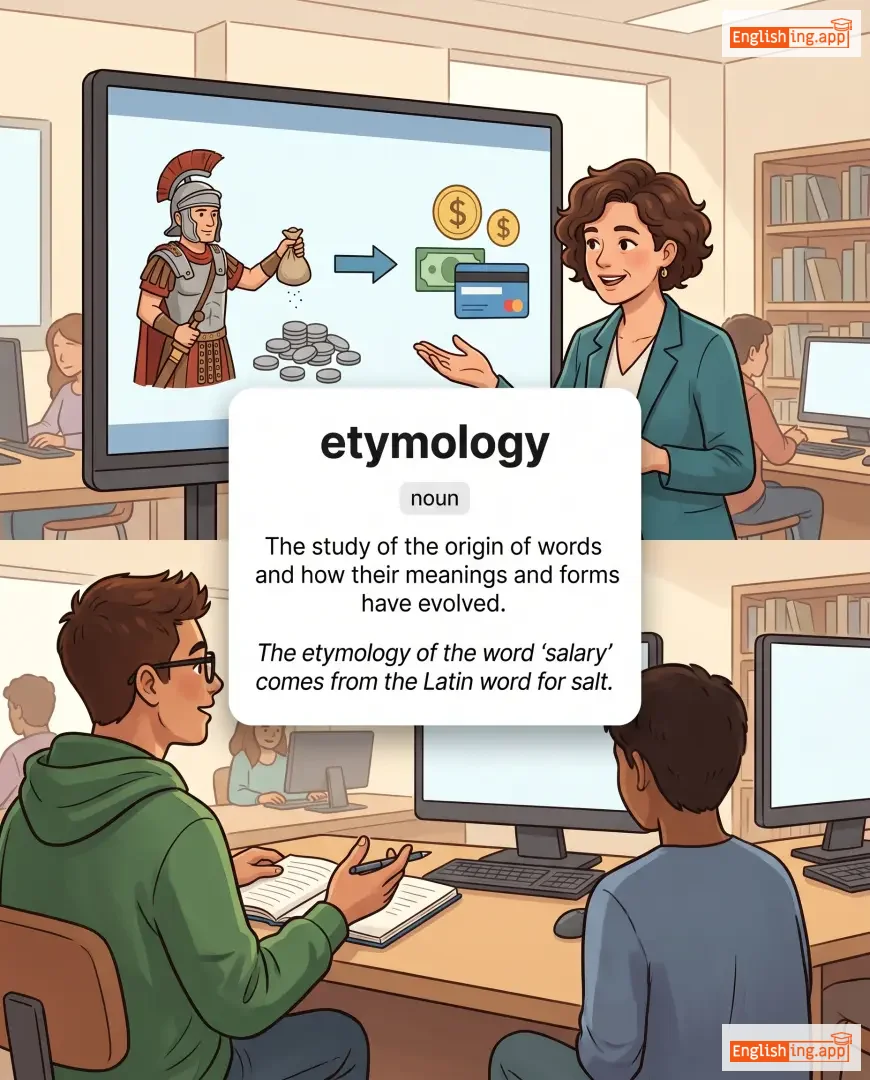
etymology definition card — visual illustration of the meaning
noun
/ˌɛtɪˈmɒlədʒi/
शब्दविज्ञान (shabdvigyan)

The study of the origin of words and how their meanings and forms have evolved.

"The etymology of the word 'salary' comes from the Latin word for salt."

"'Salary' शब्द की उत्पत्ति लैटिन शब्द 'salt' से हुई है।" ('Salary' shabd ki utpatti Latin shabd 'salt' se hui hai.)
adjective
/juːˈdʒɛnɪk/
युगेनिक (yugenik)

Relating to or aiming at improving the genetic quality of a population.

"In the early 20th century, some scientists supported eugenic policies."

"20वीं सदी की शुरुआत में कुछ वैज्ञानिकों ने युगेनिक नीतियों का समर्थन किया था।" (20vi sadi ki shuruat mein kuch vaigyanikon ne yugenik neetiyon ka samarthan kiya tha.)
eugenics definition card — visual illustration of the meaning
noun
/juːˈdʒen.ɪks/
यूजेनिक्स (yugeniks)

the study or practice of improving the genetic quality of the human population

"Eugenics has been criticized for its unethical applications in history."

"यूजेनिक्स को इसके अनैतिक उपयोगों के लिए इतिहास में आलोचना की गई है।" (Yugeniks ko iske anaitik upyogon ke liye itihas mein alochna ki gayi hai.)
adjective
/ˌjuːləˈdʒɪstɪk/
प्रशंसा संबंधी (prashansa sambandhi)

Expressing praise or admiration, often formally.

"The speaker gave a eulogistic account of the leader’s achievements."

"वक्ता ने नेता की उपलब्धियों का प्रशंसा संबंधी वर्णन किया।" (Vaktaa ne neta ki uplabdhiyon ka prashansa sambandhi varnan kiya.)
verb
/ˈjuːləˌdʒaɪz/
प्रशंसा करना (prashansa karna)

To praise highly in speech or writing, especially in honor of someone who has died.

"They gathered to eulogize their beloved teacher."

"वे अपने प्रिय शिक्षक की प्रशंसा करने के लिए इकट्ठा हुए।" (Ve apne priy shikshak ki prashansa karne ke liye ikattha hue.)
eulogy definition card — visual illustration of the meaning
noun
/ˈjuːlədʒi/
श्रद्धांजलि भाषण (shraddhanjali bhashan)

A speech or piece of writing that praises someone, especially after their death.

"Her brother delivered a heartfelt eulogy at the funeral."

"उसके भाई ने अंतिम संस्कार में एक सच्चे श्रद्धांजलि भाषण दिया।" (Uske bhai ne antim sanskar mein ek sacche shraddhanjali bhashan diya.)
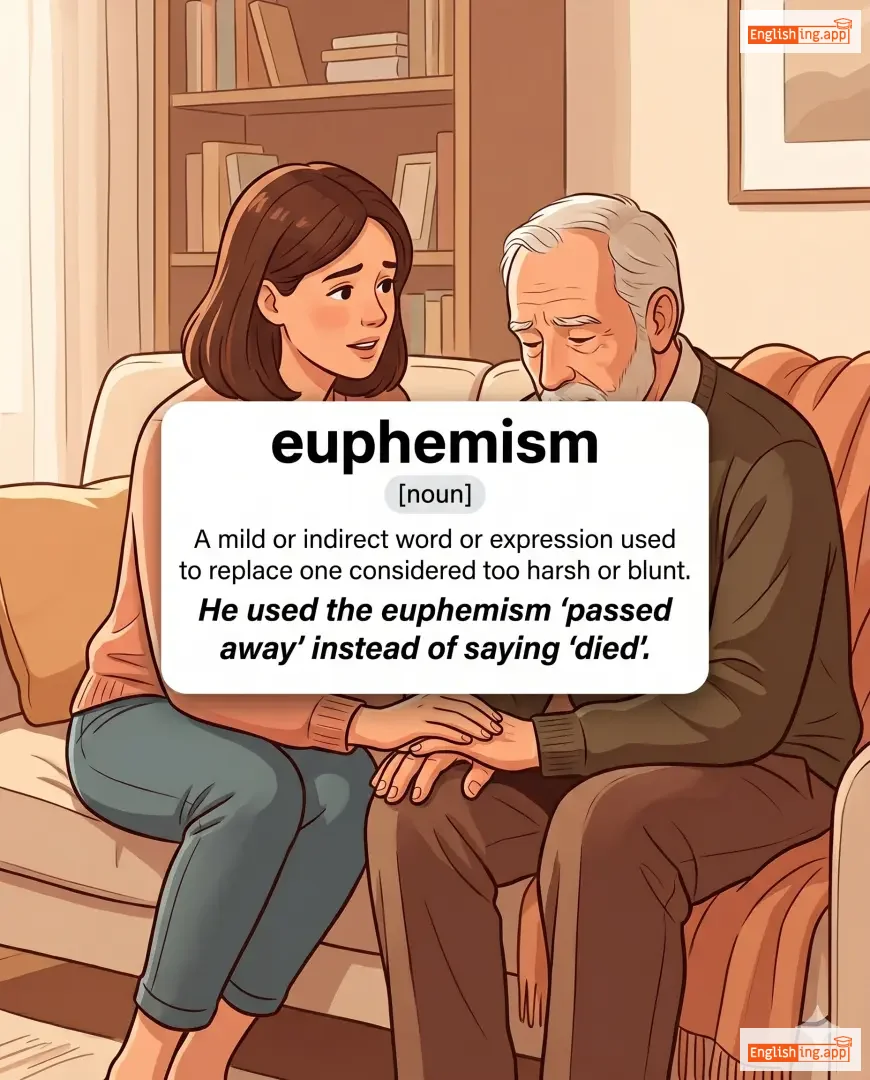
euphemism definition card — visual illustration of the meaning
noun
/ˈjuːfəmɪzəm/
कोमल शब्द (komal shabd)

A mild or indirect word or expression used to replace one considered too harsh or blunt.

"He used the euphemism 'passed away' instead of saying 'died'."

"उसने 'मरा हुआ' कहने के बजाय 'चल बसे' का युफ़ेमिज़म इस्तेमाल किया।" (Usne 'mara hua' kehne ke bajaye 'chal base' ka euphemism istemal kiya.)
adjective
/juːˈfoʊniəs/
सुमधुर ध्वनि (sumadhur dhvani)

Pleasing to the ear; having a sweet sound.

"The poet's euphonious language made the verse a delight to read."

"कवि की युफ़ोनियस भाषा ने कविता को पढ़ने में आनंददायक बना दिया।" (Kavi ki euphonious bhasha ne kavita ko padhne mein ananddayak bana diya.)
noun
/ˈjuːfəni/
सुमधुर ध्वनि (sumadhur dhvani)

The quality of being pleasing to the ear, especially through harmonious combination of words.

"The orator's speech was full of euphony and rhythm."

"वक्ता का भाषण युफ़नी और लय से भरा हुआ था।" (Vakta ka bhashan euphony aur lay se bhara hua tha.)
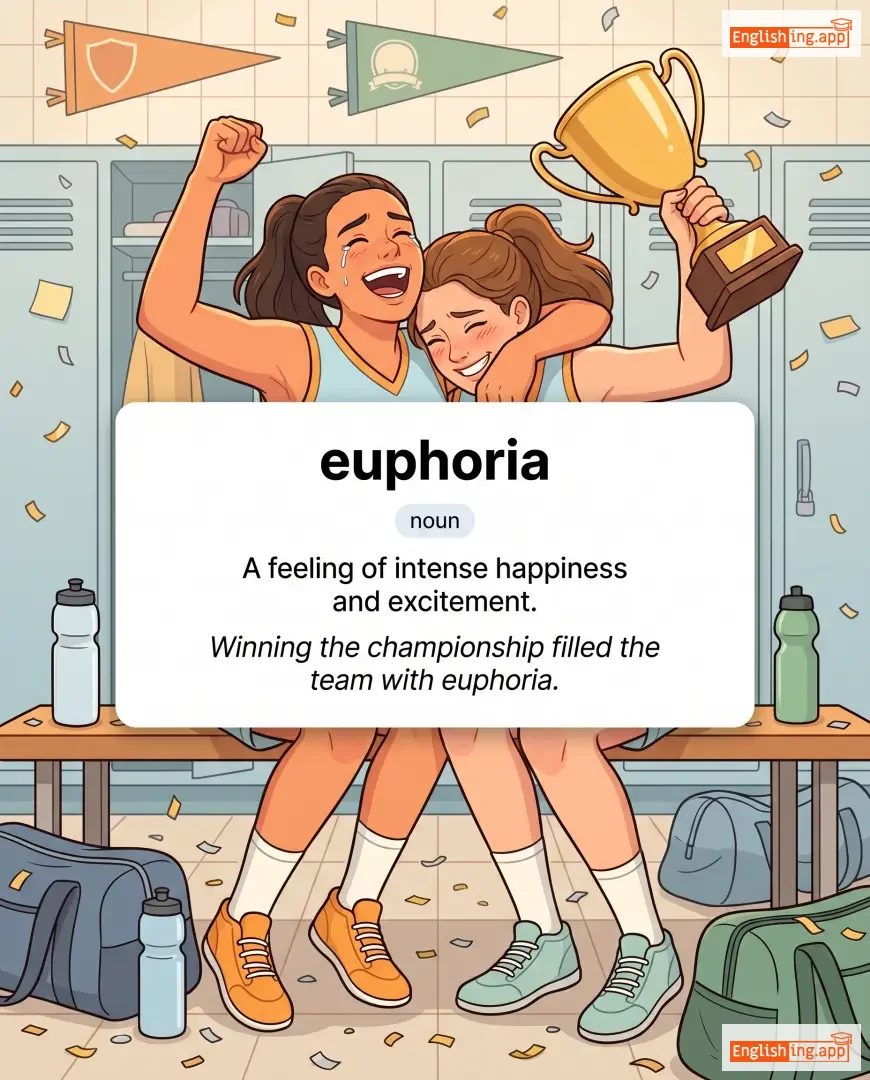
euphoria definition card — visual illustration of the meaning
noun
/juːˈfɔːriə/
उत्साह (utsah)

A feeling of intense happiness and excitement.

"Winning the championship filled the team with euphoria."

"चैम्पियनशिप जीतने से टीम को उत्साह से भर दिया।" (Championchip jeetne se team ko utsah se bhar diya.)
adjective
/juːˈfɔːrɪk/
उत्साही (utsahi)

Characterized by or feeling intense excitement and happiness.

"The fans were euphoric after their team's victory."

"टीम की जीत के बाद प्रशंसक उत्साही थे।" (Team ki jeet ke baad prashansak utsahi the.)
exclamation
/juˈriːkə/
एureka! (Eureka!)

An exclamation used to express a sudden discovery or realization.

"When the solution finally came to him, he shouted, 'Eureka!'"

"जब समाधान आखिरकार उसे मिला, उसने चिल्लाते हुए कहा, 'एureka!'" (Jab samadhan aakhirkar use mila, usne chillate huye kaha, 'Eureka!')
adjective
/ˌjʊərəˈpiːən/
यूरोपीय (yuropiya)

Relating to Europe or its people.

"She studied European history at university."

"उसने विश्वविद्यालय में यूरोपीय इतिहास का अध्ययन किया।" (Usne vishwavidyalay mein yuropiya itihas ka adhyayan kiya.)
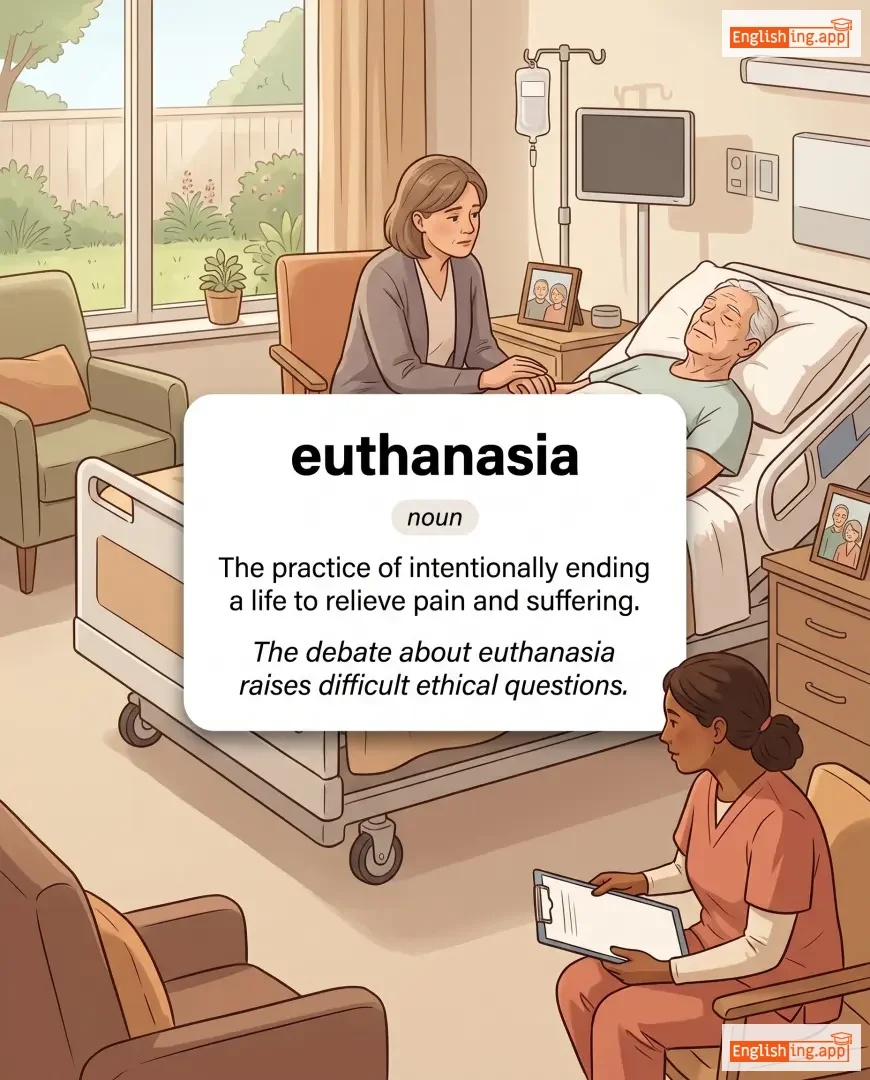
euthanasia definition card — visual illustration of the meaning
noun
/ˌjuːθəˈneɪʒə/
दान मृत्यु (daan mrityu)

The practice of intentionally ending a life to relieve pain and suffering.

"The debate about euthanasia raises difficult ethical questions."

"युथानेशिया पर बहस नैतिक प्रश्न उठाती है।" (Yuthaneshiya par behas naitik prashn uthati hai.)
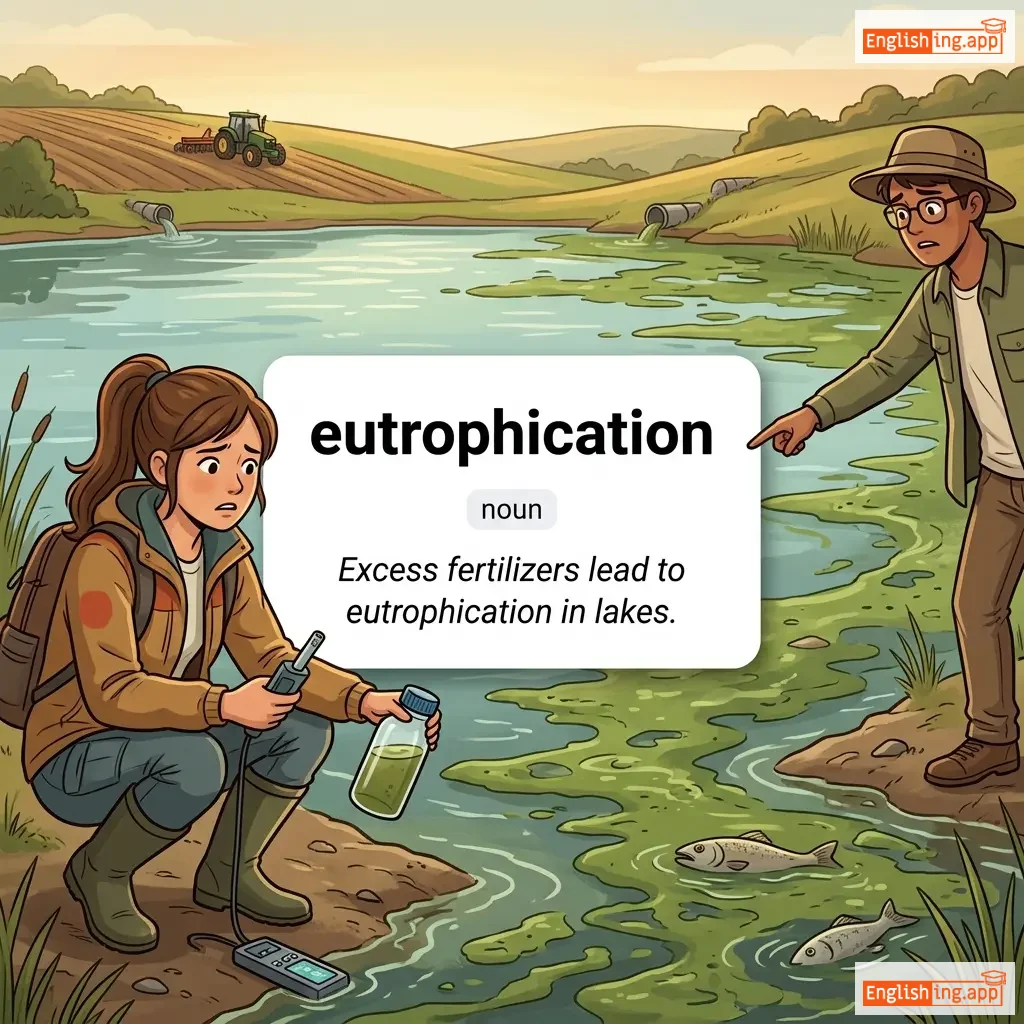
eutrophication definition card — visual illustration of the meaning
noun
/juːˌtrɑː.fɪˈkeɪ.ʃən/
जलाशयों में पोषक तत्वों की अत्यधिक समृद्धि (utrophication)

Excessive richness of nutrients in a lake or other body of water, frequently due to runoff from the land, which causes a dense growth of plant life and death of animal life from lack of oxygen.

"Excess fertilizers lead to eutrophication in lakes."

"अतिरिक्त उर्वरक झीलों में यूट्रोफिकेशन का कारण बनते हैं।" (Atirikt urvarak jheelo mein eutrophication ka kaaran bante hain.)
verb
/ɪˈvækjueɪt/
निकालना (nikalna)

To remove people from a dangerous place to safety.

"The residents were ordered to evacuate the building after the fire alarm."

"आग अलार्म के बाद निवासियों को भवन से बाहर निकलने का आदेश दिया गया था।" (Aag alarm ke baad nivaasiyon ko bhavan se bahar nikalne ka aadesh diya gaya tha.)
verb
/ɪˈveɪd/
बचना (bachna)

To escape or avoid something, especially by cleverness or trickery.

"He tried to evade the question by changing the subject."

"उसने विषय बदलकर सवाल से बचने की कोशिश की।" (Usne vishay badal kar sawal se bachne ki koshish ki.)
verb
/ɪˈvæljueɪt/
मूल्यांकन करना (mulyankan karna)

To assess or judge the value, quality, or significance of something.

"The teacher will evaluate the students’ projects tomorrow."

"टीचर कल विद्यार्थियों के प्रोजेक्ट्स का मूल्यांकन करेंगे।" (Teacher kal vidyarthiyon ke projects ka mulyankan karenge.)
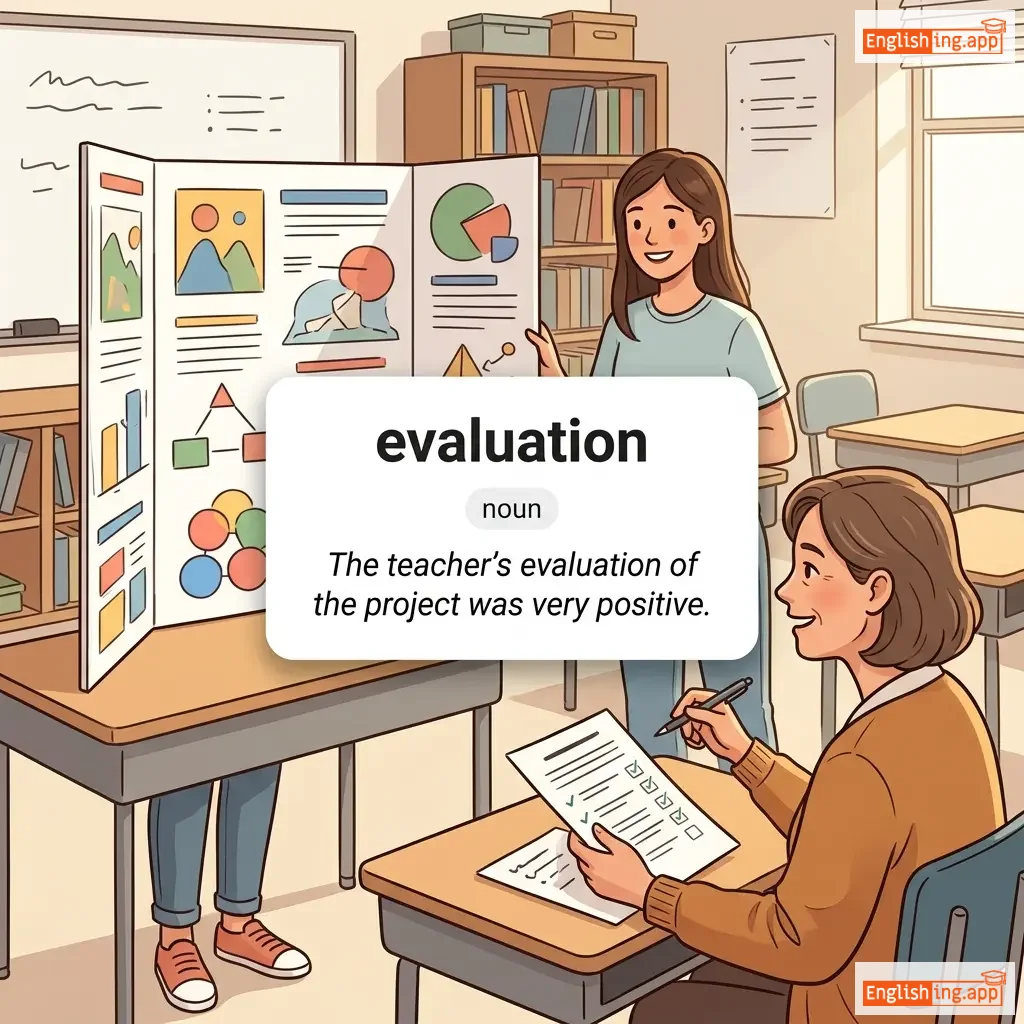
evaluation definition card — visual illustration of the meaning
noun
/ɪˌvæljʊˈeɪʃən/
मूल्यांकन (mulyankan)

The process of assessing or judging the value, quality, or importance of something.

"The teacher’s evaluation of the project was very positive."

"अध्यक्ष का परियोजना का मूल्यांकन बहुत सकारात्मक था।" (Adhyaksh ka pariyojana ka mulyankan bahut sakaratmak tha.)
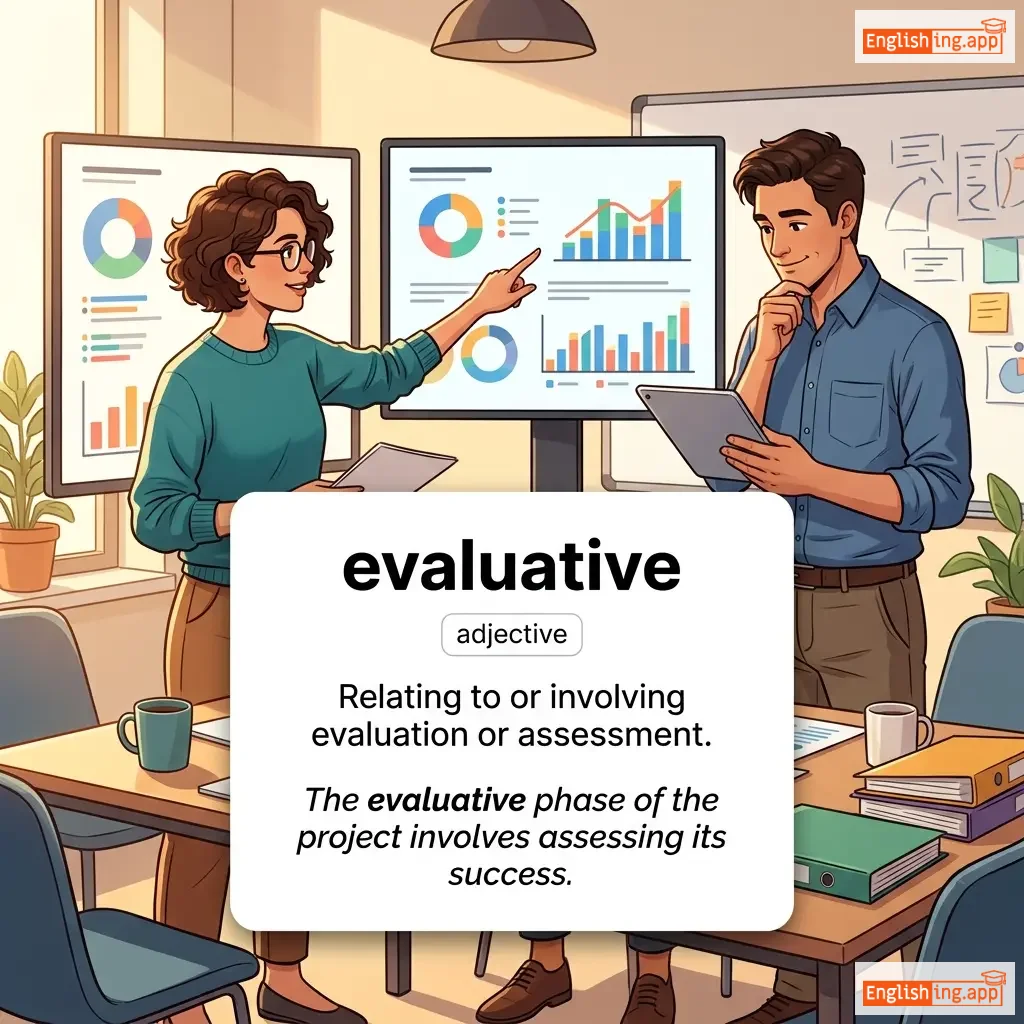
evaluative definition card — visual illustration of the meaning
adjective
/ɪˈvæljʊətɪv/
मूल्यांकनात्मक (mulyankanatmak)

Relating to or involving evaluation or assessment.

"The evaluative phase of the project involves assessing its success."

"प्रोजेक्ट के मूल्यांकनात्मक चरण में इसकी सफलता का मूल्यांकन किया जाता है।" (The project ke mulyankanatmak charan mein iski safalta ka mulyankan kiya jata hai.)
verb
/ˌɛvəˈnɛs/
धुंधला होना (dhundhla hona)

To disappear gradually; to fade away.

"The mist began to evanesce as the sun rose higher."

"सूरज चढ़ने के साथ ही कुहासा धीरे-धीरे विलीन होने लगा।" (Suraj chadhne ke sath hi kuhasa dheere-dheere vileen hone laga.)
adjective
/ˌɛvəˈnɛsənt/
क्षणिक (kshanik)

Quickly fading or disappearing; lasting for only a very short time.

"The beauty of the sunset was evanescent, fading within minutes."

"सूर्यास्त की सुंदरता क्षणिक थी, कुछ ही मिनटों में गायब हो गई।" (Suryast ki sundarta kshanik thi, kuch hi minaton mein gayab ho gayi.)
adjective
/ˌiːvænˈdʒɛlɪkəl/
ईसाई धर्मशास्त्र से संबंधित (isaai dharmashastra se sambandhit)

Relating to the Christian gospel, especially the teachings that emphasize personal faith and the authority of the Bible.

"She grew up in an evangelical church community."

"वह एक ईवेंजेलिकल चर्च समुदाय में पली-बढ़ी।" (Vah ek evangelical church samudaay mein pali-badhi.)
noun
/ɪˈvændʒəlɪst/
धर्मप्रचारक (dharmapracharak)

A person who seeks to convert others to the Christian faith, especially by public preaching.

"The evangelist traveled across the country spreading his message."

"धर्मप्रचारक देश भर में अपनी संदेश फैलाने के लिए यात्रा करते थे।" (Dharmapracharak desh bhar mein apni sandesh phailane ke liye yatra karte the.)
noun
/ɪˈvæp.ər.ə.tɪv ˈkuː.lər/
वाष्पशील शीतलन यंत्र (vashpashil sheetalan yantra)

a cooling device that uses water evaporation to reduce air temperature

"The evaporative cooler works best in dry climates."

"वाष्पशील शीतलन यंत्र शुष्क जलवायु में सबसे अच्छा काम करता है।" (vashpashil sheetalan yantra shushk jalvayu mein sabse achha kaam karta hai)
evasion definition card — visual illustration of the meaning
noun
/ɪˈveɪʒən/
परिहार (parihar)

The act of avoiding something, especially by cleverness or trickery.

"He was arrested for tax evasion."

"उसे कर चोरी के लिए गिरफ्तार किया गया था।" (Use kar chori ke liye giraftaar kiya gaya tha.)
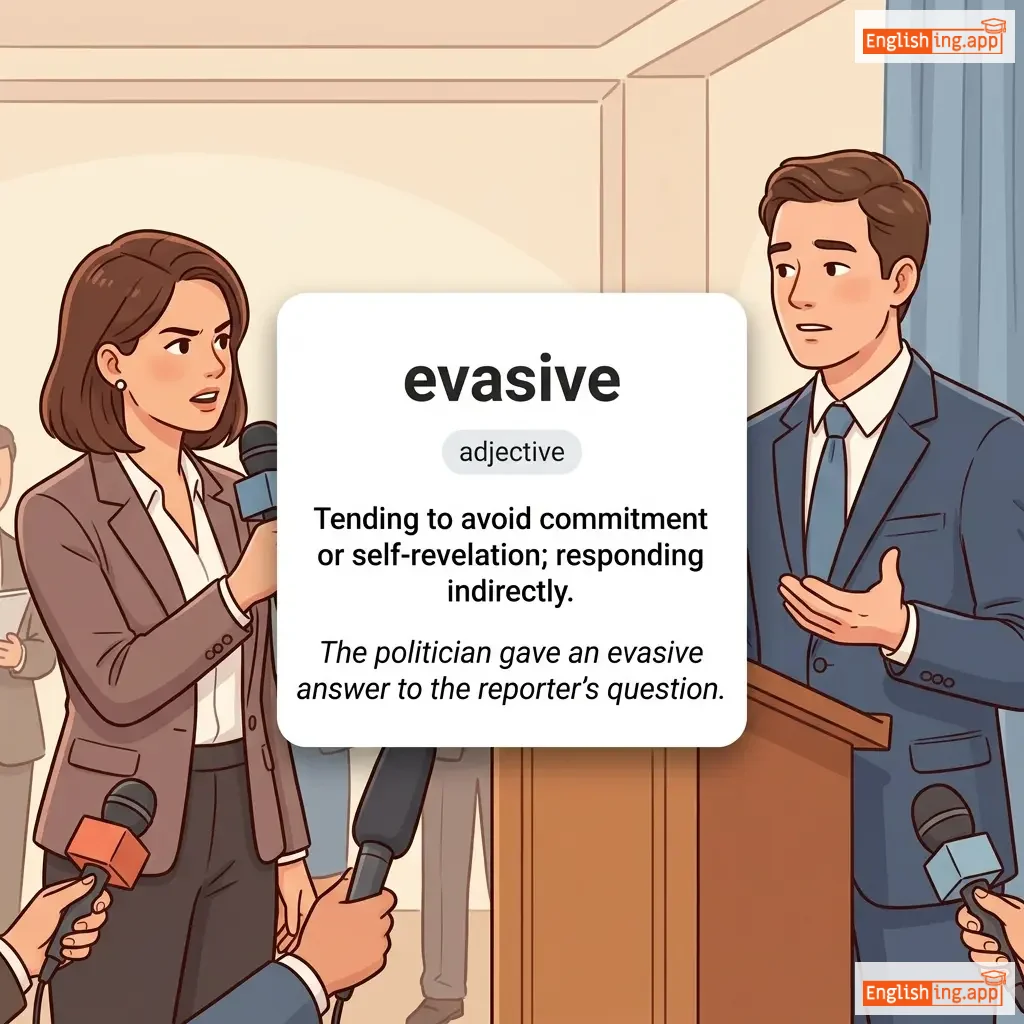
evasive definition card — visual illustration of the meaning
adjective
/ɪˈveɪsɪv/
जागरूक (jagarook)

Tending to avoid commitment or self-revelation; responding indirectly.

"The politician gave an evasive answer to the reporter's question."

"राजनेता ने रिपोर्टर के सवाल का एक जटिल जवाब दिया।" (Rajneeta ne reporter ke sawaal ka ek jatil jawab diya.)
adjective, adverb
/ˈiː.vən/
समांन (samaan)

flat or smooth; equal in degree or amount; used to emphasize something surprising

"The road was surprisingly even after the storm."

"आंधी के बाद सड़क आश्चर्यजनक रूप से समांन थी।" (Aandhi ke baad sadak aashcharyajanak roop se samaan thi.)
adjective
/ˌiːvənˈhændɪd/
निष्पक्ष (nishpaksh)

Fair and impartial; showing no bias or favoritism.

"The judge was praised for her evenhanded approach to the case."

"न्यायाधीश को मामले में निष्पक्ष दृष्टिकोण के लिए सराहा गया।" (Nyayadhish ko mamle mein nishpaksh drishtikon ke liye saraha gaya.)