वोकैबुलरीज

इंग्लिश वोकैबुलरी डिस्कवर, लर्न और मास्टर करें

e-commerce definition card — visual illustration of the meaning
noun
ˈiːˌkɒm.ɜːrs
ई-कॉमर्स (e-commerce)

The process of buying and selling goods or services through the internet.

"E-commerce has revolutionized the way people shop."

"ई-कॉमर्स ने लोगों की शॉपिंग के तरीके को क्रांतिकारी रूप से बदल दिया है।" (E-commerce ne logon ki shopping ke tareeke ko krantikari roop se badal diya hai.)
noun, verb
/ˈiː.meɪl/
ई-मेल (i-meil)

messages distributed by electronic means from one computer user to another

"I sent an e-mail to my professor yesterday."

"मैंने कल अपने प्रोफेसर को एक ई-मेल भेजी।" (maine kal apne professor ko ek i-meil bheji.)
abbreviation
/iː ˈdʒiː/
उदाहरण के लिए (udarhan ke liye)

For example (from Latin 'exempli gratia').

"You should eat more fruits, e.g., apples and bananas."

"आपको अधिक फल खाना चाहिए, उदाहरण के लिए, सेब और केले।" (Aapko adhik phal khana chahiye, udaharan ke liye, seb aur kele.)
determiner/pronoun
/iːtʃ/
प्रत्येक (pratyek)

every one of two or more people or things considered separately

"Each student received a certificate."

"प्रत्येक छात्र को प्रमाणपत्र मिला।" (pratyek chhatra ko pramanpatra mila.)
adjective
/ˈiːɡər/
आतुर / उत्सुक (atur / utsuk)

very excited and interested; keen to do something

"The children were eager to open their gifts."

"बच्चे अपने उपहार खोलने के लिए उत्साहित थे।" (Bachche apne uphaar kholne ke liye utsahit the.)
adverb
/ˈiːɡərli/
उत्सुकता से; बड़ी इच्छाशक्ति से (utsukta se; badi ichhashakti se)

with keen interest or enthusiasm; with great desire

"The children eagerly waited for the holiday to begin."

"बच्चे छुट्टी शुरू होने का बेसब्री से इंतजार कर रहे थे।" (bachche chhutti shuru hone ka besabri se intezaar kar rahe the)
noun
/ˈiː.ɡəl/
ईगल पक्षी (eagle pakshi)

large bird of prey with powerful wings and sharp talons

"The eagle soared high above the mountains."

"ईगल पहाड़ों के ऊपर ऊँचा उड़ा।" (eagle pahaadon ke upar ooncha uda)
noun
/ˈiːɡlət/
ईगल का बच्चा (eegal ka bachcha)

A young eagle.

"The eaglet waited in the nest for its mother to return."

"ईगलट ने घोंसले में अपनी माँ का इंतजार किया।" (Eeglet ne ghonsle mein apni maa ka intezaar kiya.)
noun
/ɪə(r)/
कान (kaan)

the organ of hearing and balance in humans and other animals

"She whispered something in his ear."

"उसने उसके कान में कुछ फुसफुसाया।" (Usne uske kaan mein kuchh fusfusaya.)
noun
/ˈɪər.ɪŋ/
कान की बालियां (kaan ki baaliyan)

a piece of jewelry worn on the earlobe or ear

"Her diamond earrings caught everyone's attention."

"उसके डायमंड ईयररिंग्स ने सभी का ध्यान आकर्षित किया।" (uske diamond ear-rings ne sabhi ka dhyan aakarshit kiya)
adjective/adverb
/ˈɜːrli/
जल्दी (jaldi)

before the usual or expected time

"She arrived early to the meeting."

"वह बैठक में जल्दी पहुंची।" (Wah baithak mein jaldi pahunchi.)
verb
/ˈɪə.mɑːrk/
निर्दिष्ट करना (nirdisht karna)

To designate funds, resources, or time for a particular purpose.

"The government has earmarked funds for education."

"सरकार ने शिक्षा के लिए फंड निर्धारित किए हैं।" (Sarkar ne shiksha ke liye fund nirdharit kiye hain.)
earn definition card — visual illustration of the meaning
verb
/ɜːrn/
कमाना (kamana)

To receive money or reward in return for work or service.

"She worked hard to earn enough money for college."

"उसने कॉलेज के लिए पर्याप्त पैसे कमाने के लिए कठिन मेहनत की।" (Usne college ke liye paryapt paise kamane ke liye kathin mehnat ki.)
noun
/ˈɜːrnər/
कमाई करने वाला (kamai karne wala)

A person who earns money through work or business

"She is the primary earner in her family."

"वह अपने परिवार में मुख्य कमाई करने वाला है।" (Vah apne parivar mein mukhya kamai karne wala hai.)
adjective
/ˈɜːrnɪst/
गंभीर और ईमानदार (gambheer aur imandar)

showing sincere and intense conviction

"She spoke in an earnest voice about the importance of honesty."

"वह ईमानदारी से सच्चाई के महत्व के बारे में बोल रही थी।" (Woh imandari se sachchai ke mahatva ke baare mein bol rahi thi.)
noun
/ˈɜːnɪŋz/
कमाई (kamai)

money obtained in return for labor or services

"Her monthly earnings are enough to support her family."

"उसकी मासिक कमाई अपने परिवार का समर्थन करने के लिए पर्याप्त है।" (Uski masik kamai apne parivar ka samarthan karne ke liye paryapt hai.)
noun
/ˈɪrˌplʌɡ/
कान का प्लग (kan ka plug)

a device inserted into the ear to block out noise or water

"He wore earplugs to sleep during the noisy night."

"उसने शोर वाले रात में सोने के लिए ईयरप्लग पहने।" (Usne shor wale raat mein sone ke liye earplug pahne.)
noun
/ˈɪrˌʃɑːt/
सुनाई की सीमा (sunai ki seema)

the range or distance within which a sound can be heard

"The children whispered secrets out of earshot of their parents."

"बच्चों ने अपने माता-पिता से सुनाई की सीमा के बाहर रहकर रहस्य फुसफुसाए।" (bachcho ne apne mata-pita se sunai ki seema ke baahar rehkar rahasya fusfusaye.)
adjective
/ˈɪrˌsplɪtɪŋ/
कर्णविदारक (karnavidarak)

extremely loud or piercing sound

"The earsplitting noise of the fire alarm startled everyone."

"आग का अलार्म का कर्णविदारक शोर सभी को चौंका दिया।" (Aag ka alarm ka karnavidarak shor sabhi ko chonka diya.)
noun
/ɜːrθ/
पृथ्वी (prithvi)

the planet we live on; soil or ground

"The astronauts looked back at the Earth from space."

"अंतरिक्ष यात्रियों ने अंतरिक्ष से पृथ्वी को देखा।" (Antariksh yatrion ne antariksh se prithvi ko dekha.)
noun
/ˈɜːθ.wɜːm/
केंचुआ (kenchua)

a segmented worm that lives in soil and helps decompose organic matter

"The gardener was happy to find many earthworms in the soil."

"माली को मिट्टी में कई केंचुए देखकर खुशी हुई।" (maali ko mitti mein kai kenchue dekhkar khushi hui)
adjective
/ˈɜːr.θən/
मिट्टी से बना; मिट्टी का; शिल्पकारी से संबंधित (mitti se bana; mitti ka; shilpkari se sambandhit)

made of earth or clay; relating to pottery or ceramic materials

"The kitchen had beautiful earthen pots for storage."

"रसोई में स्टोर करने के लिए सुंदर मिट्टी के बर्तन थे।" (rasoi mein store karne ke liye sundar mitti ke bartan the.)
noun
/ˈɜːr.θən pɒt/
मिट्टी का बर्तन (mitti ka bartan)

a container made of baked clay or earth, used for cooking or storing

"The earthen pot keeps water naturally cool in summer."

"मिट्टी का बर्तन गर्मी में पानी को स्वाभाविक रूप से ठंडा रखता है" (mitti ka bartan garmi mein pani ko swabhavik roop se thanda rakhta hai)
noun
/ˈɜːrθənˌwɛr/
मिट्टी के बर्तन (mitti ke bartan)

pottery made of clay and hardened by heat

"The shop displayed beautiful earthenware pots and bowls."

"दुकान में सुंदर मिट्टी के बर्तन और कटोरे प्रदर्शित थे।" (Dukaan mein sundar mitti ke bartan aur katoray pradarshit the.)
adjective
/ˈɜːrθli/
भौतिक (bhoutik)

relating to the physical world as opposed to the spiritual or heavenly; worldly

"He was more concerned with earthly pleasures than spiritual matters."

"वह आध्यात्मिक मामलों की बजाय भौतिक सुखों में अधिक रुचि रखते थे।" (Vah adhyatmik mamlo ki bajay bhoutik sukhon mein adhik ruchi rakhte the.)
earthquake definition card — visual illustration of the meaning
noun
/ˈɜːrθ.kweɪk/
भूकंप (bhookamp)

a sudden shaking of the ground caused by movements within the Earth's crust or volcanic action

"A strong earthquake hit the city last night."

"कल रात एक बड़ा भूकंप शहर को हिला दिया।" (Kal raat ek bada bhookamp shahar ko hila diya.)
adjective
/ˈɜːrθi/
पृथ्वी जैसा / सरल (prithvi jaisa / saral)

resembling or suggestive of earth or soil; simple, natural, and sometimes coarse

"The dish had a rich, earthy flavor from the mushrooms."

"वो व्यंजन मशरूम से एक समृद्ध, पृथ्वी जैसा स्वाद ले कर आया था।" (Vo vyajan mashroom se ek samriddh, prithvi jaisa swad le kar aaya tha.)
noun/verb
/iːz/
सुविधा (suvidha)

absence of difficulty or effort; to make something less serious or severe

"Meditation helps ease stress."

"ध्यान तनाव कम करने में मदद करता है।" (Dhyan tanav kam karne mein madad karta hai.)
noun
/ˈiːzl̩/
आर्टिस्ट का कैनवास स्टैंड (artist ka canvas stand)

a frame for supporting an artist's canvas while painting or drawing

"The artist placed the canvas on the easel before starting to paint."

"चित्रकार ने पेंटिंग शुरू करने से पहले कैनवास को ईज़ल पर रखा।" (Chitrakar ne painting shuru karne se pehle canvas ko easel par rakha.)
adverb
/ˈiːzəli/
आसानी से (aasani se)

without difficulty or effort

"He solved the problem easily."

"उसने आसानी से समस्या हल की।" (Usne aasani se samasya hal ki.)
noun
/iːst/
पूर्व (purv)

The direction from which the sun rises; one of the four cardinal points.

"The sun rises in the east."

"सूरज पूरब में उगता है।" (Sooraj purab mein ugta hai.)
adjective
/ˈiːstərn/
पूर्वी (purvi)

Relating to, situated in, or characteristic of the east.

"They traveled to the eastern part of the country."

"वे देश के पूर्वी भाग में यात्रा कर रहे थे।" (Ve desh ke purvi bhag mein yatra kar rahe the.)
adverb
/ˈiːstwədz/
पूर्वी दिशा में (pooree disha mein)

towards the east; in an eastern direction

"The river flows eastwards into the ocean."

"नदी पूर्वी दिशा में समुद्र की ओर बहती है।" (nadi poorvee disha mein samudra ki or bahti hai。)
adjective
/ˈiːzi/
आसान (aasaan)

not difficult; requiring little effort

"The exam was surprisingly easy."

"परीक्षा हैरान करने वाली आसान थी।" (Pariksha hairan karne wali aasaan thi.)
noun
/ˈiː.zi tʃeər/
आरामदायक कुर्सी (eezi-cheyar)

a comfortable chair with arms and a back that reclines

"He relaxed in his favorite easy-chair after work."

"काम के बाद उसने अपनी पसंदीदा ईज़ी-चेयर में आराम किया।" (kaam ke baad usne apne pasandeeda eezi-cheyar mein aaram kiya.)
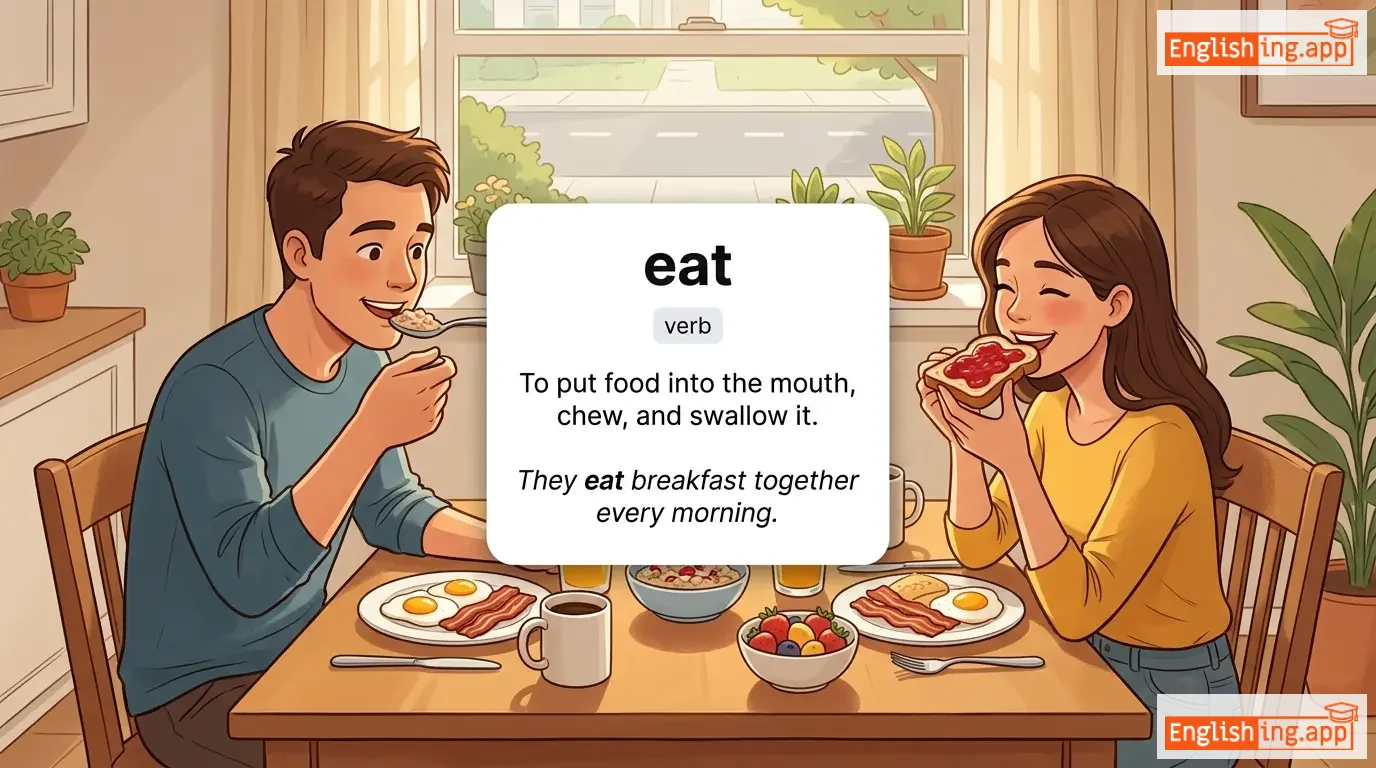
eat definition card — visual illustration of the meaning
verb
/iːt/
खाना (khana)

To put food into the mouth, chew, and swallow it.

"They eat breakfast together every morning."

"वे हर सुबह साथ में नाश्ता करते हैं।" (Ve har subah saath mein nashta karte hain.)
adjective
/ˈiːtəbl̩/
खाने योग्य (khane yogya)

suitable or safe for eating

"The berries are not only eatable but also quite tasty."

"यह बेरियाँ सिर्फ खाने योग्य नहीं बल्कि काफ़ी स्वादिष्ट भी हैं।" (Yeh beryiyan sirf khane yogya nahin balki kafi swadisht bhi hain.)
verb
/ˈiːtɪŋ/
खाना (khana)

the act of consuming food

"They were eating dinner when the phone rang."

"फोन बजने पर वे रात का खाना खा रहे थे।" (Phone bajne par ve raat ka khana khaa rahe the.)
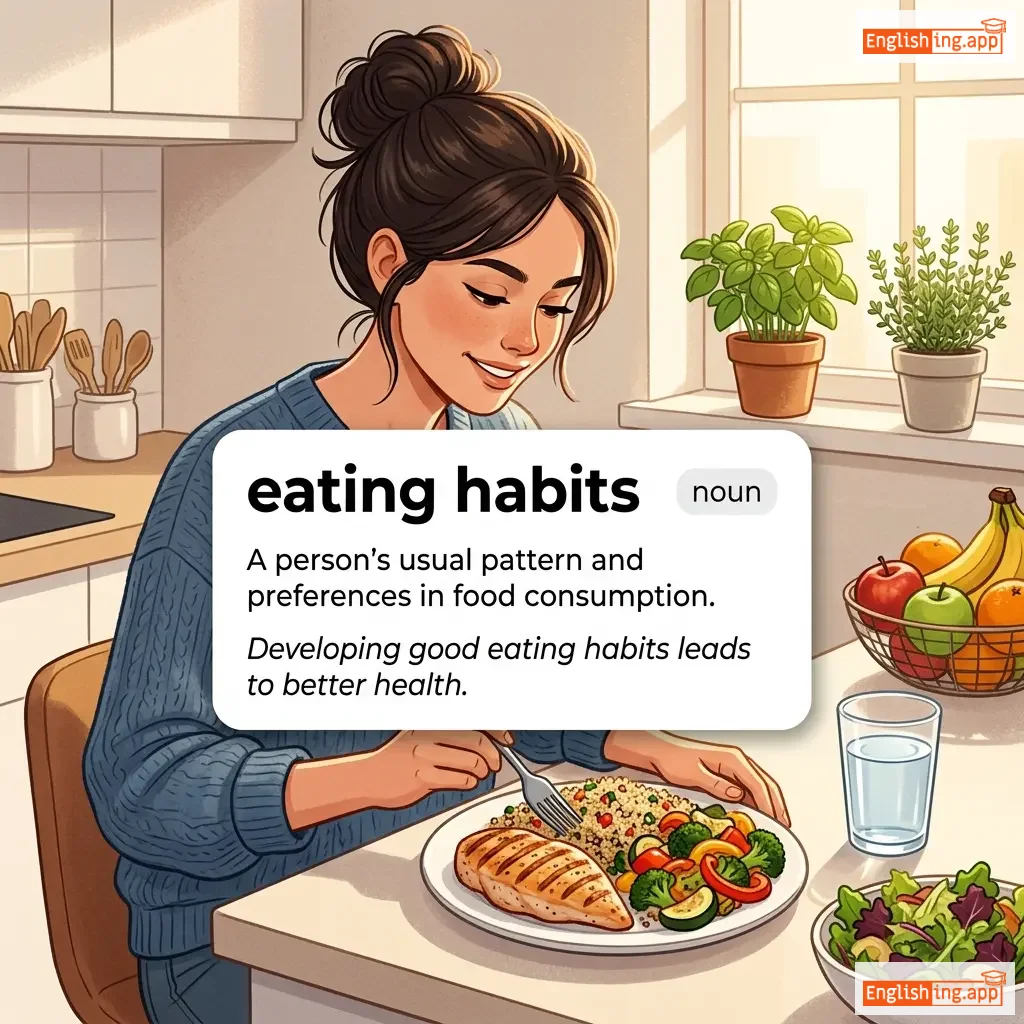
eating habits definition card — visual illustration of the meaning
noun
/ˈiː.tɪŋ ˈhæb.ɪts/
खानपान की आदतें (khanpan ki aadatein)

A person's usual pattern and preferences in food consumption.

"Developing good eating habits leads to better health."

"अच्छी खानपान की आदतें बेहतर स्वास्थ्य की ओर ले जाती हैं।" (Acchi khanpan ki aadatein behtar swasthya ki or le jaati hain.)
verb
/ˈiːvzdrɒp/
चुपके से सुनना (chupke se sunna)

to secretly listen to a conversation

"She stood near the door to eavesdrop on their conversation."

"वह उनके बातचीत को गुपचुप सुनने के लिए दरवाजे के पास खड़ी थी।" (Wah unke baatchit ko gupchup sunne ke liye darwaje ke paas khadi thi.)
verb
/ɛb/
कम होना (kam hona)

to recede, decline, or lessen gradually, often referring to the tide or emotions

"Her confidence began to ebb after the repeated failures."

"बार-बार की असफलताओं के बाद उसका आत्मविश्वास घटने लगा।" (Bar-bar ki asafaltaon ke baad uska atmavishwas ghatne laga.)
noun
/ˈeb.taɪd/
नमाव (namav)

the movement of the tide out to sea; a time when the sea level is falling

"During ebb-tide, we could walk further out on the beach."

"नमाव के दौरान, हम समुद्र तट पर और आगे चल सकते थे।" (namav ke dauran, ham samudra tat par aur aage chal sakte the.)
noun
/ɪˈbʊliəns/
उत्साह (utsah)

the quality of being cheerful, enthusiastic, and full of energy

"The teacher's ebullience inspired her students."

"अध्यापिका की उत्साह ने उनके छात्रों को प्रेरित किया।" (Adhyapika ki utsah ne unke chhatron ko prerit kiya.)
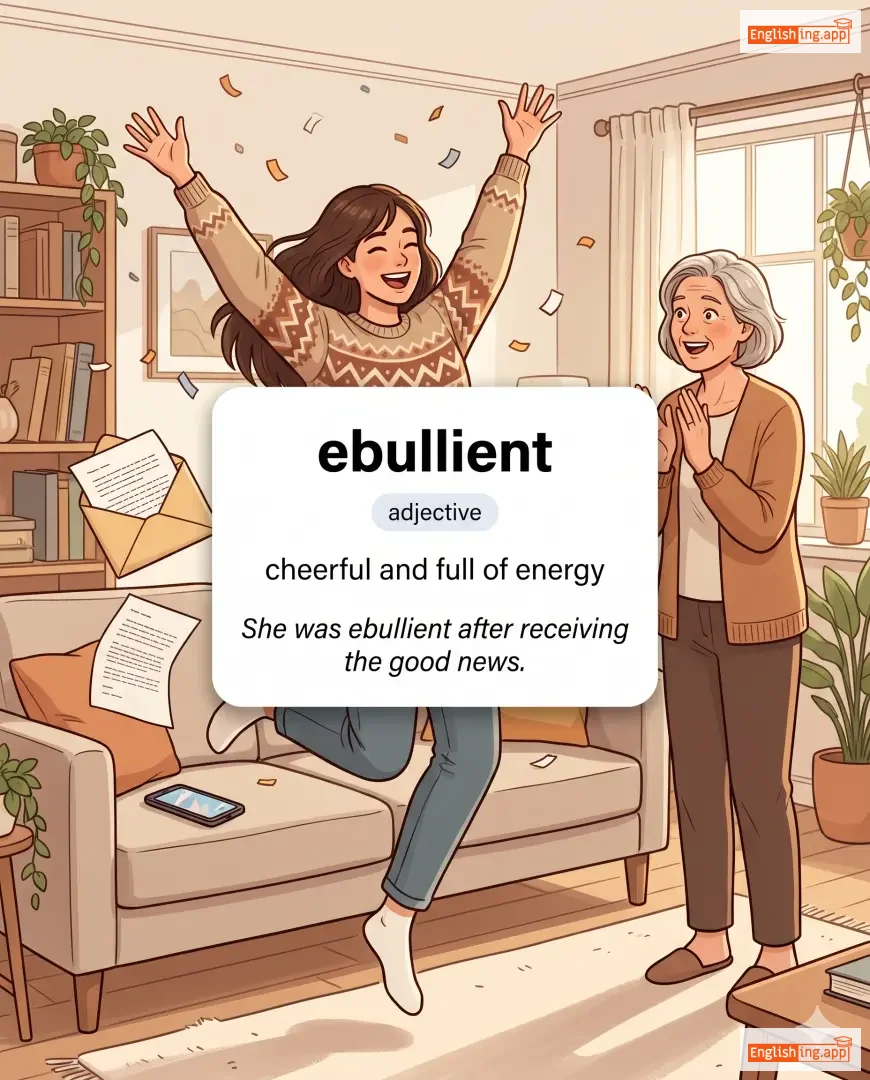
ebullient definition card — visual illustration of the meaning
adjective
/ɪˈbʊliənt/
उल्लसित (ullasit)

cheerful and full of energy

"She was ebullient after receiving the good news."

"अच्छी खबर मिलने के बाद वह उल्लसित थी।" (Achhi khabar milne ke baad vah ullasit thi.)
adjective
/ɪkˈsɛntrɪk/
अजीब (ajeev)

unconventional and slightly strange in behavior or appearance

"The artist was known for his eccentric style."

"कलाकार अपनी अजीब शैली के लिए जाना जाता था।" (Kalakar apni ajeeb shaili ke liye jaana jaata tha.)
noun
/ˌɛksɛnˈtrɪsəti/
असाधारणता (asadharanata)

the quality of being unconventional or slightly strange

"His eccentricity made him both admired and misunderstood."

"उसकी असाधारणता ने उसे दोनों प्रशंसा और गलतफहमी का कारण बना दिया।" (Uski asadharanata ne use dono prashansa aur galatfahami ka karan bana diya.)
noun
/ɪˌkliːziˈæstɪk/
धर्माधिकारी (dharmadhikari)

A member of the clergy or church official.

"The council was attended by several high-ranking ecclesiastics."

"काउंसिल में कई उच्च-रैंक वाले धर्माधिकारी उपस्थित थे।" (Council mein kai ucch-rank wale dharmadhikari upasthit the.)
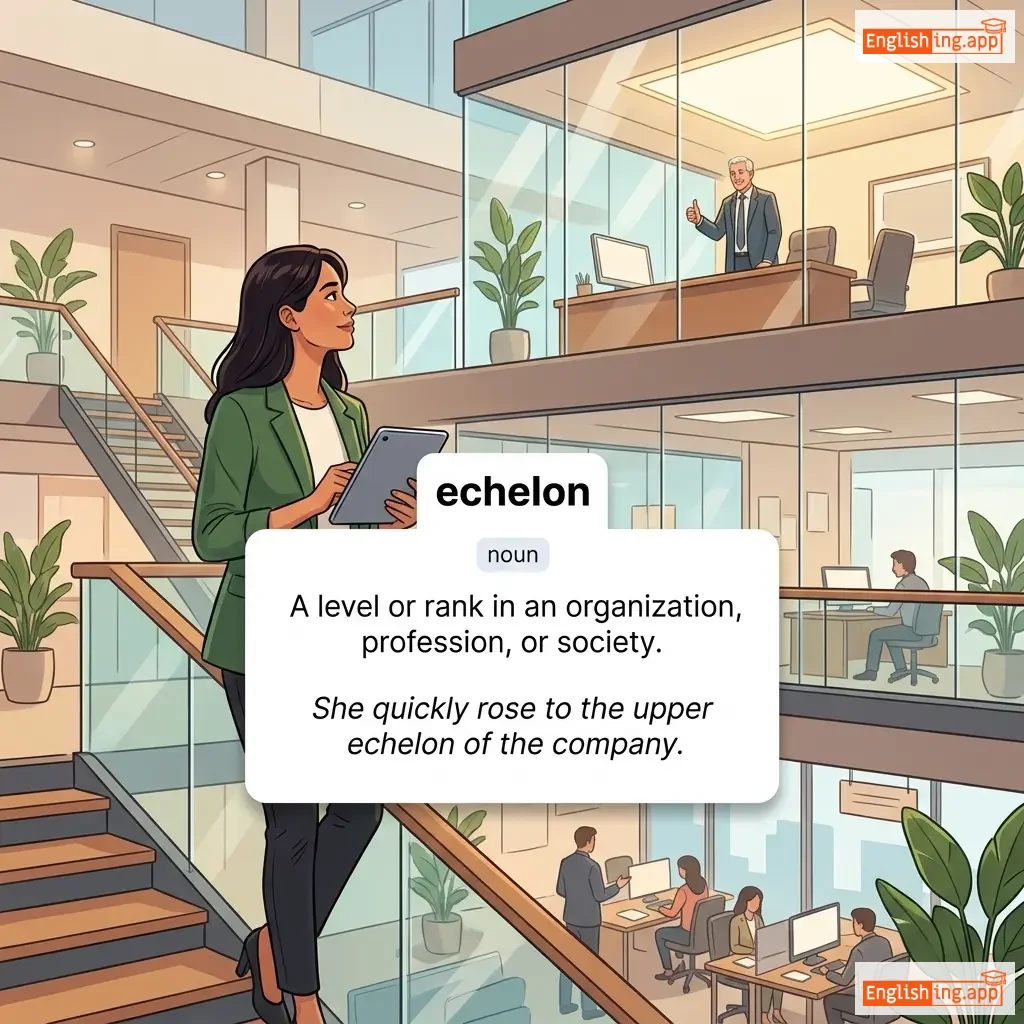
echelon definition card — visual illustration of the meaning
noun
/ˈɛʃəlɒn/
पदक्रम (padkram)

A level or rank in an organization, profession, or society.

"She quickly rose to the upper echelon of the company."

"वह जल्दी ही कंपनी के उच्च पदक्रम में पहुँच गई।" (Wah jaldi hi company ke uchch padkram mein pahunch gayi.)
noun, verb
/ˈɛkəʊ/
खुशी (khushi)

a sound that is reflected off a surface and heard again; to repeat or reflect a sound or idea.

"Her laughter echoed through the empty hall."

"जब उसे पुरस्कार मिला, तो वह अपनी खुशी छिपा नहीं सकी।" (jab use puraskar mila, to wah apni khushi chhupa nahi saki.)
echoed definition card — visual illustration of the meaning
verb
ˈɛkəʊd
गूंज उठना (goonj uthna)

To repeat or resound; to be reminiscent of something.

"The words of gratitude echoed in his heart."

"कृतज्ञता के शब्द उसके दिल में गूंज उठे।" (Krutagnata ke shabd uske dil mein goonj uthe.)