वोकैबुलरीज

इंग्लिश वोकैबुलरी डिस्कवर, लर्न और मास्टर करें

adjective
/ˌdɛməˈnaɪəkəl/
राक्षस-समान (rakshas-saman)

characteristic of or resembling a demon; wildly evil

"He gave a demoniacal laugh that terrified everyone."

"उसने एक राक्षस-समान हंसी दी जो सभी को डरा दिया।" (Usne ek rakshas-saman hansi di jo sabhi ko dara diya.)
adjective
/dɪˈmɒnstrəbl/
सिद्ध करने योग्य (sidh karne yogya)

clearly able to be shown or proven

"There was demonstrable evidence that he was innocent."

"यह सिद्ध करने योग्य सबूत था कि वह निर्दोष था।" (Yah sidh karne yogya saboot tha ki vah nirdosh tha.)
verb
/ˈdɛmənˌstreɪt/
प्रदर्शन करना (pradarshan karna)

to clearly show or prove something through evidence, explanation, or action

"The teacher demonstrated the experiment to the class."

"टीचर ने क्लास को प्रयोग डेमस्ट्रेट किया।" (Teacher ne class ko prayog demonstrate kiya.)
noun
/ˌdɛmənˈstreɪʃən/
प्रदर्शन, विरोध (pradarshan, virodh)

the act of showing something clearly, or a public protest

"The workers organized a demonstration for better wages."

"कर्मचारियों ने बेहतर वेतन के लिए एक प्रदर्शन आयोजित किया।" (Karmachariyon ne behtar vetan ke liye ek pradarshan aayojit kiya.)
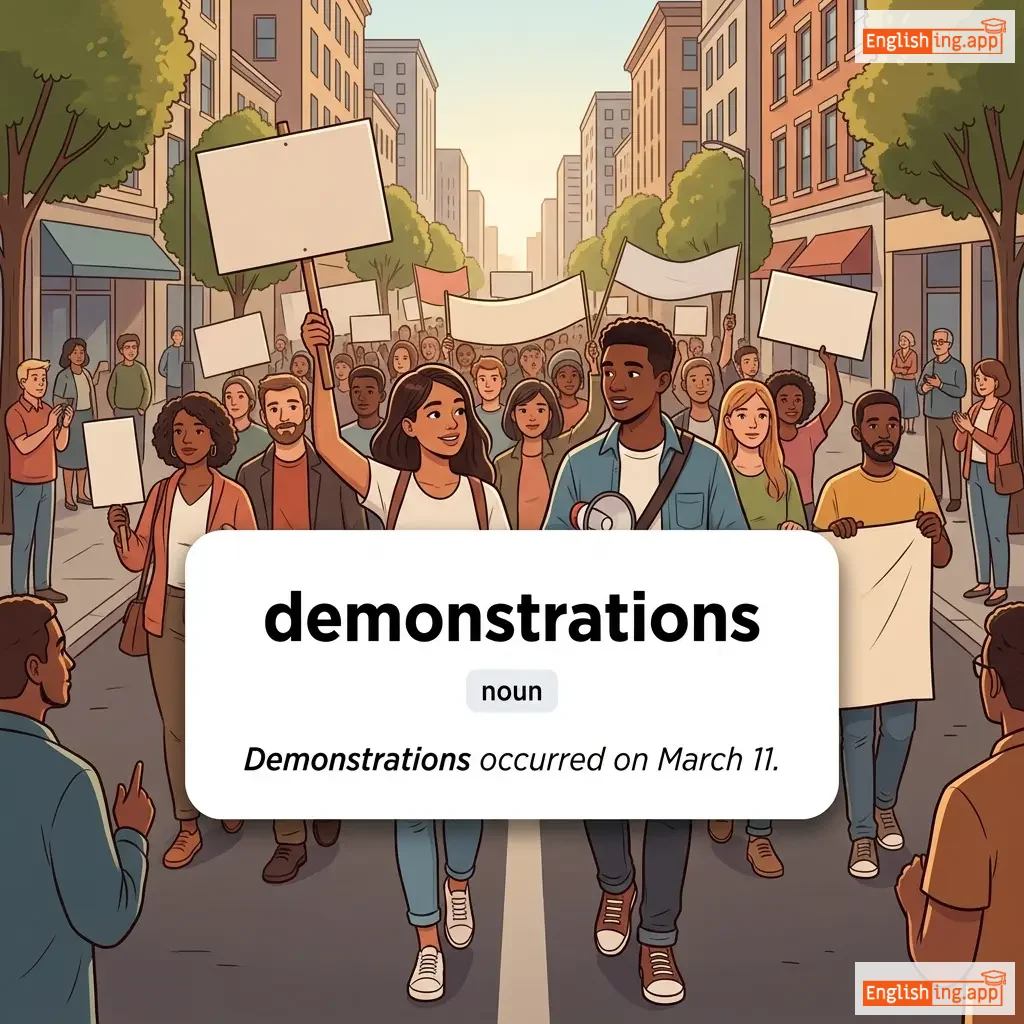
demonstrations definition card — visual illustration of the meaning
noun
ˌdemənˈstreɪʃənz
प्रदर्शन (pradarshan)

The action or process of showing the existence or truth of something by giving proof or evidence.

"Demonstrations occurred on March 11."

"11 मार्च को प्रदर्शन हुए थे।" (11 march ko pradarshan huye the.)
adjective
/dɪˈmɒnstrətɪv/
प्रकट करने वाला (prakat karne wala)

openly showing feelings, especially affection or emotion

"She was very demonstrative with her affection towards her friends."

"वह अपने दोस्तों के प्रति अपनी स्नेहभावनाओं को बहुत प्रकट करने वाली थी।" (Vah apne doston ke prati apni snehbhavnao ko bahut prakat karne wali thi.)
noun
/ˈdɛmənˌstreɪtər/
प्रदर्शक, प्रदर्शनकारी (pradarshak, pradarshankari)

a person who shows how something works or takes part in a public protest

"The demonstrators marched peacefully through the city streets."

"प्रदर्शनकारियों ने शहर की सड़कों पर शांति से मार्च किया।" (Pradarshankariyon ne shaher ki sadkon par shanti se maarch kiya.)
verb
/dɪˈmɔrəˌlaɪz/
आत्मविश्वास तोड़ना (aatmvishwas todna)

to cause someone to lose confidence or hope

"The constant criticism demoralized the young athlete."

"लगातार आलोचना ने युवा एथलीट का आत्मविश्वास तोड़ दिया।" (Lagatar alochana ne yuva athlete ka aatmavishwas tod diya.)
verb
/dɪˈmoʊt/
कम करना (kam karna)

to reduce to a lower rank or position

"The manager decided to demote the employee for poor performance."

"मैनेजर ने खराब प्रदर्शन के लिए कर्मचारी को डिमोट करने का निर्णय लिया।" (Manager ne kharab pradarshan ke liye karmchari ko demote karne ka nirnay liya.)
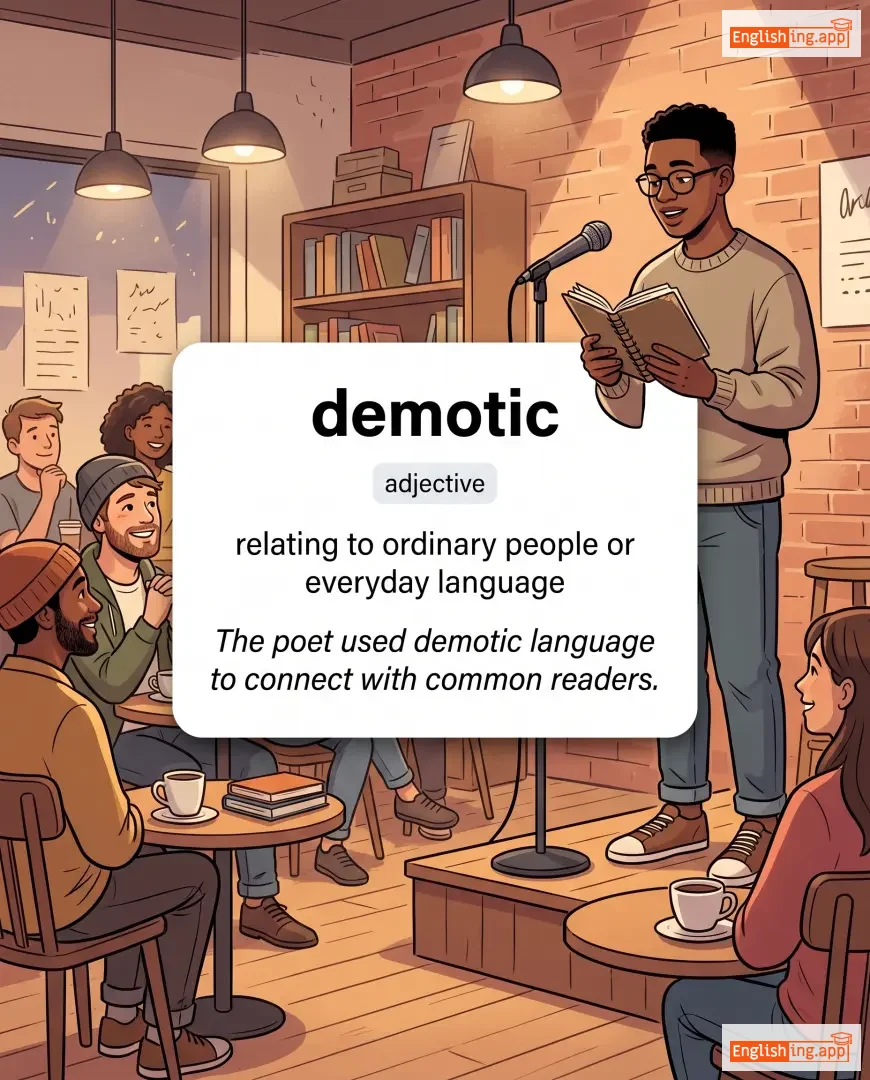
demotic definition card — visual illustration of the meaning
adjective
/dɪˈmɒtɪk/
जनसाधारण से संबंधित (janasadharan se sambandhit)

relating to ordinary people or everyday language

"The poet used demotic language to connect with common readers."

"कवि ने सामान्य पाठकों से जुड़ने के लिए जनसाधारण से संबंधित भाषा का उपयोग किया।" (Kavi ne sadharan pathako se judne ke liye janasadharan se sambandhit bhasha ka upyog kiya.)
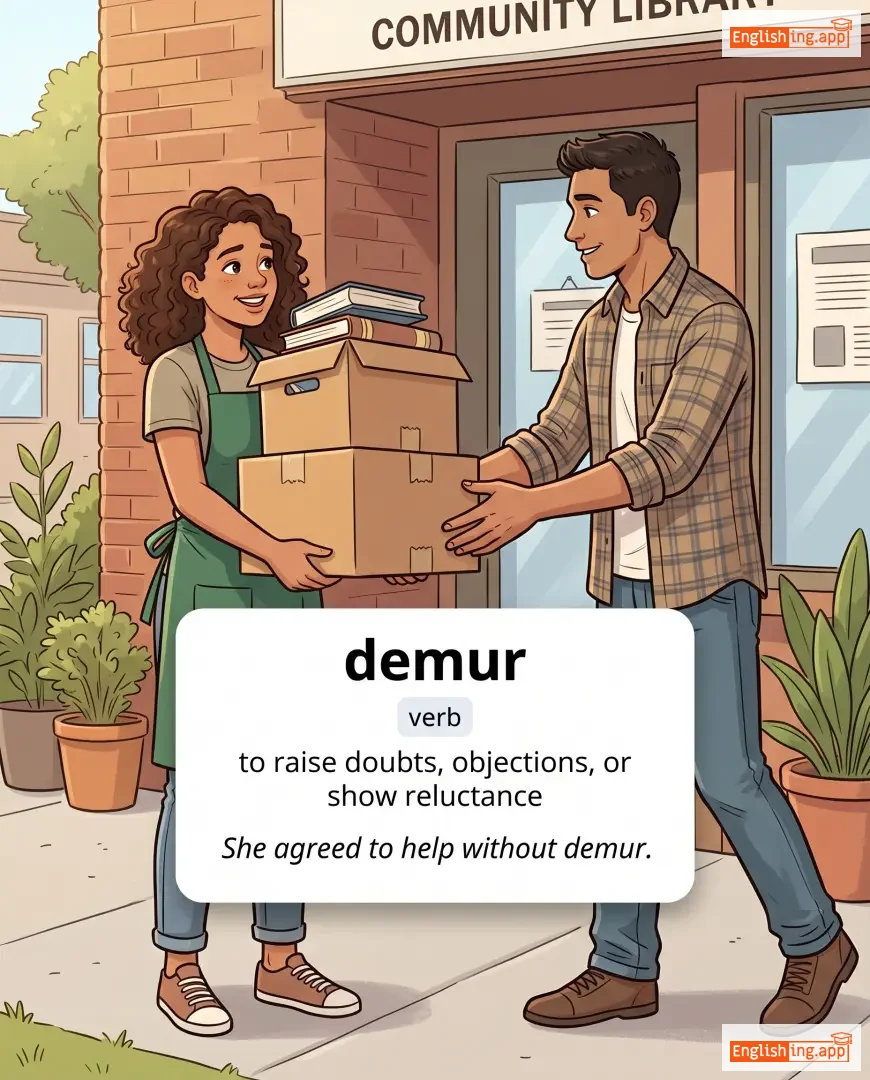
demur definition card — visual illustration of the meaning
verb
/dɪˈmɜːr/
आपत्ति जताना (aapatti jatana)

to raise doubts, objections, or show reluctance

"She agreed to help without demur."

"वह बिना आपत्ति के मदद करने के लिए सहमत हो गई।" (Wah bina aapatti ke madad karne ke liye sahmat ho gayi.)
adjective
/dɪˈmjʊər/
लाजुक (lajuk)

reserved, modest, and shy

"She gave him a demure smile."

"उसने उसे एक लाजुक मुस्कान दी।" (Usne use ek lajuk muskan di.)
noun
/dɪˈmʌrɪdʒ/
डिमरेज (dimarej)

a charge payable to the owner of a ship or vehicle for not loading or unloading on time

"The company had to pay demurrage for delaying the unloading of goods."

"कंपनी को सामान उतारने में देरी के कारण डिमरेज देना पड़ा।" (Kampani ko saman utarne mein deri ke karan dimarej dena pada.)
noun
/den/
गुफा, गड्ढा (gufa, gaddha)

a wild animal's lair or home; a small room used for relaxation

"The bear returned to its den for winter hibernation."

"भालू सर्दी के लिए अपने गुफा में लौट आया।" (bhalu sardi ke liye apne gufa mein laut aaya.)
verb
/diːˈnæʃənəlaɪz/
निजीकरण करना (nijikaran karna)

to transfer ownership from the government to private individuals or companies

"The government decided to denationalize the bank to encourage private investment."

"सरकार ने निजी निवेश को प्रोत्साहित करने के लिए बैंक को निजीकरण करने का निर्णय लिया।" (Sarkar ne niji nivesh ko protsaahit karne ke liye bank ko nijikaran karne ka nirnay liya.)
adjective
/ˈdɛndrɔɪd/
पेड़ के समान (ped ke samaan)

tree-shaped or branching like a tree

"The coral has a dendroid structure."

"कोरल की एक डेंड्रॉइड संरचना है।" (Koral ki ek dendroid sanrachna hai.)
noun
/dɛnˈdrɒlədʒi/
वृक्ष-विज्ञान (dendroloji)

the scientific study of trees and woody plants

"He is studying dendrology at the university."

"वह विश्वविद्यालय में वृक्ष-विज्ञान का अध्ययन कर रहा है।" (vah vishvavidyalay mein vrksh-vijnyan ka adhyayan kar raha hai.)
noun
/dɪˈnaɪəl/
अस्वीकरण (asweekaran)

a statement that something is not true; the refusal to accept or believe something

"His denial of the accusations surprised everyone."

"उसका आरोपों का अस्वीकरण सभी को चौंका गया।" (uska aaropon ka asweekaran sabhi ko chonka gaya.)
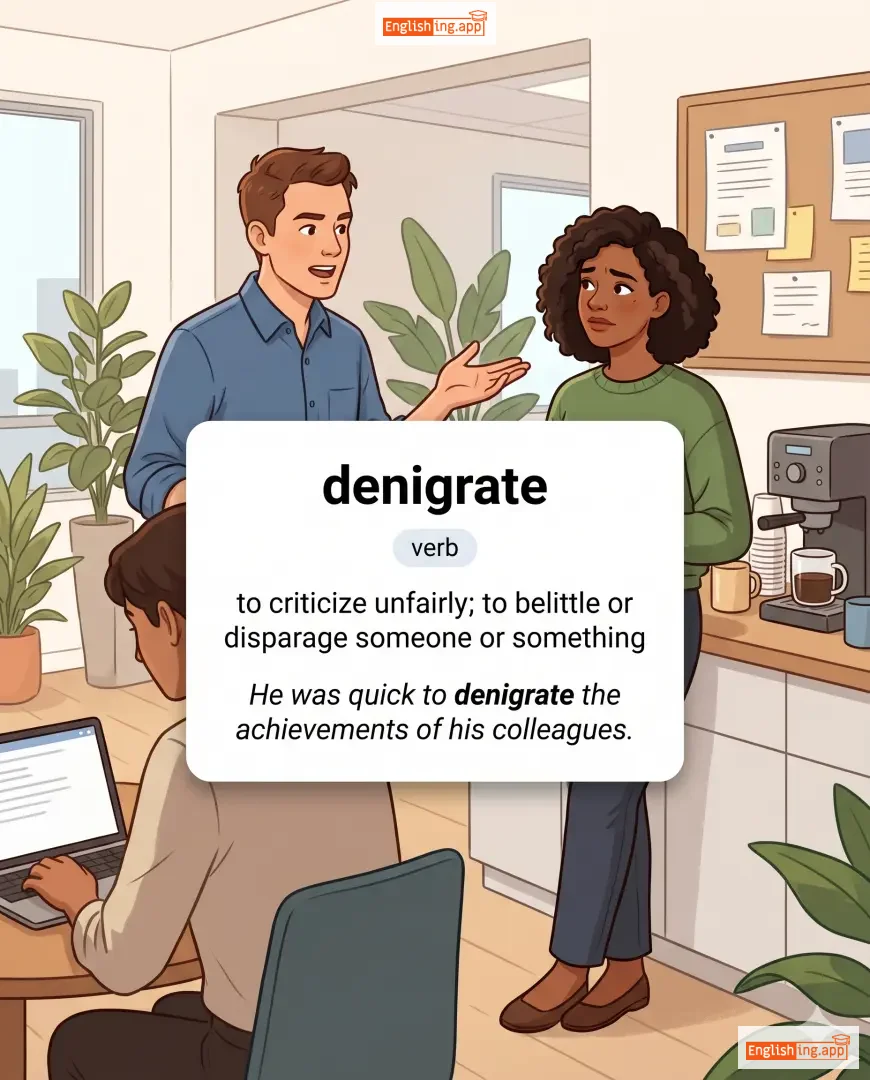
denigrate definition card — visual illustration of the meaning
verb
/ˈdɛnɪˌɡreɪt/
निंदा करना (ninda karna)

to criticize unfairly; to belittle or disparage someone or something

"He was quick to denigrate the achievements of his colleagues."

"वह अपने सहकर्मियों की उपलब्धियों को जल्दी से निंदा कर रहा था।" (Vah apne sahkarmiyon ki uplabdhiyon ko jaldi se ninda kar raha tha.)
noun
/ˈdɛnɪmz/
डेनिम पैंट (denim pant)

pants or clothes made from denim fabric, usually jeans

"He wore blue denims with a white shirt."

"उसने एक सफेद शर्ट के साथ नीले डेनिम पहने थे।" (Usne ek safed shirt ke saath neele denim pahne the.)
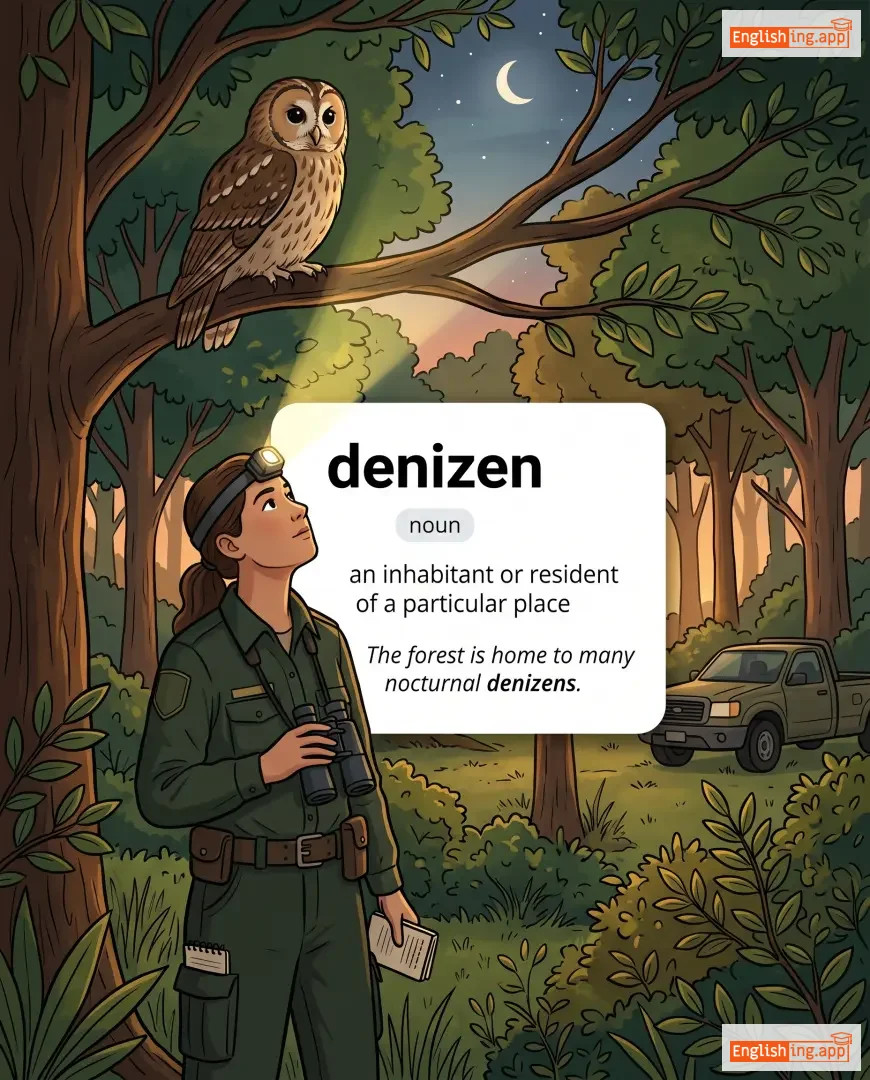
denizen definition card — visual illustration of the meaning
noun
/ˈdɛnɪzən/
निवासी (nivaasi)

an inhabitant or resident of a particular place

"The forest is home to many nocturnal denizens."

"जंगल कई रात्रिचर निवासियों का घर है।" (Jangal kai raatrichar nivaasiyon ka ghar hai.)
verb
/dɪˈnɒmɪˌneɪt/
नामकरण करना (naamkaran karna)

to give a name or designation to something

"The currency was denominated in dollars."

"मुद्रा को डॉलर में नामित किया गया था।" (Mudra ko dollar mein namit kiya gaya tha.)
noun
/dɪˌnɒmɪˈneɪʃən/
संप्रदाय, मूल्य (sampraday, muly)

a recognized autonomous branch of the Christian Church; a unit of value or currency

"The church belongs to a Protestant denomination."

"चर्च एक प्रोटेस्टेंट संप्रदाय का हिस्सा है।" (Church ek Protestant sampraday ka hissa hai.)
noun
/dɪˈnɒmɪˌneɪtər/
हर (har)

the number below the line in a fraction; a common factor in a situation

"In the fraction 3/4, the number 4 is the denominator."

"भिन्न 3/4 में, संख्या 4 डिनोमिनेटर है।" (Bhinn 3/4 mein, sankhya 4 denominator hai.)
noun
/ˌdiːnəʊˈteɪʃən/
सूचक अर्थ (soochak arth)

The literal or primary meaning of a word, in contrast to the feelings or ideas that the word suggests.

"The denotation of the word 'rose' is a type of flower."

"'रोज़' शब्द का डिनो्टेशन एक प्रकार का फूल है।" ('Rose' shabd ka denotation ek prakar ka phool hai.)
verb
/dɪˈnəʊt/
संकेत करना (sanket karna)

To be a sign of; to indicate or mean something.

"A red flag denotes danger."

"एक लाल ध्वज डेंजर का संकेत करता है।" (Ek lal dhwaj danger ka sanket karta hai.)
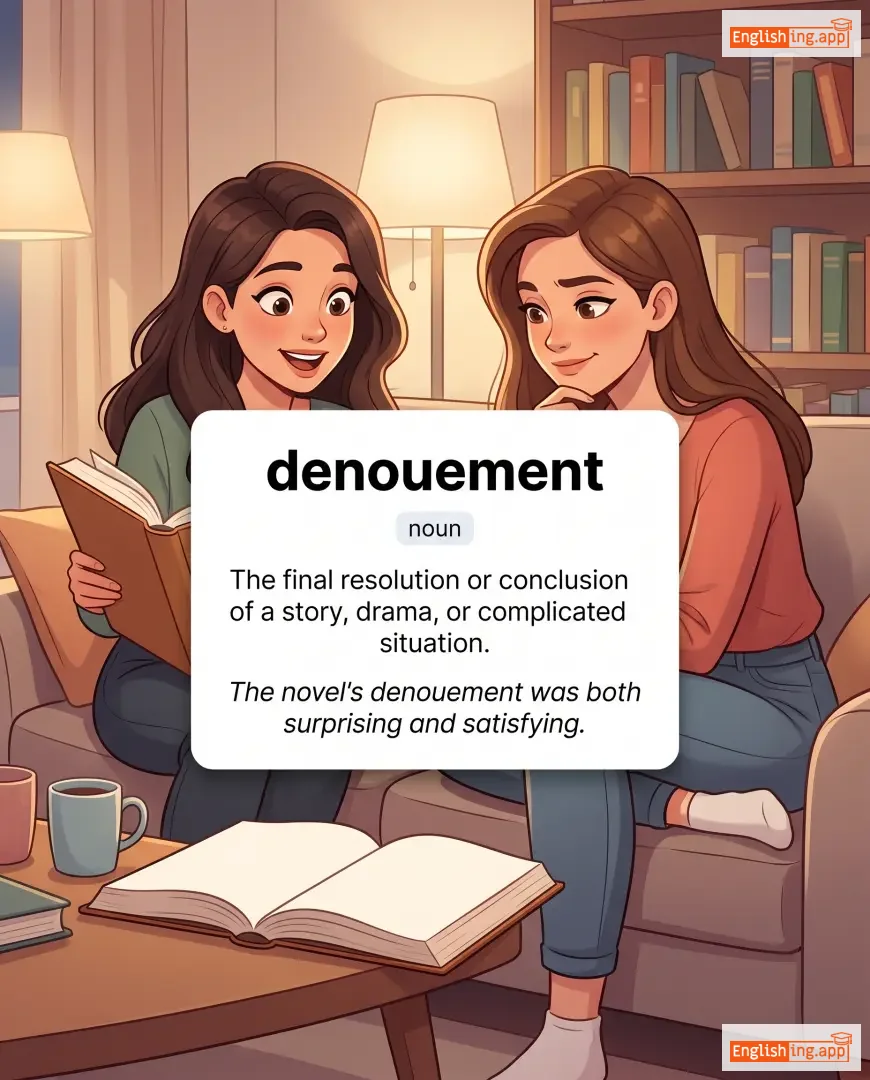
denouement definition card — visual illustration of the meaning
noun
/ˌdeɪnuːˈmɒ̃/
समाप्ति (samaapti)

The final resolution or conclusion of a story, drama, or complicated situation.

"The novel's denouement was both surprising and satisfying."

"उपन्यास का समापन आश्चर्यजनक और संतोषजनक था।" (Upanyas ka samaapan aashcharyajanak aur santoshjanak tha.)
verb
/dɪˈnaʊns/
निंदा करना (ninda karna)

To publicly declare something to be wrong, evil, or condemn strongly.

"The leader denounced corruption in his speech."

"नेता ने अपनी स्पीच में भ्रष्टाचार की निंदा की।" (Neta ne apni speech mein bhrashtachar ki ninda ki.)
adjective
/dɛns/
घना (ghana)

Closely compacted in substance; having parts crowded together.

"The forest was so dense that little sunlight reached the ground."

"जंगल इतना घना था कि सूर्य की रोशनी जमीन तक नहीं पहुँच पाई।" (Jangal itna ghana tha ki sury ki roshni zameen tak nahi pahunch paayi.)
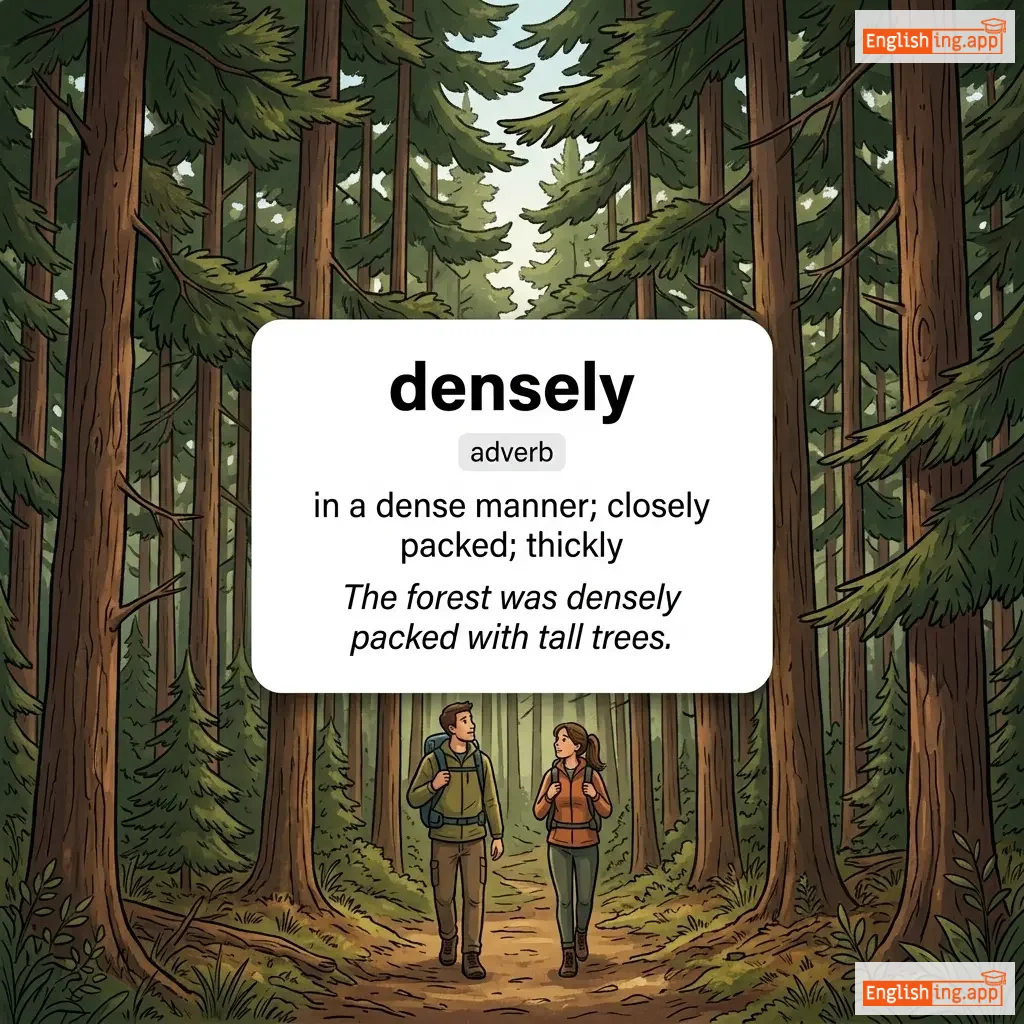
densely definition card — visual illustration of the meaning
adverb
/ˈdens.li/
घने तरीके से; करीबी पैक किया हुआ; घना (ghanay tareekay se; kareebi paak kiya hua; ghana)

in a dense manner; closely packed; thickly

"The forest was densely packed with tall trees."

"जंगल ऊँचे पेड़ों से घने तरीके से भरा हुआ था।" (jangal unche pedon se ghane tareekay se bhara hua tha)
noun
/ˈdɛnsɪti/
घनत्व (ghantva)

the degree of compactness or thickness of a substance or object

"The density of water is higher than that of air."

"पानी की घनत्व हवा से अधिक है।" (Pani ki ghantva hawa se adhik hai.)
noun/verb
/dɛnt/
डेंट (dent)

a small hollow mark on the surface of something; to make a small hollow mark

"The accident left a dent in the car door."

"दुर्घटना ने कार के दरवाजे पर एक डेंट छोड़ दिया।" (Durghatna ne car ke darwaze par ek dent chhod diya.)
adjective
/ˈdɛntəl/
दंत संबंधी (dant sambandhi)

relating to teeth or dentistry

"She goes for a dental checkup every six months."

"वह हर छह महीने में दंत जांच करवाती है।" (vah har chhah mahine mein dant jaanch karvaati hai)
noun
/ˈdɛntɪfrɪs/
दांत साफ करने वाला पदार्थ (daant saaf karne wala padarth)

a substance such as powder, paste, or liquid used to clean teeth

"He bought a new herbal dentifrice from the pharmacy."

"उसने फार्मेसी से एक नया हर्बल डेंटिफ्राइस खरीदा।" (Usne pharmacy se ek naya herbal dentifrice kharida.)
noun
/ˈden.tɪst/
दांतों का डॉक्टर (daanton ka doctor)

a medical professional who treats teeth and oral health

"I need to visit the dentist for a regular checkup."

"मुझे नियमित चेकअप के लिए दांतों के डॉक्टर के पास जाना है।" (mujhe niyamit chek-ap ke liye daanton ke doctor ke paas jana hai)
verb
/dɪˈnjuːd/
नंगा करना (nanga karna)

to strip something of its covering, possessions, or assets

"The forest was denuded of trees by illegal logging."

"जंगल को अवैध लकड़ी काटने से पेड़ों से नंगा कर दिया गया था।" (Jangal ko avaidh lakdi katne se pedo se nanga kar diya gaya tha.)
noun
/dɪˌnʌnsiˈeɪʃən/
निंदा / सार्वजनिक आरोप (ninda / sarvajanik aarop)

the public condemnation or accusation of someone or something

"The journalist's article was a strong denunciation of corruption."

"पत्रकार का लेख भ्रष्टाचार की खिलाफ एक मजबूत निंदा थी।" (Patrakar ka lekh bhrashtachar ki khilaf ek majboot ninda thi.)
verb
/dɪˈnaɪ/
अस्वीकार करना (asvikar karna)

to refuse to accept or admit something; to declare something untrue

"He denied stealing the money."

"उसने पैसे चुराने का इनकार किया।" (Usne paise churane ka inkaar kiya.)
noun
/diˈoʊ.dər.ənt/
डियोडोरेंट (diodorent)

a substance that removes or conceals unpleasant smells, especially bodily odors

"She applied deodorant before going to the gym to stay fresh during workout."

"वह जिम जाने से पहले ताजगी बनाए रखने के लिए डियोडोरेंट लगाती थी।" (vah jim jaane se pehle taazgi banaye rakhne ke liye diodorent lagati thi.)
verb
/dɪˈpɑːrt/
प्रस्थान करना (prasthan karna)

to leave, especially to start a journey

"The train will depart at 9 a.m."

"ट्रेन सुबह 9 बजे प्रस्थान करेगी।" (Train subah 9 baje prasthan karegi.)
noun
/dɪˈpɑːrtmənt/
विभाग (vibhag)

a division of a large organization such as a government, university, or company

"She works in the marketing department."

"वह विपणन विभाग में काम करती है।" (Wah vipanan vibhag mein kaam karti hai.)
noun
/dɪˈpɑːrtʃər/
प्रस्थान, विदाई (prasthaan, vidaai)

the act of leaving a place, especially to start a journey

"The plane’s departure was delayed due to fog."

"विमान का प्रस्थान धुंध के कारण विलंबित हो गया था।" (Vimaan ka prasthaan dhoondh ke kaaran vilambit ho gaya tha.)
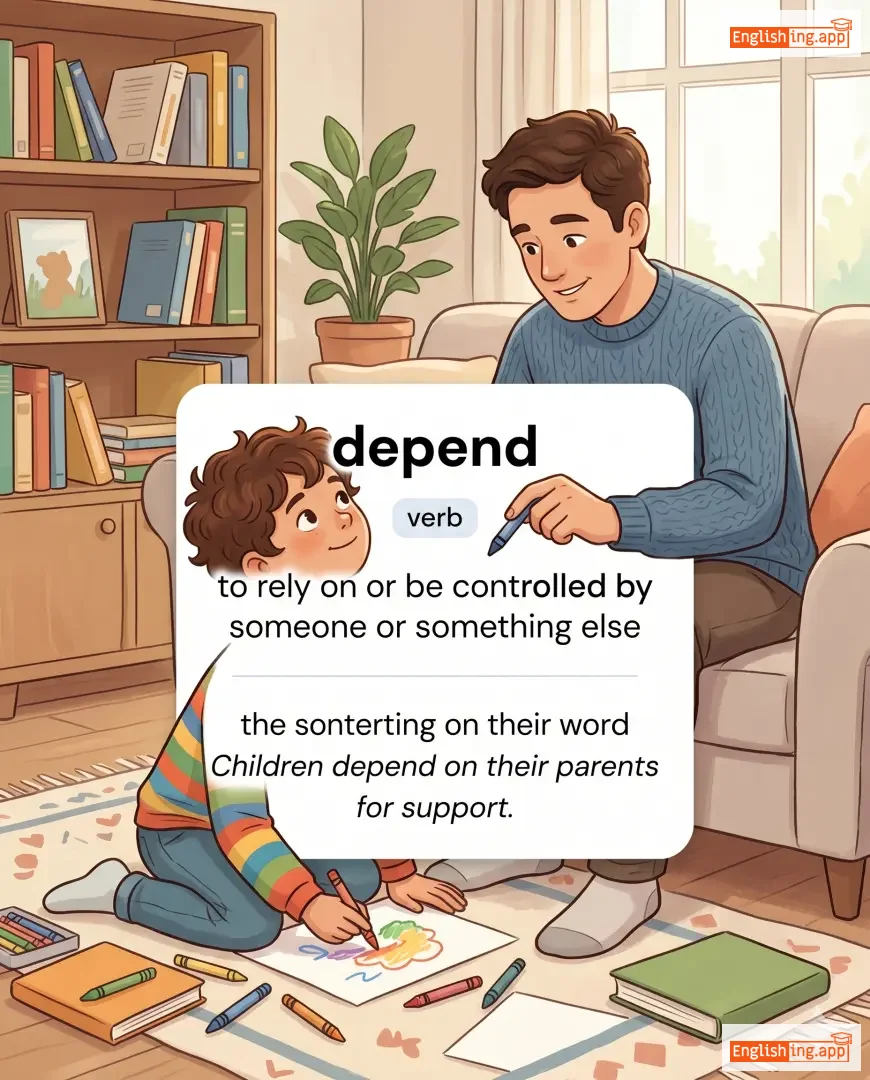
depend definition card — visual illustration of the meaning
verb
/dɪˈpɛnd/
निर्भर होना (nirbhar hona)

to rely on or be controlled by someone or something else

"Children depend on their parents for support."

"बच्चे अपने माता-पिता पर सहायता के लिए निर्भर करते हैं।" (Bachche apne mata-pita par sahayata ke liye nirbhar karte hain.)
adjective
/dɪˈpɛndəbl/
विश्वसनीय (vishvasniya)

able to be trusted or relied on; consistently reliable

"She is a dependable colleague who always meets deadlines."

"वह एक विश्वसनीय सहकर्मी है जो हमेशा समय सीमा पूरी करता है।" (vah ek vishvasniya sahakarmi hai jo hamesha samay seema poori karta hai)
noun
/dɪˈpɛndəns/
निर्भरता (nirbharta)

the state of relying on or needing someone or something

"His dependence on his parents was growing as he couldn't find a job."

"जब वह नौकरी नहीं पा सका, तो उसके माता-पिता पर निर्भरता बढ़ रही थी।" (Jab wah naukri nahin paa saka, to uske mata-pita par nirbharta badh rahi thi.)
adjective
/dɪˈpɛndənt/
निर्भर (nirbhar)

Relying on someone or something else for support or help.

"Children are dependent on their parents for care."

"बच्चे अपने माता-पिता पर देखभाल के लिए निर्भर होते हैं।" (Bacche apne mata-pita par dekhbhaal ke liye nirbhar hote hain.)
verb
/dɪˈpɛndɪŋ/
निर्भर करना (nirbhar karna)

Being contingent on or influenced by something.

"The success of the plan is depending on the team's effort."

"योजना की सफलता टीम के प्रयासों पर निर्भर कर रही है।" (Yojana ki safalta team ke prayaason par nirbhar kar rahi hai.)
verb
/dɪˈpɪkt/
चित्रित करना (chitrit karna)

to represent or show something in a picture, story, or other art form

"The painting depicts a beautiful sunset over the sea."

"चित्रकला में समुद्र के ऊपर एक सुंदर सूर्यास्त चित्रित किया गया है।" (Chitrakala mein samudra ke upar ek sundar suryasta chitrit kiya gaya hai.)
verb
/ˈdɛpɪleɪt/
बाल निकालना (baal nikaalna)

to remove hair from the skin, especially by mechanical or chemical means

"She decided to depilate her legs before the event."

"उसने इवेंट से पहले अपने पैरों से बाल हटाने का निर्णय लिया।" (Usne event se pehle apne pairon se baal hatane ka nirnay liya.)
verb
/dɪˈpliːt/
नष्ट करना (nasht karna)

to reduce the quantity or supply of something

"The long war has depleted the country's resources."

"लंबे युद्ध ने देश के संसाधनों को नष्ट कर दिया है।" (Lambe yudh ne desh ke sansadhanon ko nasht kar diya hai.)