वोकैबुलरीज

इंग्लिश वोकैबुलरी डिस्कवर, लर्न और मास्टर करें

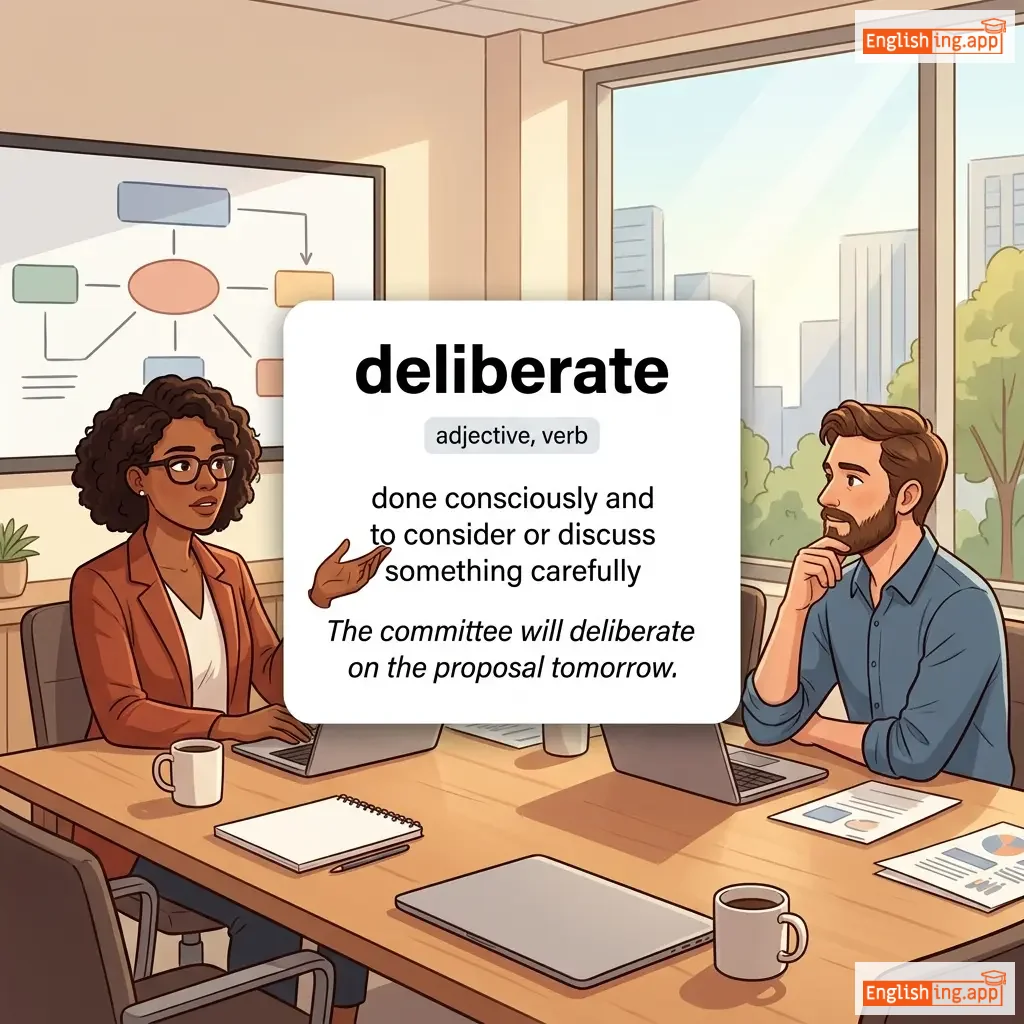
deliberate definition card — visual illustration of the meaning
adjective, verb
/dɪˈlɪbərət/ (adj), /dɪˈlɪbəreɪt/ (verb)
सचेत रूप से किया गया / विचार करना (sachet roop se kiya gaya / vichar karna)

done consciously and intentionally; to consider or discuss something carefully

"The committee will deliberate on the proposal tomorrow."

"कमिटी कल प्रस्ताव पर विचार करेगी।" (Kamiti kal prastav par vichar karegi.)
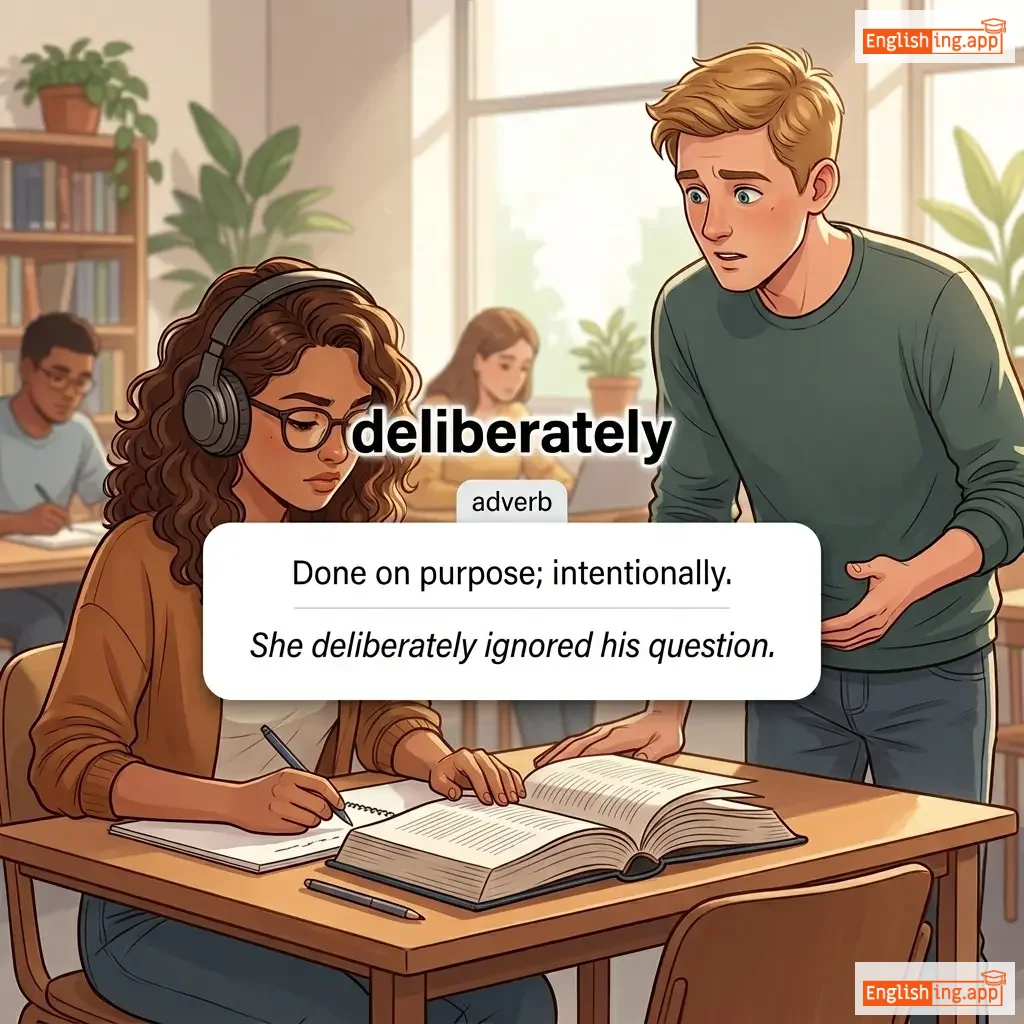
deliberately definition card — visual illustration of the meaning
adverb
/dɪˈlɪbərətli/
जानबूझकर (janboojhkar)

Done on purpose; intentionally.

"She deliberately ignored his question."

"उसने जानबूझकर उसके सवाल को अनदेखा किया।" (Usne janboojhkar uske sawal ko andekha kiya.)
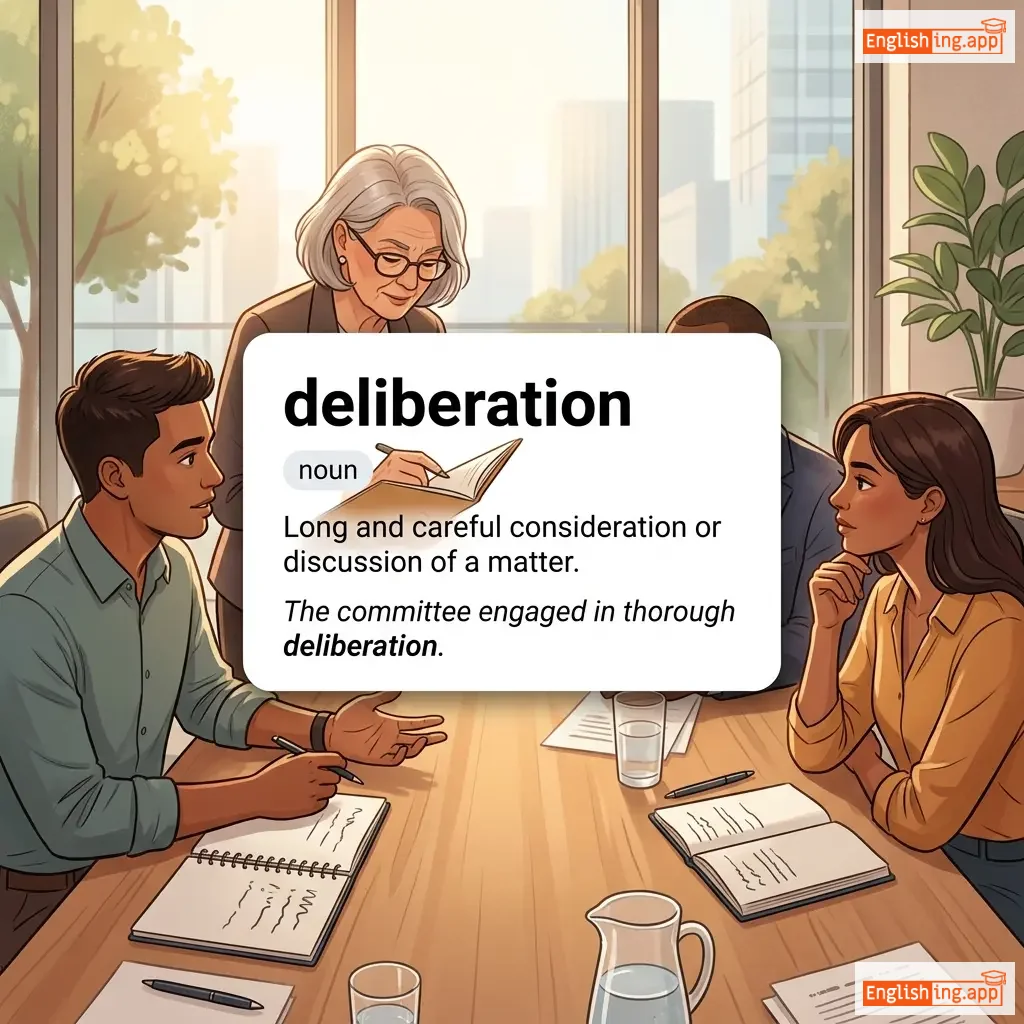
deliberation definition card — visual illustration of the meaning
noun
dɪˌlɪb.əˈreɪ.ʃən
विचार-विमर्श (vichar-vimrash)

Long and careful consideration or discussion of a matter.

"The committee engaged in thorough deliberation."

"कमेटी ने गहरे विचार-विमर्श में भाग लिया।" (Kamiti ne gahare vichar-vimrash mein bhag liya.)
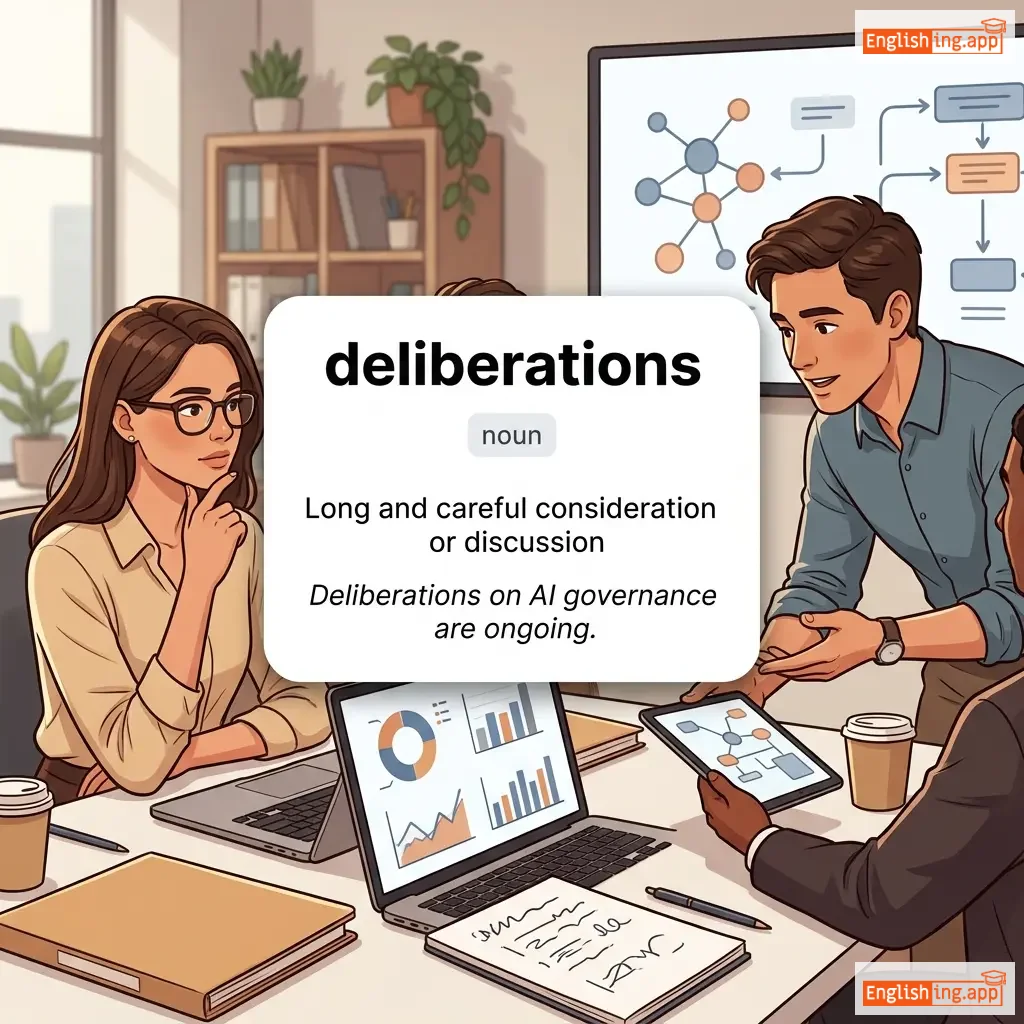
deliberations definition card — visual illustration of the meaning
noun
dɪˌlɪb.əˈreɪ.ʃənz
विचार-विमर्श (vichar-vimarsh)

Long and careful consideration or discussion

"Deliberations on AI governance are ongoing."

"AI गवर्नेंस पर विचार-विमर्श जारी हैं।" (AI governance par vichar-vimarsh jaari hain.)
noun
/ˈdɛlɪkəsi/
विशेष भोजन / नाजुकता (vishes bhojan / najukta)

a rare or expensive food item; fineness or sensitivity

"Caviar is considered a delicacy in many countries."

"कैवियार कई देशों में एक विशेष भोजन माना जाता है।" (Caviar kai deshon mein ek vishes bhojan maana jaata hai.)
adjective
/ˈdɛlɪkət/
नाज़ुक (nazuk)

Easily broken or damaged; requiring careful handling.

"The vase is very delicate, so handle it with care."

"यह फूलदान बहुत नाज़ुक है, इसलिए इसे सावधानी से संभालें।" (Yeh phooldan bahut naazuk hai, isliye ise saavdhani se sambhalen.)
adjective
/dɪˈlɪʃəs/
खुशी (khushi)

having a very pleasant taste or smell

"The cake was so delicious that everyone asked for a second slice."

"वह जब पुरस्कार प्राप्त किया तो वह अपनी खुशी को छिपा नहीं सकी।" (Vah jab puraskar prapt kiya to vah apni khushi ko chhupa nahin saki.)
noun, verb
/dɪˈlaɪt/
आनंद (anand)

great pleasure or joy; to give someone great pleasure

"The children were filled with delight when they saw the gifts."

"बच्चे उपहार देखकर आनंद से भर गए।" (bacche upahar dekhkar anand se bhar gaye.)
adjective
/dɪˈlaɪtɪd/
खुश (khush)

feeling or showing great pleasure and happiness

"She was delighted with the surprise gift."

"वह सरप्राइज उपहार से बहुत खुश थी।" (Wah surprise uphaar se bahut khush thi.)
verb
/diːˈlɪmɪt/
सीमा निर्धारित करना (seema nirdharit karna)

to fix the boundaries or limits of something

"The treaty was signed to delimit the borders of the two countries."

"संधि को दो देशों की सीमाओं को निर्धारित करने के लिए हस्ताक्षरित किया गया था।" (Sandhi ko do deshon ki seemaon ko nirdharit karne ke liye hastaksharit kiya gaya tha.)
delineate definition card — visual illustration of the meaning
verb
/dɪˈlɪnieɪt/
स्पष्ट रूप से वर्णन करना (spasht roop se varnana karna)

to describe, portray, or define something precisely and clearly

"The contract clearly delineates the responsibilities of each party."

"कॉन्ट्रैक्ट स्पष्ट रूप से हर पार्टी की ज़िम्मेदारी को वर्णित करता है।" (Contract spasht roop se har party ki zimmedari ko varnana karta hai.)
noun
/dɪˌlɪniˈeɪʃən/
विवरण (vivaran)

the precise description, drawing, or outlining of something

"The artist’s delineation of the landscape was remarkably accurate."

"कलाकार का परिदृश्य का विवरण आश्चर्यजनक रूप से सटीक था।" (Kalakar ka paridrishya ka vivaran aashcharyajanak roop se sathik tha.)
verb
/ˌdɛlɪˈkwɛs/
आर्द्रता को अवशोषित करके तरल बनना (aardrata ko avashoshit karke taral banna)

to become liquid by absorbing moisture from the air

"The salt began to deliquesce after being left in the humid room."

"नम कमरे में छोड़ने के बाद नमक तरल हो गया था।" (Nam kamre mein chhodne ke baad namak taral ho gaya tha.)
adjective
/ˌdɛlɪˈkwɛsənt/
जो नमी को सोखकर तरल हो जाता है (jo nami ko sokhkar taral ho jata hai)

tending to become liquid by absorbing moisture from the air

"Sugar is not deliquescent, but salt can be."

"चीनी डेलिक्वेसेंट नहीं है, लेकिन नमक हो सकता है।" (Cheeni deliquescent nahi hai, lekin namak ho sakta hai.)
adjective
/dɪˈlɪriəs/
पागलपन (paagalpan)

in an extremely disturbed or excited state of mind, often due to illness or emotion

"He was delirious with fever and kept muttering nonsense."

"वह बुखार से डिलीरीअस था और बकवास बड़बड़ा रहा था।" (Vah bukhaar se delirious tha aur bakwaas badbad raha tha.)
noun
/dɪˈlɪriəm/
मनोविक्षोभ (manovikshobh)

An acutely disturbed state of mind characterized by restlessness, illusions, and incoherence.

"The patient experienced delirium after the surgery due to the strong medication."

"सर्जरी के बाद रोगी को दवाइयों के कारण मनोविक्षोभ का अनुभव हुआ।" (Surgery ke baad rogi ko davaiyon ke kaaran manovikshobh ka anubhav hua.)
verb
/dɪˈlɪvər/
पहुँचाना (pahuchana)

to bring or hand over something to the intended recipient

"The courier will deliver the package tomorrow."

"कूरियर कल पैकेज पहुँचाएगा।" (Courier kal package pahuchayega.)
noun
/dɪˈlɪvəri/
वितरण (vitaran)

the act of taking goods, letters, or packages to people's houses or places of work

"The delivery of fresh vegetables arrives every morning."

"ताजे सब्ज़ियों की डिलीवरी हर सुबह पहुँचती है।" (Taje sabziyon ki delivery har subah pahuchti hai.)
noun
/ˈdɛltə/
डेल्टा (delta)

A landform at the mouth of a river where it splits into several outlets.

"The Nile Delta is one of the most fertile regions in Egypt."

"नाइल डेल्टा मिस्र के सबसे उर्वर क्षेत्रों में से एक है।" (Nile delta Misr ke sabse urvar kshetron mein se ek hai.)
deltaic landscape definition card — visual illustration of the meaning
noun
delˈteɪɪk ˈlændskeɪp
डेल्टा क्षेत्र (delta kshetra)

A geographical area formed by sediment deposits at the mouth of a river, creating a triangular land formation.

"Bangladesh has a unique deltaic landscape."

"बांगलादेश में एक अनोखा डेल्टाइक लैंडस्केप है।" (Bangladesh mein ek anokha delta kshetra hai.)
verb
/dɪˈluːd/
बेहकाना (behkaana)

To mislead someone into believing something that is not true.

"He deluded himself into thinking he could win the race without training."

"उसने खुद को धोखा दिया कि वह बिना प्रशिक्षण के दौड़ जीत सकता है।" (Usne khud ko dhokha diya ki vah bina prashikshan ke daud jeet sakta hai.)
noun
/ˈdɛljuːdʒ/
बाढ़ (baadh)

A severe flood; an overwhelming quantity of something.

"The town was hit by a deluge of rain in just a few hours."

"शहर को कुछ ही घंटों में बारिश की बाढ़ ने प्रभावित कर दिया।" (Shahar ko kuch hi ghanton mein baarish ki baadh ne prabhavit kar diya.)
noun
/dɪˈluːʒən/
विभ्रम (vibhram)

A false belief or impression maintained despite being contradicted by reality.

"He lived under the delusion that he was invincible."

"वह यह भ्रांति पालकर रहता था कि वह अजेय था।" (vah yah bhranti paalkar rehta tha ki vah ajey tha.)
adjective
/dɪˈluːsɪv/
भ्रामक (bhramak)

Giving a false or misleading impression; deceptive.

"His promises turned out to be delusive and untrustworthy."

"उसके वादे भ्रामक और अविश्वसनीय साबित हुए।" (uske wade bhramak aur avishwasniya sabit hue.)
adjective
/dɪˈluːsəri/
भ्रामक (bhramak)

Based on illusion; not real.

"He was filled with delusory hopes of becoming famous overnight."

"वह रातों-रात प्रसिद्ध होने की झूठी उम्मीदों से भरा हुआ था।" (vah raaton-raat prasiddh hone ki jhoothi ummeedon se bhara hua tha.)
verb
/dɛlv/
गहरी जांच करना (gehri janch karna)

To investigate deeply; to dig into a subject or area.

"The researcher delved into ancient manuscripts to find clues."

"शोधकर्ता ने प्राचीन पांडुलिपियों में सुराग खोजने के लिए गहरी जांच की।" (shodhakarta ne prachin pandulipiyon mein surag khojne ke liye gehri janch ki.)
verb
/diːˈmæɡnɪtaɪz/
चुम्बकीय गुण हटाना (chumbakiy gun hatana)

To remove or reduce the magnetic properties of something.

"The technician demagnetized the old cassette tape."

"तकनीशियन ने पुरानी कैसट टेप को डिमैगनेटाइज किया।" (taknishiyan ne purani cassette tape ko demagnetize kiya.)
noun
/ˈdɛməɡɒɡ/
लोकतांत्रिक नेता (loktantrik neta)

A political leader who seeks support by appealing to popular desires and prejudices rather than by using rational argument.

"The crowd was swayed by the fiery speeches of the demagogue."

"भीड़ को उस जनतांत्रिक नेता के भड़काऊ भाषणों ने प्रभावित किया।" (bheer ko us loktantrik neta ke bhadkau bhashanon ne prabhavit kiya.)
noun, verb
/dɪˈmænd/
मांग (maang)

to ask for something forcefully; the need or desire for goods or services

"Workers demanded better wages from the company."

"कर्मचारियों ने कंपनी से बेहतर वेतन की मांग की।" (Karmchariyon ne company se behtar vetan ki maang ki.)
adjective
/dɪˈmændɪŋ/
कठिन / मांग करने वाला (kathin / maang karne wala)

requiring much effort, skill, or attention; difficult to satisfy

"The job is very demanding and requires long hours of work."

"काम बहुत कठिन है और इसके लिए लंबे समय तक काम करना होता है।" (Kaam bahut kathin hai aur iske liye lambe samay tak kaam karna hota hai.)
verb
/ˈdiːmɑːrˌkeɪt/
सीमा निर्धारण करना (seema nirdharan karna)

to set the boundaries or limits of something

"The land was demarcated with fences to avoid disputes."

"ज़मीन को विवादों से बचने के लिए बाड़ों से सीमा निर्धारित की गई थी।" (Zameen ko vivadon se bachne ke liye baadon se seema nirdharit ki gayi thi.)
noun
/ˌdiː.mɑːˈkeɪ.ʃən/
सीमा निर्धारण (seema nirdharan)

the action of fixing the boundary or limits of something; separation or division

"The demarcation between public and private land was clearly marked."

"सार्वजनिक और निजी भूमि के बीच सीमा स्पष्ट रूप से चिह्नित थी।" (saarvajanik aur niji bhumi ke beech seema spasht roop se chihnit thi。)
verb
/dɪˈmiːn/
अपमानित करना (apmanit karna)

to cause someone to lose dignity or respect

"The manager demeaned his employees with rude remarks."

"मैनेजर ने रुचि की टिप्पणियों से अपने कर्मचारियों को अपमानित किया।" (Manager ne ruchi ki tippaniyon se apne karmachariyon ko apmanit kiya.)
noun
/dɪˈmiːnər/
व्यवहार (vyavhaar)

a person's outward behavior or appearance

"Her calm demeanor impressed everyone at the meeting."

"उसकी शांत व्यवहार ने मीटिंग में सभी को प्रभावित किया।" (Uski shaant vyavhaar ne meeting mein sabhi ko prabhavit kiya.)
noun
/dɪˈmiːnər/
व्यवहार (vyavhaar)

a person's outward behavior or appearance

"Her calm demeanour impressed everyone during the meeting."

"उसकी शांति भरी व्यवहार ने बैठक में सभी को प्रभावित किया।" (Uski shaanti bhari vyavhaar ne baithak mein sabhi ko prabhavit kiya.)
adjective
/dɪˈmɛntɪd/
पागल / असंवेदनशील (pagal / asamvedansheel)

behaving irrationally due to mental illness or extreme excitement

"He looked demented after hearing the shocking news."

"वह चौंकाने वाली खबर सुनकर पागल जैसा दिख रहा था।" (Vah chaunkaane waali khabar sunkar pagal jaisa dikh raha tha.)
noun
/dɪˈmɛrɪt/
दोष / दंड बिंदु (dosh / dand bindu)

A fault or disadvantage; a mark against a person for misconduct.

"He received a demerit for being late to class."

"उसे कक्षा में देर होने पर एक डिमेरिट मिला।" (Use kaksha mein der hone par ek demerit mila.)
noun
/dɪˈmeɪn/
मालिक के उपयोग के लिए जुड़ा हुआ भूमि (maalik ke upyog ke liye juda hua bhoomi)

Land attached to a manor and retained for the owner's use.

"The castle was surrounded by its vast demesne."

"महल अपनी विशाल मालिक के उपयोग के लिए जुड़ी हुई भूमि से घिरा हुआ था।" (mahal apni vishal maalik ke upyog ke liye judi hui bhoomi se ghira hua tha.)
noun
/dɪˈmaɪz/
मृत्यु / अंत (mrityu / ant)

Death or end of something, especially the end of an institution or system.

"The sudden demise of the company shocked investors."

"कंपनी का अचानक पतन निवेशकों को चौंका दिया।" (Kampani ka achanak patan niveshakon ko chonka diya.)
verb
/diːˈmoʊbəlaɪz/
सेना को मुक्त करना (sena ko mukt karna)

To release from military service or to disband troops.

"The government decided to demobilize the army after the war."

"सरकार ने युद्ध के बाद सेना को मुक्त करने का निर्णय लिया।" (Sarkar ne yudh ke baad sena ko mukt karne ka nirnay liya.)
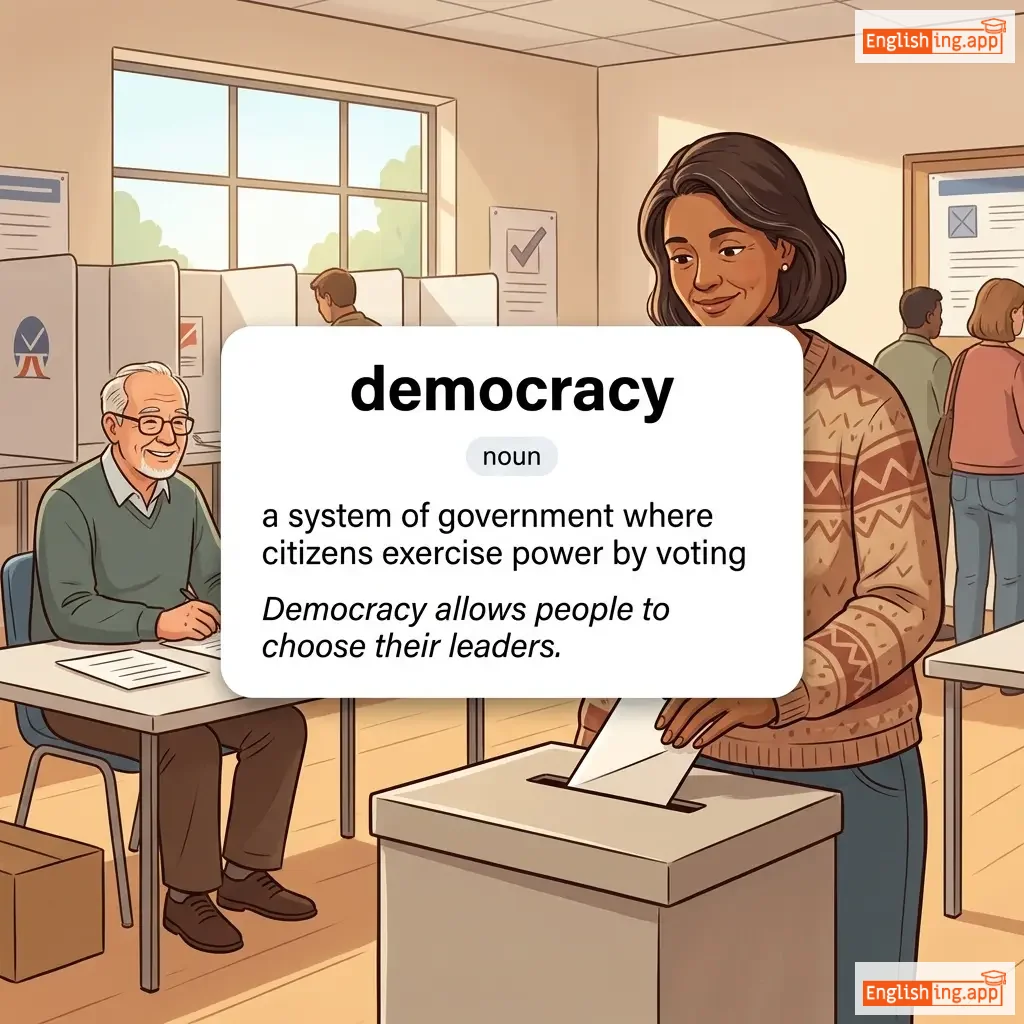
democracy definition card — visual illustration of the meaning
noun
/dɪˈmɑːkrəsi/
लोकतंत्र (loktantra)

a system of government where citizens exercise power by voting

"Democracy allows people to choose their leaders."

"लोकतंत्र लोगों को उनके नेताओं को चुनने का अधिकार देता है।" (Loktantra logon ko unke netaon ko chunne ka adhikar deta hai.)
noun
/ˈdɛməˌkræt/
लोकतंत्रवादी (loktantrwadi)

a supporter of democracy or a member of the Democratic Party in the US

"He is a strong democrat who believes in equal rights."

"वह एक मजबूत लोकतंत्रवादी है जो समान अधिकारों में विश्वास करता है।" (Vah ek majboot loktantrwadi hai jo samaan adhikaron mein vishwas karta hai.)
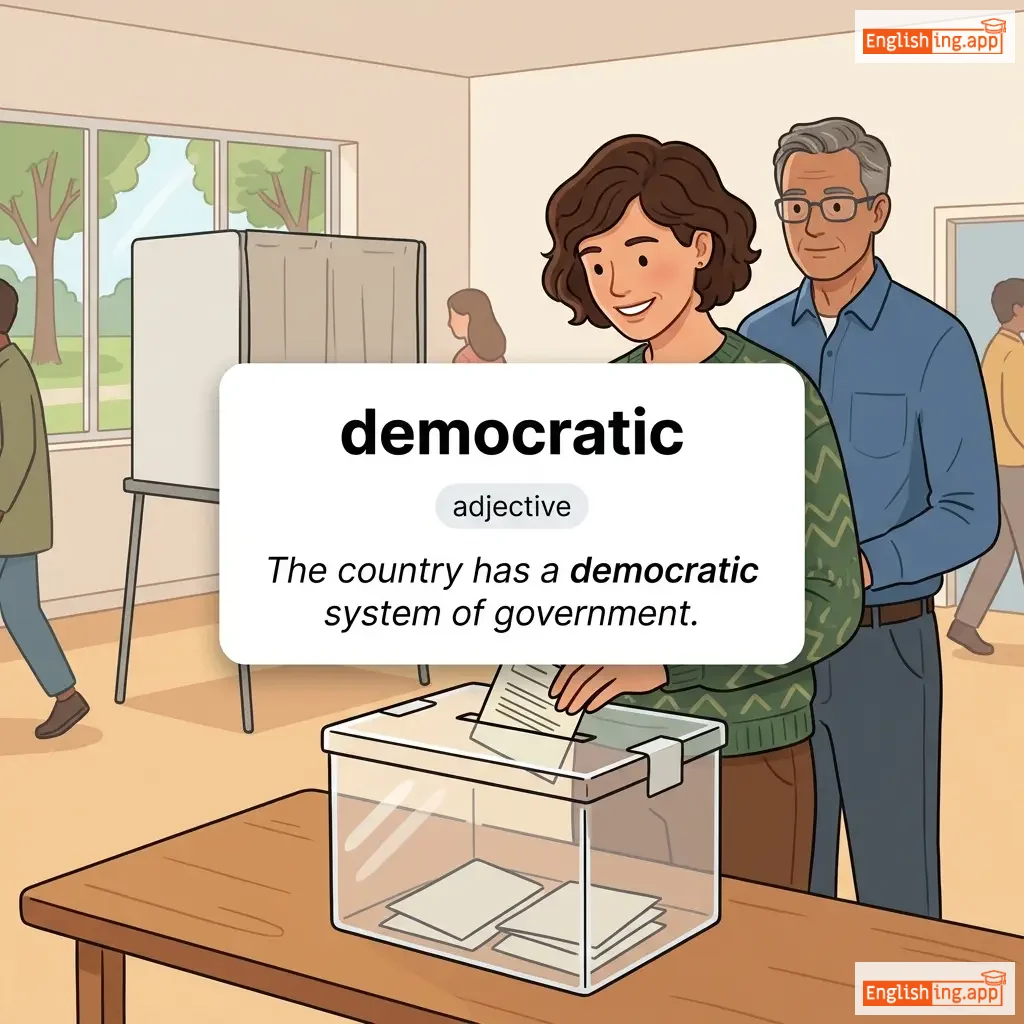
democratic definition card — visual illustration of the meaning
adjective
/ˌdɛməˈkrætɪk/
लोकतांत्रिक (loktantrik)

relating to or supporting democracy or its principles; characterized by equality and freedom

"The country has a democratic system of government."

"देश में एक लोकतांत्रिक शासन प्रणाली है।" (Desh mein ek loktantrik shasan pranali hai.)
demographic definition card — visual illustration of the meaning
adjective
/ˌdɛməˈɡræfɪk/
जनसांख्यिक (janasankhyik)

Relating to the structure of populations, such as age, race, or gender.

"The company conducted a demographic study of its customers."

"कंपनी ने अपने ग्राहकों पर एक जनसांख्यिक अध्ययन किया।" (Kampani ne apne grahakoon par ek janasankhyik adhyayan kiya.)
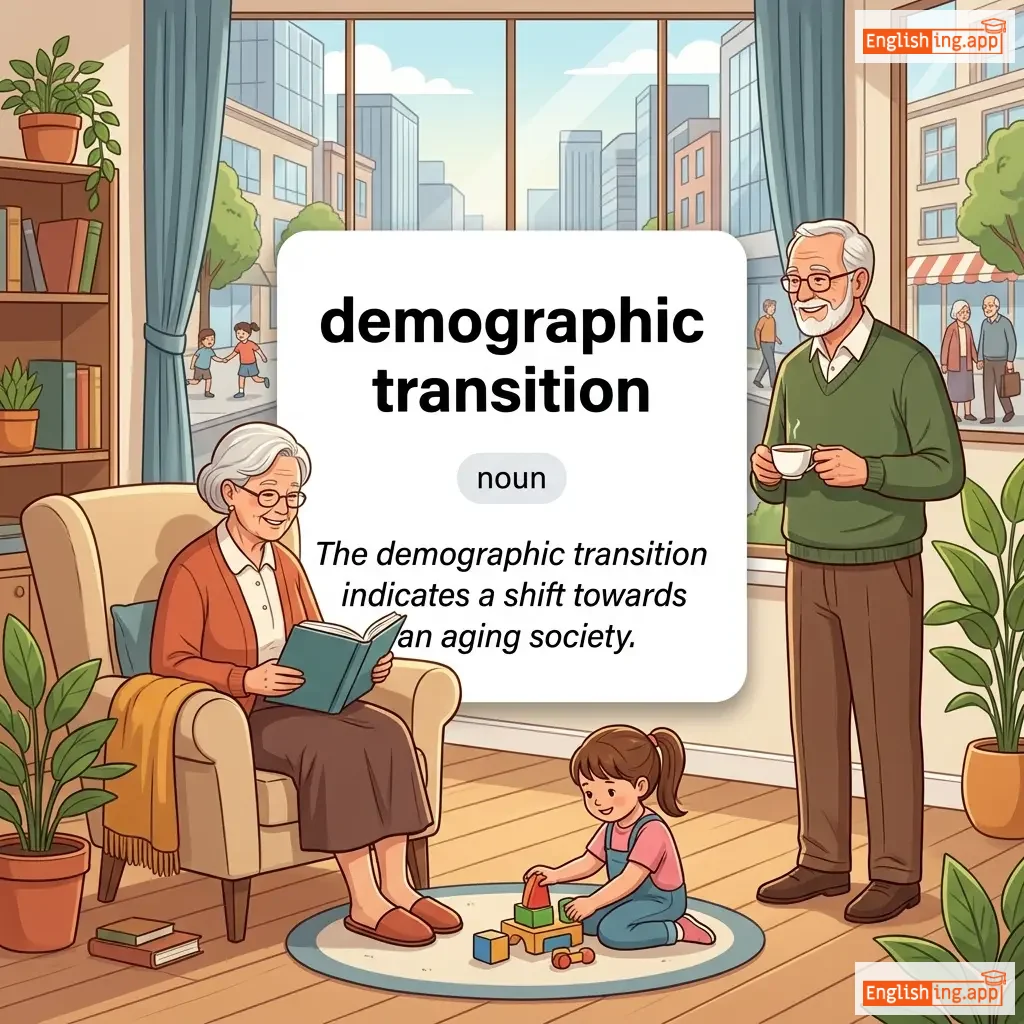
demographic transition definition card — visual illustration of the meaning
noun
ˌdɛməˈɡræfɪk trænˈzɪʃən
जनसंख्यात्मक संक्रमण (jansankhyatmak sankraman)

A shift in population patterns from high birth and death rates to low birth and death rates as a country develops economically

"The demographic transition indicates a shift towards an aging society."

"जनसंख्यात्मक संक्रमण वृद्ध समाज की ओर एक बदलाव का संकेत करता है।" (Jansankhyatmak sankraman vruddh samaj ki or ek badlav ka sanket karta hai.)
Demographics definition card — visual illustration of the meaning
noun
/ˌdɛm.əˈɡræf.ɪks/
जनसांख्यिकी (janasankhiki)

Statistical data relating to the population and particular groups within it.

"Demographics help in targeted advertising."

"डेमोग्राफिक्स लक्षित विज्ञापन में मदद करते हैं।" (Demographics lakshit vigyapan mein madad karte hain.)
verb
/dɪˈmɒlɪʃ/
ध्वस्त करना (dhvast karna)

to destroy completely, especially a building or structure

"The city decided to demolish the old stadium to build a new one."

"शहर ने एक नया बनाने के लिए पुराना स्टेडियम ध्वस्त करने का निर्णय लिया।" (Shahar ne ek naya banane ke liye purana stadium dhvast karne ka nirnay liya.)
noun
/ˌdɛməˈlɪʃən/
ध्वंस (dhvansh)

the act or process of destroying a building or structure

"The demolition of the old factory took several weeks."

"पुरानी फैक्ट्री का ध्वंस करने में कई सप्ताह लगे।" (Purani factory ka dhvansh karne mein kai saptah lage.)
noun
/ˈdiːmən/
राक्षस (raakshas)

an evil spirit or devil

"The story was about a demon who haunted the village."

"कहानी एक डिमन के बारे में थी जो गाँव को डराता था।" (Kahani ek demon ke baare mein thi jo gaon ko darata tha.)
adjective
/dɪˈmoʊniˌæk/
राक्षसी (raakshasi)

possessed, produced, or influenced by a demon; frenzied or violent

"The soldiers fought with demoniac fury."

"सैनिकों ने राक्षसी क्रोध के साथ लड़ा।" (Sainikon ne raakshasi krodh ke saath lada.)