वोकैबुलरीज

इंग्लिश वोकैबुलरी डिस्कवर, लर्न और मास्टर करें

verb
/diːˈkoʊd/
कोड तोड़ना (kod todna)

to convert a coded message into a readable form; to interpret meaning

"The software can decode the hidden message within seconds."

"सॉफ़्टवेयर कुछ सेकंड में छिपे संदेश को डिकोड कर सकता है।" (Software kuch second mein chhype sandesh ko decode kar sakta hai.)
adjective
/ˌdeɪ.kɒlˈteɪ/
गहरी गर्दन वाली पोशाक (gahari gardan wali poshak)

of a woman's dress or top, cut low so as to reveal the neck and upper chest

"She wore a decollete gown to the party."

"उसने पार्टी में एक गहरी गर्दन वाली गाउन पहनी थी।" (Usne party mein ek gahari gardan wali gaun pehni thi.)
noun
/ˌdiː.kɒmpəˈzɪʃən/
अपघटन (apghatan)

the process of decaying or breaking down into simpler parts

"The decomposition of leaves enriches the soil."

"पत्तियों का अपघटन मिट्टी को समृद्ध बनाता है।" (Pattion ka apghatan mitti ko samriddh banata hai.)
decompress definition card — visual illustration of the meaning
verb
/ˌdiː.kəmˈprɛs/
तनाव कम करना (tanav kam karna)

To relax and recover from stress or pressure.

"Taking deep breaths helps to decompress after a stressful day."

"गहरी साँस लेना एक तनावपूर्ण दिन के बाद आराम करने में मदद करता है।" (Gehri saans lena ek tanavpoorn din ke baad aaram karne mein madad karta hai.)
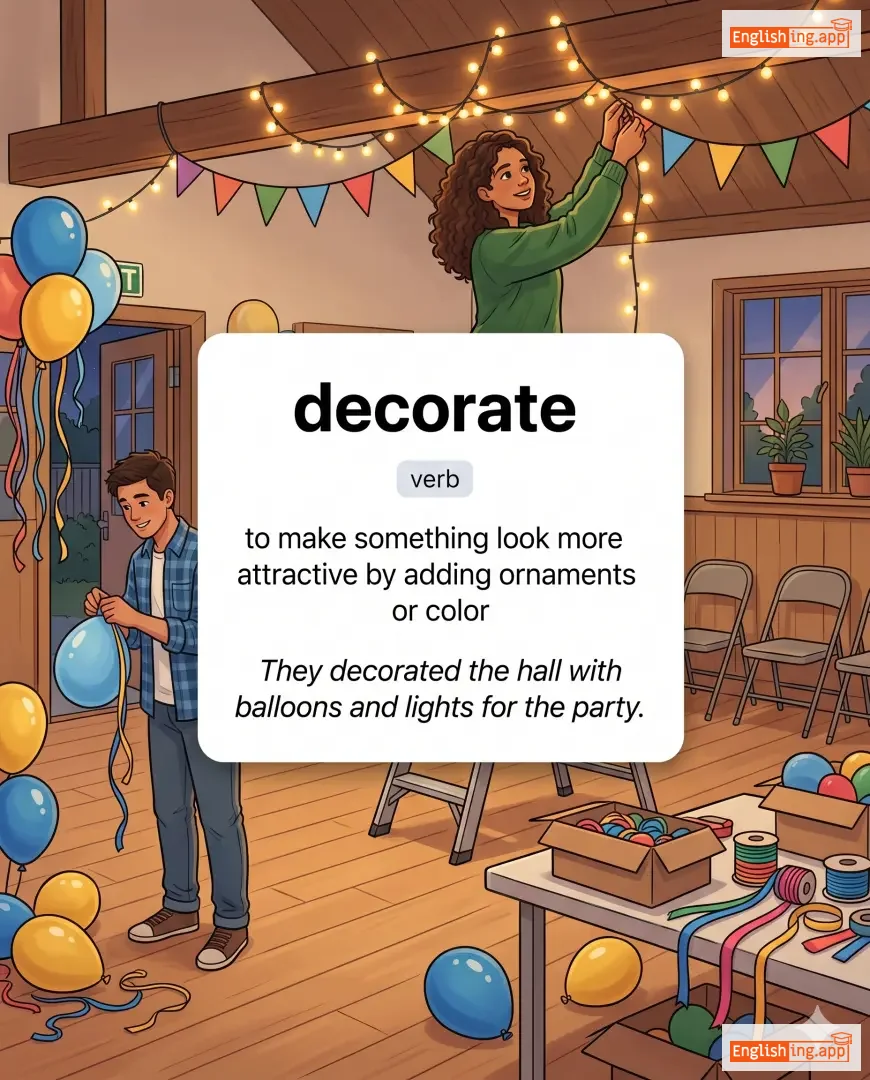
decorate definition card — visual illustration of the meaning
verb
/ˈdɛkəreɪt/
सजाना (sajana)

to make something look more attractive by adding ornaments or color

"They decorated the hall with balloons and lights for the party."

"वे पार्टी के लिए हॉल को गुब्बारों और लाइट्स से सजाते थे।" (ve party ke liye hall ko gubbaron aur lights se sajate the.)
noun
/ˌdek.əˈreɪ.ʃən/
सजावट; अलंकरण; पुरस्कार; (sajawat, alankaran, puraskar)

the process or art of decorating something; ornamental items used to beautify

"The Christmas decoration transformed the ordinary room into a festive wonderland."

"क्रिसमस की सजावट ने साधारण कमरे को एक उत्सवमय वंडरलैंड में बदल दिया।" (krismas ki sajawat ne sadharan kamre ko ek utsavmay vandeland mein badal diya.)
adjective
/ˈdekərəs/
सभ्य (sabhy)

showing proper and polite behavior; marked by good taste

"The audience gave a decorous applause after the performance."

"दर्शकों ने प्रदर्शन के बाद सभ्य तालियों से स्वागत किया।" (Darshako ne pradarshan ke baad sabhy taaliyon se swagat kiya.)
Decorum definition card — visual illustration of the meaning
noun
/dɪˈkɔːrəm/
शिष्टाचार (shishtachar)

behavior in keeping with good taste and propriety

"The students maintained decorum during the ceremony."

"छात्रों ने समारोह के दौरान शिष्टाचार बनाए रखा।" (Chhatron ne samarooh ke dauran shishtachar banaye rakha.)
adjective
/dɪˈkɔːrəs/
सभ्य (sabhy)

characterized by propriety, good taste, and proper manners

"She maintained a decourous silence during the ceremony."

"उसने समारोह के दौरान सभ्य चुप्पी बनाए रखी।" (Usne samaroah ke dauran sabhy chuppi banaye rakhi.)
noun/verb
/ˈdiːkɔɪ/
चाल (chaal)

something or someone used to lure or mislead

"The hunters used a wooden duck as a decoy."

"शिकारी ने एक लकड़ी की बत्तख को एक चाल के रूप में इस्तेमाल किया।" (Shikari ne ek lakdi ki battakh ko ek chaal ke roop mein istemaal kiya.)
verb/noun
/ˈdiːkriːs/ (noun), /dɪˈkriːs/ (verb)
घटाना (ghatana)

To become or make something smaller or fewer in number, amount, or degree.

"The population of the town has decreased over the years."

"गाँव की जनसंख्या वर्षों में घट गई है।" (Gaon ki jansankhya varshon mein ghat gayi hai.)
noun/verb
/dɪˈkriː/
आदेश (adesh)

an official order or command, often by authority

"The king issued a decree banning hunting in the forest."

"राजा ने जंगल में शिकार पर प्रतिबंध लगाने का आदेश जारी किया।" (Raja ne jangal mein shikar par pratibandh lagane ka aadesh jaari kiya.)
adjective
/dɪˈkrɛpɪt/
जीर्ण (jeern)

worn out or weakened by age or neglect

"The decrepit old house was on the verge of collapse."

"वह जीर्ण पुराना घर गिरने के कगार पर था।" (vah jeern purana ghar girne ke kagar par tha)
noun
/dɪˈkrɛpɪˌtjuːd/
दुर्बलता (durbalta)

the state of being old, weak, and worn out

"The once-great empire fell into decrepitude."

"वह एक बार महान साम्राज्य टूटकर जर्जर हो गया।" (Vah ek baar mahaan samrajya tootkar jarjar ho gaya.)
verb
/dɪˈkraɪ/
निंदा करना (ninda karna)

to publicly criticize or express strong disapproval of something

"Many activists decry the destruction of the rainforest."

"कई कार्यकर्ता वर्षावन के विनाश की निंदा करते हैं।" (Kai karyakarta varshavan ke vinash ki ninda karte hain.)
decryption definition card — visual illustration of the meaning
noun
/dɪˈkrɪp.ʃən/
डिक्रिप्शन (dikripshun)

The process of converting encrypted information back to its original form

"Decryption of sensitive files requires a secure key."

"संवेदनशील फाइलों का डिक्रिप्शन एक सुरक्षित कुंजी की आवश्यकता होती है।" (Sanvedansheel failon ka dikripshun ek surakshit kunji ki avashyakta hoti hai.)
verb
/ˈdɛdɪkeɪt/
समर्पित करना (samarpit karna)

to devote time, effort, or oneself to a particular purpose or person

"She dedicated her life to helping the poor."

"उसने गरीबों की मदद करने के लिए अपना जीवन समर्पित कर दिया।" (usne gareebon ki madad karne ke liye apna jeevan samarpit kar diya.)
adjective
/ˈdɛdɪˌkeɪtɪd/
समर्पित (samarpit)

devoted to a cause, task, or purpose

"She is a dedicated teacher who goes above and beyond for her students."

"वह एक समर्पित शिक्षक है जो अपने छात्रों के लिए ऊपर और परे जाती है।" (Wah ek samarpit shikshak hai jo apne chatron ke liye upar aur pare jaati hai.)
dedication definition card — visual illustration of the meaning
noun
/ˌdɛdɪˈkeɪʃən/
समर्पण (samarpan)

the quality of being committed to a task or purpose

"Her dedication to her studies earned her top grades."

"उसकी पढ़ाई के प्रति समर्पण ने उसे शीर्ष अंक दिलाए।" (Uski padhai ke prati samarpan ne use shreshth ank dilaye.)
verb
/dɪˈdjuːs/
निष्कर्ष निकालना (nishkarsh nikaalna)

to reach a conclusion by reasoning or inference

"From the evidence, the detective deduced that the suspect was lying."

"प्रमाण से, जासूस ने निष्कर्ष निकाला कि संदिग्ध झूठ बोल रहा था।" (Pramaan se, jasoos ne nishkarsh nikaala ki sandigdh jhooth bol raha tha.)
adjective
/dɪˈdjuːsəbl/
निष्कर्षणीय (nishkarsheeniya)

able to be deduced; possible to be inferred

"The solution is deducible from the data provided."

"समाधान डेटा से निष्कर्षणीय है।" (Samadhan data se nishkarsheeniya hai.)
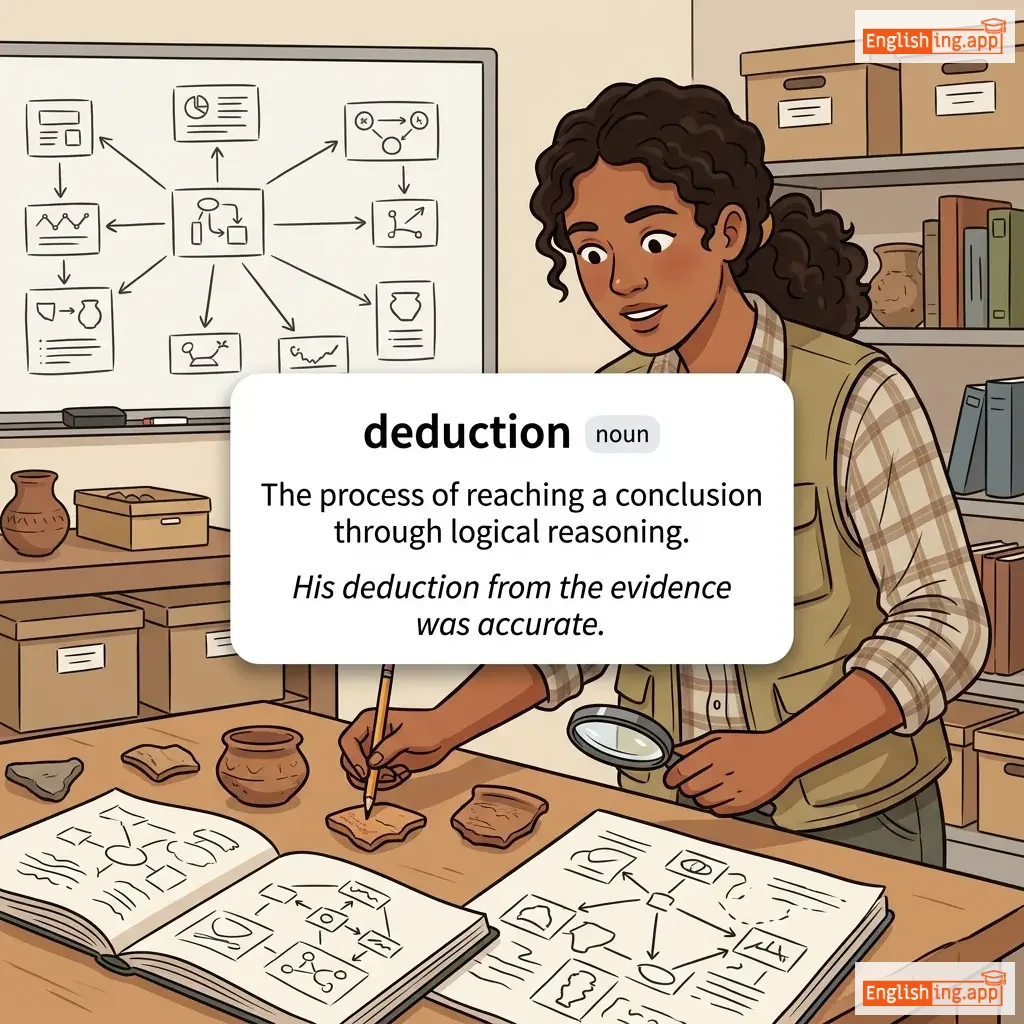
deduction definition card — visual illustration of the meaning
noun
/dɪˈdʌk.ʃən/
निष्कर्ष (nishkarsh)

The process of reaching a conclusion through logical reasoning.

"His deduction from the evidence was accurate."

"साक्ष्यों से उसका निष्कर्ष सही था।" (Sakshyon se uska nishkarsh sahi tha.)
noun
/diːd/
कर्म (karm)

an action, especially a good or evil one

"His deed of kindness will never be forgotten."

"उसका दयालु कर्म कभी नहीं भुलाया जाएगा।" (Uska dayalu karm kabhi nahi bhulaya jayega.)
verb
/diːm/
मानना, विचार करना (maanna, vichar karna)

to regard or consider in a specified way

"The project was deemed a success by the board."

"बोर्ड ने परियोजना को सफलता के रूप में माना।" (Board ne pariyojna ko safalta ke roop mein maana.)
adjective
/diːp/
सुख (sukh)

extending far down from the top or surface; profound or intense

"The lake is very deep in the middle."

"जब उसने पुरस्कार प्राप्त किया तो वह अपनी खुशी को छिपा नहीं पाई।" (Jab usne puraskar prapt kiya to vah apni khushi ko chhupa nahin paayi.)
noun
/diːp ˈkʌlər/
गहरे रंग (gahe rang)

a rich, intense, or dark shade of any color

"The artist used deep colours to create a dramatic effect."

"कलाकार ने ड्रामेटिक प्रभाव बनाने के लिए गहरे रंगों का इस्तेमाल किया।" (kalakar ne dramtik prabhav banane ke liye gehre rangon ka istemal kiya.)
deep sea definition card — visual illustration of the meaning
noun
/diːp siː/
गहरी समुद्र (gahri samudra)

The deep parts of the sea or ocean, typically beyond the continental shelf.

"Many deep-sea creatures produce bioluminescence for survival."

"कई गहरे समुद्री जीव जीवित रहने के लिए बायोल्यूमिनेसेंस उत्पन्न करते हैं।" (Kai gahre samudri jeev jeevit rehne ke liye byoluminesens utpann karte hain.)
adverb
/ˈdiːpli/
गहरे तरीके से (gahare tareeke se)

to a great depth, extent, or intensity

"She was deeply moved by the speech."

"वह भाषण से गहरे तरीके से प्रभावित हुई थी।" (Wah bhashan se gahare tareeke se prabhavit hui thi.)
noun
/dɪr/
हिरण (hiran)

a graceful wild animal with long legs and antlers, often living in forests

"A deer ran across the road suddenly."

"एक हिरण अचानक से सड़क पार कर गया।" (Ek hiran achanak se sadak paar kar gaya.)
verb
/dɪˈfeɪs/
विकृत करना (vikrit karna)

to spoil the surface or appearance of something, especially by writing or drawing on it

"The vandals defaced the wall with graffiti."

"वैंडल्स ने दीवार को ग्रैफिटी से विकृत किया।" (Vandals ne deewar ko grafiti se vikrit kiya.)
verb
/ˈdiːfælˌkeɪt/
धन की हेराफेरी करना (dhan ki heraferi karna)

to misuse or embezzle money that one is responsible for

"The accountant was accused of defalcating company funds."

"अकाउंटेंट पर कंपनी के फंड्स का दुरुपयोग करने का आरोप था।" (Accountant par company ke funds ka durupyog karne ka aarop tha.)
noun
/ˌdɛfəˈmeɪʃən/
मानहानि (maanhani)

the act of damaging someone's reputation by making false statements

"The newspaper was sued for defamation of character."

"अखबार पर चरित्र हनन का मुकदमा दायर किया गया था।" (Akhbaar par charitra hanan ka mukadma daayir kiya gaya tha.)
defame definition card — visual illustration of the meaning
verb
/dɪˈfeɪm/
बदनाम करना (badnaam karna)

to harm someone's reputation by spreading false information

"He was defamed by malicious rumors."

"वह झूठी अफवाहों से बदनाम हुआ था।" (Wah jhoothi afwahon se badnaam hua tha.)
default definition card — visual illustration of the meaning
noun, verb
/dɪˈfɔːlt/
डिफ़ॉल्ट (default)

failure to fulfill an obligation, especially to repay a loan

"The company defaulted on its loan payments."

"कंपनी अपने लोन पेमेंट्स में डिफॉल्ट हो गई।" (Kampani apne loan payments mein default ho gayi.)
verb
/dɪˈfiːt/
पराजित करना (parajit karna)

to win a victory over someone or something in a competition or battle

"Our team defeated their rivals in the final match."

"हमारी टीम ने फाइनल मैच में उनके प्रतिद्वंद्वियों को हराया।" (Hamari team ne final match mein unke pratidvandviyon ko haraya.)
noun, adjective
/dɪˈfiːtɪst/
पराजयवादी (parajayvadi)

A person who expects or is excessively ready to accept failure; showing a tendency to expect defeat.

"His defeatist attitude discouraged the rest of the team."

"उसका पराजयवादी दृष्टिकोण टीम के बाकी सदस्य को हतोत्साहित कर रहा था।" (uska parajayvadi drishtikon team ke baaki sadasya ko hatotsahit kar raha tha.)
noun, verb
/ˈdiːfɛkt/ (noun), /dɪˈfɛkt/ (verb)
दोष / दलत्याग करना (dosh / daltayag karna)

A shortcoming, imperfection, or flaw; or to abandon a cause or group for another.

"The engineer found a defect in the software code."

"इंजीनियर ने सॉफ़्टवेयर कोड में एक दोष पाया।" (engineer ne software code mein ek dosh paya.)
noun
/dɪˈfɛkʃən/
त्याग (tyag)

The act of abandoning one’s country, cause, or group in favor of another.

"The politician’s defection shocked his supporters."

"राजनीतिक नेता का त्याग उसके समर्थकों को चौंका गया।" (rajnitik neta ka tyag uske samarthakon ko chaunka gaya.)
adjective
/dɪˈfektɪv/
दोषपूर्ण; अपूर्ण (doshpoorn; apurn)

having faults or defects; imperfect

"The defective product was returned to the store."

"दोषपूर्ण उत्पाद को दुकान में वापस किया गया था।" (doshpoorn utpad ko dukaan mein wapas kiya gaya tha)
noun
/dɪˈfɛns/
रक्षा (raksha)

The act of protecting or guarding against attack, harm, or criticism.

"The castle walls were built for defence against invaders."

"महल की दीवारें आक्रमणकारियों से रक्षा के लिए बनाई गई थीं।" (mahal ki deewarein akramankariyon se raksha ke liye banayi gayi thi.)
verb
/dɪˈfɛnd/
रक्षा करना (raksha karna)

To protect someone or something from harm or attack.

"The lawyer worked hard to defend her client."

"वकील ने अपनी क्लाइंट की रक्षा करने के लिए कड़ी मेहनत की।" (Vakeel ne apni client ki raksha karne ke liye kadi mehnat ki.)
noun
/dɪˈfɛndənt/
प्रतिवादी (prativadi)

An individual, company, or institution sued or accused in a court of law.

"The defendant pleaded not guilty to the charges."

"प्रतिवादी ने आरोपों से इंकार किया।" (prativadi ne aaropon se inkar kiya.)
noun
/dɪˈfɛndər/
रक्षक (rakshak)

a person who protects someone or something from harm or attack

"The defender blocked the shot and saved the goal."

"रक्षक ने शॉट को रोका और गोल बचाया।" (rakshak ne shot ko roka aur gol bachaya.)
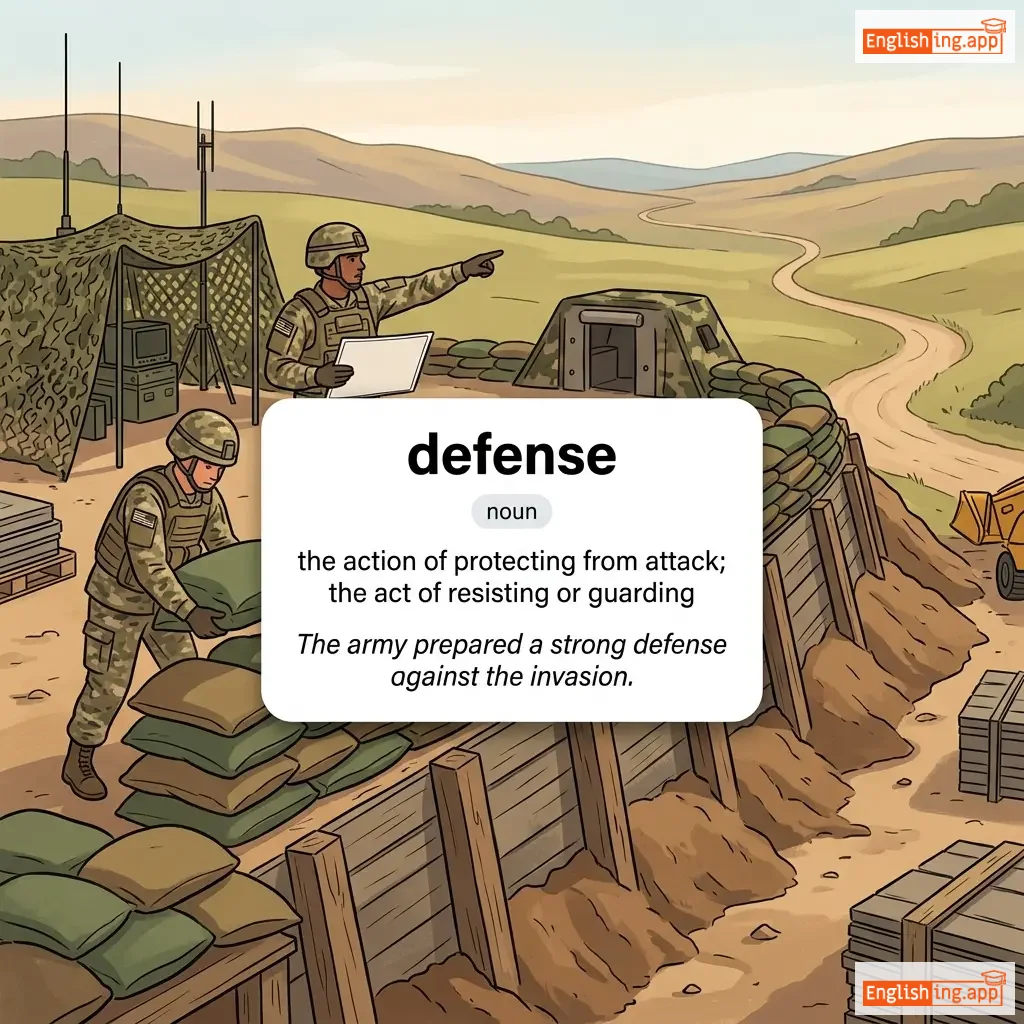
defense definition card — visual illustration of the meaning
noun
/dɪˈfɛns/
सुख (sukh)

the action of protecting from attack; the act of resisting or guarding

"The army prepared a strong defense against the invasion."

"जब उसे पुरस्कार मिला तो वह अपनी खुशी छुपा नहीं पाई।" (Jab use puraskar mila to vah apni khushi chhupa nahi paayi.)
adjective
/dɪˈfɛnsəbəl/
जो रक्षा किया जा सकता है / न्यायसंगत (jo raksha kiya ja sakta hai / nyayasangat)

Capable of being protected against attack or criticism; justifiable.

"Her decision was legally defensible."

"उसका निर्णय कानूनी रूप से रक्षात्मक था।" (uska nirnay kanuni roop se rakshatmak tha.)
adjective
/dɪˈfɛnsɪv/
रक्षात्मक (rakshatmak)

Intended to protect or defend; behaving in a way to guard against criticism or attack.

"He became defensive when asked about his mistake."

"जब उससे उसकी गलती के बारे में पूछा गया, तो वह रक्षात्मक हो गया।" (jab usse uski galti ke baare mein poochha gaya, to vah rakshatmak ho gaya.)
verb
/dɪˈfɜːr/
स्थगित करना (sthagit karna)

To postpone or delay; to yield to someone else's judgment or opinion.

"The meeting was deferred until next week."

"बैठक अगले हफ्ते तक स्थगित कर दी गई थी।" (baithak agle hafte tak sthagit kar di gayi thi.)
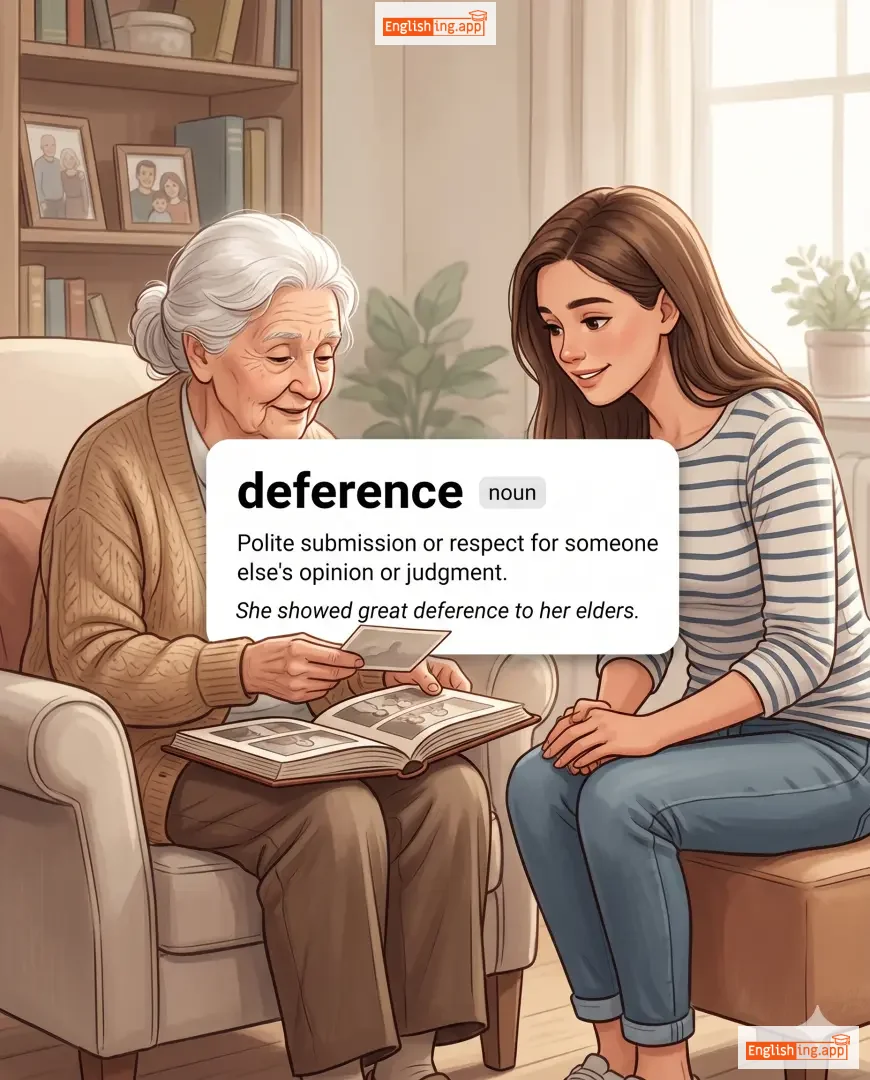
deference definition card — visual illustration of the meaning
noun
/ˈdɛfərəns/
सम्मान (samman)

Polite submission or respect for someone else's opinion or judgment.

"She showed great deference to her elders."

"उसने अपने बड़ों के प्रति महान सम्मान दिखाया।" (Usne apne baron ke prati mahan sammaan dikhaya.)
adjective
/ˌdɛfəˈrɛnʃəl/
आदरपूर्ण (aadarpoorn)

Showing or expressing respect and high regard.

"He was always deferential toward his teachers."

"वह हमेशा अपने शिक्षकों के प्रति आदरपूर्ण रहता था।" (vah hamesha apne shikshako ke prati aadarpoorn rehta tha.)
noun
/dɪˈfaɪəns/
अवज्ञा (avignya)

Open resistance or bold disobedience.

"The protest was an act of defiance against injustice."

"विरोध अन्याय के खिलाफ अवज्ञा का एक कृत्य था।" (virodh anyay ke khilaf avignya ka ek kritya tha.)