वोकैबुलरीज

इंग्लिश वोकैबुलरी डिस्कवर, लर्न और मास्टर करें

debunk definition card — visual illustration of the meaning
verb
/diːˈbʌŋk/
झूठ साबित करना (jhooth sabit karna)

To expose the falseness or exaggeration of a claim, myth, or belief.

"The scientist worked to debunk the myths about vaccines."

"विज्ञानी ने वैक्सीन्स के बारे में मिथकों को झूठा साबित करने के लिए काम किया।" (Vigyaani ne vaccines ke baare mein mithkon ko jhootha sabit karne ke liye kaam kiya.)
noun, verb
/ˈdeɪ.bjuː/
पहली सार्वजनिक उपस्थिति (pahli sarvajanik upasthiti)

The first public appearance or performance of someone or something.

"The young actor made his debut on the big stage."

"युवा अभिनेता ने बड़े मंच पर अपनी पहली सार्वजनिक उपस्थिति की।" (Yuva abhineta ne bade manch par apni pahli sarvajanik upasthiti ki.)
noun
/ˈdeb.juː.tɑːnt/
समाज में पहली बार पेश होने वाली युवती (samaj mein pehli baar pesh hone wali yuvti)

A young woman making her first formal appearance in society.

"The debutante wore a white gown at the ball."

"डेब्यूटेंट बॉल में सफेद गाउन पहने हुए थी।" (Debutante ball mein safed gown pehane hue thi.)
noun
/ˈdɛkeɪd/
दशक (dashak)

A period of ten years.

"The country has changed a lot in the past decade."

"देश पिछले दशक में बहुत बदल चुका है।" (Desh pichle dashak mein bahut badal chuka hai.)
noun
/ˈdek.ə.dəns/
पतन (patan)

Moral or cultural decline characterized by excessive indulgence in pleasure or luxury.

"The novel describes the decadence of the wealthy elite."

"उपन्यास में संपन्न वर्ग की पतन का वर्णन किया गया है।" (Upanyas mein sampann varg ki patan ka varnan kiya gaya hai.)
adjective
/ˈdɛkədənt/
उच्छृंखल, विलासी (uchchhrinkhal, vilasi)

Characterized by or reflecting a state of moral or cultural decline; excessively self-indulgent.

"The party was filled with decadent luxury and excess."

"पार्टी में उच्छृंखल विलासिता और अधिकता थी।" (Party mein uchchhrinkhal vilasita aur adhikta thi.)
noun
/ˈdɛkəˌɡɒn/
दशकोण (dashkon)

A polygon with ten sides and ten angles.

"The geometry teacher drew a perfect decagon on the board."

"गणित के शिक्षक ने बोर्ड पर एक उत्तम दशकोण बनाया।" (Ganit ke shikshak ne board par ek uttam dashkon banaya.)
noun
/ˈdɛkəˌɡræm/
दश ग्राम (dash gram)

A metric unit of mass equal to ten grams.

"The package weighed exactly one decagram."

"पैकेज का वजन बिल्कुल एक डेकाग्राम था।" (Package ka wajan bilkul ek decagram tha.)
noun
/ˈdɛkəˌliːtər/
दस लीटर (das liter)

A metric unit of capacity equal to ten liters.

"The container could hold up to one decaliter of water."

"डिब्बा एक डेकलिटर पानी समाहित कर सकता था।" (Dibba ek decaliter paani samaahit kar sakta tha.)
noun
/ˈdɛkəˌlɔːɡ/
दश आज्ञाएँ (dash agyaayein)

The Ten Commandments in the Bible; a set of fundamental rules or principles.

"The priest gave a sermon on the importance of the Decalogue."

"पादरी ने डेकालॉग के महत्व पर उपदेश दिया।" (Paadri ne decalog ke mahatv par updesh diya.)
noun
/dɪˈkæmərən/
डेकैमरॉन (बोकाच्चियो की कहानी संग्रह) (dekameron)

A collection of 100 tales written by Giovanni Boccaccio in the 14th century, told by a group of people over ten days.

"The Decameron is considered a masterpiece of classical Italian literature."

"डेकैमरॉन को इतालवी साहित्य का एक प्रमुख कार्य माना जाता है।" (Dekameron ko italvi sahitye ka ek pramukh kary maana jaata hai.)
noun
/dɪˈkæmɪtər/
डेकामीटर (dekamitar)

A metric unit of length equal to ten meters.

"The field was measured in decameters for accuracy."

"सटीकता के लिए मैदान को डेकामीटर में मापा गया था।" (Satikta ke liye maidan ko dekamitar mein mapa gaya tha.)
verb
/dɪˈkæmp/
अचानक भाग जाना (dikamp)

To depart suddenly or secretly, often to avoid trouble or escape.

"The thief decamped before the police arrived."

"चोर पुलिस के पहुँचने से पहले भाग गया।" (Chor police ke pahuchne se pehle bhag gaya.)
verb
/dɪˈkænt/
धीरे से डालना (dikeant)

To pour liquid gently from one container into another, especially without disturbing the sediment.

"She carefully decanted the wine into a clean glass."

"उसने सावधानी से शराब को एक साफ गिलास में डाला।" (Usne saavdhaani se sharab ko ek saaf gilaas mein daala.)
verb
/dɪˈkæpɪteɪt/
खुशी (khushi)

To cut off the head of a person or animal.

"The ancient executioner decapitated the criminal."

"वह पुरस्कार प्राप्त करने के बाद अपनी खुशी को छिपा नहीं सकी।" (Wah puraskar prapt karne ke baad apni khushi ko chhupa nahi sakti.)
noun
/ˈdɛkəˌpɒd/
दशपद जीव (dashapad jeev)

An arthropod with ten limbs, such as crabs, lobsters, and shrimps.

"The lobster is a well-known decapod."

"लॉबस्टर एक प्रसिद्ध दशपद जीव है।" (Lobster ek prasiddh dashapad jeev hai.)
noun
/ˌdɛkəˈsɪləbəl/
दश-अक्षरी (dash-akshari)

A line of verse with ten syllables.

"The poet often wrote in decasyllable form."

"कवि अक्सर दश-अक्षरी रूप में लिखते थे।" (Kavi aksar dash-akshari roop mein likhte the.)
verb, noun
/dɪˈkeɪ/
सड़न (sadan)

The process of rotting or decomposition; to decline in quality or strength.

"The abandoned house slowly began to decay."

"परित्यक्त घर धीरे-धीरे सड़ने लगा।" (parityakt ghar dheere-dheere sadne laga.)
noun
/dɪˈsiːt/
धोखा (dhokha)

The act of deceiving someone by concealing or misrepresenting the truth.

"His career was ruined by lies and deceit."

"उसका करियर झूठ और धोखे से बर्बाद हो गया।" (Uska kariyer jhoot aur dhokhe se barbaad ho gaya.)
adjective
/dɪˈsiːtfəl/
धोखेबाज़ (dhokhebaaz)

Deliberately misleading or dishonest.

"She gave a deceitful answer to hide the truth."

"वह सत्य को छिपाने के लिए एक धोखेबाज़ जवाब दिया।" (Vah satya ko chhupane ke liye ek dhokhebaaz jawab diya.)
verb
/dɪˈsiːv/
धोखा देना (dhokha dena)

To cause someone to believe something that is not true.

"He tried to deceive his friends with a fake story."

"उसने अपने दोस्तों को झूठी कहानी से धोखा देने की कोशिश की।" (Usne apne doston ko jhoothi kahani se dhokha dene ki koshish ki.)
verb
/dɪˈsɛləˌreɪt/
गति कम करना (gati kam karna)

to reduce speed; to slow down

"The car began to decelerate as it approached the traffic light."

"कार ट्रैफिक लाइट के पास पहुँचते हुए धीमा हो गई।" (Car traffic light ke paas pahuchte hue dheema ho gayi.)
noun
/dɪˈsɛmbər/
दिसंबर (disambar)

the twelfth and last month of the year in the Gregorian calendar

"December is usually cold in many countries."

"दिसंबर कई देशों में आमतौर पर ठंडा होता है।" (disambar kai deshon mein aamtaur par thanda hota hai)
noun
/ˈdiːsənsi/
सभ्यता (sabhyata)

behavior that conforms to accepted standards of morality or respectability

"She showed great decency by helping the stranger in need."

"उसने विपत्ति में फंसे अजनबी की मदद करके महान सभ्यता का प्रदर्शन किया।" (Usne vipatti mein phase ajnabi ki madad karke mahaan sabhyata ka pradarshan kiya.)
adjective
/ˈdiːsənt/
उचित (uchit)

conforming to standards of propriety, good taste, or morality

"He found a decent job after months of searching."

"उसे महीनों की खोज के बाद एक उचित नौकरी मिली।" (Use mahino ki khoj ke baad ek uchit naukri mili.)
decentralization definition card — visual illustration of the meaning
noun
/diːˌsen.trə.laɪˈzeɪ.ʃən/
विकेंद्रीकरण; अधिकार का वितरण (vikendrikaran; adhikar ka vitran)

the transfer of authority from central to local government; distribution of power

"The decentralization of government services improved efficiency at the local level."

"सरकारी सेवाओं का विकेंद्रीकरण स्थानीय स्तर पर दक्षता में सुधार लाया।" (sarkari sevaon ka vikendrikaran sthaniya star par dakshata mein sudhaar laaya.)
decentralized definition card — visual illustration of the meaning
adjective
/diːˈsɛntrəlaɪzd/
केन्द्रित नहीं होने वाला, विकेन्द्रीकृत (kendrit nahi hone wala, vikendrikrit)

Controlled by several local offices or authorities rather than one single one.

"The decentralized system allowed for more control at local levels."

"विकेन्द्रीकृत प्रणाली ने स्थानीय स्तर पर अधिक नियंत्रण की अनुमति दी।" (Vikendrikrit pranali ne sthaniya star par adhik niyantran ki anumati di.)
noun
/dɪˈsep.ʃən/
धोखा (dhokha)

the action of deceiving someone; the state of being deceived

"The magician's deception amazed the audience with seemingly impossible tricks."

"जादूगर का धोखा दर्शकों को अपार आश्चर्यचकित कर गया।" (jadugar ka dhokha darshako ko apaar aashcharyachakit kar gaya.)
adjective
/dɪˈsɛptɪv/
धोखेबाज (dhokhebaaz)

Giving an appearance or impression different from the truth; misleading.

"Appearances can be deceptive."

"दिखावा धोखेबाज हो सकता है।" (Dikhawa dhokhebaaz ho sakta hai.)
noun
/ˈdɛsɪˌbɛl/
डेसिबल (desibel)

a unit used to measure the intensity of sound

"The noise level in the factory exceeded 90 decibels."

"कारखाने में शोर स्तर 90 डेसिबल से अधिक था।" (Karkhane mein shor star 90 desibel se adhik tha.)
verb
/dɪˈsaɪd/
निर्णय लेना (nirnay lena)

To make a choice or judgment about something.

"She decided to study abroad after graduation."

"उसने स्नातक होने के बाद विदेश में अध्ययन करने का निर्णय लिया।" (Usne snatak hone ke baad videsh mein adhyayan karne ka nirnay liya.)
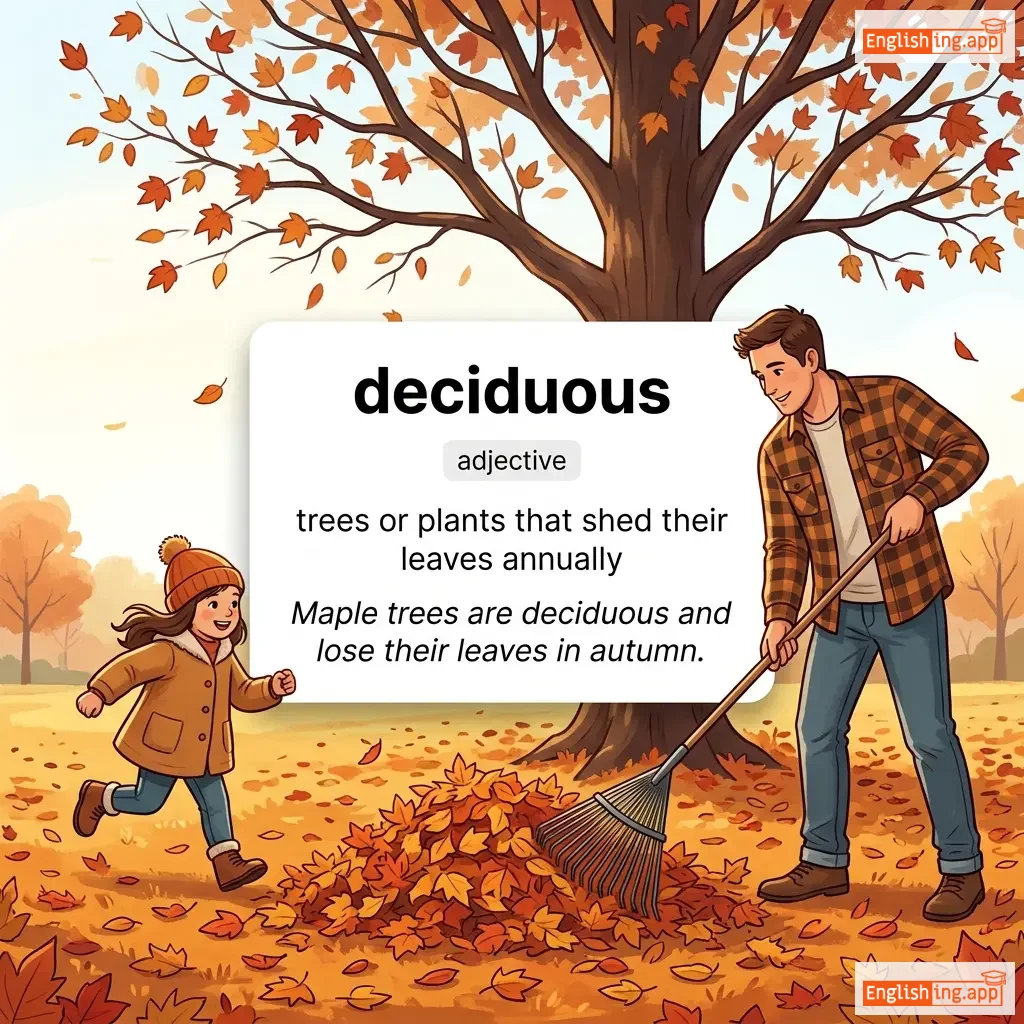
deciduous definition card — visual illustration of the meaning
adjective
/dɪˈsɪdʒuəs/
पत्तियाँ गिराने वाला (pattein girane wala)

trees or plants that shed their leaves annually

"Maple trees are deciduous and lose their leaves in autumn."

"मेपल के पेड़ पत्तियाँ गिराने वाले होते हैं और शरद ऋतु में अपनी पत्तियाँ गिरा देते हैं।" (Maple ke ped patte girane wale hote hain aur sharad ritu mein apni patte gira dete hain.)
noun
/ˈdɛsɪməl/
दशमलव (dashmalav)

A number system based on 10; a number expressed in the base-10 system.

"The number 0.75 is a decimal."

"संख्या 0.75 एक दशमलव है।" (Sankhya 0.75 ek dashmalav hai.)
verb
/ˈdɛsɪmeɪt/
नष्ट करना (nasht karna)

To destroy or kill a large proportion of something.

"The wildfire decimated the forest."

"आग ने जंगल को नष्ट कर दिया।" (Aag ne jangal ko nasht kar diya.)
noun
/ˌdɛsɪˈmeɪʃən/
विनाश (vinaash)

The act of destroying or killing a large proportion of something.

"The decimation of the city left thousands homeless."

"शहर का विनाश हजारों लोगों को बेघर कर गया।" (Shahar ka vinaash hazaaron logon ko begar kar gaya.)
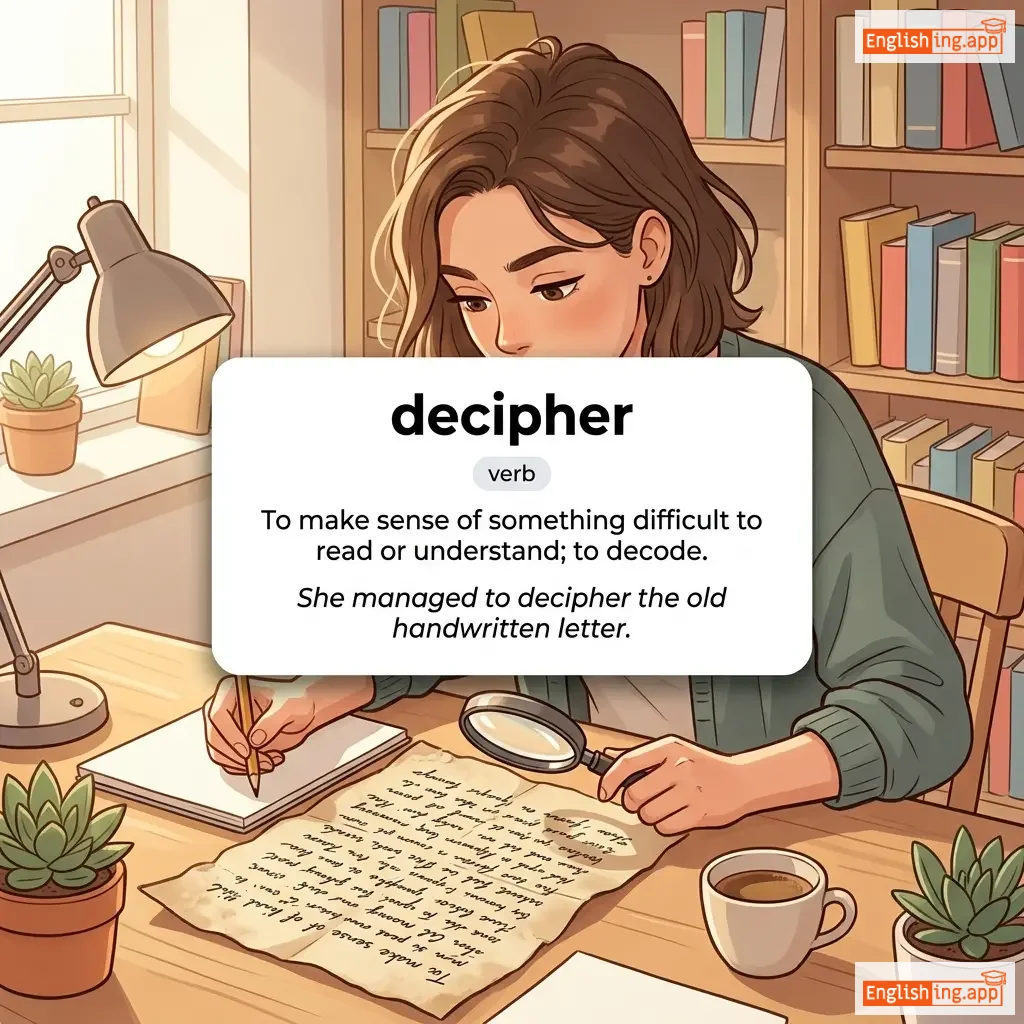
decipher definition card — visual illustration of the meaning
verb
/dɪˈsaɪfər/
कोड समझना (kod samajhna)

To make sense of something difficult to read or understand; to decode.

"She managed to decipher the old handwritten letter."

"वह पुराने हस्तलिखित पत्र को डिसाईफर करने में सफल रही।" (Wah purane hastlikhit patra ko decipher karne mein safal rahi.)
noun
/dɪˈsɪʒən/
निर्णय (nirnay)

A conclusion or choice made after consideration.

"She made a quick decision to accept the job offer."

"उसने नौकरी का प्रस्ताव स्वीकार करने का त्वरित निर्णय लिया।" (Usne naukri ka prastaav svikaar karne ka tvarit nirnay liya.)
noun
/dɪˈsɪʒənˌmeɪkɪŋ/
निर्णय लेना (nirnaya lena)

the process of making decisions, especially important or business-related decisions

"The CEO's decision-making was crucial for the success of the company."

"सीईओ का निर्णय लेना कंपनी की सफलता के लिए महत्वपूर्ण था।" (CEO ka nirnaya lena company ki safalta ke liye mahatvapurn tha.)
decisions definition card — visual illustration of the meaning
noun
/dɪˈsɪʒənz/
निर्णय (nirnay)

A conclusion or resolution reached after consideration; the action or process of deciding something.

"Making the right decisions in time was key to the project's success."

"समय पर सही निर्णय लेना परियोजना की सफलता के लिए महत्वपूर्ण था।" (Samay par sahi nirnay lena pariyojna ki safalta ke liye mahatvapurn tha.)
adjective
/dɪˈsaɪsɪv/
निर्णायक (nirnayak)

Having the ability to make decisions quickly and effectively; determining the outcome.

"Her decisive action saved the company from collapse."

"उसकी निर्णायक कार्रवाई ने कंपनी को पतन से बचाया।" (Uski nirnayak karyavahi ne company ko patan se bachaya.)
decisiveness definition card — visual illustration of the meaning
noun
dɪˈsʌɪsɪvnɪs
निर्णय लेने की क्षमता (nirnay lene ki kshamata)

The ability to make decisions quickly and effectively.

"His decisiveness during the crisis saved the company."

"उसकी निर्णय क्षमता ने संकट के दौरान कंपनी को बचाया।" (Uski nirnay kshamata ne sankat ke dauran company ko bachaya.)
noun
/dɛk/
डेक / मंच (dek / manch)

A flat surface or platform, often on a ship or building.

"We enjoyed the sunset from the upper deck of the ferry."

"हमने फेरी के ऊपरी डेक से सूर्यास्त का आनंद लिया।" (Hamne feri ke oopari dek se suryast ka anand liya.)
verb
/dɪˈkleɪm/
जोश में बोलना (josh mein bolna)

to speak aloud in a formal, passionate, or theatrical way

"The actor declaimed his lines with great intensity."

"अभिनेता ने अपनी पंक्तियाँ बड़ी उत्तेजना से डिक्लेम की।" (Abhineta ne apni panktiyan badi uttejna se deklam ki.)
noun
/ˌdɛkləˈmeɪʃən/
वक्तव्य (vaktyavya)

a formal speech delivered with rhetorical or dramatic effect

"Her declamation captivated the audience at the competition."

"उसका वक्तव्य प्रतियोगिता में दर्शकों को मंत्रमुग्ध कर गया।" (Uska vaktyavya pratyogita mein darshako ko mantrmugdha kar gaya.)
adjective
/dɪˈklæməˌtɔri/
उत्कट भाषण शैली (utkat bhashan shaili)

speaking in a loud, rhetorical, or dramatic way

"The politician’s declamatory style impressed some but irritated others."

"राजनेता की उत्कट भाषण शैली ने कुछ को प्रभावित किया लेकिन दूसरों को परेशान किया।" (Rajneta ki utkat bhashan shaili ne kuch ko prabhavit kiya lekin doosron ko pareshan kiya.)
noun
/ˌdɛkləˈreɪʃən/
घोषणा (ghoshna)

a formal or explicit statement or announcement

"The president made a declaration of independence."

"राष्ट्रपति ने स्वतंत्रता की घोषणा की।" (Rashtrapati ne svatantrata ki ghoshna ki.)
adjective
/dɪˈklærətɪv/
घोषणात्मक (ghoshanatmak)

relating to a statement that declares something; in grammar, a sentence that makes a statement

"A declarative sentence simply states a fact or opinion."

"एक घोषणात्मक वाक्य बस एक तथ्य या राय बताता है।" (ek ghoshanatmak vakya bas ek tathya ya raya batata hai)
verb
/dɪˈklɛər/
घोषणा करना (ghoshna karna)

To announce something formally or officially.

"The government declared a state of emergency."

"सरकार ने आपातकाल घोषित किया।" (Sarkar ne aapatkal ghoshit kiya.)
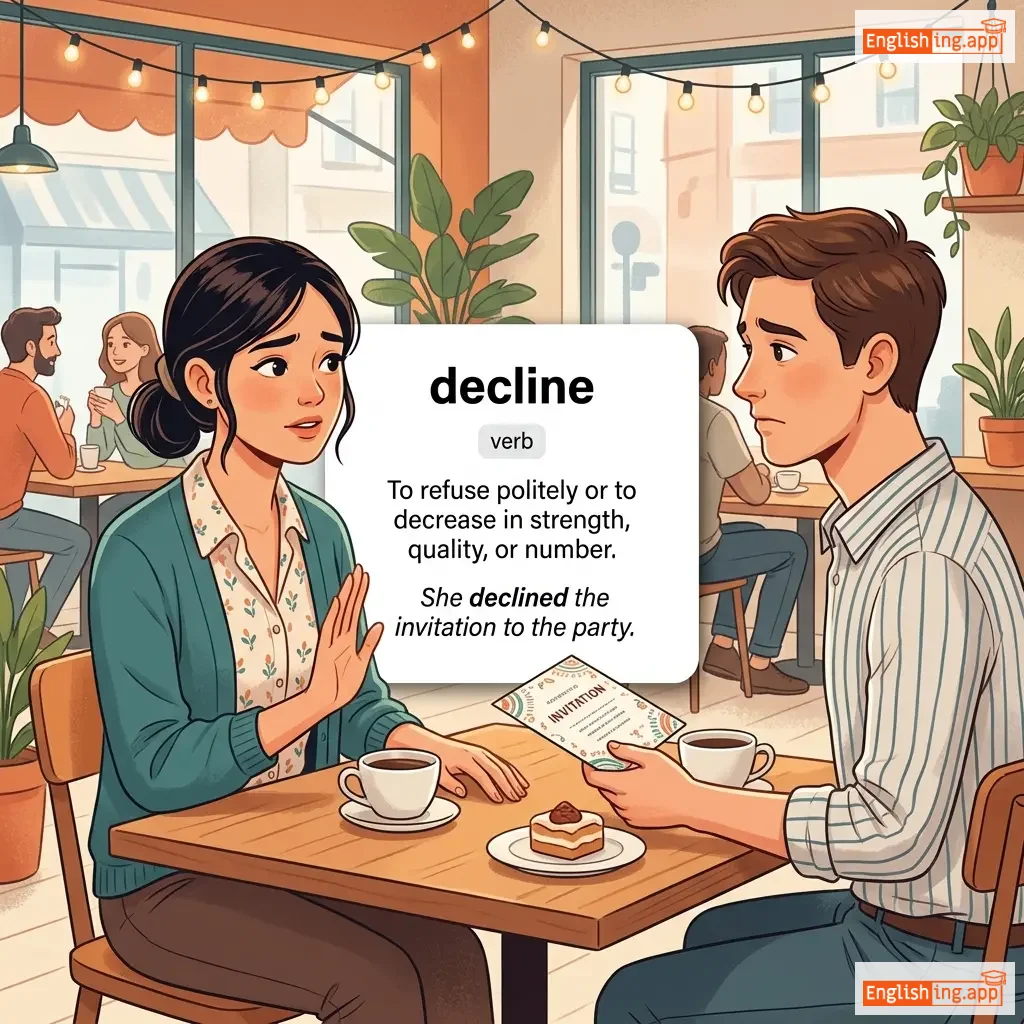
decline definition card — visual illustration of the meaning
verb
/dɪˈklaɪn/
इनकार करना (inkaar karna)

To refuse politely or to decrease in strength, quality, or number.

"She declined the invitation to the party."

"उसने पार्टी के निमंत्रण को अस्वीकार कर दिया।" (usne party ke nimantran ko asvikar kar diya)
noun
/dɪˈklɪvɪti/
ढलान (dhalan)

a downward slope of ground

"They carefully climbed down the declivity of the hill."

"उन्होंने पहाड़ी की ढलान पर सावधानी से चढ़ाई की।" (Unhone pahadi ki dhalan par saavdhaani se chadhai ki.)