वोकैबुलरीज

इंग्लिश वोकैबुलरी डिस्कवर, लर्न और मास्टर करें

noun/verb
/deɪt/
तारीख/साक्षात्कार (tareekh/sakshatkaar)

A particular day of the month or year; also, a social or romantic appointment.

"They decided to meet on the date of her birthday."

"उन्होंने उसके जन्मदिन की तारीख पर मिलने का फैसला किया।" (Unhone uske janmadin ki tareekh par milne ka faisla kiya.)
noun
/deɪts/
खजूर (khajoor)

sweet brown oval fruits that grow on date palm trees

"Dates are commonly eaten during Ramadan to break the fast."

"रमजान के दौरान उपवास तोड़ने के लिए खजूर आमतौर पर खाए जाते हैं।" (ramzan ke dauran upwas todne ke liye khajoor aamtaur par khaye jate hain)
noun
/ˈdeɪtəm/ or /ˈdætəm/
डेटा (data)

a single piece of information; a fact used as a basis for reasoning or calculation

"Each datum in the survey was carefully analyzed."

"सर्वे में प्रत्येक डेटा को सावधानीपूर्वक विश्लेषण किया गया था।" (Survey mein pratyek data ko saavdhaanipoorvak vishleshan kiya gaya tha.)
verb
/dɔːb/
पेंट करना (pent karna)

to spread a thick or sticky substance carelessly on a surface

"The children daubed paint all over the walls."

"बच्चों ने दीवारों पर पेंट लगा दिया।" (bachon ne deewaron par pent laga diya.)
noun
/ˈdɔːtər/
बेटी (beti)

a female child in relation to her parents

"They are proud of their daughter for graduating college."

"वे अपनी बेटी पर गर्व महसूस करते हैं कि उसने कॉलेज से स्नातक किया।" (ve apni beti par garv mehsoos karte hain ki usne college se snatak kiya.)
daunt definition card — visual illustration of the meaning
verb
/dɔːnt/
डराना (daraana)

to make someone feel intimidated, discouraged, or less confident

"The steep climb did not daunt the experienced hikers."

"तेज़ चढ़ाई ने अनुभवी पर्वतारोहियों को नहीं डराया।" (tez chadhai ne anubhavi parvatarohiyon ko nahin daraaya.)
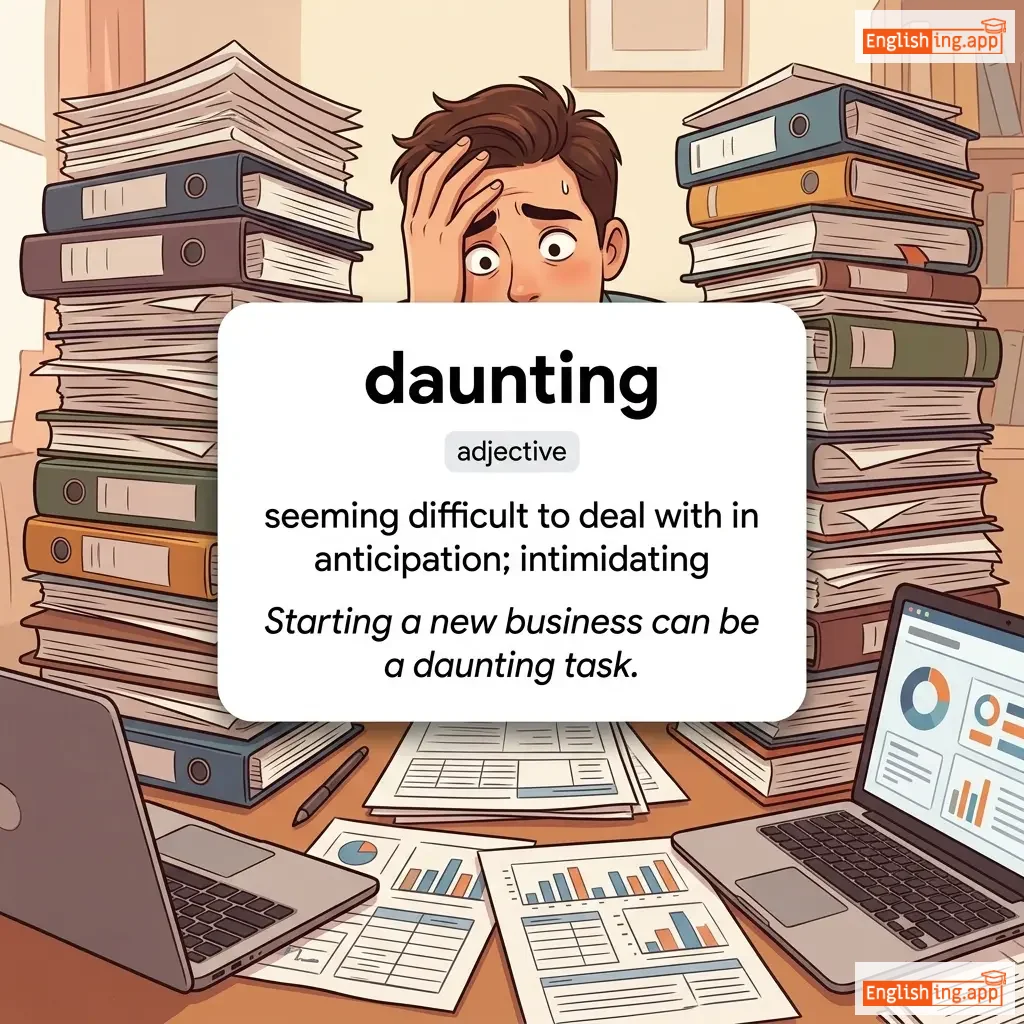
daunting definition card — visual illustration of the meaning
adjective
/ˈdɔːntɪŋ/
भयावह (bhayavah)

seeming difficult to deal with in anticipation; intimidating

"Starting a new business can be a daunting task."

"नया व्यवसाय शुरू करना एक भयावह कार्य हो सकता है।" (naya vyavsay shuru karna ek bhayavah karya ho sakta hai.)
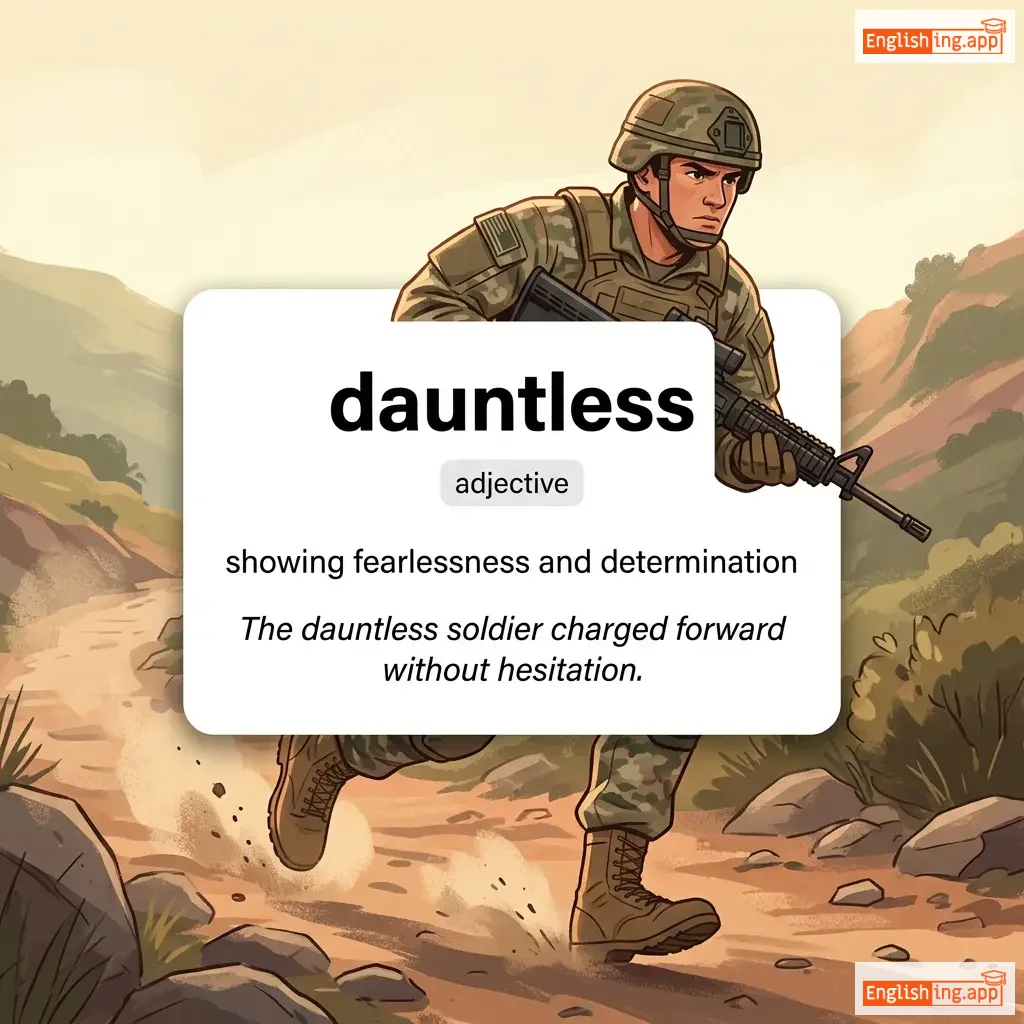
dauntless definition card — visual illustration of the meaning
adjective
/ˈdɔːntləs/
निडर (nidar)

showing fearlessness and determination

"The dauntless soldier charged forward without hesitation."

"निडर सैनिक बिना किसी हिचकिचाहट के आगे बढ़ा।" (nidar sainik bina kisi hichkichahat ke aage badha.)
verb
/ˈdɔːd(ə)l/
समय बर्बाद करना (samay barbaad karna)

to waste time by being slow or idle

"Stop dawdling and finish your homework."

"समय बर्बाद करना बंद करो और अपना होमवर्क खत्म करो।" (samay barbaad karna band karo aur apna homework khatm karo.)
noun, verb
/dɔːn/
सुबह (subah)

The first appearance of light in the sky before sunrise; to begin or become apparent.

"Hope began to dawn in her heart after hearing the good news."

"अच्छी खबर सुनने के बाद उसके दिल में उम्मीद का सूरज उगने लगा।" (Acchi khabar sunne ke baad uske dil mein umeed ka sooraj ugne laga.)
noun
/deɪ/
दिन (din)

a period of 24 hours or the time between sunrise and sunset

"She enjoyed a relaxing day at the beach."

"उसे बीच पर एक आरामदायक दिन बिताना अच्छा लगा।" (use beach par ek aaramdayak din bitana accha laga.)
noun
/ˈdeɪ.mæn/
दैनिक श्रमिक (dainik shramik)

a worker employed by the day; a day laborer

"The farmer hired a day-man to help with the harvest."

"किसान ने फसल कटाई में मदद करने के लिए एक दैनिक श्रमिक को नियुक्त किया।" (kisaan ne fasal katai mein madad karne ke liye ek dainik shramik ko niyukt kiya.)
noun
/ˈdeɪˌbreɪk/
प्रभात (prabhat)

The time in the morning when daylight first appears; dawn.

"They set out on their journey at daybreak."

"वे अपनी यात्रा प्रात: में शुरू करते हैं।" (Ve apni yatra pratah mein shuru karte hain.)
noun
/deɪz/
दिन (din)

plural of day; refers to multiple 24-hour periods of time

"The project will take at least five days to finish."

"प्रोजेक्ट को खत्म करने में कम से कम पाँच दिन लगेंगे।" (Project ko khatm karne mein kam se kam paanch din lagenge.)
verb
/deɪz/
चकरा देना (chakra dena)

to stun or confuse someone temporarily with a shock or surprise

"The bright lights dazed the runners as they entered the stadium."

"ब्राइट लाइट्स ने दौड़ने वालों को चकरा दिया जब वे स्टेडियम में घुसे।" (Bright lights ne daudne walon ko chakra diya jab ve stadium mein ghuse.)
verb
/ˈdæzəl/
चमकाना (chamakana)

to impress deeply or blind with brilliance or skill

"The magician's tricks dazzled the audience."

"जादूगर के करतब ने दर्शकों को हैरान कर दिया।" (Jadugar ke kartab ne darshako ko hairan kar diya.)
adjective
/ˈdæz.lɪŋ/
चमकदार; आकर्षक (chamakdaar; aakarshak)

extremely bright and impressive; brilliant and stunning

"The dazzling lights of the city amazed the tourists."

"शहर की चमकदार रोशनी ने पर्यटकों को हैरान कर दिया।" (shahar ki chamakdaar roshni ne paryatakon ko hairaan kar diya.)
adjective, noun
/dɛd/
मृत (mrit)

No longer alive; the end of life.

"The old tree is completely dead."

"पुराना पेड़ पूरी तरह से मृत है।" (Purana ped puri tarah se mrit hai.)
noun
/ˌdɛd ˈhiːt/
समान परिणाम (samaan parinaam)

a race or contest in which two or more competitors finish exactly equal

"The race ended in a dead-heat between the two runners."

"दौड़ प्रतियोगिता दो धावकों के बीच समान परिणाम के साथ समाप्त हुई।" (Daud pratijogita do dhaavako ke beech samaan parinaam ke saath samaapt hui.)
noun
/ˈded.lɑk/
मौन गतिरोध; ठहराव (maun gatirrodh; thaharav)

a situation in which no progress is possible; complete standstill

"The negotiations reached a deadlock when neither side would compromise."

"वार्ताएँ एक मृतलॉक में पहुँच गईं जब दोनों पक्ष समझौता करने को तैयार नहीं थे।" (vartaen ek mrtlock mein pahunch gayi jab dono paksh samjhauta karne ko tayaar nahin the.)
noun
/ˈdedlaɪn/
अंतिम समय सीमा (antim samay seema)

the latest time or date by which something must be completed

"We need to finish this project before the deadline."

"हमें यह परियोजना डेडलाइन से पहले समाप्त करनी होगी।" (Humein yah pariyojana deadline se pehle samaapt karni hogi.)
deadlines definition card — visual illustration of the meaning
noun
/ˈdɛdˌlaɪnz/
समयसीमा (samaysima)

The latest time or date by which something should be completed.

"Setting deadlines helps finish tasks."

"समयसीमा निर्धारित करने से कार्य पूरा करने में मदद मिलती है।" (Samaysima nirdharit karne se karya poora karne mein madad milti hai.)
noun
/ˈdɛdlɒk/
अवरोध (avrodh)

a situation in which progress is impossible because of disagreement

"Negotiations reached a deadlock after neither side agreed to compromise."

"बातचीत उस समय अवरोध में पहुँच गई जब दोनों पक्षों ने समझौते पर सहमति नहीं जताई।" (Baatcheet us samay avrodh mein pahunch gayi jab dono pakshon ne samjhote par sahmati nahin jatayi.)
adjective
/ˈdedli/
घातक (ghatak)

causing or able to cause death; extremely dangerous

"The snake's bite is deadly to humans."

"सांप का काटना इंसानों के लिए घातक है।" (Saanp ka kaatna insaanon ke liye ghatak hai.)
adjective
/ˈdɛdˌpæn/
निष्कलुष (nishkalush)

Deliberately impassive or expressionless in manner.

"She delivered the joke in a completely deadpan voice."

"उसने पूरी तरह से निष्कलुष आवाज में मजाक सुनाया।" (Usne puri tarah se nishkalush awaaz mein mazaak sunaya.)
adjective
/def/
बहरा; सुनने में कठिनाई होने वाला (bahra; sunne mein kathinai hone wala)

unable to hear; having a hearing impairment

"The deaf child learned to communicate using sign language."

"बहरा बच्चा साइन लैंग्वेज का उपयोग करके संवाद करना सीख गया।" (bahra bachcha sign language ka upyog karke samvad karna seekh gaya.)
🤝

deal

verb
/diːl/
खुशी (khushi)

to distribute or give out something; to handle or manage

"He had to deal with many problems at work."

"उन्हें पुरस्कार मिलने पर अपनी खुशी छुपाना मुश्किल था।" (Unhe puraskar milne par apni khushi chhupana mushkil tha.)
noun
/ˈdiːlər/
विक्रेता (vikreta)

a person or business that buys and sells goods; someone who distributes

"The car dealer offered a discount to attract customers."

"कार विक्रेता ने ग्राहकों को आकर्षित करने के लिए छूट दी।" (kaar vikreta ne graahkon ko aakarshit karne ke liye chhut dee.)
noun
/ˈdiː.lɪŋ/
व्यवहार; लेन-देन; व्यापार (vyavhaar, len-den, vyapaar)

business transactions; the way of treating people or handling situations

"His fair dealing with customers earned him an excellent reputation."

"उनकी ग्राहकों के साथ ईमानदार व्यवहार ने उन्हें उत्कृष्ट प्रतिष्ठा दिलाई।" (unki graahakon ke saath imandaar vyavhaar ne unhein utkrsht pratishtha dilayi.)
adjective
/dɪr/
प्रिय (priya)

loved or cherished; sometimes used as a polite form of address

"She is very dear to her grandparents."

"वह अपने दादा-दादी के लिए बहुत प्रिय है।" (vah apne dada-dadi ke liye bahut priya hai.)
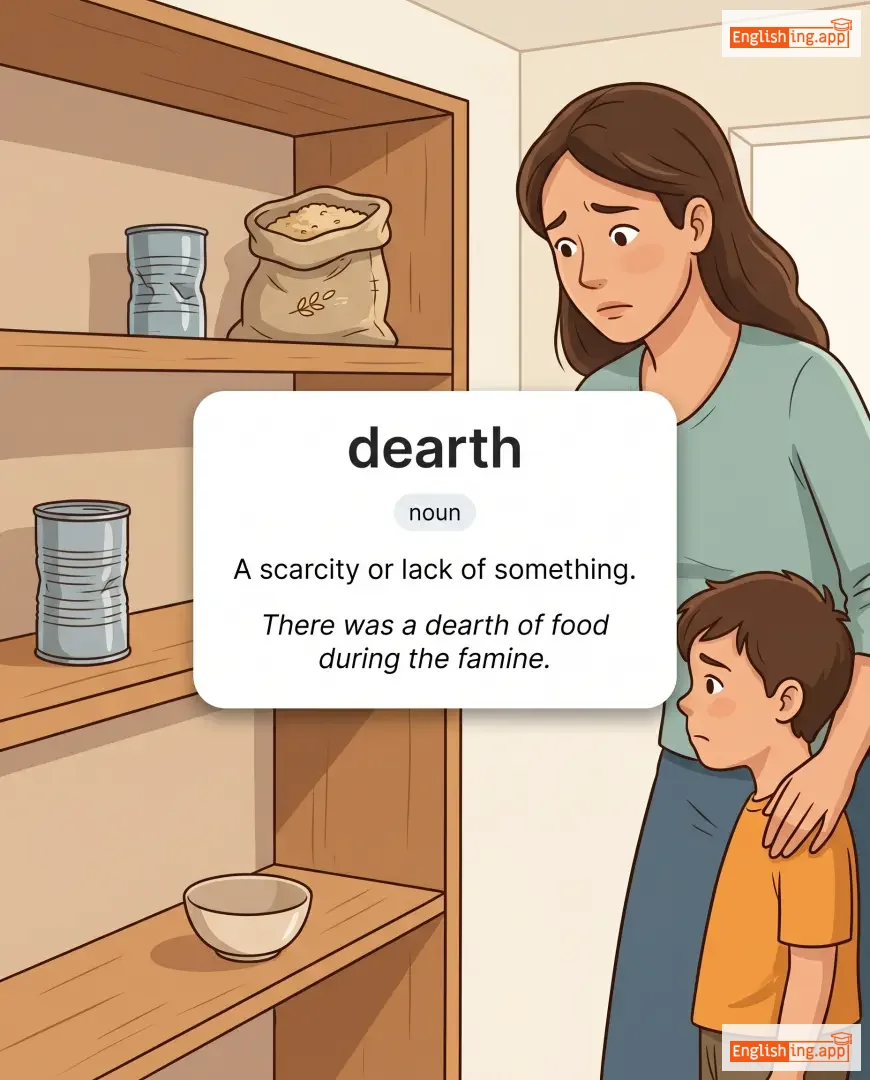
dearth definition card — visual illustration of the meaning
noun
/dɜːrθ/
कमी (kami)

A scarcity or lack of something.

"There was a dearth of food during the famine."

"वहां अकाल के दौरान खाने की कमी थी।" (Wahan akaal ke dauraan khaane ki kami thi.)
noun
/dɛθ/
मृत्यु (mrityu)

The end of life; the permanent cessation of all vital functions.

"The news of his death shocked everyone in the village."

"उसकी मृत्यु की खबर ने गाँव में सभी को चौंका दिया।" (Uski mrityu ki khabar ne gaon mein sabhi ko chaunka diya.)
noun
/ˈdɛθsˌhɛd/
कंकाल (kankal)

A representation of a human skull, often used as a symbol of death.

"The pirate flag was marked with a grim deaths-head."

"पाइरेट ध्वज पर एक भयंकर कंकाल का निशान था।" (Pirat dhvaj par ek bhayankar kankal ka nishan tha.)
noun
/deɪˈbɑːkəl/
आपत्ति (aapatti)

A sudden and complete failure; a fiasco.

"The product launch turned into a complete debacle."

"उत्पाद लॉन्च एक पूरी आपत्ति में बदल गया था।" (Utpad launch ek poori aapatti mein badal gaya tha.)
verb
/dɪˈbɑːr/
प्रतिबंधित करना (pratibandhit karna)

To officially prevent someone from doing something.

"He was debarred from entering the competition due to cheating."

"वह धोखाधड़ी के कारण प्रतियोगिता में प्रवेश करने से प्रतिबंधित हो गया।" (Vah dhokhadhadi ke karan pratijogita mein pravesh karne se pratibandhit ho gaya.)
verb
/dɪˈbɑːrk/
उतरना (utarna)

to disembark or get off a ship, aircraft, or vehicle

"The passengers debarked as soon as the ship docked."

"यात्री जहाज डोकते ही उतर गए।" (Yaatri jahaj dokte hi utar gaye.)
verb
/dɪˈbeɪs/
अधम बनाना (adhm banana)

to reduce the quality, value, or dignity of something

"Corruption can debase the values of a society."

"करप्शन एक समाज के मूल्यों को अधम बना सकता है।" (Karapshan ek samaaj ke mulyon ko adhm bana sakta hai.)
adjective
/dɪˈbeɪst/
अपमानित (apmanit)

having lost quality, value, or moral character

"The debased currency lost the trust of the people."

"अपमानित मुद्रा ने लोगों का विश्वास खो दिया।" (Apmanit mudra ne logon ka vishwas kho diya.)
adjective
/dɪˈbeɪtəbl̩/
विवादास्पद (vivaadaspad)

open to discussion or doubt; not certain

"It is debatable whether the policy will work."

"यह विवादास्पद है कि नीति काम करेगी या नहीं।" (Yeh vivaadaspad hai ki neeti kaam karegi ya nahi.)
noun, verb
/dɪˈbeɪt/
बहस (bahas)

A formal discussion on a particular topic where opposing arguments are presented.

"The students prepared well for the school debate."

"छात्रों ने स्कूल बहस के लिए अच्छी तैयारी की थी।" (Chhatron ne school bahas ke liye achhi taiyari ki thi.)
debates definition card — visual illustration of the meaning
noun
dɪˈbeɪts
बहस (bahas)

A formal discussion on a particular topic in a public meeting or legislative assembly.

"Debates foster intellectual growth."

"बहस बौद्धिक विकास को बढ़ावा देती है।" (Bahas bauddhik vikas ko badhawa deti hai.)
verb
/dɪˈbɔːtʃ/
व्यभिचार करना (vyabhichar karna)

to corrupt morally; to lead into excessive indulgence in sensual pleasures

"The novel shows how wealth can debauch a person's character."

"उपन्यास यह दिखाता है कि कैसे संपत्ति किसी के चरित्र को व्यभिचार कर सकती है।" (Upanyas yah dikhata hai ki kaise sampatti kisi ke charitr ko vyabhichar kar sakti hai.)
debauchery definition card — visual illustration of the meaning
noun
/dɪˈbɔːtʃəri/
दुराचार (durachar)

excessive indulgence in sensual pleasures; corruption or vice

"The novel depicts the debauchery of the aristocrats in the city."

"उपन्यास में शहर के अभिजात वर्ग की दुराचार को दर्शाया गया है।" (Upanyaas mein sheher ke abhijat varg ki durachar ko darshaya gaya hai.)
noun
/dɪˈbɛntʃər/
डिबेन्चर (dibenchar)

a type of debt instrument not secured by physical assets or collateral

"The company raised capital by issuing debentures to investors."

"कंपनी ने निवेशकों को डिबेंचर जारी करके पूंजी जुटाई।" (Kampani ne niveshako ko dibenchar jari karke punji jutai.)
verb
/dɪˈbɪlɪteɪt/
दुर्बल बनाना (durbal banana)

to weaken or make someone or something infirm

"The long illness debilitated his strength."

"लंबी बीमारी ने उसकी ताकत कमजोर कर दी थी।" (Lambi bimari ne uski takat kamzor kar di thi.)
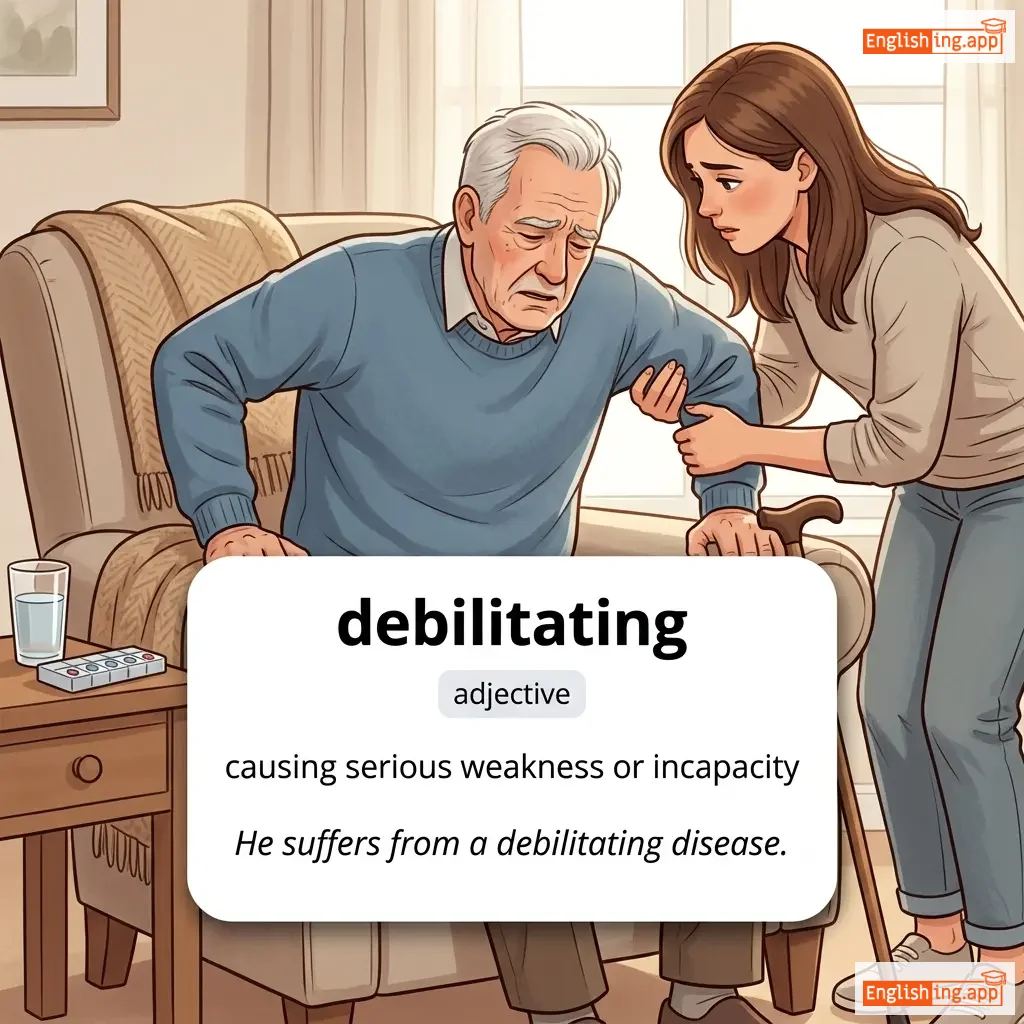
debilitating definition card — visual illustration of the meaning
adjective
/dɪˈbɪlɪteɪtɪŋ/
कमज़ोर करने वाला (kamzor karne wala)

causing serious weakness or incapacity

"He suffers from a debilitating disease."

"वह एक कमज़ोर करने वाली बीमारी से पीड़ित है।" (Woh ek kamzor karne wali bimari se peedit hai.)
noun
/ˈdeb.ɪt/
ऋण; देनदार; खाता से पैसा निकाला गया (rin; dendar; khata se paisa nikala gaya)

an entry recording an amount owed; money taken from a bank account

"The bank showed a debit of fifty dollars from my checking account."

"बैंक ने मेरे चेकिंग खाता से पचास डॉलर डेबिट किया।" (bank ne mere checking khata se pachaas dollar debit kiya.)
adjective
/ˌdɛbəˈnɛr/
आकर्षक (aakarshak)

confident, stylish, and charming, typically referring to a man

"He looked debonair in his tuxedo at the gala."

"वह गाला में अपने टक्सेडो में आकर्षक लग रहे थे।" (vah gala mein apne tuxedo mein aakarshak lag rahe the.)
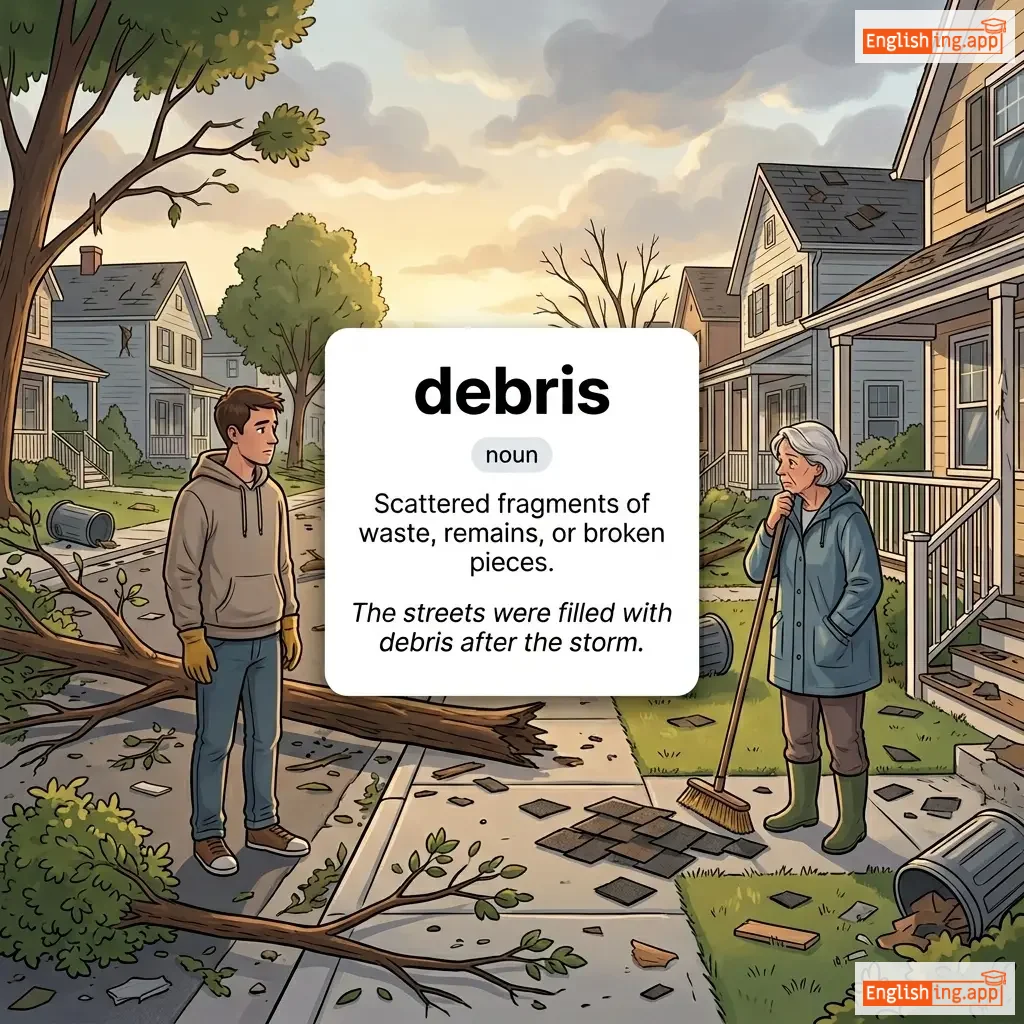
debris definition card — visual illustration of the meaning
noun
/dəˈbriː/
मलबा (malba)

Scattered fragments of waste, remains, or broken pieces.

"The streets were filled with debris after the storm."

"तूफान के बाद सड़कों पर मलबा पड़ा था।" (Toofan ke baad sadkon par malba pada tha.)
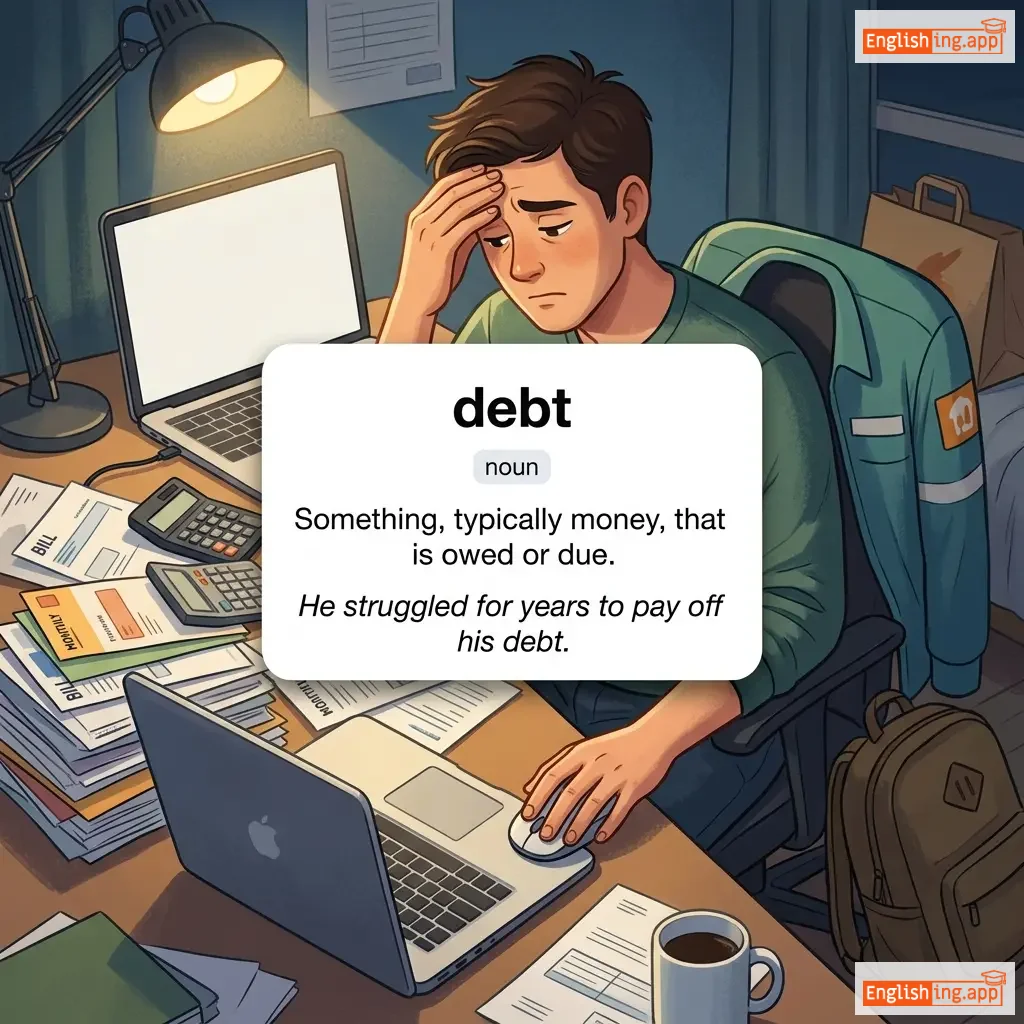
debt definition card — visual illustration of the meaning
noun
/dɛt/
ऋण (rin)

Something, typically money, that is owed or due.

"He struggled for years to pay off his debt."

"उसने अपने ऋण को चुकाने के लिए सालों तक संघर्ष किया।" (Usne apne rin ko chukane ke liye salon tak sangharsh kiya.)