वोकैबुलरीज

इंग्लिश वोकैबुलरी डिस्कवर, लर्न और मास्टर करें

noun
/ˈdɒktrɪn/
सिद्धांत (siddhant)

A set of beliefs or principles held and taught by a religious, political, or other group.

"The church follows a strict doctrine on moral values."

"चर्च नैतिक मूल्यों पर एक सख्त सिद्धांत का पालन करती है।" (Church naitik mulyon par ek sakht siddhant ka paalan karti hai.)
document definition card — visual illustration of the meaning
noun/verb
/ˈdɒkjʊmənt/
दस्तावेज़ (dastaavez)

Noun: A written, printed, or electronic record that provides information or evidence. Verb: To record information in written or electronic form.

"She carefully documented all the expenses of the trip."

"उसने यात्रा के सभी खर्चों को सावधानी से दस्तावेजीकृत किया।" (Usne yatra ke sabhi kharchon ko saavdhani se dastavejikrit kiya.)
noun/adjective
/ˌdɒkjʊˈmɛntri/
डॉक्युमेंट्री फिल्म (dokyumentri film)

A film or television program that provides a factual record or report.

"We watched a documentary about climate change."

"हमने जलवायु परिवर्तन के बारे में एक डॉक्युमेंट्री देखी।" (Humne jalvayu parivartan ke baare mein ek dokyumentri dekhi.)
noun
/ˌdɒkjʊmɛnˈteɪʃən/
डॉक्यूमेंटेशन (dokyumenteshan)

material that provides official information or evidence

"The documentation for the project is available for review."

"प्रोजेक्ट के लिए डोक्यूमेंटेशन समीक्षा के लिए उपलब्ध है।" (projēkt ke liye dokyumenteshan samīkṣā ke liye upalabdh hai.)
verb
/ˈdɒdə/
काँपते काँपते चलना (kaamte kaamte chalna)

To move in a weak and unsteady way, especially due to old age.

"The old man doddered across the street with a cane."

"वृद्ध व्यक्ति एक छड़ी के साथ काँपते काँपते सड़क पार कर रहा था।" (Vruddh vyakti ek chhadi ke saath kaamte kaamte sadak paar kar raha tha.)
adjective
/ˈdɒdərɪŋ/
काँपते हुए / कमजोर (kaampte hue / kamzor)

Weak, shaky, or unsteady, especially due to old age.

"The doddering professor struggled to climb the stairs."

"डोडरिंग प्रोफेसर सीढ़ियाँ चढ़ने में संघर्ष कर रहा था।" (Doddering professor seedhiyan chadhne mein sangharsh kar raha tha.)
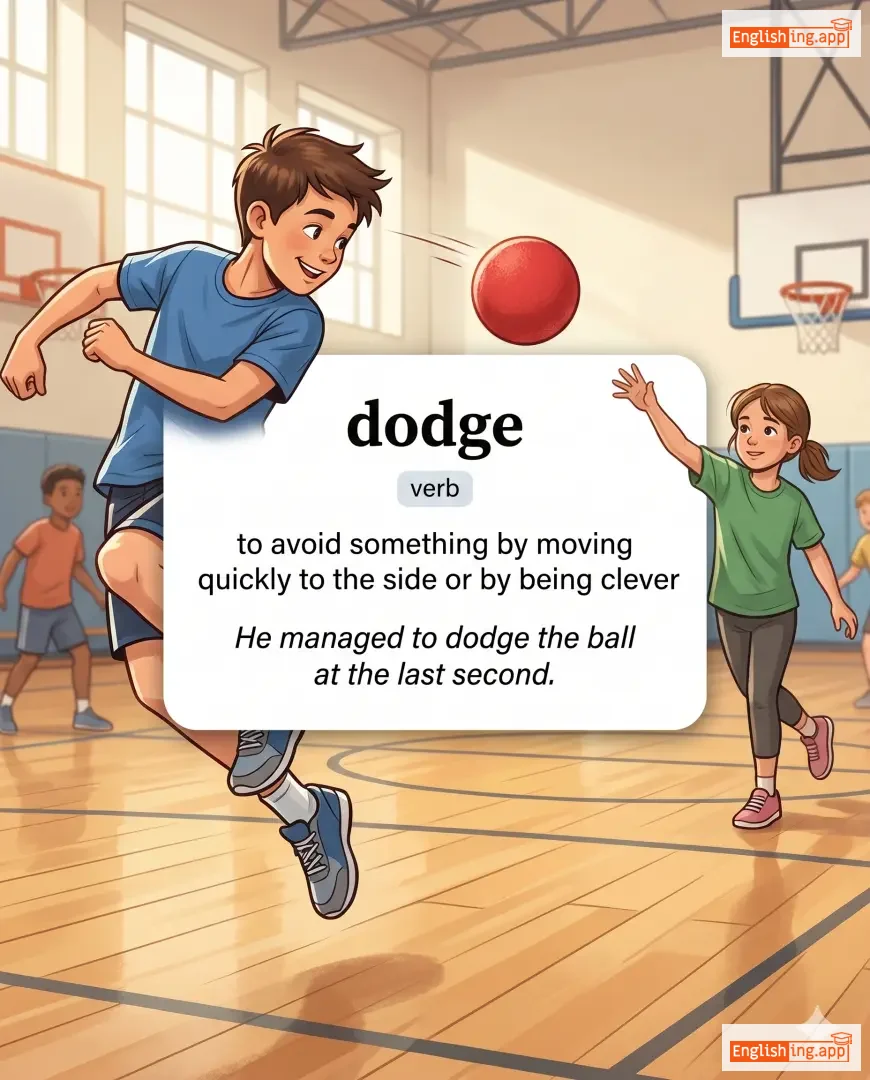
dodge definition card — visual illustration of the meaning
verb
/dɒdʒ/
बचाना (bachana)

to avoid something by moving quickly to the side or by being clever

"He managed to dodge the ball at the last second."

"वह आखिरी क्षण में गेंद को बचाने में सफल रहा।" (Wah aakhri kshan mein gend ko bachane mein safal raha.)
adjective
/ˈdɒdʒi/
संदेहास्पद; संदिग्ध; असमर्थनीय; जोखिमपूर्ण या खतरनाक (sandehaspad; sandigdh; asamarthaniyo; jokhimpoorn ya khatarnaak)

suspicious; questionable; unreliable; risky or dangerous

"That deal sounds dodgy to me."

"वो डील मेरे लिए संदिग्ध लग रही है।" (vo deal mere liye sandigdh lag rahi hai।)
noun
/doʊ/
हिरणी (hirani)

a female deer, especially an adult one

"The doe and her fawn were grazing in the meadow."

"हिरणी और उसका बच्चा मैदान में घास खा रहे थे।" (Hirani aur uska bachcha maidan mein ghas khaa rahe the.)
verb
/dɒf/
टोपि उतारना (आदर का प्रतीक) (topi utaarna (aadar ka pratik))

to take off an item of clothing, especially a hat, as a sign of respect

"He doffed his hat as the procession passed."

"उसने शृंगार के दौरान अपनी टोपि उतारी।" (Usne shringar ke dauran apni topi utaari.)
noun
/dɔːɡ/
कुत्ता (kutta)

a domesticated carnivorous mammal kept as a pet or for work

"The dog barked loudly at the stranger."

"कुत्ते ने अजनबी पर जोर से भौंका।" (Kutte ne ajnabi par zor se bhonka.)
noun
/ˈdɒɡ roʊz/
कुत्ता गुलाब (kutta gulaab)

A wild rose species with pink or white flowers and thorny stems, common in hedgerows

"The dog-rose bush grew wild along the countryside path."

"कुत्ता गुलाब की झाड़ी गांव के रास्ते के किनारे जंगली रूप में बढ़ी थी।" (kutta gulaab ki jhaadi gaon ke raste ke kinare jangli roop mein badhi thi.)
adjective
/ˈdɒɡɪd/
दृढ़ (dridh)

showing stubborn determination and persistence

"She succeeded through dogged determination."

"वह दृढ़ संकल्प के साथ सफल हुई।" (Vah dridh sankalp ke saath safal hui.)
doggedness definition card — visual illustration of the meaning
noun
ˈdɒɡ.ɪd.nəs
अडिगता (adigtā)

Stubborn persistence in achieving something without giving up.

"His doggedness in pursuing his goals was inspiring."

"उसकी अडिगता अपने लक्ष्यों को प्राप्त करने में प्रेरणादायक थी।" (Uski adigtā apne lakshyon ko prāpt karne mein preraṇādayak thī.)
doggerel definition card — visual illustration of the meaning
noun
/ˈdɒɡərəl/
अश्लील कविता (ashleel kavita)

Comic or irregular verse, often poorly constructed and lacking in artistic quality.

"The poet’s work was dismissed as mere doggerel by the critics."

"कवियों का काम आलोचकों द्वारा केवल अश्लील कविता के रूप में खारिज कर दिया गया।" (Kaviyon ka kaam alochako dwara keval ashleel kavita ke roop mein kharij kar diya gaya.)
noun
/ˈdɒɡmə/
अडिग विश्वास (adig vishwas)

A principle or set of principles laid down by an authority as incontrovertibly true.

"The religious leader strictly adhered to traditional dogma."

"धार्मिक नेता पारंपरिक अडिग विश्वास पर दृढ़ता से विश्वास करते थे।" (Dharmik neta paramparik adig vishwas par dridhta se vishwas karte the.)
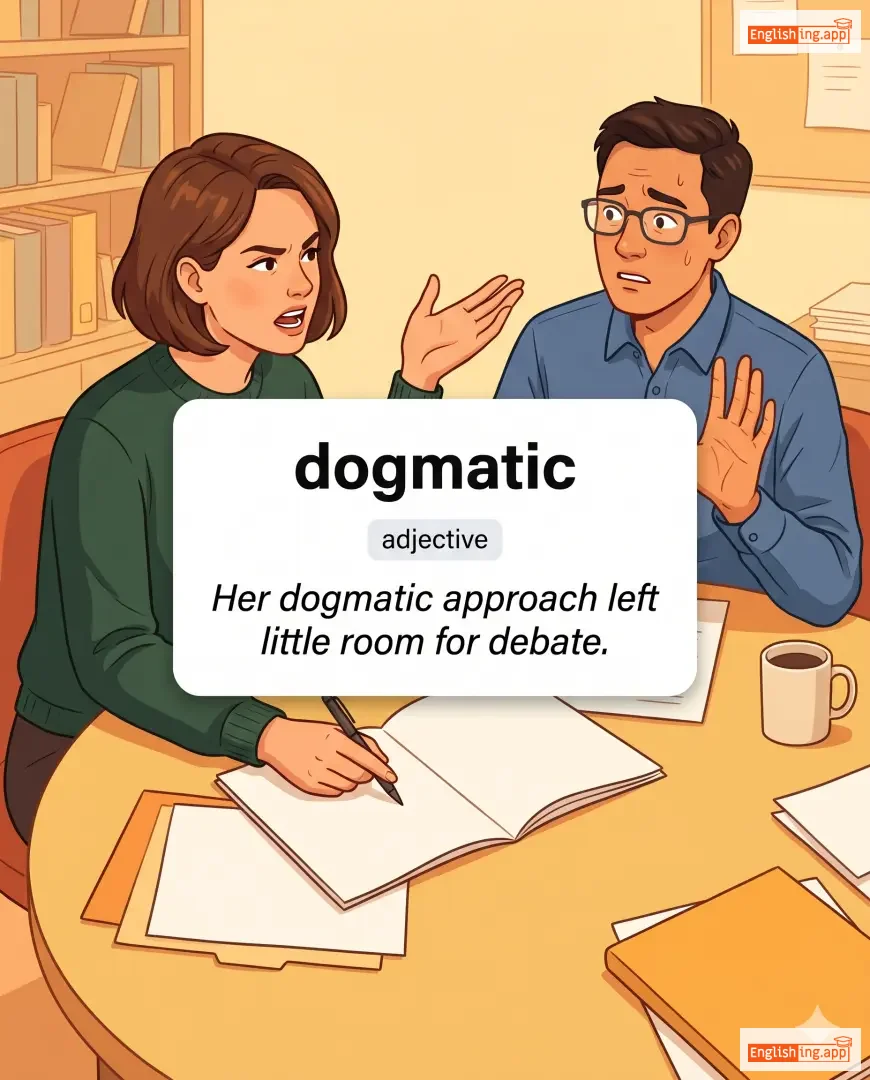
dogmatic definition card — visual illustration of the meaning
adjective
/dɒɡˈmætɪk/
कट्टरपंथी (kattarpanthi)

Inclined to lay down principles as undeniably true, without consideration of evidence or others’ opinions.

"Her dogmatic approach left little room for debate."

"उसकी कट्टरपंथी दृष्टिकोण ने बहस के लिए बहुत कम जगह छोड़ी।" (Uski kattarpanthi drishtikon ne bahas ke liye bahut kam jagah chhodi.)
verb
/ˈdɒɡmətaɪz/
अपना मत कठोरता से पेश करना (apna mat kathorta se pesh karna)

To state opinions or beliefs as if they were absolute truths.

"The professor tended to dogmatize on political issues."

"प्रोफेसर राजनीतिक मुद्दों पर कठोर रूप से अपने विचार पेश करने की प्रवृत्ति रखते थे।" (Professor rajnaitik muddon par kathor roop se apne vichar pesh karne ki pravritti rakhte the.)
noun
/ˈdɒldrəmz/
नीरस अवस्था (doldrums)

A state of inactivity, stagnation, or low spirits; also a region near the equator with calm winds.

"After the project failed, the team was stuck in the doldrums for months."

"परियोजना के असफल होने के बाद, टीम महीनों तक डॉल्ड्रम्स में फंसी रही." (pariyojana ke asafal hone ke baad, team mahino tak doldrums mein fansi rahi)
adjective
/ˈdəʊl.fəl/
उदास (udas)

Expressing sorrow or sadness; mournful.

"She gave him a doleful look before leaving."

"वह उसे जाने से पहले एक उदास नज़र से देख रही थी।" (Wah use jane se pehle ek udaas nazar se dekh rahi thi.)
adjective
/ˈdəʊl.səm/
दुःखभरा (dukhbhara)

Filled with grief or sadness; mournful.

"The dolesome ballad brought tears to their eyes."

"दुःखभरी गाने ने उनके आँखों में आंसू भर दिए।" (Dukhbhari gane ne unke aankhon mein aansu bhar diye.)
noun
/dɒl/
गुड़िया (gudiya)

a small toy resembling a human figure, especially for children

"The little girl hugged her favorite doll tightly."

"छोटी लड़की ने अपनी पसंदीदा गुड़िया को कसकर गले लगाया।" (chhoti ladki ne apni pasandida gudiya ko kaskar gale lagaya.)
noun
/ˈdɒlər/
डॉलर (dolar)

The basic monetary unit of the United States and some other countries

"I need five dollars to buy this book."

"मुझे इस किताब को खरीदने के लिए पांच डॉलर चाहिए।" (mujhe is kitab ko kharidne ke liye paanch dolar chahiye.)
noun
/ˈdəʊ.lər/
दुःख (dukh)

A state of great sorrow or distress.

"The nation was in deep dolor after the tragedy."

"देश त्रासदी के बाद गहरे दुःख में था।" (Desh traasdi ke baad gehre dukh mein tha.)
adjective
/ˈdəʊ.lə.rəs/
दुखपूर्ण (dukhpoorn)

Expressing great sorrow or distress.

"He spoke in a dolorous tone after the loss."

"हानि के बाद उसने दुखपूर्ण लहजे में बोला।" (haani ke baad usne dukhpoorn lahje mein bola)
noun
/ˈdɒlfɪn/
डॉल्फिन (dolphin)

A highly intelligent marine mammal with a streamlined body and dorsal fin

"Dolphins are known for their playful behavior and intelligence."

"डॉल्फिन अपने चंचल व्यवहार और बुद्धिमत्ता के लिए जानी जाती हैं।" (dolphin apne chanchal vyavhar aur buddhimatta ke liye jani jati hain)
noun
/doʊlt/
मूर्ख (moorkh)

A stupid or slow-witted person.

"Only a dolt would believe such a story."

"केवल एक मूर्ख ही ऐसी कहानी पर विश्वास करेगा।" (Keval ek moorkh hi aisi kahani par vishwas karega.)
noun
/dəˈmeɪn/
क्षेत्र (kshetra)

An area of knowledge, activity, or territory over which control is exercised.

"Mathematics is her main domain of expertise."

"गणित उसका मुख्य क्षेत्र है।" (Ganit uska mukhya kshetra hai.)
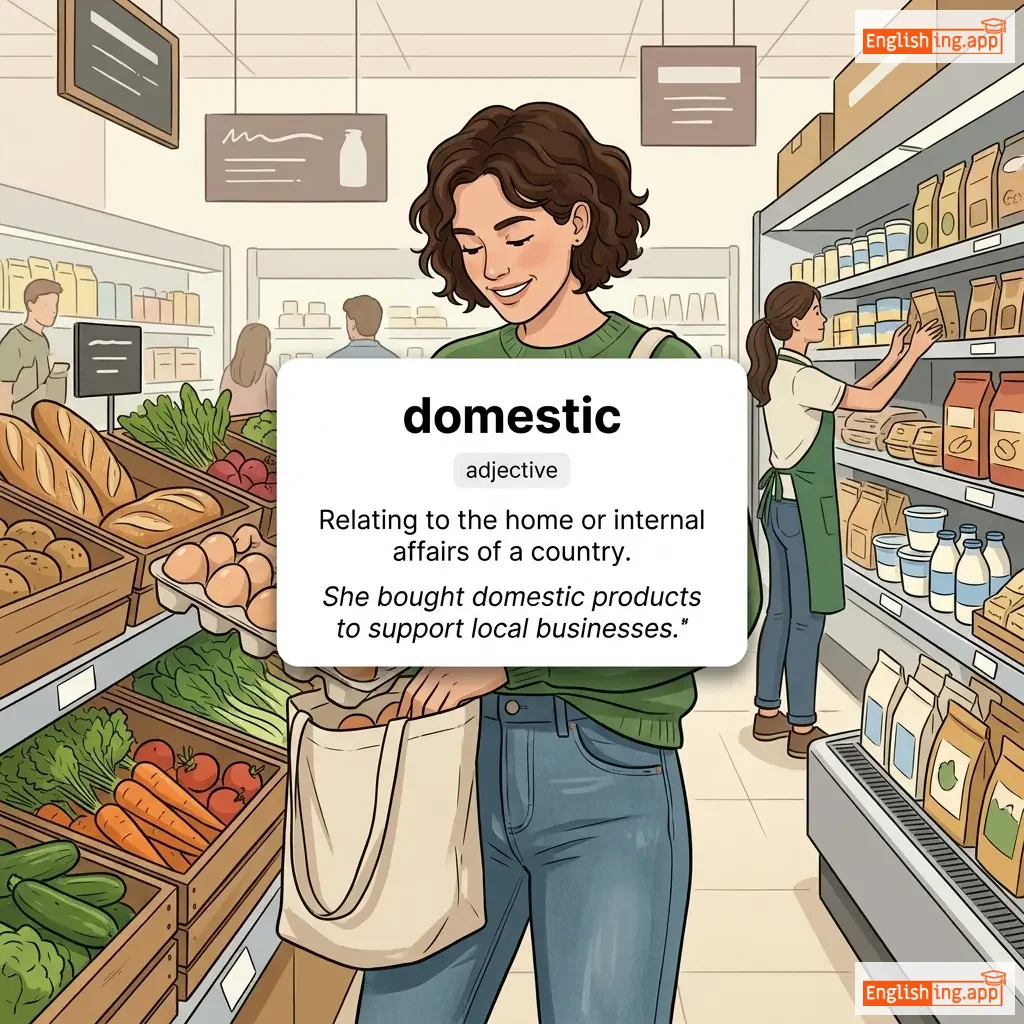
domestic definition card — visual illustration of the meaning
adjective
/dəˈmɛstɪk/
खुशी (khushi)

Relating to the home or internal affairs of a country.

"She bought domestic products to support local businesses."

"वह जब पुरस्कार प्राप्त करती, तो वह अपनी खुशी नहीं छुपा पाई।" (Wah jab puraskar prapt karti, to wah apni khushi nahi chhupa pai.)
verb
/dəˈmɛstɪkeɪt/
पालतू बनाना (paaltu banana)

to tame an animal for use by humans; to adapt something for domestic use

"Humans domesticated dogs thousands of years ago."

"मनुष्य हजारों साल पहले कुत्तों को पालतू बना चुके थे।" (Manushya hazaron saal pehle kutto ko paaltu bana chuke the.)
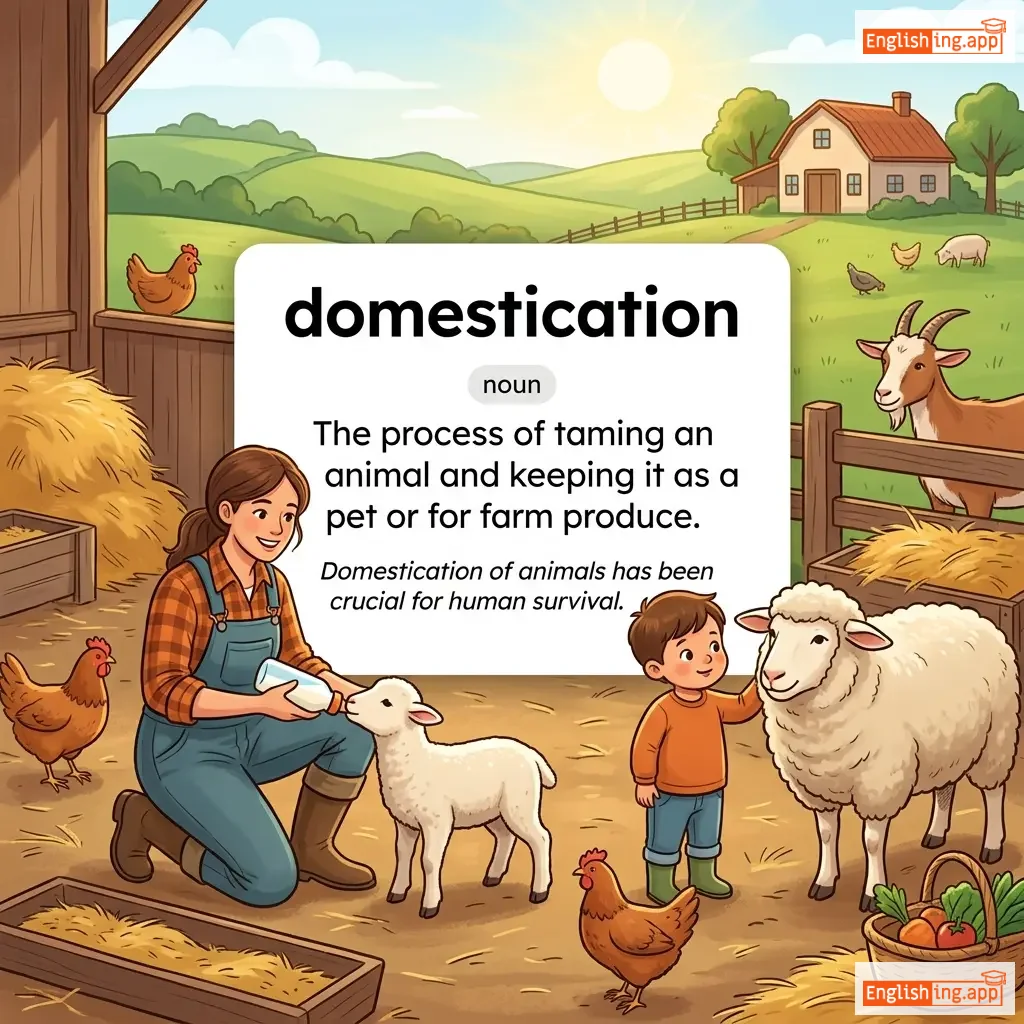
domestication definition card — visual illustration of the meaning
noun
dəˌmɛstɪˈkeɪʃən
पालतूपन (paltupan)

The process of taming an animal and keeping it as a pet or for farm produce.

"Domestication of animals has been crucial for human survival."

"पालतूपन जानवरों के लिए मनुष्य की अस्तित्व के लिए महत्वपूर्ण रहा है।" (Paltupan janwaron ke liye manushya ki astitva ke liye mahatvapurn raha hai.)
noun
/ˌdoʊ.məˈstɪs.ə.ti/
घरेलूपन (ghareloopan)

Life at home or devotion to family life.

"She enjoys the domesticity of cooking and gardening."

"वह खाना पकाने और बागवानी के घरेलूपन का आनंद लेती है।" (Vah khana pakane aur bagwani ke ghareloopan ka anand leti hai.)
noun
/ˈdɑː.mə.saɪl/
निवास स्थान (nivas sthaan)

A person's legal residence or permanent home.

"He declared Canada as his legal domicile."

"उसने कनाडा को अपनी कानूनी डोमिसाइल घोषित किया।" (Usne Kanada ko apni kanooni domicile ghoshit kiya.)
dominance definition card — visual illustration of the meaning
noun
/ˈdɑː.mə.nəns/
प्रभुत्व (prabhutv)

The state of having power and influence over others.

"The company has maintained dominance in the smartphone market."

"कंपनी ने स्मार्टफोन बाजार में प्रभुत्व बनाए रखा है।" (Kampani ne smartphone bazar mein prabhutv banaye rakha hai.)
adjective
/ˈdɑː.mə.nənt/
प्रभुत्वशाली (prabhutvashali)

Having power, authority, or influence over others; most important.

"English has become the dominant language in international business."

"अंग्रेज़ी ने अंतर्राष्ट्रीय व्यापार में प्रमुख भाषा बन गई है।" (Angrezi ne antarraashtreey vyapar mein pramukh bhasha ban gayi hai.)
verb
/ˈdɒmɪneɪt/
प्रभुत्व करना (prabhutv karna)

to have power or control over something or someone

"The company dominates the smartphone market."

"कंपनी स्मार्टफोन बाजार पर प्रभुत्व जमाती है।" (Company smartphone bazar par prabhutv jamaati hai.)
noun
/ˌdɒmɪˈneɪʃən/
वर्चस्व (varchasva)

the exercise of control or influence over someone or something

"The empire sought domination over its neighbors."

"साम्राज्य अपने पड़ोसियों पर वर्चस्व चाहता था।" (Samrajya apne padosiyon par varchasva chahta tha.)
verb
/ˌdɒmɪˈnɪə/
अहंकार से नियंत्रण करना (ahankar se niyantran karna)

to assert one's will over another in an arrogant way

"He tends to domineer over his younger colleagues."

"वह अपने छोटे सहकर्मियों पर प्रभुत्व जमाने की प्रवृत्ति रखता है।" (Vah apne chhote sahakarmiyon par prabhutv jamane ki pravritti rakhta hai.)
verb, noun
/dɒn/
पहनना / नेता (pehnna / neta)

to put on (an article of clothing); also used as a title for a respected person

"She donned her coat before leaving."

"वह बाहर जाने से पहले अपना कोट पहनने लगी।" (Woh baahar jaane se pehle apna coat pehnne lagi.)
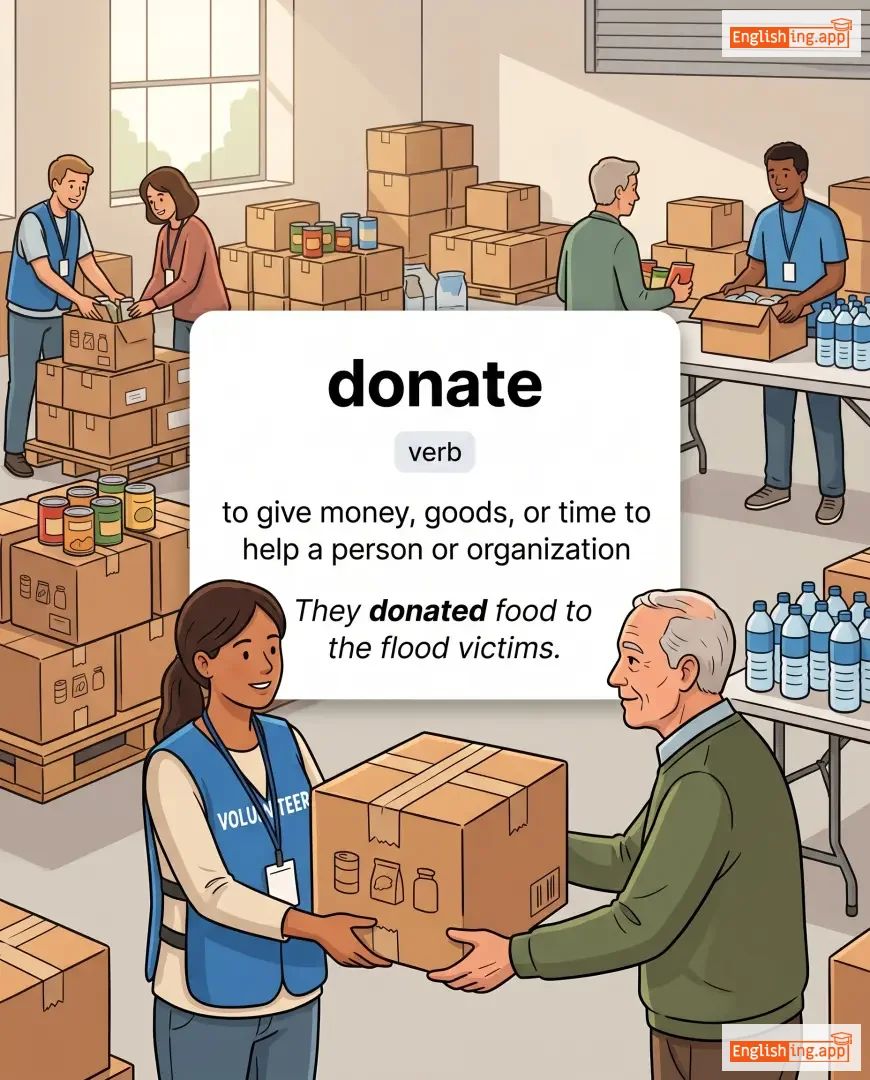
donate definition card — visual illustration of the meaning
verb
/dəʊˈneɪt/
दान करना (dan karna)

to give money, goods, or time to help a person or organization

"They donated food to the flood victims."

"उन्होंने बाढ़ पीड़ितों को खाना दान किया।" (Unhone baadh peediton ko khana dan kiya.)
noun
/dəʊˈneɪ.ʃən/
दान (daan)

something that is given to help a person or organization, often money

"He made a generous donation to the local orphanage."

"उसने स्थानीय अनाथालय को एक उदार दान दिया।" (Usne sthaniya anathalay ko ek udar dan diya.)
noun
/ˈdoʊneɪtər/
दानकर्ता (daankarta)

A person who gives something, especially money or goods, as a donation.

"The donator wished to remain anonymous after contributing a large sum."

"दानकर्ता ने एक बड़ी राशि दान करने के बाद गुमनाम रहने की इच्छा जताई।" (Daankarta ne ek badi rashi daan karne ke baad gumnaam rehne ki ichha jatai.)
noun
/doʊˈniː/
प्राप्तकर्ता (praptakarta)

A person who receives a gift or donation.

"The scholarship fund’s donee expressed heartfelt gratitude."

"स्कॉलरशिप फंड का प्राप्तकर्ता गहरी आभार व्यक्त किया।" (Scholarship fund ka praptakarta gahri aabhaar vyakt kiya.)
noun
/ˈdɒŋ.ki/
गधा (gadha)

a domesticated animal related to the horse, with long ears and a braying call

"The donkey carried heavy bags up the mountain."

"गधे ने पहाड़ पर भारी बैग उठाए।" (gadhe ne pahaad par bhaari baag uthaye.)
noun
/ˈdoʊnər/
दाताः (dataa)

A person who gives something, especially to a charity or cause.

"The donor contributed generously to the hospital’s new wing."

"दानदाता ने अस्पताल के नए विंग में उदारता से योगदान दिया।" (Daatada ne aspataal ke naye wing mein udarta se yogdan diya.)
verb
/ˈduːdəl/
डूडल करना (doodle karna)

To draw or scribble absentmindedly, often while thinking about something else.

"She doodled flowers in the corner of her notebook during class."

"वह कक्षा के दौरान अपनी नोटबुक के कोने में फूल डूडल कर रही थी।" (Vah kaksha ke dauran apni notebook ke kone mein phool doodle kar rahi thi.)
noun
/duːm/
विनाश (vinash)

A terrible fate, destruction, or unavoidable bad outcome.

"The ancient prophecy foretold the city’s doom."

"प्राचीन भविष्यवाणी ने शहर के विनाश की भविष्यवाणी की थी।" (Prachin bhavishyavani ne shahar ke vinash ki bhavishyavani ki thi.)
noun
/ˈduːmz.deɪ/
कियामत का दिन; दुनिया के अंत का दिन (kiyamat ka din; duniya ke ant ka din)

the last day of the world's existence; a time of catastrophic destruction

"The preacher spoke about doomsday and the importance of preparing spiritually."

"धर्मगुरु ने कियामत के दिन और आध्यात्मिक रूप से तैयारी करने के महत्व के बारे में बात की।" (dharmguru ne kiyamat ke din aur adhyatmik roop se taiyaari karne ke mahatva ke baare mein baat ki.)
noun
/dɔːr/
दरवाजा (darwaza)

A movable barrier that allows entry or exit to a building, room, or vehicle.

"He knocked on the door before entering the house."

"उसने घर में प्रवेश करने से पहले दरवाजे पर दस्तक दी।" (Usne ghar mein pravesh karne se pehle darwaze par dastak di.)
noun
/ˈdɔːr.mæt/
दरवाज़ा चटाई (darwaza chatai)

a mat placed in front of a door for wiping feet

"Please wipe your feet on the door-mat before entering the house."

"कृपया घर में प्रवेश करने से पहले दरवाज़ा चटाई पर अपने पैर पोंछें।" (kripya ghar mein pravesh karne se pehle darwaza chatai par apne pair ponchen.)