वोकैबुलरीज

इंग्लिश वोकैबुलरी डिस्कवर, लर्न और मास्टर करें

verb
/dɪˈsɛkt/
काटकर अध्ययन करना (kaatkar adhyayan karna)

to cut apart an animal, plant, or other organism to study its internal parts; to analyze something in detail

"In biology class, students had to dissect a frog to learn about its anatomy."

"बायोलॉजी क्लास में, छात्रों को मेंढक काटकर उसकी शारीरिक रचना के बारे में जानना था।" (Baayoloji klaas mein, chatron ko mendhak kaatkar uski shaareek rachna ke baare mein jaana tha.)
noun
/daɪˈsɛkʃən/
विच्छेदन (vichhedan)

the act of cutting apart or analyzing something in detail, especially a body or structure

"The dissection of the specimen revealed important details about its structure."

"नमूने का विच्छेदन इसके संरचना के महत्वपूर्ण विवरणों को उजागर किया।" (Namune ka vichhedan iske sanrachna ke mahatvapurn vivarano ko ujagar kiya.)
dissemble definition card — visual illustration of the meaning
verb
/dɪˈsɛmbəl/
बनावटी करना (banavati karna)

to conceal one's true motives, feelings, or beliefs; to pretend

"He tried to dissemble his anger with a forced smile."

"उसने एक मजबूरी मुस्कान के साथ अपने गुस्से को छिपाने की कोशिश की।" (Usne ek majboori muskaan ke saath apne gusse ko chhupane ki koshish ki.)
noun
/dɪˈsɛmbələr/
ढोंगी (dhongi)

a person who conceals their real feelings or intentions; a hypocrite or pretender

"The politician was accused of being a dissembler who never revealed his true plans."

"राजनेता को एक ढोंगी होने का आरोप लगाया गया था, जिसने कभी अपनी असली योजनाओं को नहीं उजागर किया।" (Rajneeta ko ek dhongi hone ka aarop lagaya gaya tha, jisne kabhi apni asli yojnaon ko nahin ujagar kiya.)
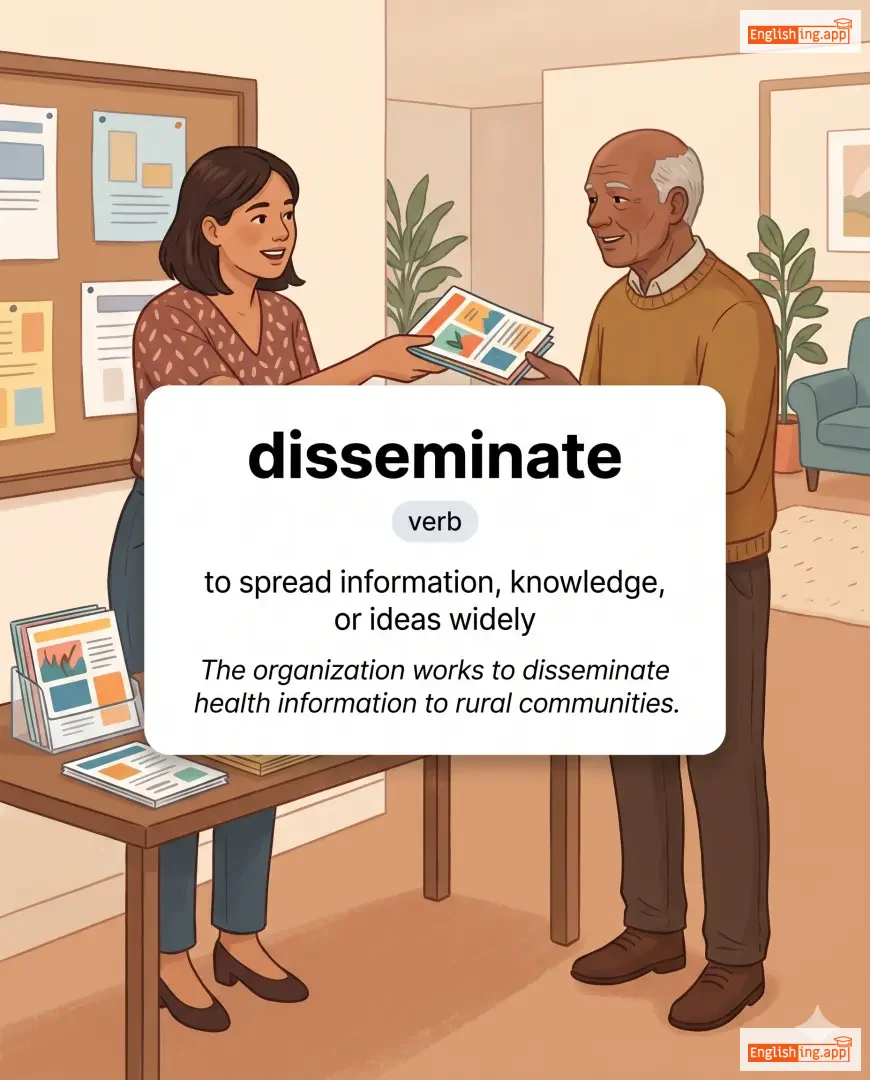
disseminate definition card — visual illustration of the meaning
verb
/dɪˈsɛmɪˌneɪt/
प्रसार करना (prasaar karna)

to spread information, knowledge, or ideas widely

"The organization works to disseminate health information to rural communities."

"संस्था ग्रामीण समुदायों तक स्वास्थ्य जानकारी फैलाने के लिए काम करती है।" (Sanstha grameen samudaayon tak swasthya jaankaari phailane ke liye kaam karti hai.)
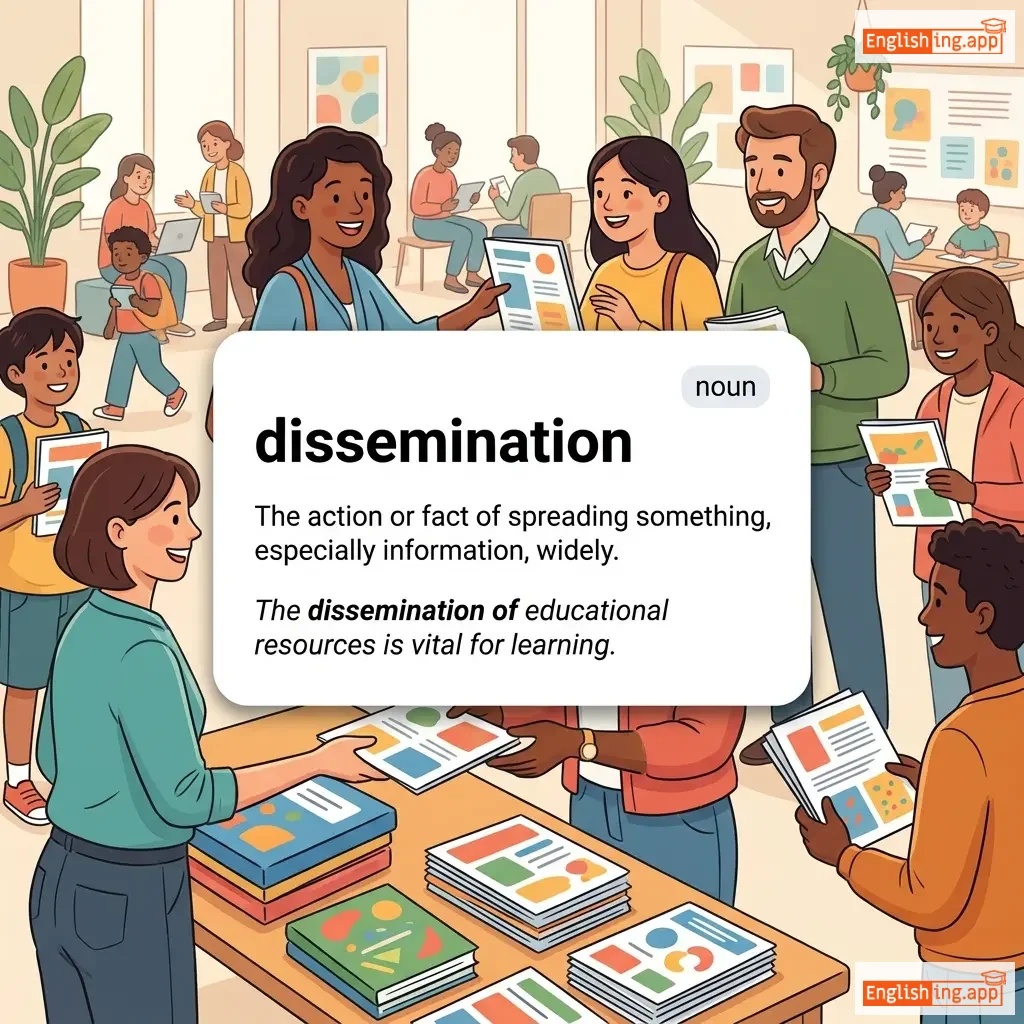
dissemination definition card — visual illustration of the meaning
noun
dɪˌsɛm.ɪˈneɪ.ʃən
प्रसार (prasar)

The action or fact of spreading something, especially information, widely.

"The dissemination of educational resources is vital for learning."

"शैक्षिक संसाधनों का प्रसार सीखने के लिए महत्वपूर्ण है।" (Shaikshik sansadhanon ka prasar seekhne ke liye mahatvapurn hai.)
noun
/dɪˈsɛnʃən/
विरोध (virodh)

Strong disagreement or difference of opinion, especially leading to discord within a group.

"The meeting ended in dissension among the committee members."

"बैठक समिति के सदस्यों के बीच विरोध में समाप्त हो गई।" (Baithak samiti ke sadasyon ke beech virodh mein samaapt ho gayi.)
verb
/dɪˈsɛnt/
असहमति (asahmati)

To hold or express opinions that are different from those officially accepted.

"Several members dissented from the majority decision."

"कई सदस्य बहुमत निर्णय से असहमत थे।" (Kai sadasya bahumat nirnay se asahmat the.)
adjective
/dɪˈsɛnʃənt/
विपक्षी (vipakshi)

Expressing or holding opinions that are opposed to the majority or official view.

"Only a few dissentient voices were heard during the debate."

"बहस के दौरान केवल कुछ ही विपक्षी आवाजें सुनी गईं।" (Bahas ke dauran keval kuch hi vipakshi aawaazain suni gayin.)
adjective
/dɪˈsɛnʃəs/
विरोधी (virodhi)

Causing or likely to cause disagreement and conflict.

"His dissentious remarks divided the group further."

"उसकी विरोधी टिप्पणियों ने समूह को और अधिक विभाजित कर दिया।" (Uski virodhi tippaniyon ne samooh ko aur adhik vibhaajit kar diya.)
noun
/ˌdɪsərˈteɪʃən/
निबंध (nibandh)

A long piece of writing on a particular subject, usually written for a university degree.

"She spent two years writing her doctoral dissertation."

"उसने अपना डॉक्टोरल निबंध लिखने में दो साल बिताए।" (Usne apna doctoral nibandh likhne mein do saal bitaaye.)
noun
/dɪsˈsɜːrvɪs/
हानि (haani)

A harmful action; something that does damage rather than help.

"Spreading false information is a disservice to the community."

"झूठी जानकारी फैलाना समुदाय के लिए एक हानि है।" (jhoothi jankari phailana samudaay ke liye ek haani hai)
verb
/dɪˈsɛvər/
विभाजित करना (vibhajit karna)

To separate or cut apart.

"The treaty sought to dissever the two hostile regions."

"संधि ने दो शत्रु प्रवृत्त क्षेत्रों को विभाजित करने का प्रयास किया।" (Sandhi ne do shatru pravrit kshetron ko vibhajit karne ka prayas kiya.)
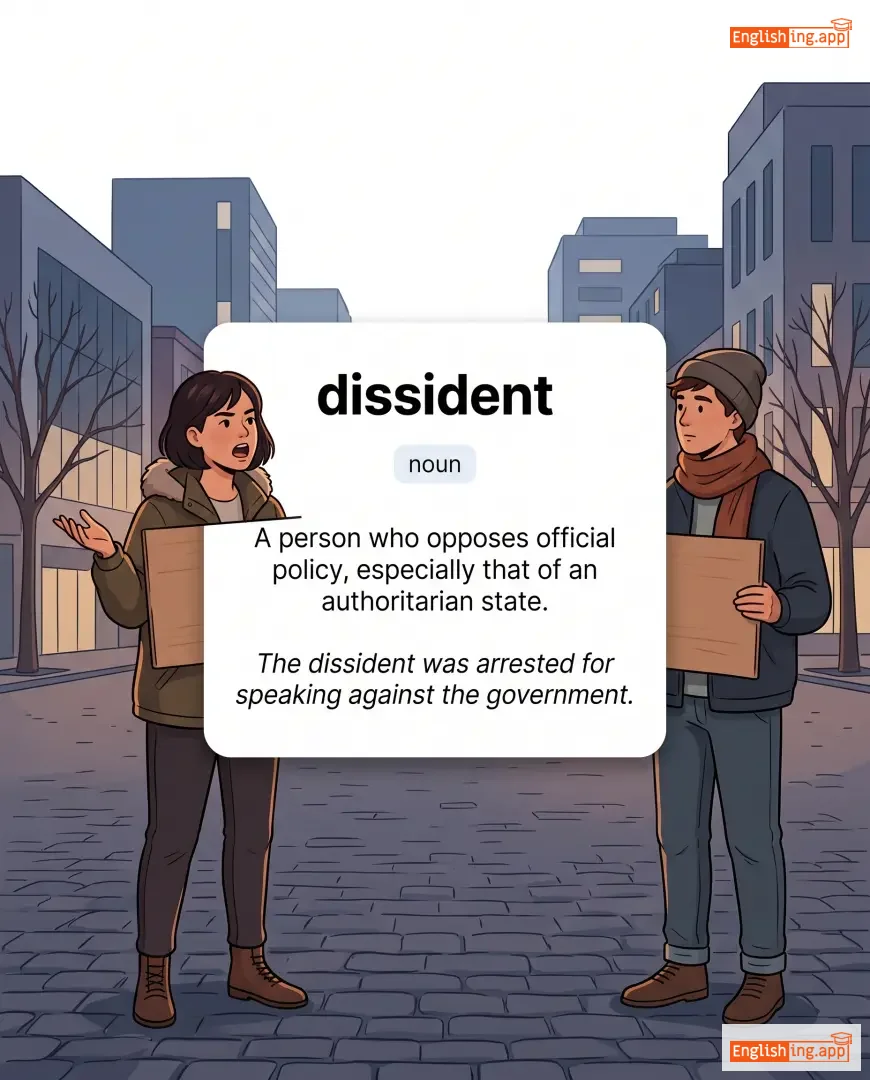
dissident definition card — visual illustration of the meaning
noun
/ˈdɪsɪdənt/
विपक्षी (vipakshi)

A person who opposes official policy, especially that of an authoritarian state.

"The dissident was arrested for speaking against the government."

"विपक्षी को सरकार के खिलाफ बोलने के लिए गिरफ्तार किया गया था।" (Vipakshi ko sarkar ke khilaf bolne ke liye giraftar kiya gaya tha.)
adjective
/dɪsˈsɪmɪlər/
असमान (asamaan)

Not alike; different.

"Though they are twins, their personalities are dissimilar."

"हालाँकि वे जुड़वां हैं, उनकी व्यक्तित्व असमान हैं।" (halanki ve judva hain, unki vyaktitva asamaan hain.)
verb
/dɪˈsɪmjʊˌleɪt/
छिपाना (chhupana)

To disguise or conceal one's true feelings or intentions.

"He tried to dissimulate his fear with a smile."

"उसने मुस्कान के साथ अपने डर को छिपाने की कोशिश की।" (Usne muskan ke saath apne dar ko chhupane ki koshish ki.)
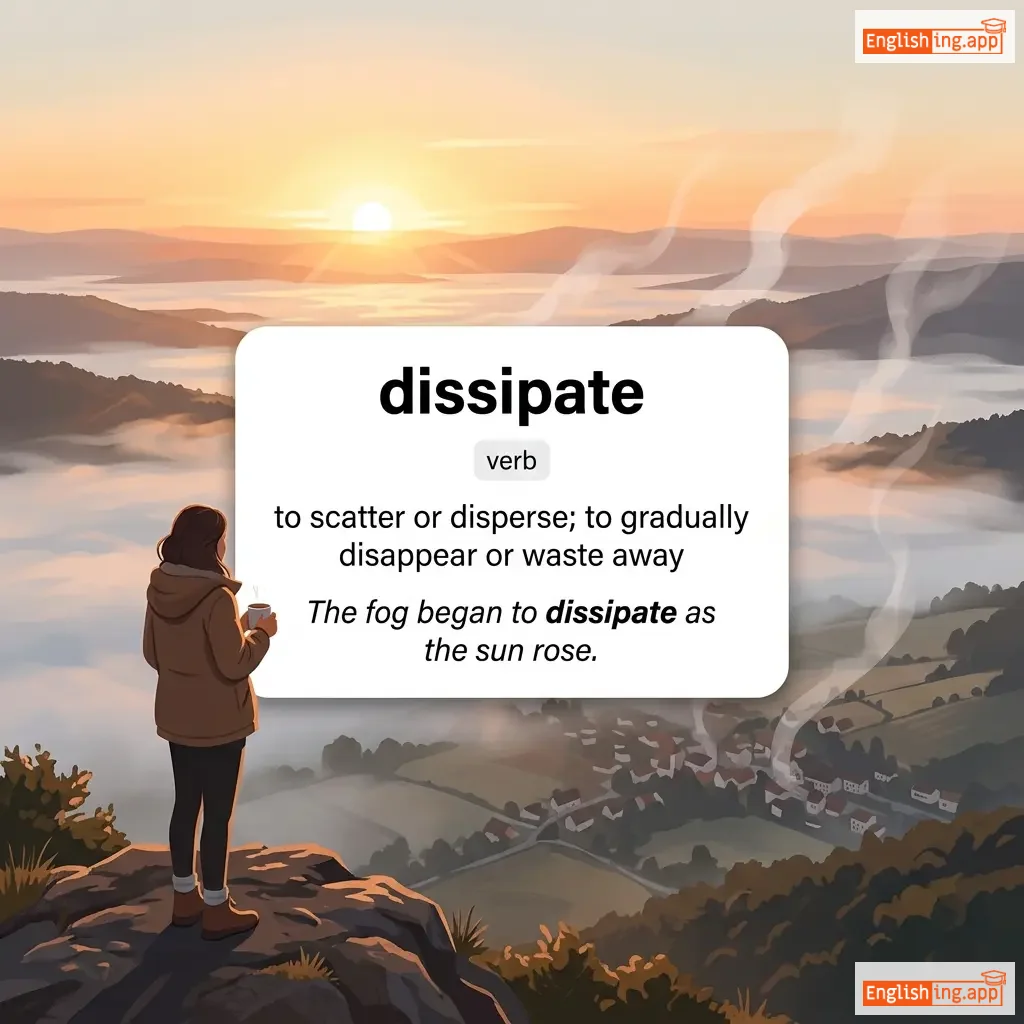
dissipate definition card — visual illustration of the meaning
verb
/ˈdɪsɪpeɪt/
विलीन होना (vileen hona)

to scatter or disperse; to gradually disappear or waste away

"The fog began to dissipate as the sun rose."

"धुंध सूर्य उगते ही विलीन होने लगी।" (dhund sury ugte hi vileen hone lagi.)
noun
/ˌdɪsɪˈpeɪʃən/
विलासिता (vilaasita)

the process of disappearing or wasting; excessive indulgence in pleasure

"The dissipation of his fortune left him in poverty."

"उसकी संपत्ति का नाश उसे गरीबी में छोड़ गया।" (Uski sampatti ka naash use gareebi mein chhod gaya.)
adjective
/ˈdɪsəluːt/
दुराचारपूर्ण (duracharpurn)

lacking moral restraint; indulging excessively in sensual pleasures

"He led a dissolute life filled with parties and gambling."

"उसने पार्टियों और जुआ खेलने से भरा एक दुराचारपूर्ण जीवन जिया।" (Usne partiyon aur jua khelne se bhara ek duracharpurn jeevan jiya.)
dissolution definition card — visual illustration of the meaning
noun
/ˌdɪsəˈluːʃən/
विघटन (vighatan)

the act of formally ending or breaking apart something, such as an organization or marriage

"The dissolution of the company was announced yesterday."

"कंपनी का विघटन कल घोषित किया गया था।" (Kampani ka vighatan kal ghoshit kiya gaya tha.)
verb
/dɪˈzɒlv/
घुलना (ghulna)

to melt or become liquid; to officially end or break up an agreement or organization

"The sugar will dissolve quickly in hot tea."

"चीनी गर्म चाय में जल्दी घुल जाएगी।" (Cheeni garm chai mein jaldi ghul jayegi.)
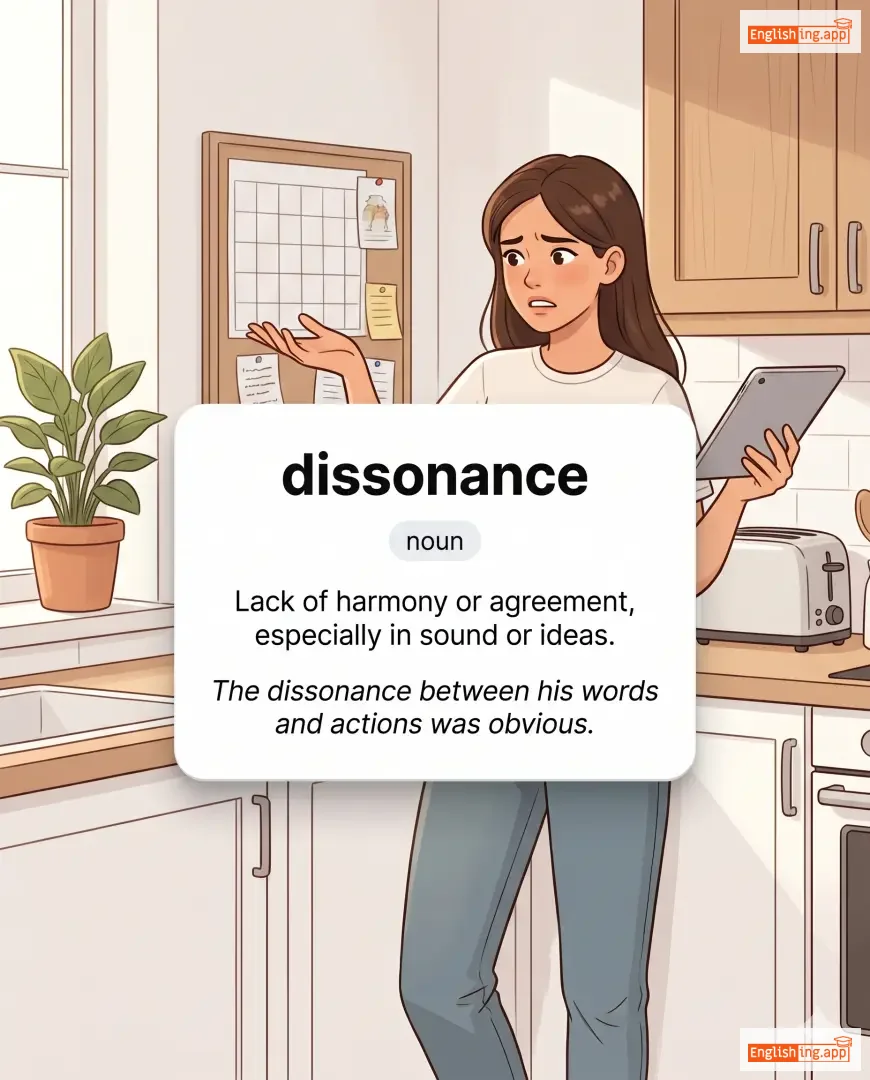
dissonance definition card — visual illustration of the meaning
noun
/ˈdɪsənəns/
असंगति (asangati)

Lack of harmony or agreement, especially in sound or ideas.

"The dissonance between his words and actions was obvious."

"उसके शब्दों और क्रियाओं के बीच असंगति स्पष्ट थी।" (uske shabdon aur kriyaon ke beech asangati spasht thi.)
adjective
/ˈdɪsənənt/
द्विविध, अप्रसंगिक (dvividh, aprasangik)

Harsh and lacking harmony; conflicting.

"The orchestra produced a dissonant sound during rehearsal."

"ऑर्केस्ट्रा ने रिहर्सल के दौरान एक अप्रसंगिक ध्वनि उत्पन्न की।" (orchestra ne rehearsal ke dauran ek aprasangik dhvani utpann ki.)
verb
/dɪˈsweɪd/
विरुद्ध मनाना, निरुत्साहित करना (viruddh manana, nirutsahit karna)

To persuade someone not to do something.

"She tried to dissuade him from quitting his job."

"उसने उसे अपनी नौकरी छोड़ने से निरुत्साहित करने की कोशिश की।" (usne use apni naukri chhodne se nirutsahit karne ki koshish ki.)
noun
/dɪˈsweɪʒən/
निरुत्साहन (nirutsahan)

The act of persuading someone not to take a course of action.

"Her dissuasion prevented him from making a bad investment."

"उसका निरुत्साहन उसे गलत निवेश करने से रोकता था।" (uska nirutsahan use galat nivesh karne se rokta tha.)
noun/adjective
/ˈdɪstæf/
महिला से संबंधित, मातृकुल (mahila se sambandhit, matrikul)

Relating to women or the maternal side of a family; also a tool for spinning thread.

"She came from the distaff side of a noble family."

"वह एक प्रतिष्ठित परिवार के मातृकुल से आई थी।" (vah ek pratishthit parivar ke matrikul se aayi thi.)
verb
/dɪsˈteɪn/
अवज्ञा करना (avignya karna)

to treat with scorn or contempt (archaic form of disdain)

"He would never distain those who had less fortune than him."

"वह कभी भी उन लोगों को अवज्ञा नहीं करता था जिनके पास उससे कम भाग्य था।" (Vah kabhi bhi un logon ko avignya nahin karta tha jinke paas usse kam bhagya tha.)
adjective
/ˈdɪstəl/
दूरस्थ (doorsath)

situated away from the center of the body or from the point of attachment

"The doctor examined the distal end of the patient’s arm."

"डॉक्टर ने रोगी के हाथ के दूरस्थ हिस्से की जांच की।" (Doktar ne rogi ke haath ke doorsth hisse ki jaanch ki.)
noun
/ˈdɪstəns/
दूरी (doori)

The amount of space between two points or places.

"The distance between Dhaka and Chittagong is about 250 kilometers."

"ढाका और चिटगाँव के बीच की दूरी लगभग २५० किलोमीटर है।" (Dhaka aur Chittagong ke beech ki doori lagbhag 250 kilometer hai.)
adjective
/ˈdɪstənt/
दूर (dur)

far away in space or time

"They could see the distant mountains from their home."

"वे अपने घर से दूर पहाड़ों को देख सकते थे।" (Ve apne ghar se door pahadon ko dekh sakte the.)
noun
/dɪsˈtɛmpər/
कुत्तों में होने वाली एक वायरल बीमारी (kutton mein hone wali ek viral bimari)

a viral disease affecting animals, especially dogs; also refers to a state of disorder

"The dog was diagnosed with distemper and needed immediate care."

"कुत्ते को डिस्टेंपर का निदान हुआ और उसे तुरंत देखभाल की आवश्यकता थी।" (Kutte ko distemper ka nidan hua aur use turant dekhbhaal ki avashyakta thi.)
distend definition card — visual illustration of the meaning
verb
/dɪsˈtɛnd/
फूलना (phoolna)

to swell or expand by pressure from within

"Her stomach began to distend after the large meal."

"उसका पेट बड़ा खाने के बाद डिस्टेंड होने लगा।" (Uska pet bada khane ke baad distend hone laga.)
adjective
/dɪˈstɛnsəbl̩/
विस्तारीकरणीय (vistarikaranīya)

Capable of being stretched or expanded.

"The stomach is a distensible organ that can expand after eating."

"पेट एक विस्तारीकरणीय अंग है जो खाने के बाद फैल सकता है।" (Pet ek vistarikaranīya ang hai jo khane ke baad phail sakta hai.)
noun
/dɪˈstɛnʃən/
सूजन (sujan)

The state of being swollen due to internal pressure.

"The patient complained of abdominal pain and distention."

"रोगी ने पेट दर्द और सूजन की शिकायत की।" (Rogi ne pet dard aur sujan ki shikayat ki.)
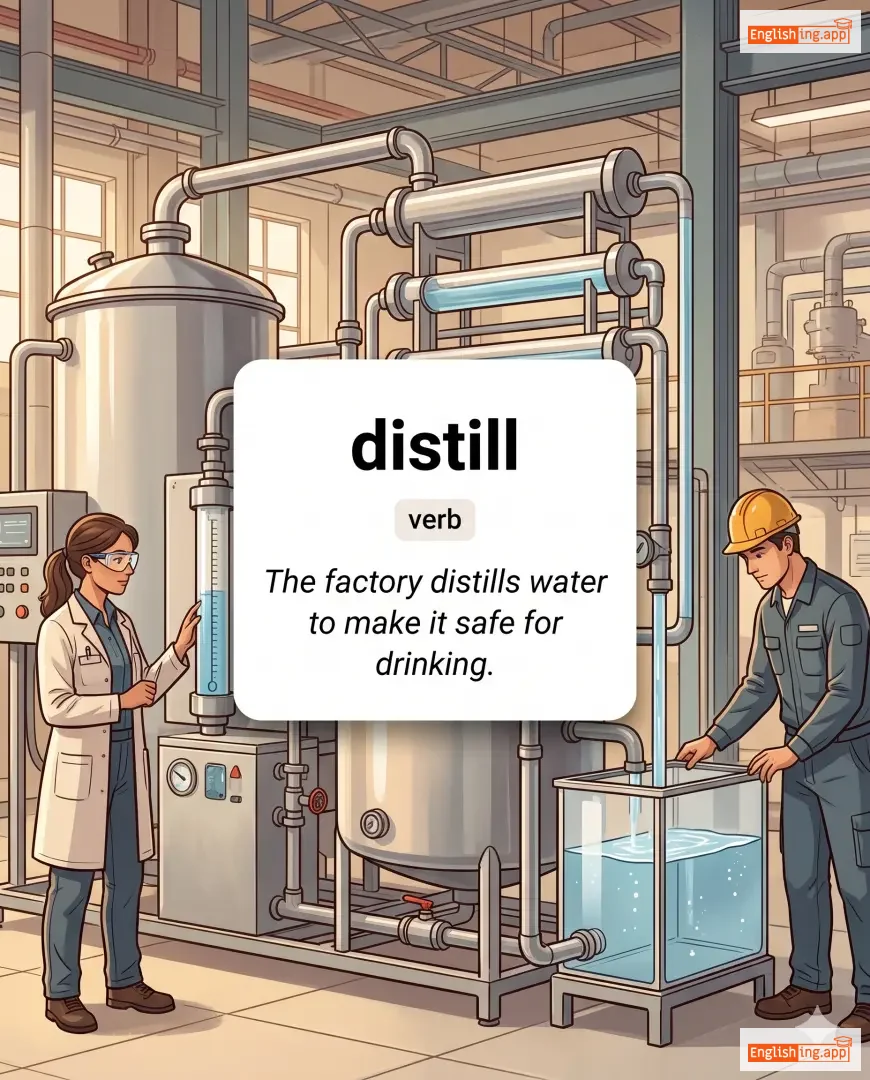
distill definition card — visual illustration of the meaning
verb
/dɪˈstɪl/
शुद्ध करना (shuddh karna)

To purify a liquid by heating and cooling; to extract the essential meaning or most important aspects.

"The factory distills water to make it safe for drinking."

"फैक्ट्री पानी को शुद्ध करने के लिए डिस्टिल करती है।" (Fakti paani ko shuddh karne ke liye distil karti hai.)
noun
/ˌdɪstɪˈleɪʃən/
सिद्धीकरण (siddhikaran)

The process of purifying a liquid by heating and cooling; the extraction of the essential meaning.

"Distillation is commonly used to produce alcoholic beverages."

"डिस्टिलेशन का सामान्यत: शराब बनाने में उपयोग किया जाता है।" (Distillation ka samanyata: sharab banane mein upyog kiya jata hai.)
noun
/dɪˈstɪlər/
डिस्टिलर (distiller)

A person or company that makes alcoholic drinks or purified liquids by distillation.

"The distiller introduced a new brand of whiskey last year."

"डिस्टिलर ने पिछले साल एक नया व्हिस्की ब्रांड पेश किया।" (Distiller ne pichle saal ek naya whisky brand pesh kiya.)
adjective
/dɪˈstɪŋkt/
विशिष्ट (vishisht)

clearly different or separate from others of its kind

"The twins have distinct personalities."

"जुड़वां बच्चों की विशिष्ट व्यक्तित्व हैं।" (Judwa bachon ki vishisht vyaktitva hain.)
noun
/dɪˈstɪŋkʃən/
अंतर (distinkshan)

a difference or contrast between similar things or people; excellence that sets someone apart

"She graduated with distinction from the university."

"उसने विश्वविद्यालय से उच्च सम्मान के साथ स्नातक किया।" (Usne vishvavidyalay se uchch samman ke saath snatak kiya.)
adjective
/dɪˈstɪŋktɪv/
विशिष्ट (vishisht)

having a quality or characteristic that makes something different and easily noticed

"The restaurant is known for its distinctive flavors."

"रेस्तरां को उसके विशिष्ट स्वाद के लिए जाना जाता है।" (Restara ko uske vishisht swad ke liye jana jata hai.)
verb
/dɪˈstɪŋɡwɪʃ/
अंतर करना (antar karna)

to recognize or show the differences between two or more things; to set apart as different

"It can be difficult to distinguish between truth and rumor."

"यह सत्य और अफवाह के बीच अंतर करना मुश्किल हो सकता है।" (Yeh satya aur afwah ke beech antar karna mushkil ho sakta hai.)
adjective
/dɪˈstɪŋɡwɪʃt/
प्रसिद्ध; सम्मानित; प्रतिष्ठित; (prasiddh; sammaanit; pratishthit)

notable; honored; famous; having a dignified appearance or manner

"He is a distinguished professor at the university."

"वह विश्वविद्यालय में एक प्रतिष्ठित प्रोफेसर हैं।" (vah vishwavidyalay mein ek pratishthit professor hain)
verb
/dɪˈstɔːrt/
विकृत करना (vikrit karna)

to twist or change the shape, appearance, or meaning of something so it is not true or accurate

"The mirror distorted her reflection."

"आइना ने उसकी परछाई को विकृत कर दिया।" (Aina ne uski parchhai ko vikrit kar diya.)
noun
/dɪˈstɔːrʃən/
विकृति, गलत प्रस्तुति (vikriti, galat prastuti)

the action of twisting, changing, or misrepresenting the shape, sound, or truth of something

"There was a distortion in the radio signal."

"रेडियो सिग्नल में एक विकृति थी।" (Radio signal mein ek vikriti thi.)
verb
/dɪˈstrækt/
ध्यान भंग करना (dhyan bhang karna)

to take someone's attention away from what they are doing or focusing on

"The loud noise distracted her during the exam."

"तेज शोर ने परीक्षा के दौरान उसका ध्यान भंग कर दिया।" (Tez shor ne pariksha ke dauran uska dhyan bhang kar diya.)
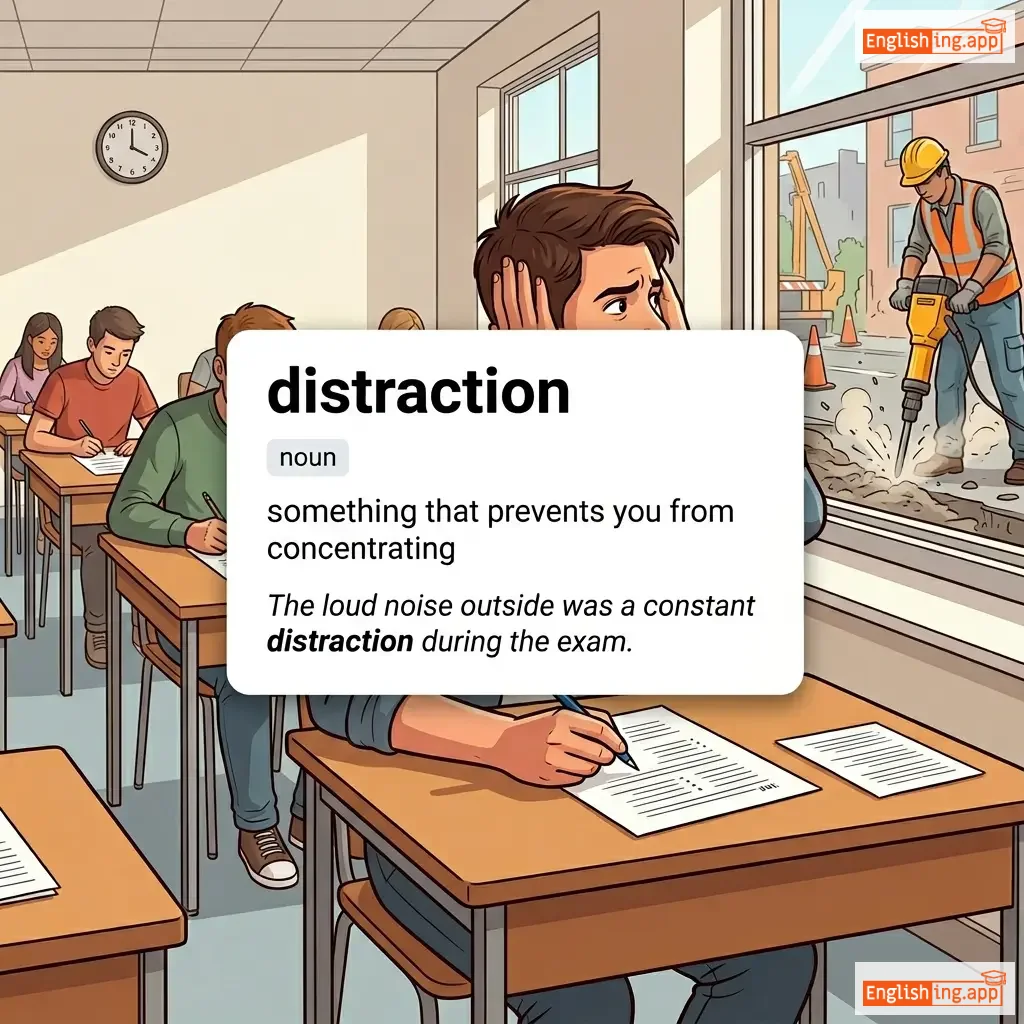
distraction definition card — visual illustration of the meaning
noun
/dɪˈstrækʃən/
विघटन (vighatan)

something that prevents you from concentrating

"The loud noise outside was a constant distraction during the exam."

"बाहर का जोरदार शोर परीक्षा के दौरान निरंतर विघटन का कारण था।" (Baahar ka jordaar shor pariksha ke dauran nirantar vighatan ka kaaran tha.)
distractions definition card — visual illustration of the meaning
noun
/dɪˈstrækʃənz/
विक्षेप (viksep)

Things that prevent someone from concentrating on something else.

"Eliminate distractions for better productivity."

"बेहतर उत्पादकता के लिए विकर्षणों को समाप्त करें।" (Behtar utpadakta ke liye vikrishnon ko samaapt karein.)
verb
/dɪˈstreɪn/
संपत्ति ज़ब्त करना (sampatti zabt karna)

to seize someone's property in order to obtain payment of rent or other money owed

"The landlord distrained the tenant's furniture for unpaid rent."

"मालिक ने किराए के लिए बकाया न होने पर किरायेदार का सामान ज़ब्त कर लिया।" (Malik ne kiraye ke liye bakaya na hone par kirayedaar ka samaan zabt kar liya.)
noun
/dɪˈstreɪnər/
संपत्ति जब्त करनेवाला (sampatti zabt karnewala)

a person, usually a landlord, who seizes another's property for unpaid debt or rent

"The distrainor took possession of the tenant's car until the debt was cleared."

"डिस्ट्रेइनर ने किरायेदार की कार कब्जे में ले ली जब तक कि कर्ज़ चुकता नहीं हो गया।" (Distrainor ne kirayedar ki car kabje mein le li jab tak ki karz chukta nahi ho gaya.)
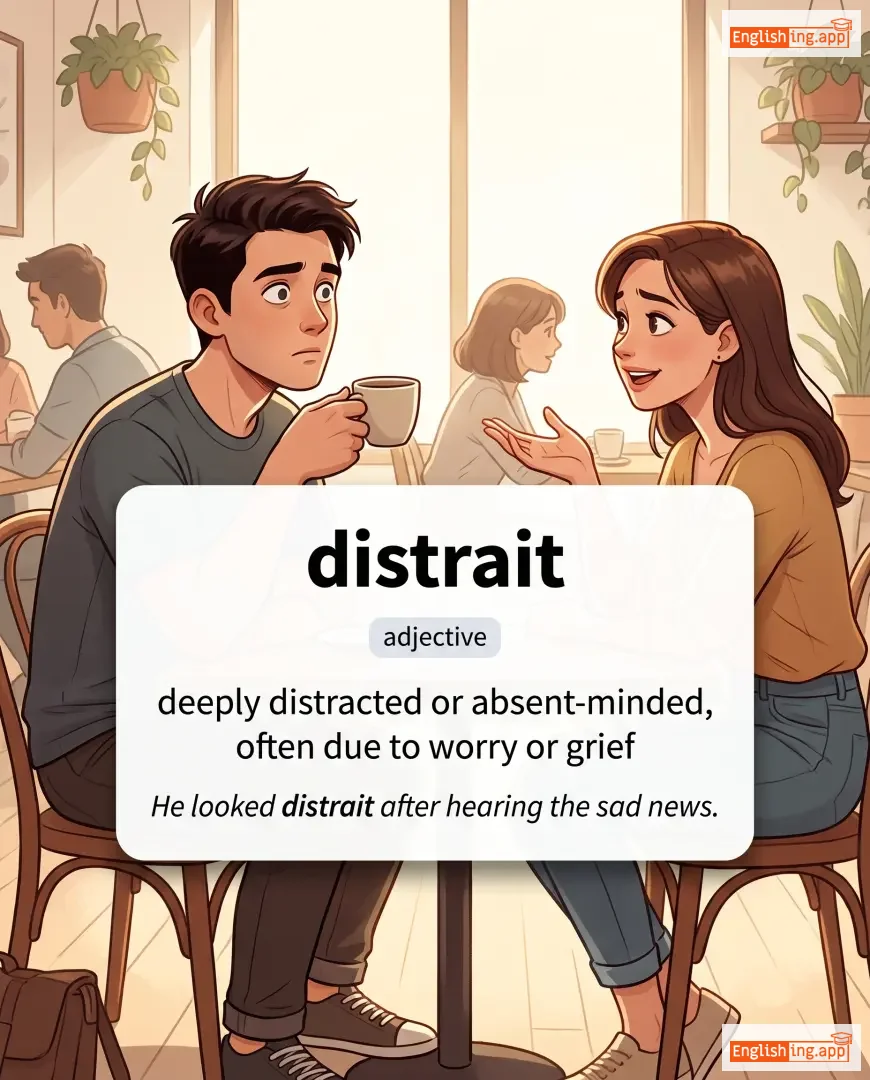
distrait definition card — visual illustration of the meaning
adjective
/dɪˈstreɪ/
विक्षिप्त (vikshipt)

deeply distracted or absent-minded, often due to worry or grief

"He looked distrait after hearing the sad news."

"उदास खबर सुनने के बाद वह विक्षिप्त लग रहा था।" (Udaas khabar sunne ke baad vah vikshipt lag raha tha.)