वोकैबुलरीज

इंग्लिश वोकैबुलरी डिस्कवर, लर्न और मास्टर करें

verb
/ˌdɪfəˈrɛnʃieɪt/
अंतर करना (antar karna)

To recognize or make a distinction between things.

"It is important to differentiate between fact and opinion."

"यह महत्वपूर्ण है कि तथ्य और राय के बीच अंतर किया जाए।" (Yah mahatvapurn hai ki tathya aur rai ke beech antar kiya jaye.)
differentiation definition card — visual illustration of the meaning
noun
/ˌdɪf.ə.ren.ʃiˈeɪ.ʃən/
विभेदन, अंतर, भेदभाव (vibhedan, antar, bhedbhav)

The action or process of differentiating or distinguishing between two or more things or people.

"Strong differentiation sets brands apart from competitors."

"स्ट्रॉन्ग डिफ़ेरेंशिएशन ब्रांड्स को प्रतियोगियों से अलग करता है।" (Strong differentiation brands ko pratijogiyon se alag karta hai.)
adverb
/ˈdɪfərəntli/
अलग तरह से (alag tarah se)

in a way that is not the same as another or as expected

"She approached the problem differently than her colleagues."

"उसने अपने सहकर्मियों से अलग तरीके से समस्या का समाधान किया।" (Usne apne sahkarmiyon se alag tareeke se samasya ka samadhan kiya.)
difficult definition card — visual illustration of the meaning
adjective
/ˈdɪf.ɪ.kəlt/
कठिन (kathin)

Needing much effort or skill to do or understand.

"The exam was so difficult that many students failed."

"परीक्षा इतनी कठिन थी कि कई छात्रों ने असफलता पाई।" (Pariksha itni kathin thi ki kai chhatron ne asafalta payi.)
noun
/ˈdɪfɪkəlti/

the state or condition of being hard to do, deal with, or understand

"He faced great difficulty in learning a new language."

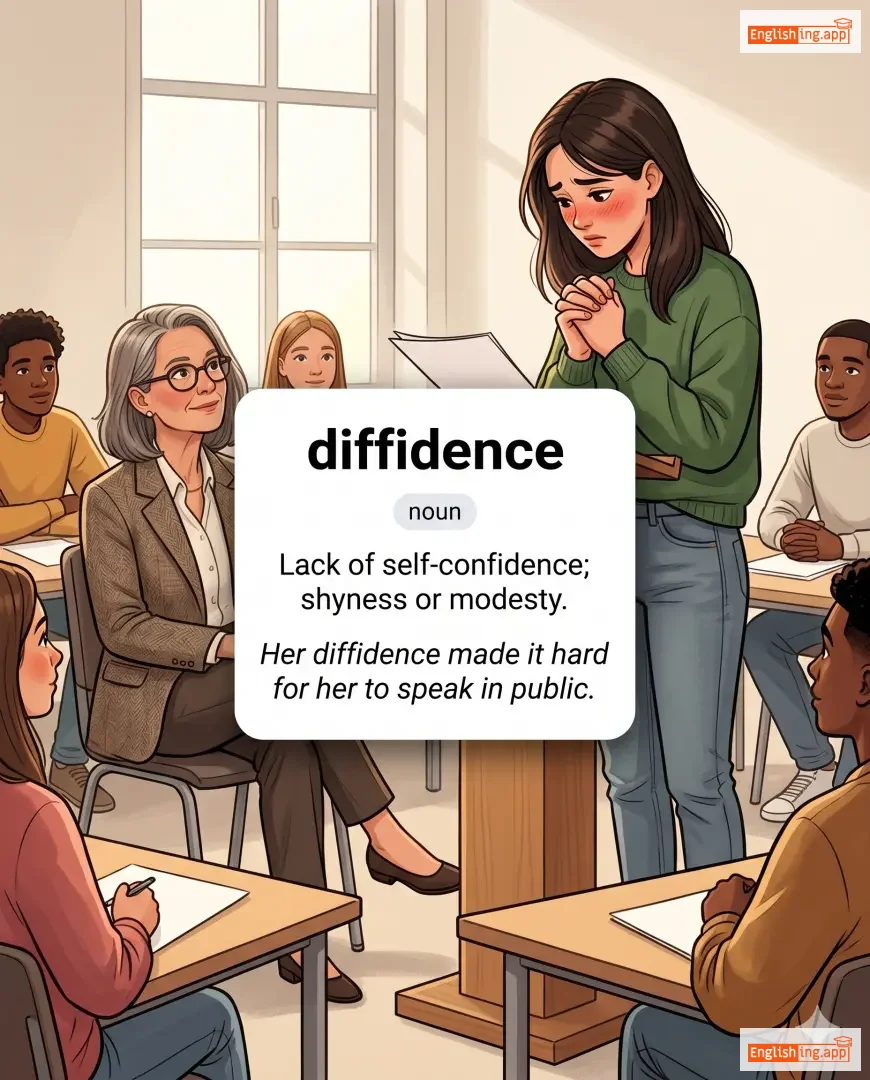
diffidence definition card — visual illustration of the meaning
noun
/ˈdɪfɪdəns/
आत्मविश्वास की कमी (atmavishwas ki kami)

Lack of self-confidence; shyness or modesty.

"Her diffidence made it hard for her to speak in public."

"उसकी आत्मविश्वास की कमी ने उसे सार्वजनिक रूप से बोलने में कठिनाई दी।" (Uski atmavishwas ki kami ne use sarvajanik roop se bolne mein kathinai di.)
adjective
/ˈdɪfɪdənt/
शर्मीला (difident)

Shy or lacking confidence in one's own abilities.

"He was too diffident to ask a question in class."

"वह कक्षा में एक सवाल पूछने से बहुत शर्मीला था।" (vah kaksha mein ek sawaal poochhne se bahut sharmila tha.)
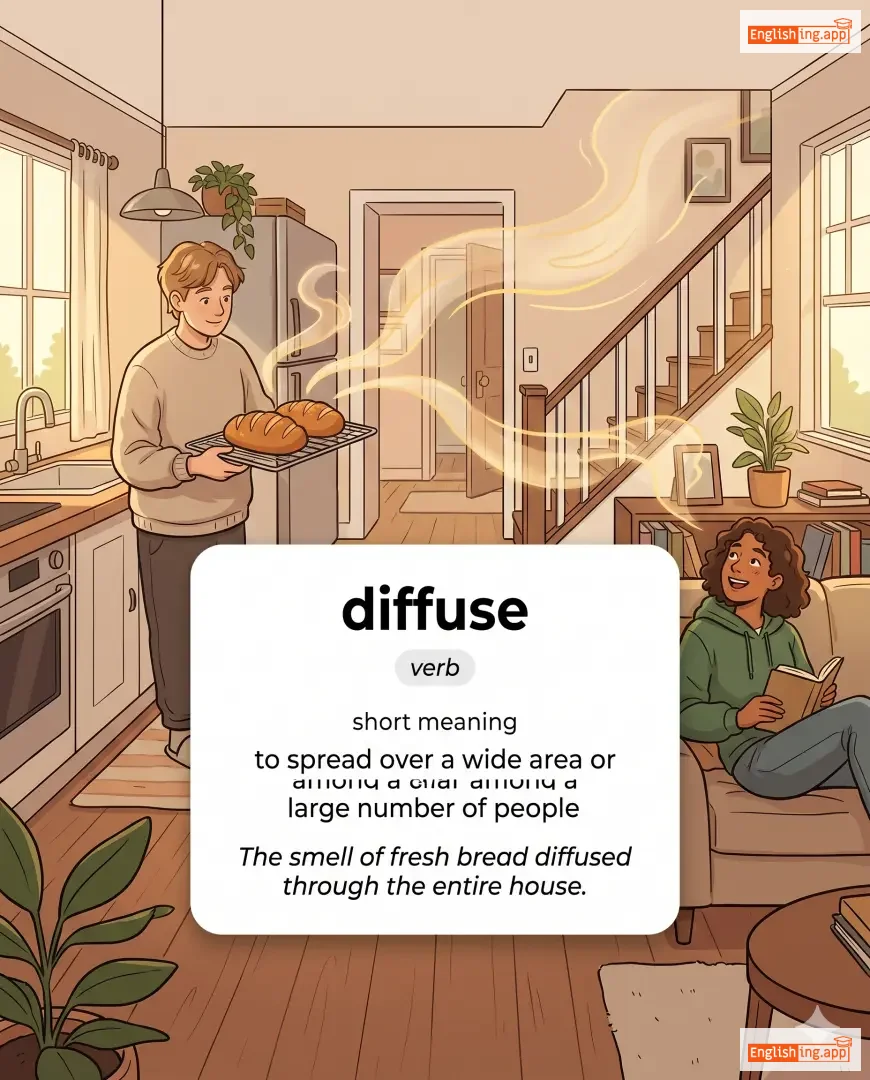
diffuse definition card — visual illustration of the meaning
verb
/dɪˈfjuːz/
व्याप्त करना (vyaapt karna)

to spread over a wide area or among a large number of people

"The smell of fresh bread diffused through the entire house."

"ताजे ब्रेड की खुशबू पूरे घर में फैल गई।" (Taje bread ki khushboo poore ghar mein phail gayi.)
adjective
/dɪˈfjuːzəbl/
विस्तार योग्य (vistaar yogya)

able to spread or be spread through a medium

"Oxygen is diffusible through cell membranes."

"ऑक्सीजन कोशिका झिल्ली के माध्यम से फैल सकता है।" (Oxygen koshika jhilli ke maadhyam se phail sakta hai.)
noun
/dɪˈfjuːʒən/
प्रसार (difiyujan)

the spreading of something more widely or the movement of particles from high to low concentration

"The diffusion of information on social media is rapid."

"सोशल मीडिया पर जानकारी का प्रसार तेज है." (social media par jaankari ka prasar tez hai)
verb
/dɪɡ/
खोदना (khodna)

to break up and move earth with a tool or machine, or with hands, paws, etc.

"They decided to dig a hole for the new tree."

"उन्होंने नए पेड़ के लिए एक गड्ढा खोदने का निर्णय लिया।" (Unhone naye ped ke liye ek gaddha khodne ka nirnay liya.)
digest definition card — visual illustration of the meaning
verb
/daɪˈdʒest/
पाचन करना (pachan karna)

to break down food in the body; to think about and understand

"It takes time to digest a heavy meal."

"यह एक भारी भोजन को पचाने के लिए समय लेता है।" (Yeh ek bhari bhojan ko pachane ke liye samay leta hai.)
digestive definition card — visual illustration of the meaning
adjective
daɪˈdʒes.tɪv
पाचन संबंधी (paachan sambandhi)

Relating to the digestion of food.

"Digestive enzymes help break down food."

"पाचन एंजाइम भोजन को तोड़ने में मदद करते हैं।" (Paachan enzymes bhojan ko todne mein madad karte hain.)
noun
/ˈdɪdʒɪt/
अंक (dijit)

a numeral from 0 to 9; also a finger or toe

"You must enter a four-digit code to unlock the phone."

"फोन को अनलॉक करने के लिए आपको चार अंकों का कोड दर्ज करना होगा।" (phone ko anlaak karne ke liye aapko chaar ankon ka kod darj karna hoga)
digital definition card — visual illustration of the meaning
adjective
/ˈdɪdʒɪtl/
डिजिटल (digital)

relating to technology that uses signals or data in the form of numbers (0s and 1s)

"She prefers digital books over printed ones."

"वह मुद्रित पुस्तकों के मुकाबले डिजिटल पुस्तकें पसंद करती है।" (Wah mudrit pustakon ke mukable digital pustakein pasand karti hai.)
digital detox definition card — visual illustration of the meaning
noun
/ˈdɪdʒɪtl ˈdɛtɒks/
डिजिटल डिटॉक्स (digital detox)

A period of time during which a person refrains from using electronic devices such as smartphones or computers, regarded as an opportunity to reduce stress or focus on social interaction in the physical world.

"A digital detox can help improve mental clarity and reduce stress."

"डिजिटल डिटॉक्स मानसिक स्पष्टता में सुधार और तनाव को कम करने में मदद कर सकता है।" (Digital detox mansik spashthata mein sudhaar aur tanav ko kam karne mein madad kar sakta hai.)
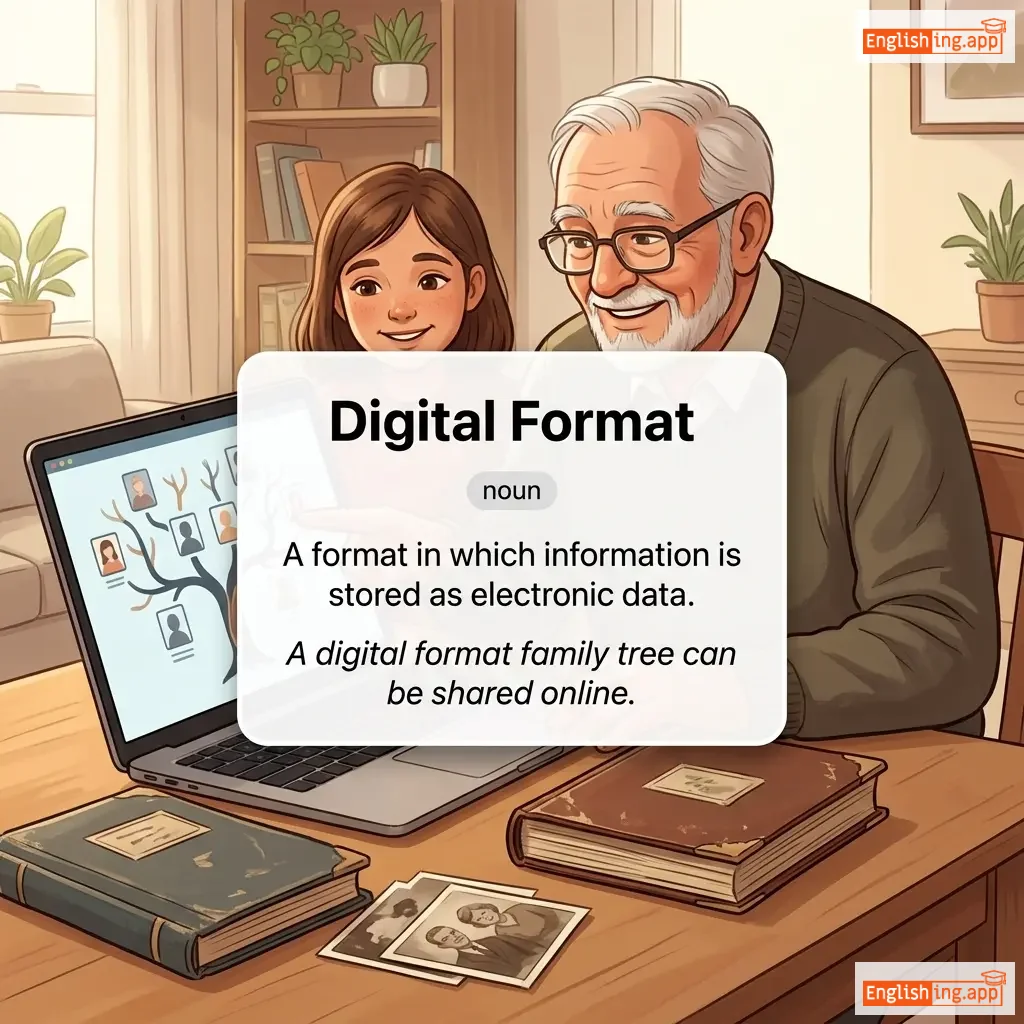
Digital Format definition card — visual illustration of the meaning
noun
ˈdɪdʒɪtəl ˈfɔːrmæt
डिजिटल प्रारूप (digital praaroop)

A format in which information is stored as electronic data.

"A digital format family tree can be shared online."

"एक डिजिटल प्रारूप पारिवारिक वृक्ष को ऑनलाइन साझा किया जा सकता है।" (Ek digital praaroop parivaarik vriksh ko online saajha kiya ja sakta hai.)
digital tools definition card — visual illustration of the meaning
noun
ˈdɪdʒ.ɪ.təl tuːlz
डिजिटल टूल्स (digital tools)

Electronic software and applications used for learning and educational purposes.

"Schools are integrating digital tools to enhance learning."

"स्कूल डिजिटल टूल्स को सीखने को बढ़ावा देने के लिए एकीकृत कर रहे हैं।" (School digital tools ko seekhne ko badhawa dene ke liye ekeekrit kar rahe hain.)
noun
/ˈdɪɡnɪˌtɛri/
महत्वपूर्ण व्यक्ति (mahatvapoorn vyakti)

a person considered to be important because of high rank or office

"Several foreign dignitaries attended the state banquet."

"कई विदेशी गणमान्य व्यक्तियों ने राज्य भोज में भाग लिया।" (Kai videshi ganmanaya vyaktiyon ne rajya bhoj mein bhag liya.)
noun
/ˈdɪɡnəti/
गरिमा (garima)

the state or quality of being worthy of respect or honor

"He faced the difficult situation with calm and dignity."

"उसने कठिन स्थिति का सामना शांति और गरिमा के साथ किया।" (Usne kathin sthiti ka saamna shaanti aur garima ke saath kiya.)
noun
/ˈdaɪɡræf/
डाइग्राफ (daigraf)

A pair of letters representing a single sound, such as 'sh' in 'ship'.

"In the word 'phone', the letters 'ph' form a digraph."

"'फोन' शब्द में 'फ' अक्षर एक डाइग्राफ बनाता है।" ('phone' shabd mein 'ph' akshar ek daigraf banata hai.)
verb
/daɪˈɡrɛs/
मुख्य विषय से भटकना (mukhya vishay se bhatakhna)

To leave the main subject temporarily in speech or writing.

"The professor began to digress from the main topic of the lecture."

"प्रोफेसर ने व्याख्यान के मुख्य विषय से भटकना शुरू किया।" (Professor ne vyakhyan ke mukhya vishay se bhatakhna shuru kiya.)
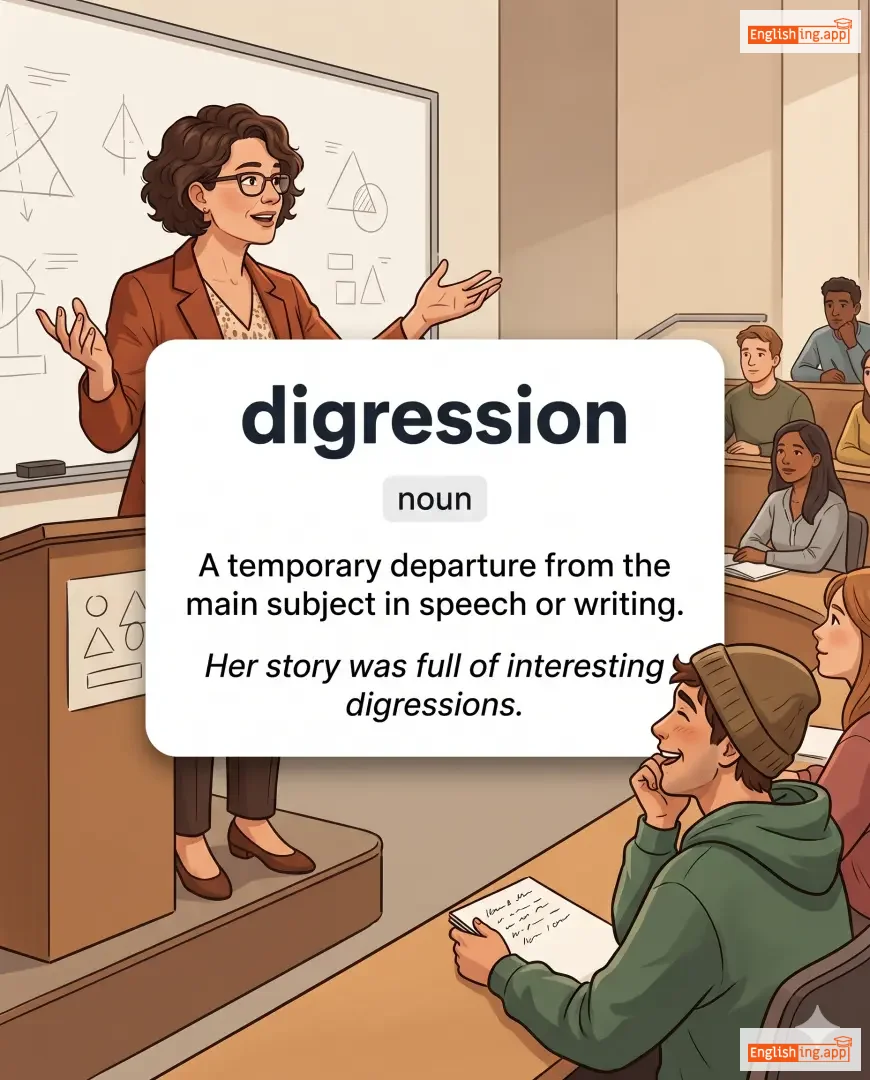
digression definition card — visual illustration of the meaning
noun
/daɪˈɡrɛʃən/
विषय से विचलन (vishay se vichalan)

A temporary departure from the main subject in speech or writing.

"Her story was full of interesting digressions."

"उसकी कहानी दिलचस्प विषयों से भरी हुई थी।" (Uski kahani dilchasp vishayon se bhari hui thi.)
adjective
/daɪˈɡrɛsɪv/
मुख्य विषय से हटने की प्रवृत्ति (mukhya vishay se hatne ki pravritti)

Tending to depart from the main subject in speech or writing.

"The speaker's digressive style made the lecture difficult to follow."

"वक्ता की डिग्रेसिव शैली ने व्याख्यान को समझना मुश्किल बना दिया।" (Vakta ki digressive shaili ne vyakhyan ko samajhna mushkil bana diya.)
verb
/dɪˈlæpɪdeɪt/
ध्वंस करना (dhwans karna)

To cause something, especially a building, to fall into ruin or disrepair.

"The abandoned house began to dilapidate over the years."

"परित्यक्त घर वर्षों के दौरान बर्बाद होने लगा।" (Parityakt ghar varshon ke dauran barbadd hone laga.)
adjective
/dɪˈlæpɪˌdeɪtɪd/
जीर्ण-शीर्ण (jeern-shirn)

Fallen into disrepair or ruin due to neglect or age.

"The family lived in a dilapidated house at the edge of town."

"परिवार शहर के किनारे एक जीर्ण-शीर्ण घर में रहता था।" (Parivaar sheher ke kinare ek jeern-shirn ghar mein rehta tha.)
noun
/dɪˌlæpɪˈdeɪʃən/
ध्वंसावस्था (dhwansavastha)

The state of disrepair or ruin as a result of neglect.

"The old temple was in a state of dilapidation."

"पुराना मंदिर ध्वंसावस्था में था।" (Purana mandir dhwansavastha mein tha.)
verb
/daɪˈleɪt/
विस्तृत करना (vistarit karna)

To make wider, larger, or more open.

"The doctor used drops to dilate the patient's pupils."

"डॉक्टर ने मरीज की पुतलियों को फैलाने के लिए दवाइयाँ इस्तेमाल कीं।" (Doktar ne mareez ki putliyon ko phailane ke liye davaiyan istemal ki.)
adjective
/ˈdɪlətɔːri/
सुस्तीपूर्ण (sustipoorn)

Tending to cause delay; slow to act.

"The committee was criticized for its dilatory response to the crisis."

"समिति को संकट के प्रति उसकी सुस्तीपूर्ण प्रतिक्रिया के लिए आलोचना की गई थी।" (Samiti ko sankat ke prati uski sustipoorn pratikriya ke liye alochana ki gayi thi.)
dilemma definition card — visual illustration of the meaning
noun
/daɪˈlɛmə/
दुविधा (duvidha)

A situation in which a difficult choice has to be made between two or more alternatives.

"She faced a dilemma about whether to accept the job offer or continue her studies."

"वह नौकरी के प्रस्ताव को स्वीकार करने या अपनी पढ़ाई जारी रखने के बारे में एक दुविधा का सामना कर रही थी।" (Vah naukari ke prastav ko sviikar karne ya apni padhai jari rakhne ke baare mein ek duvidha ka samna kar rahi thi.)
noun
/ˌdɪləˈtænt/
शौकिन (shaukin)

A person who takes up an art, activity, or subject merely for amusement, especially in a superficial way.

"He was dismissed as a dilettante in the art world because he lacked formal training."

"उसे कला की दुनिया में एक शौकिन के रूप में खारिज कर दिया गया क्योंकि उसके पास औपचारिक प्रशिक्षण नहीं था।" (Use kala ki duniya mein ek shaukin ke roop mein kharij kar diya gaya kyonki uske paas aupchaarik prashikshan nahi tha.)
diligence definition card — visual illustration of the meaning
noun
/ˈdɪlɪdʒəns/
परिश्रम (parishram)

Careful and persistent work or effort.

"Through diligence and determination, she completed her research on time."

"परिश्रम और संकल्प के माध्यम से, उसने अपना शोध समय पर पूरा किया।" (Parishram aur sankalp ke madhyam se, usne apna shodh samay par poora kiya.)
adjective
/ˈdɪlɪdʒənt/
परिश्रमी (parishrami)

Showing care and conscientiousness in one's work or duties.

"She is a diligent student who always finishes her assignments on time."

"वह एक परिश्रमी छात्रा है जो हमेशा अपने असाइनमेंट समय पर पूरा करती है।" (Wah ek parishrami chatra hai jo hamesha apne assignment samay par poora karti hai.)
verb
/daɪˈluːt/
पतला करना (patla karna)

To make a liquid thinner or weaker by adding water or another solvent.

"You should dilute the juice with water before serving it to children."

"आपको बच्चों को सर्व करने से पहले जूस को पानी से पतला करना चाहिए।" (Aapko bachon ko serve karne se pehle juice ko pani se patla karna chahiye.)
adjective
/dɪm/
मद्धम (madhyam)

not bright; having little light; not clearly visible

"The room was dim because the curtains were closed."

"कमरे में मंद रोशनी थी क्योंकि पर्दे बंद थे।" (kamre mein mand roshni thi kyonki parde band the.)
noun
/daɪm/
दस सेंट का सिक्का (das sent ka sikka)

a small coin, especially a U.S. coin worth ten cents

"He gave me a dime for the phone call."

"उसने मुझे फोन कॉल के लिए एक डाइम दी।" (Usne mujhe phone call ke liye ek dime di.)
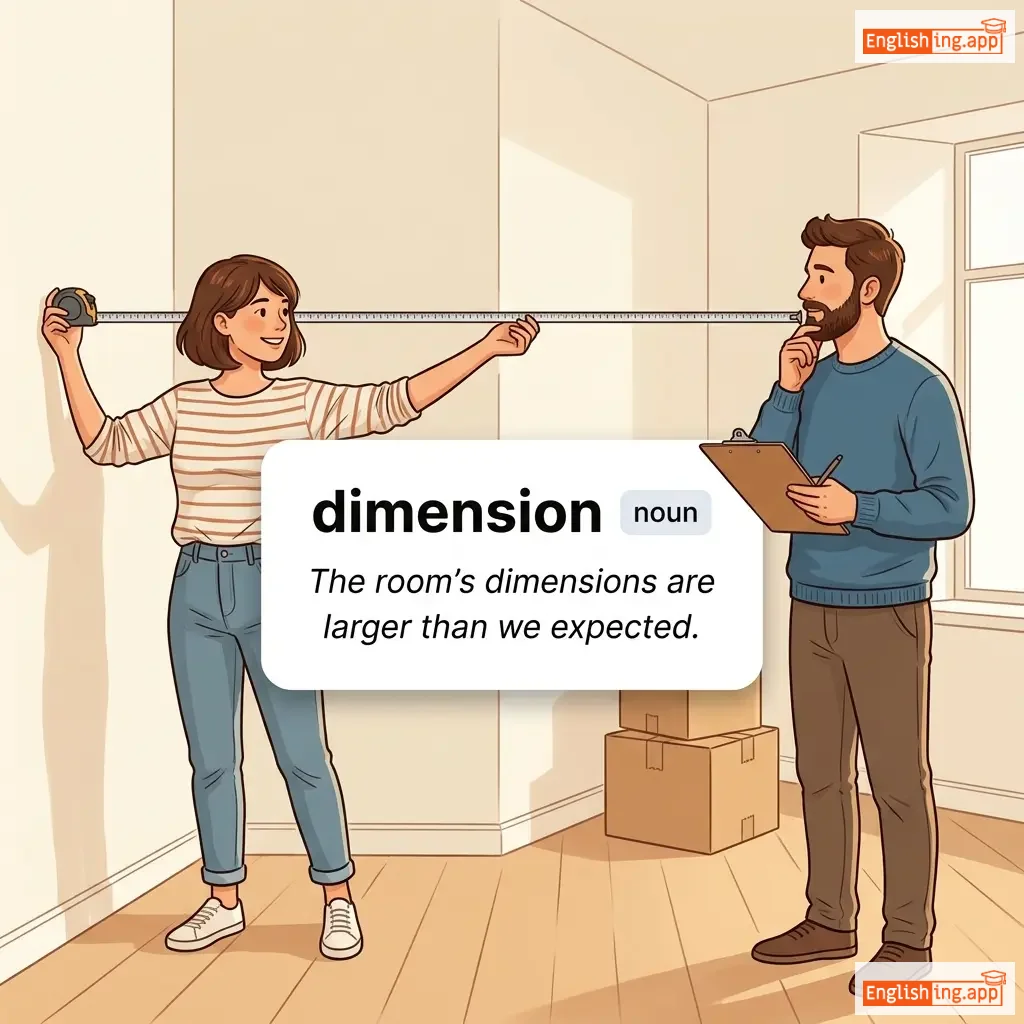
dimension definition card — visual illustration of the meaning
noun
/dɪˈmɛnʃən/
आयाम (ayam)

A measurable extent of a particular kind, such as length, breadth, depth, or height.

"The room’s dimensions are larger than we expected."

"कमरे का आकार हमारे अपेक्षा से बड़ा है।" (Kamre ka aakar hamare apeksha se bada hai.)
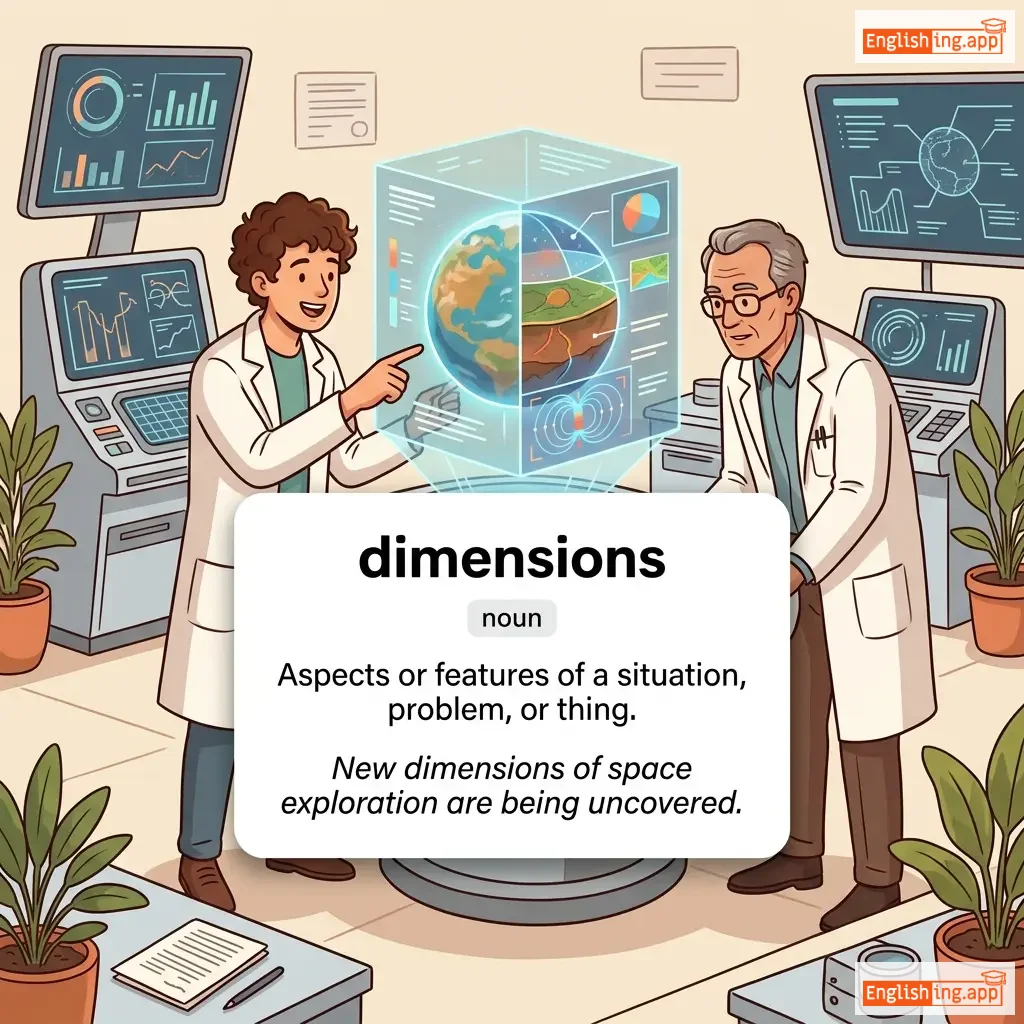
dimensions definition card — visual illustration of the meaning
noun
/daɪˈmen.ʃənz/
आयाम (aayam)

Aspects or features of a situation, problem, or thing.

"New dimensions of space exploration are being uncovered."

"अंतरिक्ष अन्वेषण के नए आयाम उजागर हो रहे हैं।" (Antariksh anveshan ke naye aayam ujagar ho rahe hain.)
verb
/dɪˈmɪnɪʃ/
कम करना (kam karna)

to make or become less; to reduce in size, importance, or value

"Over time, his influence in the company began to diminish."

"समय के साथ, कंपनी में उनका प्रभाव घटने लगा।" (samay ke saath, company mein unka prabhav ghatne laga.)
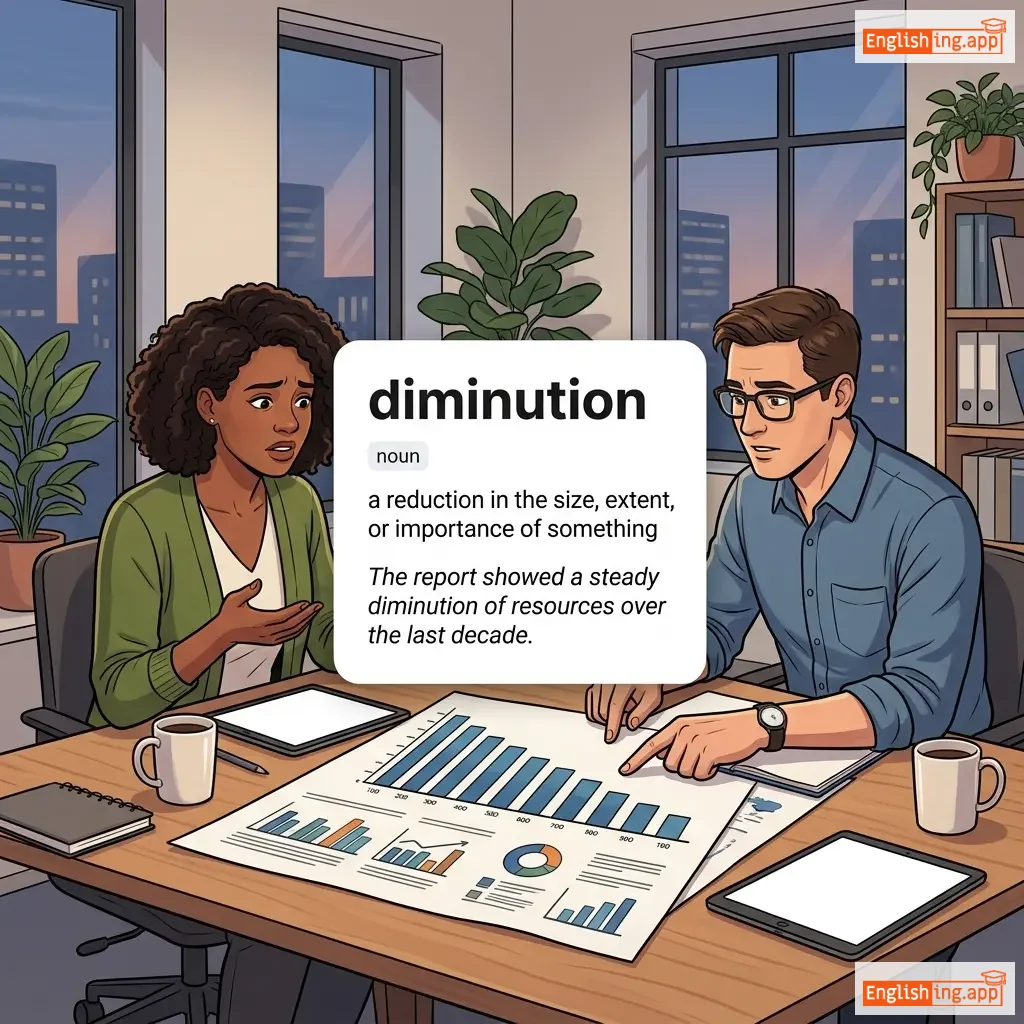
diminution definition card — visual illustration of the meaning
noun
/ˌdɪmɪˈnjuːʃən/
कमी (diminyushan)

a reduction in the size, extent, or importance of something

"The report showed a steady diminution of resources over the last decade."

"रिपोर्ट ने पिछले दशक में संसाधनों में निरंतर कमी दर्शाई।" (riport ne pichhle dashak mein sansadhano mein nirantar kami darshai)
adjective
/dɪˈmɪnjətɪv/
अत्यंत लघु (atyant laghu)

extremely or unusually small

"Despite his diminutive size, he was a powerful leader."

"उसकी अत्यंत लघु काया के बावजूद, वह एक शक्तिशाली नेता था।" (uski atyant laghu kaya ke bawjood, vah ek shaktishali neta tha.)
adverb
/ˈdɪmli/
धुंधला (dhundhla)

in a faint or unclear way; with little light

"The room was dimly lit by a single candle."

"कमरे को एक मोमबत्ती से धुंधला रोशन किया गया था।" (kamre ko ek mombatti se dhundhla roshan kiya gaya tha.)
noun
/ˈdɪm.pəl/
गाल की डिंपल (gaal ki dimple)

a small depression in the flesh, either one that exists permanently or one that forms when smiling

"Her charming dimples appeared whenever she smiled at the children."

"जब भी उसने बच्चों को देखा और मुस्काई, उसकी प्यारी डिंपल्स दिखने लगीं।" (jab bhi usne bachon ko dekha aur muskaai, uski pyaari dimples dikhne lagin.)
noun
/dɪn/
कोलाहल (kolahal)

a loud, unpleasant, and prolonged noise

"The din of traffic outside made it hard to concentrate."

"बाहर की ट्रैफिक का कोलाहल एकाग्रता में कठिनाई उत्पन्न कर रहा था।" (baahar ki traffic ka kolahal ekagrata mein kathinai utpann kar raha tha.)
verb
/daɪn/
भोजन करना (bhojan karna)

to eat a meal, especially the main meal of the day

"We usually dine at seven o'clock in the evening."

"हम आमतौर पर शाम सात बजे भोजन करते हैं।" (ham aamtour par shaam saat baje bhojan karte hain.)
noun
/ˈdɪŋɡi/
डिंगही नाव (dinghi naav)

a small boat, often carried or towed by a larger vessel, used for short trips or as a lifeboat

"They rowed the dinghy back to the yacht."

"उन्होंने यॉट पर लौटने के लिए डिंगही को रोका।" (unhone yacht par lautne ke liye dinghi ko roka.)
adjective
/ˈdɪndʒi/
मैला (maila)

gloomy and drab; dirty or discolored

"The old hotel room looked dark and dingy."

"पुराना होटल का कमरा अंधेरा और मैला दिख रहा था।" (purana hotel ka kamra andhera aur maila dikh raha tha.)
noun
/ˈdaɪnɪŋ/
भोजन (bhojan)

the act of eating a meal, especially in a formal setting

"We enjoyed fine dining at the new restaurant."

"हमने नए रेस्तरां में शानदार भोजन का आनंद लिया।" (Hamne naye restaurant mein shandaar bhojan ka anand liya.)
noun
/ˈdɪnər/
रात का खाना (raat ka khana)

the main meal of the day, usually eaten in the evening

"We had a lovely dinner at a new restaurant last night."

"हमने कल रात एक नए रेस्तरां में शानदार डिनर किया।" (Humne kal raat ek naye restaurant mein shandar dinner kiya.)
noun
/dɪnt/
प्रयास, चोट का निशान (prayas, chot ka nishan)

an impression or hollow made by a blow; force or power

"By dint of hard work, he achieved success."

"कठोर मेहनत के कारण, उसने सफलता प्राप्त की।" (Kathor mehnat ke karan, usne safalta praapt ki.)