वोकैबुलरीज

इंग्लिश वोकैबुलरी डिस्कवर, लर्न और मास्टर करें

noun
/ˈdɛvɪlri/
दैत्यकर्म (daityakarm)

Wicked or cruel behavior; mischievous actions.

"The children were full of devilry on Halloween night."

"हैलोवीन की रात बच्चों में दैत्यकर्म भरा हुआ था।" (Halloween ki raat bachon mein daityakarm bhara hua tha.)
noun
/ˈdɛvɪltrɪ/
शैतानी व्यवहार (shaitani vyavhaar)

Cruel or malicious behavior; mischief with an evil aspect.

"The villain’s deviltry terrified the townsfolk."

"खलनायक का शैतानी व्यवहार शहरवासियों को डराने वाला था।" (Khalnayak ka shaitani vyavhaar shahrawasiyon ko daraane wala tha.)
adjective
/ˈdiːviəs/
चालाक (chaalak)

Skillful at using underhanded tactics to achieve goals; not straightforward.

"He used a devious plan to gain control of the company."

"उसने कंपनी का नियंत्रण प्राप्त करने के लिए एक चालाक योजना का इस्तेमाल किया।" (Usne company ka niyantran prapt karne ke liye ek chaalak yojna ka istemal kiya.)
verb
/dɪˈvaɪz/
योजना बनाना (yojna banana)

To plan or invent something carefully.

"The engineers devised a new method to reduce costs."

"इंजीनियरों ने लागत घटाने के लिए एक नई विधि बनाई।" (Engineers ne lagat ghataane ke liye ek nai vidhi banayi.)
adjective
/dɪˈvɔɪd/
रिक्त (rikta)

Completely lacking or without something.

"His speech was devoid of any real emotion."

"उसका भाषण किसी वास्तविक भावना से रिक्त था।" (Uska bhashan kisi vastavik bhavana se rikta tha.)
verb
/dɪˈvɒlv/
हस्तांतरण करना (hastantran karna)

To pass power, responsibility, or duties to another person or group.

"The responsibility will devolve on the new manager."

"जिम्मेदारी नई प्रबंधक पर स्थानांतरित हो जाएगी।" (jimmedari nai prabandhak par sthantarit ho jayegi.)
verb
/dɪˈvoʊt/
समर्पित करना (samarpit karna)

to give time, effort, or resources to something

"She devotes much of her time to helping the poor."

"वह गरीबों की मदद करने के लिए अपना अधिकांश समय समर्पित करती है।" (Wah gareebon ki madad karne ke liye apna adhikansh samay samarpit karti hai.)
adjective
/dɪˈvoʊtɪd/
निष्ठावान (nishthawan)

Very loving, loyal, or dedicated.

"She is a devoted mother who always puts her children first."

"वह एक समर्पित माँ हैं जो हमेशा अपने बच्चों को पहले रखती हैं।" (vah ek samarpit maan hain jo hamesha apne bachcho ko pehle rakhti hain.)
noun
/ˌdɛvəˈtiː/
भक्त (bhakt)

A person who is very enthusiastic about or strongly dedicated to something or someone.

"He is a great devotee of classical music."

"वह शास्त्रीय संगीत का एक बड़ा भक्त है।" (vah shastriya sangeet ka ek bada bhakt hai)
noun
/dɪˈvoʊ.ʃən/
निष्ठा; भक्ति; समर्पण (nishtha, bhakti, samarpan)

love, loyalty, or enthusiasm for a person, activity, or cause

"Her devotion to helping others made her a beloved figure in the community."

"दूसरों की मदद करने के प्रति उसकी निष्ठा ने उसे समुदाय में एक प्रिय व्यक्ति बना दिया।" (doosron ki madad karne ke prati uski nishtha ne use samudaay mein ek priya vyakti bana diya.)
adjective
/dɪˈvaʊt/
धर्मनिष्ठ (dharmanistha)

Deeply religious or sincere.

"He is a devout believer who prays every day."

"वह एक धर्मनिष्ठ विश्वास करने वाला है जो हर दिन प्रार्थना करता है।" (vah ek dharmanistha vishwas karne wala hai jo har din prarthna karta hai.)
noun
/djuː/
ओस (os)

Tiny drops of water that form on cool surfaces at night from condensation.

"The grass was wet with morning dew."

"घास सुबह की ओस से गीली थी।" (Ghaas subah ki os se geeli thi.)
dexterity definition card — visual illustration of the meaning
noun
/dɛkˈstɛrɪti/
कौशल (kaushal)

Skill in using the hands or body; mental quickness.

"She showed great dexterity in playing the piano."

"उसने पियानो बजाने में बेहतरीन कौशल दिखाया।" (Usne piano bajane mein behtareen kaushal dikhaya.)
dexterous definition card — visual illustration of the meaning
adjective
/ˈdɛkstrəs/
कुशल (kushal)

Skillful and quick, especially with the hands.

"The craftsman was dexterous in carving wood."

"कारिगर लकड़ी काटने में कुशल था।" (Karigar lakdi katne mein kushal tha.)
noun
/ˈduːti/
धुती (dhuti)

a traditional Indian garment for men consisting of a piece of unstitched cloth worn around the waist and legs

"The elderly man wore a white dhuti during the religious ceremony."

"वृद्ध व्यक्ति ने धार्मिक समारोह में एक सफेद धुती पहनी।" (vruddh vyakti ne dharmik samaroha mein ek safed dhuti pehni.)
noun
/ˌdaɪəˈbiːtiːz/
सुख (sukh)

a medical condition in which the body cannot properly control the level of sugar in the blood

"He was diagnosed with type 2 diabetes last year."

"जब उसे पुरस्कार मिला, तो वह अपनी खुशी छुपा नहीं पाई।" (Jab use puraskaar mila, to vah apni khushi chhupa nahi pai.)
adjective
/ˌdaɪəˈbɒlɪk/
राक्षसी (raakshasi)

Extremely evil or cruel; characteristic of the devil.

"The villain devised a diabolic scheme."

"खलनायक ने एक राक्षसी योजना बनाई।" (Khalnayak ne ek raakshasi yojna banayi.)
adjective
/ˌdaɪəˈbɒlɪkəl/
दैत्यवादी (daityavadi)

Wicked, cruel, or outrageously bad; resembling the devil.

"The dictator’s diabolical rule brought misery to the nation."

"तानाशाह का दैत्यवादी शासन देश के लिए दुख लेकर आया।" (Tanashah ka daityavadi shasan desh ke liye dukh lekar aaya.)
adjective
/ˌdaɪəˈkrɪtɪkəl/
स्वरचिह्नात्मक (swarchihnatik)

Relating to a mark added to a letter to indicate a different pronunciation or stress.

"The word résumé has diacritical marks that change its meaning from resume."

"शब्द 'रेज़्युमे' में डायाक्रिटिकल चिह्न हैं जो इसके अर्थ को बदलते हैं।" ('Rezume' shabd mein diacritical chihn hain jo iske arth ko badalte hain.)
noun
/ˈdaɪəˌdɛm/
मुकुट (mukut)

A crown or headband worn as a symbol of royalty or authority.

"The queen wore a glittering diadem at the coronation."

"रानी ने राजतिलक समारोह में एक चमचमाता मुकुट पहना था।" (Rani ne rajtilak samaaroh mein ek chamchmaata mukut pehna tha.)
verb
/ˌdaɪəɡˈnoʊz/
रोग का निदान करना (rog ka nidaan karna)

To identify a disease, condition, or problem by examining symptoms.

"The doctor diagnosed him with pneumonia."

"डॉक्टर ने उसे न्यूमोनिया का निदान किया।" (Doctor ne use pneumonia ka nidaan kiya.)
noun
/ˌdaɪəɡˈnoʊsɪs/
निदान (nidhaan)

The identification of a disease, condition, or problem through examination of symptoms.

"The diagnosis confirmed that she had diabetes."

"निदान ने यह पुष्टि कर दी कि उसे मधुमेह था।" (Nidan ne yah pushti kar di ki use madhumeh tha.)
noun
/ˈdaɪəɡræm/
आरेख (aarekh)

a simplified drawing that shows the structure, relationship, or process of something

"The teacher explained the system using a clear diagram."

"शिक्षक ने एक स्पष्ट आरेख का उपयोग करके प्रणाली समझाई।" (shikshak ne ek spasht aarekh ka upyog karke pranali samjhai)
noun
/ˈdaɪəˌlɛkt/
उपभाषा (upabhasha)

A particular form of a language spoken in a specific region or by a specific group.

"He speaks a dialect of Bengali that is common in rural areas."

"वह एक बंगाली उपभाषा बोलता है जो ग्रामीण क्षेत्रों में सामान्य है।" (Vah ek Bangali upabhasha bolta hai jo grameen kshetron mein samanaya hai.)
noun
/ˌdaɪəˈlɛktɪk/
तर्कशास्त्र (tarkashastra)

A method of argument or reasoning by dialogue, especially as a means of investigating truth.

"The philosopher used dialectic to challenge his students' assumptions."

"दार्शनिक ने अपने छात्रों के अनुमान को चुनौती देने के लिए डायलेक्टिक का उपयोग किया।" (Darshanik ne apne chatron ke anumaan ko chunauti dene ke liye dialectic ka upyog kiya.)
adjective
/ˌdaɪəˈlɛktɪkəl/
वैचारिक (vaicharik)

Relating to the logical discussion of ideas and opinions.

"She took a dialectical approach to solve the complex issue."

"उसने जटिल मुद्दे को हल करने के लिए एक वैचारिक दृष्टिकोण अपनाया।" (Usne jatil mudde ko hal karne ke liye ek vaicharik drishtikon apnaya.)
noun
/ˌdaɪələˈtɪʃən/
विवेचनात्मक विशेषज्ञ (vivechanaatmak visheshagya)

A person skilled in dialectic or logical argument.

"Socrates is often considered the greatest dialectician in history."

"सोक्रेट्स को अक्सर इतिहास के सबसे महान विवेचनात्मक विशेषज्ञ के रूप में माना जाता है।" (Socrates ko aksar itihas ke sabse mahaan vivechanaatmak visheshagya ke roop mein maana jaata hai.)
noun
/ˈdaɪəlɔːɡ/
संवाद (samaad)

A conversation between two or more people, or a discussion aimed at reaching understanding.

"The two countries engaged in a dialogue to resolve their differences."

"दो देशों ने अपने मतभेदों को सुलझाने के लिए संवाद में भाग लिया।" (Do deshon ne apne matbhendon ko suljhane ke liye samaad mein bhag liya.)
noun
/ˈdaɪəmənd/
हीरा (hira)

a precious hard stone, usually clear and colorless, valued as a gemstone

"She wore a beautiful diamond necklace at the party."

"उसने पार्टी में एक सुंदर हीरे की हार पहना था।" (Usne party mein ek sundar heere ki haar pehna tha.)
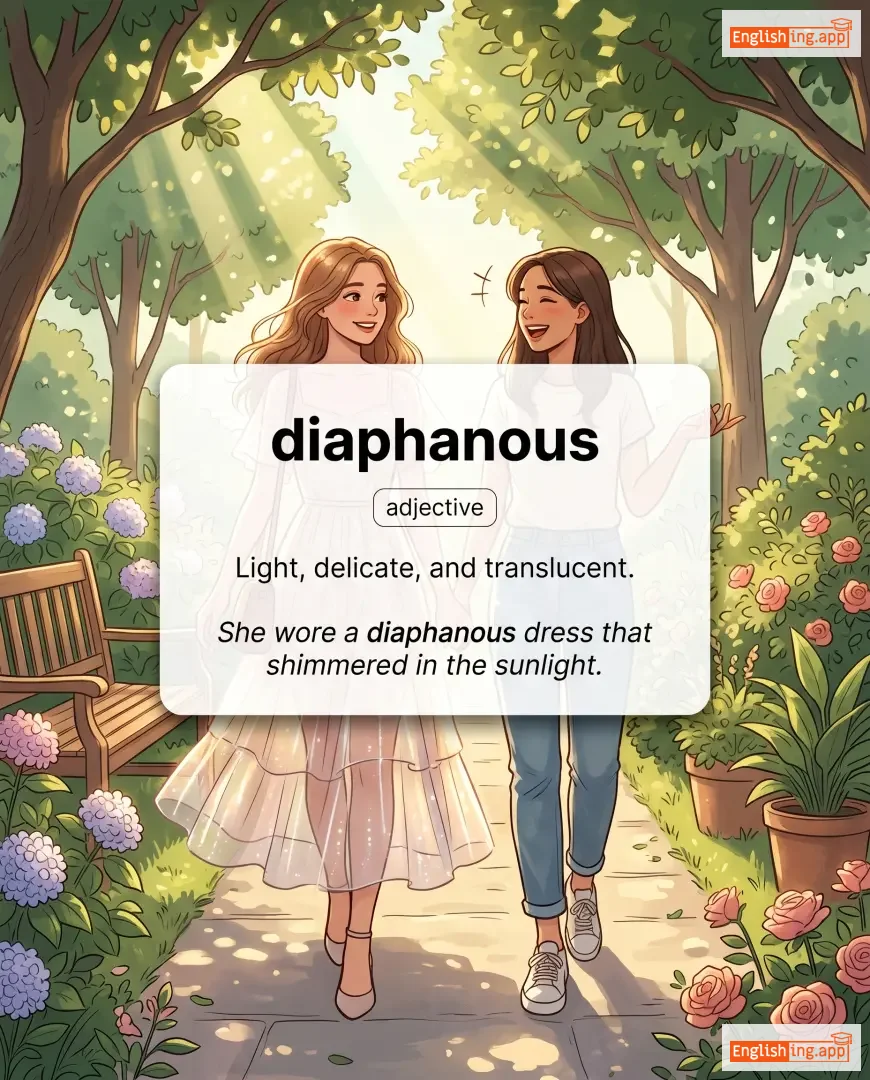
diaphanous definition card — visual illustration of the meaning
adjective
/daɪˈæfənəs/
पारदर्शी (paradarshi)

Light, delicate, and translucent.

"She wore a diaphanous dress that shimmered in the sunlight."

"उसने एक पारदर्शी ड्रेस पहनी थी जो सूर्य की रोशनी में चमक रही थी।" (Usne ek paradarshi dress pehni thi jo sury ki roshni mein chamak rahi thi.)
noun
/ˈdaɪəri/
डायरी (daayari)

a book in which one keeps a daily record of events and experiences

"She wrote about her day in her diary before going to bed."

"उसने सोने से पहले अपनी डायरी में अपने दिन के बारे में लिखा।" (Usne sone se pehle apni daayari mein apne din ke baare mein likha.)
adjective
/ˌdaɪəˈtɒmɪk/
द्वि-परमाणु (dwi-paramanu)

Consisting of two atoms.

"Oxygen is a diatomic molecule."

"ऑक्सीजन एक द्वि-परमाणु अणु है।" (Oksijan ek dwi-paramanu anu hai.)
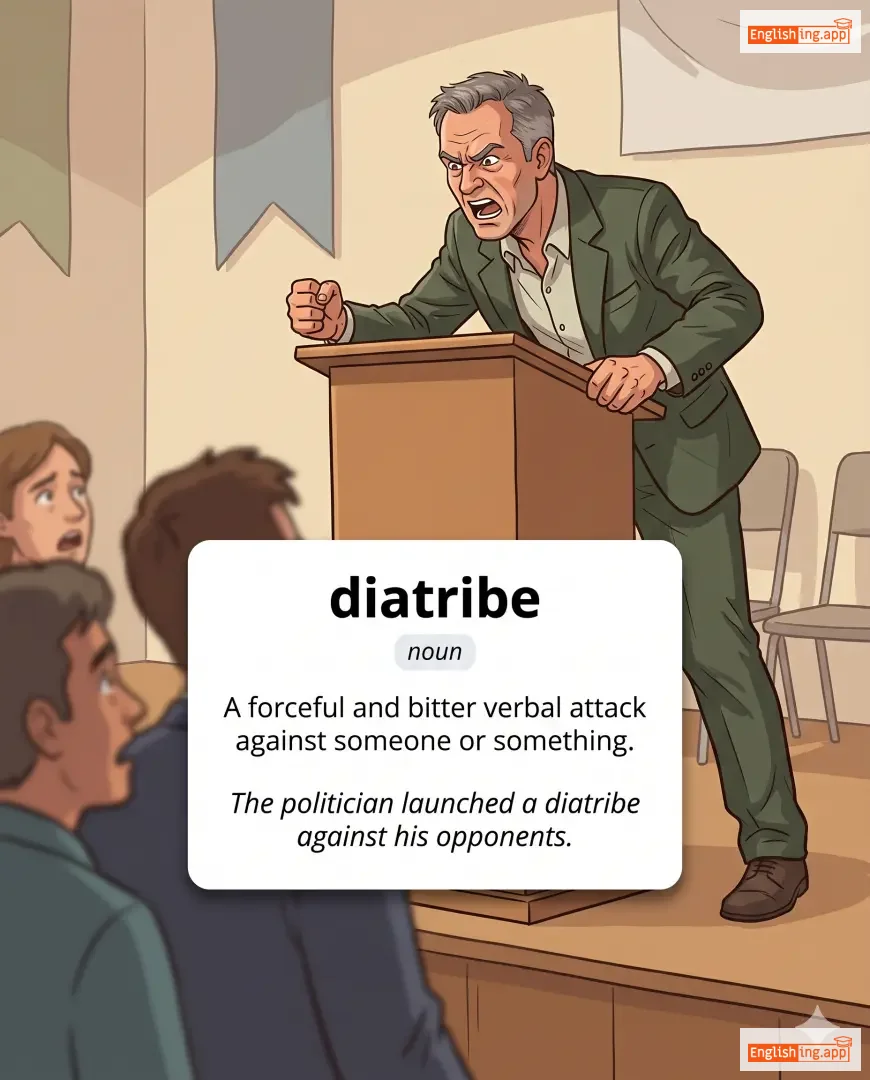
diatribe definition card — visual illustration of the meaning
noun
/ˈdaɪətraɪb/
कठोर आलोचना (kathor alochana)

A forceful and bitter verbal attack against someone or something.

"The politician launched a diatribe against his opponents."

"राजनेता ने अपने विरोधियों के खिलाफ एक कठोर आलोचना शुरू की।" (Rajneta ne apne virodhiyon ke khilaf ek kathor alochana shuru ki.)
adjective
/ˈdaɪ.si/
जोखिमपूर्ण (jokhimpoorn)

Risky or unpredictable; potentially dangerous.

"Investing in that company looks pretty dicey right now."

"उस कंपनी में निवेश करना अब काफी जोखिमपूर्ण लग रहा है।" (Us company mein nivesh karna ab kaafi jokhimpoorn lag raha hai.)
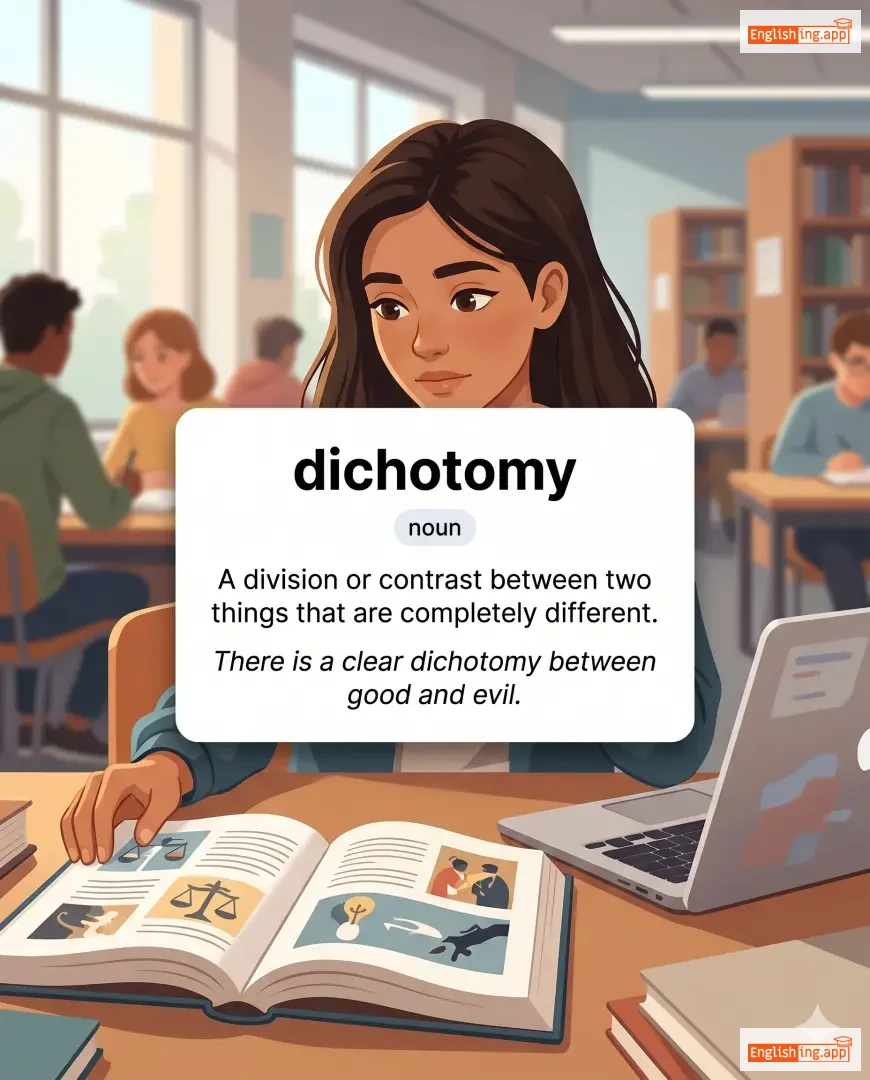
dichotomy definition card — visual illustration of the meaning
noun
/daɪˈkɒtəmi/
विभाजन (vibhajan)

A division or contrast between two things that are completely different.

"There is a clear dichotomy between good and evil."

"अच्छाई और बुराई के बीच एक स्पष्ट विभाजन है।" (Achhai aur burai ke beech ek spasht vibhajan hai.)
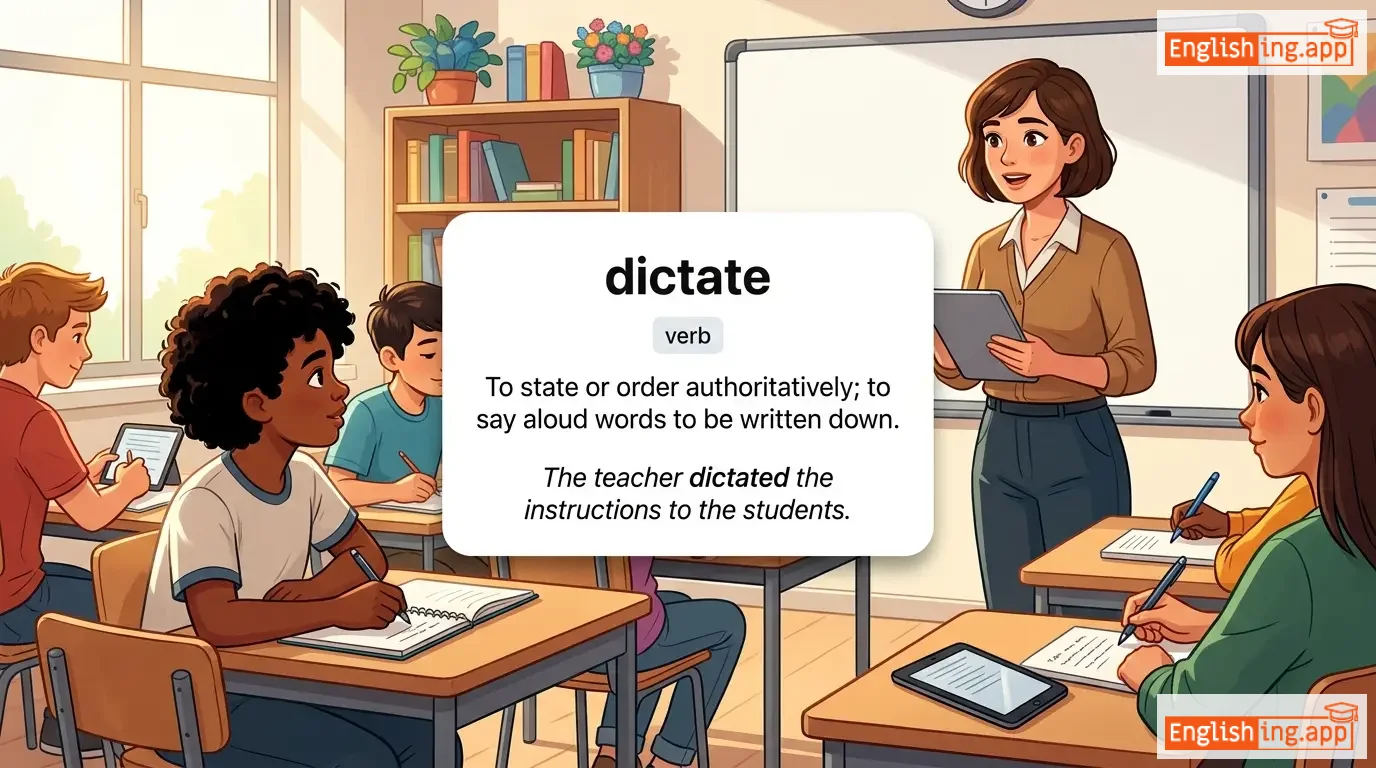
dictate definition card — visual illustration of the meaning
verb
/dɪkˈteɪt/
आदेश देना (adesh dena)

To state or order authoritatively; to say aloud words to be written down.

"The teacher dictated the instructions to the students."

"शिक्षक ने छात्रों को निर्देश दिए।" (Shikshak ne chhatron ko nirdesh diye.)
noun
/dɪkˈteɪtə/
तानाशाह (tanashah)

a ruler with total power over a country, typically one who has obtained control by force

"The dictator ruled the country with an iron fist."

"तानाशाह ने देश को लोहे की मुट्ठी से शासित किया।" (Tanashah ne desh ko lohe ki mutthi se shasit kiya.)
adjective
/ˌdɪktəˈtɔːriəl/
तानाशाही (tanashahi)

Having or showing a tendency to tell people what to do in an autocratic way.

"His dictatorial style made him unpopular among colleagues."

"उसका तानाशाही तरीका उसे सहकर्मियों के बीच अप्रिय बना देता है।" (Uska tanashahi tareeka use sahkarmiyon ke beech apriya bana deta hai.)
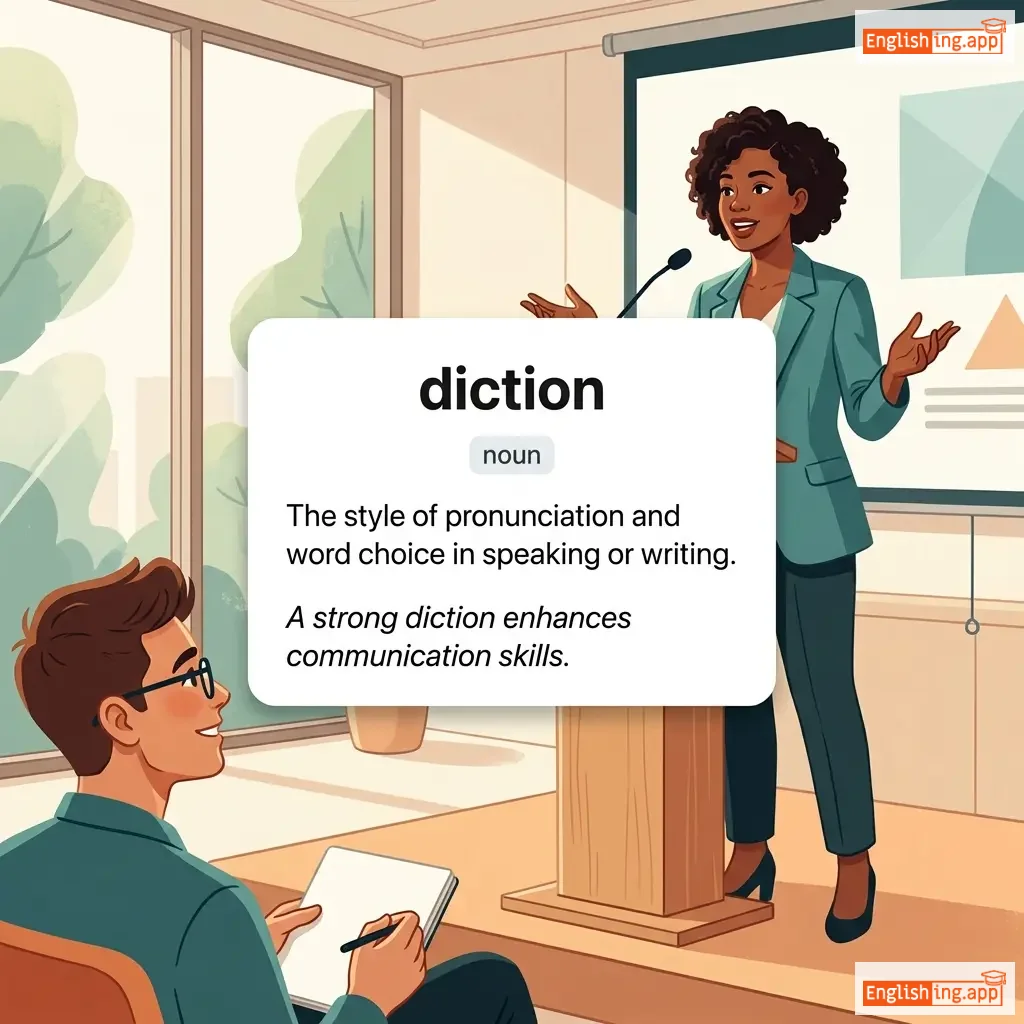
diction definition card — visual illustration of the meaning
noun
ˈdɪk.ʃən
उच्चारण और शब्द चयन (uchcharan aur shabd chayan)

The style of pronunciation and word choice in speaking or writing.

"A strong diction enhances communication skills."

"एक मजबूत डिक्शन संचार कौशल को बढ़ाता है।" (Ek majboot dikshan sanchar kaushal ko badhata hai.)
noun
/ˈdɪkʃəˌnɛri/
शब्दकोश (shabdkosh)

A reference book or electronic resource containing words, usually arranged alphabetically, with information about their meanings, pronunciations, etymologies, and usage.

"I looked up the word in the dictionary to understand its meaning."

"मैंने शब्द का अर्थ समझने के लिए शब्दकोश में देखा।" (Maine shabd ka arth samajhne ke liye shabdkosh mein dekha.)
noun
/ˈdɪktəm/
नियम (niyam)

A formal pronouncement, authoritative statement, or maxim.

"The judge’s dictum clarified the principle of equality before the law."

"न्यायधीश का dictum कानून के समक्ष समानता के सिद्धांत को स्पष्ट करता है।" (Nyayadhish ka dictum kanoon ke samakhsh samaanta ke siddhant ko spasht karta hai.)
adjective
/daɪˈdæktɪk/
शिक्षात्मक (shikshatmak)

Intended to teach, often with a moral lesson.

"The novel is not just entertaining but also didactic in nature."

"उपन्यास सिर्फ मनोरंजक नहीं, बल्कि शैक्षिक दृष्टिकोण से भी है।" (Upanyaas sirf manoranjak nahi, balki shaikshik drishtikon se bhi hai.)
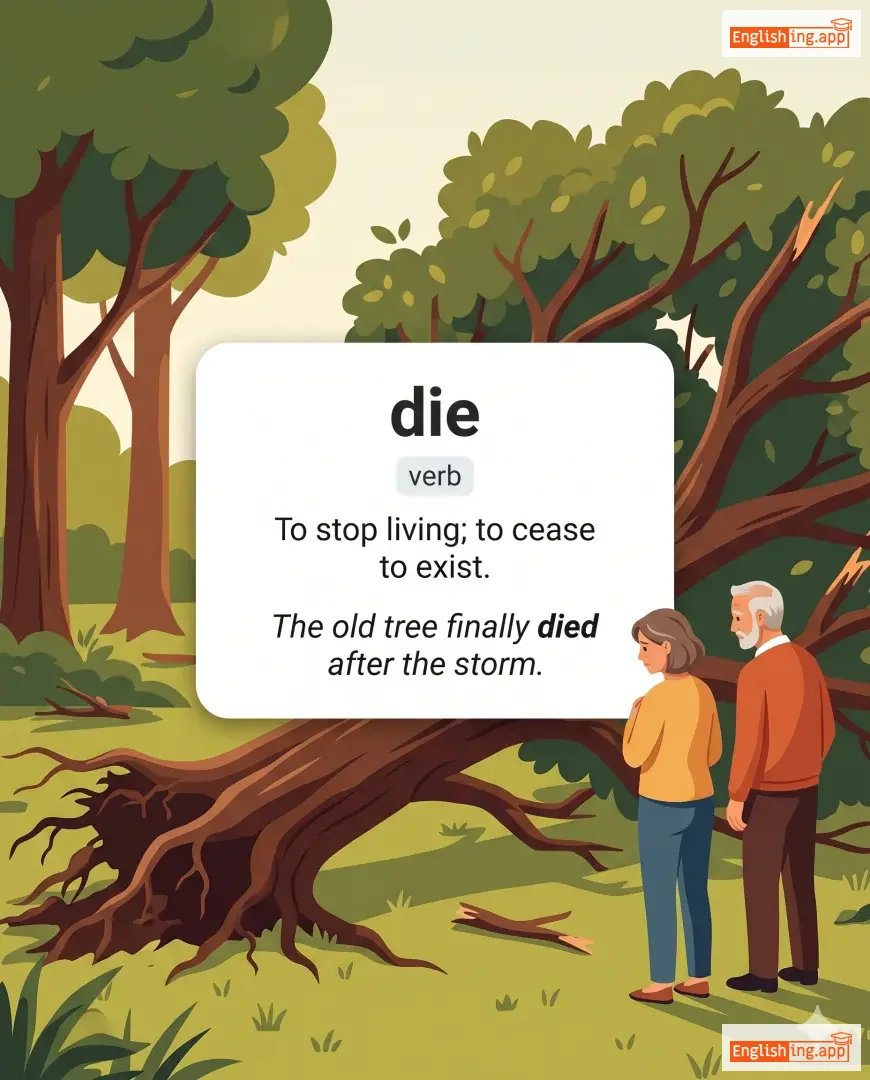
die definition card — visual illustration of the meaning
verb
/daɪ/
मरना (marna)

To stop living; to cease to exist.

"The old tree finally died after the storm."

"पुराना पेड़ तूफ़ान के बाद आखिरकार मर गया।" (Purana ped toofan ke baad aakhirkar mar gaya.)
noun
/ˈdaɪhɑːrd/
कट्टर (kattar)

A person who strongly resists change and remains loyal to a belief or cause.

"He is a diehard fan of classic rock music."

"वह क्लासिक रॉक संगीत का एक कट्टर प्रशंसक है।" (vah klaasik rok sangeet ka ek kattar prashansak hai)
noun
/ˈdaɪət/
आहार (aahar)

the kinds of food that a person usually eats

"He follows a strict vegetarian diet."

"वह एक कड़ा शाकाहारी आहार अपनाता है।" (Vah ek kada shaakahari aahar apnata hai.)
verb
/ˈdɪfər/
विभिन्न होना (vibhinn hona)

to be unlike or distinct from something else

"Opinions differ on this issue."

"इस मामले में रायें अलग हैं।" (Is maamle mein raayein alag hain.)
noun
/ˈdɪfərəns/
अंतर (antar)

A point or way in which things are not the same.

"There is a big difference between theory and practice."

"सिद्धांत और अभ्यास के बीच एक बड़ा अंतर है।" (Siddhant aur abhyas ke beech ek bada antar hai.)
adjective
/ˈdɪf.ər.ənt/
विभिन्न (vibhinn)

Not the same as another; distinct or unlike.

"Her opinion was completely different from mine."

"उसका मत मेरे से पूरी तरह से अलग था।" (Uska mat mere se puri tarah se alag tha.)
noun
/ˌdɪfəˈrɛnʃə/
विभेदक लक्षण (vibhedak lakshan)

A distinguishing characteristic that sets one thing apart from another.

"The differentia of humans is their ability to reason abstractly."

"मानवों का विभेदक लक्षण उनकी अमूर्त रूप से सोचने की क्षमता है।" (Manavon ka vibhedak lakshan unki amurt roop se sochne ki kshamata hai.)
adjective
/ˌdɪfəˈrɛnʃəl/
भेदात्मक (bhedatmak)

Relating to or showing a difference; involving a distinction.

"There is a differential treatment between the two groups."

"दो समूहों के बीच भेदात्मक उपचार है।" (Do samoohon ke beech bhedatmak upchar hai.)