वोकैबुलरीज

इंग्लिश वोकैबुलरी डिस्कवर, लर्न और मास्टर करें

noun
/sɛnˈtjʊəriən/
सेंचुरियन (centurion)

A commander of a unit of one hundred soldiers in the ancient Roman army.

"The centurion led his men into battle with courage."

"सेंचुरियन ने अपने सैनिकों को साहस के साथ युद्ध में नेतृत्व किया।" (Centurion ne apne sainikon ko sahas ke saath yudh mein netritva kiya.)
noun
/ˈsɛnʧəri/
सदी (sadi)

A period of one hundred years.

"The 20th century saw significant technological progress."

"20वीं सदी में महत्वपूर्ण तकनीकी प्रगति हुई थी।" (20vi sadi mein mahatvapurn takneeki pragati hui thi.)
noun
/ˌsiːiːˈoʊ/
मुख्य कार्यकारी अधिकारी (mukhya karyakari adhikari)

The highest-ranking person in a company, responsible for overall management.

"The CEO announced a new strategy for the company."

"सीईओ ने कंपनी के लिए एक नई रणनीति की घोषणा की।" (CEO ne company ke liye ek nai rananiti ki ghoshna ki.)
noun
/ˈsɪə.ri.əl/
सीरियल (seeriyal)

a common breakfast food made from processed grains such as wheat, oats, or corn

"She eats a bowl of cereal every morning before work."

"वह हर सुबह काम से पहले एक कटोरी सीरियल खाती है।" (vah har subah kaam se pehle ek katori serial khaati hai)
cerebral definition card — visual illustration of the meaning
adjective
/səˈriː.brəl/
मस्तिष्क संबंधी (mastisk sambandhi)

relating to the brain or intellect; intellectual rather than emotional

"He is known for his cerebral approach to problem-solving."

"समस्या हल करने के लिए उनकी सेरिब्रल दृष्टिकोण प्रसिद्ध है।" (Samasya hal karne ke liye unki cerebral drishtikon prasiddh hai.)
noun
/ˌser.əˈbreɪ.ʃən/
चिंतन (chintan)

the process of thinking or using the brain actively

"The lecture sparked intense cerebration among the students."

"व्याख्यान ने छात्रों के बीच तीव्र चिंतन को प्रेरित किया।" (Vyakhyan ne chhatron ke beech teevr chintan ko prerit kiya.)
adjective
/ˌser.ɪˈməʊ.ni.əl/
औपचारिक (aupchaarik)

relating to or used in a ceremony or formal occasion

"The president wore a ceremonial robe during the inauguration."

"राष्ट्रपति ने उद्घाटन के दौरान एक औपचारिक वस्त्र पहना था।" (Rashtrapati ne udghaatan ke dauraan ek aupchaarik vastr pehna tha.)
adjective
/ˌser.ɪˈməʊ.ni.əs/
आधिकारिक और शिष्ट (adhikarik aur shisht)

marked by formality, politeness, or strict observance of customs

"He gave her a ceremonious bow before entering the hall."

"हॉल में प्रवेश करने से पहले उसने उसे एक आधिकारिक और शिष्ट अभिवादन किया।" (Hall mein pravesh karne se pehle usne use ek adhikarik aur shisht abhivadan kiya.)
noun
/ˈsɛrəˌmoʊni/
समारोह (samaroh)

A formal event or occasion, often with rituals and traditions.

"The graduation ceremony was held in the university hall."

"स्नातक समारोह विश्वविद्यालय के सभागार में आयोजित किया गया था।" (snatak samaroh vishvavidyalay ke sabhaagar mein aayojit kiya gaya tha.)
adjective
/ˈsɜːr.tən/
निश्चित (nishchit)

Known for sure; having no doubt.

"I am certain that she will succeed."

"मुझे निश्चित है कि वह सफल होगी।" (mujhe nishchit hai ki vah safal hogi.)
adverb
/ˈsɜːrtənli/
निश्चित रूप से (nishchit roop se)

without doubt; surely; used to emphasize certainty

"I will certainly help you with your project."

"मैं निश्चित रूप से आपकी परियोजना में मदद करूंगा।" (Main nishchit roop se aapki pariyojna mein madad karunga.)
noun
/ˈsɜːtənti/
निश्चितता (nishchitata)

the state of being sure or confident about something

"There is no certainty about the weather tomorrow."

"कल के मौसम के बारे में कोई निश्चितता नहीं है।" (Kal ke mausam ke baare mein koi nishchitata nahin hai.)
noun
/sərˈtɪfɪkət/
प्रमाणपत्र (pramaanspatra)

a document serving as proof of achievement or qualification

"She received a certificate for completing the course."

"उसे पाठ्यक्रम पूरा करने के लिए एक प्रमाणपत्र प्राप्त हुआ।" (Use pathyakram poora karne ke liye ek pramaanspatra praapt hua.)
noun
/ˌsɜːrtɪfɪˈkeɪʃən/
प्रमाणीकरण (pramanikaran)

the process of officially recognizing or confirming that something or someone meets required standards; an official document proving qualification

"She received her professional certification after completing the training program."

"प्रशिक्षण कार्यक्रम पूरा करने के बाद उसे अपना पेशेवर प्रमाणीकरण मिला।" (prashikshan karyakram poora karne ke baad use apna peshevar pramanikaran mila)
noun
/ˈsɜːrtɪˌtjuːd/
निश्चय (nishchay)

Absolute certainty or conviction about something.

"She spoke with certitude about the outcome of the case."

"वह मामले के परिणाम के बारे में निश्चय के साथ बोल रही थी।" (Vah maamle ke parinaam ke baare mein nishchay ke saath bol rahi thi.)
noun
/sɛˈseɪʃən/
रोकथाम (rokttham)

The fact or process of ending or being brought to an end.

"There was a temporary cessation of hostilities."

"वहां अस्थायी रूप से शत्रुता की रोकथाम हुई थी।" (Wahan asthaayi roop se shatruta ki rokttham hui thi.)
noun
/ˈsɛʃən/
अधिकार या संपत्ति का हस्तांतरण (adhikar ya sampatti ka hastantaran)

The formal giving up of rights, property, or territory, especially by a state.

"The treaty resulted in the cession of land to the neighboring country."

"संधि के परिणामस्वरूप भूमि पड़ोसी देश को हस्तांतरित कर दी गई थी।" (Sandhi ke parinaamswaroop bhoomi padosi desh ko hastantarit kar di gayi thi.)
noun
/ˈsɛtərə/
आदि (adi)

Latin for 'the rest' or 'others'; commonly used in the phrase 'et cetera' meaning 'and so on'.

"We need to buy pens, paper, notebooks, et cetera."

"हमें पेन, कागज, नोटबुक, आदि खरीदने होंगे।" (Humein pen, kagaz, notebook, adi kharidne honge.)
verb
/ʧeɪf/
घर्षण से चोट लगना (gharshan se chot lagna)

To make or become sore by rubbing; to feel irritation or impatience.

"The tight shoes began to chafe his heels."

"टाइट जूते उसके एड़ी में चाफ़ करने लगे।" (Tight joote uske edi mein chaf karne lage.)
noun
/tʃæf/
छिलका (chhilka)

The husks of corn or other seed separated by winnowing or threshing; worthless or trivial matter.

"The farmer separated the wheat from the chaff."

"किसान ने गेहूं को छिलके से अलग किया।" (Kisan ne gehun ko chhilke se alag kiya.)
verb
/ˈtʃæfɪŋ/
चिढ़ाना (chidhana)

Teasing or joking in a lighthearted way.

"They were chaffing each other during lunch."

"वे दोपहर के खाने के दौरान एक दूसरे को चिढ़ा रहे थे।" (Ve dopehar ke khane ke dauran ek doosre ko chidhana rahe the.)
verb
/ˈtʃeɪfɪŋ/
घसने से जलन होना (ghasne se jalan hona)

To make sore by rubbing; to become irritated.

"The rough shoes were chafing his heels."

"कठिन जूते उसके एड़ी को घसकर जलन पैदा कर रहे थे।" (Kathin joote uske edee ko ghas kar jalan paida kar rahe the.)
noun
/ʃəˈɡrɪn/
दुख (dukh)

Distress or embarrassment at having failed or been humiliated.

"She left the room in chagrin after forgetting her lines."

"वह अपनी पंक्तियाँ भूलने के बाद दुखी होकर कमरे से बाहर निकल गई।" (Vah apni panktiyan bhoolne ke baad dukhi hokar kamre se bahar nikal gayi.)
noun
/tʃeɪn/
श्रृंखला (shrinkhla)

a connected series of metal rings used for fastening or securing things; a series of connected events or businesses

"He wore a gold chain around his neck."

"उसने अपनी गर्दन में एक सोने की चेन पहनी थी।" (Usne apni gardan mein ek sone ki chain pehni thi.)
noun
/tʃɛr/
कुर्सी (kursi)

a piece of furniture for one person to sit on, typically having a back and four legs

"She pulled up a chair and sat beside me."

"उसने एक कुर्सी खींच कर मेरे पास बैठ गई।" (usne ek kursi kheench kar mere paas baith gayi.)
noun
/ˈtʃɛərmən/
सुख (sukh)

the leader or head of a meeting, committee, or organization

"The chairman opened the meeting with a short speech."

"जब उसे पुरस्कार मिला, तो वह अपनी खुशी छुपा नहीं सकी।" (Jab use puraskar mila, to wah apni khushi chhupa nahin saki.)
chairperson definition card — visual illustration of the meaning
noun
ˈtʃeə.pɜː.sən
चेयरपर्सन (chairperson)

A person who is in charge of a meeting or organization; the presiding officer of a committee, board, or organization.

"The chairperson ensures procedural integrity."

"चेयरपर्सन प्रक्रियागत सत्यनिष्ठा सुनिश्चित करता है।" (Chairperson prakriyaagat satyanishtha sunishchit karta hai.)
noun
/ˈtʃɛərˌwʊmən/
अध्यक्ष महिला (adhyaksh mahila)

a woman who presides over a meeting, committee, or organization; a female leader of a board or council

"She was elected chairwoman of the company after years of experience."

"कई वर्षों के अनुभव के बाद वह कंपनी की अध्यक्ष महिला चुनी गई।" (kai varshon ke anubhav ke baad vah company ki adhyaksh mahila chuni gai)
noun
/ˈtʃælɪs/
पवित्र प्याला (pavitra pyala)

A large cup or goblet, typically used for drinking wine in religious ceremonies.

"The priest lifted the golden chalice during the ceremony."

"पुरोहित ने समारोह के दौरान सोने का प्याला उठाया।" (Purohit ne samaroha ke dauran sone ka pyala uthaya.)
challenge definition card — visual illustration of the meaning
noun/verb
/ˈtʃælɪndʒ/
चैलेंज (challenge)

a difficult task or problem that requires effort to overcome; to question or dispute

"Climbing the mountain was the biggest challenge of his life."

"पहाड़ चढ़ना उसकी जिंदगी की सबसे बड़ी चैलेंज था।" (Pahaad chadhna uski zindagi ki sabse badi challenge tha.)
noun
/ˈtʃælɪndʒɪz/
चुनौतियाँ (chunautiyan)

Difficult tasks or situations that test someone's abilities or resources.

"Overcoming challenges is the key to personal growth."

"चुनौतियों को पार करना व्यक्तिगत विकास की कुंजी है।" (Chunautiyon ko paar karna vyaktigat vikas ki kunji hai.)
adjective
/ˈtʃælɪndʒɪŋ/
चैलेंजिंग (challenging)

difficult in a way that tests one's abilities

"The mountain climb was challenging but rewarding."

"पहाड़ चढ़ाई चैलेंजिंग था लेकिन पुरस्कृत करने वाला था।" (Pahaad chadhai challenging tha lekin puraskrit karne wala tha.)
noun
/ˈtʃeɪmbər/
कक्ष (kakksh)

a large room used for formal or public events, or a private room.

"The king held meetings in his private chamber."

"राजा ने अपनी निजी कक्ष में बैठकें कीं।" (Raja ne apni niji kakksh mein baithakein keen.)
noun
/kəˈmiːliən/
गिरगिट (girgit)

a lizard known for its ability to change color to blend with its surroundings.

"The chameleon changed its color to hide from predators."

"गिरगिट ने शिकारियों से छिपने के लिए अपना रंग बदल लिया।" (Girgit ne shikariyon se chhupne ke liye apna rang badal liya.)
noun
/tʃəˈmeɪ.li/
चमेली (chameli)

a variety of jasmine flower with small white fragrant petals

"The chameli flowers are commonly used to make garlands and perfumes."

"चमेली के फूलों का उपयोग आमतौर पर मालाएं और इत्र बनाने में किया जाता है।" (chameli ke phoolon ka upayog aam taur par malaen aur itr banane mein kiya jata hai.)
noun
/tʃæmp/
चैम्पियन / विजेता (champion / vijeta)

an informal word for champion or winner.

"He is the new champ of the boxing tournament."

"वह बॉक्सिंग टूर्नामेंट का नया चैंप है।" (Woh boxing tournament ka naya champ hai.)
noun
/ˈtʃæm.pæk/
चम्पक (champak)

a fragrant yellow or white flower from a tree native to South Asia, used in perfumes and religious ceremonies

"The champak tree in the temple courtyard bloomed with golden flowers."

"मंदिर के आंगन में चम्पक का पेड़ सोने जैसे फूलों से खिला था।" (mandir ke aangan mein champak ka ped sone jaise phoolon se khila tha)
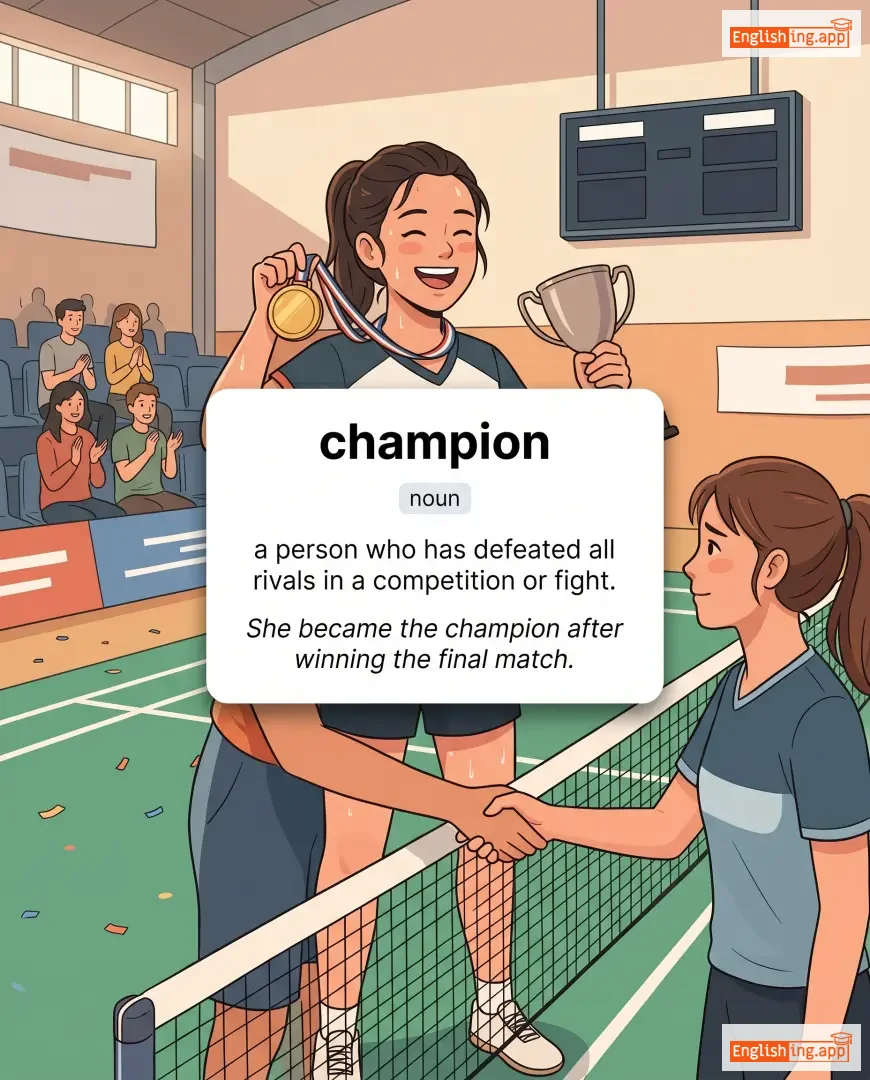
champion definition card — visual illustration of the meaning
noun
/ˈtʃæmpiən/
चैम्पियन (champion)

a person who has defeated all rivals in a competition or fight.

"She became the champion after winning the final match."

"वह फाइनल मैच जीतने के बाद चैम्पियन बन गई।" (vah final match jeetne ke baad champion ban gayi.)
noun
/ˈtʃæmpiənʃɪp/
चैम्पियनशिप (championship)

a competition to decide who is the best in a particular sport or activity.

"The championship will be held next month."

"चैम्पियनशिप अगले महीने आयोजित की जाएगी।" (championship agle mahine aayojit ki jaayegi.)
noun
/tʃæns/
अवसर (avsar)

An opportunity or possibility of something happening.

"He took a chance and applied for the job."

"उसने एक अवसर लिया और नौकरी के लिए आवेदन किया।" (Usne ek avsar liya aur naukri ke liye avedan kiya.)
noun
/ˈtʃænsələr/
कुलपति / मुख्य मंत्री (kulpati / mukhya mantri)

A senior state or legal official, or the head of a university.

"The chancellor delivered an inspiring speech at the graduation ceremony."

"कुलपति ने स्नातक समारोह में एक प्रेरणादायक भाषण दिया।" (Kulpati ne snatak samaroah mein ek preranaadayak bhashan diya.)
noun
/ˈtʃænsəri/
चांसीरी अदालत (chancery adalat)

A court of equity or the office of a chancellor.

"The case was taken to the chancery court for resolution."

"मामला समाधान के लिए चांसीरी अदालत में भेजा गया था।" (Mamla samadhan ke liye chancery adalat mein bheja gaya tha.)
change definition card — visual illustration of the meaning
verb
/tʃeɪndʒ/
बदलाव (badlav)

To make something different or to become different.

"She decided to change her career path."

"उसने अपना करियर पथ बदलने का निर्णय लिया।" (Usne apna career path badalne ka nirnay liya.)
change management definition card — visual illustration of the meaning
noun
/ˈʃeɪndʒ ˈmænɪdʒmənt/
परिवर्तन प्रबंधन (parivartan prabandhan)

The discipline that guides how we prepare, equip and support individuals, teams and organizations in making organizational change.

"Change management ensures smooth transitions."

"परिवर्तन प्रबंधन यह सुनिश्चित करता है कि परिवर्तन सुगम हो।" (Parivartan prabandhan yah sunishchit karta hai ki parivartan sugam ho.)
adjective
/ˈtʃeɪn.dʒə.bəl/
परिवर्तनीय; बदलने योग्य; (parivartaniyo; badalne yogya;)

able to be changed; likely to change frequently

"The weather is very changeable in spring."

"वसंत में मौसम बहुत ही परिवर्तनीय है।" (vasant mein mausam bahut hi parivartaniyo hai.)
verb
/ˈtʃeɪndʒɪŋ/
बदलना (badalna)

The act of becoming different; ongoing process of change.

"The weather is changing rapidly."

"मौसम तेज़ी से बदल रहा है।" (Mausam tezī se badal rahā hai.)
noun
/ˈtʃænəl/
चैनल / माध्यम (channel / madhyam)

A means of communication, or a passage for water or information.

"They launched a new TV channel last year."

"उन्होंने पिछले साल एक नया टीवी चैनल लॉन्च किया था।" (Unhone pichle saal ek naya TV channel launch kiya tha.)
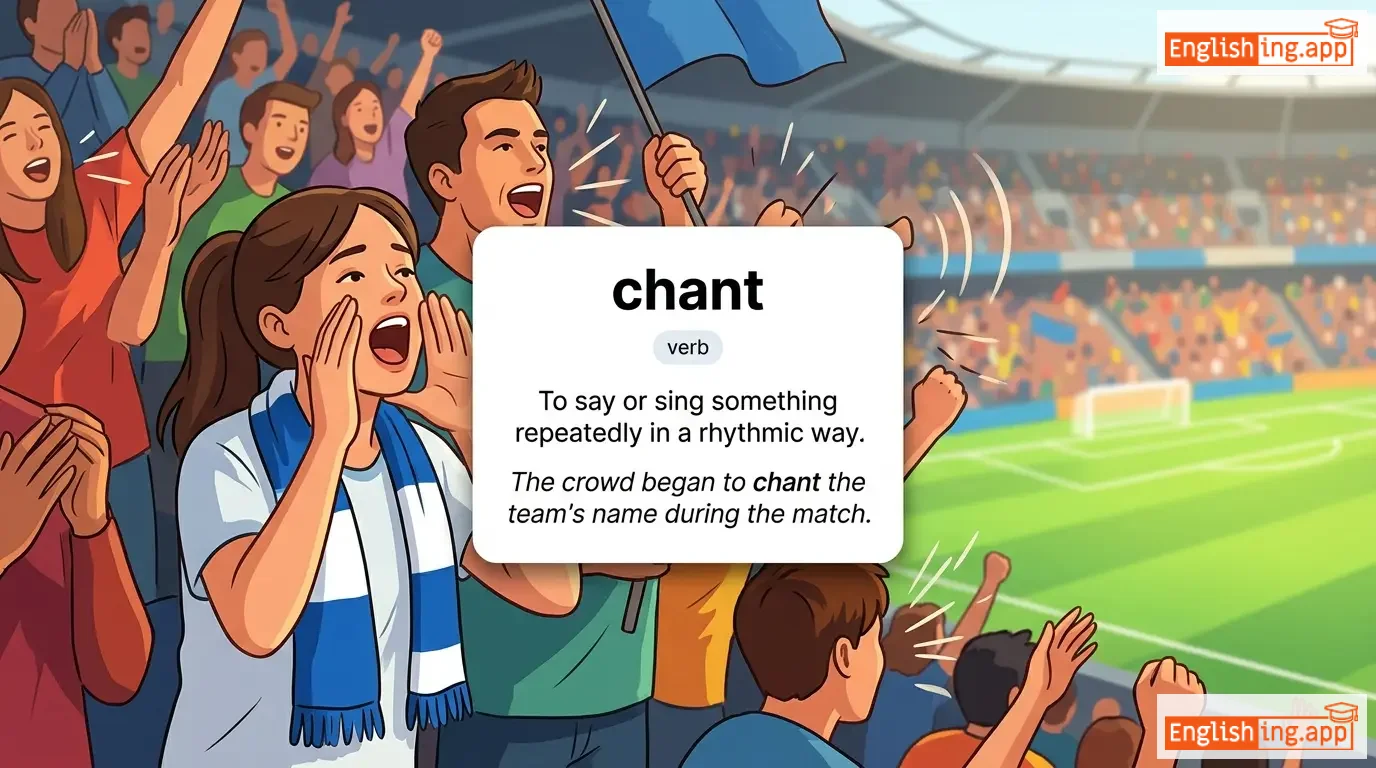
chant definition card — visual illustration of the meaning
verb
/tʃænt/
स्लोगन/गान ध्वनि करना (slogan/gaan dhvani karna)

To say or sing something repeatedly in a rhythmic way.

"The crowd began to chant the team's name during the match."

"दर्शकों ने मैच के दौरान टीम का नाम चिल्लाना शुरू किया।" (Darshako ne match ke dauran team ka naam chillana shuru kiya.)
noun
/ˈkeɪɒs/
अराजकता (arajakta)

A state of complete disorder and confusion.

"The sudden storm caused chaos in the city."

"अचानक तूफान ने शहर में अराजकता पैदा कर दी।" (Achanak toofan ne sheher mein arajakta paida kar di.)
adjective
/keɪˈɒtɪk/
अराजक (arajak)

Completely disordered or confusing.

"The classroom became chaotic when the teacher left."

"कक्षा अराजक हो गई जब शिक्षक ने छोड़ा।" (Kaksha arajak ho gayi jab shikshak ne chhoda.)