वोकैबुलरीज

इंग्लिश वोकैबुलरी डिस्कवर, लर्न और मास्टर करें

verb
/kəˈriːn/
नियंत्रणहीन तरीके से चलना (niyantranheen tareeke se chalna)

To move swiftly and in an uncontrolled way, especially in a specific direction.

"The car careened down the slippery road."

"कार पिचली सड़क पर नियंत्रणहीन तरीके से दौड़ गई।" (Kār pichalī sadak par niyantranheen tareeke se daud gayī.)
noun, verb
/kəˈrɪər/
कैरियर / पेशा (career / pesha)

As a noun: a person’s course of professional life; as a verb: to move swiftly and in an uncontrolled way.

"She built a successful career in medicine."

"वह चिकित्सा में एक सफल करियर बनाने में सक्षम थी।" (Vah chikitsa mein ek safal career banane mein saksham thi.)
adjective
/ˈkeəfriː/
चिंतामुक्त (chintamukt)

Free from worries or responsibilities; relaxed and happy.

"She enjoyed a carefree afternoon at the beach."

"उसने समुद्र तट पर एक चिंतामुक्त दोपहर का आनंद लिया।" (Usne samudra tat par ek chintamukt dopahar ka anand liya.)
adjective
/ˈkɛr.fəl/
सावधान (savdhan)

Exercising caution or showing concern to avoid mistakes or harm.

"He is always careful when crossing the road."

"वह सड़क पार करते समय हमेशा सावधान रहता है।" (Wah sadak paar karte samay hamesha savdhan rehta hai.)
adverb
/ˈkɛərfəli/
सावधानीपूर्वक (saavdhanipoorvak)

In a way that is done with attention to detail and caution to avoid mistakes or harm.

"He carefully placed the glass on the table."

"उसने सावधानीपूर्वक गिलास को मेज पर रखा।" (Usne saavdhanipoorvak gilas ko mej par rakha.)
adjective
/ˈkeər.ləs/
लापरवाह; नासमझ; असावधान; ध्यानहीन; (keyarles)

not giving sufficient attention or thought to avoiding harm or errors; negligent; inattentive

"His careless driving caused a serious accident on the highway."

"उसकी लापरवाह ड्राइविंग के कारण हाईवे पर एक गंभीर दुर्घटना हो गई।" (uski laaparwah driving ke kaaran highway par ek gambhir durghatna ho gayi.)
adverb
/ˈkeərləsli/
लापरवाही से (laparvahi se)

without care or attention; in a negligent or reckless manner

"He carelessly left the door unlocked."

"उसने लापरवाही से दरवाज़ा खुला छोड़ दिया।" (usne laparvahi se darvaza khula chhod diya)
noun
/ˈker.ləs.nəs/
लापरवाही; असावधानी (laparwahi, asavdhani)

failure to give sufficient attention to avoiding harm or errors

"His carelessness with money led to serious financial problems."

"उसकी लापरवाही के कारण उसे गंभीर वित्तीय समस्याएँ आईं।" (uski laparwahi ke karan use gambhir vittiya samasyaen aayi.)
noun
/kəˈres/
स्निग्ध स्पर्श (snigdh sparsh)

a gentle or loving touch

"The mother's gentle caress calmed the crying baby."

"माँ का स्नेहपूर्ण स्पर्श रोते हुए बच्चे को शांत कर दिया।" (Maan ka sneha-poorn sparsh rote huye bachche ko shaant kar diya.)
noun
/ˈkærɪt/
केयरट (^) (caret)

A proofreading symbol (^) used to indicate where something should be inserted.

"The editor placed a caret to show where the missing word should go."

"संपादक ने यह दिखाने के लिए एक केयरट रखा कि कहां गायब शब्द जाना चाहिए।" (Sampadak ne yah dikhane ke liye ek caret rakha ki kahan gayab shabd jana chahiye.)
adjective
/ˈkeəwɔːn/
चिंतित और थका हुआ (chintit aur thaka hua)

Showing signs of worry, stress, or exhaustion.

"His careworn face revealed years of struggle."

"उसका चिंतित चेहरा संघर्ष के वर्षों को दर्शाता था।" (Uska chintit chehra sangharsh ke varsho ko darshata tha.)
noun
/ˈkɑːrɡoʊ/
माल (maal)

goods carried by a ship, plane, or other transport

"The ship was loaded with valuable cargo."

"जहाज में कीमती माल लदा था।" (jahaj mein keemti maal lada tha.)
noun
/ˈkɑr.ɡoʊ ʃɪp/
कार्गो जहाज (kargo jahaz)

a ship or vessel that carries goods and materials from one port to another

"The cargo ship transported containers filled with electronics across the ocean."

"कार्गो जहाज ने महासागर के पार इलेक्ट्रॉनिक्स से भरे कंटेनर परिवहन किए।" (kargo jahaz ne mahaasagar ke paar electronics se bhare container parivahan kiye)
noun
/ˈkærɪkətjʊə/
कार्टून (kartoon)

A picture or description that exaggerates certain features for comic or satirical effect.

"The magazine published a caricature of the politician."

"मैगजीन ने राजनेता का एक कार्टून प्रकाशित किया।" (Magazeen ne rajneta ka ek kartoon prakaashit kiya.)
noun
/ˈkærɪlɒn/
घंटों का सेट (ghanton ka set)

A set of bells played using a keyboard, usually in a tower.

"The carillon bells rang across the town square."

"कैरीलन की घंटियाँ शहर के चौक में गूंज रही थीं।" (Carillon ki ghantiyan shahar ke chowk mein goonj rahi thin.)
noun
/ˈkɑːrmaɪn/
गहरे लाल रंग (gahare lal rang)

A vivid crimson or purplish-red color, often used as a dye or pigment.

"The artist used carmine to paint the vibrant sunset sky."

"कलाकार ने जीवंत सूर्यास्त आकाश को चित्रित करने के लिए कारमाइन का उपयोग किया।" (Kalakar ne jeevant suryast akash ko chitrith karne ke liye carmine ka upyog kiya.)
noun
/ˈkɑːrnɪdʒ/
खूनखराबा (kaarnej)

The killing of a large number of people; great destruction and bloodshed.

"The battlefield was a scene of unimaginable carnage."

"युद्धक्षेत्र अकल्पनीय रक्तपात का दृश्य था।" (yuddhakshetra akalpaneey raktpaat ka drishya tha)
carnal definition card — visual illustration of the meaning
adjective
/ˈkɑːrnəl/
शारीरिक (sharirik)

Relating to physical, especially sexual, desires and appetites.

"The book explores the conflict between spiritual and carnal desires."

"किताब आध्यात्मिक और शारीरिक इच्छाओं के बीच संघर्ष को दर्शाती है।" (Kitaab aadhyatmik aur sharirik ichhaon ke beech sangharsh ko darshati hai.)
adjective
/kɑːrˈnɪvərəs/
मांसाहारी (maansahaari)

Feeding on the flesh of other animals; meat-eating.

"Lions are carnivorous animals that hunt in groups."

"शेर मांसाहारी जानवर होते हैं जो समूहों में शिकार करते हैं।" (Sher maansahaari jaanwar hote hain jo samuhon mein shikar karte hain.)
noun
/ˈkærəm/
जीरा (jeera)

aromatic seeds of a plant used as a spice, especially in Indian cooking

"Carom seeds are often used in traditional Indian bread recipes."

"जीरा के बीज पारंपरिक भारतीय रोटी की रेसिपियों में अक्सर उपयोग किए जाते हैं।" (jeera ke beej paaramparik bhaaratiya roti ki resipiyon mein aksar upyog kiye jaate hain.)
noun
/kəˈraʊzl/
उल्लासपूर्ण पार्टी (ullaspurn party)

A noisy or lively drinking party or festivity.

"They were exhausted after a night of wild carousal."

"वे एक रात की जोरदार उल्लासपूर्ण पार्टी के बाद थके हुए थे।" (ve ek raat ki zor-dar ullaspurn party ke baad thake hue the.)
verb
/kəˈraʊz/
धूमधाम से पीना और आनंद लेना (dhumdham se peena aur anand lena)

to drink and enjoy oneself noisily, often with others

"They stayed up all night to carouse after the victory."

"वे जीत के बाद सारी रात कैरोज़ करने के लिए जागते रहे।" (ve jeet ke baad saari raat kaeroz karne ke liye jaagte rahe.)
verb
/kɑːrp/
शिकायत करना (shikayat karna)

to complain or find fault continually, often about trivial matters

"She tends to carp about the smallest inconveniences."

"वह सबसे छोटे असुविधाओं पर भी शिकायत करती है।" (vah sabse chhote asubidhaon par bhi shikayat karti hai.)
noun
/ˈkɑːr.pən.tər/
बढ़ई (badhaee)

a person who makes and repairs wooden objects and structures

"The carpenter built a beautiful wooden cabinet for the kitchen."

"बढ़ई ने रसोई के लिए एक सुंदर लकड़ी का कैबिनेट बनाया।" (badhai ne rasoi ke liye ek sundar lakdi ka kaibinet banaya)
noun
/ˈkɑːrpɪt/
गलीचा (galeecha)

a thick woven floor covering

"They bought a red carpet for the living room."

"उन्होंने लिविंग रूम के लिए एक लाल गलीचा खरीदी।" (Unhone living room ke liye ek laal galeecha khareedee.)
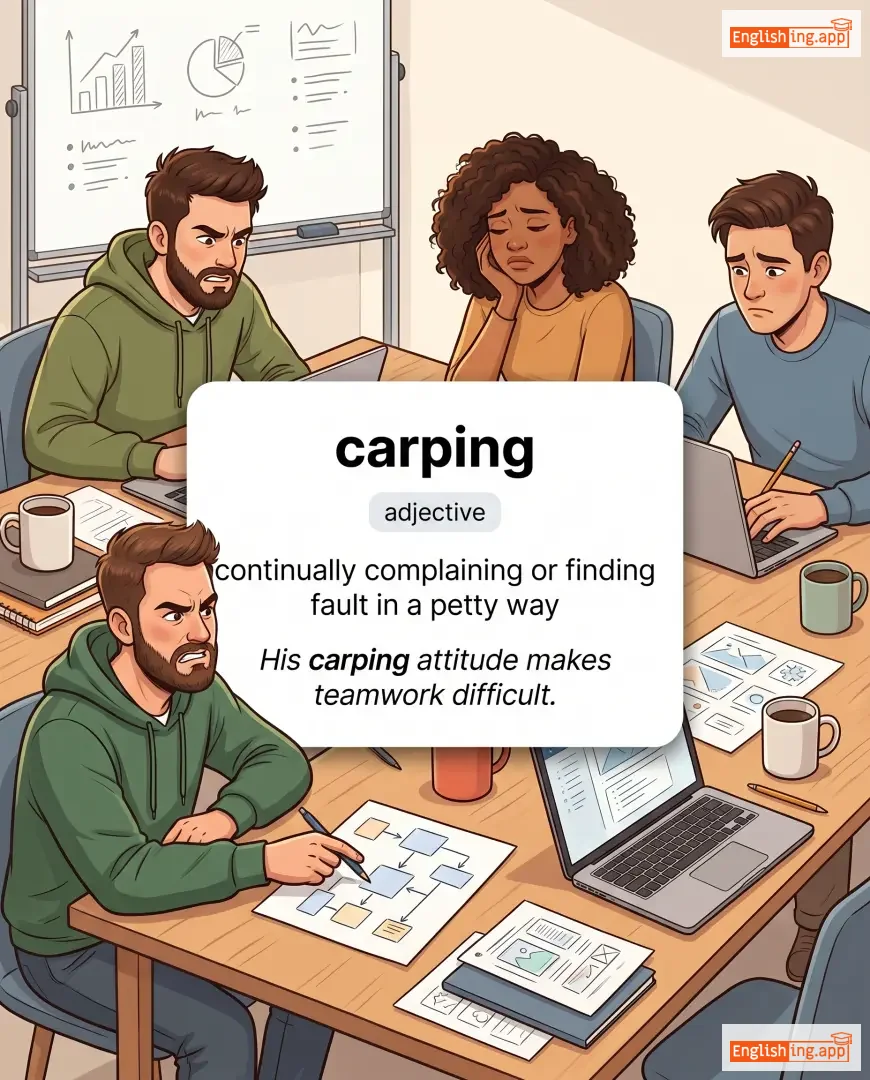
carping definition card — visual illustration of the meaning
adjective
/ˈkɑːrpɪŋ/
टांग अड़ाना (tang adana)

continually complaining or finding fault in a petty way

"His carping attitude makes teamwork difficult."

"उसका टांग अड़ाने वाला रवैया टीमवर्क को मुश्किल बनाता है।" (uska tang adane wala ravaiya teamwork ko mushkil banata hai.)
noun
/ˈkærɪdʒ/
गाड़ी (gaadi)

a vehicle, typically a four-wheeled one, used for transporting goods or people, especially in the past

"The royal family traveled in a beautiful carriage during parades."

"रॉयल फैमिली परेड के दौरान एक सुंदर गाड़ी में यात्रा करती थी।" (Royal family parade ke dauran ek sundar gaadi mein yatra karti thi.)
noun
/ˈkæriər/
वाहक (vahak)

A person or thing that carries, transports, or conveys something; also an organization that provides transport services.

"The airline is the largest carrier in the country."

"एयरलाइन देश में सबसे बड़ा वाहक है।" (Airline desh mein sabse bada vahak hai.)
noun
/ˈkæriən/
मरे हुए जानवरों का सड़ा हुआ मांस (mare hue janwaron ka sada hua maans)

the decaying flesh of dead animals

"Vultures feed on carrion left in the fields."

"गिद्ध खेतों में पड़ा मरा हुआ मांस खाते हैं।" (gidh kheton mein pada mara hua maans khate hain.)
noun
/ˈkærət/
गाजर (gajar)

a long, tapering orange root eaten as a vegetable

"She added chopped carrots to the soup."

"उसने सूप में कटी हुई गाजर डाली।" (Usne soup mein kati hui gajar daali.)
verb
/ˈkæri/
ले जाना (le jana)

To support and move something or someone from one place to another.

"She carried the bag across the street."

"उसने बैग को सड़क पार ले जाकर रखा।" (Usne bag ko sadak paar le jakar rakha.)
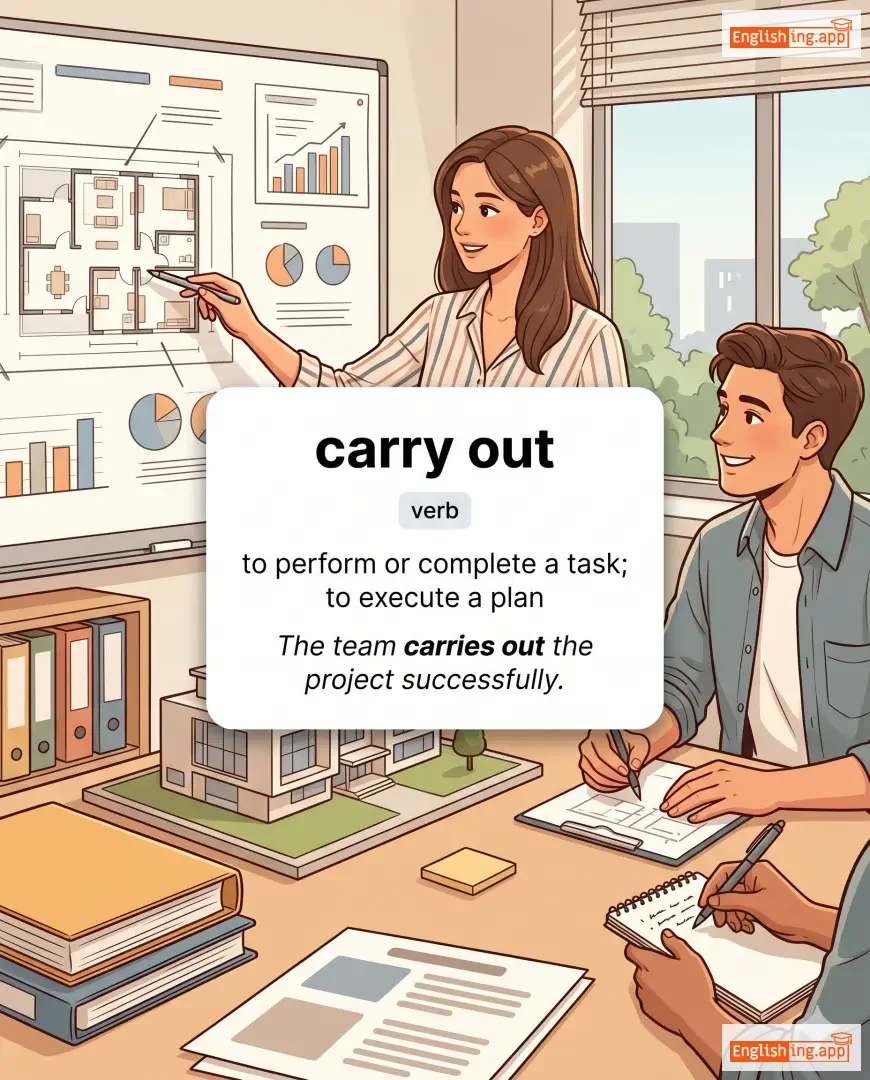
carry out definition card — visual illustration of the meaning
verb
/ˈkæri aʊt/
अंजाम देना (anjam dena)

to perform or complete a task; to execute a plan

"The team carries out the project successfully."

"टीम ने परियोजना को सफलता से पूरा किया।" (Teem ne pariyojna ko safalta se poora kiya.)
noun
/kɑːrt/
कार्ट (kaart)

a vehicle with wheels that is pulled by a person or animal for carrying goods

"The farmer loaded hay onto the cart."

"किसान ने घास को कार्ट में लादा।" (Kisaan ne ghaas ko kaart mein laada.)
noun
/ˌkɑːrt ˈblɑːnʃ/
पूर्ण स्वतंत्रता (kart blansh)

complete freedom to act as one wishes

"The manager gave her team carte blanche to design the project."

"प्रबंधक ने उसकी टीम को परियोजना डिज़ाइन करने के लिए पूरी स्वतंत्रता दे दी।" (Prabandhak ne uski team ko pariyojana dizain karne ke liye poori swatantra de di.)
noun
/ˈkɑːrtɪlɪdʒ/
उपास्थि (upasthi)

A firm, flexible connective tissue found in various parts of the body such as joints, ear, and nose.

"The doctor explained that the injury damaged the cartilage in his knee."

"डॉक्टर ने बताया कि चोट ने उसके घुटने के उपास्थि को नुकसान पहुँचाया।" (Doktar ne bataya ki chot ne uske ghoomne ke upasthi ko nuksan pahunchaya.)
noun
/kɑːrˈtɒɡrəfər/
मानचित्रकार (manchitrakar)

A person who makes maps.

"The cartographer carefully drew the map of the new territory."

"कार्टोग्राफ़र ने नए क्षेत्र का मानचित्र सावधानी से खींचा।" (Cartographer ne naye kshetra ka manchitra saavdhani se kheenchha.)
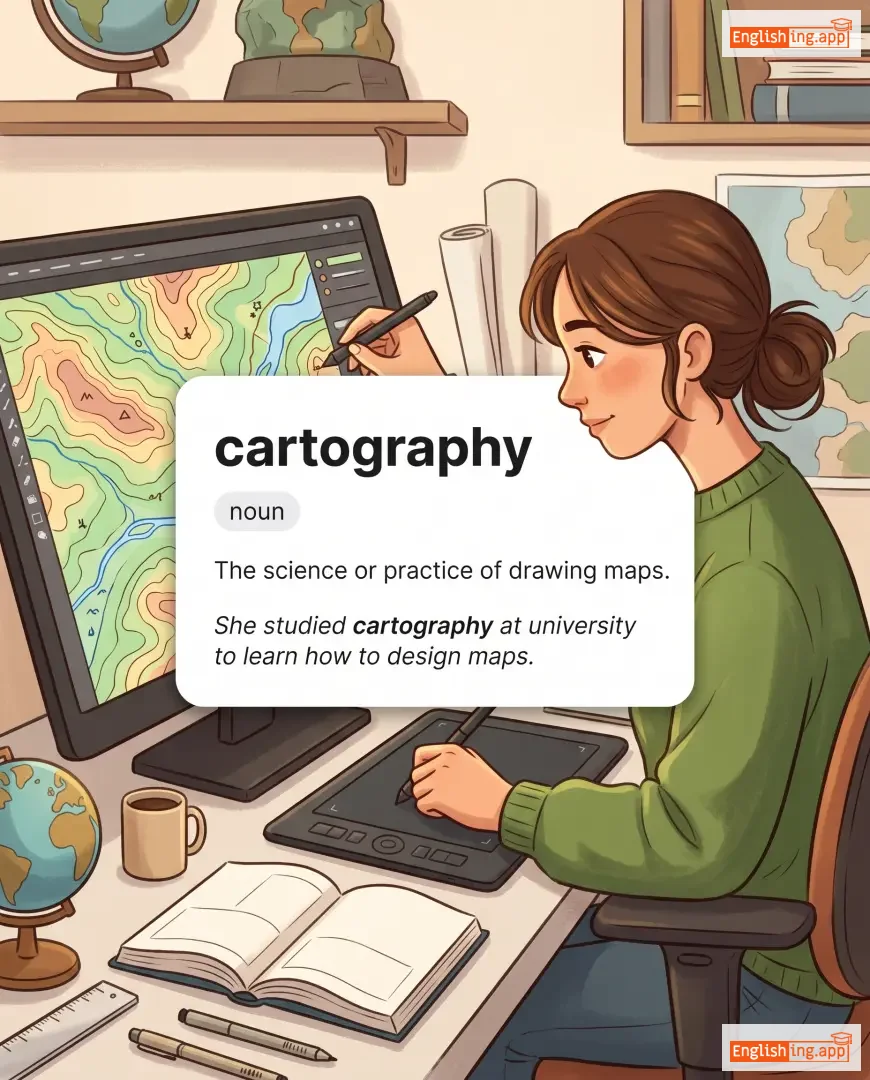
cartography definition card — visual illustration of the meaning
noun
/kɑːrˈtɒɡrəfi/
मानचित्रशास्त्र (manchitrashastra)

The science or practice of drawing maps.

"She studied cartography at university to learn how to design maps."

"उसने विश्वविद्यालय में मानचित्रशास्त्र का अध्ययन किया ताकि नक्शे डिजाइन करना सीख सके।" (Usne vishwavidyalay mein manchitrashastra ka adhyayan kiya taaki nakshhe design karna seekh sake.)
noun
/kɑːrˈtuːn/
कार्टून (cartoon)

a humorous or animated drawing, especially one in newspapers or television

"Children love watching cartoons on TV."

"बच्चे टीवी पर कार्टून देखना पसंद करते हैं।" (Bacche TV par cartoon dekhna pasand karte hain.)
noun
/ˈkɑːrtrɪdʒ/
कार्ट्रिज (kartrij)

A container holding a substance or device, such as ink for printers or bullets for firearms.

"The printer stopped working because the ink cartridge was empty."

"प्रिंटर काम करना बंद कर दिया क्योंकि स्याही का कार्ट्रिज खाली था।" (Printer kaam karna band kar diya kyonki syahi ka cartridge khaali tha.)
verb
/kɑːrv/
खुदाई करना (khudai karna)

To cut or shape something, especially wood or stone, into a desired form.

"The artist carved a beautiful statue out of marble."

"कला कारीगर ने संगमरमर से एक सुंदर मूर्ति बनाई।" (Kala karigar ne sangmarmar se ek sundar moorti banayi.)
noun
/ˌkɛəriˈætɪd/
स्तंभ में उकेरी गई महिला की मूर्ति (stambh mein ukeri gayi mahila ki moorti)

A stone carving of a draped female figure, used as a supporting column in architecture.

"The ancient temple featured a caryatid holding up the roof."

"प्राचीन मंदिर में छत को सहारा देने के लिए एक स्तंभ में उकेरी गई महिला की मूर्ति थी।" (Prachin mandir mein chhat ko sahara dene ke liye ek stambh mein ukeri gayi mahila ki moorti thi.)
noun/verb
/kæˈskeɪd/
झरना, धारा (jharna, dhara)

A small waterfall or a process that occurs in stages, one after another.

"Water cascaded down the rocky slope."

"पानी चट्टानी ढलान से झरने की तरह गिर रहा था।" (Pani chattani dhalan se jharne ki tarah gir raha tha.)
noun
/keɪs/
मामला / स्थिति (mamla / sthiti)

A particular situation, occurrence, or an instance of something; also a container or covering for something.

"In this case, we should wait for further instructions."

"इस मामले में, हमें आगे के निर्देशों का इंतजार करना चाहिए।" (Is maamle mein, humein aage ke nirdeshon ka intezaar karna chahiye.)
noun
/ˈkeɪsiːn/
केसिन (kesin)

the main protein found in milk and cheese, used in food production and supplements

"Casein protein powder is popular among athletes for muscle recovery."

"केसिन प्रोटीन पाउडर एथलीटों में मांसपेशियों की रिकवरी के लिए लोकप्रिय है।" (kesin protein powder athleets mein maanspeshiyon ki recovery ke liye lokpriya hai.)
noun
/kæʃ/
नगद (nagad)

money in the form of bills or coins, not checks or credit

"She paid the bill in cash."

"उसने बिल नकद में चुकाया।" (Usne bil nakad mein chukaya.)
noun
/ˈkæʃ.uː nʌt/
काजू मेवा (kaju mewa)

a kidney-shaped nut with a creamy texture and mild flavor

"Cashew nuts are often used in cooking and as a healthy snack."

"काजू मेवा अक्सर खाना पकाने और एक स्वस्थ नाश्ते के रूप में उपयोग किए जाते हैं।" (kaju mewa aksar khana pakane aur ek swasth nashta ke roop mein upyog kiye jate hain.)
noun
/ˈkæʃuː nʌts/
काजू के मेवे (kaju ke meve)

kidney-shaped nuts from the cashew tree, commonly eaten as snacks or used in cooking

"Cashew nuts are often used in Indian sweets and curries."

"काजू के मेवे भारतीय मिठाइयों और करी में अक्सर इस्तेमाल होते हैं।" (kaju ke meve bhartiya mithaiyon aur kari mein aksar istemal hote hain.)
noun
/kæˈʃɪər/
कॅशियर (cashier)

a person who handles payments and transactions in a store or bank

"The cashier scanned all the items and calculated the total bill."

"कैशियर ने सभी आइटम स्कैन किए और कुल बिल की गणना की।" (cashier ne sabhi aaitam scan kiye aur kul bil ki ganana ki.)
noun
/ˈkeɪ.sɪŋ/
कवर; खोल (kavar, khol)

a cover or shell that protects or encloses something

"The mechanic removed the engine casing to examine the internal parts."

"मैकेनिक ने आंतरिक हिस्सों का परीक्षण करने के लिए इंजन का कवर हटाया।" (mekanik ne aantarik hisson ka parikshan karne ke liye engine ka kavar hataaya.)
noun
/kəˈsiːnoʊ/
कैसिनो (casino)

a place where people gamble and play games of chance

"They spent the evening playing cards at the casino."

"उन्होंने शाम को कैसिनो में ताश खेलते हुए बिताई।" (Unhone shaam ko casino mein taash khelte huye bitayi.)