वोकैबुलरीज

इंग्लिश वोकैबुलरी डिस्कवर, लर्न और मास्टर करें

noun
/krʊk/
धोखेबाज़ (dhokhebaaz)

a dishonest person, especially a criminal

"The police finally caught the crook who had been stealing cars."

"पुलिस ने अंततः उस धोखेबाज़ को पकड़ लिया जो कारें चुरा रहा था।" (Police ne antatah us dhokhebaaz ko pakad liya jo kaarein chura raha tha.)
verb
/kruːn/
नर्म, धीमी और कोमल आवाज़ में गाना या गुनगुनाना (narm, dheemi aur komal awaaz mein gaana ya gungunana)

to sing or hum in a soft, low, and gentle voice

"She crooned a lullaby to help the baby fall asleep."

"वह बच्चे को सोने में मदद करने के लिए एक लोरी गा रही थी।" (Wah bachche ko sone mein madad karne ke liye ek lori gaa rahi thi.)
noun
/krɒp/
फसल (fasal)

plants that are grown and harvested for food or other use

"The farmers harvested their rice crop in autumn."

"किसानों ने शरद ऋतु में अपनी चावल की फसल काटी।" (Kisaano ne sharad ritu mein apni chawal ki fasal kaatee.)
verb
/krɒs/
पार होना (paar hona)

to go from one side to another, or to pass through

"We crossed the river using a wooden bridge."

"हमने लकड़ी के पुल का उपयोग करके नदी को पार किया।" (Hamne lakdi ke pul ka upyog karke nadi ko paar kiya.)
verb
/ˈkrɒs.briːd/
संकरित करना (sankrit karna)

to produce an animal or plant by mating two different breeds, varieties, or species

"Farmers crossbreed cows to improve milk production."

"किसान गायों को दूध उत्पादन बढ़ाने के लिए क्रॉसब्रीड करते हैं।" (Kisan gaayon ko doodh utpadan badhane ke liye crossbreed karte hain.)
adverb
/ˈkrɒswaɪz/
आड़ा-तिरछा (aada-tircha)

in the form of a cross; diagonally across

"Place the logs crosswise to build a stable fire."

"एक स्थिर आग बनाने के लिए लकड़ियों को आड़ा-तिरछा रखें।" (ek sthir aag banane ke liye lakdiyon ko aada-tircha rakhen)
adjective
/ˈkrɒtʃ.ə.ti/
चिढ़चिढ़ा (chidhchidhā)

bad-tempered, easily annoyed, and often complaining

"The crotchety old man yelled at the children for playing near his house."

"चिढ़चिढ़े बूढ़े आदमी ने बच्चों को अपनी घर के पास खेलने के लिए डांटा।" (Chidhchidhē bōṛhē ādmī nē bachōn kō apnī ghar kē paas khēlnē kē liye ḍāntā.)
verb
/kraʊtʃ/
झुका हुआ (jhuka hua)

to bend your knees and lower your body close to the ground

"The cat crouched before leaping at its prey."

"बिल्ली शिकार पर कूदने से पहले झुकी हुई थी।" (Billi shikar par koodne se pehle jhuki hui thi.)
noun
/kroʊ/
कौआ (kaua)

a large black bird known for its intelligence and harsh call

"The crow cawed loudly from the tree branch."

"कौआ ग़ुस्से में ग़ज़ब की आवाज़ में डाल से चिल्लाया।" (Kaua gusse mein gazab ki awaaz mein daal se chillaya.)
noun
/ˈkroʊ.bɑːr/
क्रोबार (krobar)

a heavy iron bar with a curved end used as a lever for prying things apart

"He used a crowbar to remove the old nails."

"उसने पुराने कीलें निकालने के लिए क्रोबार का उपयोग किया।" (usne purane keele nikaalne ke liye krobar ka upyog kiya.)
noun
/kraʊd/
भीड़ (bhir)

a large number of people gathered together

"A huge crowd gathered to watch the concert."

"कन्सर्ट देखने के लिए एक बड़ी भीड़ जमा हो गई।" (Concert dekhne ke liye ek badi bhir jama ho gayi.)
🚶‍♂️🚶‍♀️

crowded (हैपीनेस)

adjective
/ˈkraʊdɪd/
ख़ुशी (khushi)

filled with too many people or things

"The bus was so crowded that I could hardly move."

"जब उसने पुरस्कार प्राप्त किया, तो वह अपनी खुशी को छिपा नहीं सकी।" (Jab usne puraskar prapt kiya, to vah apni khushi ko chhupa nahi saki.)
noun
/kraʊn/
मुकुट (mukut)

a circular ornamental headdress worn by a monarch as a symbol of authority

"The king wore his golden crown at the ceremony."

"राजा ने समारोह में अपनी सोने की मुकुट पहनी।" (Raja ne samarooh mein apni sone ki mukut pehni.)
crucial definition card — visual illustration of the meaning
adjective
/ˈkruːʃəl/
महत्वपूर्ण (mahatvapurn)

extremely important or necessary

"Trust is crucial for a strong relationship."

"एक मजबूत रिश्ते के लिए विश्वास महत्वपूर्ण है।" (Ek majboot rishte ke liye vishwas mahatvapurn hai.)
noun
/ˈkruːsɪbəl/
कठिन परीक्षा, धातु पिघलाने का पात्र (kathin pariksha, dhaatu pighlaane ka patra)

a severe test or trial; a container used for heating substances to very high temperatures

"The team emerged stronger from the crucible of competition."

"टीम प्रतियोगिता के क्रूसिबल से मजबूत होकर उभरी।" (Team pratiyogita ke crucible se majboot hokar ubhri.)
adjective
/kruːd/
कच्चा (kaccha)

in a natural or raw state; not yet processed or refined

"The crude oil is processed into fuel and chemicals."

"कच्चा तेल ईंधन और रसायन में संसाधित होता है।" (Kaccha tel indhan aur rasayan mein sansadhit hota hai.)
adjective
/ˈkruːəl/
क्रूर (kroor)

Willfully causing pain or suffering to others, or feeling no concern about it.

"It was cruel to make fun of the injured boy."

"घायल लड़के का मजाक उड़ाना क्रूर था।" (ghayal ladke ka mazaak udaana kroor tha.)
noun
/ˈkruː.əl.ti/
क्रूरता; निर्दयता; दुख पहुंचाने का व्यवहार (krurta, nirdayata, dukh pahuchane ka vyavhaar)

behavior that causes pain or suffering to others; the quality of being cruel

"The documentary exposed the cruelty of factory farming to animals."

"डॉक्यूमेंट्री ने फैक्ट्री फार्मिंग द्वारा जानवरों पर की जाने वाली क्रूरता को उजागर किया।" (dokyumentri ne factory farming dwara janwaron par ki jaane wali krurta ko ujagar kiya.)
noun
/ˈkruːɪt/
छोटा पात्र (chhota patra)

a small container, especially for salt, pepper, oil, or vinegar, used at a dining table

"She filled the cruet with olive oil for the salad."

"उसने सलाद के लिए क्रूएट में जैतून का तेल डाला" (Usne salad ke liye cruet mein jaitoon ka tel dala)
🛳️

cruise

verb
/kruːz/
खुशी (khushi)

to travel smoothly at a moderate speed, especially for pleasure

"They decided to cruise along the coast during their vacation."

"जब उसे पुरस्कार मिला तो वह अपनी खुशी छिपा नहीं पाई।" (Jab use puraskar mila to wah apni khushi chhupa nahi pai.)
verb
/ˈkrʌmpəl/
मचमचाना (machmachana)

to crush something into folds or wrinkles

"He crumpled the paper and threw it in the bin."

"उसने कागज को मसल कर कूड़ेदान में फेंक दिया।" (Usne kagaz ko masal kar koodedan mein phenk diya.)
noun/verb
/kruːˈseɪd/
धर्मयुद्ध, जोरदार अभियान (dharmayudh, joradar abhiyan)

a vigorous campaign for a social, political, or religious cause; to fight passionately for a cause

"She has been crusading for women's rights all her life."

"वह महिलाओं के अधिकारों के लिए जीवन भर क्रूसेडिंग कर रही है।" (Wah mahilaon ke adhikaron ke liye jeevan bhar crusading kar rahi hai.)
verb
/krʌʃ/
कुछ इस हद तक दबाना या मरोड़ना कि वह क्षतिग्रस्त या नष्ट हो जाए (kuch is had tak dabana ya morna ki vah kshatigrast ya nasht ho jaye)

to press or squeeze something so hard that it is damaged or destroyed

"He accidentally crushed the paper cup in his hand."

"वह गलती से अपने हाथ में कागज का कप क्रश कर बैठा।" (Vah galti se apne haath mein kaagaz ka kap crush kar baitha.)
noun
/krʌst/
कठिन परत (kathin parat)

the hard outer surface of something, especially bread or the Earth's outer layer

"He cut off the crust of the bread before eating."

"उसने खाने से पहले रोटी की कठोर परत काट दी।" (Usne khane se pehle roti ki kathor parat kaat di.)
noun
/krʌˈsteɪʃən/
कठोर खोल वाले जलीय प्राणी (Kathor khol wale jaliya prani)

an aquatic animal with a hard shell, such as crabs, lobsters, and shrimps

"Crabs and lobsters are well-known crustaceans."

"केकड़े और लॉबस्टर अच्छे से प्रसिद्ध क्रस्टेशियन हैं।" (Kekde aur lobster achhe se prasiddh crustaceans hain.)
adjective
/krʌˈsteɪʃəs/
कठोर खोल जैसा (kathor kohl jaisa)

relating to or having a hard shell like a crustacean

"The scientist studied the crustaceous fossils."

"वैज्ञानिक ने कठोर खोल जैसे जीवाश्मों का अध्ययन किया।" (Vaigyanik ne kathor kohl jaise jibashmon ka adhyayan kiya.)
noun
/krʌtʃ/
लाठी, सहारा (lathi, sahara)

a support used by someone injured to walk; also something relied upon for support or help

"He had to use crutches after breaking his leg."

"उसे पैर टूटने के बाद लाठी का इस्तेमाल करना पड़ा।" (Use pair tootne ke baad lathi ka istemal karna pada.)
noun
/krʌks/
मुख्य बिंदु (mukhya bindu)

the most important or decisive point of an issue

"The crux of the problem lies in poor communication."

"समस्या का मुख्य बिंदु खराब संचार में छिपा हुआ है।" (Samasya ka mukhya bindu kharab sanchar mein chhupa hua hai.)
verb, noun
/kraɪ/
रोना (rona)

To shed tears as an expression of emotion such as sadness or pain; also a loud call or shout.

"The baby began to cry when she was hungry."

"जब बच्ची भूखी थी तो वह रोने लगी।" (Jab bachchi bhookhi thi to vah rone lagi.)
noun
/krɪpt/
समाधि कक्ष (samadhi kakkh)

an underground chamber, especially one beneath a church, used as a burial place

"The tourists explored the ancient crypt beneath the cathedral."

"पर्यटकों ने कैथेड्रल के नीचे प्राचीन समाधि कक्ष का अन्वेषण किया।" (Paryatkon ne cathedral ke neeche prachin samadhi kakkh ka anvishan kiya.)
cryptic definition card — visual illustration of the meaning
adjective
/ˈkrɪptɪk/
रहस्यमय (rahasyamay)

having a meaning that is mysterious or obscure

"She left a cryptic message on his voicemail."

"वह अपने वॉयसमेल पर एक रहस्यमय संदेश छोड़ गई।" (Wah apne voicemail par ek rahasyamay sandesh chhod gayi.)
cryptocurrency definition card — visual illustration of the meaning
noun
/ˌkrɪptəˈkʌrənsɪ/
डिजिटल मुद्रा (digital mudra)

A digital currency in which transactions are verified and records maintained by a decentralized system

"Cryptocurrencies are revolutionizing the financial landscape."

"क्रिप्टोकरेन्सी वित्तीय परिदृश्य में क्रांति ला रही हैं।" (Cryptocurrency vittiya paridrishya mein kranti la rahi hain.)
noun
/ˈkrɪptəɡræm/
गोपनीय कोड (gopniya kod)

a text written in code or cipher

"The detective solved the cryptogram hidden in the letter."

"जासूस ने पत्र में छिपे क्रिप्टोग्राम को हल किया।" (Jasoos ne patra mein chhipe cryptogram ko hal kiya.)
cryptographic definition card — visual illustration of the meaning
adjective
/ˌkrɪp.təˈɡræf.ɪk/
सांकेतिक लेखन (sanketik lekhan)

Relating to cryptography; involving or using secret codes or ciphers for security.

"Banks use cryptographic technology to protect transactions."

"बैंक्स लेनदेन को सुरक्षित करने के लिए क्रिप्टोग्राफिक तकनीक का उपयोग करते हैं।" (Banks lendan ko surakshit karne ke liye cryptographic takneek ka upyog karte hain.)
cryptography definition card — visual illustration of the meaning
noun
/krɪpˈtɒɡ.rə.fi/
गोपनीयता संरक्षण या एन्क्रिप्शन तकनीक (gopaneeyata sanrakshan ya encryption takneek)

The practice of securing information through encryption or coding techniques

"Modern cryptography ensures secure online transactions."

"आधुनिक क्रिप्टोग्राफी ऑनलाइन लेन-देन को सुरक्षित बनाती है।" (Aadhunik cryptography online len-den ko surakshit banati hai.)
noun
/ˈkrɪstəl/
क्रिस्टल (kristal)

a clear, transparent mineral or glass that forms a solid structure with regular patterns

"She wore a necklace made of sparkling crystal."

"उसने एक चमचमाती क्रिस्टल की हार पहनी थी।" (Usne ek chamchamati kristal ki haar pehni thi.)
verb
/ˈkrɪstəlaɪz/
क्रिस्टलाइज़ करना (krystallize karna)

to form crystals; to make an idea or plan clear and definite

"Her vague thoughts began to crystallize into a solid plan."

"उसकी अस्पष्ट सोचें एक ठोस योजना में क्रिस्टलाइज़ होने लगीं।" (Uski aspasht sochen ek thos yojna mein krystallize hone lagi.)
noun
/kʌb/
शावक (shavak)

a young bear, lion, tiger, or other large carnivorous mammal

"The bear cub stayed close to its mother for protection."

"भालू का शावक अपनी माँ के पास सुरक्षा के लिए रहा।" (bhaloo ka shaavak apni maan ke paas suraksha ke liye raha.)
adjective
/ˈkjuːbən/
क्यूबन (kyuban)

relating to Cuba, its people, or its culture

"We enjoyed delicious Cuban coffee at the café."

"हमने कैफे में स्वादिष्ट क्यूबन कॉफ़ी का आनंद लिया।" (Hamne cafe mein swadisht kyuban coffee ka anand liya.)
noun, verb
/kjuːb/
घन (ghan)

As a noun: a solid object with six equal square faces. As a verb: to cut food into small square pieces.

"She put a sugar cube in her tea."

"वह अपनी चाय में चीनी का एक क्यूब डाल रही थी।" (Vah apni chai mein cheeni ka ek cube daal rahi thi.)
noun
/ˈkjuːbeb ˈpepər/
क्यूब पेपर (kyub pepar)

aromatic spice with a slightly bitter taste and cooling aftertaste

"Cubeb pepper is used in traditional Indonesian cuisine."

"क्यूब पेपर पारंपरिक इंडोनेशियाई व्यंजन में इस्तेमाल होता है।" (kyub pepar paramparik indoneshiyai vyanjan mein istemal hota hai)
noun
/ˈkjuː.bɪ.kəl/
छोटा कक्ष (chhota kaksh)

A small partitioned-off area of a room, typically in an office.

"She works in a cubicle with three other colleagues."

"वह तीन अन्य सहकर्मियों के साथ एक क्यूबिकल में काम करती है।" (Wah teen anya sahakarmiyon ke saath ek cubicle mein kaam karti hai.)
noun
/ˈkʊk.uː/
कोयल (koyal)

a bird known for its distinctive call and for laying eggs in other birds' nests

"We heard the cuckoo calling from the forest early in the morning."

"हमने सुबह-सुबह जंगल से कुकू का आवाज सुनी।" (hamne subah-subah jangal se kkoo ka awaaz suni.)
noun
/ˈkjuː.kʌm.bər/
खीरा (kheera)

a long green vegetable with watery flesh, eaten raw in salads or cooked

"I added fresh cucumber slices to my salad."

"मैंने अपनी सलाद में ताजे क्यूकंबर के टुकड़े डाले।" (maine apni salad mein taje kyoombar ke tukde daale.)
noun/verb
/ˈkʌdʒ.əl/
लाठी (lathi)

A short, thick stick used as a weapon; to beat with a cudgel.

"The guard used a cudgel to chase away the thief."

"गार्ड ने चोर को भगाने के लिए लाठी का इस्तेमाल किया।" (Garde ne chor ko bhagane ke liye lathi ka istemal kiya.)
noun/verb
/kjuː/
संकेत (sanket)

A signal or prompt for action; to give a signal.

"The actor waited for his cue before entering the stage."

"अभिनेता मंच पर प्रवेश करने से पहले अपने संकेत का इंतजार कर रहा था।" (Abhinetā manch par pravesh karne se pehle apne sanket ka intezār kar rahā thā.)
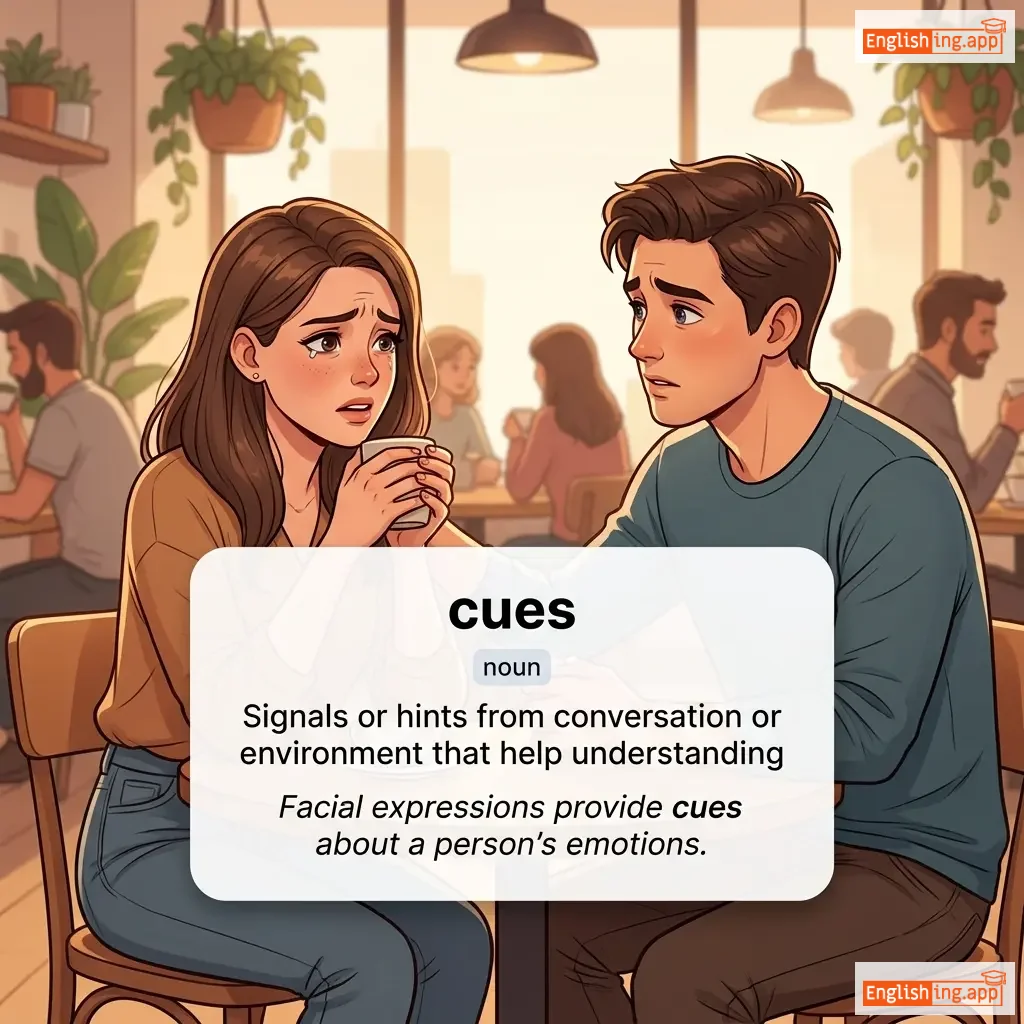
cues definition card — visual illustration of the meaning
noun
kjuːz
संकेत (sanket)

Signals or hints from conversation or environment that help understanding

"Facial expressions provide cues about a person's emotions."

"चेहरे के हाव-भाव एक व्यक्ति के इमोशन्स के बारे में संकेत देते हैं।" (Chehre ke haav-bhaav ek vyakti ke emotions ke baare mein sanket dete hain.)
noun
/kwɪˈziːn/
व्यंजन (vyanjan)

A style or method of cooking, especially characteristic of a particular country or region.

"Italian cuisine is famous all over the world."

"इतालवी व्यंजन दुनिया भर में प्रसिद्ध है।" (Itali vyanjan duniya bhar mein prasiddh hai.)
noun
/ˌkʌl də ˈsæk/
अंतिम सड़क (antim sadak)

A street or passage closed at one end; a dead end.

"They bought a house at the end of a quiet cul de sac."

"उन्होंने एक शांत अंतिम सड़क के अंत में एक घर खरीदा।" (Unhone ek shant antim sadak ke ant mein ek ghar kharida.)
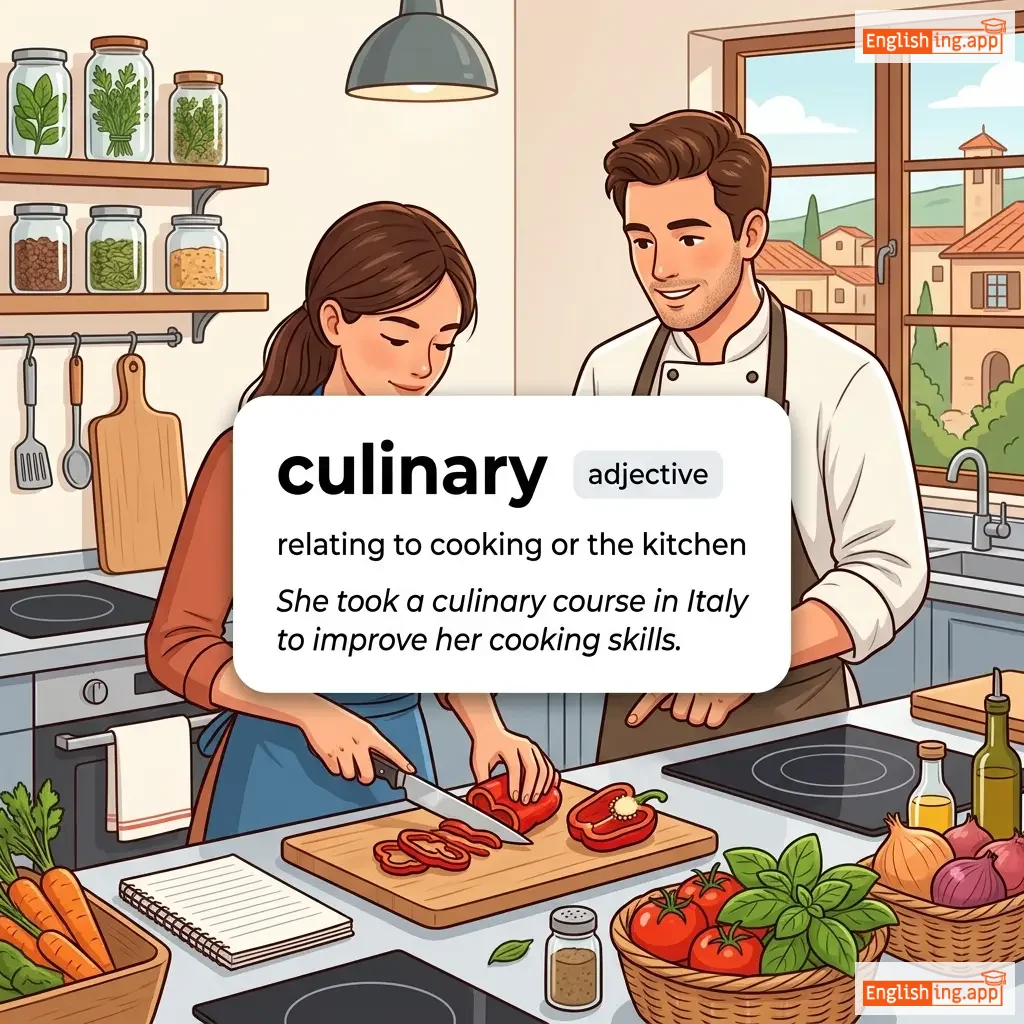
culinary definition card — visual illustration of the meaning
adjective
/ˈkʌl.ɪ.nɛr.i/
कुलिनरी (kulinary)

relating to cooking or the kitchen

"She took a culinary course in Italy to improve her cooking skills."

"वह अपनी कुकिंग कौशल को सुधारने के लिए इटली में एक कुलिनरी कोर्स कर रही थी।" (Wah apni cooking kaushal ko sudharne ke liye Italy mein ek culinary course kar rahi thi.)