वोकैबुलरीज

इंग्लिश वोकैबुलरी डिस्कवर, लर्न और मास्टर करें

verb
/ˈkɒsɪt/
अत्यधिक देखभाल करना (atyadhik dekbhal karna)

to care for and protect in an overindulgent way

"The little girl was cosseted by her grandparents."

"छोटी लड़की को उसके दादा-दादी ने बहुत स्नेह दिया।" (Chhoti ladki ko uske dada-dadi ne bahut sneh diya.)
adjective
/ˈkɒs.ɪ.tɪd/
अत्यधिक देखभाल से पाला गया (atyadhik dekhbhal se pala gaya)

pampered, treated with excessive care and attention

"The cosseted child always got what he wanted."

"अत्यधिक देखभाल से पला हुआ बच्चा हमेशा वही प्राप्त करता था जो वह चाहता था।" (Atyadhik dekhbhal se pala hua bachcha hamesha wahi prapt karta tha jo wah chahta tha.)
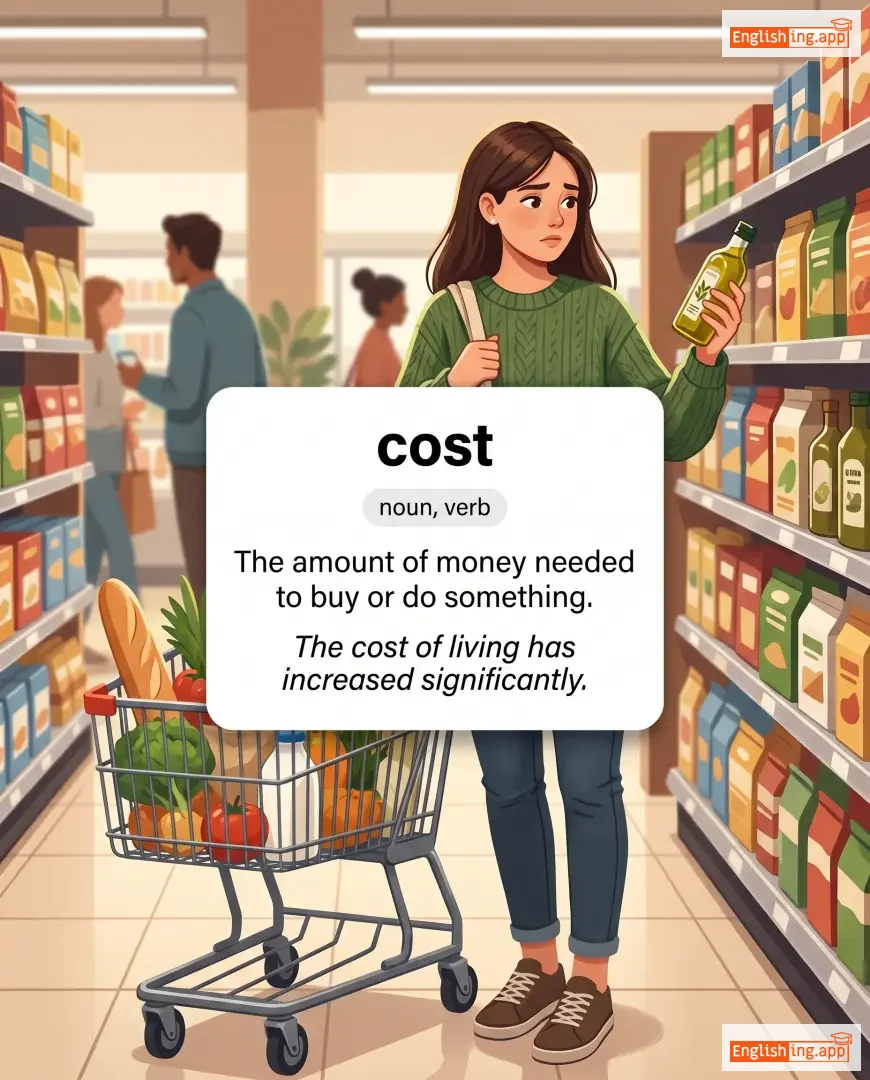
cost definition card — visual illustration of the meaning
noun, verb
/kɒst/
खर्च (kharch)

The amount of money needed to buy or do something.

"The cost of living has increased significantly."

"जीवनयापन की लागत में महत्वपूर्ण वृद्धि हुई है।" (Jeevanyapan ki lagat mein mahatvapurn vruddhi hui hai.)
cost-efficient definition card — visual illustration of the meaning
adjective
/ˌkɒst.ɪˈfɪʃ.ənt/
लागत-प्रभावी (laagat-prabhavi)

Achieving maximum productivity with minimum wasted effort or expense.

"Cost-efficient solutions benefit industries."

"लागत-प्रभावी समाधान उद्योगों को लाभ पहुंचाते हैं।" (Laagat-prabhavi samadhan udyogon ko labh pahuchate hain.)
adjective
/ˈkɔːstli/
महंगा (mahinga)

expensive or causing a lot of money, time, or effort

"Their mistake proved to be very costly for the company."

"उनकी गलती कंपनी के लिए बहुत महंगी साबित हुई।" (Unki galti company ke liye bahut mahangi sabit hui.)
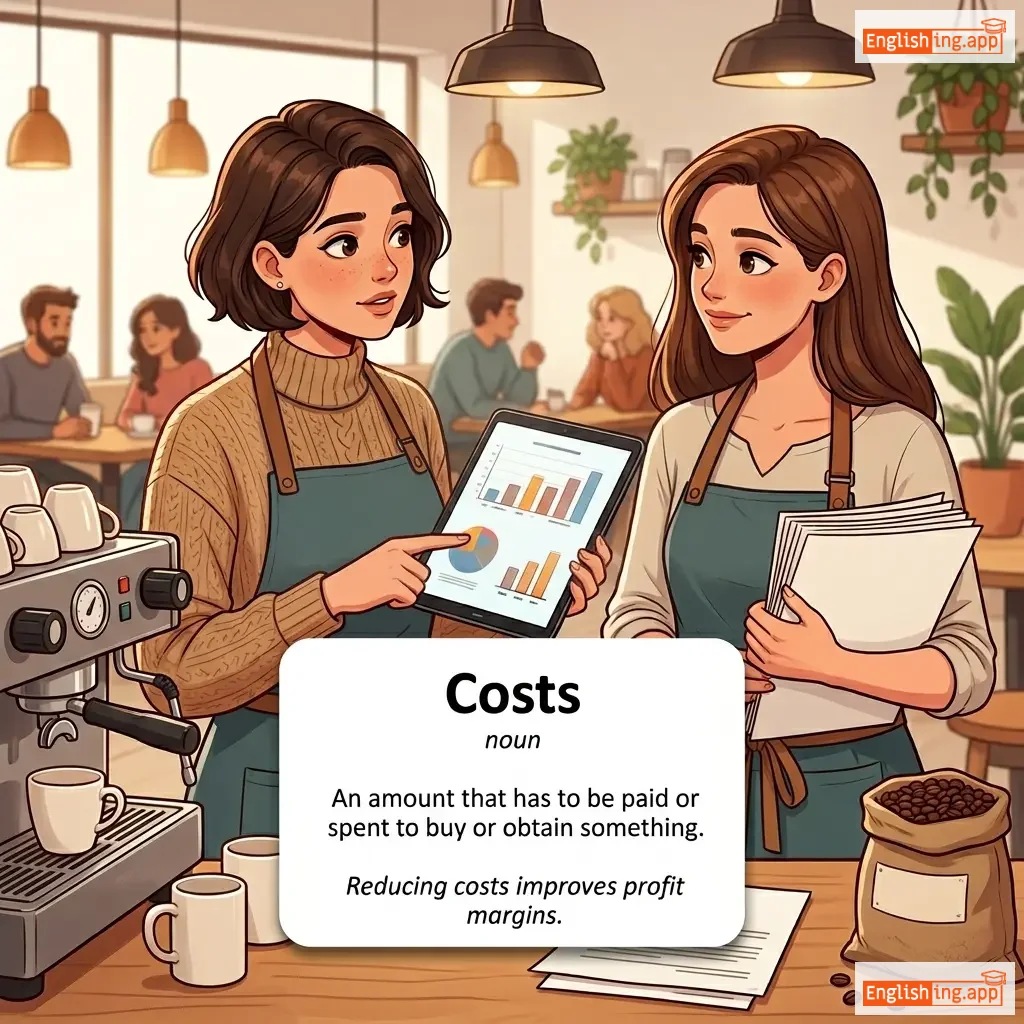
Costs definition card — visual illustration of the meaning
noun
kɒsts
लागत (laagat)

An amount that has to be paid or spent to buy or obtain something.

"Reducing costs improves profit margins."

"लागत कम करने से लाभ की सीमा में सुधार होता है।" (Laagat kam karne se laabh ki seema mein sudhaar hota hai.)
noun
/ˈkɒstjuːm/
पोशाक (poshak)

a set of clothes worn to represent a particular character, culture, or occasion

"She wore a beautiful costume for the Halloween party."

"उसने हैलोवीन पार्टी के लिए एक खूबसूरत पोशाक पहना।" (Usne Halloween party ke liye ek khoobsurat poshak pehna.)
noun
/kɒt/
पालना (kot)

a small bed, especially a portable one or one for a baby

"The baby sleeps peacefully in her cot."

"बच्ची अपनी पालना में शांति से सोती है।" (bachchi apni palna me shanti se soti hai.)
noun
/ˈkoʊ.tə.ri/
एक छोटा, विशेष समूह (ek chhota, vishesh samuh)

a small, exclusive group of people with shared interests

"He belonged to a coterie of artists who met every Friday."

"वह उन कलाकारों के एक समूह का हिस्सा था जो हर शुक्रवार मिलते थे।" (Wah un kalakaron ke ek samuh ka hissa tha jo har shukravaar milte the.)
adjective
/koʊˈtɜːr.mɪ.nəs/
समान सीमाएँ (samaan seemaayein)

having the same boundaries or extent in space, time, or meaning

"The two jurisdictions are coterminous, sharing the same borders."

"दो न्याय क्षेत्र कोटर्मिनस हैं, जो समान सीमाओं को साझा करते हैं।" (Do nyaay kshetra koterminus hain, jo samaan seemaon ko saanjha karte hain.)
noun
/ˈkɒtɪdʒ/
कुटिया (kutiya)

a small simple house, typically in the countryside

"They spent their vacation in a cozy cottage by the lake."

"उन्होंने झील के पास एक आरामदायक कुटिया में अपनी छुट्टियाँ बिताईं।" (Unhone jheel ke paas ek aaramdayak kutiya mein apni chhuttiyan bitayi.)
noun
/ˈkɒtən/
खुशी (khushi)

A soft white fibrous substance used to make cloth and thread.

"This shirt is made of pure cotton."

"उसे पुरस्कार मिलने पर अपनी खुशी छुपानी नहीं आई।" (Use puraskar milne par apni khushi chhupani nahi aayi.)
noun
/ˈkɒt.ən ˈfæb.rɪk/
कॉटन कपड़ा (kottan kapda)

textile made from cotton fibers, known for being soft, breathable, and comfortable

"Cotton fabric is perfect for summer clothing."

"कॉटन कपड़ा गर्मी के कपड़े के लिए आदर्श है।" (kottan kapda garmi ke kapde ke liye aadarsh hai)
noun
/kaʊtʃ/
सोफा (sofa)

a comfortable seat for two or more people, typically upholstered

"They sat on the couch and watched TV."

"वे सोफे पर बैठकर टीवी देख रहे थे।" (ve sofe par baithkar TV dekh rahe the.)
noun, verb
/kɒf/
खाँसी (khansi)

a sudden noisy release of air from the lungs to clear the throat or airway; to expel air suddenly from the lungs with a cough

"He has a bad cough and stayed home today."

"उसे तेज़ खाँसी है, इसलिए वह आज घर पर रहा।" (use tez khansi hai, isliye vah aaj ghar par raha)
modal verb
/kʊd/
कर सकता था (kar sakta tha)

Used to indicate possibility, ability, or permission in the past or as a polite suggestion.

"He could swim when he was a child."

"वह बचपन में तैर सकता था।" (Wah bachpan mein tair sakta tha.)
noun
/ˈkaʊn.səl/
कौंसिल (kaunsil)

an assembly of people chosen or elected to make decisions or advise on matters

"The city council voted to improve public transportation."

"शहर कौंसिल ने सार्वजनिक परिवहन को बेहतर बनाने के लिए मतदान किया।" (Shahar kaunsil ne sarvajanik parivahan ko behtar banane ke liye matdan kiya.)
noun
/ˈkaʊnsələr/
पार्षद (parshad)

an elected member of a local council who helps make decisions and represent the community

"The councillor spoke to residents about improving local roads."

"पार्षद ने स्थानीय सड़कों के सुधार पर बात की।" (parshad ne sthaniya sadkon ke sudhar par baat ki)
noun
/ˈkaʊnsɪlər/
काउंसलर (kaunsilar)

an elected member of a council, especially a local government body

"The councilor held a public meeting to discuss local issues."

"काउंसलर ने स्थानीय मुद्दों पर चर्चा करने के लिए एक सार्वजनिक बैठक आयोजित की।" (Kaunsilar ne sthanīya muddon par charchā karne ke liye ek sārbajanik baithak āyojit kī.)
verb
/ˈkaʊnsəl/
परामर्श देना (paramarsh dena)

to give professional advice or guidance to someone

"The teacher counseled the students on their career choices."

"शिक्षक ने छात्रों को उनके करियर विकल्पों पर परामर्श दिया।" (Shikshak ne chhatron ko unke career vikalpon par paramarsh diya.)
noun
/ˈkaʊnsəlɪŋ/
सलाहकारिता (salahkarita)

professional guidance or therapy to help resolve personal or psychological problems

"She decided to go for counseling after feeling stressed for months."

"महिलाओं को महीनों तक तनाव महसूस करने के बाद, उसने सलाहकारिता लेने का निर्णय लिया।" (Mahilaon ko mahino tak tanav mehsoos karne ke baad, usne salahkarita lene ka nirnay liya.)
noun
/ˈkaʊn.səl.ɪŋ/
परामर्श (paramarsh)

the process of giving professional guidance and support to help someone deal with personal, social, psychological, or career-related problems

"She decided to seek counselling to manage stress and anxiety."

"तनाव और चिंता को संभालने के लिए उसने परामर्श लेने का फैसला किया।" (tanaav aur chinta ko sambhalne ke liye usne paramarsh lene ka faisla kiya)
noun
/ˈkaʊnsələr/
परामर्शदाता (paramarshdata)

a person trained to give guidance on personal, social, or psychological problems; an advisor

"She spoke to a counsellor to get advice about her career."

"उसने अपने करियर के बारे में सलाह लेने के लिए एक परामर्शदाता से बात की।" (usne apne career ke baare mein salah lene ke liye ek paramarshdata se baat ki)
noun
/ˈkaʊn.səl.ər/
सलाहकार (salahkar)

a person trained to give guidance on personal, social, or psychological problems

"The school counselor helped the student deal with stress."

"स्कूल के काउंसलर ने छात्र को तनाव से निपटने में मदद की।" (School ke counselor ne chhatra ko tanav se nipatne mein madad ki.)
verb
/kaʊnt/
गिनती करना (ginti karna)

to determine the total number of something

"She carefully counted the money on the table."

"वह टेबल पर रखे पैसों को ध्यान से गिन रही थी।" (Wah table par rakhe paiso ko dhyaan se ghin rahi thi.)
noun
/ˈkaʊn.tə.nəns/
मुकाबला, अभिव्यक्ति; समर्थन (mukabla, abhibyakti; samarthan)

a person's face or expression; support or approval

"Her cheerful countenance brightened the room."

"उसका प्रसन्न चेहरा कमरे को रोशन कर दिया।" (Uska prasann chehra kamre ko roshan kar diya.)
noun
/ˈkaʊn.tər/
काउंटर (counter)

a flat surface in a shop, bank, or kitchen where transactions or work are done

"The cashier stood behind the counter."

"कैशियर काउंटर के पीछे खड़ा था।" (Cashier counter ke peeche khada tha.)
noun
/ˈkaʊn.tər kleɪm/
प्रत्यावेदन, उलट दावा (pratyavedan, ulat dawa)

a claim made to rebut a previous claim, often in legal contexts

"The defendant filed a counter-claim against the plaintiff."

"प्रतिवादी ने शिकायतकर्ता के खिलाफ एक प्रत्यावेदन दायर किया।" (Prativadi ne shikayatkarata ke khilaf ek pratyavedan daayar kiya.)
verb
/ˌkaʊntərˈækt/
प्रतिक्रियाविरोधी कार्य करना (pratikriyavirodhi karya karna)

to act against something in order to reduce its effect

"The medicine helps counteract the side effects of the treatment."

"दवा इलाज के दुष्प्रभावों को काउंटरऐक्ट करने में मदद करती है।" (Dawa ilaaj ke dushprabhavon ko counteract karne mein madad karti hai.)
verb
/ˌkaʊntərˈbæləns/
प्रतिकूल प्रभाव को संतुलित करना (pratikool prabhav ko santulit karna)

to offset or balance the effect of something

"Exercise can counterbalance the negative effects of stress."

"व्यायाम तनाव के नकारात्मक प्रभाव को संतुलित कर सकता है।" (Vyayam tanav ke nakaratmak prabhav ko santulit kar sakta hai.)
noun, verb
/ˈkaʊntərˌtʃɑːrdʒ/
प्रतिवादी आरोप (prativaadi aarop)

an opposing charge or accusation; to make an opposing attack

"The lawyer filed a countercharge against the accuser."

"वकील ने आरोपी के खिलाफ प्रतिवादी आरोप दायर किया।" (Vakeel ne aaropi ke khilaaf prativaadi aarop daayr kiya.)
adjective, verb, noun
/ˈkaʊntərfɪt/
नकल (nakal)

made to look like something genuine in order to deceive

"The police seized a batch of counterfeit currency."

"पुलिस ने नकल के नोटों का एक बैच जब्त किया।" (Polis ne nakal ke noton ka ek batch zabt kiya.)
adjective
/ˌkaʊntərɪnˈtuːɪtɪv/
विरोधाभासी (virodhabhaasi)

contrary to what one would intuitively expect

"His approach seems counterintuitive but it actually works."

"उसका तरीका विरोधाभासी लगता है, लेकिन यह वास्तव में काम करता है।" (Uska tareeka virodhabhaasi lagta hai, lekin yah vastav mein kaam karta hai.)
verb
/ˌkaʊntərˈmænd/
आदेश रद्द करना (adesh radd karna)

to revoke or cancel an order or command

"The general countermanded the previous orders immediately."

"जनरल ने तुरंत पिछले आदेशों को रद्द कर दिया।" (General ne turant pichhle aadeshon ko radd kar diya.)
noun
/ˈkaʊntərˌpɑːrt/
समकक्ष व्यक्ति (samaksh vyakti)

a person or thing that corresponds to or has the same function as another

"The CEO met with his counterpart in the partner company."

"सीईओ ने पार्टनर कंपनी में अपने समकक्ष व्यक्ति से मुलाकात की।" (CEO ne partner company mein apne samaksh vyakti se mulaqat ki.)
noun
/ˈkaʊntərˌpɔɪnt/
विपरीत बिंदु या विपरीत तर्क (vipareet bindu ya vipareet tark)

an argument, idea, or theme contrasting with another; also a musical term for independent melody

"Her calm attitude was a counterpoint to his anger."

"उसका शांत व्यवहार उसके गुस्से का विपरीत था।" (Uska shant vyavhaar uske gusse ka vipareet tha.)
counterproductive definition card — visual illustration of the meaning
adjective
/ˌkaʊntərprəˈdʌktɪv/
विपरीत प्रभावी (viparit prabhavi)

having the opposite of the desired effect; harmful to achieving goals

"Skipping breakfast is counterproductive to your energy levels."

"नाश्ता छोड़ना आपकी ऊर्जा स्तर के लिए विपरीत प्रभावी है।" (Nashta chhodna aapki urja star ke liye viparit prabhavi hai.)
verb
/ˌkaʊntərˈveɪl/
प्रभाव को विपरीत करना (prabhav ko vipareet karna)

to offset or counteract the effect of something

"The benefits of the new policy countervail its drawbacks."

"नई नीति के लाभ इसके नुकसान के प्रभाव को उलट देते हैं।" (Nayi neeti ke laabh iske nuksan ke prabhav ko ulat dete hain.)
noun
/ˈkaʊntɪŋˌhaʊs/
लेखा रखने का कार्यालय (lekha rakhne ka karyalaya)

a business office where accounts are kept and financial transactions are managed

"The merchant spent most of his day in the counting-house reviewing ledgers."

"व्यापारी ने अपना अधिकांश समय लेखा रखने के कार्यालय में खाता-पुस्तकें समीक्षा करने में बिताया।" (Vyapari ne apna adhikansh samay lekha rakhne ke karyalaya mein khata-pustakein sameeksha karne mein bitaya.)
adjective
/ˈkaʊntləs/
गिनती नहीं की जा सकती (ginti nahi ki ja sakti)

too many to be counted; innumerable

"There are countless stars in the sky."

"आसमान में अनगिनत तारे हैं।" (Aasman mein anginat tare hain.)
noun
/ˈkʌn.tri/
देश (desh)

a nation with its own government and borders

"Bangladesh is a beautiful country with rich culture."

"भारत एक सुंदर देश है जिसकी समृद्ध संस्कृति है।" (Bharat ek sundar desh hai jiske samriddh sanskriti hai.)
noun
/ˈkʌntrɪmən/
देशवासी (deshvasi)

a person from one's own country or rural area

"He was proud to meet a fellow countryman at the international conference."

"उसे अंतर्राष्ट्रीय सम्मेलन में एक सहदेशवासी से मिलकर गर्व हुआ।" (Use antarraashtreey sammelan mein ek sahdeshvasi se milkar garv hua.)
noun
/ˈkʌntrisaɪd/
ग्रामीण इलाका (gramin ilaka)

land outside cities and towns; rural areas with farms, fields, and villages

"She enjoys the peace and beauty of the countryside."

"वह ग्रामीण इलाके की शांति और सुंदरता का आनंद लेती है।" (vah gramin ilake ki shanti aur sundarta ka anand leti hai)
noun
/ˈkaʊnti/
जिला (zila)

A territorial division within a country, typically a region with its own local government.

"She grew up in a small county in northern England."

"वह उत्तर इंग्लैंड के एक छोटे जिले में पली-बढ़ी।" (vah uttar England ke ek chhote zile mein pali-badhi.)
noun
/kuː/
कूप (koop)

a sudden, decisive action that brings about a change, especially in government

"The military staged a coup to overthrow the existing regime."

"सैन्य ने मौजूदा शासन को उखाड़ फेंकने के लिए एक कूप किया।" (Sainya ne maujooda shasan ko ukhad fenkne ke liye ek koop kiya.)
noun
/ˈkʌpəl/
जोड़ा (joda)

two people or things considered together; a pair

"They make a lovely couple and have been married for five years."

"वे एक सुंदर जोड़ी बनाते हैं और पाँच सालों से शादीशुदा हैं।" (Ve ek sundar jodi banate hain aur paanch salon se shaadishuda hain.)
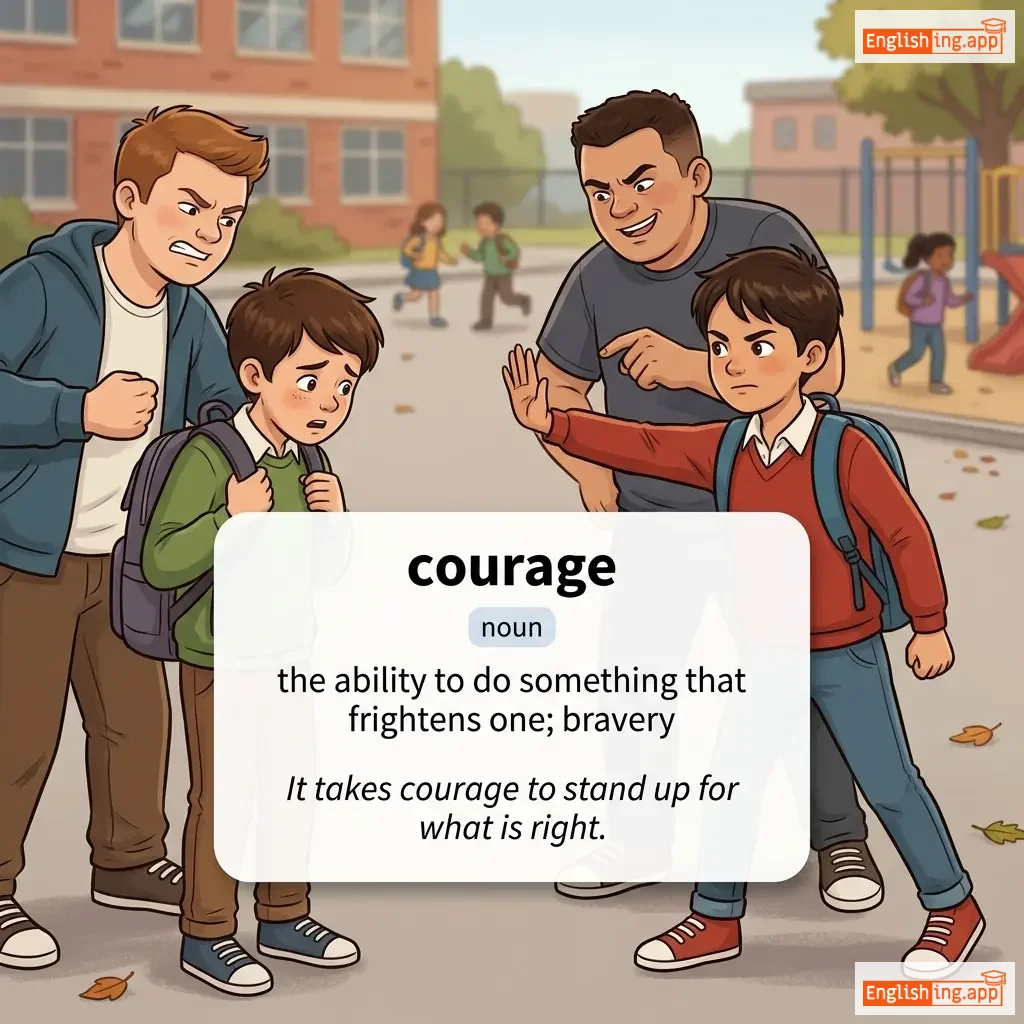
courage definition card — visual illustration of the meaning
noun
/ˈkʌrɪdʒ/
साहस (sahas)

the ability to do something that frightens one; bravery

"It takes courage to stand up for what is right."

"जो सही है उसके लिए खड़ा होने में साहस लगता है।" (Jo sahi hai uske liye khada hone mein sahas lagta hai.)
adjective
/kəˈreɪdʒəs/
साहसी (sahasi)

having or showing bravery; able to face danger or difficulty

"The firefighter was courageous as he rescued the children from the burning building."

"अग्निशामक अधिकारी साहसी थे जब उन्होंने जलती हुई इमारत से बच्चों को बचाया।" (Agnishamak adhikari sahasi the jab unhone jalti hui imarat se bachon ko bachaya.)
noun
/ˈkʊriər/
संदेशवाहक (sandeshwahaak)

a person or company that delivers messages, packages, or mail

"The courier delivered the documents on time."

"कूरियर ने समय पर दस्तावेज़ पहुँचाए।" (Courier ne samay par dastavez pahuchaye.)
noun
/kɔːrs/
कोर्स, पाठ्यक्रम या रास्ता (course, path ya pathyakram)

a direction, path, or a set of educational lessons

"She enrolled in a computer science course."

"वह कंप्यूटर विज्ञान के कोर्स में नामांकित हुई।" (Woh computer vigyan ke course mein naamankit hui.)