वोकैबुलरीज

इंग्लिश वोकैबुलरी डिस्कवर, लर्न और मास्टर करें

noun
/kənˈtʃɛrtoʊ/
संगीत रचना (sangeet rachna)

a musical composition for one or more solo instruments accompanied by an orchestra

"She played a Mozart concerto with the orchestra."

"उसने ऑर्केस्ट्रा के साथ एक मोजार्ट कॉनसर्टो बजाया।" (Usne orchestra ke saath ek Mozart concerto bajaya.)
noun
/kənˈsɛʃən/
सहमति (sahamati)

something that is granted, especially in response to demands; a compromise

"The company made several concessions during the negotiations."

"कंपनी ने बातचीत के दौरान कई सहमतियाँ दीं।" (Company ne baatcheet ke dauran kai sahmatiyan din.)
noun
/kɑːntʃ/
शंख (shankh)

a large spiral shell, often used as a trumpet in ceremonies

"The priest blew the conch to begin the ritual."

"पुजारी ने अनुष्ठान शुरू करने के लिए शंख बजाया।" (Pujari ne anushthan shuru karne ke liye shankh bajaya.)
verb
/kənˈsɪlieɪt/
सुलह करना (sulah karna)

to stop someone from being angry; to win over by friendly acts

"He tried to conciliate the angry customer with an apology."

"उसने गुस्साए ग्राहक को माफी से शांत करने की कोशिश की।" (Usne gussaaye grahak ko maafi se shaant karne ki koshish ki.)
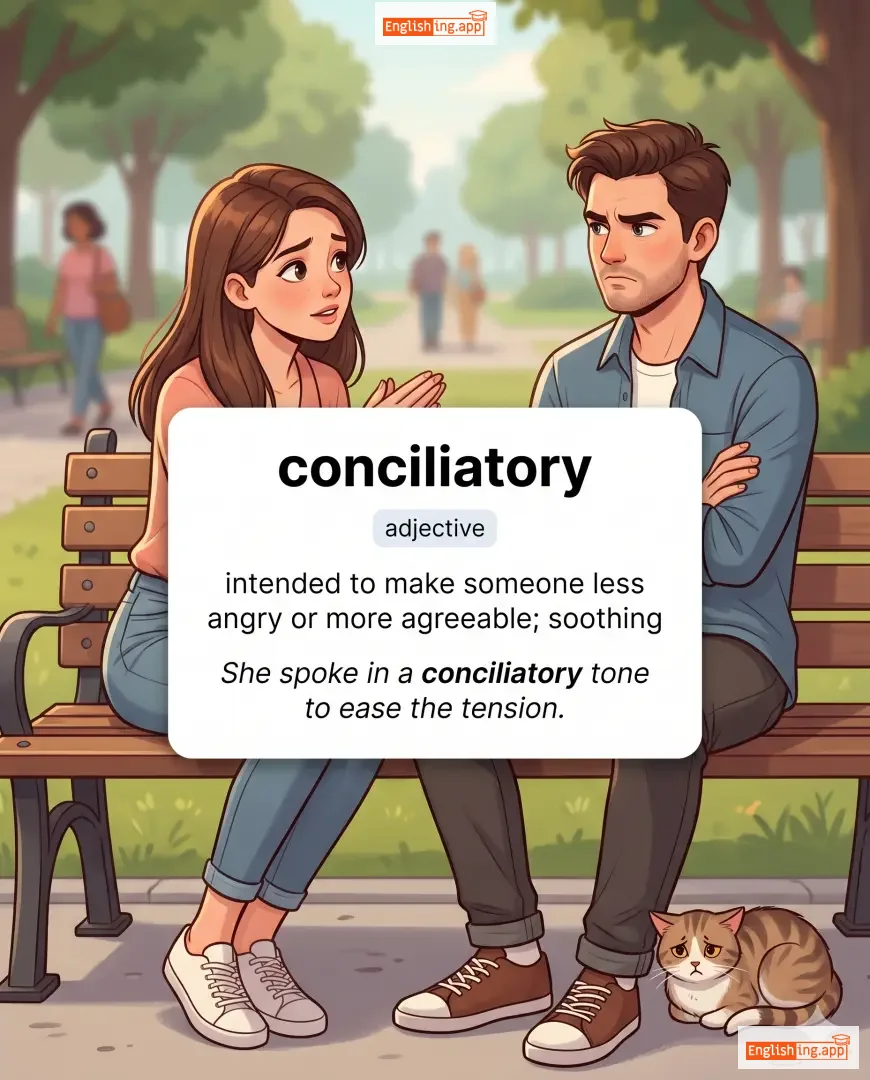
conciliatory definition card — visual illustration of the meaning
adjective
/kənˈsɪliətɔːri/
मेलमिलाप करने वाला (melmilaap karne wala)

intended to make someone less angry or more agreeable; soothing

"She spoke in a conciliatory tone to ease the tension."

"उसने तनाव को कम करने के लिए मेलमिलाप करने वाले अंदाज में बात की।" (Usne tanav ko kam karne ke liye melmilaap karne wale andaaz mein baat ki.)
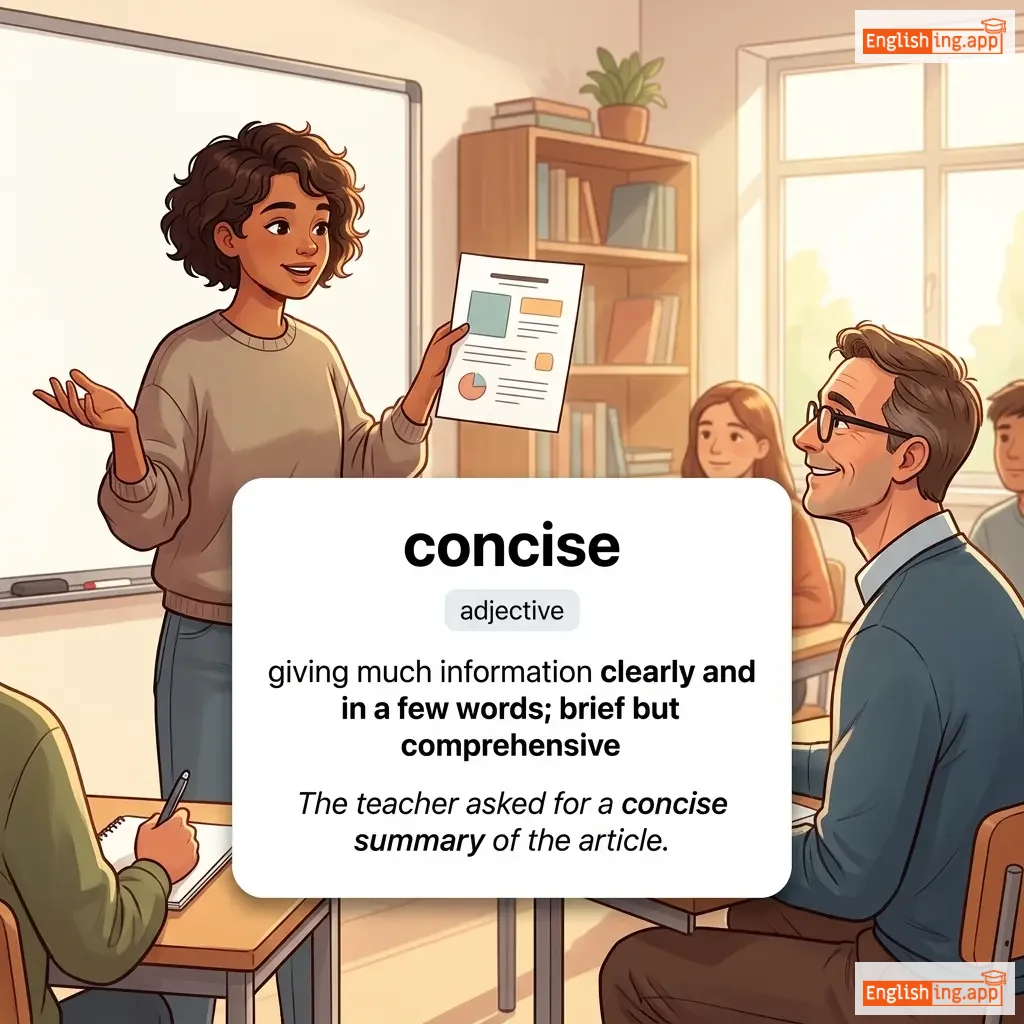
concise definition card — visual illustration of the meaning
adjective
/kənˈsaɪs/
संक्षिप्त (sankshipt)

giving much information clearly and in a few words; brief but comprehensive

"The teacher asked for a concise summary of the article."

"शिक्षक ने लेख का संक्षिप्त सारांश माँगा।" (Shikshak ne lekh ka sankshipt saaransh maanga.)
noun
/kɒŋk/
शंख (shankh)

a shell, especially a large spiral one used as a horn or for decoration

"The priest blew the conch shell to signal the start of the ceremony."

"पादरी ने समारोह की शुरुआत का संकेत देने के लिए शंख बजाया।" (padri ne samaroh ki shuruat ka sanket dene ke liye shankh bajaya.)
noun
/ˈkɒnk.leɪv/
गोपनीय बैठक (gopniya baithak)

a private meeting, especially a secret or important one

"The leaders met in a secret conclave to discuss the strategy."

"नेताओं ने रणनीति पर चर्चा करने के लिए एक गोपनीय बैठक में मुलाकात की।" (Netaon ne rananiti par charcha karne ke liye ek gopniya baithak mein mulaqat ki.)
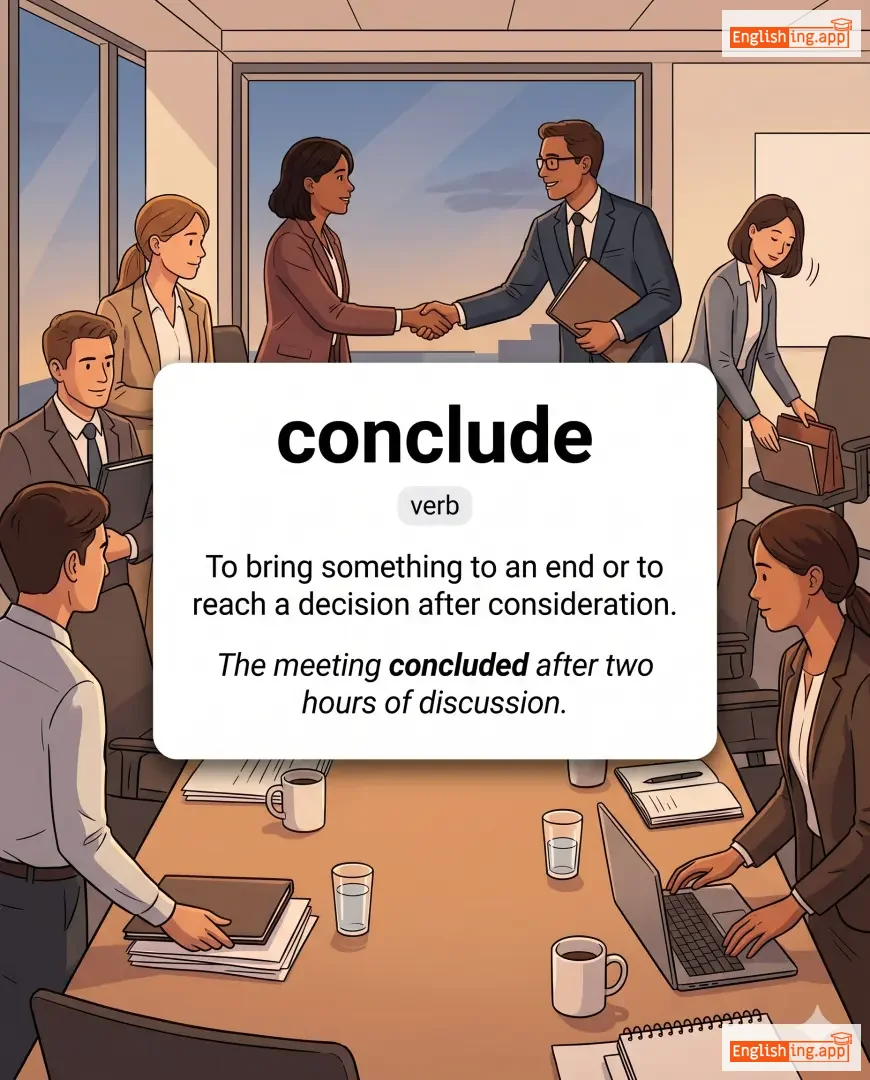
conclude definition card — visual illustration of the meaning
verb
/kənˈkluːd/
समाप्त करना, निर्णय पर पहुँचना (samaapt karna, nirnay par pahuchna)

To bring something to an end or to reach a decision after consideration.

"The meeting concluded after two hours of discussion."

"बैठक दो घंटे की चर्चा के बाद समाप्त हो गई।" (Baithak do ghante ki charcha ke baad samaapt ho gayi.)
noun
/kənˈkluːʒən/
निष्कर्ष (nishkarsh)

The end or finish of an event, process, or text; a judgment reached after consideration.

"The research paper ends with a strong conclusion."

"अनुसंधान पत्र एक मजबूत निष्कर्ष के साथ समाप्त होता है।" (Anusandhan patra ek majboot nishkarsh ke saath samaapt hota hai.)
adjective
/kənˈkluːsɪv/
निर्णायक (nirnayak)

serving to prove a case; decisive or convincing

"The DNA test provided conclusive evidence of his innocence."

"डीएनए टेस्ट ने उसकी निर्दोषता का निर्णायक प्रमाण प्रदान किया।" (DNA test ne uski nirdoshata ka nirnayak pramaan pradan kiya.)
concoct definition card — visual illustration of the meaning
verb
/kənˈkɒkt/
बनाना या तैयार करना (banana ya taiyar karna)

to make something, especially food or a story, by mixing or inventing

"He concocted a story to explain his absence."

"उसने अपनी अनुपस्थिति को स्पष्ट करने के लिए एक कहानी बनाई।" (Usne apni anupasthiti ko spast karne ke liye ek kahani banai.)
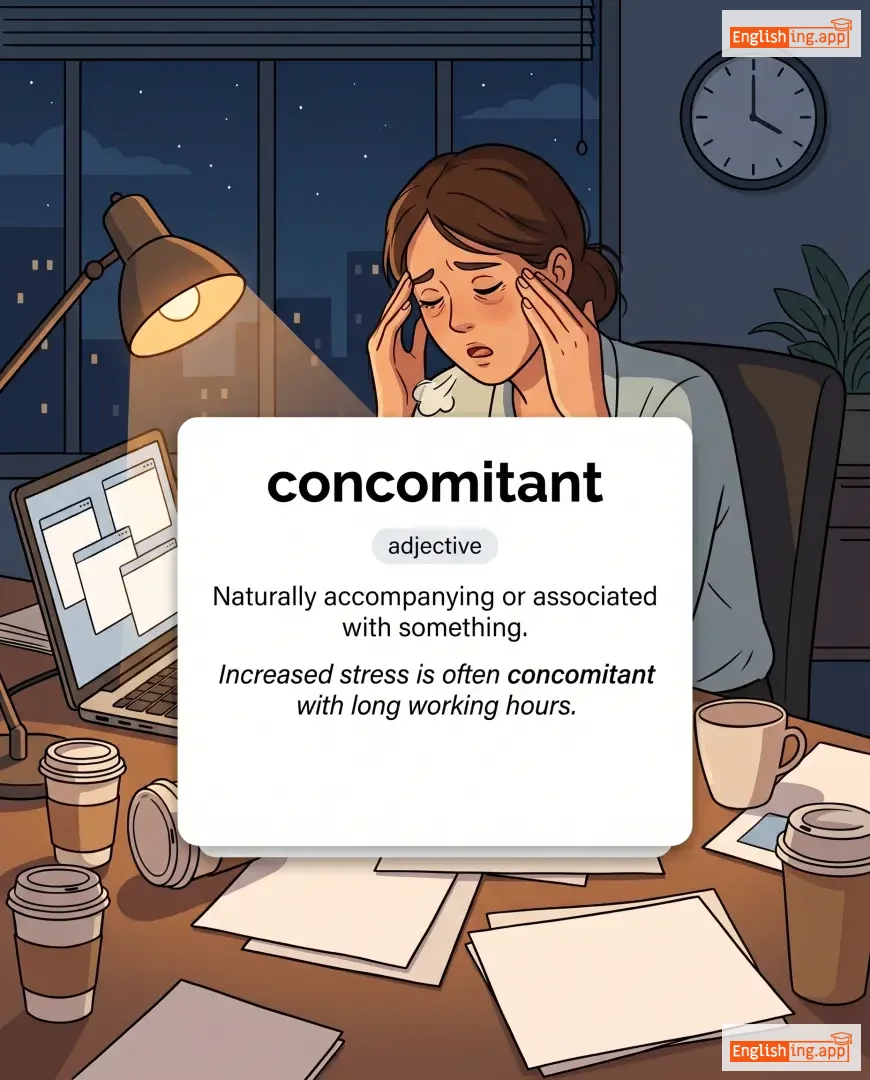
concomitant definition card — visual illustration of the meaning
adjective
/kənˈkɒmɪtənt/
सहयोगी (sahoyogi)

Naturally accompanying or associated with something.

"Increased stress is often concomitant with long working hours."

"बढ़ा हुआ तनाव अक्सर लंबे कार्यकाल के साथ सहयोगी होता है।" (Badha hua tanav aksar lambe karyakal ke sath sahoyogi hota hai.)
concord definition card — visual illustration of the meaning
noun
/ˈkɒŋ.kɔːd/
सामंजस्य (samanjasy)

Agreement or harmony between people or groups.

"The two nations lived in concord for many years."

"दोनों राष्ट्र कई वर्षों तक सामंजस्य में रहे।" (Donon rashtr kai varshon tak samanjasya mein rahe.)
noun
/kənˈkɔːrdəns/
संगति (sangati)

Agreement; also an alphabetical index of the principal words in a book.

"There is a strong concordance between the two reports."

"दो रिपोर्टों के बीच एक मजबूत संगति है।" (Do reporton ke beech ek majboot sangati hai.)
noun
/ˈkɒŋ.kɔː.dæt/
संधि (sandhi)

An agreement or treaty, especially between the Vatican and a secular government.

"The concordat established the rights of the church within the country."

"कॉनकोर्डैट ने देश में चर्च के अधिकारों की स्थापना की।" (Koncordat ne desh mein church ke adhikaron ki sthapna ki.)
adjective
/ˈkɒŋkriːt/
ठोस (thos)

based on facts, not on ideas or guesses; specific and real

"She gave a concrete example to support her argument."

"उसने अपने तर्क का समर्थन करने के लिए एक ठोस उदाहरण दिया।" (Usne apne tark ka samarthan karne ke liye ek thos udaharan diya.)
verb
/kənˈkɜːr/
सहमत होना (sahmat hona)

To agree with someone or something.

"I concur with your opinion on this matter."

"मैं इस मामले में आपकी राय से सहमत हूं।" (Main is maamle mein aapki rai se sahmat hoon.)
noun
/kənˈkʌrəns/
सहमति (sahmati)

Agreement or union in action, opinion, or occurrence; simultaneous happening of events.

"The project was completed with the concurrence of all departments."

"प्रोजेक्ट सभी विभागों की सहमति से पूरा हुआ।" (Projeckt sabhi vibhagon ki sahmati se poora hua.)
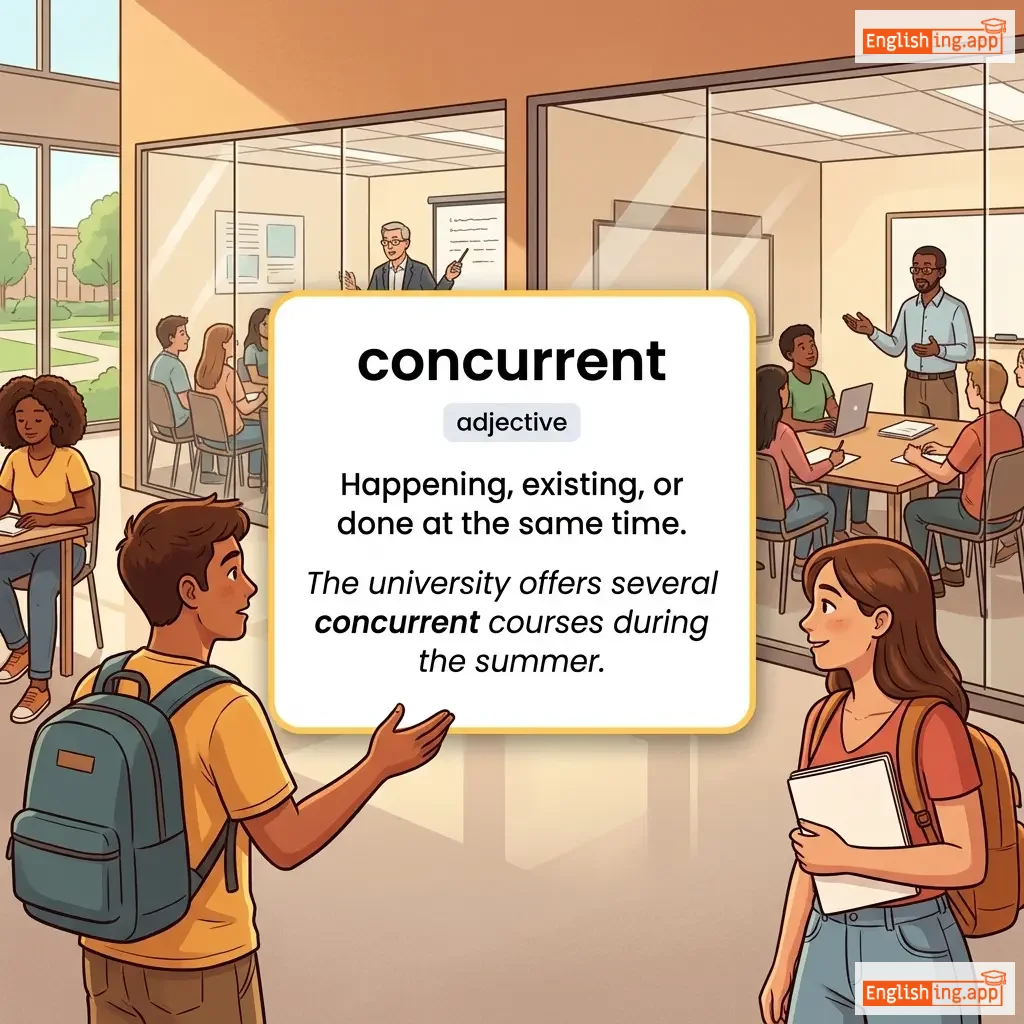
concurrent definition card — visual illustration of the meaning
adjective
/kənˈkʌrənt/
सहसंबद्ध (sahasambaddh)

Happening, existing, or done at the same time.

"The university offers several concurrent courses during the summer."

"विश्वविद्यालय समर में कई सहसंबद्ध पाठ्यक्रम प्रदान करता है।" (Vishwavidyalaya samr mein kai sahasambaddh pathyakram pradan karta hai.)
noun
/kənˈkʌʃən/
मस्तिष्क आघात (mastishk aghat)

A temporary unconsciousness or shock caused by a blow to the head.

"He suffered a concussion after falling from the bike."

"वह बाइक से गिरने के बाद मस्तिष्क आघात से पीड़ित हुआ।" (Wah bike se girne ke baad mastishk aghat se peedit hua.)
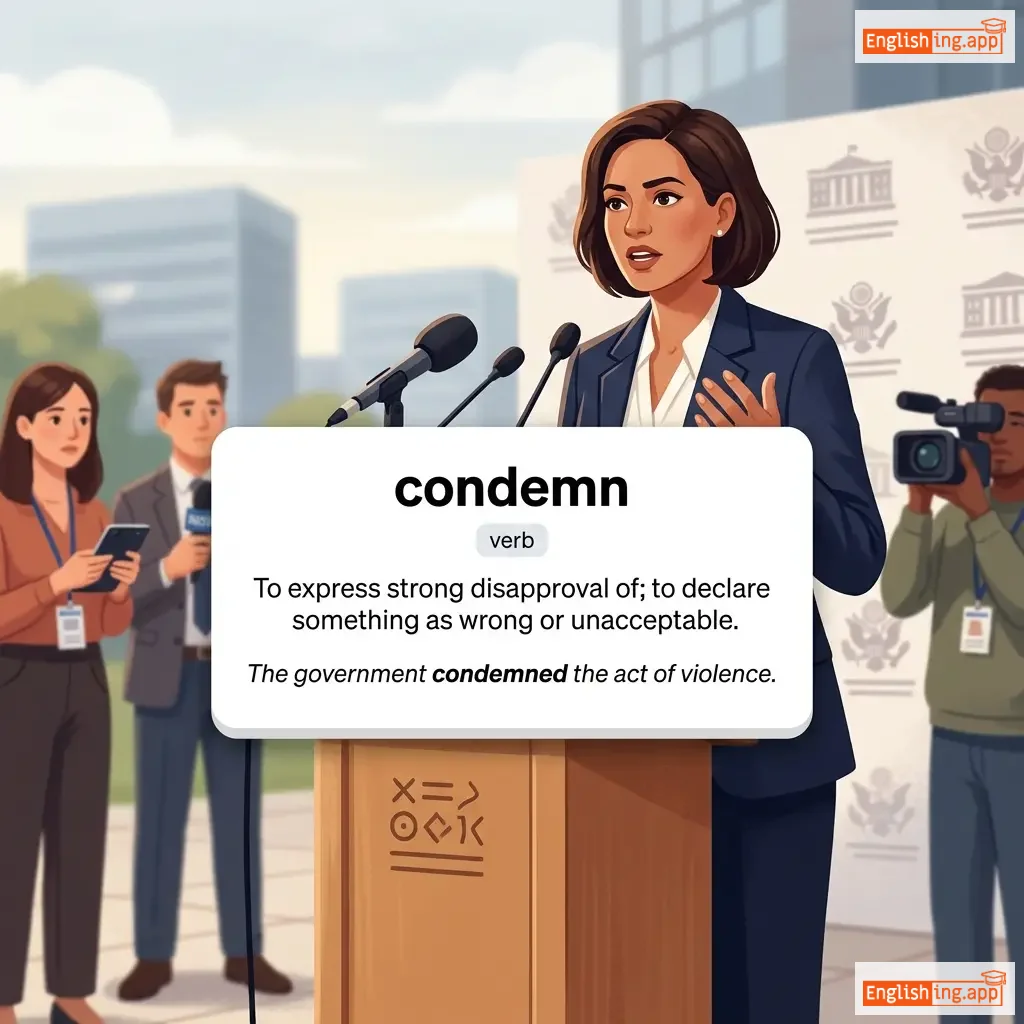
condemn definition card — visual illustration of the meaning
verb
/kənˈdɛm/
निंदा करना (ninda karna)

To express strong disapproval of; to declare something as wrong or unacceptable.

"The government condemned the act of violence."

"सरकार ने हिंसा की घटना की निंदा की।" (Sarkar ne hinsa ki ghatna ki ninda ki.)
noun
/ˌkɒndɛnˈseɪʃən/
संक्षिप्तिकरण (sankshiptikaran)

The process of water vapor changing into liquid; also, the act of making something more concise.

"Condensation formed on the windows during the cold night."

"ठंडी रात में खिड़कियों पर संक्षिप्तिकरण बन गया।" (Thandi raat mein khidkiyon par sankshiptikaran ban gaya.)
condense definition card — visual illustration of the meaning
verb
/kənˈdɛns/
संक्षेप करना (sankshhep karna)

to make something shorter, more concentrated, or more compact

"The editor asked the writer to condense the article into one page."

"संपादक ने लेखक से कहा कि वह लेख को एक पन्ने में संक्षेपित करें।" (Sampadak ne lekhak se kaha ki vah lekh ko ek panne mein sankshhepit karein.)
noun
/kənˈdenst mɪlk/
घन दूध (ghan doodh)

milk from which water has been removed and sugar added, creating a thick, sweet product

"The recipe calls for a can of condensed milk to make the dessert extra creamy."

"रेसिपी में डेज़र्ट को अतिरिक्त क्रीमी बनाने के लिए एक कैन घन दूध की आवश्यकता है।" (resipi mein desert ko atirikt kremee banane ke liye ek kyaan ghan doodh ki avashyakta hai.)
verb
/ˌkɒndɪˈsɛnd/
ऊँचे से दया दिखाना (oonche se daya dikhana)

to behave as if one is superior while being gracious to others

"He would not condescend to answer such a trivial question."

"वह इतने तुच्छ सवाल का उत्तर देने के लिए खुद को नीचा नहीं करना चाहता था।" (Wah itne tuchchh sawaal ka uttar dene ke liye khud ko neecha nahi karna chahta tha.)
adjective
/ˌkɒndɪˈsɛndɪŋ/
घमंडी (ghamandi)

having or showing an attitude of patronizing superiority

"Her condescending tone upset her colleagues."

"उसकी घमंडी आवाज़ ने उसके सहयोगियों को नाराज़ कर दिया।" (Uski ghamandi awaaz ne uske sahyogiyon ko naraaz kar diya.)
adjective
/ˈkɒndaɪn/
उचित (uchit)

deserved, appropriate, and fitting (especially punishment)

"The criminal received condign punishment for his crimes."

"अपराधी को उसके अपराध के लिए उचित दंड मिला।" (Aparadhi ko uske aparadh ke liye uchit dand mila.)
noun
/ˈkɒndɪmənt/
मसाला/सॉस (masala/sos)

a substance such as salt, mustard, or ketchup that is used to add flavor to food

"Ketchup is a popular condiment in many countries."

"केचप कई देशों में एक लोकप्रिय मसाला या सॉस है।" (Ketchup kai deshon mein ek lokpriya masala ya sos hai.)
noun
/ˈkɒndɪmənts/
मसाले या सॉस (masale ya sos)

Seasonings or sauces used to add flavor to food.

"Ketchup and mustard are popular condiments for burgers."

"केचप और मस्टर्ड बर्गर के लिए लोकप्रिय कंडिमेंट्स हैं।" (Ketchup aur mustard burger ke liye lokpriya condiments hain.)
condition definition card — visual illustration of the meaning
noun
/kənˈdɪʃən/
स्थिति, शर्त (stithi, shart)

The state of something with regard to its appearance, quality, or working order; a requirement that must be met.

"The car is in excellent condition."

"गाड़ी उत्कृष्ट स्थिति में है।" (Gaadi utkṛṣṭ sthiti mein hai.)
adjective
/kənˈdɪʃ.ən.əl/
सशर्त; शर्तों पर निर्भर (sashart; sharton par nirbhar)

dependent on certain conditions; not absolute

"The job offer is conditional upon passing the background check."

"नौकरी का प्रस्ताव पृष्ठभूमि जांच पास करने पर शर्तों पर निर्भर है।" (naukri ka prastav prishthabhoomi jaanch pass karne par sharton par nirbhar hai.)
verb
/kənˈdəʊl/
सहानुभूति प्रकट करना (sahanubhuti prakat karna)

To express sympathy for someone who is suffering or grieving.

"Neighbors came to condole with the family after the tragedy."

"बिपत्ति के बाद पड़ोसी परिवार के साथ सहानुभूति प्रकट करने आए।" (Bipatti ke baad padosi parivar ke saath sahanubhuti prakat karne aaye.)
noun
/kənˈdəʊləns/
शोकसंदेश (shoksandesh)

An expression of sympathy, especially on the occasion of death.

"She offered her sincere condolence to the grieving family."

"उसने शोकाकुल परिवार को अपनी गहरी शोकसंदेश व्यक्त की।" (Usne shokakul parivar ko apni gehri shoksandesh vyakt ki.)
condone definition card — visual illustration of the meaning
verb
/kənˈdəʊn/
स्वीकार करना (sweekar karna)

To accept or allow behavior that is morally wrong or offensive.

"The manager refused to condone harassment in the workplace."

"मैनेजर ने कार्यस्थल पर उत्पीड़न को स्वीकार करने से मना कर दिया।" (Manager ne karyasthal par utpeedan ko sweekar karne se mana kar diya.)
verb
/kənˈdjuːs/
सहायक होना (sahayak hona)

To help bring about a particular result; to contribute to something.

"Regular exercise conduces to better health."

"नियमित व्यायाम अच्छे स्वास्थ्य के लिए सहायक होता है।" (Niyamit vyaayam achhe swasthya ke liye sahayak hota hai.)
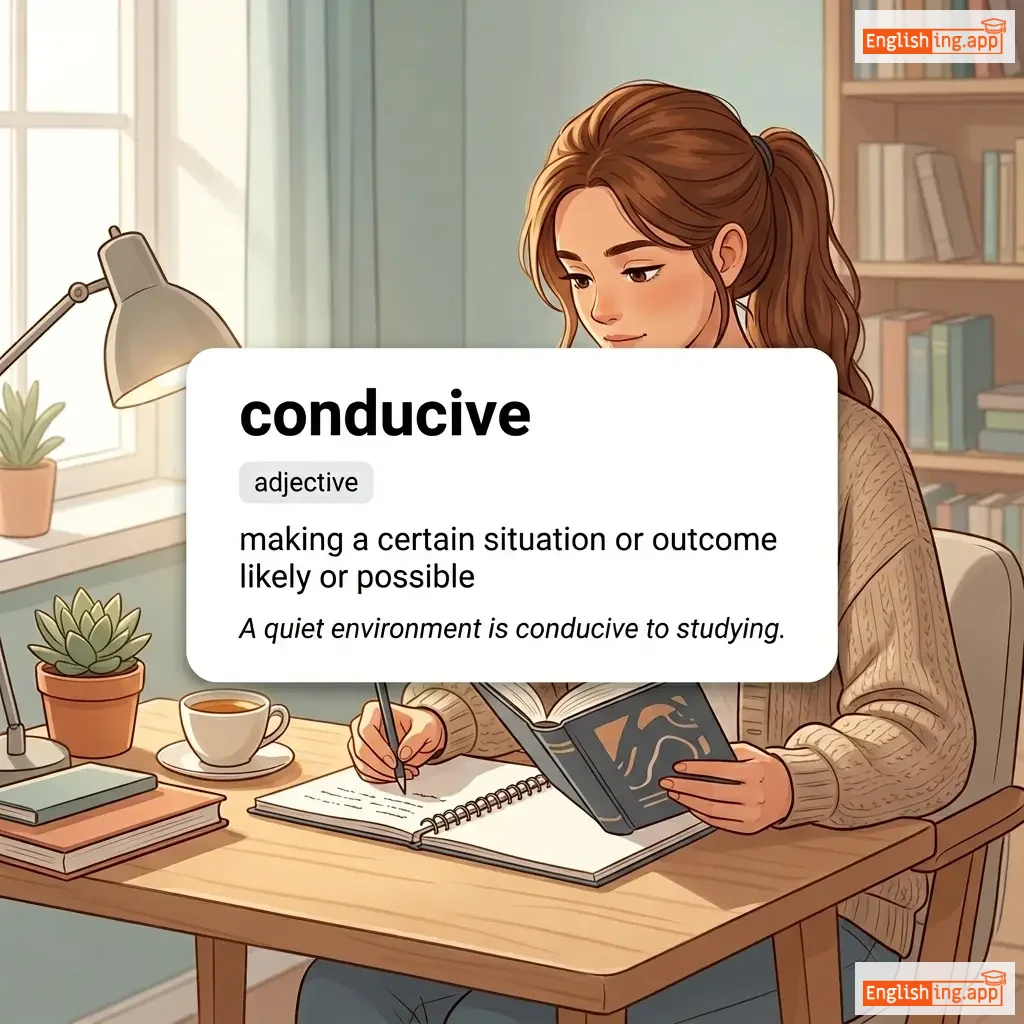
conducive definition card — visual illustration of the meaning
adjective
/kənˈdjuːsɪv/
सहायक (sahayak)

making a certain situation or outcome likely or possible

"A quiet environment is conducive to studying."

"एक शांत वातावरण अध्ययन के लिए सहायक है।" (Ek shaant vaataavaran adhyayan ke liye sahayak hai.)
noun, verb
/ˈkɒndʌkt/ (noun), /kənˈdʌkt/ (verb)
व्यवहार / संचालन (vyavhaar / sanchaalan)

to organize or carry out; or a person's behavior

"The teacher conducted the exam fairly."

"टीचर ने परीक्षा को निष्पक्ष रूप से आयोजित किया।" (Teacher ne pariksha ko nishpaksh roop se aayojit kiya.)
adjective
/kənˈdʌktəbl̩/
परिवाहनीय (parivahaniy)

capable of being conducted, especially electricity or heat

"Copper is highly conductible to electricity."

"कॉपर विद्युत के लिए अत्यधिक प्रवाहनीय है।" (Kopar vidyut ke liye atyadhik pravahaniy hai.)
noun
/kənˈdʌktər/
संयोजक / चालक (sanyojak / chalak)

a person who directs a performance or someone who collects fares on public transport; or a material that conducts electricity

"The conductor waved his baton to start the orchestra."

"कंडक्टर ने ऑर्केस्ट्रा शुरू करने के लिए अपनी छड़ी हिलाई।" (Conductor ne orchestra shuru karne ke liye apni chhadi hilai.)
noun
/ˈkɒndjuɪt/ or /ˈkɑːnduɪt/
नली / माध्यम (nali / madhyam)

a channel or pipe for conveying water, electricity, or information

"The cable was placed inside a protective conduit."

"केबल एक सुरक्षात्मक नली के अंदर रखा गया था।" (Cable ek surakshat nali ke andar rakha gaya tha.)
noun
/kənˈfɛkʃəneri/
मिठाई (mithai)

sweets, candies, and other food items made with sugar

"The shop sells a wide variety of confectionery."

"दुकान में विभिन्न प्रकार की मिठाई बिकती है।" (Dukaan mein vibhinn prakar ki mithai bikti hai.)
noun
/kənˈfɛdərəsi/
संघ (sangh)

a group of states, people, or organizations united for a common purpose

"The southern states formed a confederacy during the civil war."

"दक्षिणी राज्यों ने गृहयुद्ध के दौरान एक संघ का गठन किया था।" (Dakshini rajyon ne grihyuddh ke dauran ek sangh ka gathan kiya tha.)
noun/adjective
/kənˈfɛdərət/
संघीय (sanghiya)

a person, group, or state joined in an alliance or union; relating to a confederacy

"The confederate soldiers fought bravely in the war."

"संघीय सैनिक युद्ध में बहादुरी से लड़े।" (Sanghiya sainik yuddh mein bahaduri se lade.)
verb
/kənˈfɜːr/
परामर्श करना / प्रदान करना (paramarsh karna / pradan karna)

to discuss something important or to grant or bestow something

"The committee will confer to decide on the new policy."

"कमिटी नई नीति पर विचार करने के लिए कंफर करेगी।" (Committee nai neeti par vichar karne ke liye confer karegi.)
noun
/ˌkɒnfəˈriː/
सम्मेलन प्रतिभागी (sammelan pratibhagi)

a person who takes part in a conference

"Each conferee received a badge at the registration desk."

"प्रत्येक सम्मेलन प्रतिभागी को पंजीकरण कक्ष में एक बैज मिला।" (Pratyek sammelan pratibhagi ko panjikaran kaksh mein ek baij mila.)
conference definition card — visual illustration of the meaning
noun
/ˈkɒnfərəns/
सम्मेलन (sammelan)

A formal meeting for discussion, especially about a particular subject.

"She is attending an international business conference."

"वह एक अंतर्राष्ट्रीय व्यापार सम्मेलन में भाग ले रही है।" (vah ek antarraashtreey vyavsaayik sammelan mein bhaag le rahi hai.)
confess definition card — visual illustration of the meaning
verb
/kənˈfɛs/
स्वीकार करना (sveekar karna)

to admit that you have done something wrong or illegal

"He confessed that he had stolen the money."

"उसने स्वीकार किया कि उसने पैसे चुराए थे।" (Usne sveekar kiya ki usne paise churaaye the.)
noun
/kənˈfɛʃən/
स्वीकृति (sweekriti)

a statement admitting that one is guilty of a crime or has done something wrong

"The suspect made a full confession to the police."

"संदिग्ध ने पुलिस के सामने पूरी स्वीकृति दी।" (Sandigdh ne pulis ke saamne poori sweekriti di.)
noun
/kənˈfɛsər/
कन्फेसर (kanfesar)

A person who confesses sins or secrets, especially to a priest.

"The confessor listened patiently to the troubled man."

"कन्फेसर ने धैर्यपूर्वक परेशान आदमी की बातें सुनीं।" (Kanfesar ne dhairyapoorvak pareshan aadmi ki baatein sunee.)