वोकैबुलरीज

इंग्लिश वोकैबुलरी डिस्कवर, लर्न और मास्टर करें

noun
/kəmˈpænjən/
साथी (saathi)

a person or animal you spend time with or travel with

"He was my companion during the long journey."

"वह मेरी यात्रा के दौरान साथी था।" (vah meri yatra ke dauran saathi tha.)
noun
/ˈkʌm.pə.ni/
कंपनी (kampani)

a business organization; the presence of other people

"She started her own company to sell handmade products."

"उसने हस्तनिर्मित उत्पाद बेचने के लिए अपनी कंपनी शुरू की।" (Usne hastanirmit utpad bechne ke liye apni kompani shuru ki.)
adjective
/ˈkɒmp(ə)rəbl/
तुलनीय (tulneey)

Able to be likened to something else in size, amount, or quality.

"The two products are comparable in quality but differ in price."

"दोनों उत्पाद गुणवत्ता में तुलनीय हैं लेकिन कीमत में अलग हैं।" (dono utpaad gunvata mein tulneey hain lekin keemat mein alag hain)
adjective
/kəmˈpærətɪv/
सापेक्ष (sapeksh)

Measured or considered by comparison; relative.

"She lives in comparative comfort after moving to the city."

"शहर में आने के बाद वह सापेक्ष आराम में रहती है।" (shahar mein aane ke baad vah sapeksh aaram mein rahti hai)
compare definition card — visual illustration of the meaning
verb
/kəmˈpeər/
तुलना करना (tulna karna)

to examine the similarities and differences between two or more things

"The teacher asked us to compare two poems."

"शिक्षक ने हमसे दो कविताओं की तुलना करने को कहा।" (shikshak ne humse do kavitaon ki tulna karne ko kaha.)
noun
/kəmˈpærɪsən/
तुलना (tulna)

The act or process of examining the similarities and differences between things.

"A comparison of the two reports shows several inconsistencies."

"दो रिपोर्टों की तुलना करने पर कई असंगतियाँ दिखती हैं।" (do reporton ki tulna karne par kai asangatiyan dikhti hain)
noun
/kəmˈpɑːtmənt/
कोठरी / खंड (kothari / khand)

A separate section or space within a larger structure, such as a train or a container.

"He kept his passport in a small compartment of his bag."

"उसने अपना पासपोर्ट अपनी बैग के एक छोटे से कोठरी में रखा।" (Usne apna passport apni bag ke ek chhote se kothari mein rakha.)
compartmentalize definition card — visual illustration of the meaning
verb
/kəmˈpɑːtməntəˌlaɪz/
विभाजित करना (vibhajit karna)

To divide into sections or categories.

"It is important to compartmentalize work and personal life to maintain balance."

"यह महत्वपूर्ण है कि कार्य और व्यक्तिगत जीवन को संतुलन बनाए रखने के लिए विभाजित किया जाए।" (Yeh mahatvapurn hai ki karya aur vyaktigat jeevan ko santulan banaye rakhne ke liye vibhajit kiya jaye.)
noun
/ˈkʌm.pəs/
दिशा सूचक यंत्र (disha suchak yantra)

an instrument for finding direction with a magnetic needle pointing to magnetic north

"The hiker used a compass to find the right direction."

"यात्री ने सही दिशा ढूँढने के लिए एक कंपस का इस्तेमाल किया।" (yatri ne sahi disha dhundhne ke liye ek kampas ka istemal kiya)
noun
/kəmˈpæʃən/
दया (daya)

Sympathetic concern for the sufferings or misfortunes of others.

"The nurse treated the patients with great compassion."

"नर्स ने मरीजों के प्रति गहरी दया दिखाई।" (Nars ne mareezon ke prati gahri daya dikhai.)
adjective
/kəmˈpæʃənət/
दयालु; सहानुभूतिपूर्ण (dayalu; sahanubhuti-purn)

feeling or showing sympathy and concern for others who are suffering

"The compassionate nurse took extra time to comfort the worried patients."

"दयालु नर्स ने चिंतित मरीजों को आराम देने के लिए अतिरिक्त समय निकाला।" (dayalu nars ne chintit mareezon ko aaram dene ke liye atirikt samay nikala)
adjective
/kəmˈpætəbl/
संगत (sangat)

Able to exist or work together without conflict; harmonious.

"This software is compatible with both Windows and Mac systems."

"यह सॉफ़्टवेयर विंडोज़ और मैक दोनों सिस्टमों के साथ संगत है।" (Yeh software Windows aur Mac dono systems ke saath sangat hai.)
verb
/kəmˈpɛl/
मजबूर करना (majboor karna)

To force or drive someone to do something.

"The law compels citizens to pay taxes."

"कानून नागरिकों को कर अदा करने के लिए मजबूर करता है।" (Kanoon nagrikon ko kar ada karne ke liye majboor karta hai.)
adjective
/kəmˈpɛlɪŋ/
आकर्षक (aakarshak)

Evoking interest, attention, or admiration in a powerful way.

"She gave a compelling speech about climate change."

"उसने जलवायु परिवर्तन पर एक आकर्षक भाषण दिया।" (Usne jalvayu parivartan par ek aakarshak bhashan diya.)
compendium definition card — visual illustration of the meaning
noun
/kəmˈpɛndiəm/
संग्रह (sangrah)

A collection of concise but detailed information about a subject.

"The book is a compendium of ancient myths and legends."

"किताब प्राचीन मिथकों और किंवदंतियों का एक संग्रह है।" (Kitaab prachin mithkon aur kinvdanthiyon ka ek sangrah hai.)
verb
/ˈkɒmpənseɪt/
मुआवजा देना (muavza dena)

To give something, typically money, in recognition of loss, suffering, or work done.

"The company compensated the worker for his injury."

"कंपनी ने उसके चोट के लिए श्रमिक को मुआवजा दिया।" (Kampani ne uske chot ke liye shramik ko muavza diya.)
verb
/ˈkɒmpənseɪtɪd/
प्रतिपूर्ति की गई (pratipurti ki gayi)

to have been given something, typically money, as a recompense for loss, suffering, or work done

"The workers were compensated for their overtime hours."

"कर्मचारियों को उनके ओवरटाइम घंटे के लिए प्रतिपूर्ति की गई।" (Karmachariyon ko unke overtime ghante ke liye pratipurti ki gayi.)
noun
/ˌkɒmpənˈseɪʃən/
प्रतिपूर्ति (pratipurti)

something, typically money, given to make up for loss, injury, or work done

"She received financial compensation for the accident."

"उसे दुर्घटना के लिए वित्तीय प्रतिपूर्ति मिली।" (Use durghatna ke liye vittiya pratipurti mili.)
adjective
/kəmˈpensətɔːri/
प्रतिपूरक (pratipurak)

serving to make up for a loss, damage, or injury

"The court awarded him compensatory damages."

"अदालत ने उसे प्रतिपूरक क्षतिपूर्ति दी।" (Adalat ne use pratipurak kshatipurti di.)
verb
/kəmˈpiːt/
प्रतियोगिता करना (pratiyogita karna)

to try to win or be more successful than others in a contest or activity

"Several companies compete for dominance in the market."

"कई कंपनियां बाजार में प्रभुत्व के लिए प्रतियोगिता करती हैं।" (Kai companyaan bazar mein prabhutva ke liye pratiyogita karti hain.)
noun
/ˈkɒmpɪtəns/
क्षमता (kshamata)

the ability to do something successfully or efficiently

"Her competence as a manager impressed the board."

"एक प्रबंधक के रूप में उसकी क्षमता ने बोर्ड को प्रभावित किया।" (Ek prabandhak ke roop mein uski kshamata ne board ko prabhavit kiya.)
adjective
/ˈkɒmpɪtənt/
कुशल (kushal)

having the necessary ability, knowledge, or skill to do something successfully

"He is a competent driver who rarely makes mistakes."

"वह एक सक्षम ड्राइवर है जो शायद ही कभी गलतियां करता है।" (Wah ek kushal driver hai jo shayad hi kabhi galtiyan karta hai.)
competition definition card — visual illustration of the meaning
noun
/ˌkɒmpəˈtɪʃən/
प्रतियोगिता (pratiyogita)

a situation in which people or organizations try to be more successful than others

"The competition in the tech industry is very intense."

"तकनीकी उद्योग में प्रतियोगिता बहुत तीव्र है।" (takneekee udhyog mein pratiyogita bahut teevra hai.)
adjective
/kəmˈpetətɪv/
प्रतिस्पर्धात्मक (pratispardhatmak)

relating to or characterized by competition; having a strong desire to win or be more successful

"She has a competitive spirit that drives her to excel."

"उसमें एक प्रतिस्पर्धात्मक भावना है जो उसे उत्कृष्टता की ओर प्रेरित करती है।" (Usmein ek pratispardhatmak bhavana hai jo use utkrshtata ki aur prerit karti hai.)
competitiveness definition card — visual illustration of the meaning
noun
kəmˈpet.ɪ.tɪv.nəs
प्रतिस्पर्धात्मकता (pratispardhatmakta)

The quality of being as good as or better than others of a comparable nature; the ability to compete successfully.

"Competitiveness is vital for economic sustainability."

"प्रतिस्पर्धात्मकता आर्थिक स्थिरता के लिए आवश्यक है।" (pratispardhatmakta aarthik sthirta ke liye avashyak hai.)
noun
/kəmˈpɛtɪtər/
प्रतिद्वंदी (pratidvandi)

a person, team, or company that competes with others

"The company lowered its prices to beat its main competitor."

"कंपनी ने अपनी मुख्य प्रतिस्पर्धी को हराने के लिए अपनी कीमतें घटा दीं।" (Company ne apni mukhya pratispardhi ko harane ke liye apni keematein ghata di.)
noun
/ˌkɒmpɪˈleɪʃən/
संकलन (sankalan)

a collection of things, especially pieces of writing or music, gathered together

"The book is a compilation of his best essays."

"यह किताब उसके बेहतरीन निबंधों का संकलन है।" (Yeh kitaab uske behtareen nibandhon ka sankalan hai.)
verb
/kəmˈpaɪl/
संग्रह करना (sangrah karna)

to collect information or material and put it together in a list, report, or book

"She compiled the research data into a detailed report."

"उसने शोध डेटा को एक विस्तृत रिपोर्ट में संकलित किया।" (Usne shodh data ko ek vistaarit report mein sankalit kiya.)
noun
/kəmˈpleɪsəns/
आत्मसंतुष्टि (komplayens)

a feeling of quiet pleasure or self-satisfaction, often without awareness of potential danger

"His complacence prevented him from noticing the risks."

"उसकी आत्मसंतुष्टि ने उसे जोखिमों को नोटिस करने से रोक दिया।" (Uski aatmasantushti ne use jokhimon ko notice karne se rok diya)
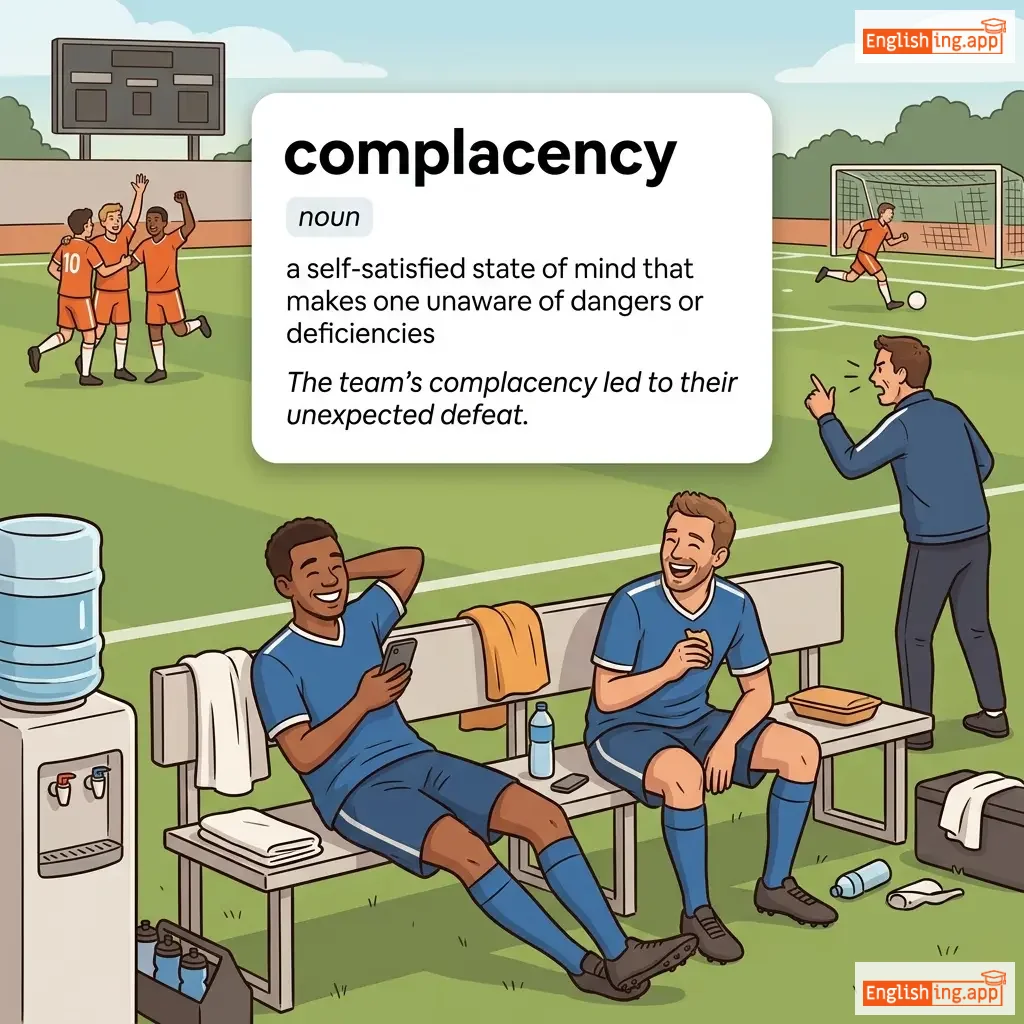
complacency definition card — visual illustration of the meaning
noun
/kəmˈpleɪsənsi/
आत्मसंतोष (aatmsantosh)

a self-satisfied state of mind that makes one unaware of dangers or deficiencies

"The team's complacency led to their unexpected defeat."

"टीम की आत्मसंतोषिता के कारण उनकी अप्रत्याशित हार हुई।" (Teem ki aatmsantoshta ke kaaran unki apratyashit haar hui.)
complacent definition card — visual illustration of the meaning
adjective
/kəmˈpleɪsənt/
आत्मसंतुष्ट (aatmsantusht)

showing self-satisfaction and a lack of concern about potential dangers or problems

"The team grew complacent after a few victories and stopped practicing hard."

"टीम कुछ जीत के बाद आत्मसंतुष्ट हो गई और कड़ी मेहनत करना बंद कर दिया।" (Team kuch jeet ke baad aatmsantusht ho gayi aur kadi mehnat karna band kar diya.)
verb
/kəmˈpleɪn/
शिकायत करना (shikayat karna)

to express dissatisfaction or annoyance about something

"He often complains about the noise in the neighborhood."

"वह अक्सर पड़ोस में शोर की वजह से शिकायत करता है।" (Vah aksar pados mein shor ki wajah se shikayat karta hai.)
noun
/kəmˈpleɪnt/
शिकायत (shikayat)

a statement that something is wrong or not satisfactory

"The manager received a complaint from a customer about poor service."

"मैनेजर को एक ग्राहक से खराब सेवा के बारे में शिकायत मिली।" (Manager ko ek grahak se kharab seva ke baare mein shikayat mili.)
noun
/kəmˈpleɪsəns/
विनम्रता, सहजता (vinmrata, sahajata)

willingness to please others; courteous compliance

"Her complaisance made her popular among her colleagues."

"उसकी विनम्रता ने उसे अपने सहकर्मियों में लोकप्रिय बना दिया।" (Uski vinmrata ne use apne sahkarmiyon mein lokpriya bana diya.)
complaisant definition card — visual illustration of the meaning
adjective
/kəmˈpleɪzənt/
अत्यधिक विनम्र (atyadhik vinamra)

willing to please others or to accept what they do or say without protest

"He was too complaisant to refuse their demands."

"वह उनकी मांगों को ठुकराने के लिए बहुत ज्यादा विनम्र था।" (vah unki maangon ko thukrane ke liye bahut zyada vinamra tha.)
complement definition card — visual illustration of the meaning
noun/verb
/ˈkɒmplɪmənt/
पूरक (purak)

something that completes or goes well with something; to add something that enhances or improves

"The scarf complements her outfit perfectly."

"स्कार्फ ने उसके आउटफिट को परफेक्टली पूरक किया।" (Skarf ne uske outfit ko perfectly purak kiya.)
adjective
/ˌkɒmplɪˈmɛntəri/
पूरक (poork)

combining in such a way as to enhance or emphasize the qualities of each other

"The two partners have complementary skills."

"दो साझेदारों की पूरक क्षमताएँ हैं।" (Do saajhedaron ki poork kshamataen hain.)
verb
/kəmˈpliːt/
पूरा करना (poora karna)

to finish making or doing something; to bring something to an end

"She managed to complete the project on time."

"वह समय पर प्रोजेक्ट को पूरा करने में सफल रही।" (Woh samay par project ko poora karne mein safal rahi.)
adverb
/kəmˈpliːtli/
पूर्णतः (poornatah)

totally; in every way possible

"The room was completely silent."

"कमरा पूरी तरह से शांत था।" (Kamra poori tarah se shaant tha.)
noun
/kəmˈpliːʃən/
सम्पूर्णता (sampurnata)

the action or process of finishing something

"The completion of the project will take another few weeks."

"प्रोजेक्ट की सम्पूर्णता में कुछ और सप्ताह लगेंगे।" (Project ki sampurnata mein kuch aur saptah lagenge.)
complex definition card — visual illustration of the meaning
adjective, noun
/ˈkɒm.pleks/
जटिल (jatil)

Consisting of many different and connected parts; not easy to understand or analyze.

"The human brain is an incredibly complex organ."

"मानव मस्तिष्क एक अविश्वसनीय रूप से जटिल अंग है।" (Manav mastisk ek avishwasniya roop se jatil ang hai.)
noun
/kəmˈplek.ʃən/
त्वचा की रंगत (tvacha ki rangat)

the natural color, texture, and appearance of a person's skin, especially on the face

"Her fair complexion glowed beautifully in the morning sunlight."

"उसकी हल्की त्वचा सुबह की धूप में खूबसूरती से चमक रही थी।" (uski halki tvacha subah ki dhoop mein khoobsurti se chamak rahi thi.)
complexity definition card — visual illustration of the meaning
noun
/kəmˈplɛksɪti/
जटिलता (jatilata)

the state or quality of being intricate or complicated

"The complexity of the problem surprised the engineers."

"समस्या की जटिलता ने इंजीनियरों को चौंका दिया।" (Samasya ki jatilata ne engineers ko chonka diya.)
compliance definition card — visual illustration of the meaning
noun
/kəmˈplaɪəns/
अनुपालन (anupalan)

The act of obeying a rule, law, or request.

"The company improved its compliance with environmental regulations."

"कंपनी ने पर्यावरणीय नियमों के प्रति अपनी अनुपालन में सुधार किया।" (Company ne paryavaraniye niyamon ke prati apni anupalan mein sudhaar kiya.)
compliant definition card — visual illustration of the meaning
adjective
/kəmˈplaɪənt/
आज्ञाकारी (aajnyaakaari)

Willing to agree with or follow rules, requests, or demands.

"She was compliant with all the safety requirements."

"वह सभी सुरक्षा आवश्यकताओं के साथ कम्प्लायंट थी।" (Woh sabhi suraksha avashyaktaon ke saath compliant thi.)
verb
/ˈkɒm.plɪ.keɪt/
जटिल बनाना (jatil banana)

To make something more difficult or confusing.

"The new rules will only complicate the process."

"नए नियम केवल प्रक्रिया को और जटिल बनाएंगे।" (Naye niyam keval prakriya ko aur jatil banayenge.)
adjective
/ˈkɒmplɪˌkeɪtɪd/
जटिल (jatil)

consisting of many interconnected parts; difficult to understand

"The instructions for the machine are too complicated to follow."

"मशीन के निर्देश पालन करने के लिए बहुत जटिल हैं।" (Mashine ke nirdesh paalan karne ke liye bahut jatil hain.)
noun
/ˌkɒmplɪˈkeɪʃən/
जटिलता (jatilata)

A problem or difficulty that makes a situation harder to deal with.

"His illness led to serious complications after surgery."

"उनकी बीमारी के कारण सर्जरी के बाद गंभीर जटिलताएँ उत्पन्न हो गईं।" (Unki bimari ke kaaran surgery ke baad gambhir jatiltaayein utpann ho gayi.)
adjective
/kəmˈplɪsɪt/
सहयोगी (अपराध में) (sohojogi (apraadh mein))

involved with others in an illegal activity or wrongdoing

"He was found complicit in the crime."

"उसे अपराध में सहयोगी पाया गया।" (Use apraadh mein sohojogi paaya gaya.)
noun
/kəmˈplɪsəti/
साजिश में संलिप्तता (saajish mein sanlipttata)

the state of being involved with others in an illegal activity or wrongdoing

"The court revealed his complicity in the fraud scheme."

"अदालत ने उसके धोखाधड़ी योजना में साजिश में संलिप्तता को उजागर किया।" (Adalat ne uske dhokhaadhadi yojna mein saajish mein sanliptata ko ujagar kiya.)