वोकैबुलरीज

इंग्लिश वोकैबुलरी डिस्कवर, लर्न और मास्टर करें

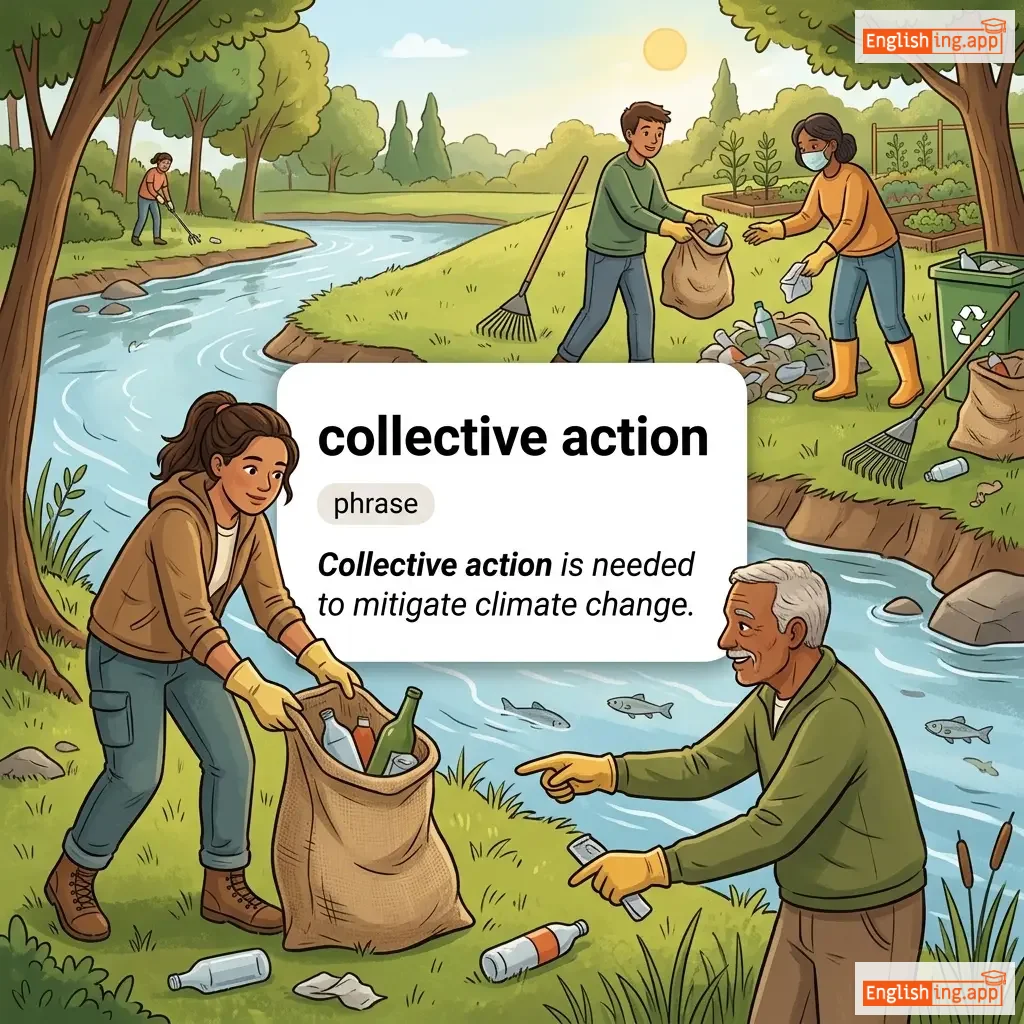
collective action definition card — visual illustration of the meaning
phrase
kəˈlek.tɪv ˈæk.ʃən
सामूहिक कार्रवाई (kalecktiv ekshan)

Action taken by a group of people working together toward a common goal or purpose.

"Collective action is needed to mitigate climate change."

"जलवायु परिवर्तन को कम करने के लिए सामूहिक कार्रवाई की आवश्यकता है." (Jalvayu parivartan ko kam karne ke liye samuhik karvai ki aavashyakta hai)
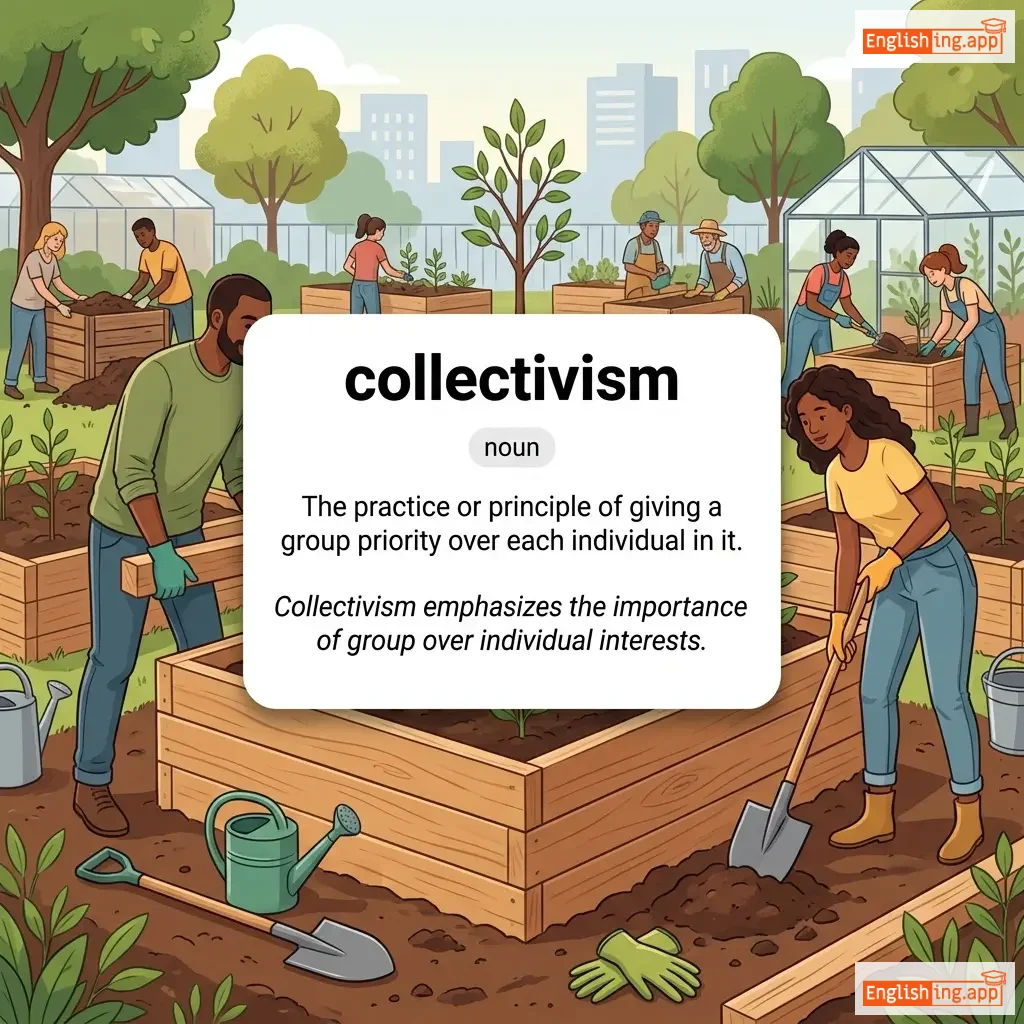
collectivism definition card — visual illustration of the meaning
noun
kəˈlɛktɪvɪzəm
सामूहिकवाद (saamuhikvaad)

The practice or principle of giving a group priority over each individual in it.

"Collectivism emphasizes the importance of group over individual interests."

"सामूहिकवाद समूह की व्यक्तिगत स्वार्थ से ऊपर महत्त्व को रेखांकित करता है।" (Saamuhikvaad samooh ki vyaktigat swarth se upar mahatva ko rekhaankit karta hai.)
noun
/kəˈlɛktər/
संग्रहकर्ता (sangrahakarta)

a person who collects things as a hobby or job

"He is a stamp collector with thousands of rare items."

"वह एक डाक टिकट कलेक्टर है जिसके पास हजारों दुर्लभ आइटम हैं।" (vah ek daak tikat kallektar hai jiske paas hazaaron durlabh item hain.)
noun
/ˈkɒlɪdʒ/
कॉलेज (college)

An educational institution where students study for degrees or professional qualifications.

"She hopes to attend college in the city next year."

"वह अगले साल शहर में कॉलेज में दाखिला लेना चाहती है।" (Vah agle saal sheher mein college mein dakhila lena chahti hai.)
noun
/kəˈliːdʒən/
कॉलेज का छात्र (college ka chhatra)

a student of a college

"The collegians were preparing for the cultural festival."

"कॉलेजियन लोग सांस्कृतिक महोत्सव के लिए तैयारी कर रहे थे।" (Collegeian log sanskritik mahotsav ke liye tayyari kar rahe the.)
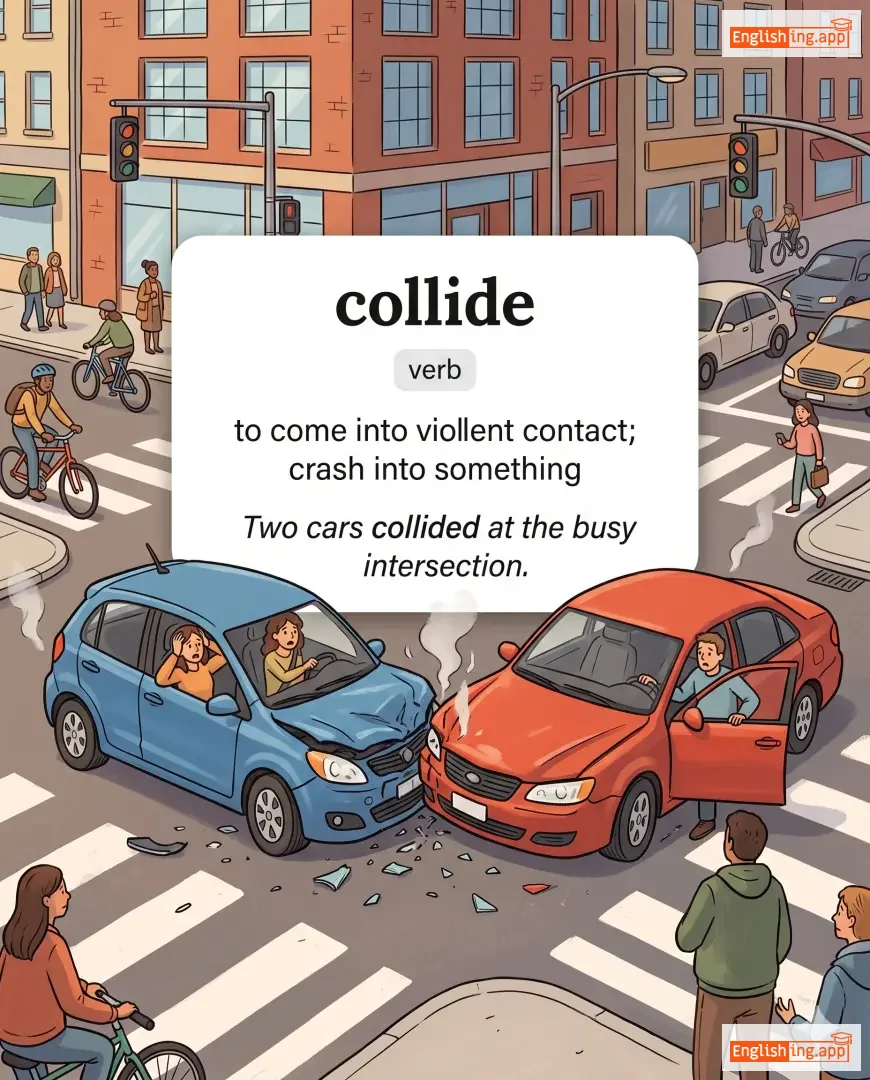
collide definition card — visual illustration of the meaning
verb
/kəˈlaɪd/
टकराना (takrana)

to come into violent contact; crash into something

"Two cars collided at the busy intersection."

"दो कारें व्यस्त चौराहे पर टकरा गईं।" (Do kaarein vyast chauraahe par takra gayi.)
noun
/ˈkɒliər/
कोल खदान श्रमिक (kol khadan shramik)

a person who works in coal mines or a ship carrying coal

"The collier spent long hours underground extracting coal."

"कोलियर ने भूमिगत लंबे समय तक कोयला निकालने में बिताया।" (Collier ne bhumigat lambe samay tak koyla nikaalne mein bitaya.)
noun
/kəˈlɪʒən/
संगर्ष (sangharsh)

an instance of two or more objects crashing into each other

"The collision on the highway caused a major traffic jam."

"हाईवे पर टक्कर ने एक बड़ा ट्रैफिक जाम उत्पन्न किया।" (Highway par takkar ne ek bada traffic jam utpann kiya.)
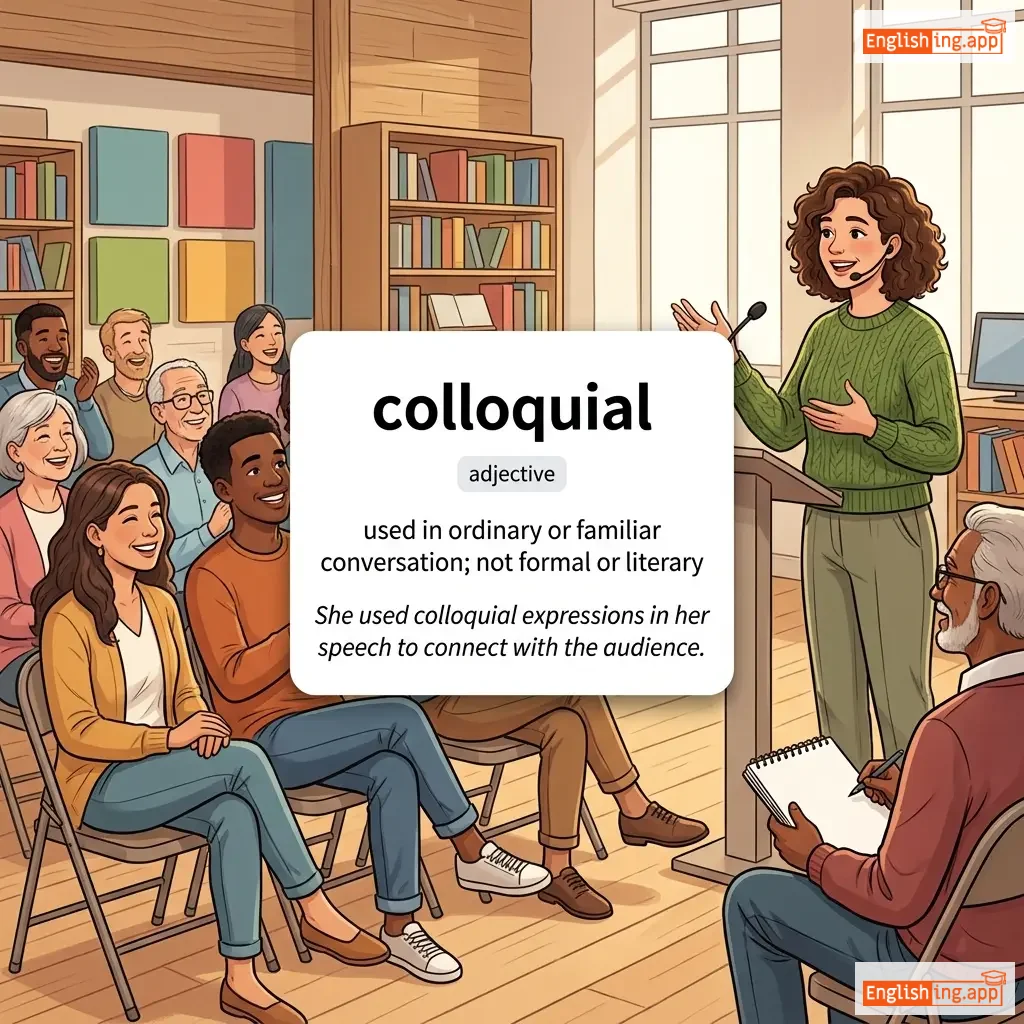
colloquial definition card — visual illustration of the meaning
adjective
/kəˈloʊkwiəl/
सामान्य भाषा (samaanya bhaasha)

used in ordinary or familiar conversation; not formal or literary

"She used colloquial expressions in her speech to connect with the audience."

"उसने अपने भाषण में श्रोताओं से जुड़ने के लिए सामान्य भाषा का उपयोग किया।" (Usne apne bhaashan mein shrotaon se judne ke liye samaanya bhaasha ka upyog kiya.)
noun
/kəˈloʊkwiəˌlɪzəm/
स्थानीय बोली (sthaniya boli)

a word or phrase used in informal speech or writing

"The novel is full of regional colloquialisms."

"उपन्यास क्षेत्रीय स्थानीय बोलियों से भरा हुआ है।" (Upanyas kshetriya sthaniya boliyon se bhara hua hai.)
noun
/ˈkɒl.ə.kwi/
औपचारिक बातचीत (aupcharik baatcheet)

A formal conversation or dialogue, often on serious or academic topics.

"The professors engaged in a deep colloquy about the future of education."

"प्रोफेसरों ने शिक्षा के भविष्य पर गहरी बातचीत की।" (Professaron ne shiksha ke bhavishya par gehri baatcheet ki.)
verb
/kəˈluːd/
षड्यंत्र करना (shadyantra karna)

To secretly cooperate or conspire with others, often for a deceitful purpose.

"The two companies colluded to fix prices in the market."

"दो कंपनियाँ बाज़ार में मूल्य तय करने के लिए षड्यंत्र कर रही थीं।" (Do companyan bazaar mein moolya tay karne ke liye shadyantra kar rahi thi.)
noun
/kəˈluːʒən/
साठगांठ (saathgaath)

A secret agreement or cooperation, especially for an illegal or dishonest purpose.

"There was evidence of collusion between the officials and the contractors."

"अधिकारियों और ठेकेदारों के बीच साठगांठ के सबूत थे।" (adhikariyon aur thekedaron ke beech saathgaath ke saboot the.)
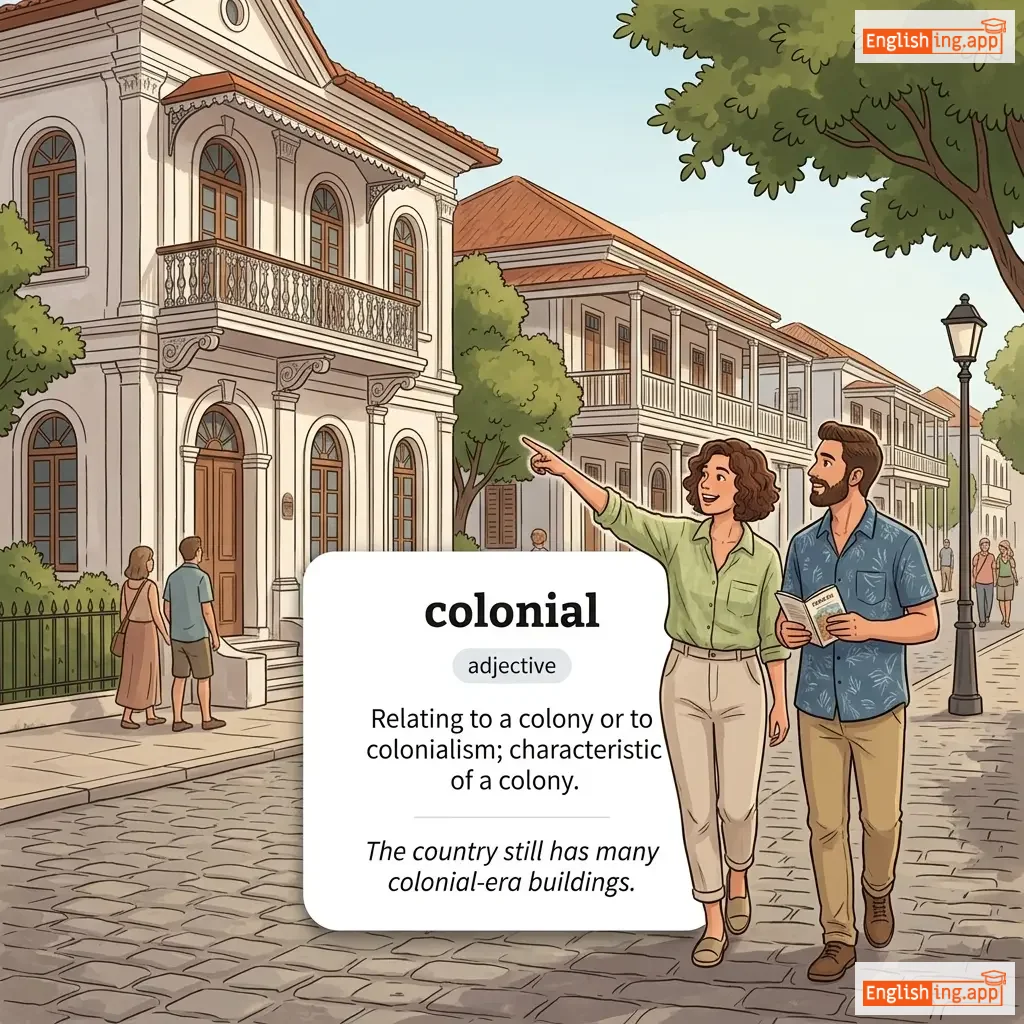
colonial definition card — visual illustration of the meaning
adjective
/kəˈloʊniəl/
उपनिवेशी (upniveshi)

Relating to a colony or to colonialism; characteristic of a colony.

"The country still has many colonial-era buildings."

"देश में अभी भी कई उपनिवेशी काल के भवन हैं।" (Desh mein abhi bhi kai upniveshi kaal ke bhavan hain.)
noun
/ˌkɒl.əˈneɪd/
स्तंभ रेखा (stambh rekha)

A row of evenly spaced columns supporting a roof, often in classical architecture.

"The visitors admired the grand colonnade at the entrance of the temple."

"यात्री मन्दिर के प्रवेश द्वार पर भव्य स्तंभ रेखा की सराहना कर रहे थे।" (Yaatri mandir ke pravesh dwaar par bhavya stambh rekha ki sarahna kar rahe the.)
noun
/ˈkɒləni/
उपनिवेश (upnivesh)

a territory or community controlled by another country or group of people

"India was once a British colony."

"भारत एक समय ब्रिटिश उपनिवेश था।" (Bharat ek samay British upnivesh tha.)
noun
/ˈkʌl.ər/
रंग (rang)

The property possessed by an object of producing different sensations on the eye as a result of the way it reflects or emits light.

"Blue is her favorite color."

"नीला उसका पसंदीदा रंग है।" (Neela uska pasandeeda rang hai.)
adjective
/ˈkʌlərfəl/
रंगीन (rangeen)

having bright colors; full of variety or interest

"The festival was full of colorful decorations."

"त्योहार रंगीन सजावट से भरा था।" (Tyohar rangeen sajavat se bhara tha.)
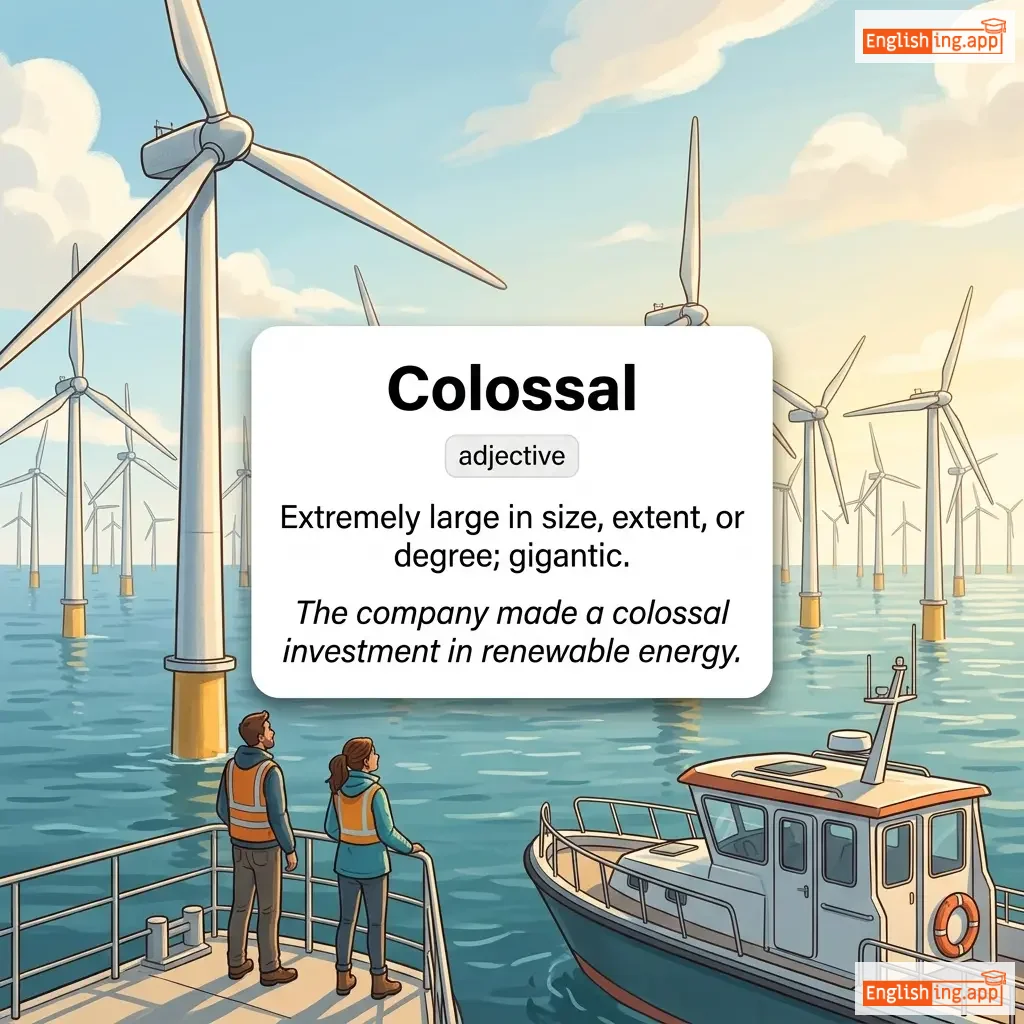
Colossal definition card — visual illustration of the meaning
adjective
/kəˈlɒsəl/
विशाल (vishal)

Extremely large in size, extent, or degree; gigantic.

"The company made a colossal investment in renewable energy."

"कंपनी ने नवीकरणीय ऊर्जा में एक विशाल निवेश किया।" (Company ne navikaranīya ūrgā mein ek vishāl nivēś kiyā.)
noun
/kəˈlɒsəs/
विशाल व्यक्ति/संगठन (vishal vyakti/sangathan)

A person or thing of enormous size, importance, or ability.

"Einstein was a colossus in the world of science."

"आइंस्टीन विज्ञान की दुनिया में एक कोलोसस थे।" (Einstein vigyan ki duniya mein ek kolosas the.)
noun
/ˈkʌl.ər/
रंग, वर्ण (rang, varn)

the property possessed by an object of producing different sensations on the eye as a result of the way it reflects light; hue, tint, shade

"What is your favorite colour for painting the bedroom walls?"

"शयनकक्ष की दीवारों को पेंट करने के लिए तुम्हारा पसंदीदा रंग क्या है?" (shayanakaksh ki deewaron ko paint karne ke liye tumhara pasandeeda rang kya hai?)
noun
/koʊlt/
घोड़े का बच्चा (ghode ka bachcha)

a young male horse, especially one under four years old

"The farmer trained the young colt to accept a saddle."

"किसान ने युवा कोल्ट को एक saddल स्वीकार करने के लिए प्रशिक्षित किया।" (kisan ne yuva colt ko ek saddle sweekar karne ke liye prashikshit kiya.)
adjective
/ˈkoʊltɪʃ/
नटखट (koltish)

Playful, energetic, and not fully mature or disciplined.

"The coltish boy ran around the field without a care."

"नटखट लड़का मैदान के चारों ओर बिना किसी चिंता के दौड़ रहा था।" (Natkhat ladka maidan ke charon aur bina kisi chinta ke daud raha tha.)
noun
/ˈkɒləm/
स्तंभ / कॉलम (stambh / kolam)

A vertical structure that supports a building; also a section of text arranged vertically in a newspaper or table.

"The ancient temple had tall marble columns."

"प्राचीन मंदिर में ऊँचे संगमरमर के स्तंभ थे।" (Prachin mandir mein unche sangmarmar ke stambh the.)
noun
/ˈkɒləmnɪst/
स्तंभकार (stambhkaar)

a journalist who regularly writes articles or opinions for a newspaper or magazine

"The columnist wrote an article about climate change."

"स्तंभकार ने जलवायु परिवर्तन पर एक लेख लिखा।" (Stambhkaar ne jalvaayu parivartan par ek lekh likha.)
noun
/ˈkoʊmə/
कोमा (koma)

A deep state of prolonged unconsciousness caused by illness or injury.

"The patient remained in a coma for several weeks."

"मरीज़ कई हफ्तों तक कोमा में था।" (mareez kai hafton tak koma mein tha.)
adjective
/ˈkoʊməˌtoʊs/
कोमा में (koma mein)

In a state of deep unconsciousness, resembling or related to coma.

"The comatose patient was kept under constant observation."

"कोमाटोज़ मरीज को निरंतर निगरानी में रखा गया था।" (Comatose mareez ko nirantar nigraani mein rakha gaya tha.)
noun
/koʊm/
कंघी (kanghi)

a toothed device for arranging or cleaning the hair

"She used a comb to style her hair before the party."

"उसने पार्टी से पहले अपने बालों को स्टाइल करने के लिए एक कंघी का इस्तेमाल किया।" (usne party se pehle apne baalon ko style karne ke liye ek kanghi ka istemal kiya.)
verb
/ˈkɒmbæt/
लड़ाई करना (ladaai karna)

to fight against something, especially to reduce or stop it

"The government is taking steps to combat corruption."

"सरकार भ्रष्टाचार से निपटने के लिए कदम उठा रही है।" (Sarkar bhrashtachar se nipatne ke liye kadam utha rahi hai.)
noun
/ˌkɒmbɪˈneɪʃən/
संयोजन / मिश्रण (sanyojan / mishran)

The act of joining or mixing two or more things together.

"This dish is a perfect combination of sweet and spicy flavors."

"यह डिश मीठे और मसालेदार फ्लेवर का एक परफेक्ट संयोजन है।" (Yah dish meethe aur masaledar flavor ka ek perfect sanyojan hai.)
verb
/kəmˈbaɪn/
मिलाना (milana)

To bring two or more things together to form a single unit.

"They decided to combine their resources for the project."

"उन्होंने परियोजना के लिए उनके संसाधनों को मिलाने का निर्णय लिया।" (Unhone pariyojna ke liye unke sansadhan ko milane ka nirnay liya.)
adjective
/kəmˈbaɪnd/
संयुक्त (sanyukt)

formed by bringing together separate parts or elements

"The combined effort of the team led to success."

"टीम के संयुक्त प्रयास ने सफलता दिलाई।" (Team ke sanyukt prayaas ne safalta dilayi.)
adjective
/kəmˈbʌstɪbəl/
ज्वलनशील (jvalansheel)

Capable of catching fire and burning easily.

"Dry leaves are highly combustible."

"सूखे पत्ते अत्यधिक ज्वलनशील होते हैं।" (sookhe patte atyadhik jvalansheel hote hain.)
come definition card — visual illustration of the meaning
verb
/kʌm/
खुशी (khushi)

to move or travel toward or into a place thought of as near or familiar

"She will come to the party later."

"जब उसे पुरस्कार मिला तो वह अपनी खुशी नहीं छुपा सकी।" (Jab use puraskar mila to vah apni khushi nahin chhupa sakee.)
noun
/ˈkʌmbæk/
कमबैक (comeback)

A return to a former status or success after a period of decline.

"The singer made a remarkable comeback after years of silence."

"गायक ने सालों की चुप्पी के बाद एक अद्वितीय कमबैक किया।" (gayak ne salon ki chuppi ke baad ek adwitiya comeback kiya.)
noun
/ˈkɒmədi/
खुशी (khushi)

A type of entertainment that is intended to make people laugh.

"We watched a hilarious comedy at the theater."

"वह पुरस्कार मिलने पर अपनी खुशी छिपा नहीं पाई।" (Wah puraskar milne par apni khushi chhupa nahi paayi.)
adjective
/ˈkʌmli/
सुंदर (sundar)

Attractive or pleasant in appearance.

"The actress was known for her comely features."

"अभिनेत्री अपनी सुंदर विशेषताओं के लिए जानी जाती थी।" (abhinetri apni sundar visheshton ke liye jani jati thi.)
noun
/kəˈmɛstɪbəl/
खाने योग्य (khane yogya)

An item of food that can be eaten.

"The picnic basket was full of delicious comestibles."

"पिकनिक की टोकरी स्वादिष्ट खाने योग्य चीजों से भरी हुई थी।" (piknik ki tokri swadisht khane yogya cheezon se bhari hui thi.)
noun
/ˈkɒm.ɪt/
धूमकेतु (dhumketu)

a celestial object consisting of ice and dust that develops a tail when approaching the sun

"Halley's Comet appears in the sky every 76 years."

"हैली का धूमकेतु हर 76 वर्षों में आकाश में दिखाई देता है।" (haili ka dhumketu har 76 varshon mein akash mein dikhai deta hai)
noun
/ˌkʌmˈʌpəns/
सजा (saza)

A deserved punishment or fate; just deserts.

"The corrupt official finally got his comeuppance in court."

"दुराचारी अधिकारी को आखिरकार कोर्ट में उसकी सजा मिली।" (duraachaaree adhikaaree ko aakhirkaar kort mein uskee saza milee.)
noun
/ˈkʌmfərt/
सांत्वना (santvna)

a state of physical ease and freedom from pain or distress

"The soft chair gave him great comfort."

"मुलायम कुर्सी ने उसे शानदार आराम दिया।" (Mulayam kursi ne use shandaar aaram diya.)
comfortable definition card — visual illustration of the meaning
adjective
/ˈkʌmf.tə.bəl/
आरामदायक (aaramdayak)

providing physical ease and relaxation; free from stress or worry

"This chair is so comfortable that I could sit here all day."

"इस कुर्सी में इतना आरामदायक है कि मैं यहाँ पूरे दिन बैठ सकता हूँ।" (Is kursi mein itna aaramdayak hai ki main yahaan poore din baith sakta hoon.)
adverb
/ˈkʌmftəbli/
आराम से (aaraam se)

in a comfortable manner; without difficulty or effort; with ease

"She was sitting comfortably in her favorite chair."

"वह अपनी पसंदीदा कुर्सी में आराम से बैठी थी।" (vah apni pasandeeda kursi mein aaraam se baithi thi)
adjective
/ˈkɒmɪk/
हास्यपूर्ण (hasyapurn)

causing or meant to cause laughter

"The movie had several comic scenes."

"फिल्म में कई हास्यपूर्ण दृश्य थे।" (Film mein kai hasyapurn drishya the.)
adjective
/ˈkɒmɪkəl/
हास्यपूर्ण (hasyapurn)

Funny in a strange or silly way; amusing.

"His comical expressions made everyone laugh."

"उसकी हास्यपूर्ण अभिव्यक्तियों ने सभी को हंसा दिया।" (uski hasyapurn abhibyaktiyon ne sabhi ko hansa diya.)
adjective
/ˈkʌmɪŋ/
आने वाला (ane wala)

approaching or happening soon

"We are preparing for the coming festival."

"हम आने वाले त्योहार की तैयारी कर रहे हैं।" (Hum ane wale tyohaar ki taiyaari kar rahe hain.)
noun
/ˈkɒmɪti/
सौजन्यता, शिष्टाचार (saujanyata, shishtachar)

Courtesy and considerate behavior towards others; mutual respect.

"The meeting was conducted with comity and respect."

"बैठक सौजन्यता और सम्मान के साथ आयोजित की गई थी।" (baithak saujanyata aur samman ke saath aayojit ki gayi thi.)
verb
/kəˈmænd/
आदेश (adesh)

to give an order authoritatively; to control or direct

"The general commanded the soldiers to move forward."

"जनरल ने सैनिकों को आगे बढ़ने का आदेश दिया।" (General ne sainiko ko aage badhne ka aadesh diya.)
command economy definition card — visual illustration of the meaning
noun
kəˈmɑːnd ɪˈkɒn.ə.mi
कमांड अर्थव्यवस्था (command arthvyavastha)

An economic system where economic activities are controlled by the government.

"In a command economy, the government controls production and prices."

"एक कमांड अर्थव्यवस्था में, सरकार उत्पादन और कीमतों को नियंत्रित करती है।" (Ek command arthvyavastha mein, sarkar utpadan aur keematon ko niyantrit karti hai.)
verb
/ˌkɒmənˈdɪə/
आधिकार लेना (adhikar lena)

To take control or possession of something, often by force or authority.

"The soldiers commandeered the villagers’ homes during the war."

"युद्ध के दौरान सैनिकों ने गांववासियों के घरों पर कब्जा कर लिया।" (yudh ke dauran sainikon ne gaanvvaasion ke gharon par kabza kar liya.)