वोकैबुलरीज

इंग्लिश वोकैबुलरी डिस्कवर, लर्न और मास्टर करें

noun
/ˈsɜːrkəmstæns/
परिस्थिति (paristhiti)

a fact or condition connected with an event or action

"She handled the difficult circumstances bravely."

"उसने कठिन परिस्थितियों का साहस से सामना किया।" (Usne kathin paristhitiyon ka sahas se samna kiya.)
noun
/ˈsɜːrkəmstænsɪz/
परिस्थितियाँ (paristhitiyan)

the conditions or facts that affect a situation

"She was forced to leave due to financial circumstances."

"वह वित्तीय परिस्थितियों के कारण जाने के लिए मजबूर हो गई थी।" (vah vittiya paristhitiyon ke kaaran jaane ke liye majboor ho gayi thi.)
circumvent definition card — visual illustration of the meaning
verb
/ˌsɜːrkəmˈvent/
बचाना (bachana)

to find a way around an obstacle; to avoid a rule or problem cleverly

"The company found a way to circumvent the new tax laws."

"कंपनी ने नए कर कानूनों से बचने का तरीका ढूंढ लिया।" (Company ne naye kar kanoonon se bachne ka tareeka dhoondh liya.)
noun
/ˈsɪstərn/
संग्रहणी (sangrahani)

A tank or container for storing water, usually for household use.

"The old house still had a cistern to collect rainwater."

"पुराने घर में अभी भी बारिश का पानी जमा करने के लिए एक संग्रहणी थी।" (Purane ghar mein abhi bhi barish ka pani jama karne ke liye ek sangrahani thi.)
noun
/ˈsɪtəˌdɛl/
किल्हा (kilha)

A fortress protecting or dominating a city.

"The ancient citadel stood guard over the town for centuries."

"प्राचीन किल्हा सदी दर सदी शहर पर पहरा देता रहा।" (Prachin kila sadi dar sadi shahar par pahra deta raha.)
noun
/saɪˈteɪʃən/
उद्धरण (uddharan)

a quotation from or reference to a book, paper, or author

"The research paper included a citation from Shakespeare."

"अनुसंधान पत्र में शेक्सपियर से एक उद्धरण शामिल था।" (Anusandhan patra mein Shakespeare se ek uddharan shamil tha.)
verb
/saɪt/
उद्धृत करना (uddhrut karna)

To refer to or quote a source as evidence or justification.

"She cited several studies to support her argument."

"उसने अपने तर्क का समर्थन करने के लिए कई अध्ययन उद्धृत किए।" (Usne apne tark ka samarthan karne ke liye kai adhyayan uddhrut kiye.)
noun
/ˈsɪtɪzən/
नागरिक (nagarik)

a legally recognized subject or national of a state

"Every citizen has the right to vote."

"हर नागरिक को वोट देने का अधिकार है।" (har nagarik ko vote dene ka adhikar hai.)
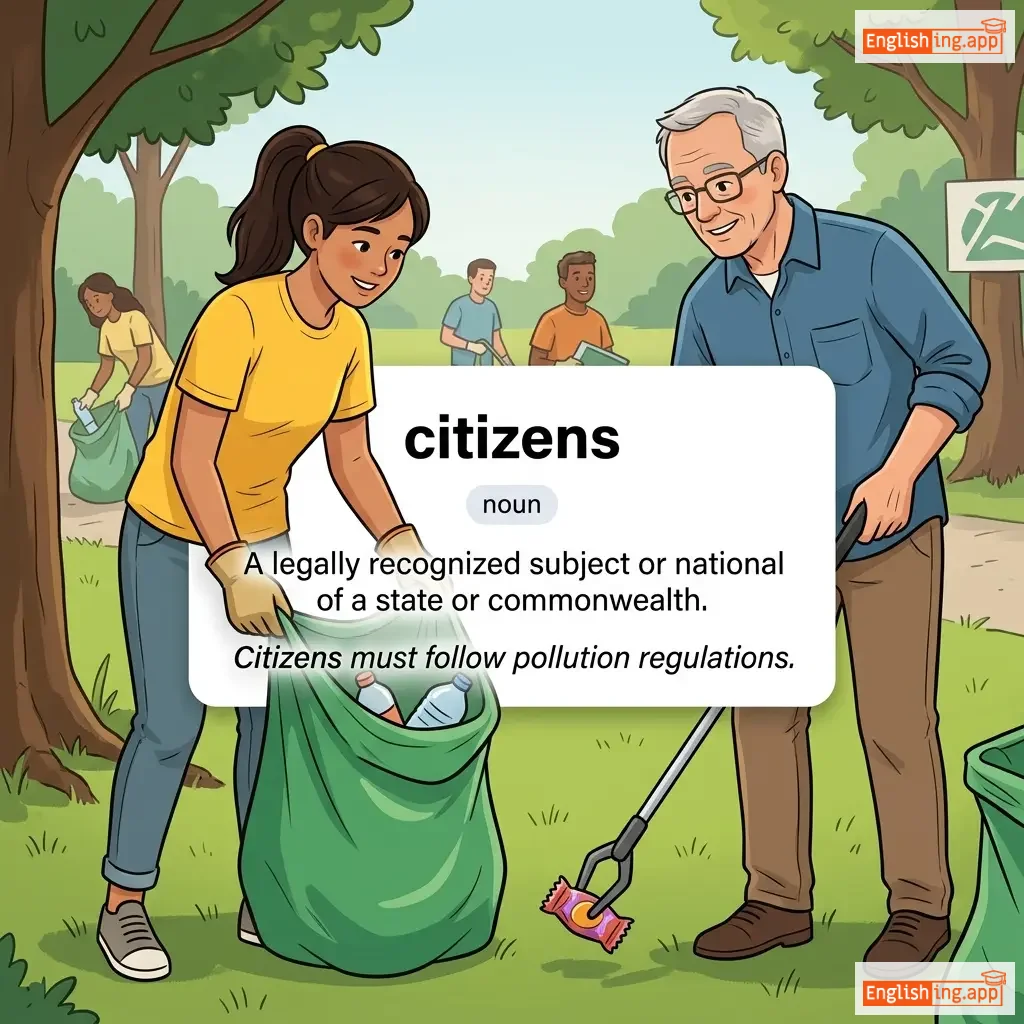
citizens definition card — visual illustration of the meaning
noun
/ˈsɪt.ɪ.zənz/
नागरिक (nagarik)

A legally recognized subject or national of a state or commonwealth.

"Citizens must follow pollution regulations."

"नागरिकों को प्रदूषण नियमों का पालन करना चाहिए।" (Nagarikon ko pradushan niyamon ka paalan karna chahiye.)
noun
/ˈsɪtɪzənʃɪp/
नागरिकता (nagritta)

the status of being a recognized member of a state or country, with rights and duties

"He applied for American citizenship after living there for ten years."

"उसने दस साल तक वहां रहने के बाद अमेरिकी नागरिकता के लिए आवेदन किया।" (Usne das saal tak wahan rehne ke baad American nagritta ke liye avedan kiya.)
noun
/ˈsɪtrɪk ˈæsɪd/
सिट्रिक ऐसिड (sitrik esid)

a natural acid found in citrus fruits, used as a food preservative and flavoring agent

"Add a pinch of citric acid to preserve the color of the fruit jam."

"फलों के जाम के रंग को संरक्षित करने के लिए एक चुटकी सिट्रिक ऐसिड डालें।" (phalon ke jam ke rang ko sanrakshit karne ke liye ek chutki sitrik esid daalen.)
noun
/ˈsɪti/
शहर (shahar)

a large town or an urban area with its own government

"Dhaka is the largest city in Bangladesh."

"दिल्ली भारत का सबसे बड़ा शहर है।" (Dilli Bharat ka sabse bada shahar hai.)
adjective
/ˈsɪvɪk/
नागरिक (nagarik)

relating to a city, town, or the duties of its citizens

"The mayor encouraged people to take part in civic activities."

"मेयर ने लोगों को नागरिक गतिविधियों में भाग लेने के लिए प्रोत्साहित किया।" (Meyar ne logon ko nagarik gatividhiyon mein bhag lene ke liye protsahit kiya.)
noun
/ˈsɪvɪks/
नागरिक शास्त्र (nagrik shastra)

the study of the rights and duties of citizens and how government works

"Civics helps students understand their responsibilities as citizens."

"नागरिक शास्त्र छात्रों को नागरिक जिम्मेदारियाँ समझने में मदद करता है।" (nagrik shastra chhatron ko nagrik zimmedariyan samajhne mein madad karta hai)
adjective
/ˈsɪvəl/
सामाजिक (samajik)

Relating to ordinary citizens and their concerns, or being polite and courteous.

"They settled the matter through civil discussion."

"उन्होंने सामाजिक चर्चा के माध्यम से मामले को सुलझाया।" (Unhone samajik charcha ke madhyam se mamle ko suljhaya.)
noun/adjective
/səˈvɪliən/
सामान्य व्यक्ति (saamanya vyakti)

a person not in the armed forces or police

"The area was evacuated to protect the civilians."

"क्षेत्र को नागरिकों की सुरक्षा के लिए खाली कर दिया गया था।" (kshetra ko nagrikon ki suraksha ke liye khaali kar diya gaya tha.)
noun
/səˈvɪləti/
सभ्यता (sabhyata)

Polite and courteous behavior.

"He treated his opponent with civility despite their differences."

"उन्होंने अपने प्रतिद्वंद्वी के साथ सिविलिटी के साथ पेश आना जारी रखा, बावजूद इसके कि उनके बीच भिन्नताएँ थीं।" (Unhone apne pratidwandi ke saath civility ke saath pesh aana jaari rakha, bawajood iske ki unke beech bhinnataen thin.)
noun
/ˌsɪvɪlaɪˈzeɪʃən/
सभ्यता (sabhyata)

the stage of human social and cultural development and organization considered most advanced

"Ancient Egypt is known for its remarkable civilization."

"प्राचीन मिस्र अपनी अद्वितीय सभ्यता के लिए प्रसिद्ध है।" (Prachin Misr apni advitiya sabhyata ke liye prasiddh hai.)
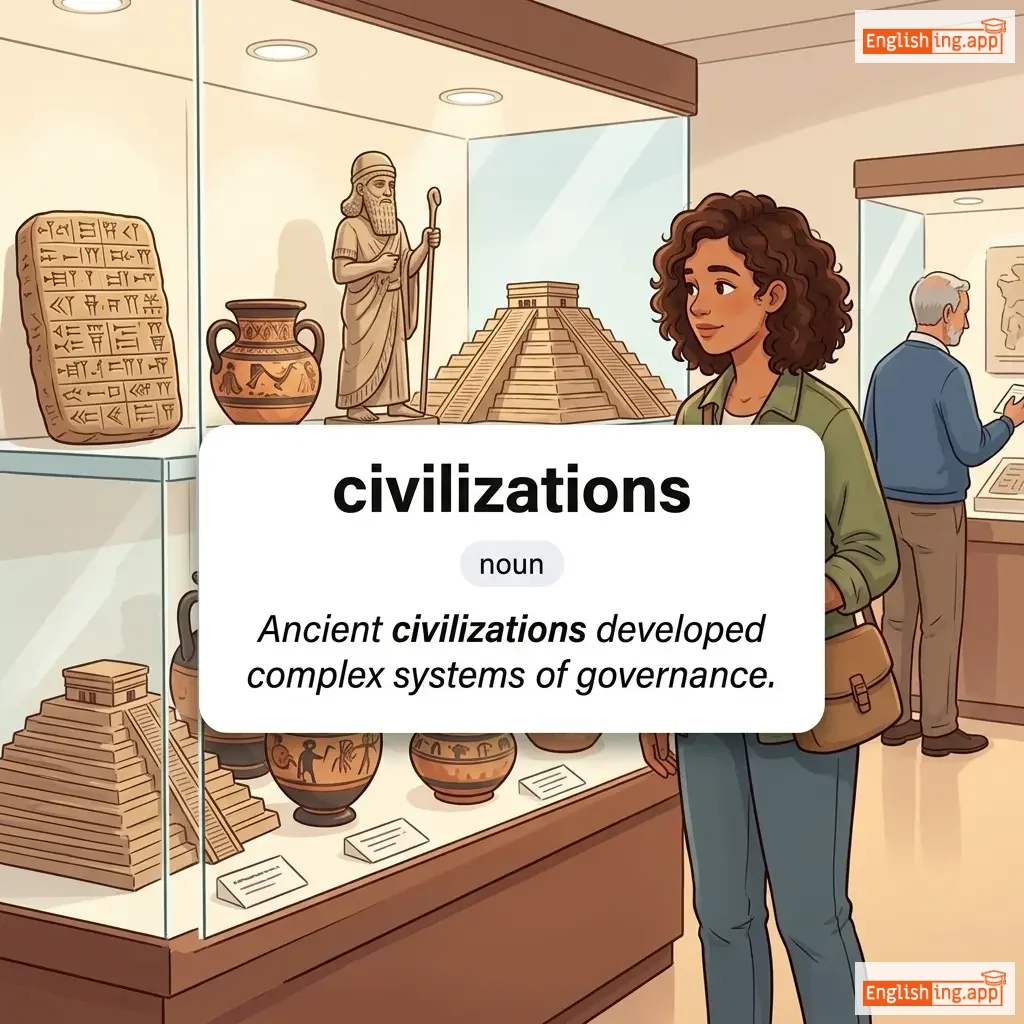
civilizations definition card — visual illustration of the meaning
noun
sɪvɪˈlɪzeɪʃənz
संस्कृतियाँ (sanskritiyan)

The stage of human social development and organization that is considered most advanced.

"Ancient civilizations developed complex systems of governance."

"प्राचीन संस्कृतियों ने शासन के जटिल प्रणालियाँ विकसित की थीं।" (Prachin sanskritiyon ne shasan ke jatil pranaliyan viksit ki thin.)
verb
/ˈsɪvɪlaɪz/
सभ्य बनाना (sabhy banana)

to bring a society or group to a more developed, organized, or socially acceptable state; to educate and refine behavior

"Education can help civilize communities by promoting shared values and respect."

"शिक्षा साझा मूल्यों और सम्मान को बढ़ावा देकर समाज को सभ्य बनाने में मदद कर सकती है।" (shiksha saanjha mulyon aur samman ko badhava dekar samaj ko sabhy banane mein madad kar sakti hai)
adjective
/klæd/
पोशाक पहने हुए (poshaak pahane hue)

dressed or covered in a particular way

"The knight was clad in shining armor."

"योद्धा चमकते हुए कवच में पोशाक पहने हुए था।" (Yoddha chamakte huye kavach mein poshaak pahane hue tha.)
claim definition card — visual illustration of the meaning
verb
/kleɪm/
दावा करना (dawa karna)

to state something as true, often without proof; to demand ownership or right

"He claimed the prize after winning the competition."

"उसने प्रतियोगिता जीतने के बाद पुरस्कार का दावा किया।" (Usne pratiyogita jeetne ke baad puraskar ka dawa kiya.)
noun
/ˈkleɪmənt/
वादकारी (vaadkari)

a person who makes a claim, especially in a legal or financial context

"The claimant filed for compensation after the accident."

"दावेदार ने दुर्घटना के बाद मुआवजे के लिए आवेदन किया।" (Daavedaar ne durghatna ke baad muavze ke liye aavedan kiya.)
claims definition card — visual illustration of the meaning
verb
kleɪmz
प्राण ले लेना (pran le lena)

To take someone's life, to cause death

"Workplace pollution claims thousands of lives annually."

"कार्यस्थल प्रदूषण प्रतिवर्ष हजारों जीवन ले लेता है।" (Karyasthal pradooshan pratibharsh hazaron jeevan le leta hai.)
noun
/klɛərˈvɔɪəns/
दूरदृष्टि (durdrishti)

the supposed ability to perceive events beyond normal sensory contact; psychic insight

"She claimed to have clairvoyance and predicted the future."

"उसने दावा किया कि उसे दूरदृष्टि है और उसने भविष्यवाणी की।" (Usne dawa kiya ki use durdrishti hai aur usne bhavishyavani ki.)
clairvoyant definition card — visual illustration of the meaning
noun, adjective
/klɛərˈvɔɪənt/
दूरदर्शी (klairvoyant)

a person who claims to have clairvoyance; having the ability to see beyond normal senses

"The clairvoyant predicted that she would travel abroad soon."

"उस दूरदर्शी ने भविष्यवाणी की कि वह जल्द ही विदेश जाएगी।" (Us dooradarshi ne bhavishyavani ki ki vah jald hi videsh jaayegi)
verb
/ˈklæmbər/
कष्ट से चढ़ना (kasht se chadhna)

to climb with effort or difficulty, often using both hands and feet

"The children clambered over the rocks to reach the cave."

"बच्चों ने गुफा तक पहुँचने के लिए चट्टानों के ऊपर कष्ट से चढ़ाई की।" (Bachon ne gufaa tak pahuchne ke liye chhatano ke upar kasht se chadhai ki.)
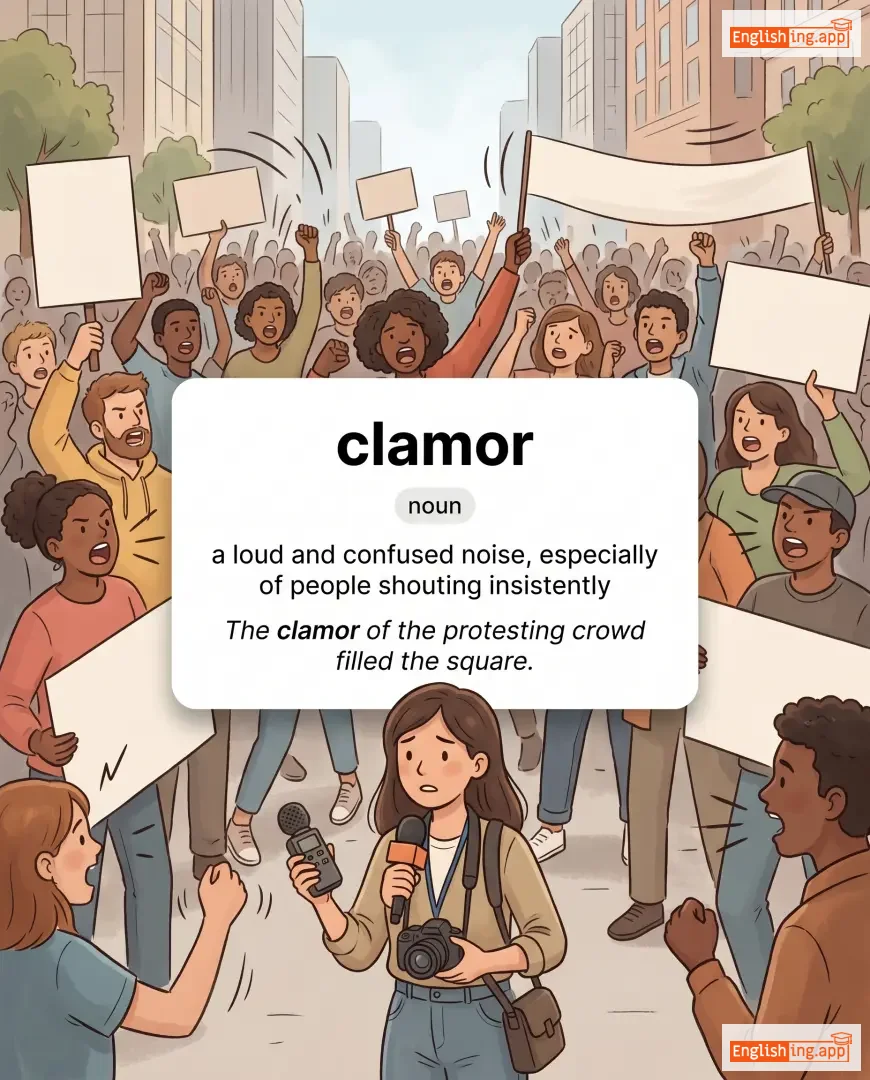
clamor definition card — visual illustration of the meaning
noun
/ˈklæmər/
कोलाहल (kolahal)

a loud and confused noise, especially of people shouting insistently

"The clamor of the protesting crowd filled the square."

"विरोध कर रहे समूह की कोलाहल ने चौक को भर दिया।" (Virodh kar rahe samuh ki kolahal ne chauk ko bhar diya.)
adjective
/ˈklæmərəs/
कोलाहलपूर्ण (kolahalpurn)

making a loud and confused noise; expressing strong demands noisily

"The clamorous audience demanded an encore from the band."

"कोलाहलपूर्ण दर्शकों ने बैंड से एक और गीत की मांग की।" (Kolahalpurn darshako ne band se ek aur geet ki mang ki.)
👨‍👩‍👧‍👦

clan (क्लैन)

noun
/klæn/
कबीला (kabila)

a large family group or a close-knit community with shared interests or ancestry

"The entire clan gathered to celebrate the festival."

"पूरा कबीला उत्सव मनाने के लिए इकट्ठा हुआ।" (Pura kabila utsav manane ke liye ikattha hua.)
adjective
/klænˈdɛstaɪn/
गुप्त (klaindestin)

kept secret or done secretly, especially for illicit purposes

"They held a clandestine meeting late at night."

"उन्होंने देर रात एक गुप्त बैठक की।" (unhone der raat ek gupt baithak ki)
noun
/ˈklæŋər/
ध्वनि, ध्वनि का शोर (dhvani, dhvani ka shor)

A loud, resonant, and continuous noise, often metallic.

"The clangor of the church bells filled the town square."

"चर्च की घंटियों का शोर शहर के चौक में गूंज रहा था।" (Church ki ghantiyon ka shor shahar ke chauk mein goonj raha tha.)
verb
/klæp/
ताली (taali)

To strike the palms of the hands together, usually to express approval or create a sharp sound.

"The audience began to clap loudly after the performance."

"दर्शकों ने प्रदर्शन के बाद जोर से ताली बजाना शुरू किया।" (Darshako ne pradarshan ke baad jor se taali bajana shuru kiya.)
noun
/ˈklæpər/
घंटी का भीतर का धातु का टुकड़ा (ghanti ka bhitar ka dhatu ka tukda)

The free-swinging metal piece inside a bell that strikes it to produce sound.

"The clapper inside the bell was broken."

"घंटी के भीतर का क्लैपर टूट गया था।" (Ghanti ke bhitar ka clapper toot gaya tha.)
clarification definition card — visual illustration of the meaning
noun
/ˌklærɪfɪˈkeɪʃən/
स्पष्टीकरण (spashtikaran)

The action of making a statement or situation less confused and more clearly comprehensible.

"The manager requested clarification on the project details."

"प्रबंधक ने परियोजना विवरण पर स्पष्टीकरण मांगा।" (Prabandhak ne pariyojana vivaran par spashtikaran manga.)
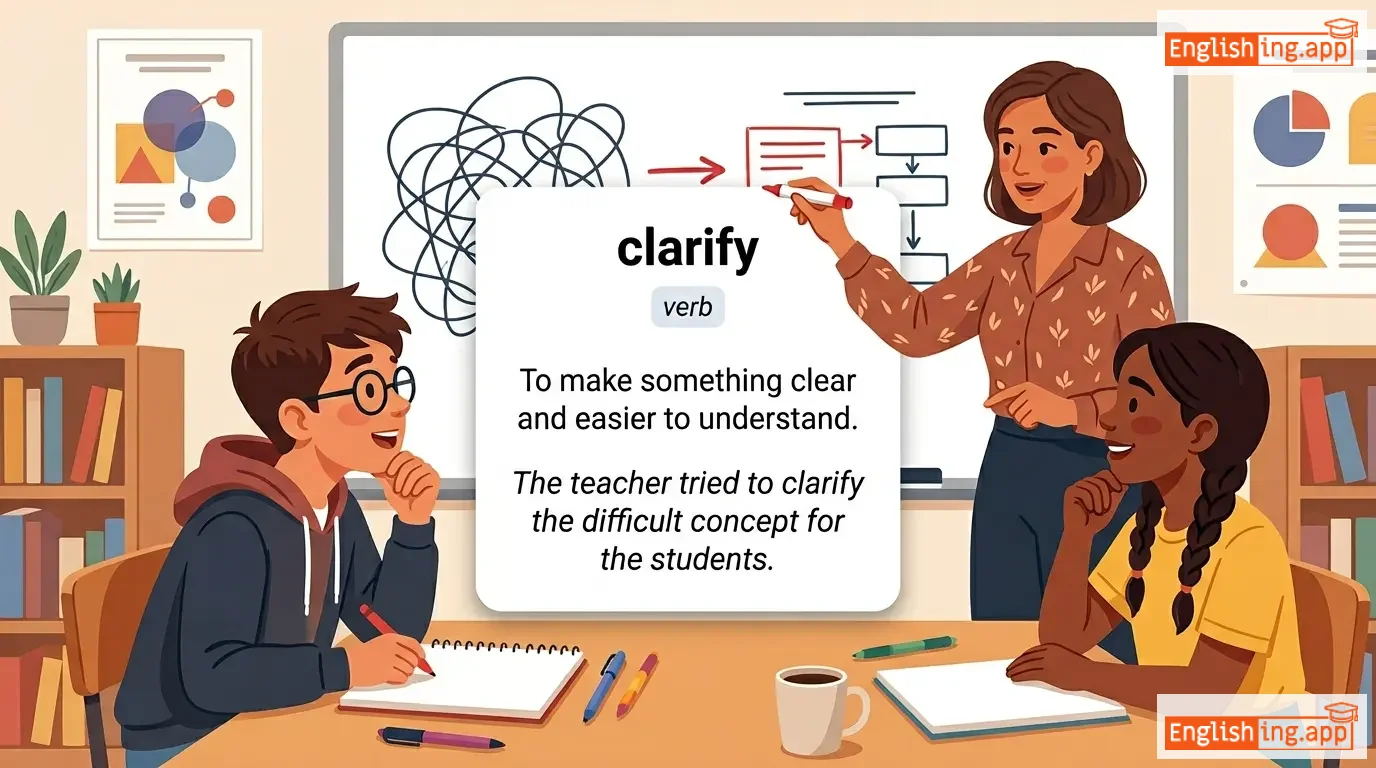
clarify definition card — visual illustration of the meaning
verb
/ˈklærɪfaɪ/
स्पष्ट करना (spasht karna)

To make something clear and easier to understand.

"The teacher tried to clarify the difficult concept for the students."

"शिक्षक ने छात्रों के लिए कठिन अवधारणा को स्पष्ट करने की कोशिश की।" (Shikshak ne chhatron ke liye kathin avdharna ko spasht karne ki koshish ki.)
adjective
/ˈklæriən/
जोरदार और स्पष्ट, जैसे एक तुरही की आवाज़ (jordar aur spashth, jaise ek turahi ki awaaz)

Loud and clear, like the sound of a trumpet; strongly expressed.

"The leader’s clarion call for unity inspired the crowd."

"नेता की एकता के लिए जोरदार अपील ने भीड़ को प्रेरित किया।" (Neta ki ekta ke liye jordar apeel ne bheed ko prerit kiya.)
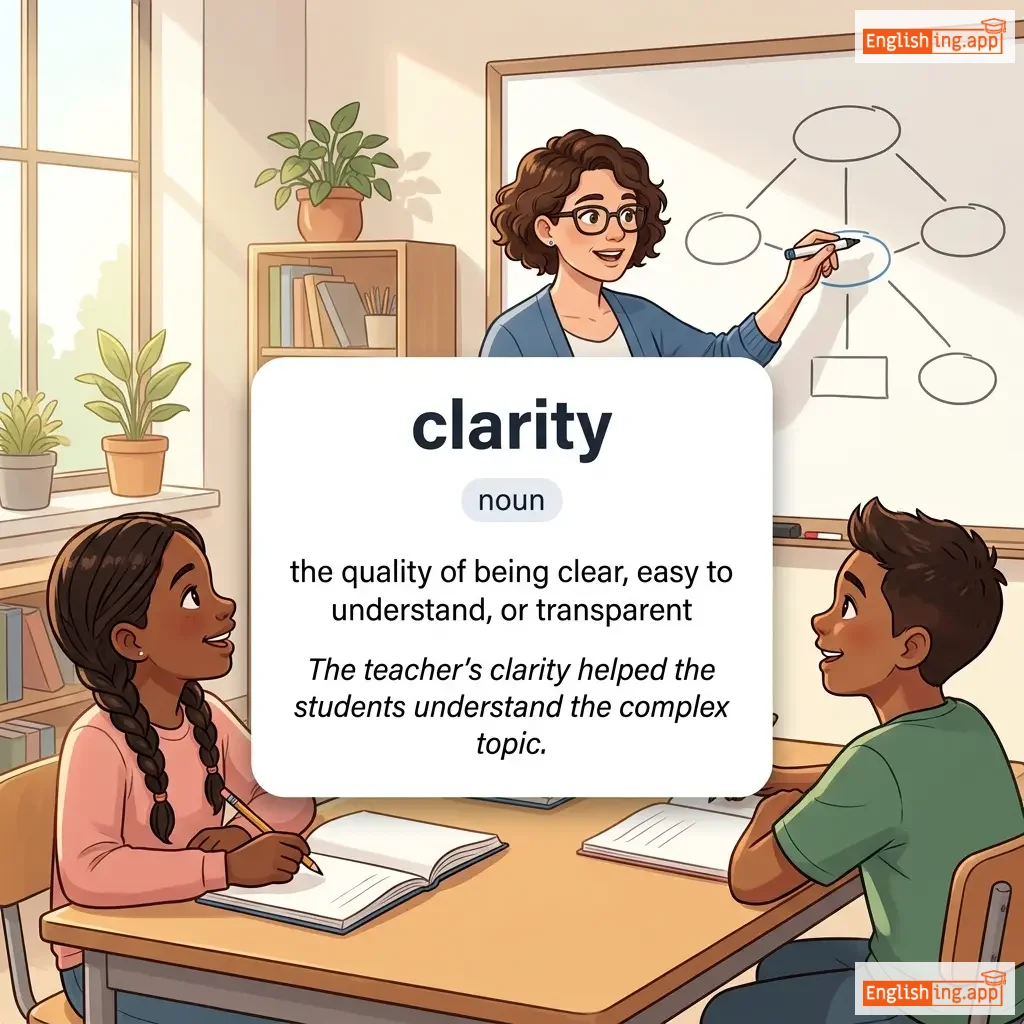
clarity definition card — visual illustration of the meaning
noun
/ˈklærəti/
स्पष्टता (spashtata)

the quality of being clear, easy to understand, or transparent

"The teacher's clarity helped the students understand the complex topic."

"शिक्षक की स्पष्टता ने छात्रों को जटिल विषय समझने में मदद की।" (Shikshak ki spashtata ne chhatron ko jatil vishay samajhne mein madad ki.)
verb
/klæʃ/
टकराव (takraav)

to come into conflict or collision with something or someone.

"The two cars clashed in the intersection."

"दो कारें चौराहे पर टकरा गईं।" (do kaarein chaurahe par takra gayin.)
verb
/klæsp/
पकड़ना / जकड़न (pakadna / jakadna)

to grasp or hold tightly; also a device for fastening

"She clasped her hands together in prayer."

"उसने प्रार्थना में अपने हाथ एक साथ पकड़ लिए।" (Usne prarthana mein apne haath ek saath pakad liye.)
noun
/klɑːs/
कक्षा (kaksha)

a group of students taught together or a category of people or things with shared characteristics

"Our class meets every morning at nine."

"हमारी कक्षा हर सुबह नौ बजे मिलती है।" (Hamari kaksha har subah nau baje milti hai.)
adjective
/ˈklæsɪk/
क्लासिक, श्रेष्ठ (klasik, shreshth)

Judged over a period of time to be of the highest quality and outstanding of its kind.

"That movie is a classic example of 90s comedy."

"वह फिल्म 90 के दशक की हास्य का एक क्लासिक उदाहरण है।" (vah film 90 ke dashak ki haasya ka ek klasik udaharan hai.)
adjective
/ˈklæsɪkəl/
प्राचीन या पारंपरिक (prachin ya paramparik)

relating to ancient Greek or Roman culture, or representing traditional excellence in art, music, or literature

"She loves listening to classical music while studying."

"वह अध्ययन करते समय शास्त्रीय संगीत सुनना पसंद करती है।" (Vah adhyayan karte samay shastriya sangeet sunna pasand karti hai.)
noun
/ˌklæsɪfɪˈkeɪʃən/
वर्गीकरण (vargikaran)

the action or process of classifying something into groups based on shared characteristics.

"The classification of animals helps in understanding their biology."

"पशुओं का वर्गीकरण उनके जीवविज्ञान को समझने में मदद करता है।" (pashuon ka vargikaran unke jeevvigyan ko samajhne mein madad karta hai.)
adjective
/ˈklæsɪfaɪd/
गोपनीय; वर्गीकृत (gopniya; vargikrit)

arranged into categories; officially secret or restricted

"The report contains classified information and cannot be shared publicly."

"इस रिपोर्ट में गोपनीय जानकारी है।" (is report mein gopniya jankari hai)
verb
/ˈklæsɪfaɪ/
वर्गीकृत करना (vargikrit karna)

to arrange or organize into categories or groups

"The librarian classified the books by subject."

"लाइब्रेरियन ने किताबों को विषय के अनुसार वर्गीकृत किया।" (Librarian ne kitabon ko vishay ke anusar vargikrit kiya.)
noun
/ˈklɑːsmeɪt/
सहपाठी (sahpathi)

a person who is in the same class or course of study as another

"I met one of my old classmates at the university event."

"मैं विश्वविद्यालय के कार्यक्रम में अपने एक पुराने सहपाठी से मिला।" (main vishwavidyalay ke karyakram mein apne ek purane sahpathi se mila)
noun
/ˈklæsˌruːm/
कक्षा (kaksha)

A room in which classes are held in a school or college.

"The teacher entered the classroom and greeted the students."

"शिक्षक कक्षा में प्रवेश कर छात्रों को अभिवादन करते हैं।" (Shikshak kaksha mein pravesh kar chhatron ko abhibadan karte hain.)
noun
/ˌklɔːstrəˈfəʊbiə/
संकीर्ण स्थानों का भय (claustrophobia)

an extreme or irrational fear of being in confined spaces

"He avoids elevators because of his claustrophobia."

"वह संकीर्ण स्थानों के भय के कारण लिफ्टों से बचता है।" (vah sankirn sthaanon ke bhay ke kaaran lifton se bachata hai)
noun
/ˈklævɪkəl/
कॉलरबोन (kolarbon)

the collarbone, a long bone that serves as a strut between the shoulder blade and the sternum

"He fractured his clavicle in the accident."

"उसने दुर्घटना में अपनी कॉलरबोन फ्रैक्चर कर दी।" (Usne durghatna mein apni kolarbon fracture kar di.)