वोकैबुलरीज

इंग्लिश वोकैबुलरी डिस्कवर, लर्न और मास्टर करें

verb
/bɪˈsiːdʒ/
घेर लेना (gher lena)

to surround a place with armed forces to capture it; to overwhelm with requests or attention

"The city was besieged by enemy troops."

"शहर को दुश्मन सैनिकों ने घेर लिया था।" (Shahar ko dushman sainikon ne gher liya tha.)
verb
/bɪˈsmɪər/
मैल लगाना (mail lagana)

to smear or cover with a sticky or dirty substance; to soil

"His clothes were besmeared with mud."

"उसके कपड़े कीचड़ से मैल लगे हुए थे।" (Uske kapde keechad se mail lage hue the.)
verb
/bɪˈsmɜːrtʃ/
कलंकित करना (kalankit karna)

to damage someone's reputation; to make dirty or stained

"He tried to besmirch her good name with false rumors."

"उसने झूठी अफवाहों से उसके अच्छे नाम को कलंकित करने की कोशिश की।" (Usne jhoothi afwahon se uske achhe naam ko kalankit karne ki koshish ki.)
adjective
/bɪˈsɒtɪd/
मोहित, प्रेम में अंधा (mohit, prem mein andha)

strongly infatuated or obsessed with someone or something

"He was completely besotted with her charm."

"वह उसकी आकर्षण से पूरी तरह से मोहित था।" (vah uski aakarshan se puri tarah se mohit tha.)
adjective
/bɛst/
सर्वश्रेष्ठ (sarvashreshth)

Of the highest quality, excellence, or standing.

"She is the best student in the class."

"वह कक्षा में सबसे अच्छी छात्रा है।" (vah kaksha mein sabse acchi chhatra hai.)
best effort definition card — visual illustration of the meaning
phrase
bɛst ˈɛf.ərt
सर्वश्रेष्ठ प्रयास (sarvashreshth prayaas)

The maximum amount of effort or energy that someone can give.

"He gave his best effort to complete the task on time."

"उसने समय पर कार्य पूरा करने के लिए अपना सर्वश्रेष्ठ प्रयास किया।" (usne samay par karya poora karne ke liye apna sarvashreshth prayaas kiya)
adjective
/ˈbiːstiəl/
जानवरों जैसा (janwaron jaisa)

Relating to beasts; showing savagery, brutality, or lacking human sensibility.

"The prisoners were treated in a bestial manner."

"क़ैदियों को एक जानवरों जैसे तरीके से व्यवहार किया गया।" (Qaidiyon ko ek janwaron jaise tareeke se vyavhaar kiya gaya.)
verb
/bɪˈstoʊ/
दान देना (daan dena)

To give or present something as a gift or honor.

"The king bestowed honors upon the brave soldiers."

"राजा ने बहादुर सैनिकों को सम्मानित किया।" (Raja ne bahaadur sainiko ko sammaanit kiya.)
verb
/bɪˈstruː/
बिखेरना (bikherna)

To scatter or cover something with objects or substances.

"The ground was bestrewn with autumn leaves."

"ज़मीन शरद की पत्तियों से बिखरी हुई थी।" (Zameen sharad ki patiyon se bikhri hui thi.)
verb
/bɪˈstraɪd/
अधिपत्य जमाना (adhipatya jamaana)

To sit or stand astride something; to dominate over.

"The statue bestrides the city square."

"प्रतिमा शहर के चौक पर अधिपत्य जमाए हुए है।" (Pratima shahar ke chawk par adhipatya jamaaye hue hai.)
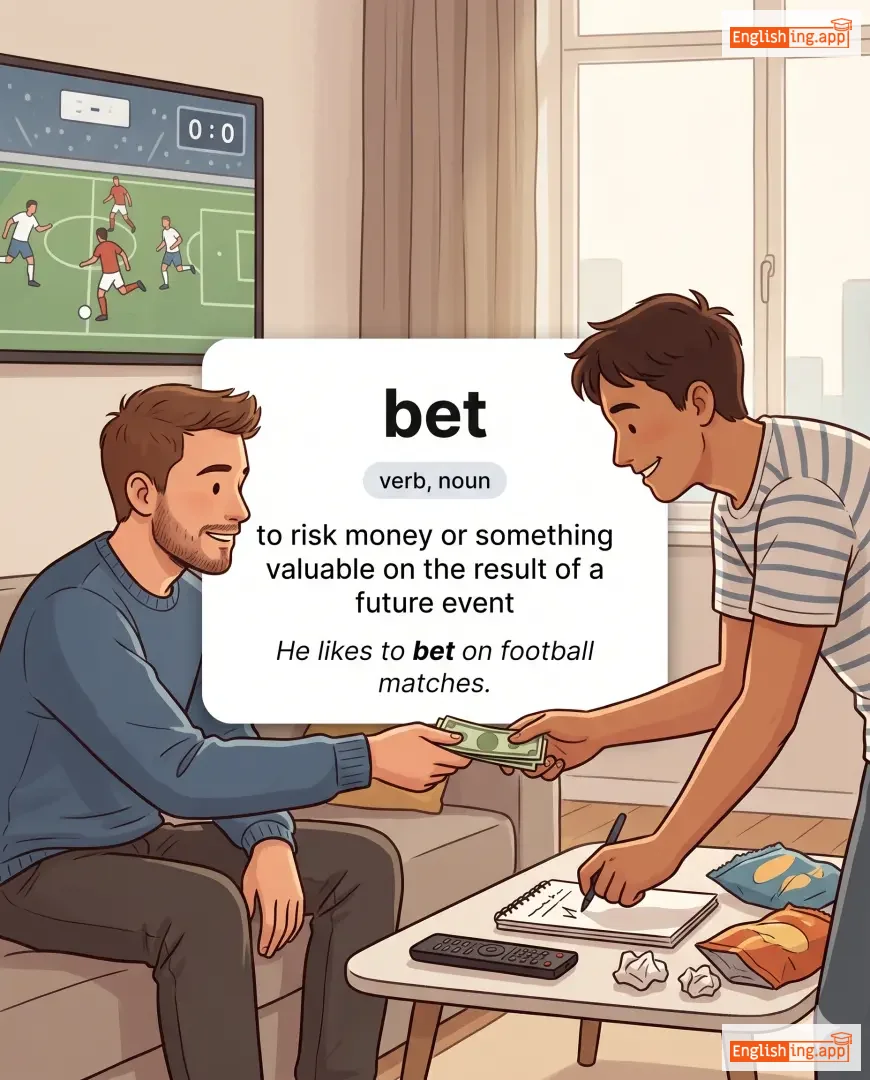
bet definition card — visual illustration of the meaning
verb, noun
/bɛt/
दांव लगाना (daav lagana)

to risk money or something valuable on the result of a future event

"He likes to bet on football matches."

"वह फुटबॉल मैचों पर दांव लगाना पसंद करता है।" (vah football matchon par daav lagana pasand karta hai.)
verb
/bɪˈteɪk/
जाना या शरण लेना (jana ya sharan lena)

to go or resort to a place or course of action, especially as a response; to apply oneself

"After dinner, she betook herself to her room to read."

"रात के खाने के बाद वह पढ़ने के लिए अपने कमरे में गई।" (raat ke khane ke baad vah padhne ke liye apne kamre mein gai)
noun
/ˌbeɪt ˈnwɑːr/
नफरत की चीज़ (nafrat ki cheez)

A person or thing that one particularly dislikes or fears.

"Grammar has always been his bete noire."

"व्याकरण हमेशा उसकी बेत न्वायर रहा है।" (Vyakaran hamesha uski bete noire raha hai.)
noun
/ˈbiː.təl nʌt/
पान (pan)

seed of the areca palm tree, often chewed as a stimulant

"Betel-nut is commonly chewed in many South Asian countries."

"पान को कई दक्षिण एशियाई देशों में सामान्यतः चबाया जाता है" (pan ko kai dokshin eshiya deshon mein saadharanata chibaya jaata hai)
verb
/bɪˈθɪŋk/
याद करना (yaad karna)

to cause oneself to consider or remember something

"He bethought himself of the promise he had made."

"उसने अपनी दी हुई वचनबद्धता को याद किया।" (Usne apni di hui vachanbaddhata ko yaad kiya.)
verb
/bɪˈtaɪd/
घटना होना (ghatna hona)

to happen or occur, usually of something that befalls someone

"Woe betide anyone who breaks the rules."

"जो कोई नियम तोड़ेगा, उसका बुरा हाल होगा।" (Jo koi niyam todega, uska bura haal hoga.)
adverb
/bɪˈtaɪmz/
समय से पहले (samay se pehle)

early; in good time

"She rose betimes to finish her work."

"वह अपना काम पूरा करने के लिए समय से पहले उठी।" (Vah apna kaam poora karne ke liye samay se pehle uthi.)
verb
/bɪˈtəʊkən/
संकेत देना (sanket dena)

to be a sign or indication of something

"Dark clouds betoken an approaching storm."

"अंधेरे बादल एक आ रहे तूफान का संकेत देते हैं।" (Andhere baadal ek aa rahe toofan ka sanket dete hain.)
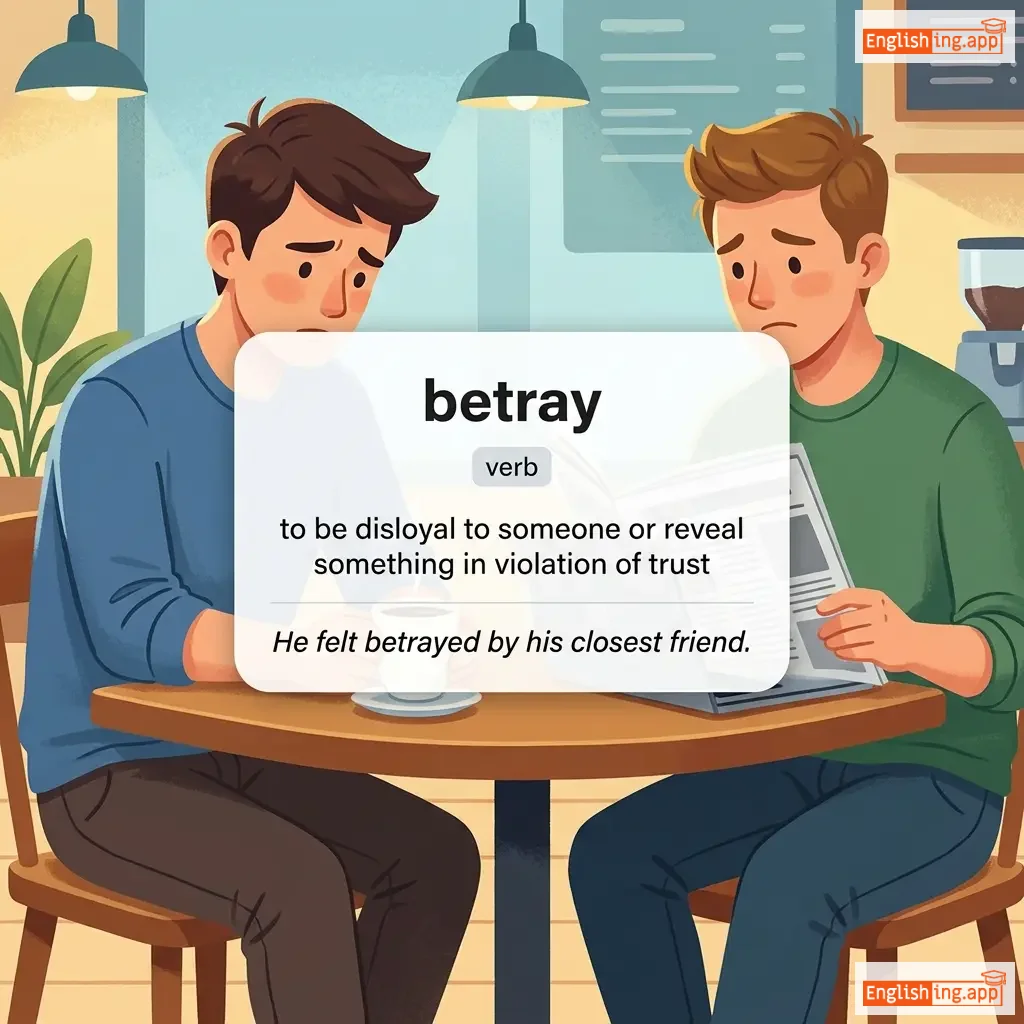
betray definition card — visual illustration of the meaning
verb
/bɪˈtreɪ/
विश्वासघात करना (vishwasghat karna)

to be disloyal to someone or reveal something in violation of trust

"He felt betrayed by his closest friend."

"वह अपने सबसे करीबी दोस्त द्वारा धोखा दिया गया महसूस करता था।" (Vah apne sabse kareeb dost dwara dhokha diya gaya mahsus karta tha.)
noun
/bɪˈtreɪəl/
धोखा; विश्वासघात (dhokha; vishwasa-ghat)

the action of betraying one's country, group, or person; disloyalty

"His betrayal of their friendship hurt her deeply."

"उनकी दोस्ती के प्रति विश्वासघात ने उसे गहरे तौर पर आहत किया।" (unki dosti ke prati vishwasa-ghat ne use gahre taur par aahat kiya.)
noun
/bɪˈtreɪər/
विश्वासघातक; धोखेबाज (vishwāshghātak, dhokhebāj)

a person who betrays someone or something; one who is disloyal

"The betrayer was exposed and faced severe consequences."

"विश्वासघातक को उजागर किया गया और उसे गंभीर परिणामों का सामना करना पड़ा।" (vishwāshghātak ko ujāgar kiyā gayā aur use gambhīr parināmō kā sāmanā karnā paṛā)
verb
/bɪˈtroʊð/
सगाई करना (sagaai karna)

To formally promise to marry someone; to engage.

"He was betrothed to the princess at a young age."

"वह बहुत कम उम्र में राजकुमारी से सगाई कर चुका था।" (Vah bahut kam umr mein raajkumari se sagai kar chuka tha.)
noun
/bɪˈtroʊðəl/
सगाई (sagai)

The formal engagement to be married.

"Their betrothal was announced to the whole village."

"उनकी सगाई को पूरे गाँव में घोषित किया गया था।" (Unki sagai ko poore gaon mein ghoshit kiya gaya tha.)
adjective, noun
/bɪˈtroʊðd/
सगाई किया हुआ (sagai kiya hua)

Engaged to be married; a person who is engaged.

"She introduced him as her betrothed."

"उसने उसे अपने सगाई किए हुए के रूप में परिचित कराया।" (Usne use apne sagai kiye hue ke roop mein parichit karaya.)
adjective, adverb, verb
/ˈbɛtər/
बेहतर (behtar)

of a more excellent or effective type or quality; to surpass or improve

"He felt better after taking the medicine."

"दवा लेने के बाद वह बेहतर महसूस कर रहा था।" (dawā lene ke bād vah behtar mahasūs kar rahā thā.)
preposition, adverb
/bɪˈtwiːn/
के बीच (ke beech)

at, into, or across the space separating two objects or regions

"She sat between her two friends."

"वह अपनी दो दोस्तों के बीच बैठी थी।" (Wah apni do doston ke beech baithi thi.)
noun, verb
/ˈbɛvəl/
ढलवा किनारा (dhalwa kinara)

A sloping edge or surface; to cut or shape an edge at an angle.

"The carpenter beveled the edges of the table."

"कारीगर ने मेज के किनारों को ढलवा किया।" (Karigar ne mej ke kinaron ko dhalwa kiya.)
noun
/ˈbɛvərɪdʒ/
पेय (pey)

a drink, especially one other than water

"I ordered a cold beverage to cool down on a hot day."

"मैंने एक ठंडा पेय ऑर्डर किया ताकि गर्म दिन में ठंडा हो सकूँ।" (Maine ek thanda pey order kiya taaki garm din mein thanda ho sakun.)
noun
/ˈbɛvi/
झुंड, समूह (jhund, samuh)

A large group of people or things of a particular kind.

"A bevy of swans floated on the lake."

"एक झुंड हंस झील पर तैर रहे थे।" (Ek jhund hans jheel par tair rahe the.)
verb
/bɪˈweɪl/
विलाप करना (vilaap karna)

to express deep sorrow or regret over something; to mourn openly

"She bewailed the loss of her childhood home."

"उसने अपने बचपन के घर के खोने पर विलाप किया।" (usne apne bachpan ke ghar ke khone par vilaap kiya)
verb
/bɪˈwɛər/
सतर्क रहना (satark rehna)

to be cautious or alert about a potential danger or problem

"Beware of the dog near the gate."

"गेट के पास कुत्ते से सावधान रहें।" (Gate ke paas kutte se savdhan rahein.)
verb
/bɪˈwɪldər/
चकरा देना (chakarā denā)

to cause someone to be confused or puzzled

"The complex instructions bewildered the students."

"जटिल निर्देशों ने छात्रों को चकरा दिया।" (Jatil nirdeshon ne chhātron ko chakarā diyā.)
verb
/bɪˈwɪtʃ/
जादू से मोहित करना (jadoo se mohit karna)

to enchant or fascinate someone as if by magic

"The dancer's performance bewitched the audience."

"नर्तकी का प्रदर्शन दर्शकों को मोहित कर गया।" (Nartaki ka pradarshan darshako ko mohit kar gaya.)
adjective
/bɪˈwɪtʃɪŋ/
मोहक (mohak)

charming, enchanting, or captivating in a magical or irresistible way

"She wore a bewitching smile that captivated everyone in the room."

"उसने एक मोहक मुस्कान पहनी थी जिसने कमरे में सभी को आकर्षित कर लिया।" (Usne ek mohak muskan pehni thi jisne kamre mein sabhi ko aakarshit kar liya.)
preposition, adverb
/bɪˈjɒnd/
से बाहर (se baahar)

at or to the further side of; more than

"The village lies beyond the river."

"गाँव नदी के पार स्थित है।" (Gaon nadi ke paar sthit hai.)
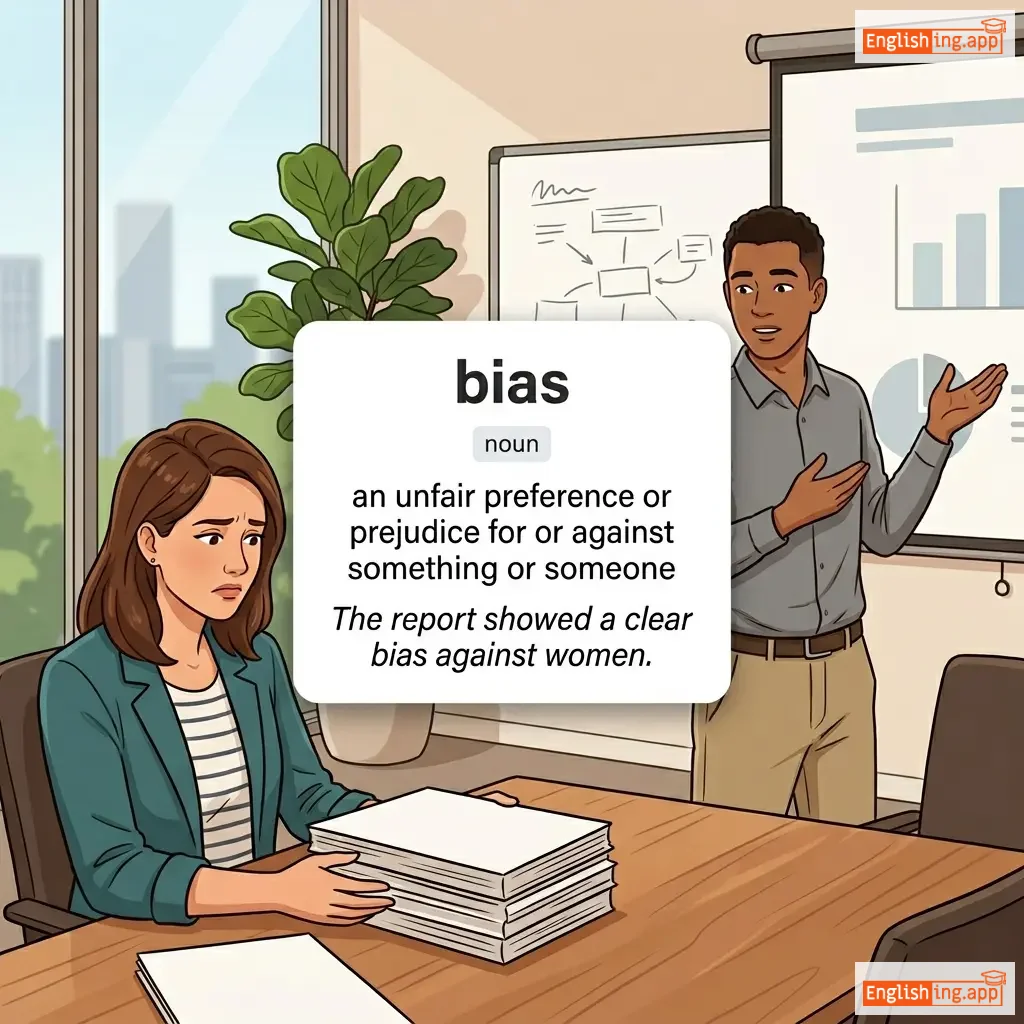
bias definition card — visual illustration of the meaning
noun
/ˈbaɪəs/
पक्षपाती (pakshapatti)

an unfair preference or prejudice for or against something or someone

"The report showed a clear bias against women."

"रिपोर्ट ने महिलाओं के खिलाफ स्पष्ट पक्षपाती दिखाया।" (Report ne mahilaon ke khilaf spashth pakshapatti dikhaya.)
adjective
/ˈbaɪəst/
पक्षपाती (pakshapathi)

having or showing an unfair tendency to favor one side or opinion

"The judge must not be biased in the case."

"न्यायाधीश को मामले में पक्षपाती नहीं होना चाहिए।" (Nyayadhish ko mamle mein pakshapati nahin hona chahiye.)
noun
/ˈbaɪbəl/
बाइबल (baibal)

the Christian scriptures consisting of the Old and New Testaments; also used for any authoritative book

"She reads the Bible every morning."

"वह हर सुबह बाइबल पढ़ती है।" (Wah har subah baibal padhti hai.)
noun
/ˌbɪbliˈɒɡrəfi/
संदर्भ सूची (sandarbha soochi)

a list of books, articles, or other sources used or referred to in scholarly work

"The report includes a detailed bibliography at the end."

"रिपोर्ट के अंत में एक विस्तृत संदर्भ सूची शामिल है।" (Report ke ant mein ek vistarit sandarbha soochi shamil hai.)
noun
/ˌbɪbliəʊˈmeɪniə/
पुस्तक प्रेम (pustak prem)

An extreme obsession with collecting or possessing books.

"His bibliomania led him to fill every room with books."

"उसकी पुस्तक प्रेम ने उसे हर कमरे को पुस्तकों से भरने पर मजबूर कर दिया।" (uski pustak prem ne use har kamre ko pustakon se bharne par majboor kar diya.)
noun
/ˈbɪbliəfaɪl/
पुस्तकप्रेमी (pustakpremi)

A person who loves or collects books.

"She is a true bibliophile who spends weekends at old bookstores."

"वह एक सच्चा पुस्तकप्रेमी है जो पुराने किताबों की दुकानों पर सप्ताहांत बिताता है।" (vah ek sachcha pustakpremi hai jo purane kitabon ki dukano par saptahant bitata hai)
adjective
/ˈbɪbjələs/
मदिरापान प्रेमी (madirapan premi)

Excessively fond of drinking alcohol.

"His bibulous habits worried his family."

"उसकी मदिरापान प्रेमी आदतों ने उसके परिवार को चिंतित कर दिया।" (Uski madirapan premi aadaton ne uske parivar ko chintit kar diya.)
adjective
/baɪˈkæmərəl/
द्व chambers वाली (dw chambers wali)

Having two branches or chambers, especially in a legislature.

"The United States has a bicameral legislature consisting of the Senate and the House of Representatives."

"संयुक्त राज्य अमेरिका में द्व chambers वाली विधायिका है, जिसमें सेनेट और हाउस ऑफ रिप्रजेंटेटिव्स शामिल हैं।" (sanyukt rajya amerika mein dw chambers wali vidhayika hai, jismein senate aur house of representatives shamil hain.)
verb
/ˈbɪkər/
तुच्छ झगड़ा करना (tuchchh jhagadā karnā)

To argue or quarrel about trivial matters.

"The children began to bicker over the last piece of cake."

"बच्चों ने आखिरी केक के टुकड़े पर झगड़ा करना शुरू कर दिया।" (bachcho ne ākhirī cake ke tukde par jhagda karna shuru kar diyā.)
noun
/ˈbaɪsɪkl/
सुख (sukh)

a vehicle with two wheels that you ride by pedaling

"He rides his bicycle to school every day."

"जब उसने पुरस्कार प्राप्त किया तो वह अपनी खुशी नहीं छिपा पाई।" (Jab usne puraskar prapt kiya to vah apni khushi nahin chhupa pai.)
verb
/bɪd/
प्रस्ताव देना (prastav dena)

to offer a certain amount of money for something, especially at an auction

"She bid $200 for the antique vase."

"उसने प्राचीन फूलदान के लिए $200 की बोली लगाई।" (Usne prachin phooldan ke liye 200 dollar ki boli lagayi.)
verb
/baɪd/
इंतजार करना (intzar karna)

to wait patiently for the right time or opportunity

"He decided to bide his time before making a move."

"उसने कदम उठाने से पहले समय का इंतजार करने का निर्णय लिया।" (Usne kadam uthane se pehle samay ka intzar karne ka nirnay liya.)
adjective
/baɪˈɛniəl/
द्विवार्षिक (dvivarshik)

happening every two years

"The biennial festival attracts thousands of visitors."

"द्विवार्षिक महोत्सव हजारों पर्यटकों को आकर्षित करता है।" (Dvivarshik mahotsav hazaron paryatak ko akarshit karta hai.)
noun
/bɪər/
शववाहन ढांचा (shavvahan dhancha)

a frame or stand on which a coffin or body is placed before burial or cremation

"The coffin was placed on the bier during the funeral service."

"अंत्येष्टि सेवा के दौरान कोफिन शववाहन ढांचे पर रखा गया था।" (Antyestti seva ke dauran kofin shavvahan dhancha par rakha gaya tha.)
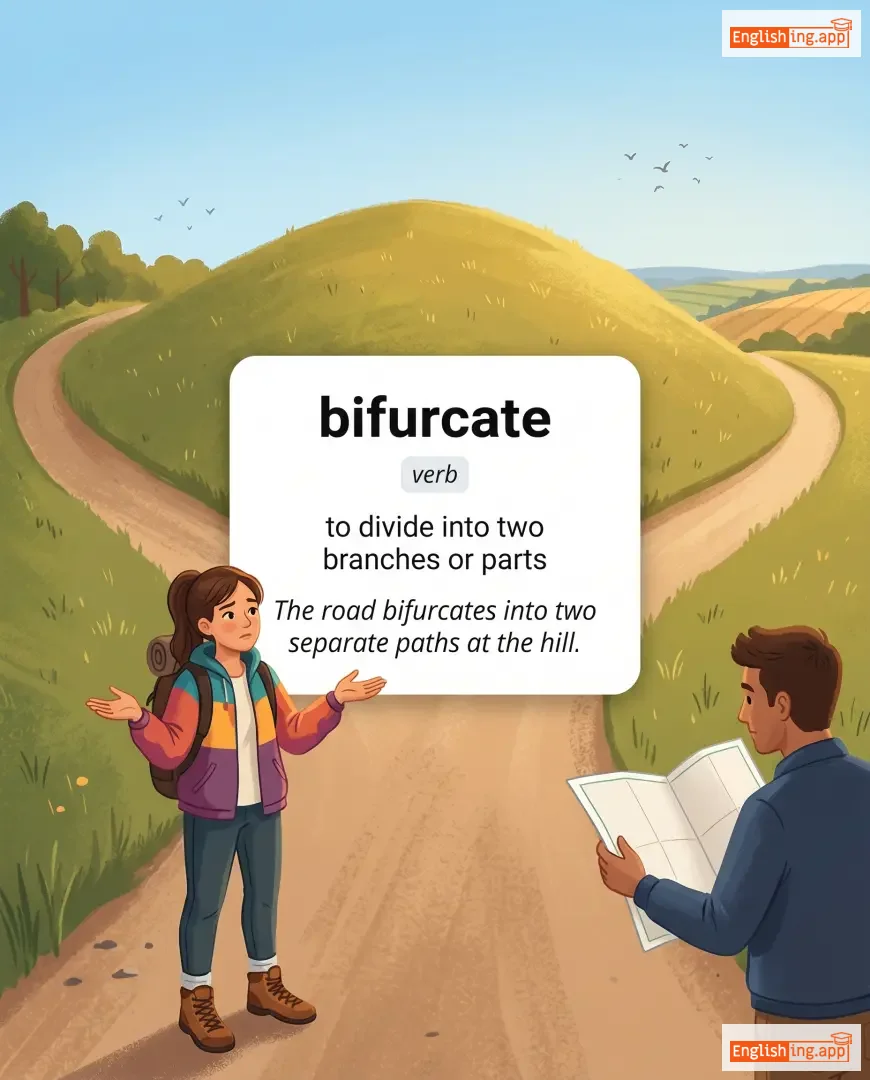
bifurcate definition card — visual illustration of the meaning
verb
/ˈbaɪfərˌkeɪt/
दो हिस्सों में विभाजित करना (do hisso mein vibhajit karna)

to divide into two branches or parts

"The road bifurcates into two separate paths at the hill."

"रास्ता पहाड़ी पर दो अलग रास्तों में विभाजित हो जाता है।" (Rasta pahadi par do alag raaston mein vibhajit ho jata hai.)