वोकैबुलरीज

इंग्लिश वोकैबुलरी डिस्कवर, लर्न और मास्टर करें

noun
/bɪˈliːvər/
विश्वासी (vishwasi)

a person who believes in something, especially a religious faith, idea, or principle

"She is a strong believer in hard work and honesty."

"वह मेहनत और ईमानदारी में दृढ़ विश्वासी है।" (vah mehnat aur imandari mein dridh vishwasi hai)
verb
/bɪˈlɪtl/
कमतर समझना (kamtar samajhna)

To make someone or something seem less important or less valuable.

"He often belittled his coworkers to feel superior."

"वह अक्सर अपने सहकर्मियों को हीन महसूस कराने के लिए उन्हें कमतर समझता था।" (Woh aksar apne sahkarmiyon ko heen mehsoos karane ke liye unhe kamtar samajhta tha.)
noun
/bɛl/
घंटी (ghanti)

a hollow object, usually made of metal, that makes a ringing sound when struck

"The school bell rang loudly at noon."

"दोपहर में स्कूल की घंटी जोर से बजी." (Dopahar mein school ki ghanti zor se baji.)
noun
/bel ˈæp.əl/
बेल सेब (bel seb)

a tropical fruit with a crisp texture and sweet taste, scientifically known as Syzygium malaccense

"The bell apple tree produces beautiful red fruits that are popular in tropical regions."

"बेल सेब का पेड़ खूबसूरत लाल फल उत्पन्न करता है जो उष्णकटिबंधीय क्षेत्रों में लोकप्रिय है" (Bel seb ka ped khoobsurat lal phal utpann karta hai jo ushnakatibandhiya kshetron mein lokpriya hai)
noun
/bɛl/
सुंदर महिला (sundar mahila)

A beautiful woman, especially the most attractive woman at a gathering.

"She was the belle of the ball that evening."

"वह उस शाम कार्यक्रम की सबसे सुंदर महिला थी।" (Wah us shaam karyakram ki sabse sundar mahila thi.)
adjective
/ˈbɛlɪˌkoʊs/
युद्धप्रिय (yuddhpriya)

Showing a tendency to argue or fight; aggressive.

"His bellicose attitude often got him into unnecessary conflicts."

"उसका युद्धप्रिय रवैया उसे अक्सर अनावश्यक संघर्षों में डाल देता था।" (Uska yuddhpriya ravaiya use aksar anaavashyak sangharshon mein daal deta tha.)
belligerent definition card — visual illustration of the meaning
adjective
/bəˈlɪdʒərənt/
युद्धप्रिय (yuddhapriya)

Hostile and aggressive; eager to fight.

"She became belligerent when the waiter got her order wrong."

"वह उस समय युद्धप्रिय हो गई जब वेटर ने उसका आदेश गलत लिया।" (Wah us samay yuddhapriya ho gayi jab waiter ne uska aadesh galat liya.)
noun
/ˈbɛlˌwɛðər/
पथप्रदर्शक (pathpradarshak)

A person or thing that leads or indicates a trend.

"The company is seen as a bellwether of the technology industry."

"कंपनी को तकनीकी उद्योग के पथप्रदर्शक के रूप में देखा जाता है।" (Kampani ko takneeki udyog ke pathpradarshak ke roop mein dekha jata hai.)
noun
/ˈbɛli/
पेट (pet)

The front part of the human body below the chest; stomach or abdomen.

"He rubbed his belly after the big meal."

"वह बड़े खाने के बाद अपने पेट को सहलाने लगा।" (vah bade khane ke baad apne pet ko sehlane laga.)
verb
/bɪˈlɒŋ/
संबद्ध होना (sambaddh hona)

to be in the right place or to be a member of a group

"She felt she truly belonged to the team."

"वह महसूस करती थी कि वह वास्तव में टीम का हिस्सा थी।" (vah mahsus karti thi ki vah vastav mein team ka hissa thi.)
adjective
/bɪˈlʌvɪd/
प्रिय (priya)

dearly loved, highly regarded

"She was the beloved queen of the kingdom."

"वह राज्य की प्रिय रानी थी।" (Woh rajya ki priya rani thi.)
preposition
/bɪˈloʊ/
नीचे (neeche)

At a lower level or position than something else.

"The basement is below the ground floor."

"बेसमेंट ग्राउंड फ्लोर के नीचे है।" (basement ground floor ke neeche hai.)
noun
/bɛlt/
कमरबंद (kamarband)

a strip of material worn around the waist to support clothes or as decoration

"He tightened his belt before leaving for work."

"काम पर जाने से पहले उसने अपनी कमरबंद कस ली।" (kaam par jaane se pehle usne apni kamarband kas li.)
verb
/bɪˈmoʊn/
शोक करना (shok karna)

To express discontent or sorrow over something.

"Critics bemoaned the lack of diversity in the film."

"आलोचकों ने फिल्म में विविधता की कमी पर शोक व्यक्त किया।" (Aalochako ne film mein vidhata ki kami par shok vyakt kiya.)
verb
/bɪˈmjuːz/
चकराना (chakrana)

To confuse or puzzle someone.

"The complex instructions bemused the new employees."

"जटिल निर्देशों ने नए कर्मचारियों को भ्रमित कर दिया।" (Jatil nirdeshon ne naye karyakariyon ko bhramit kar diya.)
adjective
/bɪˈmjuːzd/
हैरान, उलझा हुआ (hairaan, uljha hua)

confused, puzzled, or lost in thought

"She looked bemused when he asked the strange question."

"जब उसने अजीब सवाल पूछा, तो वह हैरान दिखी।" (Jab usne ajeeb sawaal poocha, to vah hairaan dikhi.)
noun
/bɛntʃ/
बेंच (bench)

a long seat for several people, typically made of wood or stone

"They sat on the park bench watching the sunset."

"वे पार्क की बेंच पर बैठकर सूर्यास्त देख रहे थे।" (ve park ki bench par baithkar suryast dekh rahe the.)
benchmark definition card — visual illustration of the meaning
noun
/ˈbɛntʃmɑːrk/
मानक (maanak)

a standard or point of reference against which things are compared or assessed

"The company set a new benchmark for customer service."

"कंपनी ने ग्राहक सेवा के लिए एक नया मानक स्थापित किया।" (Kampani ne grahak seva ke liye ek naya maanak sthapit kiya.)
benchmarking definition card — visual illustration of the meaning
noun
/ˈbɛntʃˌmɑːr.kɪŋ/
बेंचमार्किंग (benchmarking)

Comparing with a specific industry or competitor to set standards

"Companies use benchmarking to assess their performance."

"कंपनियाँ अपने प्रदर्शन का मूल्यांकन करने के लिए बेंचमार्किंग का उपयोग करती हैं।" (Kampaniyaan apne pradarshan ka mulyankan karne ke liye benchmarking ka upyog karti hain.)
verb
/bɛnd/
झुकना / मोड़ना (jhukna / modna)

to curve something or cause it to change shape; to move the body or part of it downward or forward

"She had to bend down to pick up the coin."

"उसे सिक्का उठाने के लिए झुकना पड़ा।" (Use sikka uthane ke liye jhukna pada.)
adjective
/ˈbɛndi/
लचीला (lachila)

Easily curved or flexible.

"The bendy straw made it easier to drink from the cup."

"लचीला स्ट्रॉ कप से पीने को और आसान बना दिया।" (lachila stro kap se peene ko aur aasan bana diya.)
preposition
/bɪˈniːθ/
नीचे / तले (neeche / tale)

in or to a lower position than something; under

"The cat was hiding beneath the bed."

"बिल्ली बिस्तर के नीचे छुपी हुई थी।" (Billi bistar ke neeche chhupi hui thi.)
noun
/ˌbɛnɪˈdɪkʃən/
आशीर्वाद (ashirvad)

a blessing or expression of good wishes, often at the end of a religious service

"The priest gave a final benediction before the congregation left."

"पुजारी ने कांग्रीगेशन के जाने से पहले अंतिम आशीर्वाद दिया।" (Pujari ne congregation ke jane se pehle antim ashirvad diya.)
noun
/ˈbɛnɪˌfæktər/
दानदाता, उपकारी (danadata, upkari)

a person who gives money or help to a cause or individual

"The school received a large donation from an anonymous benefactor."

"स्कूल को एक अज्ञात दाता से एक बड़ा दान प्राप्त हुआ।" (School ko ek agyat data se ek bada dan prapt hua.)
noun
/ˈbɛnɪfɪs/
धर्मगुरु की नियुक्ति (dharmguru ki niyukti)

a permanent church appointment for which property and income are provided

"The bishop appointed him to a wealthy benefice."

"बिशप ने उसे एक संपन्न धर्मगुरु की नियुक्ति दी।" (Bishop ne use ek sampann dharmguru ki niyukti di.)
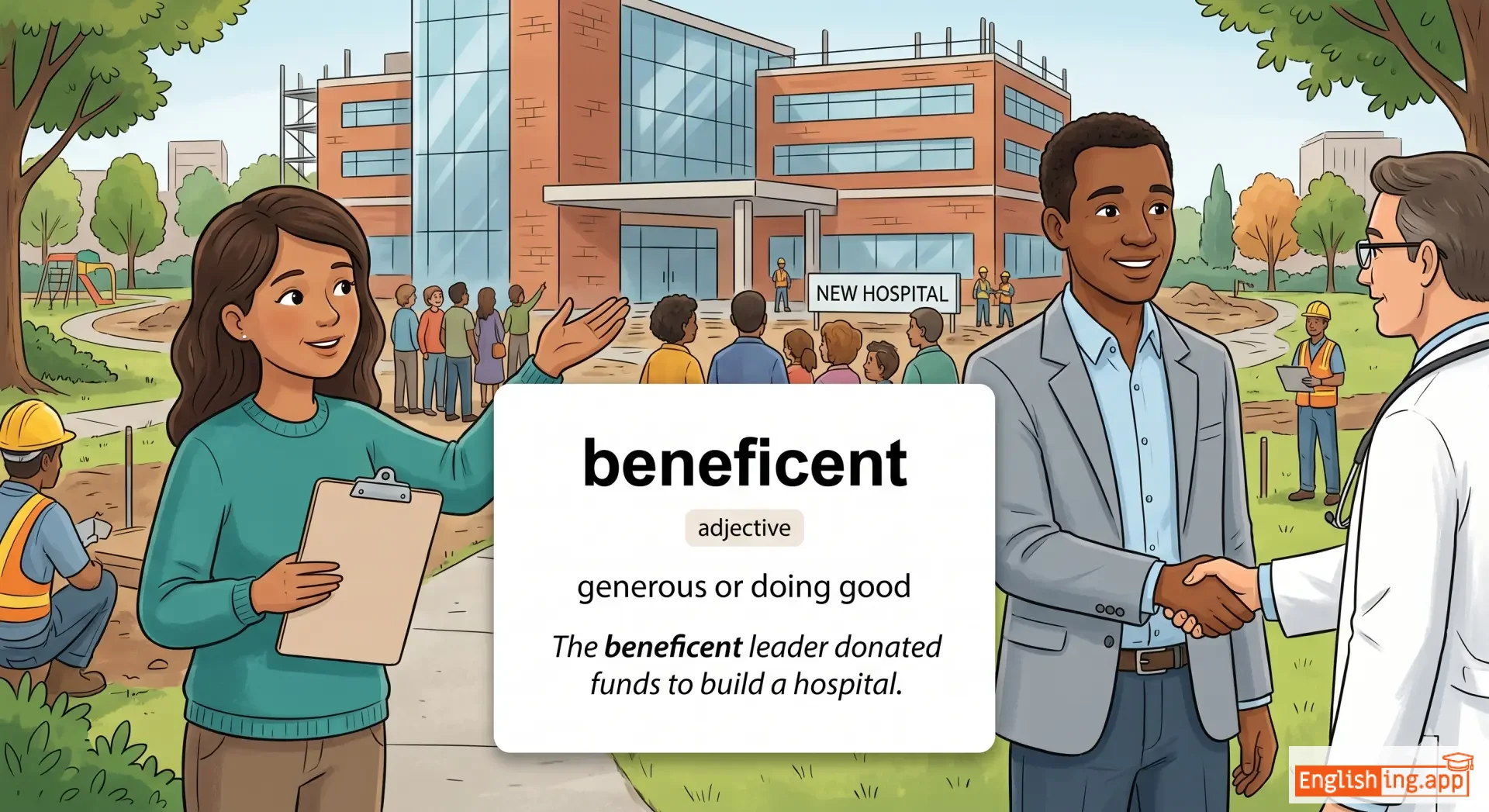
beneficent definition card — visual illustration of the meaning
adjective
/bəˈnɛfɪsənt/
उदार, कृपालु (udar, kripalu)

generous or doing good

"The beneficent leader donated funds to build a hospital."

"उदार नेता ने अस्पताल बनाने के लिए धन दान किया।" (udar neta ne aspataal banane ke liye dhan daan kiya.)
beneficial definition card — visual illustration of the meaning
adjective
/ˌbɛnɪˈfɪʃəl/
लाभकारी (labhkari)

producing good or helpful results; favorable or advantageous

"Regular exercise is beneficial for your health."

"नियमित व्यायाम आपके स्वास्थ्य के लिए लाभकारी है।" (Niyamit vyaayam aapke swasthya ke liye labhkari hai.)
noun
/ˌbɛnɪˈfɪʃəri/
लाभार्थी (labharthi)

a person who receives something, especially money or property, from a will or insurance policy

"She is the sole beneficiary of her father’s estate."

"वह अपने पिता की संपत्ति की एकमात्र लाभार्थी है।" (vah apne pita ki sampatti ki ekmatra labharthi hai.)
noun/verb
/ˈbɛnɪfɪt/
लाभ / फायदा (labh / faida)

an advantage, profit, or good effect; to receive help or an advantage

"Employees benefit from the company’s health insurance program."

"कर्मचारी कंपनी के स्वास्थ्य बीमा कार्यक्रम से लाभ उठाते हैं।" (karmachari company ke swasthya bima karyakram se labh uthate hain.)
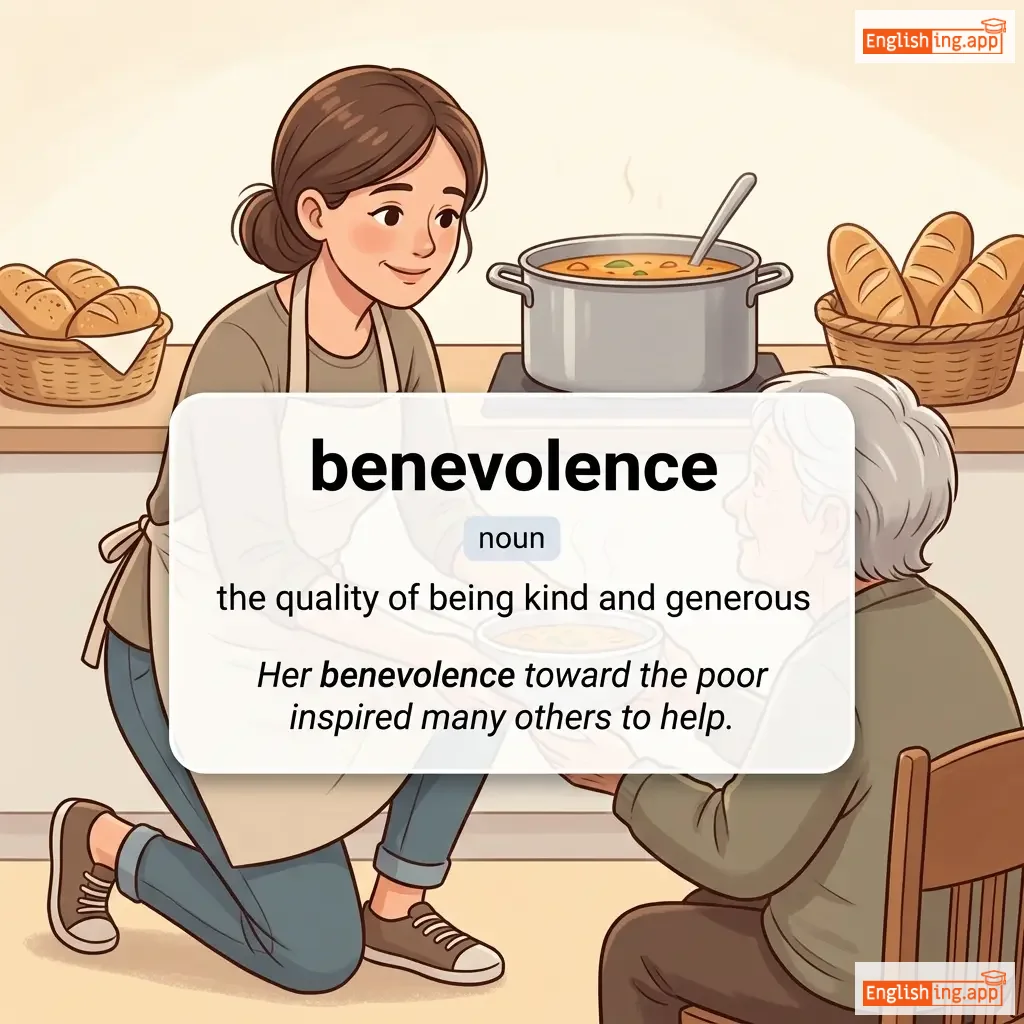
benevolence definition card — visual illustration of the meaning
noun
/bəˈnɛvələns/
उदारता (udarata)

the quality of being kind and generous

"Her benevolence toward the poor inspired many others to help."

"ग़रीबों के प्रति उसकी उदारता ने दूसरों को मदद करने के लिए प्रेरित किया।" (Garibon ke prati uski udarta ne doosron ko madad karne ke liye prerit kiya.)
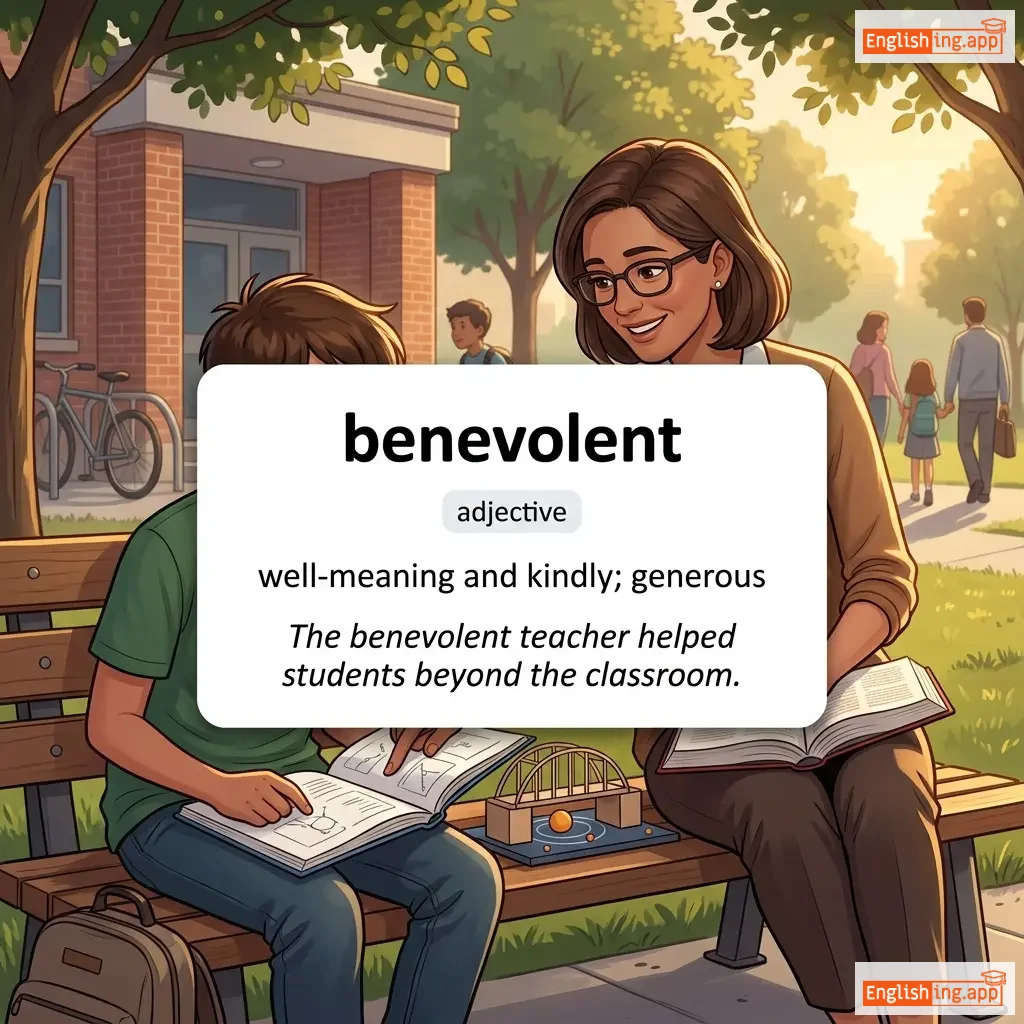
benevolent definition card — visual illustration of the meaning
adjective
/bəˈnɛvələnt/
दयालु (dayalu)

well-meaning and kindly; generous

"The benevolent teacher helped students beyond the classroom."

"दयालु शिक्षक ने कक्षा से बाहर छात्रों की मदद की।" (Dayalu shikshak ne kaksha se baahar chhatron ki madad ki.)
adjective
/bɪˈnaɪtɪd/
अज्ञानपूर्ण, अंधकारमय (ajnayanpurn, andhakaramay)

In a state of intellectual or moral ignorance; overtaken by darkness.

"The explorers were lost in the benighted forest without any guide."

"अन्वेषक बिना किसी मार्गदर्शक के अंधकारमय जंगल में खो गए थे।" (Anveshak bina kisi margdarshak ke andhakaramay jangle mein kho gaye the.)
adjective
/bɪˈnaɪn/
सदयी, हानिरहित (sadayi, haanirhit)

Gentle, kind, or not harmful (especially of a disease or tumor).

"The doctor assured her that the tumor was benign."

"डॉक्टर ने उसे आश्वस्त किया कि ट्यूमर हानिरहित था।" (Doktar ne use aashvast kiya ki tumor haanirhit tha.)
adjective
/bɪˈnɪɡnənt/
दयालु, उदार (dayalu, udar)

Kindly and benevolent in nature.

"The teacher’s benignant attitude made the students feel comfortable."

"टीचर का दयालु रवैया छात्रों को आरामदायक महसूस कराता था।" (Teacher ka dayalu ravayya chatron ko aaramdayak mehsoos karata tha.)
noun
/bɪˈnɪɡnəti/
सद्भावना, कोमलता (sadbhaavna, komalta)

The quality of being kind and gentle.

"She treated everyone with benignity and respect."

"उसने सभी को सद्भावना और सम्मान के साथ व्यवहार किया।" (Usne sabhi ko sadbhaavna aur samman ke saath vyavhaar kiya.)
noun
/ˈbɛnɪsən/
आशीर्वाद (ashirvad)

A blessing or benefit.

"The rain was a benison for the drought-stricken farmers."

"बारिश सूखा प्रभावित किसानों के लिए आशीर्वाद था।" (Barish sukhha prabhavit kisano ke liye ashirvad tha.)
adjective
/bɛnt/
दृढ़प्रतिज्ञ / झुकाव (dridhpratigya / jhukav)

strongly determined or having a natural talent or inclination for something

"She is bent on becoming a successful lawyer."

"वह एक सफल वकील बनने के लिए दृढ़प्रतिज्ञ है।" (Wah ek safal vakil banne ke liye dridhpratigya hai.)
verb
/bɪˈnʌm/
सुन्न करना (sunn karna)

to make physically numb or without sensation; to make mentally dull or insensitive

"The freezing wind seemed to benumb his fingers within minutes."

"कड़ाके की ठंड ने कुछ ही मिनटों में उसकी उंगलियाँ सुन्न कर दीं।" (kadake ki thand ne kuch hi minaton mein uski ungliyan sunn kar diin)
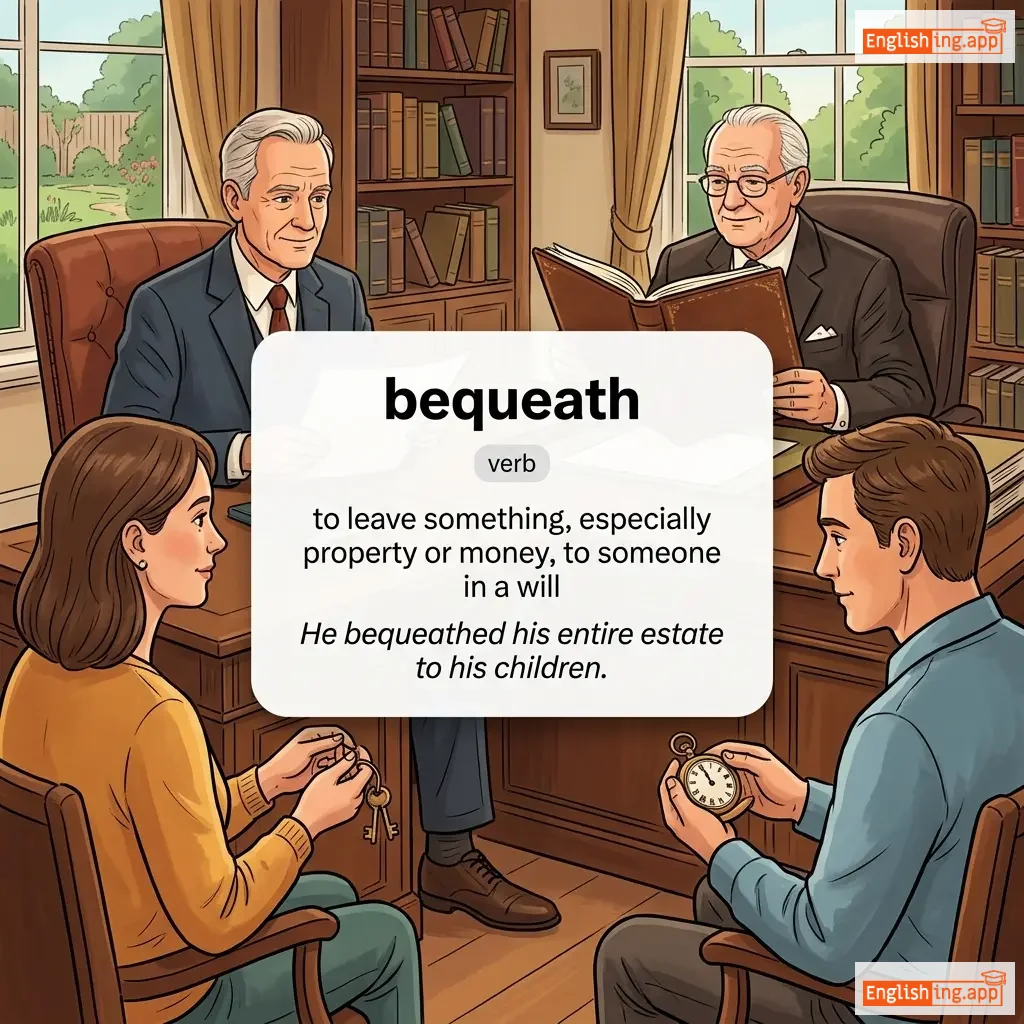
bequeath definition card — visual illustration of the meaning
verb
/bɪˈkwiːð/
वसीयत में देना (vasiayat mein dena)

to leave something, especially property or money, to someone in a will

"He bequeathed his entire estate to his children."

"उसने अपनी पूरी संपत्ति अपने बच्चों को वसीयत में दे दी।" (Usne apni puri sampatti apne bachcho ko vasiayat mein de di.)
verb
/bɪˈreɪt/
कड़ी फटकार लगाना (kadi fatkaar lagana)

to scold or criticize angrily

"The teacher berated the student for being late."

"अध्यक्ष ने देरी के लिए छात्र को कड़ी फटकार लगाई।" (Adhyaksh ne deri ke liye chatra ko kadi fatkaar lagayi.)
verb
/bɪˈriːv/
प्रियजन खोना (priyojan khona)

to deprive someone of a loved one through death

"She was bereaved of her husband last year."

"पिछले साल वह अपने पति से वंचित हो गई थी।" (pichle saal wah apne pati se vanchit ho gayi thi.)
adjective
/bɪˈriːvd/
प्रियजन खोने वाला (priyojan khone wala)

suffering the loss of a loved one through death

"The bereaved mother wept silently at the funeral."

"वह बरीव्ड माँ अंतिम संस्कार में चुपचाप रो रही थी।" (vah bereaved maa antim sanskar mein chupchaap ro rahi thi.)
noun
/bɪˈriːvmənt/
शोक (beraiwment)

The state of having lost a loved one through death.

"She received many letters of sympathy during her time of bereavement."

"अपने शोक के दौरान उसे कई सहानुभूति भरे पत्र मिले।" (Apne shok ke dauran use kai sahanubhuti bhare patra mile.)
adjective
/bɪˈrɛft/
वंचित (vanchit)

Deprived of or lacking something, especially a nonmaterial asset.

"After the betrayal, he felt bereft of hope and trust."

"धोखा देने के बाद, उसने उम्मीद और विश्वास से वंचित महसूस किया।" (dhokha dene ke baad, usne ummid aur vishwas se vanchit mehsoos kiya.)
adjective
/bəˈzɜːrk/
हंगामा (hungama)

Out of control with anger or excitement; wild or frenzied.

"The fans went berserk when their team won the championship."

"उनकी टीम ने चैंपियनशिप जीत ली, तो फैंस बर्सर्क हो गए।" (unki team ne championship jeet li, to fans berserk ho gaye.)
noun
/bɜːrθ/
बर्थ / लंगर स्थान (berth / langar sthan)

A place to sleep on a ship or train; a ship's allocated place at a dock.

"They reserved a lower berth on the overnight train."

"उन्होंने रात की ट्रेन पर एक निचली बर्थ आरक्षित की।" (unhone raat ki train par ek nichli berth aarakshit ki.)
verb
/bɪˈsiːtʃ/
विनती करना (vintee karna)

To ask someone urgently and fervently to do something; to beg.

"He beseeched the judge for mercy."

"उसने न्यायधीश से दया की भीख माँगी।" (usne nyayadhish se daya ki bheekh maangi.)
verb
/bɪˈsɛt/
चारों ओर से हमला करना, परेशान करना (charon or se hamla karna, pareshan karna)

to trouble, harass, or attack on all sides

"The village was beset by constant floods."

"गाँव को लगातार बाढ़ों से घेरा गया था।" (Gaon ko lagatar baadon se ghera gaya tha.)
preposition
/bɪˈsaɪd/
के पास (ke paas)

next to or at the side of someone or something

"She sat beside her best friend during the ceremony."

"वह समारोह के दौरान अपनी सबसे अच्छी दोस्त के पास बैठी थी।" (Vah samaroah ke dauran apni sabse acchi dost ke paas baithi thi.)
adverb, preposition
/bɪˈsaɪdz/
इसके अलावा (iske alawa)

in addition to; apart from

"Besides English, he also speaks French."

"इसके अलावा, वह फ्रेंच भी बोलता है।" (Iske alawa, vah French bhi bolta hai.)