वोकैबुलरीज

इंग्लिश वोकैबुलरी डिस्कवर, लर्न और मास्टर करें

noun/verb
/ˈbætəl/
युद्ध (yuddh)

A fight between armed forces or a struggle to achieve or resist something.

"The soldiers prepared for the final battle."

"सैनिकों ने अंतिम युद्ध के लिए तैयारी की।" (Sainikon ne antim yuddh ke liye taiyari ki.)
noun
/ˈbætəlˌfiːld/
युद्धभूमि (yuddhbhumi)

a place where a battle is fought

"The battlefield was covered with the remnants of the fight."

"युद्धभूमि युद्ध के अवशेषों से भरी हुई थी।" (Yuddhbhumi yuddh ke avasheshon se bhari hui thi.)
adjective
/ˈbæti/
पागल (pagal)

crazy or eccentric in behavior

"The old man down the street is a bit batty but harmless."

"सड़क के किनारे वाला बूढ़ा आदमी थोड़ा पागल है लेकिन हानिरहित है।" (Sadak ke kinare wala boodha aadmi thoda pagal hai lekin hanirhit hai.)
noun
/ˈbɔːbəl/
सजावटी गहना (sajavati gehna)

A small, decorative trinket or ornament, often of little value.

"She wore a shiny bauble around her neck."

"उसने अपनी गर्दन में एक चमचमाता सजावटी गहना पहना था।" (Usne apni gardan mein ek chamchamata sajavati gehna pehna tha.)
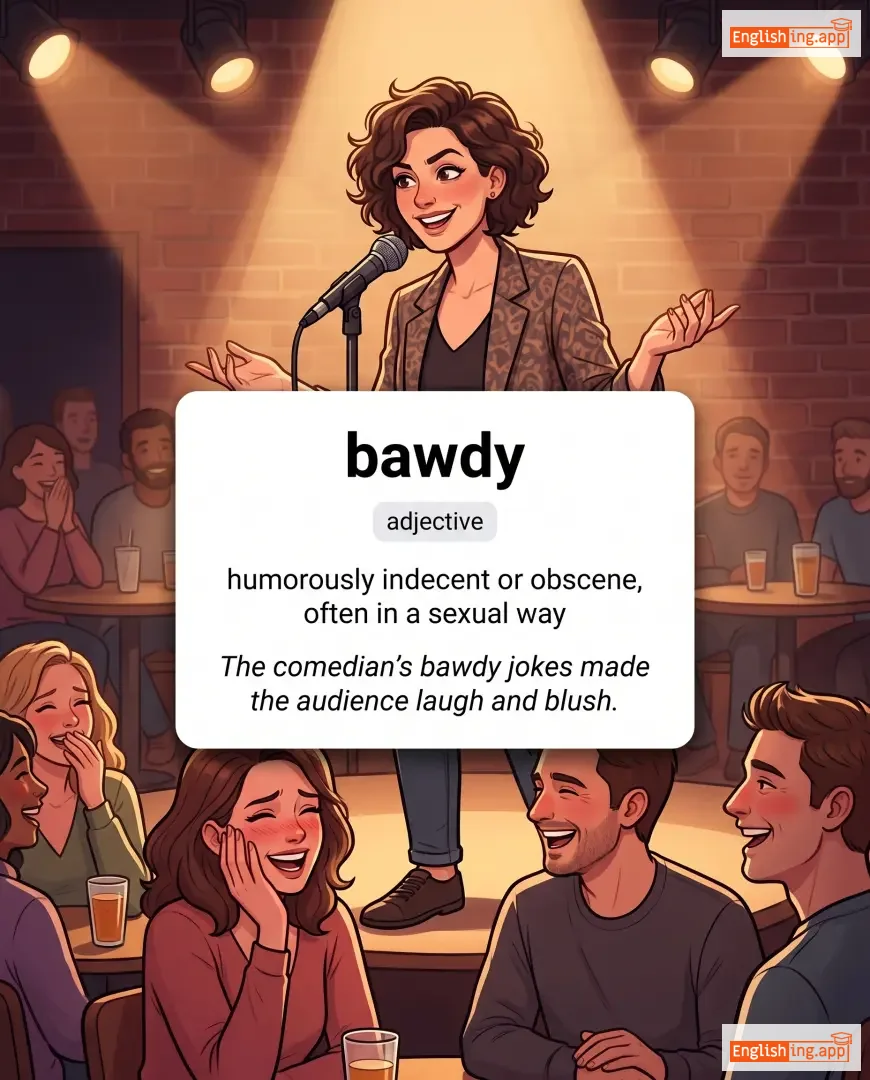
bawdy definition card — visual illustration of the meaning
adjective
/ˈbɔːdi/
अश्लील (ashleel)

humorously indecent or obscene, often in a sexual way

"The comedian’s bawdy jokes made the audience laugh and blush."

"कॉमेडियन के अश्लील चुटकुलों ने दर्शकों को हंसाया और शरमिंदा किया।" (Comedian ke asleel chutkulo ne darshako ko hansaya aur sharminda kiya.)
verb
/bɔːl/
जोर से चिल्लाना (jor se chillana)

to shout or cry loudly

"The baby bawled all night, keeping everyone awake."

"बेबी सारी रात जोर से रोता रहा, सबको जागते हुए रखा।" (Baby saari raat jor se rota raha, sabko jaagte hue rakha.)
noun
/beɪ/
खाड़ी (khadi)

a broad inlet of the sea where the land curves inward

"The ship anchored safely in the bay."

"जहाज ने खाड़ी में सुरक्षित रूप से लंगर डाला।" (Jahaj ne khadi mein surakshit roop se langar dala.)
noun
/beɪ liːf/
बे लीफ (be leaf)

dried aromatic leaf of the bay laurel tree used as a culinary herb

"Add a bay leaf to the soup for extra flavor."

"सूप में अतिरिक्त स्वाद के लिए एक बे लीफ डालें।" (soop mein atirikt swad ke liye ek be leaf daalen)
verb
/ˈbeɪɪŋ/
भौंकना (bhaunkna)

making a loud, prolonged barking or howling sound, especially of dogs

"The baying of the hounds echoed through the forest."

"हाउंड्स का भौंकना जंगल में गूंज रहा था।" (Hounds ka bhaunkna jangal mein goonj raha tha.)
verb
/biː/
होना (hona)

To exist, to occur, or to have a particular quality.

"She wants to be a doctor."

"वह डॉक्टर बनना चाहती है।" (Woh doctor banna chahti hai.)
noun
/biːtʃ/
समुद्रतट (samudratat)

An area of sand or small stones beside the sea or a lake.

"They spent the day relaxing on the beach."

"उन्होंने समुद्रतट पर आराम करते हुए पूरा दिन बिताया।" (Unhone samudratat par aaram karte hue poora din bitaya.)
noun
/biːd/
माला; बीन (maala, been)

a small round object with a hole through it for threading

"She made a necklace with colorful beads."

"उसने रंगीन बीड्स से एक हार बनाया।" (Usne rangeen beads se ek haar banaya.)
noun
/biːk/
चोंच (chonch)

the hard pointed part of a bird's mouth

"The eagle has a sharp beak for tearing meat."

"ईगल के पास मांस को फाड़ने के लिए एक तेज़ चोंच है।" (eegal ke paas maans ko faadne ke liye ek tez chonch hai)
noun
/biːm/
किरण / बीम (kiran / bim)

a ray or shaft of light; a long piece of wood or metal used to support weight

"A beam of sunlight entered through the window."

"एक किरण की रोशनी खिड़की से अंदर आई।" (Ek kiran ki roshni khidki se andar aayi.)
noun
/biːn/
बीन्स (beens)

A seed that is eaten as a vegetable or used to make food products.

"She cooked a pot of bean soup."

"उसने एक कटोरी बीन्स सूप पकाया।" (Usne ek katori beens soop pakaya.)
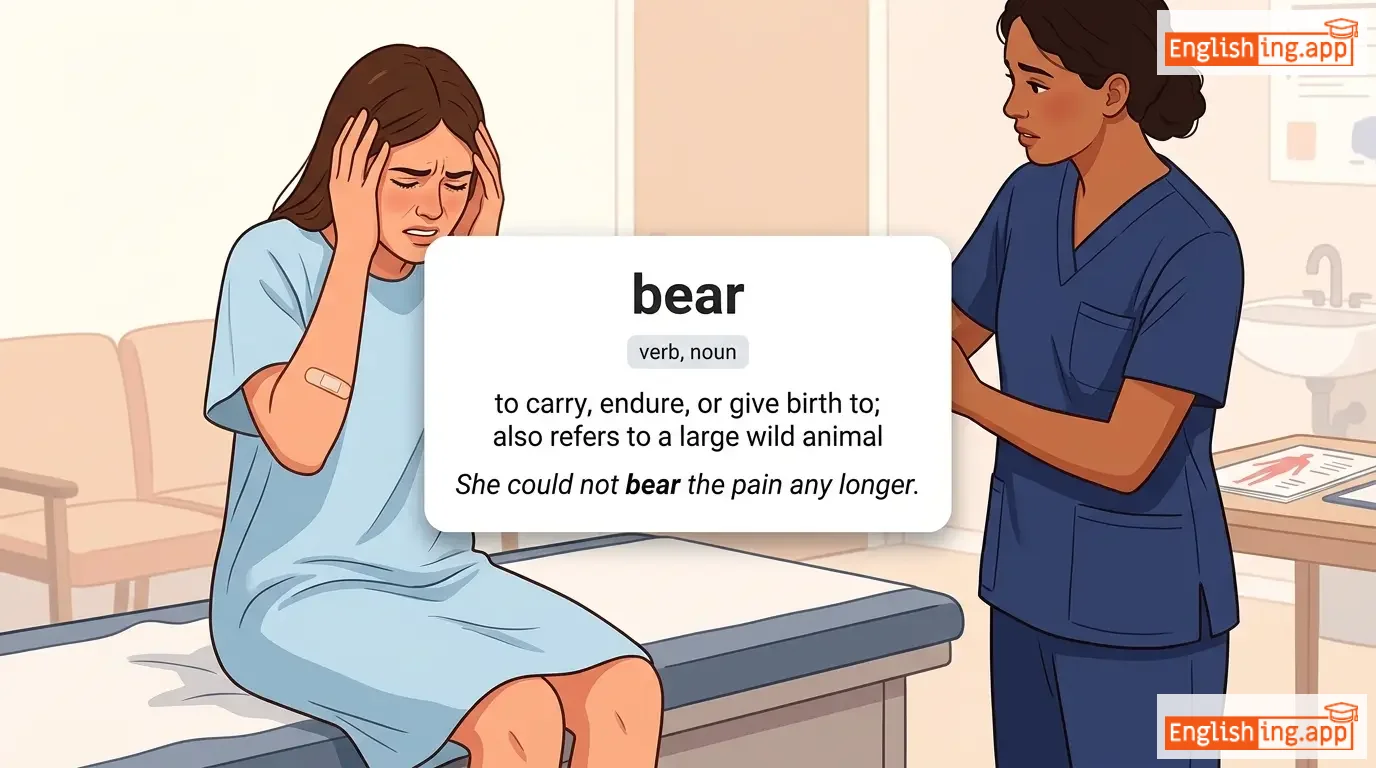
bear definition card — visual illustration of the meaning
verb, noun
/bɛər/
सहन करना / भालू (sahan karna / bhalu)

to carry, endure, or give birth to; also refers to a large wild animal

"She could not bear the pain any longer."

"वह अब और दर्द सहन नहीं कर सकती थी।" (Vah ab aur dard sahan nahin kar sakti thi.)
adjective
/ˈbeə.rə.bəl/
सहनशील; सहन करने योग्य; कष्टकारी नहीं (bierabal)

able to be endured; tolerable; not too unpleasant or painful

"The pain became bearable after taking the medicine."

"दवा लेने के बाद दर्द सहनीय हो गया।" (dawa lene ke baad dard sahanīya ho gaya.)
noun
/bɪəd/
खुशी (khushi)

the hair growing on the lower part of a man's face

"He decided to grow a beard during his vacation."

"वह पुरस्कार प्राप्त करने पर अपनी खुशी नहीं छुपा सकी।" (Wah puraskaar prapt karne par apni khushi nahin chhupa sakee.)
noun
/ˈbeə.rər/
वाहक; दस्तावेज़ का धारक (vahak; dastavez ka dharak)

a person who carries or brings something; holder of a document

"The bearer of this message must deliver it quickly."

"इस संदेश के वाहक को इसे जल्दी पहुंचाना होगा।" (Is sandesh ke vahak ko ise jaldi pahunchana hoga.)
noun
/ˈbɛərɪŋ/
आचरण / भंगिमा (acharan / bhangima)

a person's way of standing or moving; relevance or connection to something

"Her calm bearing impressed everyone in the room."

"उसकी शांत भंगिमा ने कमरे में सभी को प्रभावित किया।" (Uski shaant bhangima ne kamre mein sabhi ko prabhavit kiya.)
noun
/biːst/
जानवर / beast (jaanwar / beast)

a large or dangerous animal; a cruel or brutal person

"The lion is known as the king of beasts."

"शेर को जानवरों का राजा कहा जाता है।" (Sher ko janwaron ka raja kaha jata hai.)
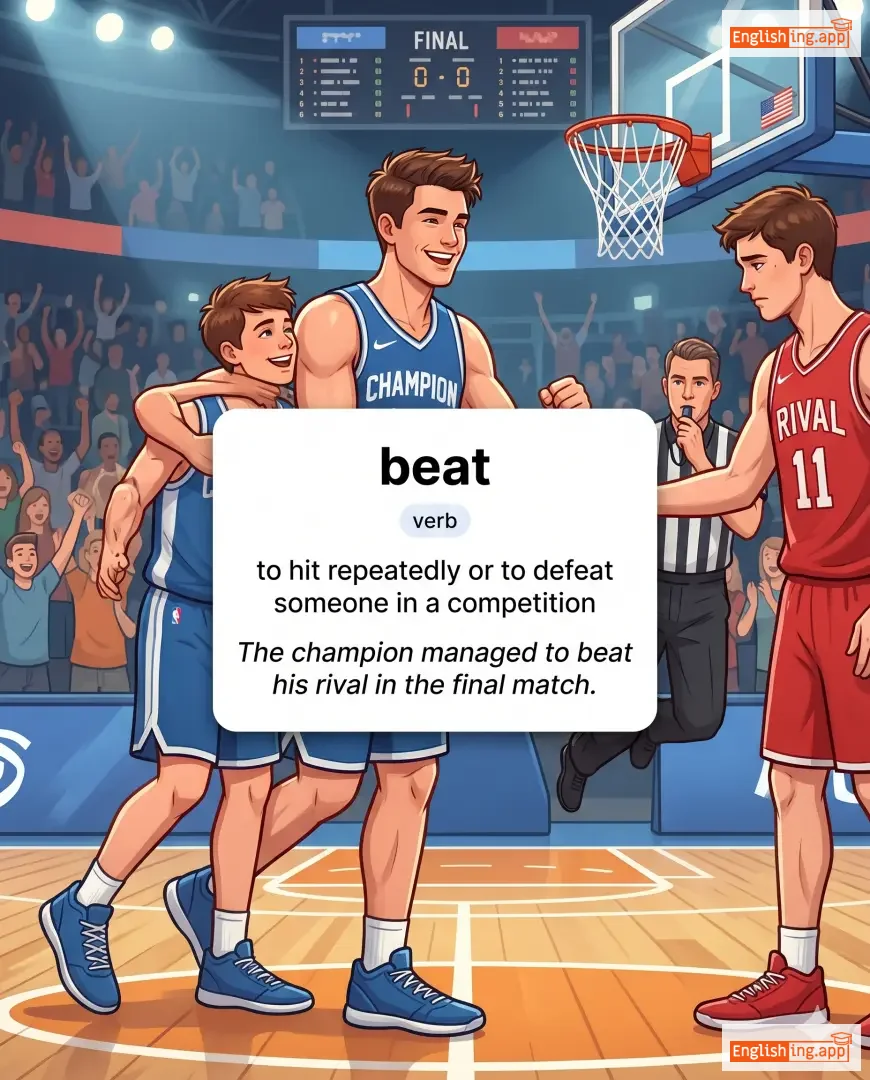
beat definition card — visual illustration of the meaning
verb
/biːt/
हारना, मारना (harna, maarna)

to hit repeatedly or to defeat someone in a competition

"The champion managed to beat his rival in the final match."

"चैंपियन ने फाइनल मैच में अपने प्रतिद्वंद्वी को हराया।" (Champion ne final match mein apne pratidvandvi ko haraaya.)
noun
/ˈbiːtənd raɪs/
चि़ड़ा (chira)

flattened rice; rice that has been parboiled, dried, and beaten into flat flakes

"Beaten rice is commonly eaten with milk and sugar for breakfast."

"चि़ड़ा आमतौर पर दूध और चीनी के साथ नाश्ते में खाया जाता है।" (chira aamtor par dudh aur chini ke sath nashtay mein khaya jata hai.)
adjective
/ˌbiːəˈtɪfɪk/
आध्यात्मिक रूप से खुश (adhyatmik roop se khush)

blissfully happy or showing great joy

"She had a beatific smile after hearing the good news."

"अच्छी खबर सुनने के बाद उसके चेहरे पर एक आध्यात्मिक खुशी थी।" (Achhi khabar sunne ke baad uske chehre par ek adhyatmik khushi thi.)
beatify definition card — visual illustration of the meaning
verb
/biˈætɪfaɪ/
धन्य घोषित करना (dhanya ghoshit karna)

to make blessed or holy, especially in the Roman Catholic Church, to declare a deceased person to be among the blessed

"The pope decided to beatify the martyr for his faith and sacrifice."

"पोप ने विश्वास और बलिदान के लिए शहीद को बीटिफाई करने का निर्णय लिया।" (Pop ne vishwas aur balidan ke liye shaheed ko beatify karne ka nirnay liya.)
noun
/biˈætɪtjuːd/
सर्वोत्तम आशीर्वाद या सुख, जो अक्सर यीशु के पर्वत पर उपदेश से संबंधित होता है (sarvottam aashirvad ya sukh, jo aksar Yeshu ke parvat par updesh se sambandhit hota hai)

supreme blessedness or happiness, often used in reference to the sayings of Jesus in the Sermon on the Mount

"She felt a state of beatitude after receiving the good news."

"वह अच्छी खबर मिलने के बाद एक आशीर्वाद की स्थिति में महसूस कर रही थी।" (Vah achhi khabar milne ke baad ek aashirvad ki sthiti mein mahsus kar rahi thi.)
noun
/boʊ/
प्रेमी (premee)

a male admirer or boyfriend; a fashionable young man

"She arrived at the party with her beau."

"वह अपने प्रेमी के साथ पार्टी में आई।" (Vah apne premee ke saath party mein aayi.)
adjective
/ˈbjuː.tɪ.fəl/
सौंदर्य (saundarya)

pleasing to the senses or mind; very attractive

"The garden looked beautiful in the morning sunlight."

"बग़ीचा सुबह की धूप में बहुत सुंदर दिख रहा था।" (Bagicha subah ki dhoop mein bahut sundar dikh raha tha.)
adverb
/ˈbjuːtɪfəli/
सुंदर ढंग से (sundar dhang se)

in a beautiful or pleasing manner; excellently or skillfully

"She sang beautifully at the concert."

"उसने कॉन्सर्ट में सुंदर ढंग से गाया।" (usne concert mein sundar dhang se gaya)
verb
/ˈbjuːtɪfaɪ/
सुंदर बनाना (sundar banana)

to make something more beautiful or attractive

"The city plans to beautify the old park with trees and lights."

"शहर पुराने पार्क को पेड़ों और रोशनी से सुंदर बनाने की योजना बना रहा है।" (shahar purane park ko pedon aur roshni se sundar banane ki yojana bana raha hai)
noun
/ˈbjuːti/
सुंदरता (sundarta)

a combination of qualities that please the senses or mind

"The beauty of the sunset took her breath away."

"सूर्यास्त की सुंदरता ने उसका दिल छू लिया।" (Suryasth ki sundarta ne uska dil chhoo liya.)
verb
/bɪˈkɑːm/
शांत करना (shaant karna)

to make calm or still; to deprive a sailing vessel of wind

"The captain tried to becalm the anxious crew."

"कप्तान ने घबराए हुए चालक दल को शांत करने की कोशिश की।" (Kaptaan ne ghabraaye hue chaalak dal ko shaant karne ki koshish ki.)
conjunction
/bɪˈkɔːz/
क्योंकि (kyonki)

for the reason that; since

"He stayed home because it was raining."

"वह घर पर रहा क्योंकि बारिश हो रही थी।" (Vah ghar par raha kyonki baarish ho rahi thi.)
noun
/bɛk/
संकेत / छोटी धारा (sanket / chhoti dhara)

a gesture of beckoning; a small stream or brook (chiefly Northern English)

"The servant came at his master's beck and call."

"नौकर अपने मालिक के आदेश पर तुरंत आया।" (Naukar apne malik ke aadesh par turant aaya.)
verb
/ˈbɛkən/
इशारा करके बुलाना (ishara karke bulana)

to signal or call someone to come closer, often with a gesture; to attract or invite

"She beckoned him to come closer with a wave of her hand."

"उसने हाथ हिलाकर उसे पास आने का इशारा किया।" (usne haath hilakar use paas aane ka ishara kiya)
verb
/bɪˈkʌm/
होना (hona)

to begin to be; to develop into

"He became a successful doctor after years of hard work."

"सालों की मेहनत के बाद वह एक सफल डॉक्टर बन गए।" (Saalon ki mehnat ke baad vah ek safal doctor ban gaye.)
adjective
/bɪˈkʌmɪŋ/
आकर्षक (aakarshak)

attractive, suitable, or flattering to the wearer or situation

"That dress is very becoming on her."

"वह ड्रेस उस पर बहुत आकर्षक लग रही है।" (vah dress us par bahut aakarshak lag rahi hai.)
noun
/bɛd/
बिस्तर (bistar)

a piece of furniture for sleeping or resting on

"She lay down on the bed and fell asleep quickly."

"उसने बिस्तर पर लेटकर जल्दी ही सो गई।" (Usne bistar par letkar jaldi hi so gayi)
noun
/ˈbed ˌkʌv.ər/
बेड कवर (bed cover)

a protective covering for a bed, typically a bedspread or comforter

"She pulled the bed cover up to her chin to stay warm."

"उसने अपनी ठंडी से बचने के लिए बेड कवर को अपने ठुड्डी तक खींच लिया।" (usne apni thandi se bachne ke liye bed cover ko apne thuddi tak kheench liya)
noun
/ˈbed ʃiːt/
बेडशीट (bedsheet)

a large rectangular piece of cloth used as bedding to lie on or under

"The clean white bed sheet felt soft against her skin."

"साफ सफेद बेडशीट उसकी त्वचा के खिलाफ मुलायम महसूस हो रही थी।" (saaf safed bedsheet uski twacha ke khilaf mulaayam mahsus ho rahi thi)
noun
/ˈbed sted/
बेड का फ्रेम (bed ka frame)

the framework of a bed; a bed frame without bedding

"The wooden bed stead was very sturdy."

"लकड़ी का बेड स्टेड बहुत मजबूत था।" (lakdi ka bed sted bahut majboot tha)
verb
/bɪˈdɔːb/
माखना (makhna)

to smear or cover with a sticky or dirty substance

"The children bedaubed the wall with paint."

"बच्चों ने दीवार को रंग से माख दिया।" (Bachon ne deewar ko rang se maakh diya.)
verb
/bɪˈdɛk/
सजाना (sajana)

to decorate or adorn something in a showy way

"The hall was bedecked with flowers for the wedding."

"शादी के लिए हॉल को फूलों से सजाया गया था।" (Shaadi ke liye hall ko phoolon se sajaya gaya tha.)
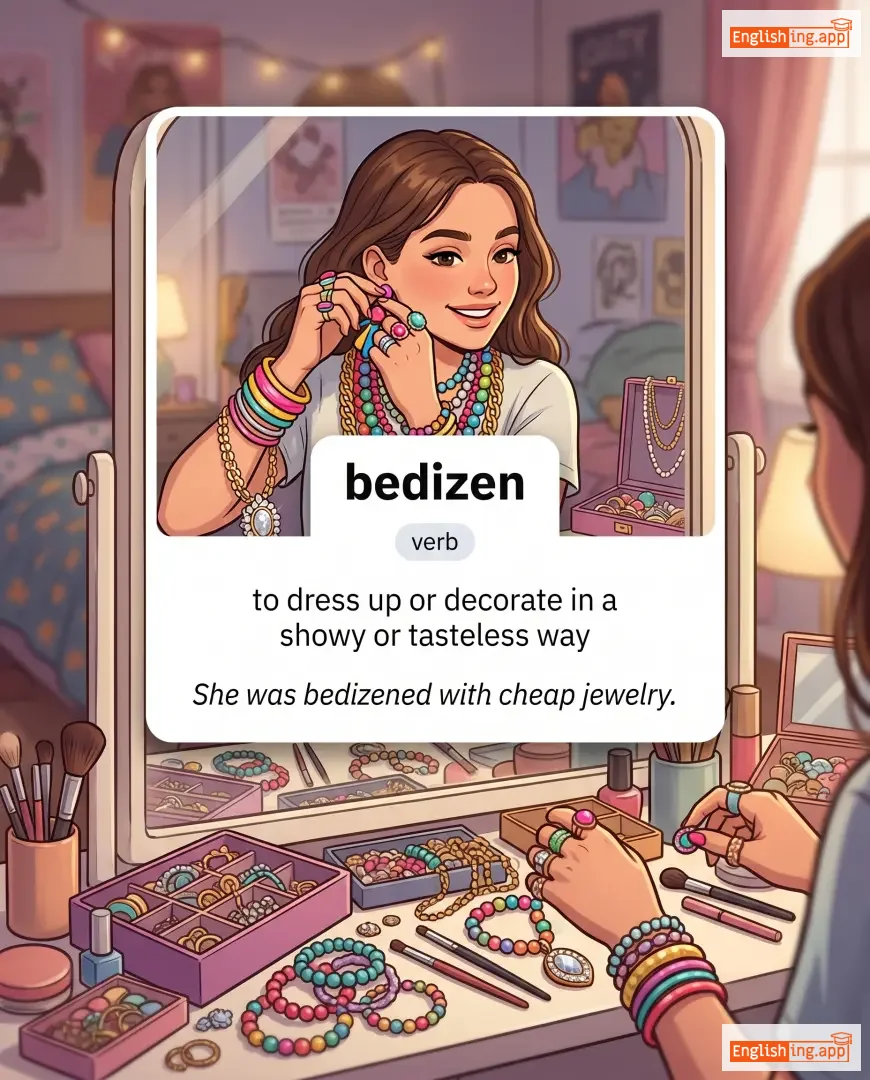
bedizen definition card — visual illustration of the meaning
verb
/bɪˈdaɪzən/
आलंकृत करना (aalaṅkrut karna)

to dress up or decorate in a showy or tasteless way

"She was bedizened with cheap jewelry."

"वह सस्ते गहनों से आलंकृत थी।" (Vah saste gheno se aalankrit thi.)
noun
/ˈbɛdləm/
अराजकता (arajakta)

a scene of uproar and confusion; chaos

"There was bedlam in the market after the news spread."

"खबर फैलने के बाद बाजार में अराजकता थी।" (Khabar phailne ke baad bazaar mein arajakta thi.)
verb
/bɪˈdræɡəl/
कीचड़ में भीगकर गंदा और अस्तव्यस्त होना (keechar mein bheegkar ganda aur astavyast hona)

to make something wet, dirty, and untidy by dragging it through mud or water

"The children came home bedraggled after playing in the rain."

"बच्चे बारिश में खेलते हुए गंदे और भीगे घर लौटे।" (Bachche barish mein khelte hue gande aur bheege ghar lauthe.)
adjective
/ˈbed.rɪd.ən/
बिस्तर पर पड़ा हुआ (bistar par pada hua)

confined to bed; unable to leave one's bed due to illness or infirmity

"The elderly man has been bedridden for several months."

"वृद्ध व्यक्ति कई महीनों से बिस्तर पर पड़ा हुआ है।" (vruddh vyakti kai mahino se bistar par pada hua hai.)
noun
/ˈbɛd.rɒk/
आधार (aadhar)

the solid rock layer beneath the soil; the fundamental basis of something

"Trust is the bedrock of a healthy relationship."

"भरोसा एक स्वस्थ रिश्ते का आधार है।" (Bharosa ek swasth rishte ka aadhar hai.)
noun
/ˈbɛdruːm/
शयनकक्ष (shaynakkakh)

A room used for sleeping in.

"The children were playing in the bedroom."

"बच्चे बेडरूम में खेल रहे थे।" (bachche bedroom mein khel rahe the.)
noun
/biː/
मधुमक्खी (madhumakkhi)

a flying insect that collects nectar and produces honey

"A bee landed on the flower to collect nectar."

"एक मधुमक्खी फूल पर बैठकर अमृत इकट्ठा कर रही थी।" (Ek madhumakkhi phool par baithkar amrit ikattha kar rahi thi.)