वोकैबुलरीज

इंग्लिश वोकैबुलरी डिस्कवर, लर्न और मास्टर करें

noun
/briːz/
हल्की हवा (halki hawa)

a gentle wind; a light and pleasant current of air.

"A cool breeze came through the window."

"एक ठंडी हवा खिड़की से अंदर आई।" (Ek thandi hawa khidki se andar aayi.)
noun
/ˈbriːzˌweɪ/
ब्रीज़वे (breezway)

A roofed outdoor passage, often connecting two buildings.

"The breezeway connected the house to the garage."

"ब्रीज़वे ने घर को गैराज से जोड़ा।" (Breezway ne ghar ko garage se joda.)
noun
/ˈbrɛviˌɛri/
प्रार्थना पुस्तक (prarthana pustak)

A book containing the service for each day, used in Christian liturgy.

"The monk read from the breviary during morning prayers."

"भिक्षु ने सुबह की प्रार्थना के दौरान प्रार्थना पुस्तक से पढ़ा।" (Bhikshu ne subah ki prarthana ke dauran prarthana pustak se padha.)
noun
/ˈbrɛvɪti/
संक्षिप्तता (sankshipta)

Concise and exact use of words in writing or speech.

"The brevity of the speech kept the audience engaged."

"भाषण की संक्षिप्तता ने श्रोताओं को आकर्षित रखा।" (Bhashan ki sankshipta ne shrotaon ko aakarshit rakha.)
verb
/braɪb/
घूस (ghoos)

To persuade someone to act in one's favor, typically illegally, by offering money or gifts.

"The official was caught trying to bribe the inspector."

"अधिकारी को निरीक्षक को घूस देने की कोशिश करते हुए पकड़ा गया।" (Adhikari ko nirikshak ko ghoos dene ki koshish karte hue pakda gaya.)
noun
/ˈbrɪk ə ˌbræk/
सजावटी सामान (sajavti saman)

Small decorative objects or ornaments, often of little value.

"The shelves were filled with old bric-a-brac from her travels."

"उसकी यात्रा से लाए गए पुराने सजावटी सामान से शेल्फ़ भरी हुई थी।" (Uski yatra se laaye gaye purane sajavti saman se shelf bhari hui thi.)
noun
/brɪk/
ईंट (eent)

A rectangular block of clay or similar material used in building walls and other structures.

"The workers laid brick after brick to build the wall."

"कामकाजी लोग दीवार बनाने के लिए ईंट दर ईंट रखते गए।" (Kaamkaji log deewaar banane ke liye eent dar eent rakhte gaye.)
noun
/ˈbrɪk.bæt/
ईंट का टुकड़ा; कड़ी आलोचना या निंदा (int ka tukda; kadi alochna ya ninda)

a piece of brick, especially one used as a missile; harsh criticism or censure

"The angry protesters threw brickbats at the building windows."

"गुस्साए प्रदर्शनकारियों ने इमारत की खिड़कियों पर ईंट के टुकड़े फेंके।" (gussaaye pradarshankariyon ne imarat ki khidkiyon par int ke tukde fenke.)
noun
/braɪd/
दुल्हन (dulhan)

a woman on her wedding day or just before and after the event

"The bride looked stunning in her white dress."

"दुल्हन अपनी सफेद पोशाक में शानदार लग रही थी।" (Dulhan apni safed poshak mein shandar lag rahi thi.)
noun
/ˈbraɪd.ɡrʊm/
दूल्हा (dulha)

a man on his wedding day or just before and after the event

"The nervous bridegroom waited at the altar for his bride to arrive."

"नर्वस दूल्हा वेडिंग में अपनी दुल्हन का इंतजार कर रहा था।" (nervous dulha wedding mein apni dulhan ka intezaar kar raha tha.)
noun
/brɪdʒ/
पुल (pul)

A structure built to span a physical obstacle, such as a river or road, for the purpose of providing passage.

"The bridge connects the two cities across the river."

"पुल ने नदी के उस पार दोनों शहरों को जोड़ा।" (Pul ne nadi ke us paar dono shahron ko joda.)
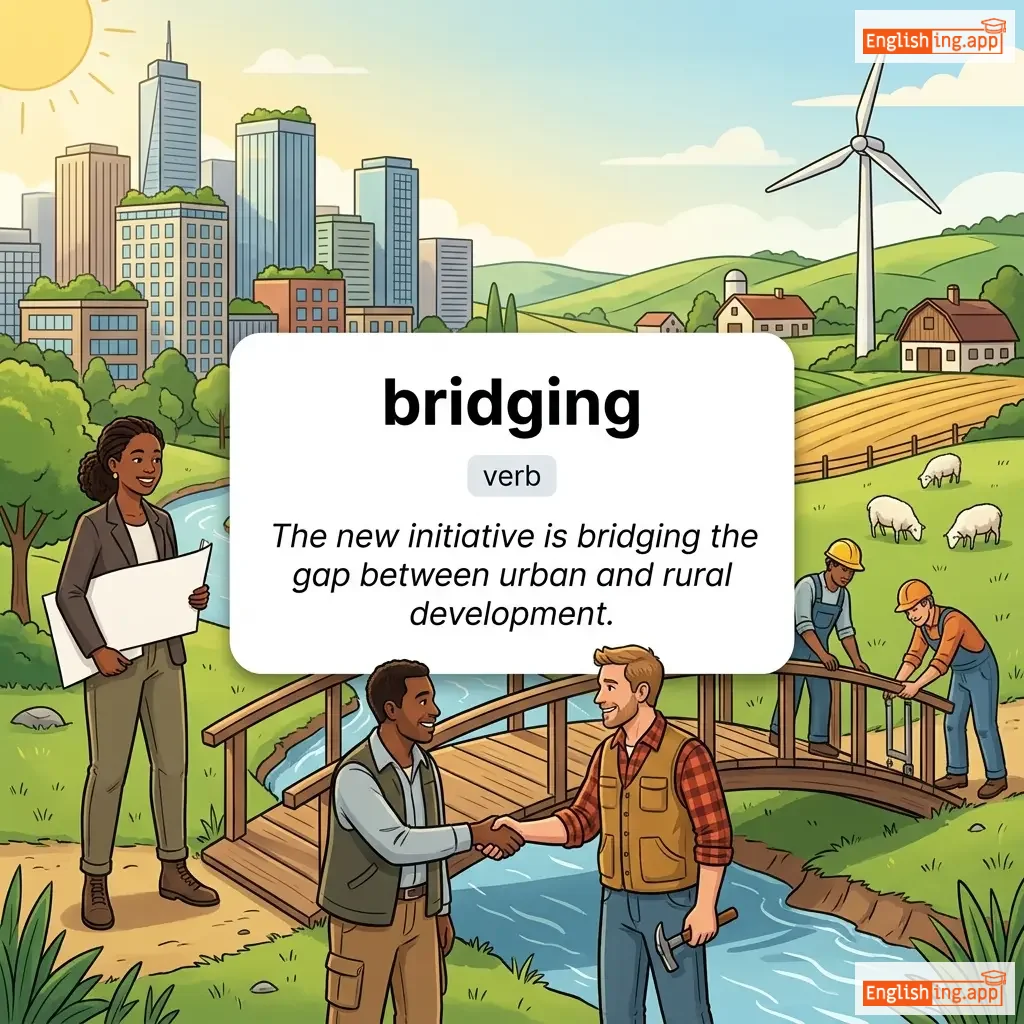
bridging definition card — visual illustration of the meaning
verb
/ˈbrɪdʒɪŋ/
सेतु निर्माण करना, जोड़ने का काम करना (setu nirmaan karna, jodne ka kaam karna)

The action of building a bridge over something; connecting or reducing the distance between two things.

"The new initiative is bridging the gap between urban and rural development."

"नया पहल शहरी और ग्रामीण विकास के बीच अंतर को सेतु बना रहा है।" (Naya pahal shahri aur gramin vikas ke beech antar ko setu bana raha hai.)
noun/verb
/ˈbraɪ.dəl/
घोड़े की लगाम (ghode ki lagam)

A bridle is a piece of equipment used to control a horse; as a verb, it means to show anger or to restrain.

"The rider tightened the bridle before setting off."

"सवार ने सेटिंग ऑफ़ से पहले ब्राइडल को कस दिया।" (sawar ne setting off se pehle bridle ko kas diya.)
adjective, noun, verb
/briːf/
संक्षिप्त (sankshipt)

Short in duration; a summary of information.

"The manager briefed the team before the meeting."

"मैनेजर ने मीटिंग से पहले टीम को संक्षेप में जानकारी दी।" (Manager ne meeting se pehle team ko sankshipt mein jankari di.)
adverb
/ˈbriːfli/
संक्षेप में (sankṣep mein)

For a short time; in a few words.

"She spoke briefly about her travel experience."

"उसने अपने यात्रा अनुभव के बारे में संक्षेप में बात की।" (Usne apne yatra anubhav ke baare mein sankṣep mein baat ki.)
noun
/brɪˈɡeɪd/
ब्रिगेड (brigade)

A large group of people organized for a specific purpose, especially a military unit.

"The fire brigade arrived quickly to put out the flames."

"फायर ब्रिगेड जल्दी आग बुझाने के लिए आई।" (Fire brigade jaldi aag bujhane ke liye aayi.)
noun
/ˌbrɪɡ.əˈdɪər/
ब्रिगेडियर (brigadier)

A military officer rank, usually commanding a brigade.

"The brigadier inspected the troops before the parade."

"ब्रिगेडियर ने परेड से पहले सैनिकों का निरीक्षण किया।" (Brigadier ne parade se pehle sainikon ka nirikshan kiya.)
noun
/ˈbrɪɡ.ənd/
डकैत (dakaait)

A member of a gang that ambushes and robs people in forests or mountains; a bandit.

"The travelers were attacked by brigands in the mountains."

"यात्री पहाड़ों में डकैतों द्वारा हमले का शिकार हो गए।" (Yaatri pahaadon mein dakaaiton dvara hamle ka shikar ho gaye.)
adjective
/braɪt/
चमकीला (chamkeela)

Giving out or reflecting a lot of light; intelligent or cheerful.

"The bright sun lit up the entire valley."

"चमकीली सूरज ने पूरी घाटी को रोशन कर दिया।" (Chamkeeli suraj ne poori ghaati ko roshan kar diya.)
verb
/ˈbraɪtən/
चमकदार बनाना (chamakdar banana)

to make something lighter or more colorful; to improve mood or make happier

"A few kind words can brighten someone's day."

"कुछ अच्छे शब्द किसी का दिन उजला कर सकते हैं।" (kuch acche shabd kisi ka din ujla kar sakte hain)
adverb
/ˈbraɪtli/
उज्ज्वल रूप से (ujjval roop se)

in a way that gives off a lot of light; in a vivid, cheerful, or intelligent manner

"The stars shone brightly in the clear night sky."

"साफ़ रात के आकाश में तारे उज्ज्वल रूप से चमक रहे थे।" (saaf raat ke aakash mein taare ujjval roop se chamak rahe the)
adjective
/ˈbrɪliənt/
शानदार (shandar)

Exceptionally clever, talented, or impressive; very bright or radiant.

"She gave a brilliant performance on stage."

"वह मंच पर शानदार प्रदर्शन दे रही थी।" (Woh manch par shandar pradarshan de rahi thi.)
noun/verb
/brɪm/
किनारा (kinara)

The edge of a container; as a verb, to be full to the point of overflowing.

"Her eyes brimmed with tears of joy."

"उसकी आँखें खुशी के आंसुओं से छलक आईं।" (Uski aankhen khushi ke aansuon se chalk aayi.)
noun
/ˈbrɪmˌstoʊn/
गंधक (gandhak)

Sulfur, especially when considered as fiery and associated with hell or divine punishment.

"The preacher spoke of fire and brimstone to warn the congregation."

"उपदेशक ने समुदाय को आग और गंधक के बारे में चेतावनी देने के लिए बात की।" (updeshak ne samudaay ko aag aur gandhak ke baare me chetavani dene ke liye baat ki)
adjective
/ˈbrɪndl̩d/
धब्बेदार (dhabbedar)

Having a brownish or tawny color with streaks or spots of another color.

"The farmer owned a brindled cow with distinctive stripes."

"किसान के पास एक धब्बेदार गाय थी।" (Kisaan ke paas ek dhabbedar gaay thi.)
noun
/braɪn/
नमकीन पानी (namkeen paani)

Water saturated with salt, often used for preserving food.

"The olives were stored in brine to keep them fresh."

"जैतून को ताजगी बनाए रखने के लिए नमकीन पानी में रखा गया था।" (Jaitoon ko taazgi banaye rakhne ke liye namkeen paani mein rakha gaya tha.)
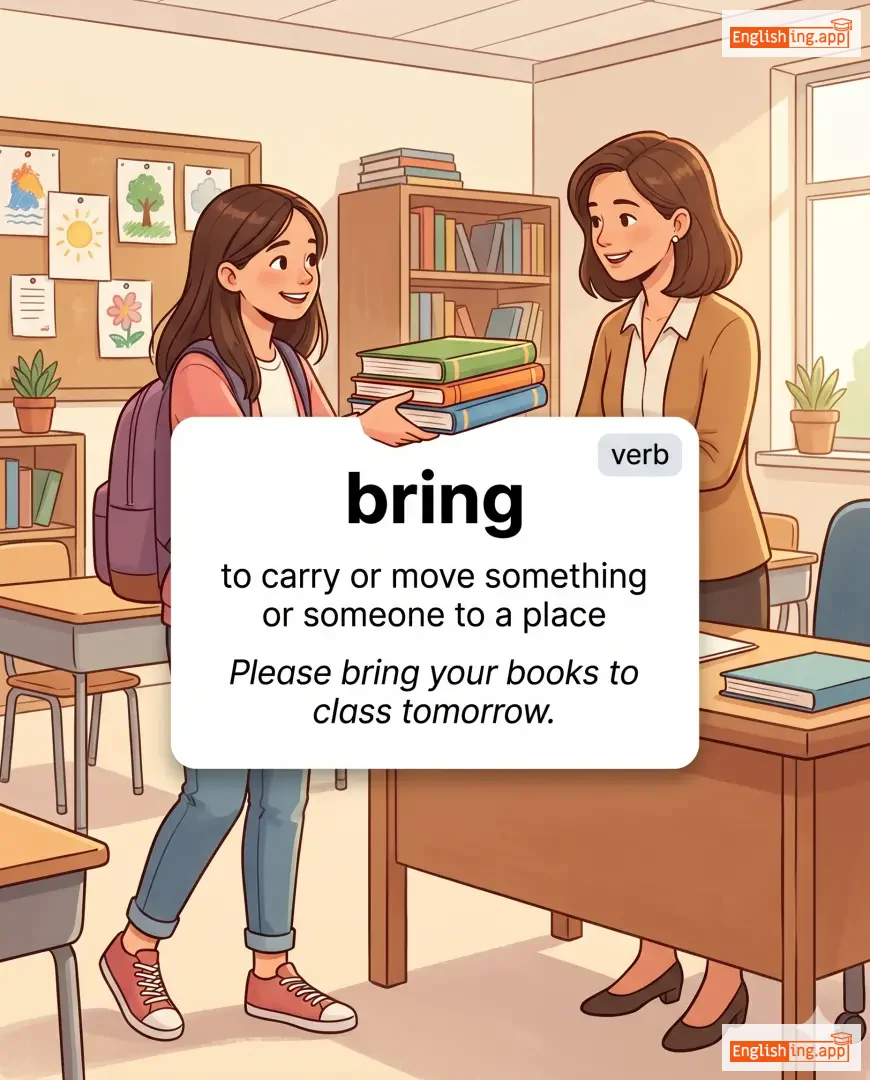
bring definition card — visual illustration of the meaning
verb
/brɪŋ/
लाना (lana)

to carry or move something or someone to a place

"Please bring your books to class tomorrow."

"कृपया अपनी किताबें कल क्लास में लाकर लाएं।" (Kripya apni kitaabein kal class mein laakar laayein.)
noun
/ˈbrɪn.dʒəl/
बैंगन (baingan)

a large purple vegetable that is white inside; also called eggplant

"My mother cooked brinjal curry for lunch."

"मेरी माँ ने दोपहर के भोजन के लिए बैंगन की करी बनाई।" (meri maan ne dopahar ke bhojan ke liye baingan ki curry banai)
noun
/brɪŋk/
कगार (kagar)

The edge or point just before a significant event or change.

"The company was on the brink of bankruptcy."

"कंपनी दिवालियापन के कगार पर थी।" (Company deewaliapan ke kagar par thi.)
adjective
/brɪsk/
तेज़ (tez)

Quick, energetic, and active in movement or speech.

"She took a brisk walk in the morning to stay healthy."

"उसने सुबह में स्वस्थ रहने के लिए तेज़ चलना किया।" (Usne subah mein swasth rehne ke liye tez chalna kiya.)
verb, noun
/ˈbrɪsəl/
कठोर बाल; गुस्से में प्रतिक्रिया करना (kathor baal; gusse mein pratikriya karna)

to react angrily or defensively; a short stiff hair or fiber

"The cat bristled when it saw the dog."

"बिल्ली कुत्ते को देखकर गुस्से में खड़ी हो गई।" (Billi kutte ko dekhkar gusse mein khadi ho gayi.)
adjective
/ˈbrɪslɪŋ/
उत्तेजित; खड़े बाल (uttejit; khade baal)

full of energy, anger, or excitement; showing bristles standing up

"He entered the room bristling with confidence."

"वह आत्मविश्वास से भरा हुआ कमरे में दाखिल हुआ।" (Vah atma-vishwas se bhara hua kamre mein daakhil hua.)
noun
/brɪˈtæniə/
ब्रिटेन का व्यक्तित्व (Britten ka vyaktitv)

the personification of Britain, often shown as a woman with a helmet and shield

"Britannia has been a symbol of Britain since Roman times."

"ब्रिटानिया ने रोमन काल से ब्रिटेन का प्रतीक बनने के बाद से एक प्रतीक के रूप में काम किया है।" (Britannia ne Roman kaal se Britten ka pratik banne ke baad se ek pratik ke roop mein kaam kiya hai.)
noun
/ˈbrɪtɪˌsɪzəm/
ब्रिटिश शब्द या विशेषता (British shabd ya visheshata)

a word, phrase, or characteristic feature of British English

"The word 'lorry' is a well-known Briticism."

"'लॉरी' शब्द एक प्रसिद्ध ब्रिटिसिज़म है।" ('Lorry' shabd ek prasiddh Briticism hai.)
adjective
/ˈbrɪtɪʃ/
ब्रिटिश (british)

relating to Great Britain or its people

"She loves British culture and traditions."

"वह ब्रिटिश संस्कृति और परंपराओं को पसंद करती है।" (Vah British sanskriti aur paramparao ko pasand karti hai.)
adjective
/ˈbrɪtl/
नाज़ुक (naazuk)

easily broken or cracked; hard but liable to break

"The glass was so brittle that it cracked easily."

"गिलास इतना नाज़ुक था कि वह आसानी से टूट गया।" (Gilaas itna naazuk tha ki wah aasani se toot gaya.)
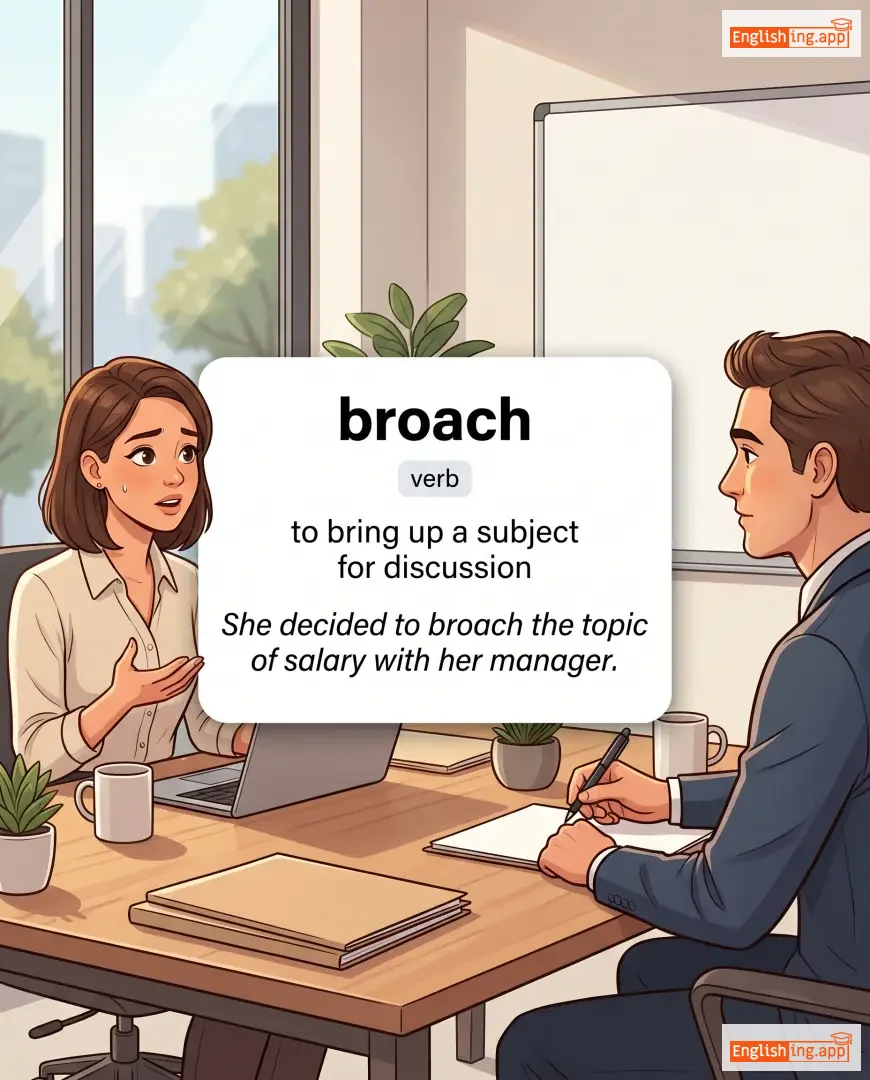
broach definition card — visual illustration of the meaning
verb
/broʊtʃ/
उठाना (uthana)

to bring up a subject for discussion

"She decided to broach the topic of salary with her manager."

"उसने अपनी सैलरी के विषय को अपने मैनेजर से उठाने का निर्णय लिया।" (Usne apni salary ke vishay ko apne manager se uthane ka nirnay liya.)
adjective
/brɔːd/
विस्तृत (vistrit)

wide in extent, range, or scope

"The river is very broad at this point."

"इस बिंदु पर नदी बहुत विस्तृत है।" (Is bindu par nadi bahut vistrit hai.)
noun
/ˈbrɔːd.bænd/
ब्रॉडबैंड (broadband)

a high-capacity transmission technique using a wide range of frequencies.

"Broadband internet has become a necessity in modern homes."

"ब्रॉडबैंड इंटरनेट आधुनिक घरों में एक आवश्यकता बन गया है।" (Broadband internet ādhunik gharon mein ek āvaśyaktā ban gayā hai.)
verb
/ˈbrɔːdˌkæst/
प्रसारण करना (prasaran karna)

to transmit a program or information by radio, television, or online media

"The match was broadcast live on television."

"मैच को टेलीविज़न पर लाइव प्रसारित किया गया।" (Match ko television par live prasarit kiya gaya.)
noun
/ˈbrɔːdˌkæstər/
ब्रॉडकास्टर (broadcaster)

a person or organization that transmits a broadcast program.

"The broadcaster aired the match live to millions of viewers."

"ब्रॉडकास्टर ने मैच को लाखों दर्शकों के लिए लाइव प्रसारित किया।" (Broadcaster ne match ko laakhon darshako ke liye live prasarit kiya.)
verb
/ˈbrɔːdən/
विस्तार करना (vistar karna)

to make wider or larger in scope; to expand ideas, experience, or understanding

"Travel can broaden your perspective on different cultures."

"यात्रा विभिन्न संस्कृतियों पर आपका दृष्टिकोण विस्तृत कर सकती है।" (yatra vibhinna sanskritiyon par aapka drishtikon vistarit kar sakti hai)
adverb
/ˈbrɔːdli/
व्यापक रूप से (vyapak roop se)

in a general or wide manner.

"The rules are broadly similar across all regions."

"नियम सभी क्षेत्रों में सामान्य रूप से समान हैं।" (Niyam sabhi kshetron mein sadharan roop se samaan hain.)
noun
/ˈbrɔːdˌsaɪd/
कड़ा हमला (kada hamla)

a strong verbal attack or a sheet of paper printed on one side

"The politician launched a broadside against his opponent."

"राजनेता ने अपने प्रतिद्वंद्वी के खिलाफ कड़ा हमला बोला।" (Rajneta ne apne pratidvandi ke khilaf kada hamla bola.)
noun
/brəˈkeɪd/
आलंकरण वाला कपड़ा (aalankaran wala kapda)

a rich fabric woven with a raised pattern, often in gold or silver thread

"She wore a beautiful brocade dress to the wedding."

"उसने शादी में एक सुंदर ब्रोकैड ड्रेस पहनी।" (Usne shaadi mein ek sundar brocade dress pehni.)
noun
/broʊˈʃʊr/
ब्रॉशर (broshar)

a small booklet or pamphlet containing information or advertising

"The travel agent gave us a brochure about the holiday package."

"ट्रैवल एजेंट ने हमें छुट्टियों के पैकेज के बारे में एक ब्रॉशर दिया।" (Travel agent ne humein chhuttiyon ke package ke baare mein ek broshar diya.)
noun
/ˈbroʊɡən/
भारी जूता (bhari joota)

A heavy, sturdy shoe, often made of leather.

"The farmer wore old brogans while working in the field."

"किसान खेत में काम करते समय पुराने ब्रोगन पहने हुए थे।" (Kisan khet mein kaam karte samay purane brogan pehne hue the.)
noun
/broʊɡ/
मजबूत जूता; उच्चारण (majboot joota; uchcharan)

A strong outdoor shoe; also a marked accent, especially Irish or Scottish.

"He bought a pair of stylish brogues for the wedding."

"उसने शादी के लिए एक स्टाइलिश ब्रोग खरीदी।" (Usne shaadi ke liye ek stylish brog khareedi.)
verb
/brɔɪl/
सेंकना/ग्रिल करना (senkana/grill karna)

To cook food by direct heat, usually under a grill or over a fire.

"She broiled the chicken until it was golden brown."

"वह चिकन को सुनहरा भूरा होने तक ब्रॉयल करती थी।" (Wah chicken ko sunahara bhura hone tak broil karti thi.)
verb; adjective
/broʊk/
टूटा था; कंगाल (toota tha; kangaal)

past tense of break; having no money or being financially poor

"I broke my phone last night and now I’m completely broke."

"मैंने कल रात अपना फोन तोड़ दिया और अब मैं पूरी तरह कंगाल हूँ।" (maine kal raat apna phone tod diya aur ab main poori tarah kangaal hoon)