वोकैबुलरीज

इंग्लिश वोकैबुलरी डिस्कवर, लर्न और मास्टर करें

noun
/ˈbɒdi/
शरीर (sharir)

the physical structure of a person or animal

"Exercise helps keep the body healthy."

"व्यायाम शरीर को स्वस्थ रखने में मदद करता है।" (vyayam sharir ko swasth rakhne mein madad karta hai.)
noun
/ˈbɒdiɡɑːrd/
बॉडीगार्ड (bodyguard)

a person employed to protect someone from harm

"The celebrity arrived with her bodyguard."

"सेलिब्रिटी अपनी बॉडीगार्ड के साथ आई।" (celebrity apni bodyguard ke saath aayi.)
noun
/bɒɡ/
दलदल (daldal)

an area of wet, spongy ground; a swamp or marsh

"The hikers got stuck in a bog."

"हाइकर्स एक दलदल में फंस गए।" (Haikers ek daldal mein fans gaye.)
verb
/ˈbɒɡəl/
चकरा देना (chakra dena)

to overwhelm or confuse; to be astonished or puzzled by something

"The complexity of the puzzle boggled his mind."

"पजल की जटिलता ने उसके दिमाग को चकरा दिया।" (Pazal ki jatilta ne uske dimaag ko chakra diya.)
adjective
/ˈboʊɡəs/
झूठा (jhootha)

false, fake, or not genuine

"The police arrested him for using a bogus ID card."

"पुलिस ने उसे झूठे आईडी कार्ड का उपयोग करने के लिए गिरफ्तार किया।" (Police ne use jhoothe ID card ka upyog karne ke liye giraftar kiya.)
adjective
/boʊˈhiːmiən/
बेवकूफ़, कला-प्रेरित और स्वतंत्र जीवनशैली (bohemian)

unconventional, artistic, and free-spirited in lifestyle or appearance

"She decorated her apartment in a bohemian style with colorful fabrics."

"उसने अपने अपार्टमेंट को बोहेमियन शैली में रंग-बिरंगे कपड़ों से सजाया।" (Usne apne apartment ko bohemian shaili mein rang-birange kapdon se sajaya.)
verb
/bɔɪl/
उबालना (ubaalna)

to heat a liquid until it starts to bubble and turn into vapor.

"Please boil some water for tea."

"कृपया चाय के लिए कुछ पानी उबालें।" (kripya chai ke liye kuch pani ubaalein.)
adjective
/bɔɪld/
उबला हुआ (ubla hua)

cooked in boiling water

"She served boiled eggs for breakfast."

"उसने नाश्ते में उबाले हुए अंडे परोसे।" (usne nashtay mein ubla hua anday parose)
adjective
/ˈbɔɪstərəs/
हंगामा करने वाला (hungama karne wala)

noisy, energetic, and cheerful; rowdy

"The children were boisterous during the birthday party."

"जन्मदिन की पार्टी के दौरान बच्चे हंगामा कर रहे थे।" (Janmadin ki party ke dauran bachche hungama kar rahe the.)
adjective
/boʊld/
साहसी (sahasi)

showing courage, confidence, or willingness to take risks

"She made a bold decision to start her own business."

"उसने अपना खुद का व्यवसाय शुरू करने का साहसी निर्णय लिया।" (Usne apna khud ka vyavsay shuru karne ka sahasi nirnay liya.)
adverb
/ˈbəʊld.li/
धैर्यपूर्वक; निडरता से (dhairyapurvak; nidrata se)

in a confident and brave way; without fear

"She boldly stepped forward to face the challenge."

"उसने चुनौती का सामना करने के लिए साहसपूर्वक कदम बढ़ाए।" (usne chunauti ka samna karne ke liye sahaspurvak kadam badhaye.)
noun
/ˈboʊld.nəs/
साहस; धैर्य (sahas, dhairya)

willingness to take risks; confidence and courage in behavior

"Her boldness in confronting the problem impressed everyone."

"समस्या का सामना करते समय उसकी साहसिकता ने सभी को प्रभावित किया।" (samasya ka samna karte samay uski sahasikta ne sabhi ko prabhavit kiya.)
noun
/boʊl/
वृक्ष का तना (vriksh ka tana)

the trunk of a tree

"The bole of the tree was thick and strong."

"वृक्ष का तना मोटा और मजबूत था।" (Vriksh ka tana mota aur majboot tha.)
noun
/bəˈlɛəroʊ/
बोलेरो (एक स्पैनिश नृत्य या छोटे सामने से खुले जैकेट) (bolero)

A Spanish dance in slow triple time, or a short jacket open at the front.

"The dancers performed a passionate bolero at the festival."

"नर्तकियों ने उत्सव में एक भावुक बोलेरो प्रस्तुत किया।" (Nartakiyon ne utsav mein ek bhavuk bolero prastut kiya.)
noun
/boʊl/
गोल आकार का बीज फल (जैसे कपास या फ्लैक्स) (bol)

The rounded seed capsule of plants such as cotton or flax.

"The farmer examined the cotton boll to check its quality."

"किसान ने कपास के बोल की गुणवत्ता जांचने के लिए उसका परीक्षण किया।" (Kisan ne kapas ke bol ki gunwatta janchne ke liye uska parikshan kiya.)
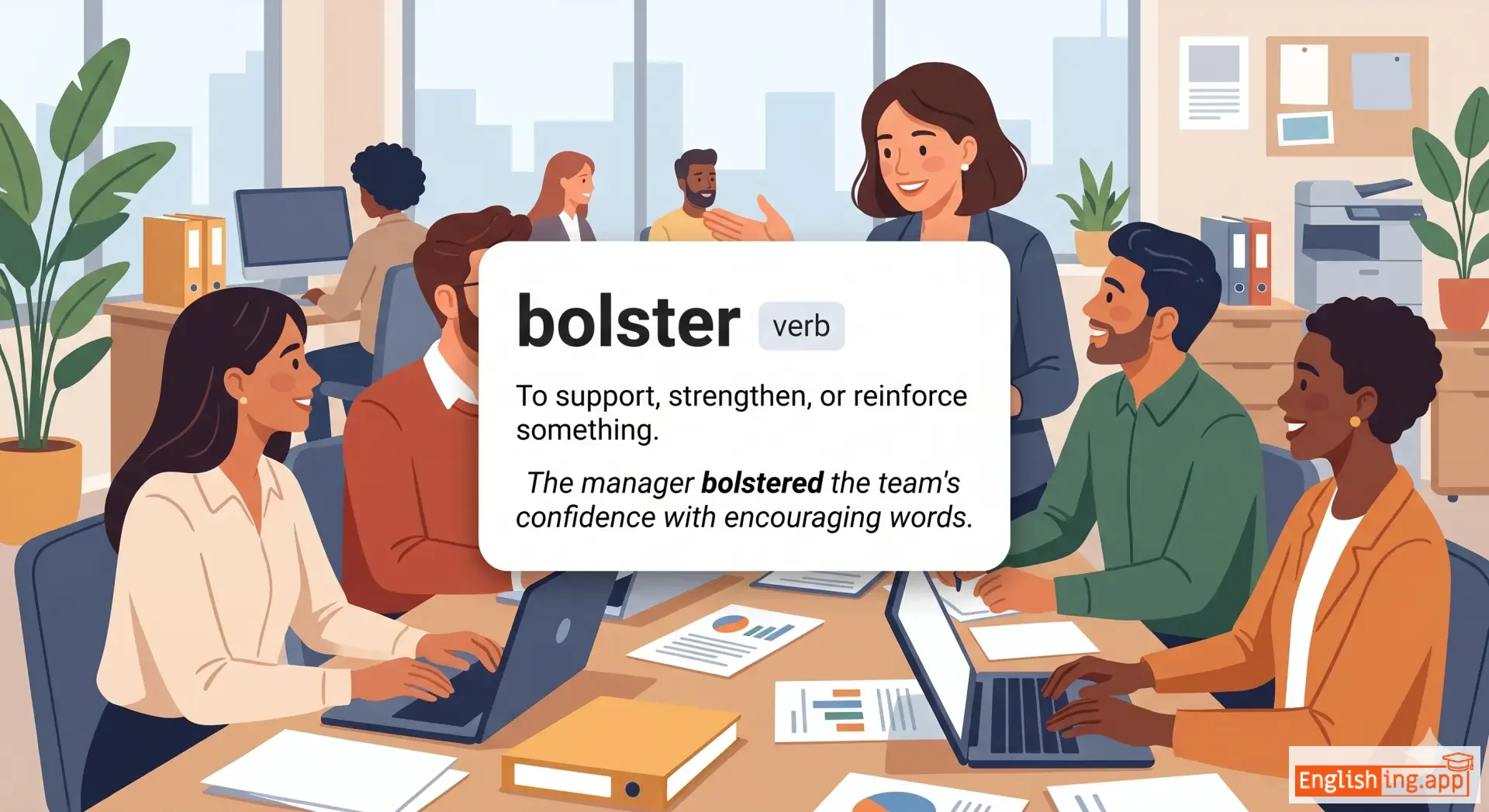
bolster definition card — visual illustration of the meaning
verb
/ˈboʊlstər/
सहायता करना, मजबूत करना (bolster)

To support, strengthen, or reinforce something.

"The manager bolstered the team's confidence with encouraging words."

"मैनेजर ने टीम के आत्मविश्वास को प्रोत्साहन शब्दों से बढ़ाया।" (Manager ne team ke atma-vishwas ko protsahan shabdon se badhaya.)
verb
/boʊlt/
तेज़ी से भागना; बोल्ट से जकड़ना (bolt)

To move suddenly and quickly; also to fasten something with a bolt.

"The horse bolted from the stable after hearing a loud noise."

"घोड़ा तेज़ी से अस्तबल से बाहर भाग गया जब उसने तेज़ आवाज़ सुनी।" (ghoda tezi se astabal se baahar bhag gaya jab usne tez awaaz suni.)
noun/verb
/bɑːm/
बॉम्ब (bomb)

A weapon that explodes; also to attack with bombs or to fail badly.

"The city was bombed heavily during the war."

"युद्ध के दौरान शहर में भारी बमबारी की गई।" (Yuddh ke dauran sheher mein bhaari bombbaari ki gayi.)
verb
/bɒmˈbɑːrd/
प्रहार करना (prahar karna)

to attack continuously with bombs, questions, or other forces

"Reporters bombarded the minister with difficult questions."

"रिपोर्टर्स ने मंत्री को कठिन सवालों से बॉम्बार्ड कर दिया।" (Reporters ne mantri ko kathin sawalon se bombard kar diya.)
noun
/ˌbɒmbərˈdɪər/
बॉम्बार्डियर (bombardier)

a member of a bomber crew responsible for releasing bombs

"The bombardier released the bombs with precision."

"बॉम्बार्डियर ने सटीकता से बम गिराए।" (Bombardier ne sathikta se bam giraaye.)
noun
/bɒmˈbɑːrdmənt/
बमबारी (bambari)

a continuous attack with bombs or other projectiles

"The city endured a heavy bombardment during the war."

"शहर ने युद्ध के दौरान भारी बमबारी सहन की।" (Shahar ne yudh ke dauran bhaari bambari sahan ki.)
noun
/ˈbɒmbæst/
अत्यधिक आडंबरपूर्ण भाषा (atyadhik aadambarpurn bhasha)

speech or writing that is overly pompous and inflated

"His campaign speech was full of bombast but lacked real substance."

"उसकी प्रचार भाषण बॉम्बास्ट से भरी थी लेकिन असली सार नहीं था।" (Uski prachar bhashan bombast se bhari thi lekin asli saar nahin tha.)
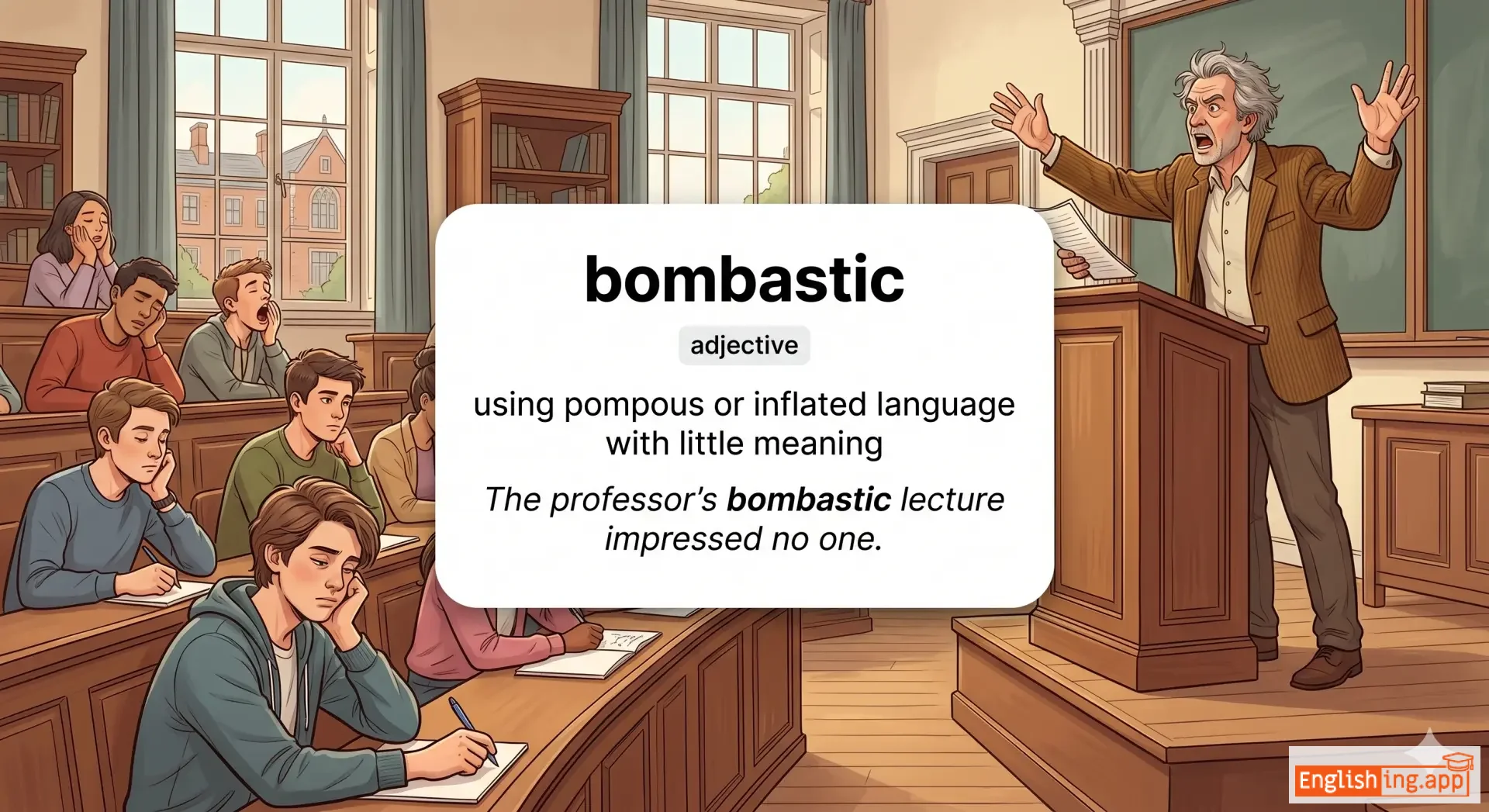
bombastic definition card — visual illustration of the meaning
adjective
/bɒmˈbæstɪk/
अतिरेकपूर्ण (atirekpurn)

using pompous or inflated language with little meaning

"The professor’s bombastic lecture impressed no one."

"प्रोफेसर का अतिरेकपूर्ण व्याख्यान किसी को प्रभावित नहीं कर पाया।" (Professor ka atirekpurn vyakhyan kisi ko prabhavit nahi kar paya.)
noun
/bɒmˈbeɪ dʌk/
बॉम्बे बतख मछली (bombay batakh machhli)

a type of lizardfish found in coastal waters, commonly eaten dried and salted in South Asia

"Bombay duck is a popular delicacy when dried and fried."

"बॉम्बे बतख मछली सूखने और तलने पर एक लोकप्रिय व्यंजन है।" (bombay batakh machhli sookhne aur talne par ek lokpriya vyanjan hai)
noun
/ˈbɒmər/
बमवर्षक विमान (bamvarshak viman)

military aircraft designed to drop bombs on targets

"The bomber squadron flew over the city at dawn."

"बमवर्षक विमानों का स्क्वाड्रन सुबह शहर के ऊपर से उड़ा।" (bamvarshak vimanon ka squadron subah shahar ke upar se uda.)
noun
/ˈbɒmɪŋ/
बमबारी (bambaraee)

an attack using bombs or explosives

"The city was devastated by the bombing."

"शहर को बमबारी से तबाह कर दिया गया था।" (shahar ko bambaree se tabah kar diya gaya tha.)
adjective
/ˌboʊnəˈfaɪdi/
सही; प्रामाणिक; वैध; (sahi; pramanik; vaidh;)

genuine; authentic; legitimate

"She is a bonafide expert in her field."

"वह अपने क्षेत्र में एक सही विशेषज्ञ है।" (vah apne kshetra mein ek sahi visheshagya hai)
noun
/bəˈnæn.zə/
संपत्ति या अच्छे भाग्य में अचानक वृद्धि लाने वाली स्थिति या घटना (sampatti ya acche bhagya mein achanak vruddhi lane wali sthiti ya ghatna)

a situation or event that creates a sudden increase in wealth, good fortune, or profits

"The oil discovery was a bonanza for the small country."

"तेल की खोज छोटे देश के लिए एक बोनांजा था।" (tel ki khoj chhote desh ke liye ek bonanja tha.)
noun
/bɒnd/
संबंध (sambandh)

a connection or relationship between people or things

"The sisters share a close bond."

"बहनें एक-दूसरे के साथ गहरा संबंध साझा करती हैं." (bahnen ek-dusre ke saath gehra sambandh saanjha karti hain)
noun
/ˈbɑn.dɪdʒ/
दासता; बंधन (daasta, bandhan)

the state of being a slave; the state of being under the control of a force or influence

"The people fought to escape from the bondage of oppression."

"लोग अत्याचार की बंधन से बचने के लिए संघर्ष कर रहे थे।" (log atyachaar ki bandhan se bachne ke liye sangharsh kar rahe the.)
noun
/boʊn/
हड्डी (haddi)

the hard parts of a skeleton that form the structure of the body

"The dog buried a bone in the garden."

"कुत्ते ने बगीचे में एक हड्डी दफन की।" (kutte ne bagiche mein ek haddi dafna ki.)
noun
/ˈbɒnəmi/
सौहार्द्र (sauhardra)

Cheerful friendliness and geniality.

"The meeting was filled with laughter and bonhomie."

"बैठक हंसी और सौहार्द्र से भरी थी।" (baithak hansi aur sauhardra se bhari thi.)
adjective
/ˈbɒni/
मनोहर; सुंदर; खुशमिजाज (manohar; sundar; khushmijaz)

cheerful; pretty; attractive

"The bonny child played happily in the garden."

"मनोहर बच्चा बाग में खुशी-खुशी खेल रहा था।" (manohar bachcha baag mein khushi-khushi khel raha tha)
noun
/ˈbəʊnəs/
बोनस (bonus)

an extra payment or reward given in addition to what is usual or expected.

"Employees received a year-end bonus for their hard work."

"कर्मचारियों ने अपनी कड़ी मेहनत के लिए साल के अंत में बोनस प्राप्त किया।" (karmachariyon ne apni kadi mehnat ke liye saal ke ant mein bonus prapt kiya.)
verb/noun
/buː/
हंगारी/चेतावनी की ध्वनि (hungari/chetavani ki dhvani)

To show disapproval by shouting 'boo'; or a sound made to surprise or scare.

"The audience began to boo the bad performance."

"दर्शकों ने खराब प्रदर्शन पर बू करना शुरू कर दिया।" (darshako ne kharab pradarshan par boo karna shuru kar diya.)
noun
/buːb/
मूर्ख व्यक्ति; स्तन (अनौपचारिक) (moorkh vyakti; stan)

a foolish or clumsy person; an informal and sometimes rude term for a woman's breast

"He felt like a complete boob after forgetting the meeting."

"मीटिंग भूल जाने के बाद उसे लगा कि वह पूरा मूर्ख है।" (meeting bhool jaane ke baad use laga ki vah poora moorkh hai)
noun
/ˈbuːbi/
मूर्ख व्यक्ति (moorkh vyakti)

a foolish or gullible person; a silly individual

"He felt like a booby after making such a simple mistake."

"इतनी सरल गलती करने के बाद उसे खुद को मूर्ख महसूस हुआ।" (itni saral galti karne ke baad use khud ko moorkh mehsoos hua)
noun, verb
/bʊk/
पुस्तक / बुकिंग करना (pustak / booking karna)

A set of written, printed, or blank pages fastened together; to arrange for someone to have a seat, room, or ticket in advance.

"I booked a table at the restaurant for dinner."

"मैंने डिनर के लिए रेस्टोरेंट में एक टेबल बुक की।" (Maine dinner ke liye restaurant mein ek table book ki.)
noun
/bʊk ˈbaɪn.dər/
पुस्तक बाइंडर (pustak binder)

a person whose job is to fasten the pages of books together and put covers on them

"The old book binder carefully restored the antique manuscript."

"पुराना पुस्तक बाइंडर पुराने पांडुलिपि को सावधानी से बहाल करता था।" (Purana pustak binder purane pandulipi ko saavdhani se bahaal karta tha.)
noun
/bʊk ˈsel.ər/
पुस्तक विक्रेता (pustak vikreta)

a person who sells books, especially as a business

"The book seller recommended a great novel for my summer reading."

"बुक सेलर ने मेरी गर्मी की छुट्टियों के लिए एक शानदार उपन्यास की सिफारिश की।" (buk seller ne meri garmi ki chhuttiyon ke liye ek shandaar upanyas ki sifaarish ki.)
noun
/ˈbʊkɪŋ/
बुकिंग (booking)

the act of reserving accommodations, tickets, etc.

"I made a booking for a hotel room in advance."

"मैंने अग्रिम रूप से एक होटल कमरे की बुकिंग की।" (Maine agrim roop se ek hotel kamre ki booking ki.)
adjective
/ˈbʊkɪʃ/
पुस्तकप्रिय (pustakpriya)

Spending much time reading or studying; scholarly but lacking practical experience.

"He was too bookish to enjoy outdoor activities."

"वह आउटडोर गतिविधियों का आनंद लेने के लिए बहुत पुस्तकप्रिय था।" (vah outdoor gatividhiyon ka anand lene ke liye bahut pustakpriya tha.)
noun
/ˈbʊkʃɒp/
किताबों की दुकान (kitabon ki dukan)

a retail store where books are sold

"She spent an hour browsing in the small bookshop."

"उसने छोटी किताबों की दुकान में एक घंटा बिताया।" (usne chhoti kitabon ki dukan mein ek ghanta bitaya)
noun
/ˈbʊkstɔːr/
पुस्तक की दुकान (pustak ki dukan)

a shop where books are sold

"She spent an entire afternoon browsing in the bookstore."

"उसने पूरा दोपहर पुस्तक की दुकान में बिताया।" (usne pura dopahar pustak ki dukan mein bitaya)
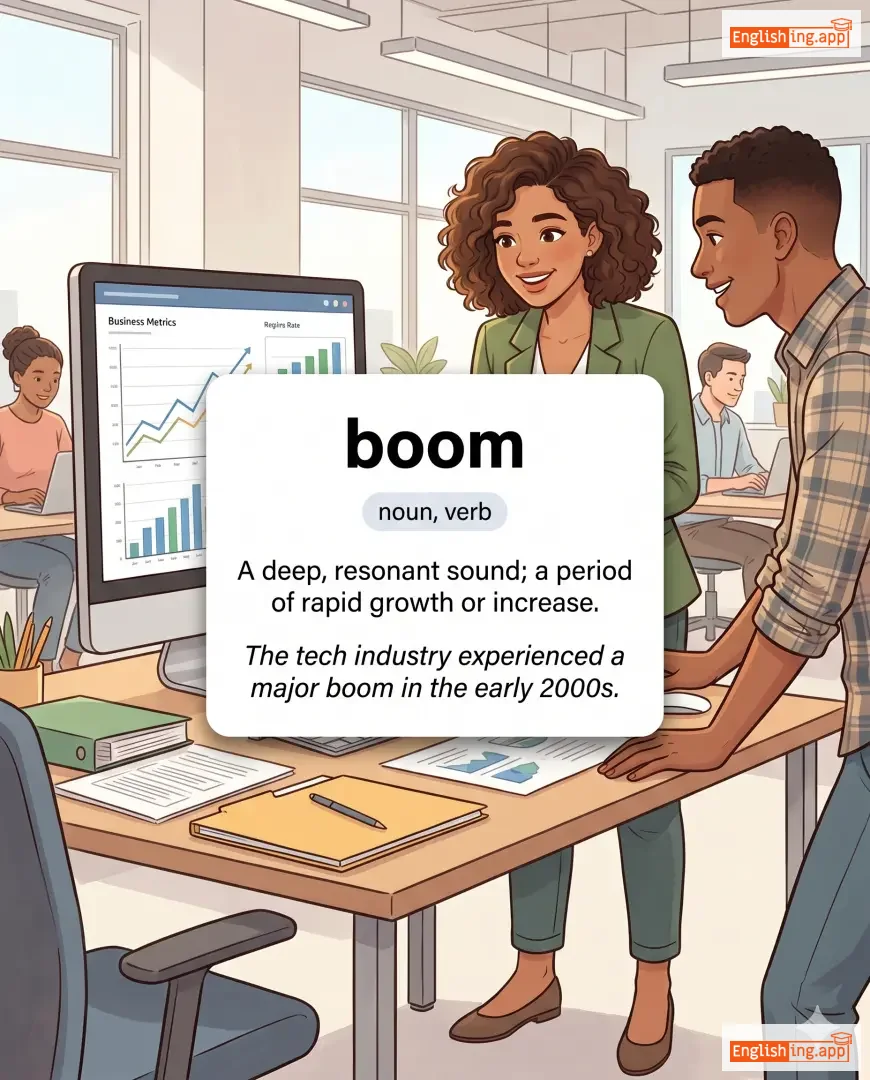
boom definition card — visual illustration of the meaning
noun, verb
/buːm/
वृद्धि, तेज़ी से वृद्धि (vruddhi, tezi se vruddhi)

A deep, resonant sound; a period of rapid growth or increase.

"The tech industry experienced a major boom in the early 2000s."

"2000 के दशक की शुरुआत में तकनीकी उद्योग में एक बड़ी वृद्धि देखी गई।" (2000 ke dashak ki shuruaat mein takneeki udyog mein ek badi vruddhi dekhi gayi.)
noun
/buːn/
आशीर्वाद (ashirvad)

A thing that is helpful or beneficial.

"The internet is a boon to modern education."

"इंटरनेट आधुनिक शिक्षा के लिए एक आशीर्वाद है।" (internet aadhunik shiksha ke liye ek ashirvad hai.)
noun
/bʊər/
असभ्य (ashabhya)

A rude, insensitive, or ill-mannered person.

"He was such a boor at the dinner table."

"वह डिनर टेबल पर ऐसा असभ्य था।" (vah dinner table par aisa asabhya tha.)
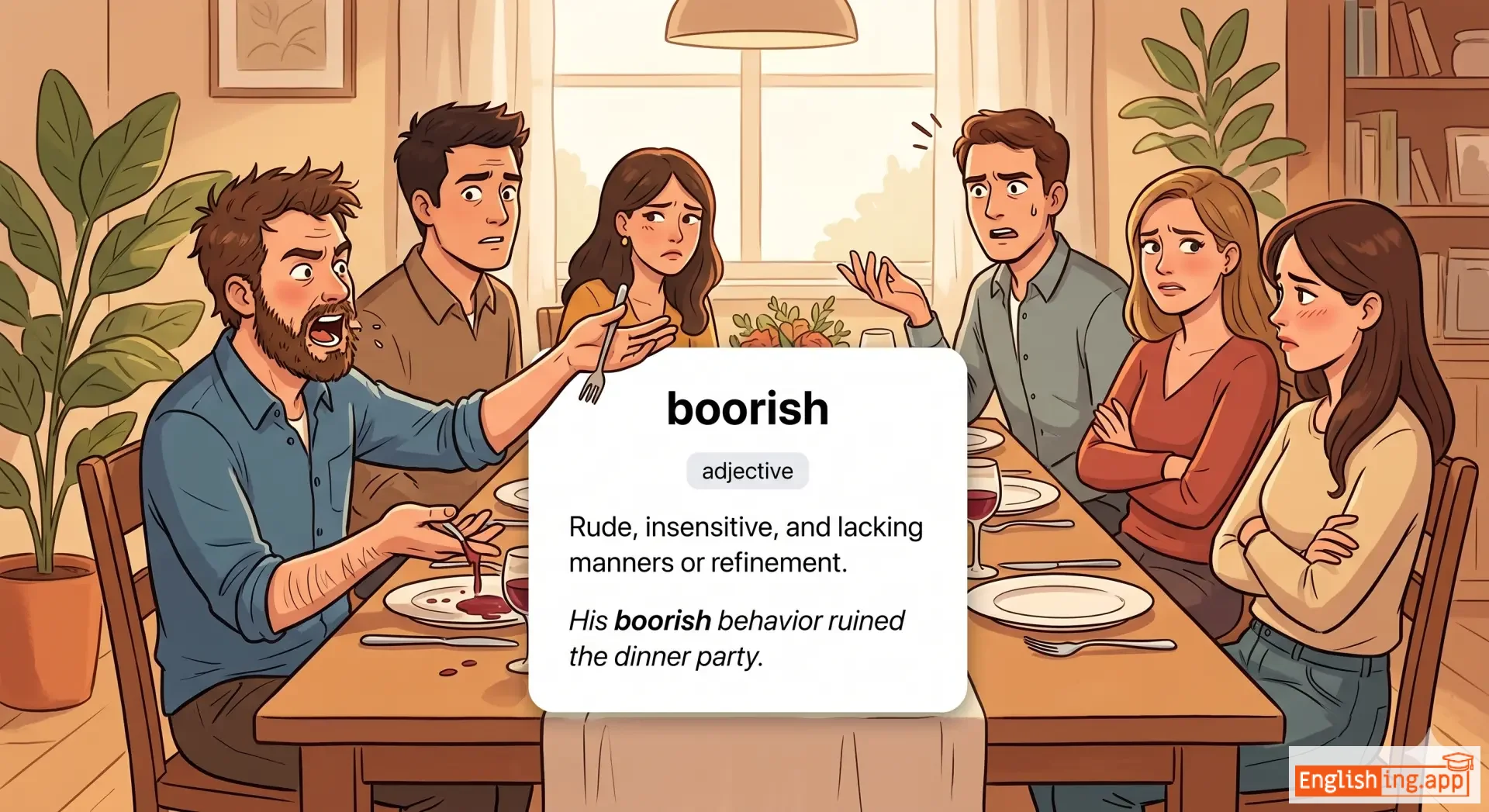
boorish definition card — visual illustration of the meaning
adjective
/ˈbʊərɪʃ/
असभ्य (asabhya)

Rude, insensitive, and lacking manners or refinement.

"His boorish behavior ruined the dinner party."

"उसका असभ्य व्यवहार रात के खाने की पार्टी को खराब कर दिया।" (uska asabhya vyavhaar raat ke khane ki party ko kharaab kar diya.)
verb
/buːst/
बढ़ाना (badhana)

To increase, improve, or raise something.

"The company launched a campaign to boost sales."

"कंपनी ने बिक्री बढ़ाने के लिए एक अभियान शुरू किया।" (Company ne bikri badhane ke liye ek abhiyan shuru kiya.)
noun, verb
/buːt/
जूता (joota)

A type of shoe that covers the ankle or higher; to start up a computer system.

"He put on his boots before going hiking."

"वह हाइकिंग पर जाने से पहले अपने बूट्स पहनता है।" (vah hiking par jaane se pehle apne boots pehenta hai.)