वोकैबुलरीज

इंग्लिश वोकैबुलरी डिस्कवर, लर्न और मास्टर करें

adjective
/ˈblɪŋkəd/
संकीर्णदृष्टि (sankirndrishti)

Having a limited or narrow outlook; unable or unwilling to consider other perspectives.

"His blinkered attitude stopped him from seeing the bigger picture."

"उसकी संकीर्णदृष्टि ने उसे बड़े चित्र को देखने से रोक दिया।" (Uski sankirndrishti ne use bade chitra ko dekhne se rok diya.)
noun
/blɪs/
आनंद (anand)

Perfect happiness or great joy.

"The couple enjoyed a moment of pure bliss on their wedding day."

"जोड़े ने अपनी शादी के दिन शुद्ध आनंद का एक पल महसूस किया।" (Jode ne apni shaadi ke din shuddh anand ka ek pal mehsoos kiya.)
noun
/ˈblɪs.tər/
बुलबुला, जलन से उत्पन्न घाव (bulbula, jalan se utpann ghaav)

a small bubble on the skin filled with serum and caused by friction, burning, or other damage

"The new shoes gave her a painful blister on her heel."

"नए जूते ने उसके एड़ी पर एक दर्दनाक ब्लिस्टर दे दिया।" (nae jute ne uske edi par ek dardnak blister de diya.)
adjective
/blaɪð/
निर्विकार (nirvikar)

Showing a casual and cheerful indifference considered improper or carefree happiness.

"She had a blithe disregard for the rules."

"उसने नियमों की ओर निर्विकार नजरें डालीं।" (Usne niyamon ki or nirvikar nazre daalein.)
adjective
/ˈblaɪðsəm/
हर्षित (harshit)

cheerful, carefree, and full of joy

"She entered the room with a blithesome smile that lifted everyone's spirits."

"वह एक हर्षित मुस्कान के साथ कमरे में प्रवेश किया जिसने सभी का मनोबल बढ़ाया।" (Vah ek harshit muskaan ke saath kamre mein pravesh kiya jise sabhi ka manobal badhaya.)
verb
/bloʊt/
फूला हुआ (phoola hua)

to swell or cause to swell, often due to fluid or gas

"Eating too much junk food can bloat your stomach."

"ज्यादा जंक फूड खाने से आपका पेट फूला सकता है।" (zyada junk food khane se aapka pet phoola sakta hai.)
adjective
/ˈbloʊtɪd/
फूला हुआ (phoola hua)

swollen or puffed up, often unpleasantly

"After the big meal, he felt bloated and uncomfortable."

"बड़े खाने के बाद, वह फूला हुआ और असहज महसूस कर रहा था।" (Bade khane ke baad, vah phoola hua aur asahaj mahsus kar raha tha.)
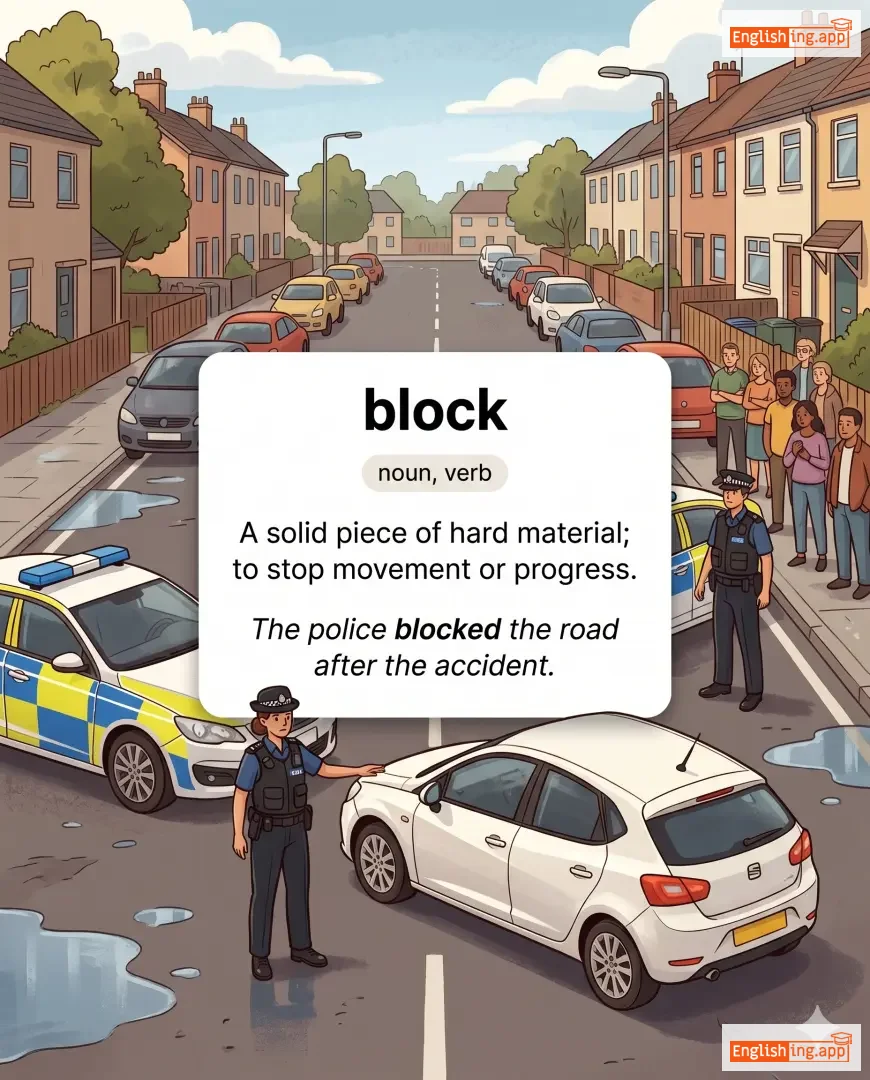
block definition card — visual illustration of the meaning
noun, verb
/blɑːk/
बाधा / ब्लॉक (badha / blok)

A solid piece of hard material; to stop movement or progress.

"The police blocked the road after the accident."

"हादसे के बाद पुलिस ने सड़क को ब्लॉक कर दिया।" (Haadse ke baad police ne sadak ko blok kar diya.)
noun
/blɑːˈkeɪd/
नाका (naaka)

an act of sealing off a place to prevent goods or people from entering or leaving

"The navy set up a blockade around the harbor."

"नौसेना ने बंदरगाह के चारों ओर नाका लगा दिया।" (Nausena ne bandargah ke charon or naaka laga diya.)
noun
/ˈblɒk.ɪdʒ/
अवरोध (avrodh)

an obstruction that makes movement or flow difficult or impossible

"The drain blockage caused water to overflow in the kitchen."

"नालियों का अवरोध किचन में पानी बहने का कारण बना।" (naliyon ka avrodh kitchen mein paani behne ka kaaran bana.)
blockchain definition card — visual illustration of the meaning
noun
/ˈblɒkˌtʃeɪn/
ब्लॉकचेन (blockchain)

A system of recording information in a way that makes it difficult or impossible to change, hack, or cheat the system

"Blockchain technology ensures transparency in financial transactions."

"ब्लॉकचेन तकनीकी वित्तीय लेनदेन में पारदर्शिता सुनिश्चित करती है।" (Blockchain takneeki vittiya lendene mein paardarshita nishchit karti hai.)
adjective
/blɒnd/
हल्के रंग के बालों वाला (halke rang ke balon wala)

having light-colored hair, typically pale yellow or golden.

"She has long blond hair that shines in the sunlight."

"उसके लंबे सुनहरे बाल सूरज की रोशनी में चमकते हैं।" (Uske lambe sunahare baal suraj ki roshni mein chamakte hain.)
noun
/blʌd/
रक्त (rakt)

The red liquid that circulates in the arteries and veins of humans and animals.

"The doctor took a sample of blood for testing."

"डॉक्टर ने परीक्षण के लिए रक्त का नमूना लिया।" (Doctor ne parikshan ke liye rakt ka namuna liya.)
noun
/ˈblʌdˌbæθ/
रक्तपात (raktapat)

an event in which a lot of people are killed or injured, especially in a violent conflict

"The war turned into a bloody bloodbath."

"युद्ध एक खून-खराबे में बदल गया था।" (Yuddh ek khoon-kharabe mein badal gaya tha.)
adjective
/ˈblʌdləs/
रक्तरहित (raktarhit)

without bloodshed; lacking violence or vitality

"The revolution was surprisingly bloodless."

"क्रांति हैरान करने वाले तरीके से रक्तरहित थी।" (Kranti hairaan karne wale tareeke se raktarhit thi.)
noun
/ˈblʌd.ʃed/
रक्तपात; खूनखराबा (raktapat; khoonkharaba)

the killing or wounding of people, typically in large numbers during a conflict

"The peace treaty was signed to prevent further bloodshed."

"शांति संधि पर हस्ताक्षर किए गए थे ताकि आगे रक्तपात को रोका जा सके।" (shanti sandhi par hastakshar kiye gaye the taki aage raktapat ko roka ja sake.)
adjective
/ˈblʌdi/
लहुलुहान (lahuluhan)

covered in, involving, or containing blood; also used informally for emphasis in British English.

"The soldier returned from battle with a bloody arm."

"सैनिक युद्ध से लहुलुहान हाथ के साथ वापस आया।" (Sainik yuddh se lahuluhan haath ke saath wapas aaya.)
noun, verb
/bluːm/
खिलना; विकसित होना (khilna; viksit hona)

to produce flowers; to develop or flourish; a flower or the state of flowering

"The roses bloom beautifully every spring."

"हर वसंत में गुलाब सुंदर रूप से खिलते हैं।" (har vasant mein gulaab sundar roop se khilte hain)
noun, verb
/ˈblɒsəm/
फूल खिलना (phool khilna)

a flower or mass of flowers on a tree or plant; to develop or flourish

"The small garden began to blossom in spring."

"वसंत में छोटा बगीचा खिलने लगा।" (vasant mein chhota bagicha khilne laga)
noun
/blɑːtʃ/
धब्बा (dhabba)

a large, irregular spot or stain, often on skin or fabric

"His shirt had a red blotch from the spilled juice."

"उसकी शर्ट में गिरा हुआ जूस से लाल धब्बा था।" (Uski shirt mein gira hua juice se laal dhabba tha.)
noun
/blaʊz/
ब्लाउज़ (blouz)

a woman's loose upper garment resembling a shirt

"She wore a beautiful silk blouse to the party."

"उसने पार्टी में एक सुंदर सिल्क की ब्लाउज़ पहनी।" (usne party mein ek sundar silk ki blouz pehni)
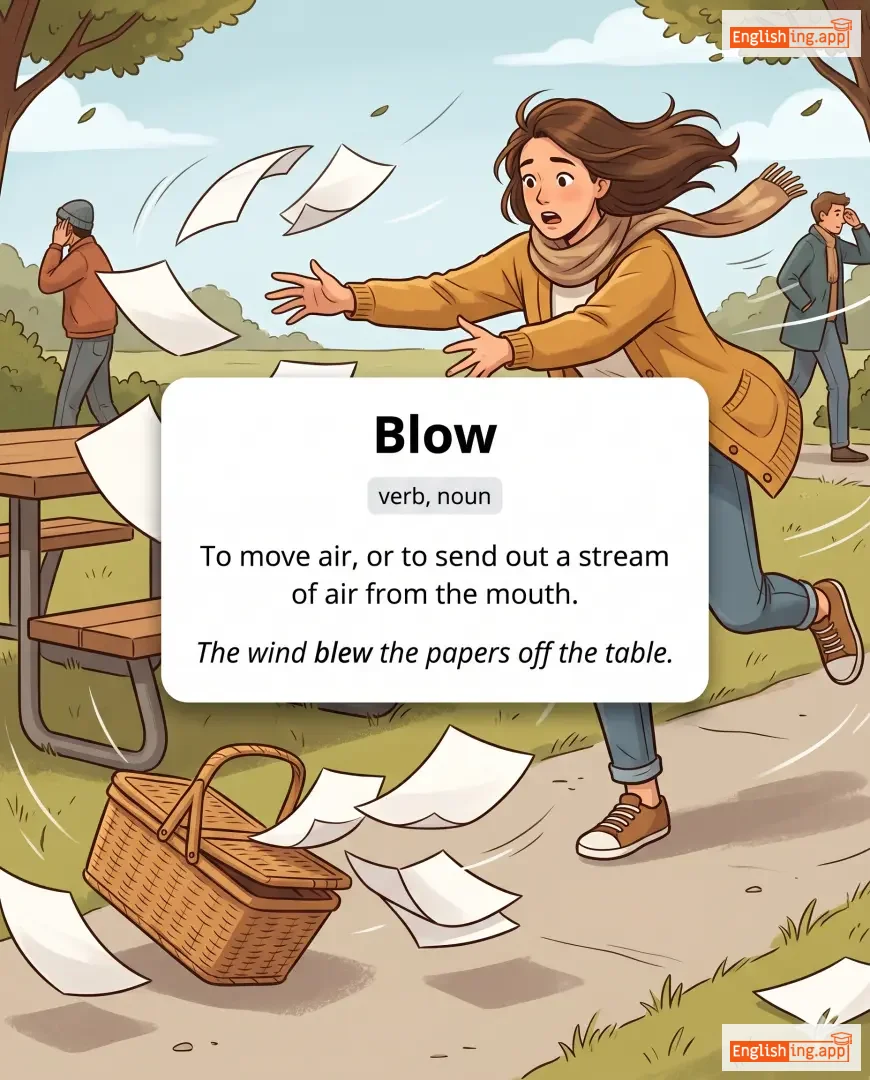
Blow definition card — visual illustration of the meaning
verb, noun
/bloʊ/
फूँक मारना / आघात (phoonk marna / aaghaat)

To move air, or to send out a stream of air from the mouth.

"The wind blew the papers off the table."

"हवा ने कागज़ों को टेबल से उड़ा दिया।" (Hawa ne kagazon ko table se uda diya.)
phrasal verb
/bloʊ aʊt/
बुझा देना (bujha dena)

to extinguish by blowing; to fail suddenly or burst; to expand or exceed limits dramatically

"She blew out the candles on her birthday cake."

"उसने अपने जन्मदिन के केक की मोमबत्तियाँ बुझा दीं।" (usne apne janmadin ke kek ki momabattiyaan bujha diin)
noun
/ˈbloʊˌhɑrd/
घमंडी व्यक्ति (ghamandi vyakti)

a person who brags a lot or talks in a boastful way

"Everyone avoided the blowhard at the party because he wouldn't stop bragging."

"पार्टी में सभी घमंडी व्यक्ति से बचते थे क्योंकि वह अपनी बड़ाई करने से नहीं रुकता था।" (Party mein sabhi ghamandi vyakti se bachate the kyunki vah apni badaai karne se nahi rukta tha.)
verb
/ˈblʌdʒən/
हथौड़े से मारना (hathode se maarna)

to hit someone with a heavy object; to force someone into doing something

"The guard was bludgeoned by the attacker in the alley."

"गार्ड को गली में हमलावर ने हथौड़े से मारा।" (Guard ko gali mein hamlawaara ne hathode se maara.)
adjective
/bluː/
नीला (neela)

the color of the clear sky; feeling sad or depressed

"She wore a bright blue dress to the party."

"वह पार्टी में एक चमकदार नीला ड्रेस पहने थी।" (Vah party mein ek chamakdaar neela dress pehene thi.)
noun
/ˌbluː ˈblʌd/
ब्लू-ब्लड (blue-blood)

a person of noble birth; aristocrat

"She came from a family of blue-bloods with centuries of royal heritage."

"वह एक कुलीन परिवार से आई थी जिसमें शाही विरासत के कई शताब्दियाँ थीं।" (vah ek kuleen parivar se aayi thi jismein shahi virasat ke kai shatabdiyaan thiin.)
noun
/ˈbluː.ber.i/
ब्लूबेरी (blueberry)

a small round blue fruit that grows on bushes

"She picked fresh blueberries for the pie."

"उसने पाई के लिए ताजे ब्लूबेरी तोड़े।" (usne pai ke liye taje blueberry tode)
blueprint definition card — visual illustration of the meaning
noun
/ˈbluːˌprɪnt/
ब्लूप्रिंट (blueprint)

a detailed plan or design; a guide for making something

"The architect shared the blueprint of the new building with the team."

"वास्तुकार ने टीम के साथ नए भवन का ब्लूप्रिंट साझा किया।" (Vastukar ne team ke saath naye bhavan ka blueprint saajha kiya.)
noun
/bluːz/
ब्लूज़ (blues)

a feeling of sadness; a style of music with melancholy themes

"Listening to blues music always calms him down."

"ब्लूज़ संगीत सुनने से उसे हमेशा शांति मिलती है।" (Blues sangeet sunne se use hamesha shanti milti hai.)
verb
/blʌf/
धोखा देना (dhokha dena)

to deceive someone by pretending to have strength, knowledge, or resources that one does not actually possess

"He tried to bluff his way into the exclusive club."

"वह एक्सक्लूसिव क्लब में घुसने के लिए ब्लफ करने की कोशिश कर रहा था।" (Woh exclusive club mein ghusne ke liye bluff karne ki koshish kar raha tha.)
noun
/ˈblʌfər/
धोखेबाज़ (dhokhebaaz)

a person who pretends to be more confident, skilled, or knowledgeable than they really are; someone who deceives others by bluffing

"Everyone eventually realized that he was just a bluffer with no real experience."

"आखिरकार सभी को समझ आ गया कि वह सिर्फ़ एक धोखेबाज़ था।" (aakhirkaar sabhi ko samajh aa gaya ki vah sirf ek dhokhebaaz tha)
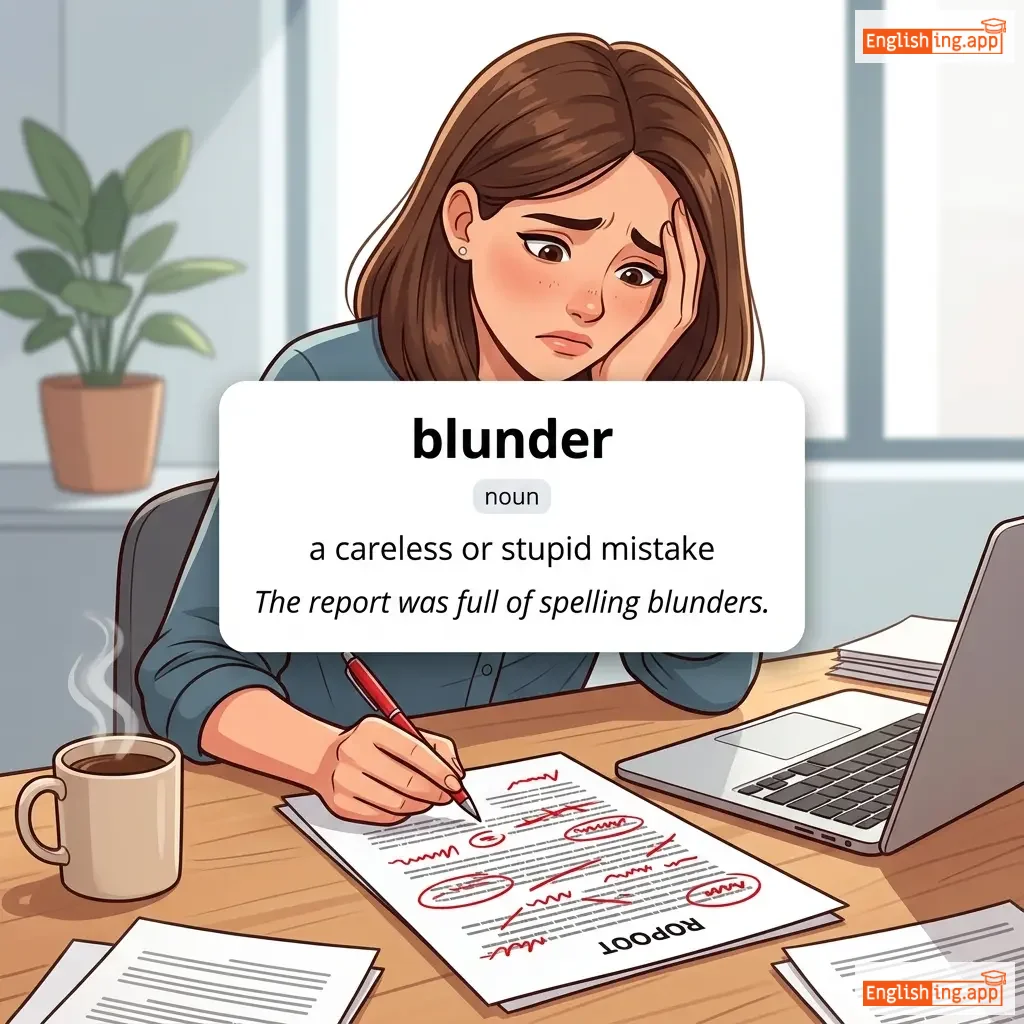
blunder definition card — visual illustration of the meaning
noun
/ˈblʌndər/
गलती (galti)

a careless or stupid mistake

"The report was full of spelling blunders."

"रिपोर्ट में वर्तनी की कई गलतियाँ थीं।" (Report mein vartani ki kai galtiyan thi.)
adjective
/blʌnt/
मुलायम, सीधा (mulayam, seedha)

not sharp; direct and straightforward in speech

"Her blunt remarks offended some people."

"उसकी सीधी टिप्पणी ने कुछ लोगों को आहत कर दिया।" (Uski seedhi tippani ne kuch logon ko ahat kar diya.)
adverb
/ˈblʌnt.li/
सीधे; बिना शिष्टता के (seedhe; bina shishtata ke)

in a direct way without trying to be polite; frankly

"He told her bluntly that she was wrong."

"उसने उसे सीधे कहा कि वह गलत थी।" (Usne use seedhe kaha ki vah galat thi.)
verb
/blɜːr/
धुंधलाना (dhundhlana)

to make something unclear or difficult to see

"Tears blurred her vision."

"आंसुओं ने उसकी दृष्टि को धुंधला कर दिया।" (Aansuo ne uski drishti ko dhundhla kar diya.)
noun
/blɜːrb/
प्रचारात्मक विवरण (pracharatmak vivaran)

a short promotional description of a book, product, or service

"The back cover had a blurb praising the novel."

"पीछे के कवर पर उपन्यास की सराहना करते हुए एक प्रचारात्मक विवरण था।" (Peeche ke cover par upanyas ki sarahna karte hue ek pracharathmak vivaran tha.)
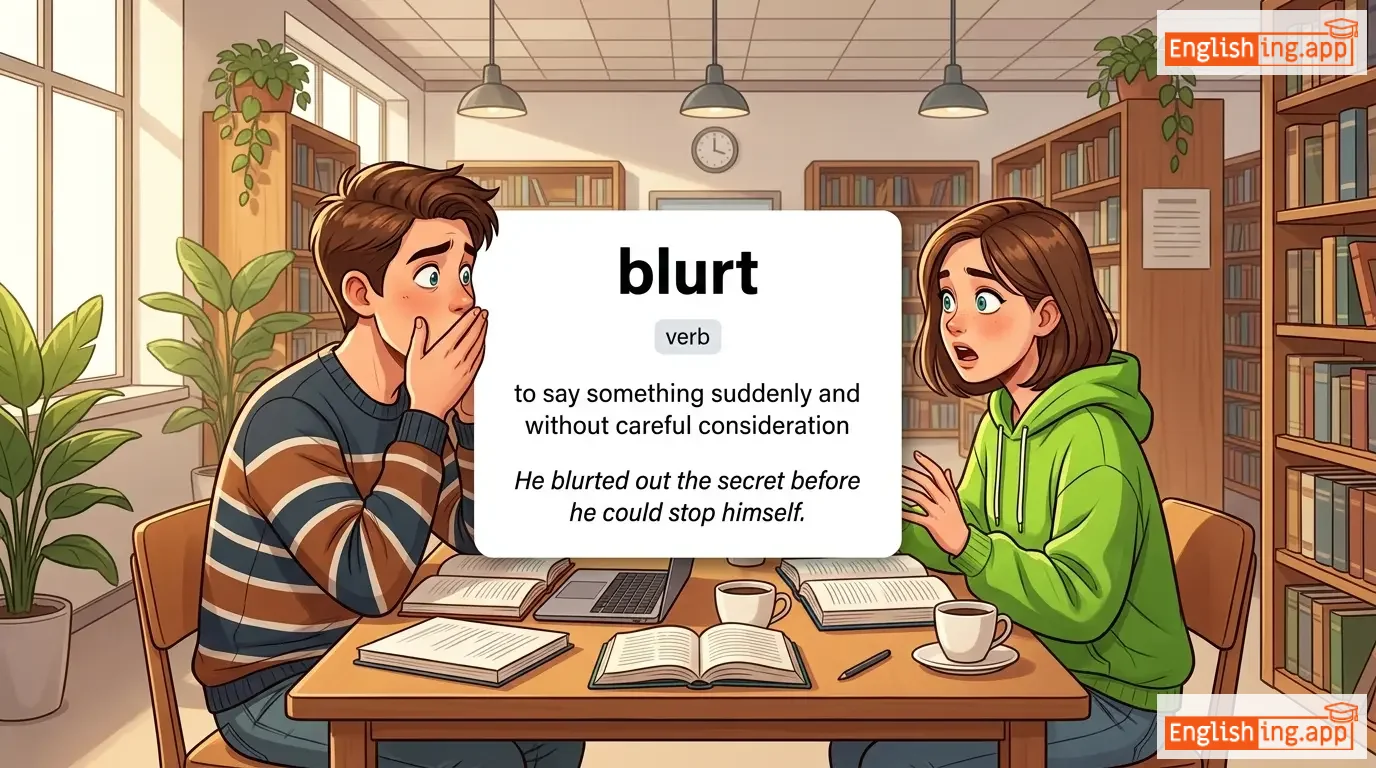
blurt definition card — visual illustration of the meaning
verb
/blɜːrt/
आकस्मिक रूप से कुछ बोलना (aakasmik roop se kuch bolna)

to say something suddenly and without careful consideration

"He blurted out the secret before he could stop himself."

"उसने राज़ अचानक उगल दिया इससे पहले कि वह खुद को रोक पाता।" (Usne raaz achanak ugal diya isse pehle ki woh khud ko rok pata.)
verb
/blʌʃ/
लज्जा से लाल होना (lajja se lal hona)

to become red in the face due to embarrassment or shyness

"She blushed when he complimented her."

"वह जब उसकी तारीफ करती है तो वह शरमाकर लाल हो जाती है।" (Vah jab uski tareef karti hai to vah sharmakar lal ho jati hai.)
verb
/ˈblʌstər/
धमकी देना (dhamki dena)

to speak loudly in an aggressive or threatening way, often without real power

"The manager blustered about firing people but did nothing."

"मैनेजर ने लोगों को निकालने की धमकी दी, लेकिन कुछ नहीं किया।" (Manager ne logon ko nikaalne ki dhamki di, lekin kuch nahi kiya.)
noun
/ˈboʊ.ə/
बोआ सांप (boa saap)

a large non-venomous snake that kills prey by constriction

"The boa constrictor wrapped around its prey."

"बोआ कन्स्ट्रिक्टर ने अपने शिकार के चारों ओर लपेट लिया।" (boa constrictor ne apne shikar ke chaaron or lapet liya)
noun
/bɔːrd/
बोर्ड (bord)

a flat, thin, rectangular piece of material such as wood; also a group of people managing an organization

"The board decided to increase the budget."

"बोर्ड ने बजट बढ़ाने का फैसला किया।" (Board ne bajat badhaane ka faisla kiya)
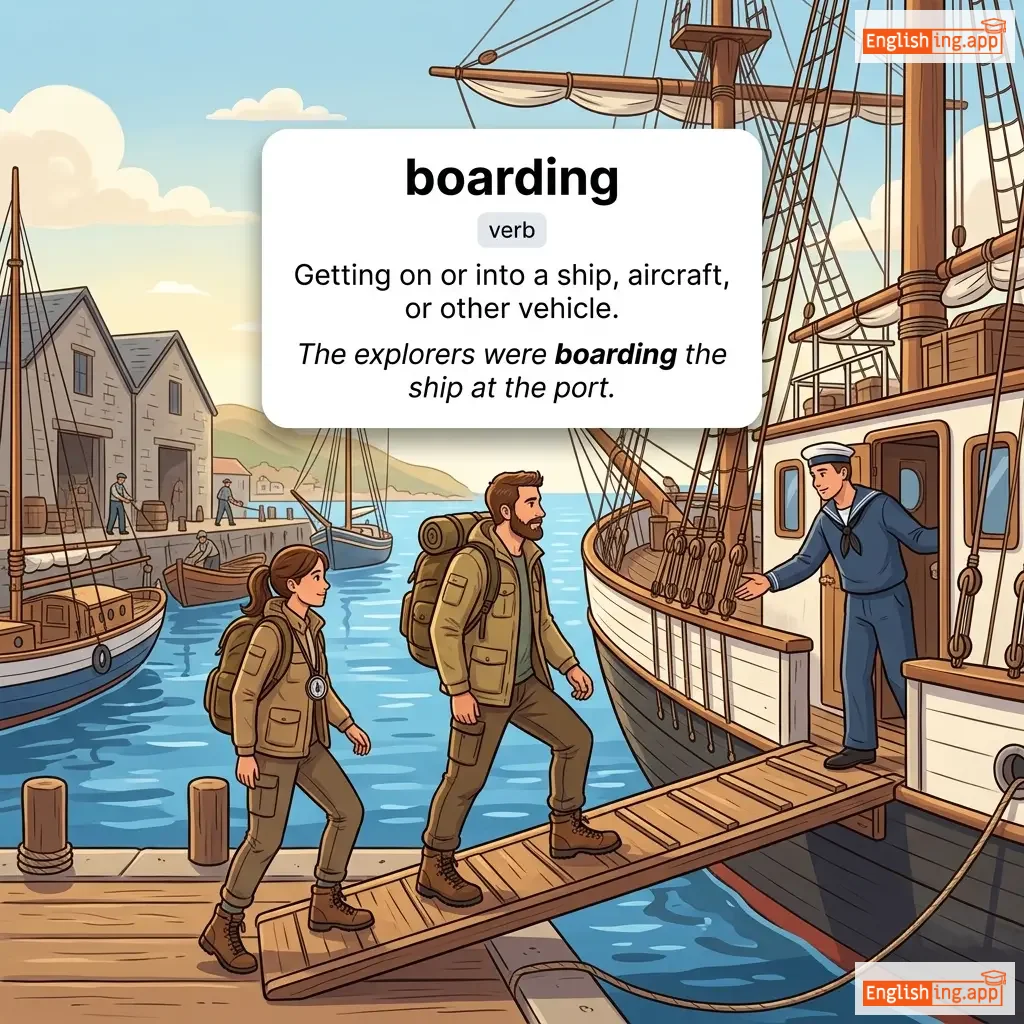
boarding definition card — visual illustration of the meaning
verb
/ˈbɔːrdɪŋ/
सवारी करना (sawari karna)

Getting on or into a ship, aircraft, or other vehicle.

"The explorers were boarding the ship at the port."

"अन्वेषक पोर्ट पर जहाज में चढ़ रहे थे।" (Anveshak port par jahaz mein chadh rahe the.)
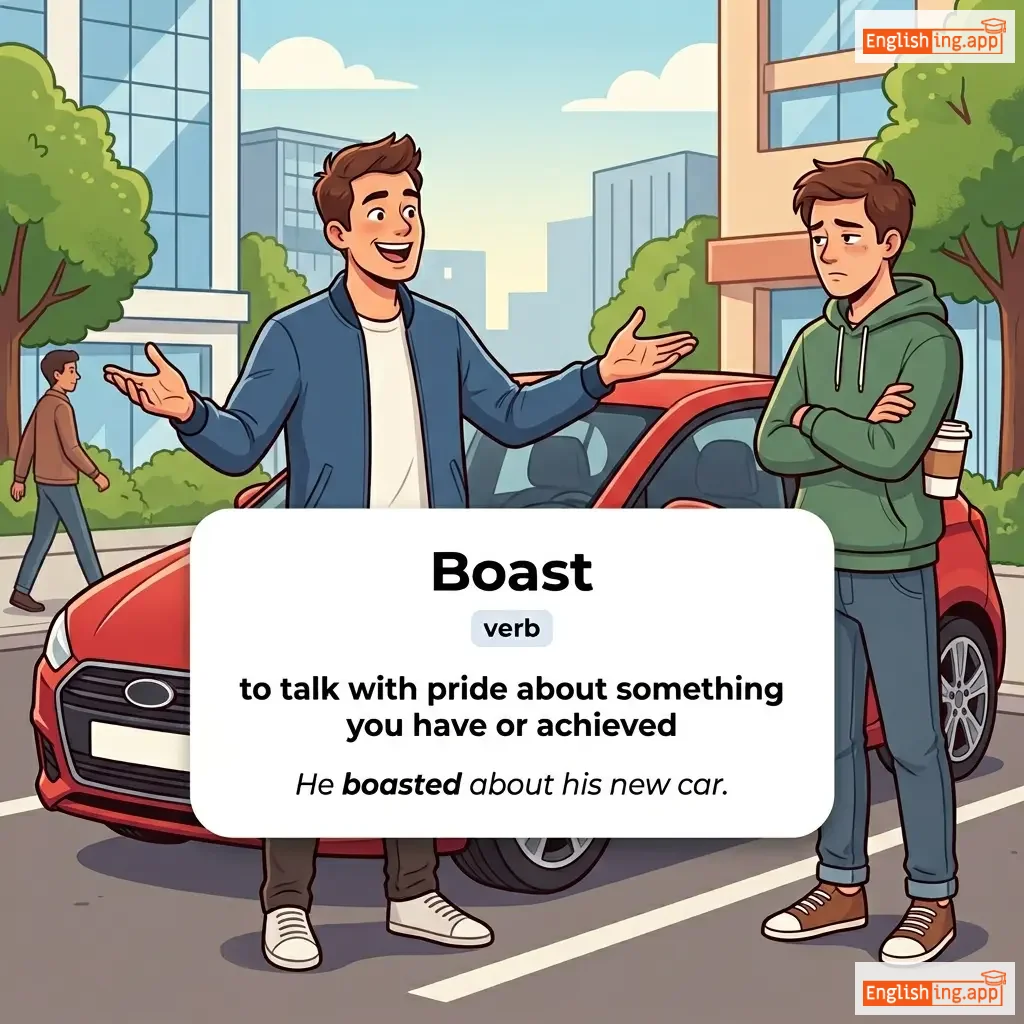
Boast definition card — visual illustration of the meaning
verb
/boʊst/
घमंड करना (ghamand karna)

to talk with pride about something you have or achieved

"He boasted about his new car."

"उसने अपनी नई कार के बारे में घमंड किया।" (Usne apni nai car ke baare mein ghamand kiya.)
noun
/boʊt/
नौका (nouka)

a small vessel used for traveling on water

"They took a boat across the river."

"उन्होंने नदी पार करने के लिए एक नाव ली।" (unhone nadi paar karne ke liye ek naav li.)
noun
/ˈboʊsən/
जहाज का अधिकारी (jahaj ka adhikari)

a ship's officer in charge of equipment and the crew

"The boatswain supervised the sailors on deck."

"बोटस्वैन ने डेक पर नाविकों की देखरेख की।" (Boteswain ne dek par navikon ki dekhrekh ki.)
noun, verb
/bɒb/
ऊपर-नीचे हिलना (upar-niche hilna)

a short sudden movement up and down; to move quickly up and down

"The small boat began to bob on the waves."

"छोटी नाव लहरों पर ऊपर-नीचे होने लगी।" (chhoti naav lahron par upar-niche hone lagi)
verb
/boʊd/
पूर्वसूचना देना (purvasoochna dena)

to be an omen of a particular outcome, often something bad

"The dark clouds bode a heavy storm."

"अंधेरे बादल एक भारी तूफान का पूर्वाभास देते हैं।" (andhere baadal ek bhaari toofan ka purvabhaas dete hain.)
noun
/ˈbɒdɪs/
बोडिस (bodis)

the part of a woman's dress that covers the body from the neck to the waist

"She wore a dress with an embroidered bodice."

"उसने कढ़ाई किया हुआ बोडिस के साथ एक ड्रेस पहनी थी।" (usne kadhai kiya hua bodis ke saath ek dress pehni thi.)
adjective
/ˈbɒdɪli/
शारीरिक (sharirik)

relating to or concerning the body

"He suffered bodily harm in the accident."

"उसने दुर्घटना में शारीरिक चोट पाई।" (usne durghatna mein sharirik chot paayi.)